How to resolve AdBlock issue?
Refresh this page
How to resolve AdBlock issue?
Refresh this page
Lake County News,California
  • Home
    • Registration Form
  • News
    • Education
    • Veterans
    • Community
      • Obituaries
      • Letters
      • Commentary
    • Police Logs
    • Business
    • Recreation
    • Health
    • Religion
    • Legals
    • Arts & Life
    • Regional
  • Calendar
  • Contact us
    • FAQs
    • Phones, E-Mail
    • Subscribe
  • Advertise Here
  • Login

News

Lake County Planning Commission to discuss cell tower, cannabis, climate plan

LAKEPORT, Calif. — The Lake County Planning Commission will meet this week to discuss a new cell tower, get a cannabis update and discuss a new county climate plan.

The meeting will begin at 9 a.m. Thursday, Oct. 9, in the board chambers on the first floor of the Lake County Courthouse, 255 N. Forbes St., Lakeport.

The agenda is here.

To participate in real-time, join the Zoom meeting by clicking this link. 

The webinar ID is 994 1760 2765, the pass code is 155982. 

Access the meeting via one tap mobile at +16699006833,,99417602765#,,,,*155982# or dial in at 669-900-6833.

The meeting also can be viewed on the county’s website or Facebook page.

At 9:05 a.m., the commission will hold a public hearing to consider a major use permit for a 150-foot-tall monopole wireless communication tower at 6720 Leslie Place in Lucerne.

The tower will be located within a 50-foot by 50-foot lease area that also will contain tower support equipment. 

In an untimed item, the commission will receive an update from planning staff on cannabis regulation.

The staff report explains, “Since 2014, regulations concerning cannabis-related businesses have been established. The Board of Supervisors has periodically revised these regulations to reflect updates in state law and to incorporate insights gained from existing procedures. This update reflects a considerable amount of input from the Board of Supervisors, Planning Commission, Cannabis Ordinance Task Force, relevant departments, and the public.

The report continues, “Staff recommends amending Article 27, Uses Generally Permitted in light of these contributions, while we concurrently work on establishing thresholds of significance through the CEQA process for issues associated with the revised Cannabis Ordinance, Article 73, which is in the Drafting process with the Planning Division.”

In another untimed item, the commission will receive a presentation and hold a discussion on the Lake County Climate Action Plan.

Staff reported that the county and the two cities are developing a Climate Adaptation Plan to address climate-related hazards and build community resilience countywide. 

“This Climate Adaptation Plan will use the Pillars of Landscape Resilience framework developed by the Lake County's Office of Climate Resiliency in 2022 to map out adaptation strategies. The framework addresses resilience through ten interconnected pillars: air quality, water security, wetland integrity, biodiversity conservation, forest resilience, carbon sequestration, fire dynamics, fire-adapted communities, economic diversity, and social and cultural well-being,” the report explains.

“The Climate Adaptation Plan will aim to reduce climate risks for all residents with focused attention on populations with higher vulnerability, strengthen infrastructure systems to maintain essential services during hazard events, and enhance the social and cultural well-being of vulnerable populations and community support systems,” staff reported.

Email Elizabeth Larson at This email address is being protected from spambots. You need JavaScript enabled to view it.. Follow her on Twitter, @ERLarson, and on Bluesky, @erlarson.bsky.social. Find Lake County News on the following platforms: Facebook, @LakeCoNews; X, @LakeCoNews; Threads, @lakeconews, and on Bluesky, @lakeconews.bsky.social. 

Supreme Court opens with cases on voting rights, tariffs, gender identity and campaign finance to test the limits of a constitutional revolution

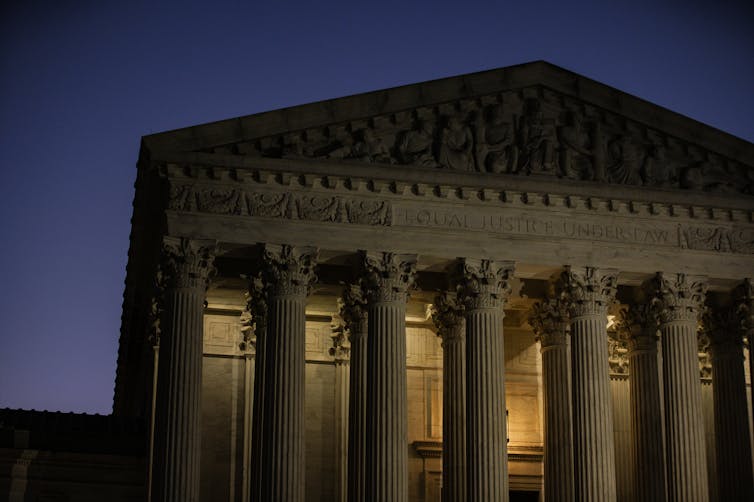
The U.S. Supreme Court building at dawn in Washington, D.C. Samuel Corum/Bloomberg via Getty Images

The most influential cases before the U.S. Supreme Court this term, which begins on Oct. 6, 2025, reflect the cultural and partisan clashes of American politics.

The major cases in October and November address the role of race in elections, conversion therapy and the Trump tariffs. Later cases include campaign finance and transgender sports.

This year’s controversies focus on three dominant themes. One is the continuing constitutional revolution in how the justices read our basic law. The court has shifted from a living reading of the Constitution, which says the Constitution should adapt to the American people’s evolving values and the needs of contemporary society, to an original reading, which aims to enforce the constitutional principles understood by the Americans who ratified them.

Another clear theme is the deep cultural division among Americans. The core disputes at the court this year reflect controversial factual questions about gender and race: How pervasive and influential is racism in the current day? Are gender transitions a recognized fact, which means that they must be accepted in sports competitions, or can a state assert that trans athletes are not women?

A final theme is the struggle for partisan advantage embedded in several cases.

A portion of the U.S. Constitution, torn into blue and red pieces.
The justices’ constitutional interpretations could have major partisan significance. Douglas Rissing, iStock/Getty Images Plus

Constitutional revolution

Until just a few years ago, the majority of justices would have agreed that the proper way to read the Constitution was as an evolving document, an approach usually described as living constitutionalism.

The new majority reads the Constitution as an expression of enduring principles, which maintain their historical meaning unless the American people collectively decide to amend the document, an approach known as originalism.

Since 2022, this revolutionary shift has led to dramatic changes in the law on abortion, religion, guns, affirmative action and the power of federal agencies to regulate in areas such as the environment, public health or student debt.

This year, the constitutional revolution – “a historic constitutional course correction” as legal scholars Gary Jeffrey Jacobsohn and Yaniv Roznai put it – turns to transgender politics.

Little v. Hecox and West Virginia v. B.P.J. ask whether a state can ban transgender athletes from participating in girls or women’s sports. The plaintiffs are middle school and university students who were banned by state laws from participating as a female competitor. They are asking the court to rule that transgender identity is a protected category similar to race and gender under the equal protection clause of the 14th Amendment.

Originalists argue that the meaning of the 14th Amendment is clear and fixed. It establishes the equal status of racial minorities as holders of rights. But originalists do not believe the equal protection clause was meant to apply to sexual identities unless that is explicitly approved through a constitutional amendment by the American public.

Originalists also emphasize the role of federalism as a core constitutional principle. Federalism allocates a great deal of authority to state legislatures to make decisions when a question of rights is uncertain.

For these reasons the court majority is likely to see the regulation of who gets to participate in women’s sports as a state-by-state decision.

Cultural divisions, disputed perceptions

The status of transgender identity also reflects the disputed perceptions of reality that have come to dominate American politics. In essence, the Iowa and West Virginia sports cases ask the court to rule whether a transgender girl – a person assigned male at birth who has transitioned to align with their identity as a girl or woman, as the AP Stylebook phrases it – is a girl or a boy.

The court is likely to leave such questions about what is factually true for state legislatures to determine.

The same need for the court to determine who can decide what is or is not a legitimate fact also applies to this year’s controversy over conversion therapy. Colorado bans the practice – condemned by many professional medical associations – in which counselors attempt to alter sexual orientation or gender identity.

Chiles v. Salazar challenges the Colorado law as a violation of the First Amendment’s protections of free speech and religious liberty.

An original reading of the First Amendment provides strong support for open expression on controversial topics, even by medical professionals. But on the factual question of whether homosexuality or gender identity in young people is indisputably innate or immutable, the court may defer to state legislatures to decide whether licensed professionals must assert only a specific set of accepted facts.

Partisan advantage

Many observers perceive a partisan as well as principled divide on the current court. Decisions in several cases this year potentially give a distinct advantage in future elections to Democrats or Republicans.

The most clear case may be about the regulation of campaign finance. National Republican Senatorial Committee v. FEC – a lawsuit begun in 2022 by then-U.S. Sen. JD Vance – asks the court to overturn a restriction that bars political parties from coordinating unlimited spending on campaign advertising with the official campaign.

Many Democrats believe Republicans will be the larger beneficiaries in the coming years if the court rules that the current limits violate the First Amendment.

Then there’s the challenge to the constitutionality of the Trump tariffs.

Learning Resources v. Trump will determine whether the recent tariffs are authorized by Congress under the International Emergency Powers Act of 1977. The answer hinges on the application of what’s known as the “major questions doctrine,” which limits presidential authority over issues of great economic or policy importance in the absence of direct endorsement from Congress.

The major questions doctrine is an originalist concept, but in the court’s view it may not apply to actions in the foreign policy realm – including tariffs – where the president has greater discretion.

A container ship loaded with hundres of containers, coming into a port.
Will the court strike down Trump’s tariffs on imported goods such as those on this ship in Oakland, Calif.? Justin Sullivan/Getty Images

Race and elections

The case that represents all three trends at the court is Louisiana v. Callais on the creation of majority-Black congressional districts.

The Voting Rights Act of 1965 outlaws racial discrimination in voting. This landmark legislation from the civil rights era helped raise the rate of Black voter registration and turnout in Southern states from less than half the white rate to exceeding it over the past 60 years.

The question in front of the court is whether the law requires a state to make sure that some congressional districts have a majority of Black voters.

The argument opposing the intentional creation of racial districts is that the equal protection clause of the 14th Amendment demands the same treatment of all citizens regardless of race, banning any distinction even when designed to benefit minorities.

Underlying the differences of opinion are competing perceptions of the prevalence and influence of racism in the current day. This dispute was clear in the court’s 2013 Shelby County decision, which struck down the part of the Voting Rights Act that limited Southern states from passing new elections laws without “pre-clearance” from the Department of Justice. That requirement aimed to ensure that new laws would not discriminate against Black voters, whether intentionally or unintentionally.

In striking down that requirement, Chief Justice John Roberts ruled that “no one can fairly say” that the South “shows anything approaching the ‘pervasive,’ ‘flagrant,’ ‘widespread,’ and ‘rampant’ discrimination that faced Congress in 1965.”

Justice Ruth Bader Ginsburg famously responded that removing the Voting Rights Act’s protections was “like throwing away your umbrella in a rainstorm because you are not getting wet.”

The ultimate number of majority-Black districts in Louisiana is not only a question of constitutional principles applied to prevailing facts. It is also about partisan advantage. Partisans on both sides are well aware that a majority-Black district is also a Democratic district.

So whether the state ends up with two or just one – or potentially even none – of its six congressional districts shaped by race could shift the future partisan balance in a closely divided Congress.

With partisan advantage, clashing perceptions of reality and revolutionary readings of the Constitution all in play, the rulings of the Supreme Court this year will reach far into American politics and culture.The Conversation

Morgan Marietta, Professor of American Civics, University of Tennessee

This article is republished from The Conversation under a Creative Commons license. Read the original article.

Updated Guenoc resort development agreement, Sonoma Clean Power on supervisors’ agenda

LAKE COUNTY, Calif. — The Board of Supervisors this week will consider adopting an ordinance to approve a development agreement for a south county resort and will discuss the process to move forward with community choice aggregation to purchase energy for the unincorporated county.

The‌ ‌board will meet beginning ‌at‌ ‌9‌ ‌a.m. Tuesday, Oct. 7, in the board chambers on the first floor of the Lake County Courthouse, 255 N. Forbes St., Lakeport.

The‌ ‌meeting‌ ‌can‌ ‌be‌ ‌watched‌ ‌live‌ ‌on‌ ‌Channel‌ ‌8, ‌online‌ ‌and‌ ‌on‌ ‌the‌ ‌county’s‌ ‌Facebook‌ ‌page. ‌Accompanying‌ ‌board‌ ‌documents, ‌the‌ ‌agenda‌ ‌and‌ ‌archived‌ ‌board‌ ‌meeting‌ ‌videos‌ ‌also‌ ‌are‌ ‌available‌ ‌at‌ ‌that‌ ‌link. ‌ ‌

To‌ ‌participate‌ ‌in‌ ‌real-time, ‌join‌ ‌the‌ ‌Zoom‌ ‌meeting‌ ‌by‌ ‌clicking‌ ‌this‌ ‌link‌. ‌ ‌

The‌ ‌meeting‌ ‌ID‌ ‌is‌ 865 3354 4962, ‌pass code 726865.‌ ‌The meeting also can be accessed via one tap mobile at +16694449171,,86533544962#,,,,*726865#. The meeting can also be accessed via phone at 669 900 6833.

At 10 a.m., the board will hold a public hearing to rescind a resolution that it adopted on Aug. 26 for the development agreement for the Guenoc Valley Mixed-Use Planned Development Project. 

The action is needed because staff reported that, based on the county zoning ordinance, the Board of Supervisors has to use an ordinance — not a resolution to approve a development agreement. The board will then consider a new ordinance with an updated development agreement.

At 3 p.m., the board will consider a staff review of a proposed joint powers agreement with Sonoma Clean Power for community choice aggregation, which would allow the county to purchase power at a lower cost for residents in the unincorporated county.

The cities of Clearlake and Lakeport joined the board in a special meeting on Sept. 30 to discuss working with Sonoma Clean Power. On Thursday, the Clearlake City Council considered joining Sonoma Clean Power and voted down the proposal.

The staff report to the board said there is no proposed decision making action for this meeting.

The board’s discussion will include a conceptual introduction of draft enabling resolutions and an ordinance for the county to join Sonoma Clean Power and possible direction to staff.

The board and the Lakeport City Council are expected to decide on the matter separately in their meetings on Oct. 21.

The full agenda follows.

CONSENT AGENDA

5.1: Approve continuation of proclamation declaring a Clear Lake hitch emergency.

5.2: Approve continuation of proclamation of the existence of a local emergency due to pervasive tree mortality.

5.3: Approve continuation of emergency proclamation declaring a shelter crisis in the county of Lake.

5.4: Adopt proclamation recognizing Sept. 15 through Oct. 15, 2025, as Hispanic Heritage Month in Lake County.

5.5: Adopt proclamation designating the month of October 2025 as Domestic Violence Awareness Month in Lake County.

5.6: Adopt proclamation designating the month of October 2025 as Head Start Awareness in Lake County.

5.7: Adopt proclamation designating the month of October 2025 as Pregnancy and Early Infant Loss Awareness Month in Lake County.

5.8: Adopt proclamation designating the week of Oct. 5-11, 2025, as National 4-H Week in Lake County.

5.9: Adopt resolution approving agreement with the California Department of Food and Agriculture for the Glassy-Winged Sharpshooter Program in the amount of $43,975.17 for the period of July 1, 2025, through Sept. 30, 2026.

5.10: Approve Board of Supervisors meeting minutes for Aug. 19, 2025, Sept. 16, 2025, and Sept. 23, 2025.

5.11: Adopt resolution authorizing the submittal for the CalRecycle Solid Waste Disposal and Codisposal Site Cleanup Grant Program, illegal disposal site abatement for $500,000, and authorize Deputy Community Development Administrator Shannon Walker-Smith to sign.

5.12: Adopt resolution authorizing the 2025-26 grant project, Lake County Victim-Witness Assistance Program, and authorize the district attorney to certify that the County of Lake will comply with all applicable assurances.

5.13: Adopt resolution authorizing the Public Services director to submit applications to CalRecycle for all grant applications for which the county of Lake is eligible.

5.14: Approve amendment three to the agreement between the county of Lake and Consor for engineering services for the replacement of Bartlett Creek at Bartlett Springs Road Bridge (14C-0106) and authorize the chair to sign.

5.15: (a) Approve amendment 2 and 2b between the county of Lake and Summit Food Services to be effective Oct. 1, 2025, with no change from the original contract but to approve a CPI increase, and (b) authorize the chair to sign the amendment.

TIMED ITEMS

6.2, 9:03 a.m.: Pet of the Week.

6.3, 9:05 a.m.: Presentation of proclamation recognizing Sept. 15 through Oct. 15, 2025, as Hispanic Heritage Month in Lake County.

6.4, 9:10 a.m.: Presentation of proclamation designating the month of October 2025 as Head Start Awareness in Lake County.

6.5, 9:15 a.m.: Presentation of proclamation designating the week of Oct. 5 to 11, 2025, as National 4-H Week in Lake County.

6.6, 9:20 a.m.: Presentation of proclamation designating the month of October 2025 as Pregnancy and Early Infant Loss Awareness Month in Lake County.

6.7, 9:25 a.m.: Presentation of proclamation designating the month of October 2025 as Domestic Violence Awareness Month in Lake County.

6.8, 9:30 a.m.: Consideration of presentation of the semiannual employee service awards for the County of Lake.

6.9, 10 a.m.: Public hearing, consideration of (a) rescission of Resolution 2025-102 adopting Development Agreement 24-01 for the Guenoc Valley Mixed-Use Planned Development Project, and (b) draft ordinance adopting Development Agreement 24-01 for the Guenoc Valley Mixed-Use Planned Development Project.

6.10,  11 a.m.: Consideration of request for board direction regarding establishment of an ad hoc committee for development of agriculture road standards.

6.11, 1 p.m.: Consideration of Western Region Town Hall presentation to the Lake County Board of Supervisors.

6.12, 1:30 p.m.: Hearing, consideration of hearing request regarding code enforcement notice of nuisance and order to abate; 14526 Snead Dr., Cobb (APN 052-042-11); property owner: Jose Barbosa Garcia.

6.13, 2 p.m.: Consideration of a county fee deferral program and participating in California Statewide Community Development Authority’s Statewide Community Infrastructure Program.

6.14, 2:30 p.m.: Consideration of presentation on cannabis policy update process.

6.15, 3 p.m.: (a) Consideration of staff review of Sonoma Clean Power Joint Powers Agreement; (b) conceptual introduction of draft enabling resolutions and ordinance for county to join Sonoma Clean Power and possible direction to staff (no action on part b, discussion and possible direction to staff only).

UNTIMED ITEMS

7.2: Consideration of an update on Xabatin: Big Lake Big Science documentary and approval of further usage of film.

7.3: Consideration of the agreement between county of Lake and Clover Valley Guest Home for adult residential support services and specialty mental health services in the amount of $1,200,000 for fiscal year 2025-26.

7.4: Consideration of approval of Amendment No. 1 to the agreement between county of Lake and Redwood Community Services Inc., Phoenix House Crisis Residential Treatment Facility, for fiscal year 2025-26.

7.5: Consideration to approve the submission of the attached letter to the Department of Health Care Services regarding a recoupment notice seeking recovery of funds for Specialty Mental Health Services inpatient claims and services provided to beneficiaries with Unsatisfactory Immigration Status from 2011-2020.

7.6: Consideration of resolution approving County of Lake Health Services to apply for funding in the amount of $488,205 through the California Department of Public Health for fiscal years 2025 through 2030 and authorize the director of Health Services to sign said application.

7.7: Consideration to (a) waive the formal bidding requirement and (b) authorize the IT director to issue a purchase order for Microsoft 365 and associated services renewal in the amount of $343,629.24.

7.8: Consideration of update to the Lake County Library Collection Development Policy.

CLOSED SESSION

8.1: Conference with legal counsel: Existing litigation pursuant to Gov. Code Sec. 54956.9(d)(1) – FERC Proceeding No. P-77, Potter Valley Hydroelectric Project.

Email Elizabeth Larson at This email address is being protected from spambots. You need JavaScript enabled to view it.. Follow her on Twitter, @ERLarson, and on Bluesky, @erlarson.bsky.social. Find Lake County News on the following platforms: Facebook, @LakeCoNews; X, @LakeCoNews; Threads, @lakeconews, and on Bluesky, @lakeconews.bsky.social. 

Clearlake Police seek missing man 

Wences Acosta. Courtesy photo.


UPDATE: The Clearlake Police Department reported that Acosta has been located.

LAKE COUNTY, Calif. — The Clearlake Police Department is attempting to locate a missing man.

Authorities are seeking Wences Acosta, 34.

Acosta is a Hispanic male adult, 5 feet 10 inches tall and 250 pounds, with black hair and brown eyes. 

He was last seen in the area of Dam Road in Clearlake, wearing a black or white shirt, gray sweatpants and no shoes. 

If you have any information regarding his whereabouts, please contact the Clearlake Police Department at 707-994-8251, Extension 1.

Cobb area pavement project to resume Oct. 13

LAKE COUNTY, Calif. — A county road construction project in the Cobb area that was stopped temporarily over the summer due to quality concerns is set to restart.

The work is part of the county’s 2024 Pavement Rehabilitation Project, which will resume on Monday, Oct. 13.

The $5 million project was paused over the summer due to quality and durability concerns, as Lake County News has reported.

At the board’s Sept. 9 meeting, the supervisors approved a $1 million change to the contract with Argonaut Constructors Inc. to upgrade the project’s surface treatment from chip
seal to a longer-lasting asphalt paving surface, raising the total contract cost to $6.1 million.

Lake County Public Works said the work that’s slated to begin next week will include grading existing road sections; placing new asphalt pavement, aggregate base and shoulder backing; and adjusting utility covers to match the new road surface.

Public Works said drivers should expect construction activity and possible delays in the Cobb area while the work is underway.

For questions or more information, contact the Lake County Public Works Department at 707-263-2341.

Email Elizabeth Larson at This email address is being protected from spambots. You need JavaScript enabled to view it.. Follow her on Twitter, @ERLarson, and on Bluesky, @erlarson.bsky.social. Find Lake County News on the following platforms: Facebook, @LakeCoNews; X, @LakeCoNews; Threads, @lakeconews, and on Bluesky, @lakeconews.bsky.social. 

Federal judge blocks deployment of California National Guard to Portland

On Sunday night, in a court victory for California, a federal judge blocked the Trump Administration’s attempt to deploy 300 California National Guard soldiers to Portland, Oregon – an effort the judge called an improper effort to “circumvent” her ruling on Saturday that Oregon National Guard members could not be federalized and deployed. 

Judge Karin Immergut, a Trump appointee, granted the state of California’s request for a temporary restraining order, which halts any federalization, relocation or deployment of any guards members to Oregon from any state.

“The rule of law has prevailed — and California’s National Guard will soon be heading home,” said Gov. Gavin Newsom. “This ruling is more than a legal victory, it’s a victory for American democracy itself. Donald Trump tried to turn our soldiers into instruments of his political will. While our fight continues, tonight the rule of law said ‘hell no’.”

“The Trump Administration’s flagrant disregard for the courts was on full display when it sought to circumvent Judge Immergut’s order blocking the federalization of the Oregon National Guard by redeploying troops from Los Angeles to Portland,” said Attorney General Rob Bonta. “This disrespect for the rule of law cannot stand — and I’m glad the court agreed. The president’s move to deploy the National Guard of one state over the objections of a governor to another state over the objections of a second is well outside of the norms or practices of any president in recent history. But this President is determined to take as much power as the courts will give him. This fight isn’t over, but today’s rebuke of the President’s illegal actions is a step in the right direction.”

Earlier on Sunday, Gov. Newsom announced the state’s intention to sue the Trump Administration after the White House sought to deploy 300 California National Guard personnel into Portland — a move Newsom called illegal — the day after a federal district court blocked the attempted federalization of Oregon’s National Guard. 

California joined Oregon’s suit in the Oregon federal court. 

Trump tries to send California troops to Oregon

Despite a federal court order finding no legal basis to deploy state National Guard troops to the streets of Portland and ordering that control of the Oregon National Guard be returned to state command, the Trump Administration tried to send 300 federally controlled members of the California National Guard to Portland to take their place. 

The troops originally had been federalized months ago in response to what Newsom’s office called “unfounded claims” that unrest in Los Angeles — conditions that never necessitated their deployment in the first place, and have long since subsided anyway. 
 
Courts rebuke Trump for deployment 

In her Saturday ruling, Judge Immergut rejected the Trump Administration’s justification for deploying federalized troops, writing in her order, “This historical tradition boils down to a simple proposition: this is a nation of Constitutional law, not martial law. Defendants have made a range of arguments that, if accepted, risk blurring the line between civil and military federal power — to the detriment of this nation.”

The court found that the president’s own statements regarding the deployment of federalized National Guard were not “conceived in good faith” and were “simply untethered to the facts.”

  • 90
  • 91
  • 92
  • 93
  • 94
  • 95
  • 96
  • 97
  • 98
  • 99

Community

  • Lake County Wine Alliance offers sponsor update; beneficiary applications open 

  • Mendocino National Forest announces seasonal hiring for upcoming field season

Public Safety

  • Lakeport Police logs: Thursday, Jan. 15

  • Lakeport Police logs: Wednesday, Jan. 14

Education

  • Woodland Community College receives maximum eight-year reaffirmation of accreditation from ACCJC

  • SNHU announces Fall 2025 President's List

Health

  • California ranks 24th in America’s Health Rankings Annual Report from United Health Foundation

  • Healthy blood donors especially vital during active flu season

Business

  • Two Lake County Mediacom employees earn company’s top service awards

  • Redwood Credit Union launches holiday gift and porch-to-pantry food drives

Obituaries

  • Rufino ‘Ray’ Pato

  • Patty Lee Smith

Opinion & Letters

  • The benefits of music for students

  • How to ease the burden of high electric bills

Veterans

  • CalVet and CSU Long Beach team up to improve data collection related to veteran suicides

  • A ‘Big Step Forward’ for Gulf War Veterans

Recreation

  • Wet weather trail closure in effect on Upper Lake Ranger District

  • Mendocino National Forest seeking public input on OHV grant applications

  • State Parks announces 2026 Anderson Marsh nature walk schedule 

  • BLM lifts seasonal fire restrictions in central California

Religion

  • Kelseyville Presbyterian to host Ash Wednesday service and Lenten dinner Feb. 18

  • Kelseyville Presbyterian Church to hold ‘Longest Night’ service Dec. 21

Arts & Life

  • Auditions announced for original musical ‘Even In Shadow’ set for March 21 and 28

  • ‘The Rip’ action heist; ‘Steal’ grounded in a crime thriller

Government & Politics

  • Lake County Democrats issue endorsements in local races for the June California Primary

  • County negotiates money-saving power purchase agreement

Legals

  • March 3 hearing on ordinance amending code for commercial cannabis uses

  • Feb. 12 public hearing on resolution to establish standards for agricultural roads

How to resolve AdBlock issue?
Refresh this page