 How to resolve AdBlock issue?
News
The town hall will take place from 5:30 to 7 p.m. Monday, Sept. 12.
The event can be accessed through this link; by phone at 669-900-6833, conference ID 859 7981 8979; or through PG&E’s website, www.pge.com/webinars.
PG&E said its regional team will discuss its local approach to improving customer service and safety, and introduce local leadership teams, including Regional Vice President Ron Richardson.
Last year, PG&E began transitioning to a Regional Service Model by grouping together counties with similar characteristics into five separate regions. For the North Coast, the counties are Humboldt, Lake, Marin, Mendocino, Napa, Siskiyou, Sonoma, Trinity.
The company said this approach is bringing it closer to its customers and helping address issues more efficiently and effectively at the local level.
During the town hall, PG&E experts will provide a brief presentation, after which participants will have the opportunity to ask questions.
Participants will be able to hear about recent work; learn about wildfire prevention efforts, including safety outages; prepare for wildfire season with safety updates; and provide feedback and ask questions of the local leadership team.
Closed captioning will be available in English, Spanish and Chinese and dial-in numbers will be available for those who aren’t able to join online.
For the full webinar events schedule, additional information on how to join and recordings and presentation materials from past events, visit www.pge.com/webs.
More information and resources to help you and your family prepare for and stay safe in the event of an emergency can be found at www.safetyactioncenter.pge.com/.
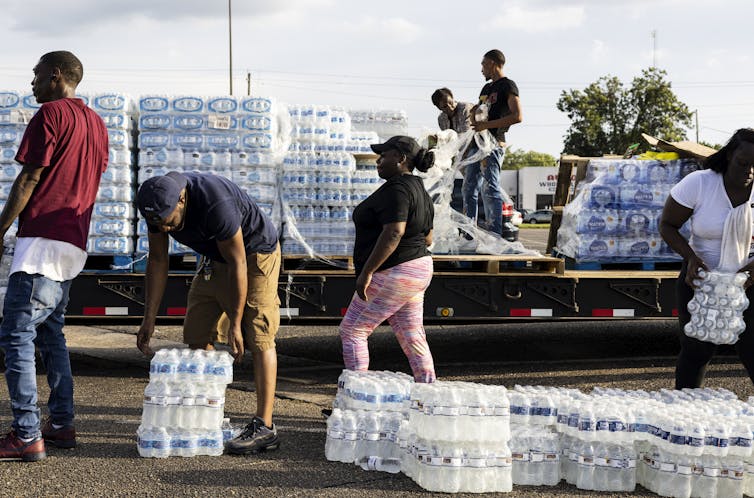
The 1960s and 1970s were a golden age of infrastructure development in the U.S., with the expansion of the interstate system and widespread construction of new water treatment, wastewater and flood control systems reflecting national priorities in public health and national defense. But infrastructure requires maintenance, and, eventually, it has to be replaced.
That hasn’t been happening in many parts of the country. Increasingly, extreme heat and storms are putting roads, bridges, water systems and other infrastructure under stress.
Two recent examples – an intense heat wave that pushed California’s power grid to its limits in September 2022, and the failure of the water system in Jackson, Mississippi, amid flooding in August – show how a growing maintenance backlog and increasing climate change are turning the 2020s and 2030s into a golden age of infrastructure failure.
I am a civil engineer whose work focuses on the impacts of climate change on infrastructure. Often, low-income communities and communities of color like Jackson see the least investment in infrastructure replacements and repairs.
Crumbling bridge and water systems
The United States is consistently falling short on funding infrastructure maintenance. A report by former Federal Reserve Board Chairman Paul Volcker’s Volcker Alliance in 2019 estimated the U.S. has a US$1 trillion backlog of needed repairs.
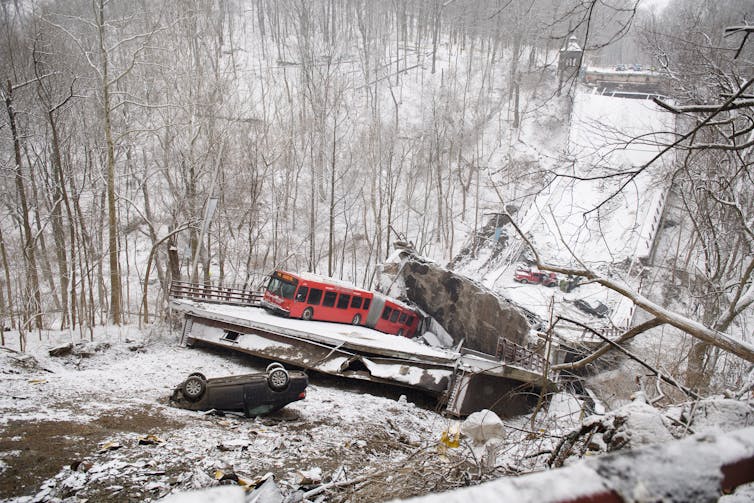
Over 220,000 bridges across the country – about 33% of the total – require rehabilitation or replacement.
A water main break now occurs somewhere in the U.S. every two minutes, and an estimated 6 million gallons of treated water are lost each day. This is happening at the same time the western United States is implementing water restrictions amid the driest 20-year span in 1,200 years. Similarly, drinking water distribution in the United States relies on over 2 million miles of pipes that have limited life spans.
The underlying issue for infrastructure failure is age, resulting in the failure of critical parts such as pumps and motors.
Aging systems have been blamed for failures of the water system in Jackson, wastewater treatment plants in Baltimore that leaked dangerous amounts of sewage into the Chesapeake Bay and dam failures in Michigan that have resulted in widespread damage and evacuations.
Inequality in investment
Compounding the problem of age is the lack of funds to modernize critical systems and perform essential maintenance. Fixing that will require systemic change.
Infrastructure is primarily a city and county responsibility financed through local taxes. However, these entities are also dependent on state and federal funds. As populations increase and development expands, local governments have cumulatively had to double their infrastructure spending since the 1950s, while federal sources remained mostly flat.
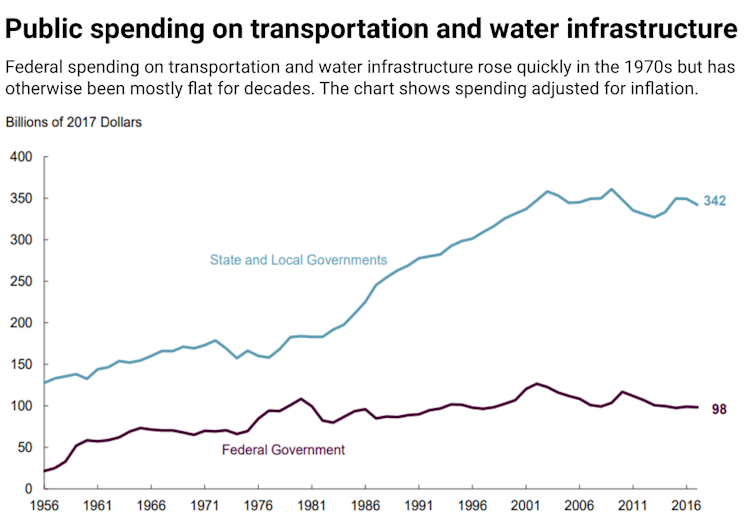
Inequity often underlies the growing need for investment in low-income U.S. communities.
Over 2 million people in the United States lack access to safe drinking water and basic sanitation. The greatest predictor of those who lack this access is race: 5.8% of Native American households lack access, while only 0.3% of white households lack access. In terms of sanitation, studies in predominantly African American counties have found disproportionate impacts from nonworking sewage systems.
Jackson, a majority-Black state capital, has dealt with water system breakdowns for years and has repeatedly requested infrastructure funding from the state to upgrade its struggling water treatment plants.
Climate change exacerbates the risk
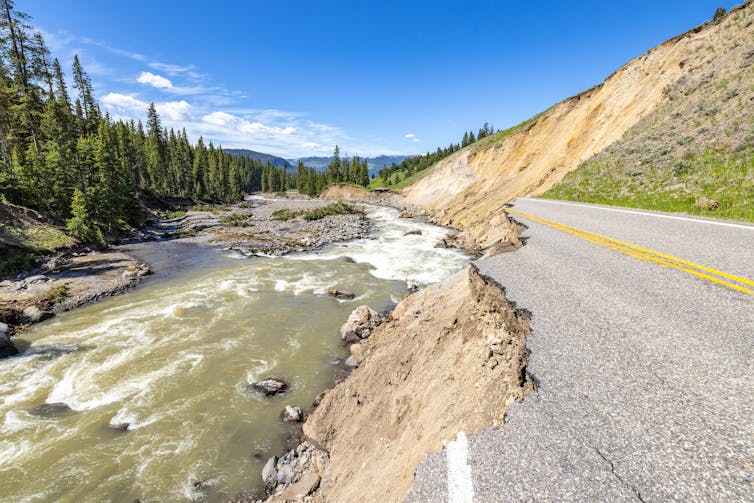
The consequences of inadequate maintenance are compounded by climate change, which is accelerating infrastructure failure with increased flooding, extreme heat and growing storm intensity.
Much of the world’s infrastructure was designed for an environment that no longer exists. The historic precipitation levels, temperature profiles, extreme weather events and storm surge levels those systems were designed and built to handle are now exceeded on a regular basis.
Unprecedented rainfall in the California desert in 2015 tore apart a bridge over Interstate 10, one of the state’s most important east-west routes. Temperatures near 120 degrees Fahrenheit (49 C) forced the Phoenix airport to cancel flights in 2017 out of concern the planes might not be able to safely take off.
A heat wave in the Pacific Northwest in 2020 buckled roads and melted streetcar cables in Portland. Amtrak slowed its train speeds in the Northeast in July 2022 out of concern that a heat wave would cause the overhead wires to expand and sag and rails to potentially buckle.
Power outages during California’s September 2022 heat wave are another potentially life-threatening infrastructure problem.
The rising costs of delayed repairs
My research with colleagues shows that the vulnerability of the national transportation system, energy distribution system, water treatment facilities and coastal infrastructure will significantly increase over the next decade due to climate change.
We estimate that rail infrastructure faces additional repair costs of $5 billion to $10 billion annually by 2050, while road repairs due to temperature increases could reach a cumulative $200 billion to $300 billion by the end of the century. Similarly, water utilities are facing the possibility of a trillion-dollar price tag by 2050.
After studying the issue of climate change impacts on infrastructure for two decades, with climate projections getting worse, not better, I believe addressing the multiple challenges to the nation’s infrastructure requires systemic change.
Two items are at the top of the list: national prioritization and funding.
Prioritizing the infrastructure challenge is essential to bring government responsibilities into the national conversation. Most local jurisdictions simply can’t afford to absorb the cost of needed infrastructure. The recent infrastructure bill and the Inflation Reduction Act are starting points, but they still fall short of fixing the long-term issue.
Without systemic change, Jackson, Mississippi, will be just the start of an escalating trend.
Paul Chinowsky, Professor of Civil Engineering, University of Colorado Boulder
This article is republished from The Conversation under a Creative Commons license. Read the original article.
The regulation is the first in the nation requiring insurance companies to provide discounts to consumers under the Safer from Wildfires framework created by the California Department of Insurance in partnership with state emergency preparedness agencies.
The Office of Administrative Law has 30 working days to determine whether the proposed regulation satisfies the requirements of the state’s Administrative Procedure Act. Once approved, the regulation text will be filed with the California Secretary of State and become state law.
“My Department is laser-focused on doing everything we can to protect consumers and hold insurance companies accountable,” said Commissioner Lara. “My groundbreaking regulation will help more Californians find insurance they can afford. It aligns insurance discounts with fire safety actions being expedited by our state emergency leaders and local governments. And, most importantly, it will save lives by helping California become safer from wildfires.”
This regulation is part of a comprehensive solution that Commissioner Lara initiated after taking office to protect consumers from climate change-intensified wildfires.
The Department is submitting this regulation as it recognizes National Preparedness Month in September.
Regulations follow extensive public input, Safer from Wildfires partnership
Commissioner Lara directed the Department of Insurance to write regulations to protect consumers and improve market competition after hearing first-hand from consumers about their frustration with insurance companies that did not consider mitigation in their rating plans.
Following town hall meetings in more than 38 counties and an extensive investigatory hearing in 2020, Lara took what he learned from Californians to shape these rules that will promote a fair, transparent and safer insurance market.
In October 2021, Lara shared an initial version of the text of regulation. Following further public input, he formally proposed his regulations in February of 2022.
The regulation incorporates “Safer from Wildfires,” a new framework of wildfire safety measures created in January by a first-ever partnership between the Department of Insurance and the emergency preparedness agencies in Governor Newsom’s Administration, including the California Department of Forestry and Fire Protection, the Governor’s Office of Emergency Services, the Governor’s Office of Planning and Research, and the California Public Utilities Commission.
“Home Hardening retrofits, along with Defensible Space significantly increase a home’s chance of surviving a wildfire,” said Chief Daniel Berlant, Cal Fire deputy director of Community Wildfire Preparedness & Mitigation. “Using the latest fire science and recent wildfire data, these retrofits and landscaping requirements provide a strong path to structure survivability. Cal Fire is currently funding over three hundred million dollars in local wildfire prevention projects to prepare communities against wildfire, but we know it will take every resident doing their part to ensure California is fully protected.”
Regulations will drive down costs and create transparency for consumers
Once approved, the regulation will require all insurance companies to submit new rates that recognize the benefit of safety measures such as upgraded roofs and windows, defensible space, and community-wide programs such as Firewise USA and the Fire Risk Reduction Community designation developed by the state’s Board of Forestry and Fire Protection, which currently includes the counties of Los Angeles, Santa Barbara, and Butte as well as cities and local districts.
Transparency is another important benefit of this regulation, by requiring insurance companies to provide consumers with their property’s “risk score” and creating a right to appeal that score.
“My regulation is the result of listening closely to the needs of consumers and businesses and crafting common-sense, lasting solutions that strengthen our ability to protect Californians from the threat of climate change-intensified wildfires,” said Lara.
The Safer from Wildfires regulation is part of a larger solution he is pursuing for consumers and wildfire survivors that includes working to increase insurance protections and market competition to help protect consumers.
Mireya Turner, who was nearing the end of her second term and had filed to seek a third term uncontested, was hired on Aug. 30 as the permanent Lake County Community Development director on a permanent basis.
Citing her new responsibilities, Turner immediately resigned her council seat, leading to the discussion on Tuesday about how to fill it.
City Clerk/Administrative Services Director Kelly Buendia said state law requires the council to take action within 60 days to either make an appointment or call a special election.
Buendia said there wasn’t enough time to call a special election because Turner’s seat expires in December.
If Turner wins the seat in November, as it’s expected she will, she would then have to resign the seat, Buendia said.
She also pointed out that community members could sign up to run as write-in candidates. That candidacy period runs from Sept. 12 to Oct. 25.
Mayor Stacey Mattina, whose seat also is up for election on Nov. 8 and is running unopposed, asked if they could appoint another city commissioner or a former council member to fill the seat until the end of the year, an idea Councilman Kenny Parlet said he liked.
City Attorney David Ruderman explained that while the council could make an appointment, in two years, at the time of the next municipal election, the seat would be on the ballot for the remaining two years, as required by law.
City Manager Kevin Ingram said that, if Turner won her seat and had to resign, leading to an appointment for two years, that opens up the potential for four of the five council seats to be on the ballot at the same time in 2024.
Ingram suggested that the council direct staff to go ahead and prepare a news release to generate a list of potential applicants for the two-year term, while also giving direction to staff to reach out specifically to previous council members and current commission members to find out if any are interested in a short-term appointment.
Ingram said that gives the council the opportunity to weigh both options.
“I like that,” said Mattina.
Councilman Michael Green made a motion based on Ingram’s proposal, which the council approved 4-0.
Ingram told the council that staff would bring the matter back for discussion at the Oct. 18 meeting.
The council then took nominations for mayor pro tem. Michael Froio nominated Green while Mattina nominated Parlet. After two votes, Parlet was elected to the job.
In other business during the meeting, the open portion of which ran just short of four hours, the council held a hearing to introduce a general plan amendment, zoning code amendment and approval of a mitigated negative declaration under the California Environmental Quality Act for the Parkside Residential Project, proposed by Waterstone Residential, at 1310 Craig Ave.
The project, which includes 128 new apartment units and 48 cluster homes on the 15-acre site, is facing opposition from nearby residents who say it will negatively impact their neighborhood.
The project is due for a second hearing on Sept. 20.
The council also heard a presentation on the second phase of a feasibility study on a recreation center and approved the revised 10-year commercial lease agreement with the Lakeport Yacht Club for use of the facility located at 15 Fifth St., at a cost of about $140 a month for the first two years, then rising to $163.75 per month with an annual Consumer Price Index increase on top of that.
Email Elizabeth Larson at
The data cover 162,912 positions and a total of nearly $10.38 billion in 2021 wages and more than $2.92 billion in health and retirement costs for 3,061 special districts.
Special districts are governmental entities created by a local community to meet a specific need.
Data for 2021 show the top 10 districts by total wages are health care, transportation, utility, water, and fire districts. The top 10 individual salaries reported are all in health care districts.
In Lake County, there are 30 special districts, with 413 employees. In 2021, those districts paid salaries totaling $11,315,911, with benefits of $3,811,700.
The top 10 special districts in Lake County by total wages and retirement are as follows:
• Lake County Fire Protection District: 40 employees; wages, $1,911,823; retirement, $782,966.
• Kelseyville Fire Protection District: 29 employees; wages, $1,502,623; retirement, $463,993.
• Northshore Fire Protection District: 39 employees; wages, $1,350,935; retirement, $444,338.
• Clearlake Oaks Water District: 23 employees; wages, $1,162,113; retirement, $359,343.
• Lakeport Fire Protection District: 28 employees; wages, $1,092,064; retirement, $554,992.
• Hidden Valley Lake Community Services District: 23 employees; wages, $1,063,821; retirement, $480,375.
• Lake County Vector Control District Mosquito Abatement: 14 employees; wages, $658,242; retirement, $277,696.
• Konocti County Water District: 21 employees; wages, $592,621; retirement, $128,650.
• Cobb Area County Water District: 19 employees; wages, $384,963; retirement, $91,485;
• Lower Lake County Waterworks District No. 1: 16 employees; wages, $362,111; retirement, $80,951.
California law requires cities, counties and special districts to annually report compensation data to the state controller.
The state controller also maintains and publishes state and California State University salary data.
A list of districts that did not file or filed incomplete reports is available here.
Users of the site can:
• View compensation levels on maps and search by region;
• Narrow results by name of the district or by job title; and
• Export raw data or custom reports.
Since the GCC website launched in 2010, it has registered more than 14 million pageviews. The site contains pay and benefit information on more than two million government jobs in California, as reported annually by each entity.
As the chief fiscal officer of California, Controller Yee is responsible for accountability and disbursement of the state’s financial resources. The controller has independent auditing authority over government agencies that spend state funds.
Follow the Controller on Twitter at @CAController and on Facebook at California State Controller’s Office.
The prolonged heat wave is on track to be California’s hottest and longest for September and is projected to set a new record high for demand on the state’s energy grid with a load forecast of 51,276 megawatts today.
The state’s emergency response and efforts by large energy users, energy producers and California residents has helped to prevent outages during this extreme heat event, and even greater action will be needed in the days ahead as the state faces peak temperatures.
Californians’ action to conserve energy during the Flex Alert on Monday saved 1,000 megawatts of power. An additional 2,000 megawatts of savings was needed on Tuesday given the higher forecasts.
The state has also taken other urgent actions to bring more power onto the grid, including importing energy from out-of-state, installing emergency generators and creating a Strategic Reliability Reserve.
“Californians have stepped up in a big way during this record heat wave, but with the hottest temperatures here now, the risk of outages is real. We all have to double down on conserving energy to reduce the unprecedented strain on the grid,” said Newsom. “We need everyone – individuals, businesses, the state and energy producers — to do their part in the coming days and help California continue to meet this challenge.”
An executive order Newsom issued on Tuesday extends provisions of his earlier emergency proclamation and executive order through this Friday to increase energy production, reduce strain on the grid and provide additional flexibility to state agencies, energy users and utility operators.
Newsom on Tuesday also signed AB 2645 by Assemblymember Freddie Rodriguez (D-Pomona), which requires counties to ensure community resilience centers can serve as community-wide assets to mitigate public health impacts during disasters, including extreme heat events, and integrate these centers into their local emergency plans.
The California Independent System Operator has called a Flex Alert for Wednesday, asking Californians to reduce their electricity consumption between 4 p.m. and 9 p.m. to save power and reduce the risk of outages.
Extreme heat endangers vulnerable Californians, including our elderly and those with health concerns. State agencies and departments have gathered resources and information to help the public stay safe, cool, and connected during this heat wave, more information can be found here.
Tips for how to stay safe during extreme heat:
• If you don’t have an air conditioner, go to a shopping mall or public building for a few hours. If you must be outdoors, wear lightweight clothing and sunscreen, avoid the hottest parts of the day, and avoid strenuous activities.
• Sweating removes needed salt and minerals from the body. Avoid drinks with caffeine (tea, coffee, and soda) and alcohol.
• Check on friends and family and have someone do the same for you. If you know someone who is elderly or has a health condition, check on them twice a day. Watch for signs of heat exhaustion or heat stroke. Know the symptoms of heat-related illness and be ready to help.
• Find cooling centers in your area by contacting your county or calling your local health department, or find one at Cooling Centers | California Governor’s Office of Emergency Management
• Employers who have questions or need assistance with workplace health and safety programs can call Cal/OSHA’s Consultation Services Branch at 800-963-9424. Complaints about workplace safety and health hazards can be filed confidentially with Cal/OSHA district office. Cal/OSHA’s Heat Illness Prevention program includes enforcement of the heat regulation as well as multilingual outreach and training programs for California’s employers and workers. Cal/OSHA inspectors will be conducting unannounced inspections checking for compliance at worksites throughout the state.