 How to resolve AdBlock issue?
News

At this point in the COVID-19 pandemic, nearly everyone has experienced the panic and uncertainty that come with having mild COVID-like symptoms – such as a cough and sore throat – only to test negative day after day. With cold and flu season just around the corner, that state of frustrating uncertainty is likely to strike most of us again.
Both COVID-19 and the flu are contagious respiratory illnesses that have similar symptoms, making it difficult to distinguish between the two viral infections without a lab test. Testing is the only way to know which virus is causing your symptoms. In fact, labs are working to create one test that can detect both COVID-19 and the flu.
As a nursing professor with experience in public health promotion, I am often asked about the differences between the flu and COVID-19. This year I am fielding many questions about the timing of getting the new COVID-19 booster and the flu shot and whether they can be given together.
Parsing the symptoms
Symptoms of both COVID-19 and the flu can range from mild – or no noticeable symptoms at all – to severe. While flu infection does not typically affect one’s ability to taste or smell, loss of taste or smell has been a common symptom associated with COVID-19 infection. Both infections can cause fevers, chills, body aches and fatigue. More severe symptoms of either infection include difficulty breathing and subsequent infections like pneumonia.
During the 2021-2022 flu season, the term “flurona” made its way into the COVID-19 vernacular. Flurona refers to a simultaneous infection with both the flu and COVID-19. While only a few cases of co-infections have been reported, it would not be surprising to see more of them this coming flu season. Vaccination for both the flu and COVID-19 is your best protection against both.
Timing the shots
With the newly formulated COVID-19 booster shot now available and flu season just around the corner, a natural question is whether there is an optimal timing for the two shots.
The answer to that question is to get both as soon as possible. It is important to consider that it takes approximately two weeks after vaccination for the body to develop antibodies from both the COVID-19 vaccines and the flu vaccine.
As long as you have completed your primary COVID-19 vaccine series and it has been at least eight weeks since your last COVID-19 booster, now is the time to get the updated COVID-19 vaccine that targets both the original strain of SARS-CoV-2 – the virus that causes COVID-19 – and the most recent omicron subvariants. The original COVID-19 vaccines and booster series have dramatically reduced the number of COVID-19 infection and death rates, as well as cases of severe COVID-19 that lead to hospitalization.
While everyone 6 months of age and older are recommended to receive both the COVID-19 and flu vaccines, certain populations have a higher risk for severe infection, such as pregnant women, and should be extra vigilant about getting vaccinated.
Further, among those vaccinated against COVID-19, symptoms during an infection tend to be milder. However, due in part to the quickly evolving nature of the virus, it’s become clear that immune protection from COVID-19 vaccination or infection does not last forever. While studies show that the primary COVID-19 series maintains efficacy against severe disease and death six months after vaccination, protection against infection decreases by between 20% to 30% by six months after vaccination.
This decline in immune protection is exactly why booster shots are so critical. Without a large uptake of booster shots in the population, COVID-19 infection rates could surge again.
Timing is also important with the flu vaccine. Flu cases typically begin to rise in October and peak between December and February, but can last through May. Ideally, people should get vaccinated before flu begins to spread, making September or early October the ideal flu vaccination time.
A difficult flu season ahead
Due to lockdowns, reduced travel, school closures and mask mandates in the first and second years of the pandemic, both the 2020-2021 and 2021-2022 flu seasons were estimated to have fewer hospitalizations and deaths from the flu compared to many of the pre-pandemic years.
In the fall of 2021, experts became concerned about the potential for a COVID-19 and flu “twindemic,” especially as COVID-19 restrictions were lifting and masks were coming off. Fortunately, the worst didn’t bear out – flu numbers in the 2021-2022 season did not return to pre-pandemic levels. However, the possibility of a “twindemic” is not out of the picture for the coming flu season.
Flu seasons are inherently difficult to predict. With most people traveling again, schools open, mask mandates lifted and workers headed back to the office, people are undoubtedly going to be exposed to germs that they have been more protected from for the last two and a half years.
To further compound this, flu vaccine rates have been lower during the pandemic, suggesting that Americans may be out of the habit of getting their annual flu shot.
Pairing the shots
Many are also wondering whether they can or should get both the updated COVID-19 booster and the flu shot at the same time. The good news is, yes, it is safe for both adults and children 12 years of age and up who are eligible for the updated COVID-19 booster to get these vaccines simultaneously.
A recent study found that common vaccine side effects such as pain at the injection site occurred at slightly higher rates when someone received the flu vaccine and a COVID-19 vaccine at the same time, as opposed to receiving only a COVID-19 booster. However, those reactions, including fatigue and headache, were mild and resolved within a day or two.
You don’t need to make two separate vaccine visits as long as you are due for your next COVID-19 shot. However, I don’t recommend waiting to get your flu shot if you are not yet due for a COVID-19 booster. The Centers for Disease Control and Prevention suggests everyone receive their flu vaccine by the end of October. But if you miss that deadline, it is absolutely better to get vaccinated later in the season than not at all.
Community matters too
Getting the flu and COVID-19 vaccines isn’t just about your own health, it’s about family and community health too. Communities with higher vaccination rates have fewer opportunities to spread the virus.
Keep in mind that many people cannot be vaccinated because they have weakened immune systems or are undergoing treatments. They depend on those around them for protection. While one person may experience mild symptoms if they contract the flu or COVID-19, they could spread the virus to others who could become severely ill. Because it’s impossible to predict how people will react if they get sick, getting the flu and COVID-19 vaccines is the best prevention strategy.
Libby Richards, Associate Professor of Nursing, Purdue University
This article is republished from The Conversation under a Creative Commons license. Read the original article.
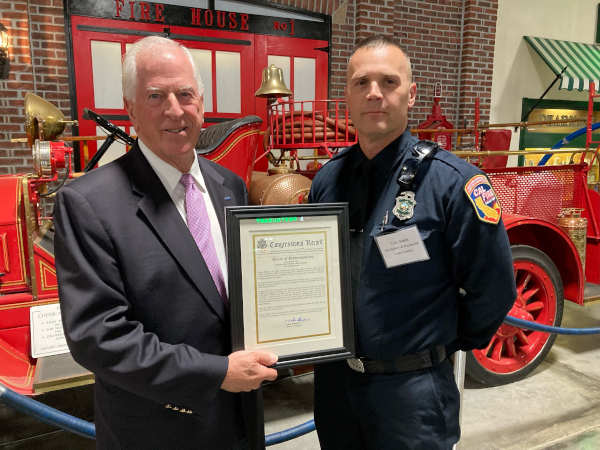
LAKE COUNTY, Calif. — On Sunday, Rep. Mike Thompson (CA-05) announced Lakeport Police Officer Juan Altamirano and Cory Smith of the Lake County Fire Protection District as the 2022 Lake County Public Safety Heroes.
Each year, Thompson honors law enforcement officers and first responders in our community who have gone above and beyond the call of duty.
“Our first responders play an essential role in keeping our communities safe and saving lives. Every year, it is a great honor to be able to recognize some of our public safety heroes from our district for their incredible work on behalf of our communities,” said Thompson. “Cory Smith is a proven leader in Lake County, serving as both a paramedic and fire marshal. His coolness and skill under pressure led to the safe evacuation of multiple endangered citizens during the Cache fire.”
Thompson continued, “Officer Altamirano is an exemplary officer and demonstrates important values of respect and commitment to duty. I am proud to recognize Mr. Smith and Officer Altamirano for their heroic efforts and they are well deserving of this award.”
In August 2021, Smith responded to the Cache fire in Clearlake as a member of Prevention 715. There, they worked tirelessly to remove fences and clear paths alongside two engine companies from Cal Fire.
During the assignment, they discovered two individuals in immediate danger from nearby flames, one of whom had severe burns. Upon evacuation, they radioed for a medical unit to transport her to a nearby hospital.

Early last year, Officer Altamirano demonstrated his compassion, respect, and dedication to duty while responding to a suspicious vehicle report.
Altamirano found a truck and loaded trailer broken down in an area of Lakeport that was dangerous for the driver and other motorists.
Upon further inspection, he found that the truck and trailer were carrying a family and all their possessions, and they had no resources to get the vehicle out of the way or operating at that time.
Officer Altamirano used his own personal resources, not those of the department, to have the truck and trailer towed to a safe location to wait while the family could make other arrangements. Any other action could have placed the family in jeopardy of losing their vehicle and possessions.
While reviewing Officer Altamirano’s actions, other similar incidents came to light, in which he provided meals and water to other community members in need, and found creative ways to provide service to his community above and beyond the call of duty.
The full list of the Public Safety Heroes of the Year for the Fifth Congressional District is below.
Captain John Angell, Crockett-Carquinez Fire Department
Sergeant Zach Lekse, Martinez Police Department
Cory Smith, Lake County Fire
Officer Juan Altamirano, Lakeport Police Department
Rodger Collinson, Napa Fire Department
Deputy Brian Ringo, Napa County Sheriff’s Office
Deputy Joseph Schiavoni, Napa County Sheriff’s Office
Detective Rory Logan, Benicia Police Department
Robert O’Connor, Solano County Paramedic
Kristy and Bob Brindley, Just1Mike Foundation
Officer Westin Schindler, Santa Rosa Police Department
Sergeant Terry White and Officers Jason Jucutan, Jeff Badger, Dane Schindler and Brett Wright, Santa Rosa Police Department Special Enforcement Team
The board will meet beginning at 9 a.m. Tuesday, Sept. 27, in the board chambers on the first floor of the Lake County Courthouse, 255 N. Forbes St., Lakeport.
The meeting can be watched live on Channel 8, online at https://countyoflake.legistar.com/Calendar.aspx and on the county’s Facebook page. Accompanying board documents, the agenda and archived board meeting videos also are available at that link.
To participate in real-time, join the Zoom meeting by clicking this link.
The meeting ID is 973 4955 4438, pass code 986184. The meeting also can be accessed via one tap mobile at +16694449171,,97349554438#,,,,*986184#.
All interested members of the public that do not have internet access or a Mediacom cable subscription are encouraged to call 669-900-6833, and enter the Zoom meeting ID and pass code information above.
To submit a written comment on any agenda item visit https://countyoflake.legistar.com/Calendar.aspx and click on the eComment feature linked to
the meeting date. If a comment is submitted after the meeting begins, it may not be read during the meeting but will become a part of the record.
In an untimed item, the board will consider the county’s contractual relationship with Elijah House and the retention of an outside auditor to review and assess contract and funding compliance, appropriations and expenditures.
The nonprofit, based in Oroville, ran the county’s homeless shelter from July 2020 to the end of last month.
In recent months, questions have arisen about the nonprofit’s performance and its accountability.
The board also will consider retaining special legalized services to address PG&E's wildfire mitigation activities and a request by the Clearlake Oaks Keys Property Owners Association for a waiver of fees for an aquatic weed herbicide treatment permit.
At 9:10 a.m., the board will host the presentation of Employee Service Awards.
At 10 a.m., the supervisors will hold a public hearing for a proposed rezone and a negative declaration sought by Daniel Sosa for 3774 and 3794 E. Highway 20, Nice, the Nice Market.
Sosa is asking to rezone the property from Highway Commercial-Design Review to Community Commercial in order to allow retail sales of commercial cannabis.
The full agenda follows.
CONSENT AGENDA
5.1: Review of revised response of the AVA Authority to the 2021-22 Grand Jury Final Report.
5.2: Approve the agreement between county of Lake and Kings View Professional Services for MIS support services for FY 2022-23 in the amount of $158,469 and authorize the board chair to sign.
5.3: Approve agreement between the county of Lake and 4Leaf Inc, for structural plan reviews of large residential projects for an amount not to exceed $50,000, and authorize the chair to sign.
5.4: Waive the formal bidding requirement and authorize the IT director to issue purchase orders to Dell Marketing L.P. for Microsoft Apps for Enterprise licenses; and authorize IT director to sign Microsoft Enterprise Agreement enrollment paperwork.
5.5: a) Approve bid relief for Converse Construction Inc. for Bid No. 22-08, Hill Road Correctional Facility Backup Generator Project; and b) award of Bid No. 22-08 to G.D. Nielson Construction Inc. in the amount of $507,456 and authorize the chair to sign the agreement and notice of award.
5.6: (a) Approve acceptance of donation from Juneko Steele in the amount of $65,000, to be allocated for the purchase of a 2023 Chevy Tahoe K-9 vehicle and a K-9 prisoner transport insert; and (b) approve purchase of one (1) 2023 Chevrolet Tahoe Police Pursuit Vehicle 4x4 from Folsom Chevrolet in an amount not to exceed $60,000 from the Sheriff/Coroner Budget Unit 2201, Object Code 62.72 and; (c) adopt resolution to allocate unanticipated revenue for the purchase of K-9 vehicle and a K-9 prisoner transport insert for use by the Lake County Sheriff’s Office; and (d) waive the competitive bidding process under 38.2 (3) as the bidding process would produce no economic benefit to the county; and (e) authorize the sheriff/coroner or his designee to sign the purchase order(s).
5.7: Approve first amendment to the contract between county of Lake and Adams Ashby Group for HOME and CDBG loan portfolio management services in the amount of $50,000, from July 1, 2020, to Dec. 31, 2022, and authorize the chair to sign.
5.8: (a) Waive the competitive bidding process, pursuant to Lake County Code Section 2-38.2, based on a determination that competitive bidding would produce no economic benefit to the county; (b) authorize Special Districts administrator/assistant purchasing agent to issue a purchase order not to exceed $25,000 to DXP Turbo for the purchase of two replacement high service pumps.
TIMED ITEMS
6.2, 9:10 a.m.: Presentation of Employee Service Awards.
6.3, 10 a.m.: Public hearing, consideration of proposed rezone (RZ 22-02) and negative declaration (IS 22-19). Applicant: Daniel Sosa. Project Location: 3774 and 3794 E. Highway 20, Nice (APNs 032-181-02 and 03).
UNTIMED ITEMS
7.2: Consideration of appointments of a director and alternate to the California State Association of Counties Board of Directors for 2023.
7.3: Consideration of the following advisory board appointment: Hartley Cemetery District.
7.4: (a) Consideration of a resolution authorizing application for grant funding under the Regional Climate Collaboratives Program, as administered by the Strategic Growth Council; (b) consideration of a draft partnership agreement for the Climate Safe Lake Project, and authorization of a designee to sign.
7.5: Consideration of resolution of intention to the Lake County Board of Supervisors to initiate an amendment to the zoning ordinance relating to appeals.
7.6: Consideration of resolution of intention of the Lake County Board of Supervisors to initiate the following amendments: An amendment to Chapter 5 of the Lake County Code relating to permitting ag-exempt and temporary ag structures, an amendment to Chapter 27 of the Lake County Code regarding mitigation fees, and an amendment to Article 68 of the zoning ordinance regarding definitions of temporary building types.
7.7: Discussion and consideration of the county’s contractual relationship with Elijah House and the retention of an outside auditor to review and assess contract and funding compliance, appropriations and expenditures.
7.8: Consideration of retention of specialized legal services to address PG&E's wildfire mitigation activities.
7.9: Consideration of request by the Clearlake Oaks Keys Property Owners Association for a waiver of fees for an aquatic weed herbicide treatment permit.
CLOSED SESSION
8.1: Conference with legal counsel: Existing litigation pursuant to Gov. Code section 54956.9(1) – Flesch v. County of Lake.
8.2: Conference with legal counsel: Existing litigation pursuant to Gov. Code section 54956.9(d)(1 -) Center for Biological Diversity, et al. v. County of Lake, et al.
8.3: Public employee evaluation: Title: Behavioral Health director.
Email Elizabeth Larson at
The commission will meet beginning at 6 p.m. Tuesday, Sept. 27, in the council chambers at Clearlake City Hall, 14050 Olympic Drive.
The agenda can be found here.
Submit comments and questions in writing for commission consideration by sending them to Administrative Services Director/City Clerk Melissa Swanson at
Community members also can participate via Zoom. The webinar ID is 826 9498 8020.
To attend by phone, dial in at +1 669 444 9171; one tap mobile is available, +16694449171,,82694988020# US.
The meeting also can be watched on the city’s YouTube account.
To give the planning commission adequate time to review your questions and comments, please submit written comments before 4 p.m. Tuesday, Sept. 27.
The main item of business on the Tuesday agenda is a public hearing for the commission to consider adopting a resolution adopting a mitigated negative declaration based on an initial study and a conditional use permit for the Burns Valley Development located at 14885 Burns Valley Road.
The development includes the city’s planned new recreation center, as well as the new Public Works Department worlds yard and building facility, sports fields for baseball, T-ball and soccer, police department storage facilities, a vehicle and equipment storage area, and public access/facilities.
Email Elizabeth Larson at

The U.S. Senate voted to ratify an international treaty on Sept. 21, 2022, and join 137 other countries in agreeing to phase out a class of climate-warming chemicals that are widely used as coolants in refrigerators, air conditioners and heat pumps.
If you’re getting a sense of déjà vu, don’t be surprised.
These chemicals, called hydrofluorocarbons, or HFCs, were commercialized in the 1990s as a replacement for earlier refrigerants that were based on chlorofluorocarbons, or CFCs. CFCs were destroying the ozone layer high in the Earth’s atmosphere, which is essential for protecting life from the Sun’s harmful ultraviolet radiation.
HFCs are less harmful than CFCs, but they create another problem – they have a strong heat-trapping effect that is contributing to global warming.
If HFCs can be phased down globally – as many countries have agreed to do under the 2016 Kigali Amendment to the Montreal Protocol, the treaty just ratified by the U.S. Senate on a bipartisan vote – that would avoid about half a degree Celsius of temperature rise compared to preindustrial times. China, a major producer of these chemicals, ratified the amendment effective Sept. 15, 2021. And the U.S. Environmental Protection Agency finalized a rule in 2021 to cut HFCs production and imports.
Let’s take a closer look at what HFCs are and what might replace them next.
How HFCs keep rooms and food cool
Refrigerators and air conditioning use a technology known as a heat pump. It sounds almost miraculous – heat pumps use energy to take heat out of a cold place and dump it in a warm place.
Here’s how a refrigerator works: A fluid – CFCs back in the old days, and now HFCs – circulates in the walls of the refrigerator, absorbing the ambient heat to keep the fridge cooled down. As that liquid absorbs the heat, it evaporates. The resulting vapor is pumped to the coils on the back of the refrigerator, where it is condensed back to a liquid under pressure. In the process, the heat that was absorbed from inside the fridge is released into the surrounding room.
Air conditioners and home heat pumps do the same thing: they use electric-powered compressors and evaporators to move heat into or out of a house.
Choosing the right fluid for a refrigerator means finding a substance that can be evaporated and condensed at the right temperatures by changing the pressure on the fluid.
CFCs seemed to fit the bill perfectly. They didn’t react with the tubing or compressors to corrode the equipment, and they weren’t toxic or flammable.
Unfortunately, the chemical stability of CFCs turned out to be a problem that threatened the whole world, as scientists discovered in the 1980s. Leaking CFCs, mostly from discarded equipment, remain in the atmosphere for a long time. Eventually they make their way to the stratosphere, where they are finally destroyed by UV radiation from the sun. But when they break down, they create chlorine that reacts with the protective ozone, letting dangerous radiation through to the Earth’s surface.
When production of CFCs was eliminated in the 1990s to protect the ozone layer, new refrigerants were developed and the industry shifted to HFCs.
Why HFCs are a climate problem
HFCs are like CFCs but much more reactive in air, so they never reach the stratosphere where they could harm Earth’s protective radiation shield. They largely saved the world from impending ozone disaster, and they are now found in refrigerators and heat pumps everywhere.
But while HFCs’ chemical reactivity prevents them from depleting the ozone layer, their molecular structure allows them to absorb a lot of thermal radiation, making them a greenhouse gas. Like carbon dioxide on steroids, HFCs are extremely good at capturing infrared photons emitted by the Earth. Some of this radiant energy warms the climate.
Unlike carbon dixoide, reactive HFCs are consumed by chemistry in the air, so they only warm the climate for a decade or two. But a little bit goes a long way – each HFC molecule absorbs thousands of times as much heat as a carbon dixoide molecule, making them powerful climate pollutants.
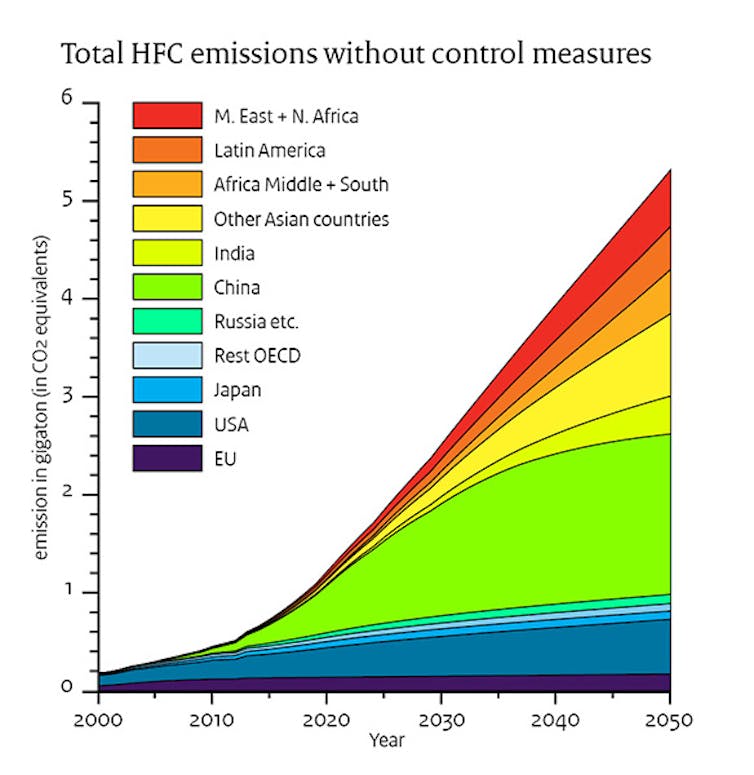
HFCs leaking from discarded cooling equipment are estimated to contribute about 4% of global greenhouse gas emissions – about twice as much as aviation.
This is why it’s time to retire HFCs and swap them out for alternative refrigerants. They’ve done their job saving the ozone layer, but now HFCs are a major contributor to short-term global warming, and their use has been increasing as demand for cooling increases around the world.
What can replace HFCs?
Because they are so powerful and short-lived, stopping the production and use of HFCs can have a significant cooling effect on the climate over the next couple of decades, buying time as the world converts its energy supply from fossil fuels to cleaner sources.
The good news is that there are alternative refrigerants.
Ammonia and hydrocarbons like butane evaporate at room temperature and have been used as refrigerants since the early 20th century. These gases are short-lived, but they have a downside. Their greater reactivity means their compressors and plumbing have to be more corrosion-resistant and leak-proof to be safe.

The chemical industry has been developing newer alternatives intended to be safer for both people and climate, but as we saw with CFCs and HFCs, inert chemicals can have unintended consequence. Several industry leaders have supported efforts to phase out HFCs.
So, it’s time for another generation of cooling equipment. Just as TVs and audio equipment and light bulbs have evolved over past decades, refrigerators and air conditioners will be replaced by a new wave of improved products. New refrigerators will look and work just like the ones we’re used to, but they will be much gentler on the climate system.
This updates an article originally published on May 4, 2021, with the U.S. Senate ratifying the Kigali Amendment.
Scott Denning, Professor of Atmospheric Science, Colorado State University
This article is republished from The Conversation under a Creative Commons license. Read the original article.
Call Lake County Animal Care and Control at 707-263-0278 or visit the shelter online at http://www.co.lake.ca.us/Government/Directory/Animal_Care_And_Control.htm for information on visiting or adopting.
The following cats at the shelter have been cleared for adoption.

‘Mama’
“Mama” is a 2-year-old domestic shorthair cat with an all-black coat.
She is in cat room kennel No. 7, ID No. LCAC-A-3884.

‘Willow’
“Willow” is a female domestic shorthair cat with a gray and white coat.
Shelter staff said she has a quiet personality, but also has lots of love and purrs to give. “She likes to greet you with a cute little meow and flashy tail swish.”
She is in cat room kennel No. 47, ID No. LCAC-A-3762.

Male domestic shorthair kitten
This 4-year-old male domestic shorthair kitten has a yellow tabby coat with white markings.
“This sweet little guy loves gentle pets. He has a great purr machine that comes on as soon as he sees you. He is also one of our master kitty bakers and makes wonderful kitty biscuits. He does have a playful side when toys are introduced,” staff said.
He is in cat room kennel No. 53, ID No. LCAC-A-3971.

Female domestic shorthair
This 1-year-old female domestic shorthair has a buff coat.
“This lovely lady may take a little bit of time to warm up to you, but once she does you'll get to meet one of the sweetest kitties. She will make your hand tired from all the pets she wants,” shelter staff said.
She is in cat room kennel No. 56, ID No. LCAC-A-3972.

Male domestic shorthair cat
This 1-year-old male domestic shorthair cat has a black coat.
Shelter staff said he is a sweet, talkative kitty, who loves head scratches and will rub all over your legs as you walk through the room.
He is in cat room kennel No. 60, ID No. LCAC-A-3932.
Email Elizabeth Larson at