 How to resolve AdBlock issue?
News
Following brief interviews with two former council members, Bob Rumfelt and George Spurr, the council appointed Spurr to fill the seat formerly held by Mireya Turner, who resigned in August to take the Lake County Community Development Department director job on a permanent basis.
At its Sept. 6 meeting, the council had directed staff to reach out to former council members to find out if any of them would be interested in filling the remainder of Turner’s term, which expires at year’s end.
Rumfelt served for 16 years on the council, ending in 2010. Spurr left the council at the end of 2020 after serving one term.
After both Rumfelt and Spurr had spoken briefly to the council, the council began to discuss the temporary appointment. Then Rumfelt returned to the microphone and said he was pulling his hat out of the ring in favor of Spurr.
The council then voted unanimously to approve Spurr’s three-month appointment, with Administrative Services Director/City Clerk Kelly Buendia administering the oath of office to Spurr, who was immediately seated on the dais with the other four council members.
There may still be more need for additional council appointments before the year is over, however.
By the time of her resignation, Turner had already signed up to run for a third term and her name will be on the ballot in November.
If she is elected, she will need to resign her post and the council will have to make another temporary appointment, this one for two years, until the next municipal election.
Write-in candidates have until Oct. 25 to sign up to run for Turner’s seat.
In addition, Councilman Michael Green has made it broadly known that he has applied for the District 4 supervisorial seat vacated by Tina Scott. That position will be appointed by the governor.
As a result, the city has begun to seek additional applicants should it need to fill those seats.
In other business, at the request of developer Peter Schellinger, owner of Waterstone Residential, the council voted to continue a public hearing for general plan and zoning changes for his Parkside Residential Project at 1310 Craig Ave.
Schellinger is seeking approvals to build 128 new apartment units and 48 cluster homes on the 15-acre site, next to the original Parkside subdivision near Westside Community Park.
Neighbors at the Parkside subdivision have pushed back on the plan, citing issues such as traffic, wildfire risk and water use.
Schellinger said he had participated in a Zoom meeting initiated by the neighbors, who have expressed their concerns to him directly.
“We are pushing forward to try to get the financing in place,” he said, noting that there is a very unique opportunity now to take advantage of state financing.
He said he would go back and reconvene with the neighbors and would work with city staff on how he would like to proceed.
The council also set special meetings on Dec. 12 and 13 to make appointments to city commissions and committees with terms expiring this year and received an update on the city’s GIS and asset management program.
Email Elizabeth Larson at
The California Coastal Commission reported that for the past two years the event was limited to self-guided cleanups because of the pandemic, but this year’s cleanup saw more than 600 in-person cleanup sites taking place throughout the state — a return to near full capacity.
Volunteers gathered hundreds of tons of trash at beaches, shorelines, and inland waterways, cleaning up at locations in virtually all of California’s 58 counties. Cleanups took place up and down the coast, from the Oregon to Mexico border, and as far inland as Lake Tahoe.
California’s event is part of the International Coastal Cleanup, the world’s largest volunteer event dedicated to the marine environment, which is organized by the Ocean Conservancy.
With 60% of the cleanup sites reporting, the statewide count stands at 27,185 volunteers.
Those volunteers picked up 220,861 pounds of trash and an additional 29,702 pounds of recyclable materials, for a total of 250,563 pounds or 125 tons.
In Lake County, there were six cleanup sites: Lucerne Harbor Park; Rodan Slough Park, Nice; Library Park, Lakeport; Highland Springs Recreation Area, Lakeport; Konocti CrossFit, Kelseyville; and Austin Park Beach, Clearlake.
Lake County Water Resources said there were 70 Lake County volunteers, who covered 30 miles during the Cleanup Day.
They collected 2,735.66 pounds of trash and 150 pounds of recyclables, Water Resources said.
“We were amazed by the response to the call for self-guided cleanups over these past two years. But it’s not surprising — Californians cherish their coast and want to take care of it,” said the commission’s Executive Director Jack Ainsworth. “Even so, we are so pleased about returning to in-person cleanups. These events really do more than help us capture huge amounts of trash before it enters the ocean. Coastal Cleanup Day brings us together to celebrate our precious waterways and coastal resources as a community.”
Volunteers not only removed trash from the environment today, but they also kept track of all the items they removed as part of one of the world’s largest and longest-running community science projects.
This data, and the trends it displays over the many years in which it has been collected, has revealed a great deal about the extent and nature of the marine debris problem over time, and has provided California with crucial information needed to address the sources of the problem.
Based on past cleanup data, 75% of the debris that volunteers removed today was composed of plastic, a material that never completely biodegrades and has numerous harmful consequences in the environment. Plastic debris can kill wildlife, leach toxic chemicals into the environment, and even introduce them into the food chain.
The data has also shown that up to 80% of the trash on the California coast originates on land, so volunteers across the state helped prevent enormous amounts of trash from ever reaching the ocean, no matter where they participated.
Most unusual items:
Every-day debris and plastic items weren’t the only things found on Coastal Cleanup Day. Volunteers also picked up a number of “unusual” items during this year’s cleanup. The Winners of the 2022 Most Unusual Item contest are:
• Coastal California: A volunteer along the Berkeley shoreline in Alameda County found a large, framed photo of a Jack Russell Terrier.
• Inland California: A volunteer in Colusa County found a trophy with a plaque that read “Best Couples Skater 2006.”
In addition to in-person cleanups, the Coastal Commission continues its COVID-inspired push to encourage volunteers to run self-guided cleanups throughout neighborhoods across the state.
The self-guided cleanups serve the same purpose as the Cleanup Day events that took place today: to prevent trash from ever having the opportunity to reach our coast. Self-guided cleanups throughout California help to stop trash where it starts, which is primarily within urban areas most prone to stormwater runoff.
To date, 522 Californians have conducted a neighborhood cleanup, removing 2,437 pounds of trash during 211 cleanups.
The person or person who will be appointed will serve approximately two years, with a term ending in 2024.
Those interested in being considered for appointment to serve as council member on the Lakeport City Council are invited to submit a council member vacancy application.
The application can be obtained online at www.cityoflakeport.com or at Lakeport City Hall, located at 225 Park St., Lakeport.
Qualified candidates must reside in Lakeport city limits, be at least 18 years of age and registered to vote in the city of Lakeport.
The five-member City Council serves as the legislative body of the city and is responsible for setting policy, adopting the annual budget, adopting laws, determining services to
be provided and the funding levels, and appointing citizens to its advisory boards and commissions.
Applications may be submitted electronically to
Completed applications must be returned to the Office of the City Clerk no later than Thursday, Dec. 13, at 5 p.m.
Once the application period has closed, the applications will be distributed to the City Council for review.
The City Council will decide at a future council meeting on the process to use for the appointment.
Medicaid enrollment soared by 25% during the COVID-19 pandemic – but a big decline could happen soon

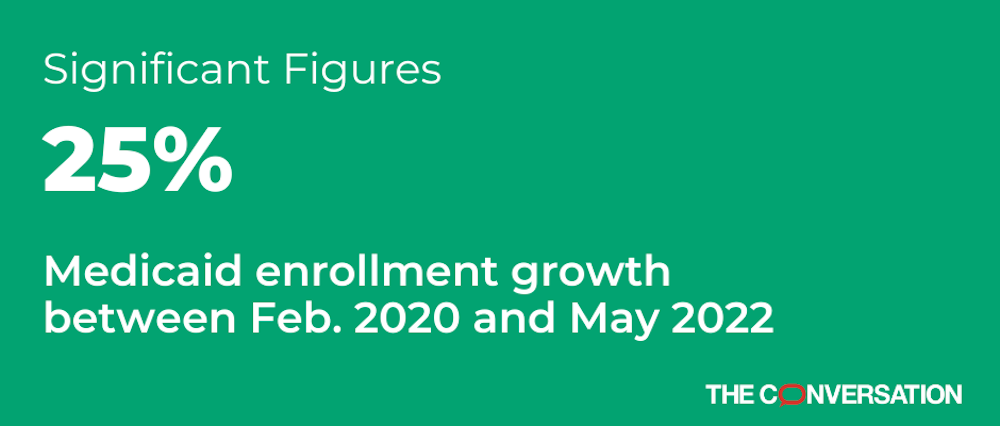
Medicaid, the government-funded U.S. health insurer for people with low incomes, grew by about 25% between February 2020 and May 2022 as policies adopted at the outset of the COVID-19 pandemic expanded the program’s reach.
All told, the number of people enrolled in Medicaid and the Children’s Health Insurance Program, or CHIP, which serves kids in families with low to moderate incomes, increased from 71 million to 89 million. That’s roughly 27% of all Americans.
The pandemic-related increase in Medicaid enrollment was slightly larger than the 24.7% increase seen after the Affordable Care Act (ACA) expanded Medicaid for adults, starting in 2014.
But unlike Medicaid expansion under the ACA, these pandemic policies are temporary. They will end once the federal government’s COVID-19 public health emergency expires. Some experts predict Medicaid enrollment could fall by as many as 15 million people when this happens, disrupting health care for many Americans.
In a new article we published in the Journal of the American Medical Association on Sept. 20, 2022, we examine how Medicaid serves Americans, analyze the program’s importance for health equity, and assess how Medicaid grew and changed during the COVID-19 pandemic.
As health policy researchers, we believe that Medicaid’s growth since 2020 highlights the program’s importance during economic and public health crises. It also underscores how painful the unwinding of these pandemic policies is likely to be to those who may end up uninsured.
Federal changes
In March 2020, Congress passed the first of several large spending packages, called the Families First Coronavirus Response Act. To help states shoulder increased Medicaid costs associated with the pandemic, that measure increased the share of Medicaid spending the federal government pays for by 6.2 percentage points in all states.
This aid has made a big difference for states, which split the costs of Medicaid with the federal government. Before the pandemic, the federal government was paying about 65% of Medicaid’s costs overall, with the precise share varying based on a state’s average income. States picked up the other 35% of Medicaid costs. These costs accounted for more than one-fourth of state budgets before the pandemic.
The extra federal money for Medicaid came with an important requirement: states accepting funds could not remove anyone from Medicaid who was enrolled as of March 2020 or gained Medicaid afterwards – as long as the official public health emergency, first declared on Jan. 31, 2020, remained in effect. These policies also applied to CHIP.
All 50 states and the District of Columbia accepted the higher federal payments in exchange for keeping Medicaid enrollment stable during the pandemic.
Greater stability
These changes helped to address longstanding instability in Medicaid coverage for many people. Before the pandemic, nearly 25% of those with Medicaid would enter or exit the program each year as their short-term circumstances changed.
People would lose Medicaid coverage when their income ticked up, their family circumstances changed, they aged out of CHIP, or they failed to complete required paperwork. Losing Medicaid coverage can lead to someone ending up without any health insurance at all, which increases the likelihood they will postpone or never get needed care. Having the same people frequently entering and exiting the program also increases the program’s administrative costs over time.
Changes to Medicaid policy in response to the pandemic made it much easier for everyone enrolled in Medicaid to keep their coverage. To illustrate, just over half of Wisconsin’s Medicaid growth in 2020 came from that state keeping existing enrollees in the program who might otherwise have lost coverage for at least a few months.
Young adults, especially those aged 18 and 19, and Americans who recently gave birth are two groups that benefited from this change in Medicaid policy.
What’s next
Even with many aspects of daily life getting back to normal, and President Joe Biden’s comments to the media about the pandemic being “over,” the official public health emergency that spurred Medicaid enrollment growth still remains in force.
When the government renewed the declaration for the 10th time in July 2022, it set a new expiration date of Oct. 13, 2022. The administration also said it would provide states with 60 days notice before it would end the federal emergency declaration, which suggests the declaration will be renewed at least one more time.
When the emergency ends, states will have to reevaluate eligibility for everyone with Medicaid within 12 months. Extra federal funding for states will also end.
These changes will have profound consequences. Millions of people will have to reestablish their eligibility for Medicaid and are at risk of losing coverage if they do not complete the required paperwork on time.
The administration may ultimately decide to renew the COVID-19 emergency declaration again, as hundreds of Americans are still dying daily from the disease. Keeping it in place would prevent a massive drop in Medicaid enrollment and make it easier to continue other COVID-19 public health policies, such as making free COVID-19 testing and vaccinations widely available.
Beyond extending the public health emergency, we believe that states and the federal government can seek new ways to minimize disruptions in coverage and to make Medicaid more accessible to the millions of Americans who depend on it for health insurance.
Julie Donohue, Professor and Chair of Health Policy and Management, University of Pittsburgh Health Sciences and Eric T. Roberts, Assistant Professor of Health Policy and Management, University of Pittsburgh Health Sciences
This article is republished from The Conversation under a Creative Commons license. Read the original article.
A lightning storm began at around 7:30 p.m., and shortly after 8 p.m. heavy rain started to fall.
Over the course of an hour, between 8 and 9 p.m., nearly an inch of rain fell in the Lucerne area, based on Lake County News’ weather station.
Shortly before 8:30 p.m., flooding was reported on Lakeshore Boulevard in Lakeport.
Coinciding with the heavy rain, there was a report of a downed tree blocking the road in the 16000 block of Cobb Boulevard.
At Highway 175 and Adams Springs Road, there were rocks in the roadway at about 8:20 p.m. that were reported to be “larger than a doghouse,” according to the California Highway Patrol logs.
Pacific Gas and Electric Co. reported early in the evening that there were several power outages around Lake County, the largest impacting approximately 2,111 customers in the south county area.
By early Tuesday, most of the south county customers had been restored, with some smaller outages still pending resolution around Hidden Valley Lake, Boggs Mountain, Clearlake and Lakeport.
A hazardous weather outlook remains in effect for Lake County due to more rain that’s forecast through Wednesday.
Less than a quarter of an inch is expected on Tuesday, with the potential for a smaller amount on Wednesday, based on the Lake County forecast.
Email Elizabeth Larson at
The board will meet beginning at 9 a.m. Wednesday, Sept. 21, and Thursday, Sept. 22, in the board chambers on the first floor of the Lake County Courthouse, 255 N. Forbes St., Lakeport.
The meeting can be watched live on Channel 8, online at https://countyoflake.legistar.com/Calendar.aspx and on the county’s Facebook page.
Accompanying board documents, the agenda and archived board meeting videos also are available at that link.
Each day of the hearings has a different Zoom link.
For Wednesday, the Zoom link is here; the meeting ID is 972 4365 5590, pass code 716589. The meeting also can be accessed via one tap mobile at +16694449171,,97243655590#,,,,*716589# or by dialing 669-900-6833
For Thursday, the Zoom link is here; the meeting ID is 946 4937 4295, pass code 716589. The meeting also can be accessed via one tap mobile at +16699006833,,94649374295#,,,,*145426# or by dialing 669-900-6833.
The board will consider a budget with appropriations for all funds totaling $351,946,439, an increase of $32,560,324 from the previous fiscal year, according to the memo to the board from County Administrative Officer Susan Parker and Assistant County Administrative Officer Stephen Carter.
The final recommended budget must be adopted no later than Oct. 2, based on state Government Code.
Email Elizabeth Larson at