 How to resolve AdBlock issue?
News

KELSEYVILLE, Calif. — Looking for a way to meet people, get some exercise, and have so much fun that you won’t even notice all the calories you’re burning?
Head on over to the new pickleball courts located on Lincoln Street in Kelseyville, adjacent to the Gard Street tennis facility.
Invented in 1965 by three dads trying to amuse their kids, pickleball is a combination of tennis, badminton and Ping-Pong.
The sport has a welcoming vibe, is inexpensive, and is easy enough that newcomers can immediately play.
Named the fastest growing sport in the nation for the last two years by the Sports and Fitness Industry Association, pickleball is equally enjoyed by men and women of all ages.
Michael Shay, president of the Lake County Tennis Association, was instrumental in bringing pickleball to the area.
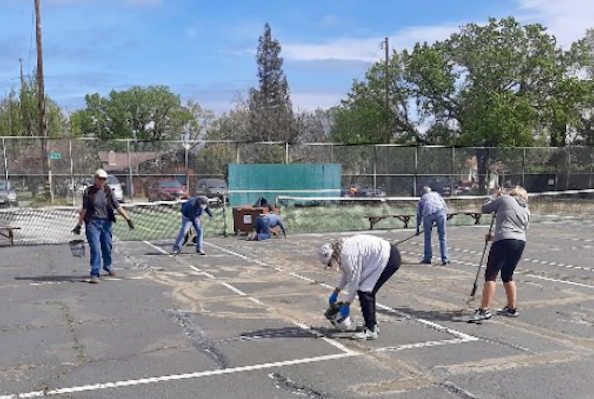
Funded by a few local donations, he and a handful of volunteers from the association converted a portion of the cracked, weed-ridden asphalt in the Gard Street tennis facility into two smooth, bright green pickleball courts, each about a quarter of the size of a tennis court.
Play began in January and it soon became clear that more courts were needed. With a generous donation from Lake County Tribal Health, two more courts were added, again with an all-volunteer labor crew.
Nets, balls and paddles are provided by the association, although many purchase their own paddles once hooked on the sport.
Shay has plans for additional courts and equipment as need increases and funding allows. This latest effort will require significant funds and approval of the Kelseyville Unified School District.
Tribal Health has started off the fundraising effort by pledging $10,000 provided all the needed
Money is raised.
For more information, visit https://lctennis.org/ or email questions to Michael Shay at
Better yet, cruise on over to Lincoln Street and check out the action Monday, Wednesday and Friday from 8 to 11 a.m., Tuesday and Thursday from 6 to 9 p.m., and Sunday from 9 to 11 a.m. If you go, don’t be surprised if you run home and buy a paddle.
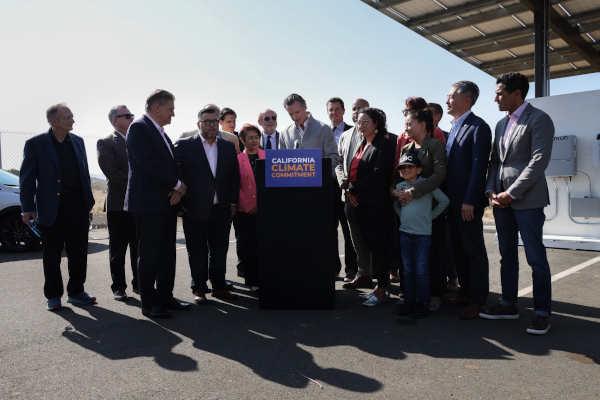
On Friday, California enacted some of the nation’s most aggressive climate measures in history as Gov. Gavin Newsom signed a sweeping package of legislation to cut pollution, protect Californians from big polluters, and accelerate the state’s transition to clean energy.
The governor partnered with legislative leaders this session to advance groundbreaking measures to achieve carbon neutrality no later than 2045 and 90% clean energy by 2035, establish new setback measures protecting communities from oil drilling, capture carbon pollution from the air, advance nature-based solutions, and more.
The Governor’s Office said this is an essential piece of the California Climate Commitment, a record $54 billion investment in climate action that exceeds what most countries are spending and advances economic opportunity and environmental justice in communities across the state.
Over the next two decades, the California Climate Commitment will:
• Create 4 million new jobs;
• Cut air pollution by 60%;
• Reduce state oil consumption by 91%;
• Save California $23 billion by avoiding the damages of pollution;
• Reduce fossil fuel use in buildings and transportation by 92%; and
• Cut refinery pollution by 94%.
Taken together, the Governor’s Office said these measures represent the most significant action on the climate crisis in California’s history and raises the bar for governments around the world.
“This month has been a wake-up call for all of us that later is too late to act on climate change. California isn’t waiting any more,” said Newsom. “Together with the Legislature, California is taking the most aggressive action on climate our nation has ever seen. We’re cleaning the air we breathe, holding the big polluters accountable, and ushering in a new era for clean energy. That’s climate action done the California Way – and we’re not only doubling down, we’re just getting started.”
With multiple oil refineries in the distance, the governor signed the legislation alongside legislative leaders at the USDA Forest Service Regional Office on Mare Island, a facility powered by clean energy that also feeds the grid.
“Our state has been facing extreme temperatures, putting our communities, especially our most vulnerable neighbors, at risk. We’re also continuing to deal with an historic drought and the ongoing threat of wildfires. The challenges of climate change are here, and this Legislative session, we took bold action to address these severe conditions and mitigate future risk both through our state budget and key legislation,” said Senate President pro Tempore Toni G. Atkins (D-San Diego). “We established ambitious and necessary goals to reduce carbon emission and increase renewable energy. We provided the tools industry needs to capture and store carbon before it hits the atmosphere. And we invested in critical infrastructure programs that will keep us firmly planted on the path to a greener future, while simultaneously creating jobs that will support families across the state. California has, and will continue to, lead the nation on not only addressing the worsening climate crisis, but finding proactive solutions.”
“It’s great to see California and the governor celebrating our collective dedication to climate response. The Assembly has initiated this kind of legislation for years, and put forward some of these bills more than a year ago,” said Assembly Speaker Anthony Rendon (D-Lakewood). “That makes it especially heartening to be able to enact a package like this as a team. I look forward to working on additional climate change legislation with the Governor and the Senate. We are just getting started.”
The climate package signed Friday includes:
CARBON NEUTRALITY: AB 1279 by Assemlymembers Al Muratsuchi (D-Torrance) and Cristina Garcia (D-Bell Gardens) codifies the statewide carbon neutrality goal to dramatically reduce climate pollution.
Establishes a clear, legally binding, and achievable goal for California to achieve statewide carbon neutrality as soon as possible, and no later than 2045, and establishes an 85% emissions reduction target as part of that goal.
PROTECT COMMUNITIES AGAINST OIL DRILLING: SB 1137 by Senators Lena Gonzalez (D-Long Beach) and Monique Limón (D-Santa Barbara) protects communities from the harmful impacts of the oil industry.
Establishes a setback distance of 3,200 feet between any new oil well and homes, schools, parks or businesses open to the public.
Ensures comprehensive pollution controls for existing oil wells within 3,200 feet of these facilities.
100% CLEAN ELECTRIC GRID: SB 1020 by Senator John Laird (D-Santa Cruz) establishes a pathway toward the state’s clean energy future.
Creates clean electricity targets of 90% by 2035 and 95% by 2040 with the intent of advancing the state’s trajectory to the existing 100% clean electricity retail sales by 2045 goal.
CAPTURING AND REMOVING CARBON POLLUTION: SB 905 by Senators Anna Caballero (D-Merced) and Nancy Skinner (D-Berkeley) and SB 1314 by Senator Monique Limón (D-Santa Barbara) advance engineered technologies to remove carbon pollution, while banning the use of those technologies for enhanced oil recovery.
Establishes a clear regulatory framework for carbon removal and carbon capture, utilization and sequestration.
Bans the practice of injecting carbon dioxide for the purpose of enhanced oil recovery.
NATURE-BASED SOLUTIONS: AB 1757 by Assemblymembers Cristina Garcia (D-Bell Gardens) and Robert Rivas (D-Salinas) enlists nature in the state’s climate agenda.
Requires the state to develop an achievable carbon removal target for natural and working lands.
Last week, Gov. Newsom signed legislation to help protect Californians from more frequent and severe heat waves driven by climate change. This month’s legislative action comes on the heels of California enacting a world-leading regulation to phase out sales of new gas-powered cars by 2035.
In a July letter to the Chair of the California Air Resources Board, or CARB, Gov. Newsom called for the state to ensure that the 2022 Climate Change Scoping Plan provides a path to achieve both the 2030 climate goal and state carbon neutrality no later than 2045, requesting that the final plan incorporate new efforts to advance offshore wind, clean fuels, climate-friendly homes, carbon removal and address methane leaks.
The full set of bills the Governor signed that work toward achieving the state’s climate goals include:
AB 1279 by Assemblymember Al Muratsuchi (D-Torrance) – The California Climate Crisis Act.
AB 1384 by Assemblymember Jesse Gabriel (D-Encino) – Resiliency Through Adaptation, Economic Vitality, and Equity Act of 2022.
AB 1389 by Assemblymember Eloise Gómez Reyes (D-Colton) – Clean Transportation Program: project funding preferences.
AB 1749 by Assemblymember Cristina Garcia (D-Bell Gardens) – Community emissions reduction programs: toxic air contaminants and criteria air pollutants.
AB 1757 by Assemblymember Cristina Garcia (D-Bell Gardens) – California Global Warming Solutions Act of 2006: climate goal: natural and working lands.
AB 1857 by Assemblymember Cristina Garcia (D-Bell Gardens) – Solid waste.
AB 1909 by Assemblymember Laura Friedman (D-Glendale) – Vehicles: bicycle omnibus bill.
AB 1985 by Assemblymember Robert Rivas (D-Salinas) – Organic waste: recovered organic waste product procurement targets.
AB 2061 by Assemblymember Philip Ting (D-San Francisco) – Transportation electrification: electric vehicle charging infrastructure.
AB 2075 by Assemblymember Philip Ting (D-San Francisco) – Energy: electric vehicle charging standards.
AB 2108 by Assemblymember Robert Rivas (D-Salinas) – Water policy: environmental justice: disadvantaged and tribal communities.
AB 2204 by Assemblymember Tasha Boerner Horvath (D-Encinitas) – Clean energy: Labor and Workforce Development Agency: Deputy Secretary for Climate.
AB 2278 by Assemblymember Ash Kalra (D-San Jose) – Natural resources: biodiversity and conservation report.
AB 2316 by Assemblymember Christopher Ward (D-San Diego) – Public Utilities Commission: customer renewable energy subscription programs and the community renewable energy program.
AB 2440 by Assemblymember Jacqui Irwin (D-Thousand Oaks) – Responsible Battery Recycling Act of 2022.
AB 2446 by Assemblymember Chris Holden (D-Pasadena) – Embodied carbon emissions: construction materials.
AB 2622 by Assemblymember Kevin Mullin (D-South San Francisco) – Sales and use taxes: exemptions: California Hybrid and Zero-Emission Truck and Bus Voucher Incentive Project: transit buses.
AB 2700 by Assemblymember Kevin McCarty (D-Sacramento) – Transportation electrification: electrical distribution grid upgrades.
AB 2836 by Assemblymember Eduardo Garcia (D-Coachella) – Carl Moyer Memorial Air Quality Standards Attainment Program: vehicle registration fees: California tire fee.
SB 379 by Senator Scott Wiener (D-San Francisco) – Residential solar energy systems: permitting.
SB 529 by Senator Robert Hertzberg (D-Van Nuys) – Electricity: electrical transmission facilities.
SB 887 by Senator Josh Becker (D-Menlo Park) – Electricity: transmission facility planning.
SB 905 by Senator Anna Caballero (D-Merced) – Carbon sequestration: Carbon Capture, Removal, Utilization, and Storage Program.
SB 1010 by Senator Nancy Skinner (D-Berkeley) – Air pollution: state vehicle fleet.
SB 1020 by Senator John Laird (D-Santa Cruz) – Clean Energy, Jobs, and Affordability Act of 2022.
SB 1063 by Senator Nancy Skinner (D-Berkeley) – Energy: appliance standards and cost-effective measures.
SB 1075 by Senator Nancy Skinner (D-Berkeley) – Hydrogen: green hydrogen: emissions of greenhouse gases.
SB 1109 by Senator Anna Caballero (D-Merced) – California Renewables Portfolio Standard Program: bioenergy projects.
SB 1137 by Senator Lena Gonzalez (D-Long Beach) – Oil and gas: operations: location restrictions: notice of intention: health protection zone: sensitive receptors.
SB 1145 by Senator John Laird (D-Santa Cruz) – California Global Warming Solutions Act of 2006: greenhouse gas emissions: dashboard.
SB 1158 by Senator Josh Becker (D-Menlo Park) – Retail electricity suppliers: emissions of greenhouse gases.
SB 1203 by Senator Josh Becker (D-Menlo Park) – Net-zero emissions of greenhouse gases: state agency operations.
SB 1205 by Senator Ben Allen (D-Santa Monica) – Water rights: appropriation.
SB 1215 by Senator Josh Newman (D-Fullerton) – Electronic Waste Recycling Act of 2003: covered battery-embedded products.
SB 1230 by Senator Monique Limόn (D-Santa Barbara) – Zero-emission and near-zero-emission vehicle incentive programs: requirements.
SB 1251 by Senator Lena Gonzalez (D-Long Beach) – Governor’s Office of Business and Economic Development: Zero-Emission Vehicle Market Development Office: Zero-Emission Vehicle Equity Advocate.
SB 1291 by Senator Bob Archuleta (D-Pico Rivera) – Hydrogen-fueling stations: administrative approval.
SB 1314 by Senator Monique Limόn (D-Santa Barbara) – Oil and gas: Class II injection wells: enhanced oil recovery.
SB 1322 by Senator Ben Allen (D-Santa Monica) – Energy: petroleum pricing.
SB 1382 by Senator Lena Gonzalez (D-Long Beach) – Air pollution: Clean Cars 4 All Program: Sales and Use Tax Law: zero emissions vehicle exemption.
Gov. Newsom previously signed:
AB 2251 by Assemblymember Lisa Calderon (D-Whittier) – Urban forestry: statewide strategic plan.
SB 1174 by Senator Robert Hertzberg (D-Van Nuys) – Electricity: eligible renewable energy or energy storage resources: transmission and interconnection.
For full text of the bills, visit: http://leginfo.legislature.ca.gov.

Sharks are some of the most ecologically important and most threatened animals on Earth. Recent reports show that up to one-third of all known species of sharks and their relatives, rays, are threatened with extinction. Unsustainable overfishing is the biggest threat by far.
Losing sharks can disrupt coastal food webs that billions of people depend on for food. When food chains lose their top predators, the rest can unravel as smaller prey species multiply.
In my years of talking with the public about sharks and ocean conservation, I’ve found that many people care about sharks and want to help but don’t know how. The solutions can be quite technical, and it’s challenging to understand and appreciate the scale and scope of some of the threats.
At the same time, there is an enormous amount of oversimplification and even misinformation about these important topics, which can lead well-intentioned people to support policies that experts know won’t work.
I am a marine conservation biologist and have sought to improve this situation by surveying shark researchers and helping scientists identify research topics that can advance conservation. I’ve also written a book, “Why Sharks Matter: A Deep Dive With the World’s Most Misunderstood Predator.” Here are three ways that anyone can make a difference for sharks and avoid taking steps that are ineffective or even harmful.
Don’t eat unsustainable seafood
The No. 1 threat to sharks and rays – and arguably, to marine biodiversity in general – is unsustainable overfishing. Some fishing methods are incredibly destructive to marine life and habitats.
They can also produce high rates of bycatch – the unintended catch of nontarget species. For example, fishermen pursuing tuna may accidentally catch sea turtles or sharks swimming near the tuna.
The single most effective thing that individual consumers can do is to avoid seafood produced using these harmful methods. This does not mean completely avoiding seafood, as some advocates urge. Seafood is healthy, delicious and culturally important, and there are environmentally friendly ways of catching it sustainably. There are even sustainable fisheries for sharks.
Reputable organizations such as California’s Monterey Bay Aquarium publish sustainable seafood guides that rate different types of seafood based on how they are caught or raised. While experts may quibble over details of some of these rankings, consumers can follow these guidelines and know that they are helping to protect sharks and ocean life in general.
Support reputable environmental nonprofits, not harmful extremists
Lots of great environmental nonprofit organizations work on shark issues and offer opportunities to get involved, such as donating money and communicating with elected officials and other decision-makers. In my book, I describe the work of many of these groups, including my favorite, Shark Advocates International.
Unfortunately, some organizations promote pseudoscience that doesn’t help anyone or anything. In a 2021 study, colleagues and I surveyed employees of 78 nonprofits that work on shark conservation issues to understand whether and how these organizations engaged with the science of shark conservation.
We found that a small but vocal minority had never read scientific reports or spoken with scientists, and held blatantly incorrect and harmful views that cannot help sharks. For example, some organizations are trying to get certain airlines to stop carrying shark products like dried fins, without acknowledging that well over 95% of fins are shipped by sea or that sustainable sources of these fins exist.
One of my particular pet peeves is amateur online petitions that may not reflect actual conditions. For example, in the spring of 2022, some 60,000 people signed a petition calling for Florida to ban the practice of shark finning – without recognizing that Florida had banned shark finning in the early 1990s. As I explain in my book, it is essential to identify organizations that use science in support of worthwhile conservation goals and avoid promoting others that do not.
Look to experts
Many ocean science, management and conservation experts are active on social media. Following them is a great way to learn about fascinating new scientific discoveries and conservation issues.
Unfortunately, sharks also get a lot of sensational coverage in the media, and well-intentioned but uninformed people often spread misinformation on social media. For example, you may have seen posts celebrating Hawaii for banning shark fishing in its waters – but these posts don’t note that about 99% of fishing in Hawaii occurs in federal waters.
Don’t take the bait. By getting your information from reliable sources, you can help other people learn more about these fascinating, ecologically important animals, why they need humans’ help and the most effective steps to take.
David Shiffman, Post-Doctoral and Research Scholar in Marine Biology, Arizona State University
This article is republished from The Conversation under a Creative Commons license. Read the original article.

NASA’s Perseverance rover is well into its second science campaign, collecting rock-core samples from features within an area long considered by scientists to be a top prospect for finding signs of ancient microbial life on Mars.
The rover has collected four samples from an ancient river delta in the Red Planet’s Jezero Crater since July 7, bringing the total count of scientifically compelling rock samples to 12.
“We picked the Jezero Crater for Perseverance to explore because we thought it had the best chance of providing scientifically excellent samples — and now we know we sent the rover to the right location,” said Thomas Zurbuchen, NASA’s associate administrator for science in Washington. “These first two science campaigns have yielded an amazing diversity of samples to bring back to Earth by the Mars Sample Return campaign.”
Twenty-eight miles wide, Jezero Crater hosts a delta — an ancient fan-shaped feature that formed about 3.5 billion years ago at the convergence of a Martian river and a lake.
Perseverance is currently investigating the delta’s sedimentary rocks, formed when particles of various sizes settled in the once-watery environment.
During its first science campaign, the rover explored the crater’s floor, finding igneous rock, which forms deep underground from magma or during volcanic activity at the surface.
“The delta, with its diverse sedimentary rocks, contrasts beautifully with the igneous rocks — formed from crystallization of magma — discovered on the crater floor,” said Perseverance project scientist Ken Farley of Caltech in Pasadena, California. “This juxtaposition provides us with a rich understanding of the geologic history after the crater formed and a diverse sample suite. For example, we found a sandstone that carries grains and rock fragments created far from Jezero Crater — and a mudstone that includes intriguing organic compounds.”
“Wildcat Ridge” is the name given to a rock about 3 feet (1 meter) wide that likely formed billions of years ago as mud and fine sand settled in an evaporating saltwater lake. On July 20, the rover abraded some of the surface of Wildcat Ridge so it could analyze the area with the instrument called Scanning Habitable Environments with Raman & Luminescence for Organics & Chemicals, or SHERLOC.
SHERLOC’s analysis indicates the samples feature a class of organic molecules that are spatially correlated with those of sulfate minerals.
Sulfate minerals found in layers of sedimentary rock can yield significant information about the aqueous environments in which they formed.
What Is organic matter?
Organic molecules consist of a wide variety of compounds made primarily of carbon and usually include hydrogen and oxygen atoms. They can also contain other elements, such as nitrogen, phosphorus, and sulfur.
While there are chemical processes that produce these molecules that don’t require life, some of these compounds are the chemical building blocks of life.
The presence of these specific molecules is considered to be a potential biosignature — a substance or structure that could be evidence of past life but may also have been produced without the presence of life.
In 2013, NASA’s Curiosity Mars rover found evidence of organic matter in rock-powder samples, and Perseverance has detected organics in Jezero Crater before.
But unlike that previous discovery, this latest detection was made in an area where, in the distant past, sediment and salts were deposited into a lake under conditions in which life could potentially have existed.
In its analysis of Wildcat Ridge, the SHERLOC instrument registered the most abundant organic detections on the mission to date.
“In the distant past, the sand, mud, and salts that now make up the Wildcat Ridge sample were deposited under conditions where life could potentially have thrived,” said Farley. “The fact the organic matter was found in such a sedimentary rock — known for preserving fossils of ancient life here on Earth — is important. However, as capable as our instruments aboard Perseverance are, further conclusions regarding what is contained in the Wildcat Ridge sample will have to wait until it’s returned to Earth for in-depth study as part of the agency’s Mars Sample Return campaign.”
The first step in the NASA-ESA (European Space Agency) Mars Sample Return campaign began when Perseverance cored its first rock sample in September 2021. Along with its rock-core samples, the rover has collected one atmospheric sample and two witness tubes, all of which are stored in the rover’s belly.
The geologic diversity of the samples already carried in the rover is so good that the rover team is looking into depositing select tubes near the base of the delta in about two months. After depositing the cache, the rover will continue its delta explorations.
“I’ve studied Martian habitability and geology for much of my career and know firsthand the incredible scientific value of returning a carefully collected set of Mars rocks to Earth,” said Laurie Leshin, director of NASA's Jet Propulsion Laboratory in Southern California. “That we are weeks from deploying Perseverance’s fascinating samples and mere years from bringing them to Earth so scientists can study them in exquisite detail is truly phenomenal. We will learn so much.”
More about the mission
A key objective for Perseverance’s mission on Mars is astrobiology, including caching samples that may contain signs of ancient microbial life. The rover will characterize the planet’s geology and past climate, pave the way for human exploration of the Red Planet, and be the first mission to collect and cache Martian rock and regolith.
Subsequent NASA missions, in cooperation with ESA, would send spacecraft to Mars to collect these sealed samples from the surface and return them to Earth for in-depth analysis.
The Mars 2020 Perseverance mission is part of NASA’s Moon to Mars exploration approach, which includes Artemis missions to the Moon that will help prepare for human exploration of the Red Planet.
JPL, which is managed for NASA by Caltech, built and manages operations of the Perseverance rover.
For more about Perseverance visit https://mars.nasa.gov/mars2020/.
UPPER LAKE, Calif. — The condition of the levees in Upper Lake and the potential flood risk for area residents should the levees fail has prompted the Western Region Town Hall to call a special workshop to update the community on the situation.
The Western Region Town Hall, or WRTH, will host a special workshop at 5:30 p.m. Wednesday, Sept. 28, at the Habematolel community center, 9460 Main St. in Upper Lake.
The reason for the workshop is to inform the community of potential flood risk due to the condition of the area’s levees, which don’t allow for the capacity of water flow they were designed for, which in turn could lead to flooding.
The workshop will feature several tables in order for government agencies and groups to take part in the discussion of a solution, along with flood insurance agents.
Invited agencies include the U.S. Army Corps of Engineers, Lake County Water Resources, the Lake County Sheriff’s Office of Emergency Services and Natural Resources Conservation Service, among others.
Lake County Public Works Director Scott De Leon, whose department includes Water Resources, confirmed to Lake County News that he and Marina Deligiannis, the Water Resources deputy director, will be at the Sept. 28 workshop.
WRTH set the workshop date during a special meeting held Aug. 31. At that time, the town hall’s board also discussed a postcard mailer that will be sent out to residents in the potential flood zone ahead of the workshop.
As serious as the situation is, WRTH Board member Claudine Pedroncelli said many community members are unaware of it, and she wants to get them to the workshop.
The area of concern is on the Middle Creek and Clover Creek diversion levees, the diversion structure and Old Clover Creek closure structure in Flood Zone 8.
The county has named that area the “Middle Creek Flood Control Project,” which is operated by the Lake County Watershed Protection District.
The Lake County Water Resources website said the project consists of a system of 14.4 miles of levees, a pump station and a diversion channel to divert Clover Creek overflow around the town of Upper Lake, see map.
“The upper portion of the project protects the community of Upper Lake from flooding by Middle Creek and Clover Creek. The lower portion of the system protects farmland and some residences from inundation by Clear Lake,” the county website explained.
This area is not to be confused with the Middle Creek Flood Damage Reduction and Ecosystem Restoration Project, a 1,650-acre area located south of Upper Lake that extends to the Rodman Slough and along a portion of the Nice-Lucerne Cutoff.
The Middle Creek and Clover Creek levees — which are called State Plan of Flood Control, or SPFC, levees — do not provide protection in a 100-year flood, according to a feasibility study released by the county of Lake in December.
That study found that, with the existing levees in place, a 100-year storm event could result in unprecedented flooding in the town of Upper Lake due to the lack of capacity of the system.
That means the 1,100 residents of the area could see anywhere from half an inch to 10 feet of water covering their property.
The models included in the study showed that in the case of a levee failure, downtown Upper Lake could be underwater at depths of between 3 to 10 feet. In one of those scenarios, the firehouse on Main Street would be under 7 feet of water.
“Nobody can put their head in the sand any longer. It’s an emergency,” said Julia Carrera, a WRTH Board member whose day job is as an inspector for the State Water Board, at the Aug. 31 meeting. Since that meeting, she has resigned from the WRTH Board.
Playing into all of this is changing climate and increasingly extreme weather, with multiple year droughts followed by years of heavy rain, as was seen in 2017 and 2019, and atmospheric river events such as the one that hit Upper Lake and the rest of Lake County hard in October.
District 3 Supervisor EJ Crandell, the chair of the Board of Supervisors, noted during the special Aug. 31 meeting that “the workshop is the most important thing” in the next steps of the process to address the situation.
The workshop, organizers said, will allow community members to weigh in on a number of alternatives for fixing the levee system.
Advocating for a solution
The December feasibility study presented three main alternatives for levee repair and improvement:
Alternative No. 1: Raising and strengthening in place 2.7 miles of levees on Middle Creek and the Clover Creek Diversion that provide direct protection to the community, improving them to a 100-year level of protection; improving “freeboard,” defined by the Federal Emergency Management Agency, or FEMA, as the vertical distance from the 1-percent-annual chance flood elevation up to the top of the levee; modifying or replacing the diversion structure; extending the Clover Creek levee’s left bank by about 1,000 feet to high ground to prevent flanking; and installing a shallow cutoff wall.
Alternative No. 2: Sediment management and vegetation clearing in the channel to convey 100-year flow, in addition to all of the aspects in Alternative No. 1.
Alternative No. 3: Raising structures to be above the 100-year floodplain level; considering school modifications for an evacuation center; and other emergency action and evacuation enhancements, including improved mapping of the floodplain and levee breach timing, and evacuation routes and coordination.
Based on the timeline given as part of the December feasibility study, an alternatives comparison was expected to be completed midyear, with the preferred alternative to be selected and information about that alternative to be emailed to stakeholders.
De Leon said this week that the county has not yet made a decision on the preferred alternative, and that the county’s consultant is still working through the process of assessing the choices.
The workshop, which is meant to gather the community’s input on the best levee alternative, has taken several months to schedule.
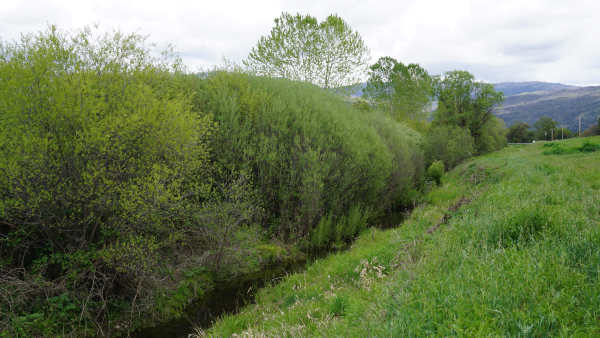
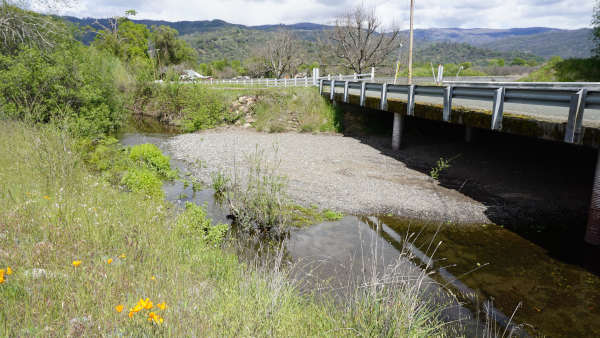
While the workshop now has a set date, many community members Lake County News has spoken to about the situation are unhappy with the fact that little has been done over the last several years to maintain the levees, which are now heavily overgrown with vegetation, and to clear sediment such as gravel buildup from the channels.
They also question why Supervisor Crandell, in his capacity as board chair, hasn’t scheduled it for a discussion before the Board of Supervisors in order to direct quick action by Water Resources to address the situation.
Seeking county government action
Although it’s forecast to be a potentially dry winter, that hasn’t allayed fears that a levee failure could happen any time.
That’s because, even in dry water years, there can be rain events that can pose a threat for heavy flooding.
That was the case on Oct. 24, when an atmospheric river pummeled the region, landing some of its heaviest punches on the historically wetter Upper Lake area.
Bob Partida, who has lived next to the levee at the Elk Mountain Road bridge since the early 1980s, estimated that 9 inches of rain fell in nine hours that day. He shared with Lake County News pictures of how that rainstorm filled up the levee channel near his home.
“Nine inches in one night and still nobody's done anything,” he said at the special Aug. 31 workshop planning meeting.
Partida said his home has flooded five times in 40 years. While it didn’t flood in October, he’s on edge about the danger to the entire community.
Partida said he wants to know when something is going to happen on the county’s end.
He’s not alone. Since March, Partida, WRTH board members and other Upper Lake residents have been visiting Board of Supervisors meetings to speak during public comment and ask for help.
On March 22, Partida, along with Carrera, WRTH Chair Tim Chiara — who lives in Nice — and Upper Lake resident Melinda Wright all asked the board to take action.
Carrera told the board that she was concerned that the levee is compromised and could break due to a significant rain event, “and the hydrology involved with that will take out the businesses and residences of Upper Lake in a way that we’ve never seen before because the levee has never broken. It hasn’t been maintained.”
At that time, the group presented a 12-page letter addressed to the Board of Supervisors, De Leon and Assemblywoman Cecilia Aguiar-Curry, asking for the supervisors to agendize a discussion with De Leon about “remedies for the flood safety of citizens and property of Upper Lake including funding and timeline.”
They also asked that the discussion include the program for maintenance which would keep the Middle Creek flood bypass channel in continuous repair in anticipation of high rainfall and a program for maintaining Clover Creek, including proper channel bed elevations and vegetation control.
A Lake County News Public Records Act request pertaining to the levees showed that in May Carrera contacted the Natural Resources Conservation Service, or NRCS, about the potential for funding through the Emergency Watershed Program to repair the levees.
Carrera, Chiara and Wright went to the Board of Supervisors again on Aug. 16, when Chiara, on behalf of WRTH, asked the supervisors to pursue funding NRCS through the to restore the levee system to original capacity.
Carrera added a request at that time to clear the levee channels to make them safe.
Wright said they flooded in 2005 and 2006, and the levee was not as overgrown as it is now. “We don’t want to be flooded again,” she said, adding that FEMA had to come in and help them.
Despite those requests, the supervisors have not had a discussion of the matter, the channel has not been cleaned out and it is not clear if the county of Lake has made the formal request to NRCS for help with the levees.
At the Aug. 31 meeting, in response to a question from Lake County News about what comes after the workshop, WRTH members said they hope to sit with Crandell and discuss next steps and then take it to the Board of Supervisors for a full discussion.
Still, they are concerned that they’re running out of time.
“We aren’t going to get what we need this year and we’re probably going to flood,” said Carrera.
Email Elizabeth Larson at
Middle Creek Flood Control Project Map by LakeCoNews on Scribd
On Aug. 15, Judge Andrew Blum granted the new trial motion for Antonio Thomas Magalhaes, 36, of Nice, said Deputy District Attorney Rich Watson.
Magalhaes was arrested in August 2020 and charged with assaulting two victims, one over the course of for six months, from September 2018 to March 2019, breaking into her home and raping her, and also raping a second woman in December 2019.
In April, a jury convicted Magalhaes of seven separate crimes: assault with intent to commit sodomy while committing a first degree burglary; sodomy by force; forcible rape; first degree burglary; rape of an intoxicated person; rape of an unconscious person; and domestic violence involving corporal injury.
He was set to be sentenced in July, at which time he was facing a maximum period of 38 years to life in prison.
However, at that point his attorney filed a motion for a new trial.
During the Aug. 15 hearing, Judge Blum granted Magalhaes a new trial because of evidentiary issues in the case, including a witness not returning to complete her testimony on cross examination, Watson said.
Watson said Magalhaes’ case is scheduled for further proceedings on Sept. 20 and is set for a new trial on Oct. 12.
Email Elizabeth Larson at