 How to resolve AdBlock issue?
News
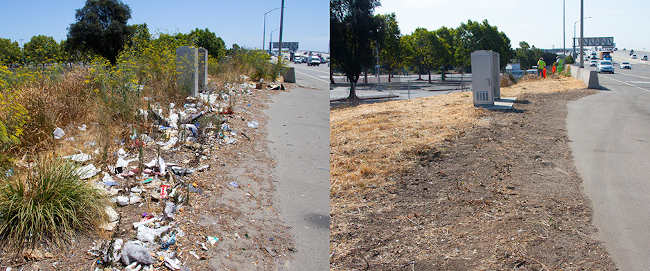
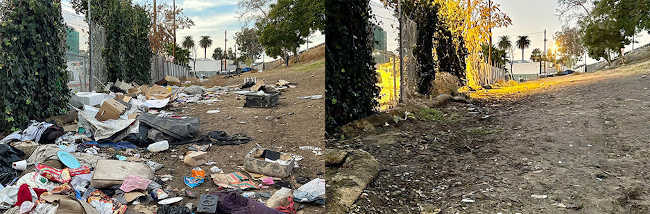
Gov. Gavin Newsom’s Clean California initiative hit a major milestone of removing one million cubic yards of litter from the state’s roadsides since the program’s inception less than 15 months ago.
That’s more than 16,700 tons of litter — enough to build two stacks of trash from the Earth’s surface to beyond the International Space Station, 250 miles in orbit.
“California is the most beautiful place in the world, and we need to do more to keep our communities clean and safe,” said Gov. Newsom. “With an investment of over $1 billion, Clean California projects are cleaning up our neighborhoods and enriching our public spaces by removing litter and debris from our roadsides throughout our state.”
Clean California is a sweeping $1.1 billion, multiyear clean-up effort led by Caltrans to remove trash, create thousands of jobs, and engage communities to transform public spaces.
Since Clean California launched in July 2021, Caltrans has removed 300 percent more litter from the state highway system compared to 2020 and hired 759 new team members, including maintenance workers who collect litter and remove graffiti.
“Removing 1 million cubic yards of trash from our roadways is a very big step toward fulfilling Governor Newsom’s vision for Clean California. I salute the many communities joining this effort to make our state cleaner, safer and more beautiful,” said Caltrans Director Tony Tavares.
Along with roadside cleanup efforts, Caltrans has held 180 free Dump Day events statewide to allow Californians to safely dispose of bulk items, collecting more than 18,000 tires and 5,000 mattresses.
Clean California also offers a $250 monthly volunteer incentive stipend through the Adopt-A-Highway program, increasing highway adoptions by nearly 1,000. These highway adopters have collected 3,000 cubic yards of trash during the past 15 months.
Clean California grants have funded 231 projects to revitalize and beautify underserved communities, some of which are already complete and now sources of community pride. The recently enacted state budget includes $100 million to fund another round of Clean California local grant projects.
For more information on how to transform your community and become a part of Clean California, visit CleanCA.com.
The City of Clearlake Animal Association also is seeking fosters for the animals waiting to be adopted.
Call the Clearlake Animal Control shelter at 707-273-9440, or email
Visit Clearlake Animal Control on Facebook or on the city’s website.
The following dogs are available for adoption. New additions are at the top.

‘Mikey’
“Mikey” is a male German shepherd mix with a short brown and tan coat.
He has been neutered.
He is dog No. 51012855.

‘Andy’
“Andy” is a male American pit bull mix with a short gray and white coat.
He is dog No. 48995415.

‘Babs’
“Babs” is a female Labrador retriever mix with a short black coat.
She has been spayed.
She is dog No. 49505856.

‘Bear’
“Bear” is a male Labrador retriever-American pit bull mix with a short charcoal and fawn coat.
He has been neutered.
He is dog No. 48443153.

‘Big Phil’
“Big Phil” is a 13-year-old male American pit bull terrier mix with a blue coat.
He has been neutered.
He is dog No. 49951647.

‘Buster’
“Buster” is a male pit bull mix with a short tan coat.
He has been neutered.
He is dog No. 50762164.

‘Foxie’
“Foxie” is a female German shepherd with a red, black and white coat.
She has been spayed.
She is dog No. 49702845.

‘Hakuna’
“Hakuna” is a male shepherd mix with a tan coat.
He has been neutered.
He is dog No. 50176912.

‘Hondo’
“Hondo” is a male Alaskan husky mix with a buff coat.
He has been neutered.
He’s dog No. 50227693.

‘Keilani’
“Keilani” is a 3-year-old female German shepherd mix with a black and tan coat.
She has been spayed and she is house trained.
She is dog No. 50427566.

‘Luciano’
“Luciano” is a male Siberian husky mix with a short black and white coat.
He has been neutered.
He is dog No. 50596272.

‘Mamba’
“Mamba” is a male Siberian husky mix with a gray and cream-colored coat.
He has been neutered.
He is dog No. 49520569.

‘Matata’
“Matata” is male shepherd mix with a tan coat.
He has been neutered.
He is dog No. 50176912.

‘Sadie’
“Sadie” is a female German shepherd mix with a black and tan coat.
She has been spayed.
She is dog No. 49802563.

‘Snowball’
“Snowball is a 1 and a half year old male American Staffordshire terrier mix with a short white coat.
He has been neutered.
He is dog No. 49159168.

‘Teddy’
“Teddy” is a male retriever mix with a cream-colored coat.
He has been neutered.
He is dog No. 49583194.

‘Terry’
“Terry” is a handsome male shepherd mix with a short brindle coat.
He gets along with other dogs, including small ones, and enjoys toys. He also likes water, playing fetch and keep away.
Staff said he is now getting some training to help him build confidence.
He is dog No. 48443693.

‘Willie’
“Willie” is a male German shepherd mix with a black and tan coat.
He has been neutered.
He is dog No. 50596003.
Email Elizabeth Larson at
The surviving spouse has important estate administration duties at the death of the first spouse to die (i.e., “the deceased spouse”). These sometimes go neglected until the surviving spouse dies. The surviving spouse needs to examine how the deceased spouse’s assets are titled.
Real properties may be held by a husband and wife as tenants in common, as joint tenancy assets, as community property, as community property with right of survivorship, or as trustee(s) if the asset is held in trust.
Assets held as tenants in common, or by the deceased spouse in his or her name alone, are subject to the deceased spouse’s will or, if no will exists, the laws of intestacy.
Furthermore, during life California law generally presumes that all assets acquired by married people while married and domiciled in California are community property (section 760 Family Code).
This general presumption is rebuttable by a preponderance of the evidence. The presumption applies during the couple’s lifetime and, specifically in divorce or creditor proceedings involving either spouse, but, importantly, does not apply at death at which time the form of title controls (In re Brace (2020) 9 C5th 903).
If the deceased spouse died without a will then the deceased spouse’s separate property goes by intestacy to the deceased spouse’s surviving spouse and children, if relevant. Any community property goes entirely to the surviving spouse by intestacy.
Assets that belong to the deceased spouse individually and require a court order for a surviving spouse to inherit title are still not required to pass through probate. That is true whether or not such assets pass under a will or by intestacy. A so-called spousal property petition can be used to retitle assets from the deceased spouse into the surviving spouse’s name alone.
Other assets may transfer either by right of survivorship or by trust administration. Assets held in trust require private trust administration. Trust administration, however, is not self-executing and has similarities with a court probate administration. Unfortunately, the administration of a joint husband and wife trust often goes ignored by the surviving spouse.
Some married couples have joint trusts that requires the deceased spouse’s share of the trust assets to be transferred into an irrevocable by-pass trust (i.e., a so-called “A-B” Trust) — where the deceased spouse’s assets are held and administered until the death of the surviving spouse — then failing to divide the joint trust at the deceased spouse’s death means bigger problems later on when the surviving spouse dies.
Assets where the surviving spouse while alive could have filed a spousal property petition to remove the deceased spouse from title will require a probate of the surviving spouse’s estate. Only a personal representative of the surviving spouse’s probate can file a spousal property petition to transfer assets from the deceased spouse to the surviving spouse’s estate.
After the surviving spouse has settled the deceased spouse’s estate, the surviving spouse can then more completely update his or her own estate planning. This is work that usually cannot fully be accomplished until the deceased spouse’s name is removed from title to assets.
The foregoing discussion is not legal advice. Consult an attorney if facing these legal issues.
Dennis A. Fordham, attorney, is a State Bar-Certified Specialist in estate planning, probate and trust law. His office is at 870 S. Main St., Lakeport, Calif. He can be reached at
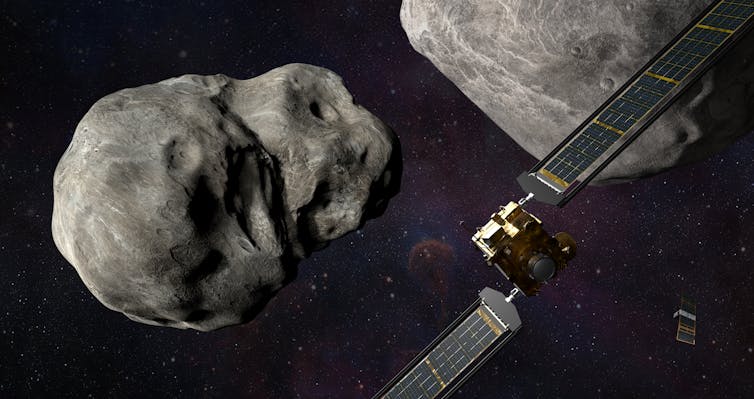
On Sept. 26, 2022, NASA plans to change an asteroid’s orbit.
The large binary asteroid Didymos and its moonlet Dimorphos currently pose no threat to Earth. But by crashing a 1,340-pound (610-kilogram) probe into Didymos’ moon at a speed of approximately 14,000 mph (22,500 kph), NASA is going to complete the world’s first full-scale planetary defense mission as a proof of concept. This mission is called the Double Asteroid Redirection Test, or DART.
I am a scholar who studies space and international security, and it is my job to ask what the likelihood really is of an object crashing into the planet – and whether governments are spending enough money to prevent such an event.
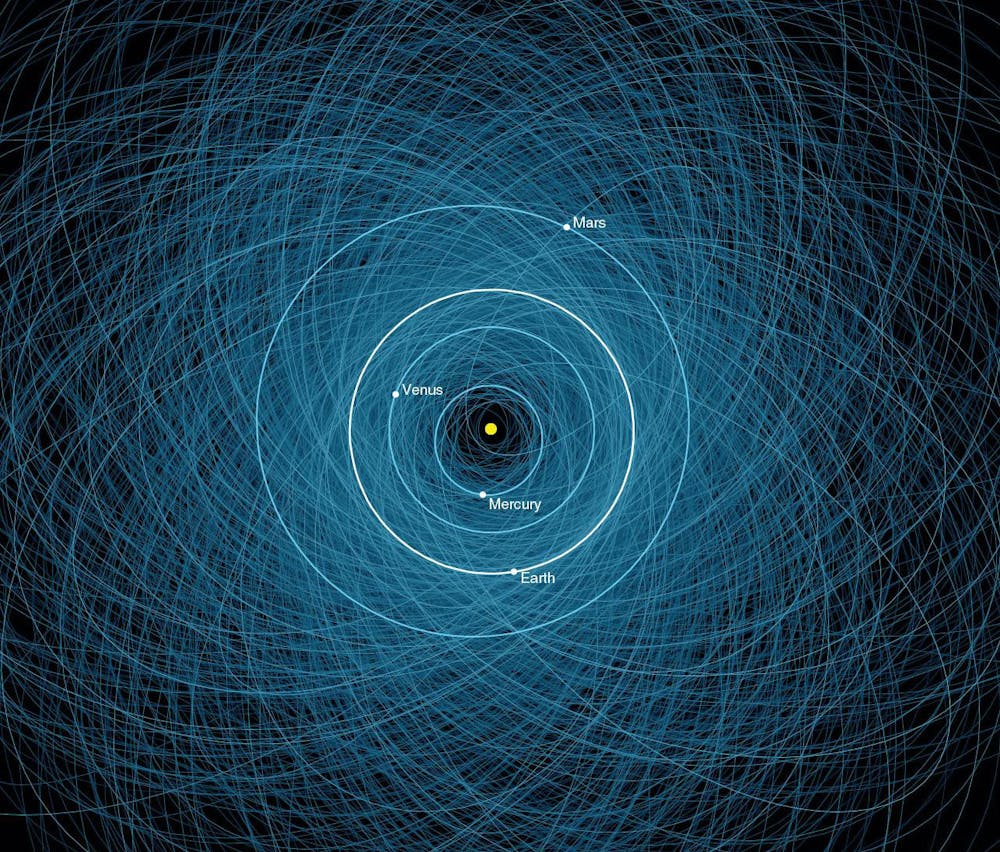
To find the answers to these questions, one has to know what near-Earth objects are out there. To date, NASA has tracked only an estimated 40% of the bigger ones. Surprise asteroids have visited Earth in the past and will undoubtedly do so in the future. Experiments like the DART mission may help prepare humanity for such an event.
The threat from asteroids and comets
Millions of cosmic bodies, like asteroids and comets, orbit the Sun and often crash into the Earth. Most of these are too small to pose a threat, but some can be cause for concern. Near-Earth objects include asteroids and comets whose orbits will bring them within 120 million miles (193 million kilometers) of the Sun.
Astronomers consider a near-Earth object a threat if it will come within 4.6 million miles (7.4 million kilometers) of the planet and if it is at least 460 feet (140 meters) in diameter. If a celestial body of this size crashed into Earth, it could destroy an entire city and cause extreme regional devastation. Larger objects – 0.6 miles (1 kilometer) or more – could have global effects and even cause mass extinctions.
The most famous and destructive celestial impact took place 65 million years ago when an asteroid with a 6-mile (10-kilometer) diameter crashed into what is now the Yucatán Peninsula. It wiped out most plant and animal species on Earth, including the dinosaurs.
But smaller objects can also cause significant damage. In 1908, an approximately 164-foot (50-meter) celestial body exploded over the Podkamennaya Tunguska River in Siberia. It leveled more than 80 million trees over 830 square miles (2,100 square kilometers). In 2013, an asteroid only 65 feet (20 meters) across burst in the atmosphere 20 miles (32 kilometers) above Chelyabinsk, Russia. It released the equivalent of 30 Hiroshima bombs’ worth of energy, injured over 1,100 people and caused US$33 million in damage.
The likely next asteroid of substantial size to potentially hit Earth is asteroid 2005 ED224. When the 164-foot (50-meter) asteroid passes by on March 11, 2023, there is roughly a 1 in 500,000 chance of impact.
Watching the skies
While the chances of a larger cosmic body striking Earth are small, the devastation would be enormous.
Congress recognized this threat, and in the 1998 Spaceguard Survey, it tasked NASA to find and track 90% of the estimated total of near-Earth objects 0.6 miles (1 kilometer) across or bigger within 10 years. NASA surpassed the 90% goal in 2011.
In 2005, Congress passed another bill requiring NASA to expand its search and track at least 90% of all near-Earth objects 460 feet (140 meters) or larger by the end of 2020. That year has come and gone and, mostly because of a lack of financial resources, only 40% of those objects have been mapped.
As of Sept. 18, 2022, astronomers have located 29,724 near-Earth asteroids, of which 10,189 are 460 feet (140 meters) or larger in diameter and 855 are at least 0.6 miles (1 kilometer) across. About 30 new objects are added each week.
A new mission funded by Congress in 2018 is scheduled in 2026 to launch an infrared space-based telescope – NEO Surveyor – dedicated to searching for potentially dangerous asteroids.
Cosmic surprises
We can prevent a disaster only if we know it is coming, and asteroids have sneaked up on Earth before.
A so-called “city-killer” asteroid the size of a football field passed less than 45,000 miles (72,420 kilometers) from Earth in 2019. An asteroid the size of a 747 jet came close in 2021, as did an asteroid 0.6 miles (1 kilometer) wide in 2012. Each of these was discovered only about a day before it passed Earth.
Research suggests that Earth’s rotation creates a blind spot, hiding some asteroids from detection or making them appear stationary. This may be a problem, as some surprise asteroids do not miss us. In 2008, astronomers spotted a small asteroid only 19 hours before it crashed into rural Sudan.
The recent discovery of an asteroid 1.2 miles (2 kilometers) in diameter suggests that there are still big objects lurking.


What can be done?
To protect the planet from cosmic dangers, early detection is key. At the 2021 Planetary Defense Conference, scientists recommended a minimum of five to 10 years’ preparation time to mount a successful defense against hazardous asteroids.
If astronomers find a dangerous object, there are four ways to mitigate a disaster. The first involves regional first-aid and evacuation measures. A second approach would involve sending a spacecraft to fly near a small- or medium-sized asteroid; the gravity of the craft would slowly change the object’s orbit. To change a bigger asteroid’s path, we can either crash something into it at high speed or detonate a nuclear warhead nearby.
The DART mission will be the first-ever attempt to deflect a large asteroid. But this will not be the first time humanity has sent something to an asteroid. NASA’s Deep Space Impact mission crashed a probe into the comet 9P/Tempel in 2005 to take scientific measurements of the comet, and in 2018 Japan’s Hayabusa2 mission collected samples from the asteroid Ryugu and brought them back to Earth, but neither of these was designed as a planetary defense test.
The DART mission should generate a lot of useful information. This data will come from a camera aboard the DART spacecraft that will send images back to Earth up until the time of impact. In addition, a tiny satellite called LICIACube that was deployed from DART on Sept. 11, 2022, will take photos of the impact. A follow-up mission from the European Space Agency, called Hera, will launch in 2024 and rendezvous with Didymos in 2026 to begin collecting data.
Spending on planetary defense
In 2021, NASA’s planetary defense budget was $158 million, just 0.7% of NASA’s total budget and 0.02% of the roughly $700 billion U.S. defense budget.
Is this the right amount to invest in monitoring the skies, given the fact that some 60% of all potentially dangerous asteroids remain undetected? This is an important question to ask when one considers the potential consequences.
Investing in planetary defense is akin to buying homeowners insurance. The likelihood of experiencing an event that destroys your house is small, yet people buy insurance nonetheless.
If even a single object larger than 460 feet (140 meters) hits the planet, the devastation and loss of life would be extreme. A bigger impact could quite literally wipe out most species on Earth. Even if no such body is expected to hit Earth in the next 100 years, the chance is not zero. In this low-likelihood-versus-high-consequences scenario, investing in protecting the planet from dangerous cosmic objects may give humanity some peace of mind and could prevent a catastrophe.
This is an updated version of a story originally published on March 1, 2022.
Svetla Ben-Itzhak, Assistant Professor of Space and International Relations, Air University
This article is republished from The Conversation under a Creative Commons license. Read the original article.
On Thursday, Gov. Gavin Newsom announced the grants, which are part of the $490 million Access California Preschool, Transitional Kindergarten and Full-Day Kindergarten Facilities Grant Program.
“California is committed to increasing opportunity and equity for every student across the state, regardless of their Zip code or background,” said Gov. Newsom. “We’ve made major strides over the years to expand services to support young children and their families and provide access to free, high-quality, inclusive prekindergarten education for all children. This funding is critical for school districts to construct the facilities necessary to support the expanded learning time.”
The program, administered by the Department of General Services Office of Public School Construction, provides funding to school districts that lack the facilities to provide full-day programs for preschool, transitional kindergarten and full-day kindergarten.
Forty-seven projects for 44 school districts — including Lucerne Elementary, the only Lake County District — were initially funded in the 2019-20 fiscal year to create 147 new Title V compliant classrooms.
In that first round, the State Allocation Board at its October 2019 meeting apportioned $1,683,516 for Lucerne Elementary.
Due to its successful implementation, the program was expanded to include preschool and transitional kindergarten facilities.
At its meeting on Wednesday, the State Allocation Board awarded approximately $33.7 million for 11 projects within 11 school districts statewide.
The projects are located within Lake, Kern, Kings, Merced, Monterey and Tulare counties.
In this latest round, Lucerne Elementary received $2,018,191, according to the meeting documents.
The state matching funds for program projects are distributed to local school districts to help finance new school construction projects or the retrofit of existing classrooms, the Department of General Services reported.
State officials said funding priority is given to school districts that lack financial resources to provide a local match and/or are located in an underserved community.
Lucerne Elementary Superintendent Megan Grant said the early education grant is for the construction of two new transitional kindergarten classrooms.
“We are excited to continue to expand our school capacity with brand-new classrooms,” Grant said.
The Office of Public School Construction will distribute the funds to eligible school districts in two phases.
The first phase provides funding to assist school districts in the design of the project, and the second phase provides funding to assist in the construction of the project.
Additional funding is expected to be allocated at the State Allocation Board’s October meeting.
Email Elizabeth Larson at
In a letter to superintendents and charter school administrators, CDPH Director and State Public Health Officer Tomás J. Aragón warned that “rainbow fentanyl” is a potentially fatal drug found in pills and powders in a variety of bright colors, shapes and sizes that could attract young people.
“Rainbow fentanyl can be found in many forms, including pills, powder, and blocks that can resemble sidewalk chalk or candy,” said Dr. Aragón. “Any pill, regardless of its color, shape, or size, that does not come from a health care provider or pharmacist can contain fentanyl and can be deadly."
In its letter, CDPH points to a recent warning from the United States Drug Enforcement Agency that notes the highly addictive and potentially deadly “rainbow fentanyl” has been found in at least 18 states.
Anyone who encounters fentanyl in any form should not handle it and should call 911 immediately.
Recognizing the signs of opioid overdose can save a life. Here are some things to look for:
• Small, constricted “pinpoint pupils.”
• Falling asleep or losing consciousness.
• Slow, weak, or no breathing.
• Choking or gurgling sounds.
• Limp body.
• Cold and/or clammy skin.
• Discolored skin (especially in lips and nails).
It may be hard to tell if a person is high or experiencing an overdose. If you aren’t sure, treat it like an overdose. Here are the steps that could save a life:
• Call 911 immediately.
• Administer naloxone, if available.
• Try to keep the person awake and breathing.
• Lay the person on their side to prevent choking.
• Stay with the person until emergency help arrives.
Get more facts about Fentanyl from the Centers for Disease Control and Prevention.
Some California schools have created naloxone policies in response to increases in opioid overdoses among youth. Naloxone is a life-saving medication used to reverse an opioid overdose.
CDPH encourages schools that are interested in developing these policies and receiving free naloxone to review relevant regulations and apply for a Statewide Standing Order for Naloxone.
The California Department of Health Care Services Naloxone Distribution Project offers free naloxone to qualified organizations, including schools and universities.
Visit the CDPH Overdose Prevention Initiative site for more information, including resources for adult role models and educators.