 How to resolve AdBlock issue?
News

More than 44% of teens reported persistent feelings of sadness and hopelessness in the first half of 2021, according to a report from the Centers for Disease Control and Prevention. The early 2022 report, which was based on an online survey, also found that nearly 20% had seriously considered suicide, and 9% attempted suicide.
The COVID-19 pandemic is a likely contributor to these startling figures, but rates of teen mental illness have been rising over the past decade.
One crucial factor that has received little attention in supporting teen mental health is the role that parents can play.
This is surprising, since research has clearly established that participation by a caregiver in their child’s mental health treatment is directly related to a successful outcome. A key reason for this is that parents generally interact with their teen on a daily basis and can model and cultivate coping skills.
Yet, for mental health professionals, it can be challenging to integrate parents into teens’ treatment when there are discrepancies between the perspectives, goals and expectations of teens and parents. In addition, consent and privacy laws sometimes limit providers’ abilities to disclose key details about a teen’s mental health to parents.
As researchers studying childhood trauma and adolescent development, we see parents and caregivers as a critical link in addressing the urgent mental health crisis among teens.
The teenage years can be brutal
Parents often dread the teenage years, anticipating mood swings, risk-taking behaviors and endless arguments. Some of this is developmentally normal: Teens are developing their identities, testing limits and asserting their autonomy. These combined factors can lead to hostility and a lower-quality parent-teen relationship.
Physically, teens are sleep-deprived, in part due to overly early school start times and hormonal changes associated with puberty. As a result, teens can be irritable and sensitive to stressors. They also haven’t developed the self-control to manage their reactions.
And it’s important to note that half of all mental illness emerges by age 14 and 75% by age 24, making adolescence a highly sensitive period for the prevention and treatment of mental health problems.
Signs and symptoms of a mental health concern
Mental health problems in teens can sometimes take unexpected forms. Depression and anxiety can manifest as irritability and noncompliance, which parents may reasonably view as disrespect and laziness. Understanding what is beneath those behaviors is challenging. Teens are quite secretive, so they may not disclose the extent of their struggles.
Traumatic experiences like bullying, dating violence and sexual harassment and assault are unfortunately too common in adolescence and can cause drastic changes in behavior and affect.
Although anxiety is a normal emotional response at any age, about a third of adolescents have some type of anxiety disorder, and about 10% experience severe impairment as a result. Teens struggling with chronic anxiety may experience agitation or irritability, issues with sleep, perfectionist tendencies, or may try to avoid stressful things altogether.
Among teens, 17% struggle with depression. Depression generally involves a loss of interest or pleasure in daily activities, but it is more than feeling blue. For teens, symptoms of depression may look like withdrawing from family or social activities, shutting down during conversations or conflict, lethargy, difficulty concentrating, hopelessness about the future or negative feelings of self-worth.
Depression can also be associated with self-harm and suicide.
In determining whether a teen is experiencing a mental illness, parents should consider how behaviors are affecting their teens’ everyday lives and plans for the future. Those who are falling behind in school, damaging important relationships or engaging in high-risk behaviors may be most likely to be experiencing a mental health issue – as opposed to typical teenage challenges.
A shortage of mental health care
Despite the growing need for mental health care, the U.S. has a dire shortage of professionals to meet the demand. Insurance companies create barriers to accessing mental health care by restricting the numbers of in-network providers and approved sessions. As a result, many providers prioritize patients who will pay out of pocket.
Parents and teens may wait months for an appointment, and the quality and effectiveness of the services they receive are highly variable. All the while, symptoms may worsen, straining the family and compromising teens’ social and academic opportunities.
The powerful role parents can play
This is where parents come in, since they can serve as role models for teens’ coping and emotional development.
While good sleep, consistent exercise and quality meals can often be the first line of defense in preventing and managing symptoms of mental health problems, there are several behavioral strategies for parenting struggling teens. Indeed, foster parents care for children with complex histories of trauma, and many of the behavior management strategies taught to foster parents may be useful for traditional family settings as well.
When teens are unkind or disrespectful, parents may take it personally. But parents who are aware of and able to manage their own triggers can react calmly to challenging behavior, creating opportunities for effective communication with their teen.
Building and maintaining the parent-teen connection, such as by watching a TV show together or other low-pressure opportunities to be together, is key. These experiences create safe spaces and opportunities for teens to communicate about difficult emotions or situations. Parents who assist teens in recognizing, talking about and dealing with difficult thoughts and feelings help them to understand how their thoughts and feelings can affect their behavior.
Parents can also help their teens manage negative emotions by reinforcing their self-esteem and strengths and encouraging self-efficacy. Parents who offer praise to their teens who are working hard to overcome challenges – as opposed to focusing solely on the outcome – can help teens see their worth beyond their accomplishments.
At the same time, teens require boundaries that allow them to build self-reliance, exercise independence and practice compromise in certain situations. Behavior contracts – in which teens and their parents agree to certain conditions in writing – can provide a structured way to establish shared expectations.
When consequences are necessary, natural consequences allow teens to learn without parental intervention. For example, if a teen stays up late the night before a big softball game, their coach may bench them for playing poorly. Parents can help teens to connect the frustration and disappointment they experience to their choices regarding sleep, which can be more helpful for their future decision-making than getting into an argument with a parent about their decision or receiving a parent-imposed consequence, such as removing phone privileges.
When natural consequences are not an option, discipline should be specific, time-limited and focused on a specific outcome, such as not allowing preferred activities until homework and chores are complete.
It is also important that parents avoid power struggles with their teens by modeling respectful communication without trying to manage the teen’s reaction or perspective. Teens are unlikely to admit to being wrong – particularly in a heated moment – and if the point is made, there is rarely a benefit to insisting upon a particular reaction such as a forced apology.
Parents can best support their teens by maintaining connection alongside enforcing structure and discipline. While challenging behaviors can be the status quo of adolescence, parents should be on the lookout for signs that might reflect a pervasive mental health issue, since early detection and treatment is crucial.
Toria Herd, Postdoctoral Researcher in Psychology, Penn State and Sarah A. Font, Associate Professor of Sociology and Public Policy, Penn State
This article is republished from The Conversation under a Creative Commons license. Read the original article.
Call Lake County Animal Care and Control at 707-263-0278 or visit the shelter online for information on visiting or adopting.
The following cats at the shelter have been cleared for adoption.

‘Sampson’
“Sampson” is a male domestic shorthair with a black coat.
He is in cat room kennel No. 77, ID No. LCAC-A-4317.

Male domestic shorthair
This 3-year-old male domestic shorthair cat has an orange tabby coat.
“This guy can be shy at first, but once he knows that you are all about the pets, he will roll right over and start his purr machine. He has a unique curly tail which he flicks around when curious,” shelter staff said.
He is in cat room kennel No. 13, ID No. LCAC-A-4021.

Male domestic shorthair
This 8-year-old male domestic shorthair cat has an orange tabby coat.
He is in cat room kennel No. 47, ID No. LCAC-A-4319.
Email Elizabeth Larson at
“Residents have been very receptive to learn more on how to be ready in the event of wildfire,” said KFSC Community Education and Outreach Committee Chair Cathy Sylar.
KFSC volunteers have visited an estimated 150 residents in the Westwind Mobile Home Park, Walnut Cove Mobile Home Park, and surrounding neighborhoods.
Additionally, KFSC board members were present at the Ely Stage Stop’s Fiddler Jam on Nov. 6 to engage community members and distribute educational materials.
Educational materials handed out to Konocti area residents included Zonehaven magnets, sign up information for wildfire notifications from both Lake County Alerts and Watch Duty, and how to prepare emergency go bags.
Konocti Fire Safe Council considers getting this information out especially critical to residents along the Soda Bay corridor, as they share a single road in and out should an evacuation occur.
The Konocti Fire Safe Council was recently formed to unite residents in the Konocti area and address the challenges of living in a location that is highly vulnerable to wildfire. This includes fire risk reduction and hazardous vegetation mitigation, defensible space, home hardening and evacuation preparedness.
The geographic coverage of the Konocti Fire Safe Council encompasses seven designated Zonehaven evacuation zones that include Gaddy Lane, along Soda Road to the intersection of Kit’s Corner & Hwy 29, Point Lakeview Road and State Highway 281.
The zones are KEL-E103, KEL-E109, KEL-E117, KEL-E120, KEL-E122, KEL-E134, KEL-E146 and KEL-E152.
The KFSC represents such communities as Soda Bay, Kelseyville Riviera, Riviera Estates, Lakeview Estates, Konocti Shores, Riviera West, Buckingham, Riviera Heights and numerous mobile home parks, private homes, and businesses along the Soda Bay Road corridor.
If you would like the KFSC Outreach Committee to visit your neighborhood or would like to request additional information about the Konocti Fire Safe Council, please contact Cindy Jassar at 707-279-2245 or email
Dogs available for adoption this week include mixes of border collie, Catahoula leopard puppy, Doberman pinscher, German shepherd, husky, Labrador retriever, pit bull, shepherd and wirehaired terrier.
Dogs that are adopted from Lake County Animal Care and Control are either neutered or spayed, microchipped and, if old enough, given a rabies shot and county license before being released to their new owner. License fees do not apply to residents of the cities of Lakeport or Clearlake.
The following dogs at the Lake County Animal Care and Control shelter have been cleared for adoption.
Call Lake County Animal Care and Control at 707-263-0278 or visit the shelter online for information on visiting or adopting.

‘Chico’
“Chico” is a 5-year-old male bull terrier with a short white coat and black markings.
He is in kennel No. 6, ID No. LCAC-A-4314.

Male German shepherd
This 1-year-old male German shepherd has a short black and tan coat.
He is in kennel No. 8, ID No. LCAC-A-4310.

Male Labrador retriever
This 1.5 year old male Labrador retriever has a short black coat.
He is in kennel No. 10, ID No. LCAC-A-4273.

Female husky
This 2-year-old female husky has a short brown coat with white markings.
She is in kennel No. 11, ID No. LCAC-A-4269.

Male Catahoula leopard puppy
This 2-month-old male Catahoula leopard puppy has a red, tan and white coat.
He is in kennel No. 12a, ID No. LCAC-A-4263.

Female Catahoula leopard puppy
This 2-month-old female Catahoula leopard puppy has a red, tan and white coat.
She is in kennel No. 12c, ID No. LCAC-A-4261.

Female Labrador retriever
This 3-month-old female Labrador retriever has a short black coat.
She is in kennel No. 13, ID No. LCAC-A-4162.

Male Labrador retriever
This 2-year-old male Labrador retriever has a short black coat.
He is in kennel No. 14, ID No. LCAC-A-4112.

Male Doberman pinscher
This 1-year-old male Doberman pinscher has a short brown coat.
He is in kennel No. 15, ID No. LCAC-A-4313.

Female border collie mix
This 4-year-old female border collie mix has a short tricolor coat.
She is in kennel No. 18, ID No. LCAC-A-4285.

Female pit bull puppy
This 2-month-old female pit bull puppy has a short white and red coat.
She is in kennel No. 23c, ID No. LCAC-A-4120.

‘Faith’
“Faith” is a 10-year-old female wirehaired terrier with a short black and tan coat.
She is in kennel No. 26, ID No. LCAC-A-4280.
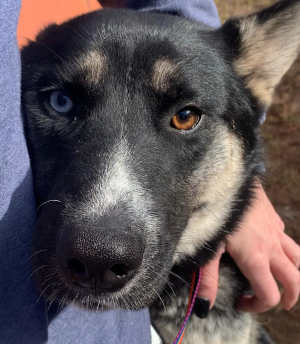
Female husky
This 2-year-old female husky has a short tricolor coat and one blue and one brown eye.
She is in kennel No. 27, ID No. LCAC-A-4257.

Female German shepherd
This 10-month-old female German Shepherd has a short light-colored coat.
She is in kennel No. 28, ID No. LCAC-A-4297.

Female Doberman pinscher
This 1-year-old female Doberman pinscher has a short black and tan coat.
She is in kennel No. 29, ID No. LCAC-A-4279.
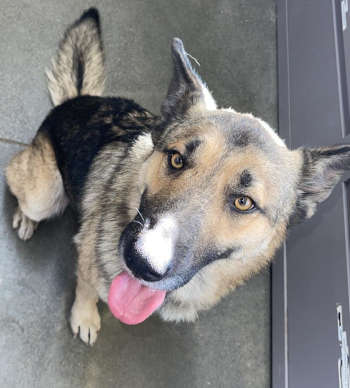
Male shepherd
This 3-year-old male shepherd has a short black and tan coat.
He is in kennel No. 31, ID No. LCAC-A-4312.

Female pit bull
This 1-year-old female pit bull has a short tan coat.
She is in kennel No. 32, ID No. LCAC-A-4283.

Male shepherd mix
This 2-year-old male shepherd has a red and white coat.
He is in kennel No. 34, ID No. LCAC-A-4337.
Email Elizabeth Larson at
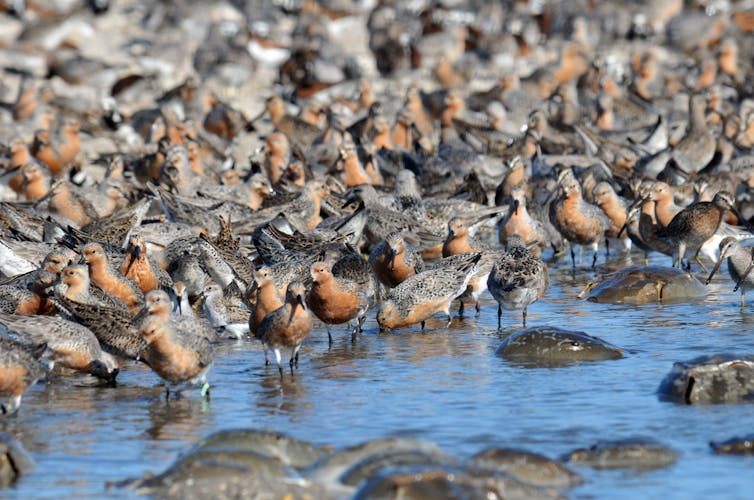
A biodiversity crisis is reducing the variety of life on Earth. Under pressure from land and water pollution, development, overhunting, poaching, climate change and species invasions, approximately 1 million plant and animal species are at risk of extinction.
One ambitious proposal for stemming these losses is the international initiative known as 30x30: conserving and protecting at least 30% of Earth’s surface, on land and at sea, by 2030.
Currently, 112 countries support this initiative, including the United States. More nations may announce their support at the international biodiversity conference that opens Dec. 7, 2022, in Montreal.
Scientists say that protecting 30% of Earth’s surface will help species and ecosystems recover from the stresses that are depleting them. It also will conserve valuable services that nature provides to humans, such as buffering coasts from storms and filtering drinking water. Protecting forests and grasslands can help slow climate change by promoting carbon storage in soil and plants.
As researchers in ecology, conservation and global sustainability, we study biodiversity around the world, from giant pandas deep in the forests of China to sea lions along the shorelines of New Zealand. Saving a wide variety of living things requires striking a balance between the needs of nature and people, and a global, holistic perspective. We believe a metacoupling approach, which looks at human-nature interactions within and across different areas, can help achieve the 30x30 goal.
What is a protected area?
Since 30x30 focuses on protecting space for wild nature, many people assume it means setting swaths of land or ocean aside and keeping people out of them. But that’s not always true.
As of mid-2021, 16.64% of the world’s land and 7.74% of its oceans were in protected areas. The International Union for the Conservation of Nature, a partnership of governments and civil society groups that tracks the health of the natural world, classifies protected areas in six categories:
- Strict nature reserve or wilderness area
- National park
- Natural monument or feature
- Habitat or species management area
- Protected landscape or seascape
- Protected area with sustainable use of natural resources
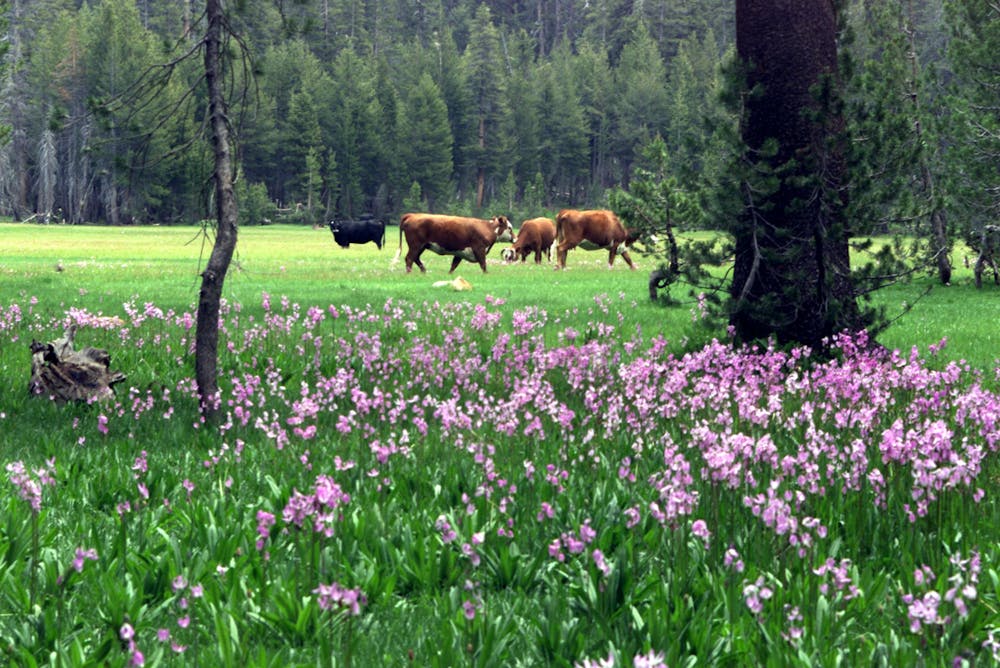
Many countries’ 30x30 conservation pledges are likely to include areas such as forests and grasslands that are open for recreation, logging, livestock grazing and other uses.
Few intact ecosystems remain
Scientists agree that protected areas need to include a large variety of species, ecosystems and habitats that the 30x30 initiative aims to conserve. There are many ways to choose and prioritize new areas for protection. Criteria can include the species, habitats and ecosystems that an area contains; its connections to other protected areas; how large and intact an area is; and the benefits it provides to people who live in, near and far from it.
Some scientists contend that the top priorities should be places that are still ecologically intact and virtually untouched by humans. But only about 3% of the Earth’s land and oceans are still in this state. And even wilderness areas can’t escape the effects of climate change caused by human activities elsewhere.
Over 58% of our planet’s land and 41% of its oceans are already under moderate to intense human pressure. This means that most newly protected areas will effectively be works in progress, with restoration projects to help species recover, improve habitat quality and make ecosystems healthier.
Another 40% of land and 10% of oceans have experienced relatively low impacts from human activities. Terrestrial ecosystems with the lowest human footprints include tundra, boreal forests and deserts. At the other extreme, tropical, subtropical and temperate forests are at the highest risk.
In the oceans, areas with the lowest human pressures are near the poles or in polar regions. Coral ecosystems, which are home to 25% of all marine life, are under the most pressure.
It isn’t always possible to protect large areas. Some scientists argue that small areas can still successfully protect species, but others disagree. In our view, what ultimately matters is how multiple protected areas are connected and how close they are to each other.
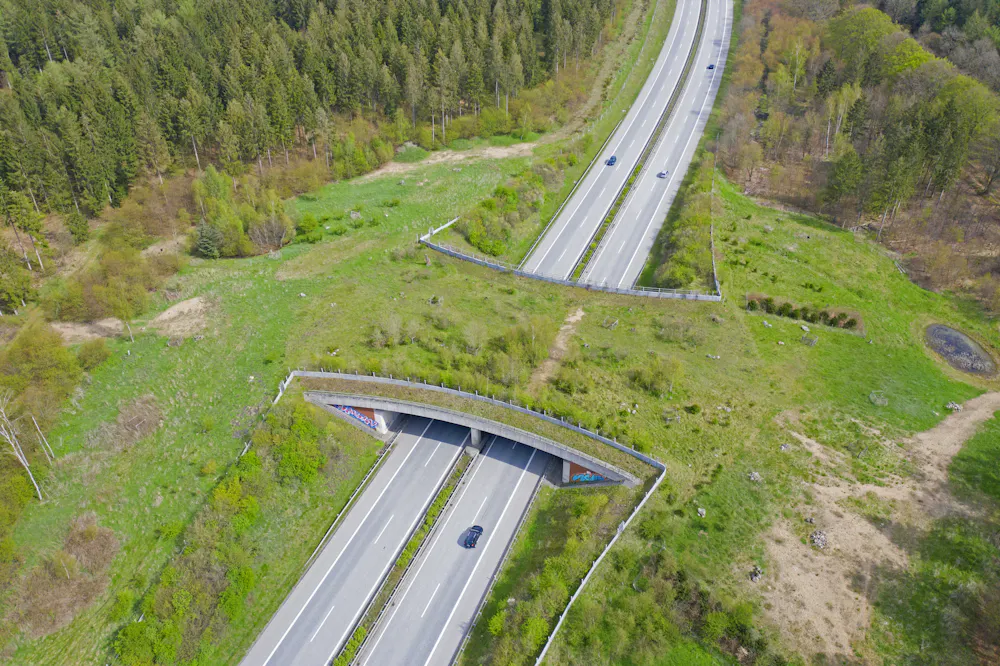
Connections can develop naturally, like the flyways that migrating birds use to travel between continents. Or they can be structures built by humans, such as wildlife bridges over highways. Connecting protected areas is important because it promotes genetic diversity and makes it possible for species to move in response to climate change and other threats.
The metacoupling approach
Given all these factors, selecting protected areas can get complicated. Based on our research, we think that a holistic approach can make 30x30 feasible and effective. It has three parts.
First, protected areas should meet both conservation needs and human needs. Second, in creating newly protected areas, researchers and managers should consider how they will interact with adjacent areas. Third, researchers and officials should assess how newly protected areas will interact with areas far away – including in other countries.
This approach is guided by the metacoupling framework, which is an integrated way to study and manage human-nature interactions within and between different places. It recognizes that human and natural systems in a given place can be affected for better or worse by people, policies and markets both nearby and far away.
At Wolong Nature Reserve in southwestern China, one of us, Jack Liu, has worked with Chinese collaborators to understand and manage human-nature interactions in ways that support the recovery of a global wildlife icon – giant pandas. Wolong, which is now part of China’s Giant Panda National Park, was one of the first and largest panda reserves in China, and also houses numerous other rare animals and plants. It is also home to almost 6,000 people.

Forest is an important part of panda habitat, but over time the human population in Wolong grew and needed more resources, such as wood for cooking and heating or to make goods for visiting tourists. In a 2001 study, our team showed that panda habitat in Wolong declined faster after the reserve was established in 1975 than it had before that time. Increasing demand for wood was degrading and fragmenting the forest and negatively affected panda population numbers.
To reverse this trend, our team worked with the Chinese government to provide more financial support to the local community in the early 2000s. This increased household incomes and reduced the need to harvest wood.
Taking a broad geographic view of the pandas’ situation helped to produce a positive outcome. Recognizing that panda habitat was being affected not just by human-nature interactions inside Wolong but also by interactions between Wolong and adjacent and distant places showed that conservation subsidies from the faraway central government in Beijing could improve protection for Wolong forests.
In 2016 the International Union for Conservation of Nature downlisted and reclassified giant pandas from endangered to vulnerable. Today there are an estimated 1,800 giant pandas in the wild, thanks partly to government subsidies that helped strike a balance between humans’ needs and those of pandas.
All protected areas are influenced by human actions both nearby and far away. We believe that creating and managing protected areas using a holistic metacoupling approach will make it easier to achieve the 30x30 goal and make sound decisions that sustain nature and human well-being around the world.
Veronica Frans, PhD Student in Fisheries & Wildlife and Ecology, Evolutionary Biology & Behavior, Michigan State University and Jianguo "Jack" Liu, Rachel Carson Chair in Sustainability, Michigan State University
This article is republished from The Conversation under a Creative Commons license. Read the original article.
BERKELEY, Calif. — The James Webb Space Telescope has turned its infrared cameras on Saturn’s moon Titan, giving astronomers another eye on the largest and one of the most unusual moons in the solar system.
The only satellite with a dense atmosphere, it’s also the only world besides Earth that has standing bodies of liquid on its surface, including rivers, lakes and seas — though the liquid is thought to be methane, ethane and other hydrocarbons that are toxic to humans.
The new observations, combined with those from Earth-bound telescopes, will help astronomers understand the weather patterns on Titan in advance of a NASA mission to the moon, called Dragonfly, that is scheduled for launch in 2027.
A multirotor lander, Dragonfly will assess the habitability of Titan's unique environment, investigate the moon’s unusual chemical stew, and search for signatures of water-based or hydrocarbon-based life.
Astronomers have observed Titan for decades, since before the Voyager encounter in 1980. Over approximately the past 25 years, they focused powerful ground-based and orbital telescopes on the satellite, complementing observations by NASA’s Cassini mission to Saturn, which observed Titan between 2004 and 2017.
University of California, Berkeley, astronomer Imke de Pater led many Titan observations using high-resolution adaptive optics on the Keck Telescopes in Hawai’i.
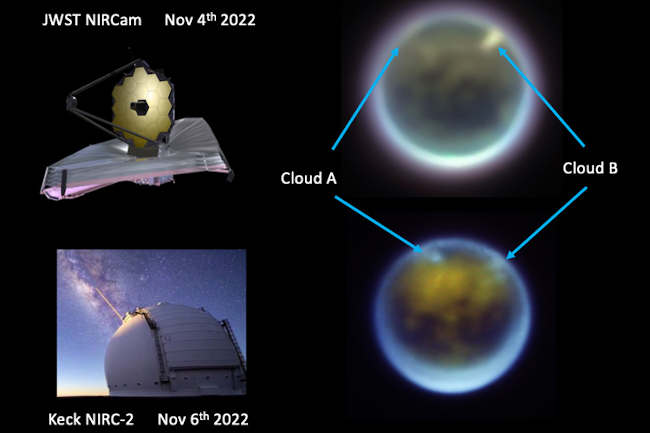
After the James Webb Space Telescope, or JWST, imaged Titan on Nov. 4, the telescope’s Titan team saw what looked like two clouds in the atmosphere.
Titan team lead Conor Nixon quickly emailed de Pater and Katherine de Kleer — a UC Berkeley Ph.D. who is now an assistant professor of planetary science and astronomy at the California Institute of Technology — to help confirm the clouds and track their movement with the Keck Telescope.
A series of Keck images taken about 30 and 54 hours later showed similar clouds — likely the same ones — but slightly displaced because of the moon’s rotation relative to Earth.
“We were concerned that the clouds would be gone when we looked at Titan one and two days later with Keck, but to our delight there were clouds at the same positions, looking like they might have changed in shape,” said de Pater, a UC Berkeley Professor of the Graduate School.
The power of JWST
Though the quality of the JWST and Keck images may look about the same to the untrained eye, de Pater noted that JWST has instruments that can measure aspects of Titan’s atmosphere that Keck cannot, complementing one another. In particular, JWST’s infrared spectroscopic capability allows it to pinpoint the altitudes of clouds and hazes with much better accuracy.
“By using spectrometers on JWST together with the optical image quality with Keck, we get a really complete picture of Titan,” she said, such as the heights of clouds, the atmosphere’s optical thickness, and the elevation of haze in the atmosphere.
In particular, at wavelengths where Earth’s atmosphere is opaque — that is, Titan cannot be seen from any Earth-based telescope — JWST can observe and provide information on the lower atmosphere and surface.
In early September, and again earlier this week, de Pater and de Kleer participated in an international observing campaign to catch the occultation by Titan of a distant star.
Organized by Eliot Young, a senior program manager at the Southwest Research Institute in Boulder, Colorado, the occultation offered an opportunity to probe Titan’s atmospheric structure in more detail using the Keck Telescope and the Very Large Telescope in Chile.
These observations are coordinated with occultations observed from other large telescopes and Doppler wind retrievals on Titan from the Atacama Large Millimeter Array, a radio telescope in Chile.
In conjunction with recent wind modeling results, these observations contribute to a broader understanding of atmospheres on Earth, on planets around other stars, and on our neighboring planets and moons in the solar system.
“This is some of the most exciting data we have seen of Titan since the end of the Cassini-Huygens mission in 2017, and some of the best we will get before NASA’s Dragonfly arrives in 2032,” said Zibi Turtle of Johns Hopkins University, who is Dragonfly’s principal investigator. “The analysis should really help us to learn a lot about Titan’s atmosphere and meteorology.”
Robert Sanders writes for the UC Berkeley News Center.