 How to resolve AdBlock issue?
News

Editor’s note: Kelseyville Unified has offered clarification on the tournament history, which is included in this updated version of the story.
KELSEYVILLE, Calif. — On Dec. 15 to 17, Kelseyville High School celebrates a 50-year basketball tradition as it hosts the 2022 Stokes Tournament.
Visiting schools for the boys’ competition include Ukiah, Middletown and Potter Valley. Visiting schools for the girls’ competition include Upper Lake, Lower Lake and Ferndale.
Games begin on Thursday at 3:30 p.m. right after school in the Kelseyville High School gym where students are expected to fill the stands.
Friday games also begin at 3:30 p.m., and Saturday championship games start at 2:30 p.m.
The annual Stokes Tournament began in 1970 when F. Russel Stokes, owner of Stokes Ladders, offered to sponsor the event.
Although it started as a postseason tournament of champions, within a few years it became a postseason invitational tournament that drew teams from all over the state, mostly from Northern California schools.
Not only did the event promote great competition, it provided generations of basketball players with wonderful memories.
Historically, basketball players from out of the area would stay with local families during the tournament. Visiting players would attend school with their Kelseyville hosts and then compete when their teams hit the court.
After the tournament, visiting players and Kelseyville students danced the night away to celebrate the end of another successful competition.
Mountain Vista Middle School Principal Scott Conrad has a long history with the tournament, having been a player, a coach, the Kelseyville High athletic director, and the tournament director.
He acknowledged that if you do the math, this is not exactly the 50th anniversary but said, “We’re celebrating this year because COVID messed everything up.”
Conrad believes the Stokes Tournament is a great example of how people in Kelseyville come together to create wonderful experiences for kids.
The Stokes Tournament was named after F. Russell Stokes after he tragically died in a car accident on December 7, 1977. He was the president of the Kelseyville Unified School District Board at the time and a strong advocate for school sports and vocational programs, now called career and technical education.
As a tribute to him, the district renamed the tournament after him. His wife, Janice, continued to fund the tournament after his passing, then the Hook family purchased the ladder company and continued the tradition of sponsoring the tournament.
In 2012, when the Panella family took over at Stokes Ladders, they too continued the tradition.
Greg Panella is the grandson of Russell and Janice Stokes, and his wife, Allison, is currently the vice president of the Kelseyville Unified School District Board.
With tournament funding in place, others rushed in to manage the logistics. Coaches and school administrators invited teams and coordinated round robin schedules.
Conrad said that retired Kelseyville High Principal Matt Cockerton “kept the tournament going for most of its existence.”
During much of that time, art teacher Debbie Ingalls (now retired) hand-drew the tournament brackets and created such beautiful designs on the pennants that high schools left them hanging in their gyms for decades.
During the mid-to-late 1980s, while Jerry Hook managed Stokes Ladders, his brother, Ken, coached at Clear Lake High, so Clear Lake High and Kelseyville High co-sponsored the tournament. This is when Lake County Record-Bee reporter, Brian Sumpter, started covering the tournament, bringing the action to life for those who missed it (or those who wanted to relive it).
The games were announced by longtime Mountain Vista Middle School principal and Kelseyville High golf team coach, John Berry (now retired), and former Kelseyville High English teacher, track coach, and athletic director, Rico Abordo.
“When I was in the Chico area going to college and doing my student teaching, I ran into guys who had played in tournaments in the early 1970s. Their experience stuck with them. It’s always been a first-class event — great memories, great competition,” Conrad said.
Kelseyville Unified School District Superintendent Dave McQueen thanked the staff, volunteers, and community members who have made — and who continue to make — this tournament possible.
“This is what we do in Kelseyville. It’s all about the kids,” McQueen said.
TOURNAMENT SCHEDULE
First team listed is the home team (and will wear white jerseys.
Thursday, Dec. 15
3:30 p.m.: Upper Lake versus Lower Lake (Girls)
5 p.m.: Ukiah versus Middletown (Boys)
6:30 p.m.: Kelseyville versus Ferndale (Girls)
8 p.m.: Kelseyville versus Pacific Union (Boys)
Friday, Dec. 16
3:30 p.m.: Ukiah versus Potter Valley (Boys)
5 p.m.: Ferndale versus Upper Lake (Girls)
6:30 p.m.: Kelseyville versus Middletown (Boys)
8 p.m.: Kelseyville vs Lower Lake (Girls)
Saturday, Dec. 17
2 p.m.: Lower Lake versus Ferndale (Girls)
3:30 p.m.: Middletown versus Potter Valley (Boys)
5 p.m.: Three-point competition
6 p.m.: Kelseyville versus Upper Lake (Girls)
7:30 p.m.: Kelseyville versus Ukiah (Boys)
MIDDLETOWN, Calif. — The Middletown Area Town Hall this week will get updates from the county Community Development Department and take final board nominations.
MATH will meet at 7 p.m. Thursday, Dec. 8, in the Middletown Community Meeting Room/Library at 21256 Washington St., Middletown. The meeting is open to the public.
To join the meeting via Zoom click on this link; the meeting ID is 659 964 1209. Call in at 669-900-6833.
In a discussion timed for 7:05 a.m., MATH on Thursday will host guest speaker Mireya Turner, director of the Lake County Community Development Department, and Andrew Amelung, Community Development’s Cannabis Program manager.
Turner and Amelung will speak about department changes, cannabis, Middletown area projects, cell tower regulations, new state fire safe regulations and the area plan. There also will be time for questions.
Also on Thursday, at 8 p.m. the group will accept final nominations for the 2023 board and discuss Zoom.
At 8:15 p.m. they will discuss a cell tower.
The MATH Board includes Chair Monica Rosenthal, Vice Chair Ken Gonzalez, Secretary Todd Fiora, Rosemary Córdova and Bill Waite.
MATH — established by resolution of the Lake County Board of Supervisors on Dec. 12, 2006 — is a municipal advisory council serving the residents of Anderson Springs, Cobb, Coyote Valley (including Hidden Valley Lake), Long Valley and Middletown.
For more information emailThis email address is being protected from spambots. You need JavaScript enabled to view it. .
Email Elizabeth Larson atThis email address is being protected from spambots. You need JavaScript enabled to view it. . Follow her on Twitter, @ERLarson, or Lake County News, @LakeCoNews.
MATH will meet at 7 p.m. Thursday, Dec. 8, in the Middletown Community Meeting Room/Library at 21256 Washington St., Middletown. The meeting is open to the public.
To join the meeting via Zoom click on this link; the meeting ID is 659 964 1209. Call in at 669-900-6833.
In a discussion timed for 7:05 a.m., MATH on Thursday will host guest speaker Mireya Turner, director of the Lake County Community Development Department, and Andrew Amelung, Community Development’s Cannabis Program manager.
Turner and Amelung will speak about department changes, cannabis, Middletown area projects, cell tower regulations, new state fire safe regulations and the area plan. There also will be time for questions.
Also on Thursday, at 8 p.m. the group will accept final nominations for the 2023 board and discuss Zoom.
At 8:15 p.m. they will discuss a cell tower.
The MATH Board includes Chair Monica Rosenthal, Vice Chair Ken Gonzalez, Secretary Todd Fiora, Rosemary Córdova and Bill Waite.
MATH — established by resolution of the Lake County Board of Supervisors on Dec. 12, 2006 — is a municipal advisory council serving the residents of Anderson Springs, Cobb, Coyote Valley (including Hidden Valley Lake), Long Valley and Middletown.
For more information email
Email Elizabeth Larson at
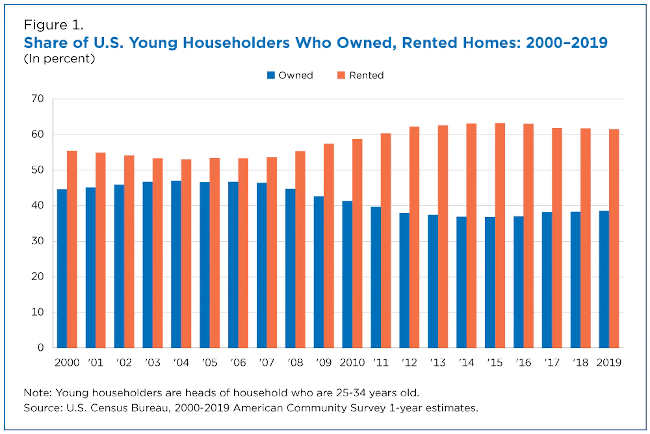
Before the 2007-2009 Great Recession, homeownership among households headed by adults ages 25 to 34 spiked as risky lending practices greatly expanded access to mortgage credit. Soon after, the nation experienced a housing market crash and economic downturn.
Since then, lending options tightened and home prices soared. This limited young householders’ ability to own a home, driving down ownership rates which had yet to return to pre-recession levels by 2019.
Homeownership among households headed by adults ages 25 to 34 was highest from 2003 to 2007. Rates for those years, just prior to the Great Recession, ranged from 46.4% to 47.0%, according to data from the 2000-2019 American Community Survey, or ACS, one-year estimates.
By 2010, right after the recession ended, homeownership among young heads of household had declined to 41.3% and continued to decline to 36.8% in 2015.
The impact on the housing market of the COVID-19 pandemic, which began in 2020, is not captured in this dataset.
What changed?
Following the Great Recession, the financial landscape and opportunities for young adults to become homeowners shifted.
Stricter lending practices and credit standards made it difficult for young adults without a stable employment history and financial resources to buy a home.
At the same time, especially in the latter half of the most recent decade, home prices rose substantially, creating another barrier to homeownership for young buyers.
Young adults at the time were also delaying major life events such as forming their own households and getting married, typical precursors to homeownership.
Homeownership before and after the Great Recession
Homeownership among young householders peaked in the years prior to the 2007-2009 Great Recession (Figure 1) but plunged almost 10.0 percentage points from 2007 to 2015.
The lowest rates of homeownership among young householders occurred between 2014 and 2016. They saw a slight increase after that, but not to their high pre-recession levels.
Education and homeownership
Higher levels of educational attainment are typically associated with greater economic stability, employment and full-time work, and lower levels with lower incomes and greater economic hardship.
The economic effects of higher educational attainment also tend to protect individuals during economic downturns.
According to ACS data, homeownership rates among young householders differed by educational attainment. This is largely because higher education usually results in higher earnings critical for obtaining home loans and purchasing first homes.
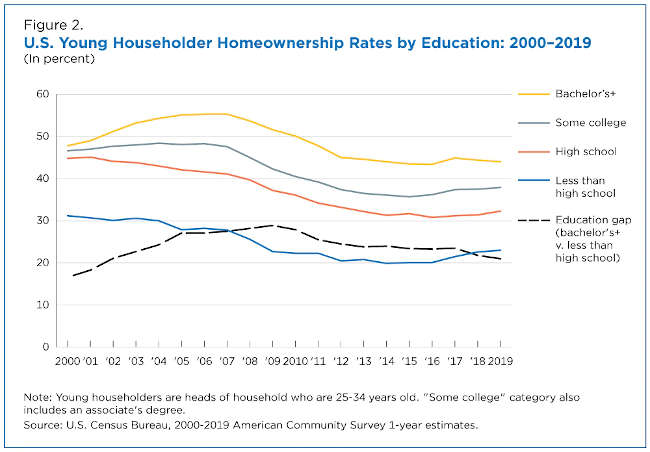
We reviewed estimates of homeownership rates between 2000 and 2019 among young householders by four education categories: less than a high school degree; high school degree but no college; some college or an associate degree; and a bachelor’s degree or higher (Figure 2).
In 2000, homeownership rates were most similar among householders with a bachelor’s degree or higher (47.8%), some college (46.6%), and a high school degree (44.8%). But the rate for householders with less than a high school education was approximately one-third lower than the other educational categories (31.2%).
Homeownership rates have been stratified by educational attainment throughout the first decade of the 21st century.
The rates for householders with a bachelor’s degree or at least some college peaked just before the Great Recession.
Rates for householders with at least a bachelor’s degree were highest (between 54.3% and 55.3%) from 2004 to 2007, and for householders with some college (between 46.6% and 48.3%) from 2000 to 2006. Meanwhile, rates for householders with a high school degree or less declined through the first decade of the 21st century.
Post-recession homeownership rates were lower than pre-recession rates for all education groups, but there were significant differences between education groups.
The decline in homeownership halted between:
• 2012 and 2016 for householders with less than a high school education (19.9% to 20.8%).
• 2016 and 2018 for those with a high school degree (30.8% to 31.4%).
• 2013 and 2016 for those with some college (35.7% to 36.5%).
• 2015 and 2016 for those with a bachelor’s degree or higher (43.4% to 43.5%).
In 2019, young householders with a bachelor’s degree or higher had the highest homeownership rate (44.0%), followed by those with some college (37.9%), a high school degree (32.3%), and less than high school (23.0%).
Homeownership rates decreased for all education levels among young householders after the recession and were still below pre-recession level highs in 2019.
The education gap in homeownership – the difference between householders with less than a high school education and those with a bachelor’s degree or higher – still existed but narrowed after the recession.
The education gap in young household homeownership was 16.6 percentage points in 2000. It increased before and during the recession, plateauing at 28.9 percentage points in 2009. It declined to 21.0 percentage points in 2019.
Rise in diversity
The nation’s young population has become increasingly diverse during the past two decades. Both younger and non-White households have historically had lower homeownership rates than older and White households.
One might expect higher education to reduce differences in homeownership by race and Hispanic origin. However, there are substantial differences even among this most highly educated group.
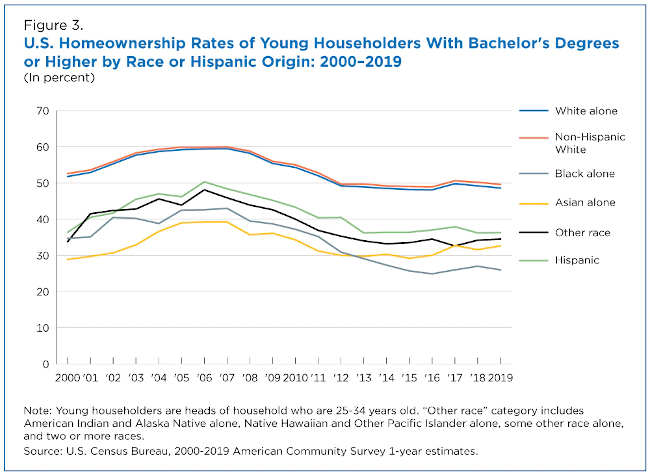
For example, highly educated young Black householders experienced the greatest post-recession declines in homeownership, while young and highly educated Asian householders experienced the smallest declines (Figure 3).
In 2000, over half of young householders with a bachelor’s degree or higher identifying as White alone (51.8%) or non-Hispanic White (52.6%) owned homes.
In contrast, just over a third of similarly educated Hispanic (36.4%) and Black alone young householders (34.7%) owned homes. Young householders with a bachelor’s degree or higher identifying as Asian alone – who experienced the smallest declines after the recession – had the lowest rates of homeownership (28.9%).
Young household homeownership rates among the more educated peaked just before or in the early days of the Great Recession for each race category and Hispanic origin.
Peak rates of homeownership for non-Hispanic White and White alone young householders with a bachelor’s degree or higher were 59.3% to 60.0% and 57.7%-59.5%, respectively, followed by young Hispanic householders (50.3%), Other race (48.1%), Black alone (42.5%-43.0%), and Asian alone (39.0%-39.2%).
In 2019, only Hispanic homeownership rates had returned to their 2000 rates among more educated young householders, and no analyzed racial category had returned to the elevated homeownership rates experienced just before the recession. Less than half of young householders with a bachelor’s degree or higher identifying as White alone (48.6%) or non-Hispanic White (49.6%) owned homes.
In contrast, roughly one-third of similarly educated Hispanic (36.3%) and Asian alone young householders (32.6%) owned homes. Young householders with a bachelor’s degree or higher identifying as Black alone – who experienced the largest declines after the recession – had the lowest rates of homeownership (26.0%).
As the nation moves through this decade and experiences its economic challenges, we will continue to analyze the effects of educational attainment and diversity on homeownership among young householders.
Erik L. Hernandez and Christopher Mazur are survey statisticians in the Census Bureau’s Social, Economic, and Housing Statistics Division.
SACRAMENTO — Following unexplained gas price hikes that led to record profits for Big Oil, Gov. Gavin Newsom and state Sen. Nancy Skinner (D-Berkeley) on Monday unveiled a proposed price gouging penalty on oil companies’ excess profits to deter excessive price increases and keep money in Californians’ pockets.
The language of the proposed price gouging penalty can be read below.
“California’s price gouging penalty is simple — either Big Oil reins in the profits and prices, or they’ll pay a penalty,” said Gov. Newsom. “Big Oil has been lying and gouging Californians to line their own pockets long enough. I look forward to the work ahead with our partners in the Legislature to get this done.”
“Putting the governor’s proposal in print allows the Legislature and the public to begin discussions on this important issue. No one can deny that California’s gas prices were outrageously high compared to other states. And those high prices hurt California consumers and businesses,” said Skinner.
The proposal introduced Monday by Sen. Skinner comes as the California Legislature is assembling in a special session called by the governor to pass a price gouging penalty.
The Legislature will also consider efforts to empower state agencies to more closely review gas costs, profits and pricing as well provide the state with greater regulatory oversight of the refining, distribution and retailing segments of the gasoline market in California.
The proposal would discourage oil refiners from fleecing Californians by making it unlawful to charge excessive profits — excessive refiner margins would be punishable by a civil penalty from the California Energy Commission, or CEC.
The amount of the maximum margin and the amount of the penalty will be determined through the legislative process.
Any penalties collected by the penalty will go to a Price Gouging Penalty Fund and then given back to Californians.
The proposal also improves transparency and oversight of the oil industry by the state, expanding the CEC and the California Department of Tax and Fee Administration’s ability to investigate and obtain information on costs, profits and pricing so that the state can better address the causes of pricing irregularities and minimize the likelihood of future supply or price shocks.
According to a recent poll from Consumer Watchdog, 60% of California voters support a price-gouging penalty.
In the third quarter of 2022, from July to September, oil companies reported record high profits:
• Phillips 66 profits jumped to $5.4 billion, a 1243% increase over last year’s $402 million;
• BP posted $8.2 billion in profits, its second-highest on record, with $2.5 billion going toward share buybacks that benefit Wall Street investors;
• Marathon Petroleum profits rose to $4.48 billion, a 545% increase over last year’s $694 million;
Valero’s $2.82 billion in profits that were 500% higher than the year before;
• PBF Energy’s $1.06 billion that was 1700% higher than the year before;
• Shell reported a $9.45 billion haul that sent $4 billion to shareholders for stock buybacks;
• Exxon reported their highest-ever $19.7 billion in profits;
• Chevron reported $11.2 billion in profits, their second-highest quarterly profit ever.
The language of the proposed price gouging penalty can be read below.
“California’s price gouging penalty is simple — either Big Oil reins in the profits and prices, or they’ll pay a penalty,” said Gov. Newsom. “Big Oil has been lying and gouging Californians to line their own pockets long enough. I look forward to the work ahead with our partners in the Legislature to get this done.”
“Putting the governor’s proposal in print allows the Legislature and the public to begin discussions on this important issue. No one can deny that California’s gas prices were outrageously high compared to other states. And those high prices hurt California consumers and businesses,” said Skinner.
The proposal introduced Monday by Sen. Skinner comes as the California Legislature is assembling in a special session called by the governor to pass a price gouging penalty.
The Legislature will also consider efforts to empower state agencies to more closely review gas costs, profits and pricing as well provide the state with greater regulatory oversight of the refining, distribution and retailing segments of the gasoline market in California.
The proposal would discourage oil refiners from fleecing Californians by making it unlawful to charge excessive profits — excessive refiner margins would be punishable by a civil penalty from the California Energy Commission, or CEC.
The amount of the maximum margin and the amount of the penalty will be determined through the legislative process.
Any penalties collected by the penalty will go to a Price Gouging Penalty Fund and then given back to Californians.
The proposal also improves transparency and oversight of the oil industry by the state, expanding the CEC and the California Department of Tax and Fee Administration’s ability to investigate and obtain information on costs, profits and pricing so that the state can better address the causes of pricing irregularities and minimize the likelihood of future supply or price shocks.
According to a recent poll from Consumer Watchdog, 60% of California voters support a price-gouging penalty.
In the third quarter of 2022, from July to September, oil companies reported record high profits:
• Phillips 66 profits jumped to $5.4 billion, a 1243% increase over last year’s $402 million;
• BP posted $8.2 billion in profits, its second-highest on record, with $2.5 billion going toward share buybacks that benefit Wall Street investors;
• Marathon Petroleum profits rose to $4.48 billion, a 545% increase over last year’s $694 million;
Valero’s $2.82 billion in profits that were 500% higher than the year before;
• PBF Energy’s $1.06 billion that was 1700% higher than the year before;
• Shell reported a $9.45 billion haul that sent $4 billion to shareholders for stock buybacks;
• Exxon reported their highest-ever $19.7 billion in profits;
• Chevron reported $11.2 billion in profits, their second-highest quarterly profit ever.
Price Gouging Penalty Proposal Language by LakeCoNews on Scribd
LAKE COUNTY, Calif. — The Board of Supervisors this week will consider how to proceed with appointing a sheriff-coroner now that the current sheriff has announced his retirement.
The board will meet beginning at 9 a.m. Tuesday, Dec. 6, in the board chambers on the first floor of the Lake County Courthouse, 255 N. Forbes St., Lakeport.
The meeting can be watched live on Channel 8, online at https://countyoflake.legistar.com/Calendar.aspx and on the county’s Facebook page. Accompanying board documents, the agenda and archived board meeting videos also are available at that link.
To participate in real-time, join the Zoom meeting by clicking this link.
The meeting ID is 984 2104 8682, pass code 206625. The meeting also can be accessed via one tap mobile at +16694449171,,98421048682#,,,,*206625#.
All interested members of the public that do not have internet access or a Mediacom cable subscription are encouraged to call 669-900-6833, and enter the Zoom meeting ID and pass code information above.
To submit a written comment on any agenda item visit https://countyoflake.legistar.com/Calendar.aspx and click on the eComment feature linked to the meeting date. If a comment is submitted after the meeting begins, it may not be read during the meeting but will become a part of the record.
In an untimed item, the board will review and consider the process to appoint a permanent sheriff-coroner to serve until Jan. 2, 2025.
Sheriff Brian Martin announced in October that he planned to retire on Dec. 30.
A memo to the board from Martin and County Administrative Officer Susan Parker explains that California Government Code Section 24105 says that the highest-ranking officer may temporarily discharge the duties of sheriff-coroner, “until the vacancy is filled in the manner provided by law.”
Martin has identified Captain Christopher D. Chwialkowski as the highest ranking and senior deputy next in line of authority based on his promotion date to the rank of captain at the Sheriff’s Office as of April 2015.
“Captain Chwialkowski will temporarily discharge the duties of the office of Sheriff-Coroner beginning on December 31, 2022 and continue until the Board of Supervisors has interviewed candidates and formally appointed a permanent Sheriff-Coroner to serve until January 2, 2025,” the memo said.
Additionally, it’s being recommended to the supervisors that, in order to provide a smooth transition, they immediately notice the Lake County Sheriff-Coroner vacancy as a promotional opportunity, open for five days, and schedule public candidate interviews for the permanent sheriff-coroner, to serve through Jan. 2, 2025.
The Board of Supervisors will then conduct the interviews on Dec. 20.
In other business, at 10:30 a.m., the agriculture department will present the 2021 Lake County Annual Crop Report.
In another timed item, at 1 p.m., the board will get the Lake County Health Services bimonthly update.
The board also will consider adding Juneteenth as a county paid holiday.
The full agenda follows.
CONSENT AGENDA
5.1: Appoint Jenavive Herrington as interim auditor-controller/county clerk for the period from Dec. 14, 2022, to Jan. 2, 2023.
5.2: Appoint Patrick Sullivan as interim treasurer-tax collector for the period from Dec. 31, 2022, to Jan. 2, 2023.
5.3: Adopt resolution amending Resolution No. 2022-129 to provide a temporary loan from Non Departmental Revenue Fund 001 Budget Unit 1120 to CDBG PI Capital Projects Fund 936 Budget Unit 1796, to provide a temporary loan from Non Departmental Revenue Fund 001 Budget Unit 1120 to CDBG PI Business RLF Fund 091 Budget Unit 1891.
5.4: Adopt resolution amending Resolution No. 2022-118 adopting the Final Recommended Budget for Fiscal Year 2022-2023 to move revenues and appropriations associated with four CDBG grants for Small Business Loans from Fund 936 Budget Unit 1796 CDBG Capital Projects to Fund 091 Budget Unit 1891 CDBG PI Business RLF.
5.5: Approve Amendment No. 2 to the agreement between county of Lake and Hilltop Recovery Services for Substance Use Disorder ASAM Levels 1.0, 2.1, 3.1, intensive outpatient and outpatient drug free treatment services for fiscal year 2022-23 in the amount of $386,150.00 and authorize the board chair to sign.
5.6: Approve Board of Supervisors minutes for Nov. 8, 2022, and Nov. 15, 2022.
5.7: Appoint Health Programs Coordinator Kim Tangermann to serve on the Partnership Health Plan Board of Commissioners and represent Lake County for a period of four years.
5.8: Adopt resolution establishing an extra help English as a Second Language Program Coordinator for the Library Budget Unit 6011.
5.9: Authorize IT Director to issue a purchase order to SAITECH in the amount of $40,480 for 20 Cisco Catalyst 9200L switches.
5.10: Approve contract between county of Lake and Public Consulting Group Inc. for the California Outcome and Accountability Program in the amount of $249,360, for the term of Oct. 1, 2022, to July 31, 2027, and authorize the chair to sign.
5.11: Approve contract between county of Lake and Tennyson Center for Children for the Families Together Neighbors Program in the amount of $32,500 for the term of April 1, 2022, to June 30, 2025, and authorize the chair to sign.
5.12: Approve contract between county of Lake and North Coast Opportunities Inc. for stage one child care services, for the term of July 1, 2022, to June 30, 2025, in the amount of $90,000 per fiscal year, and authorize the chair to sign.
5.13: Approve contract between county of Lake and Mendocino Private Industry Council Inc. for the CalWORKs Expanded Subsidized Employment Program, in the amount of $240,000 for the term of Sept. 1, 2022, to June 30, 2025, and authorize the chair to sign.
TIMED ITEMS
6.3, 10:15 a.m.: Hearing on account and proposed assessment for 10849 E. Highway 20, Clearlake Oaks.
6.4, 10:30 a.m.: Presentation of the 2021 Lake County Annual Crop Report.
6.5, 11:30 a.m.: a) Presentation of the current status and next steps for the Big Valley Groundwater Sustainability Plan; and b) consideration and approval of resolution authorizing the board of directors of the Lake County Watershed Protection District acting as the Big Valley Groundwater Sustainability Agency to file a grant application for the implementation of the Big Valley Groundwater Sustainability Plan and authorize the chair of the board of directors to sign.
6.6, 1 p.m.: Lake County Health Services bimonthly update.
UNTIMED ITEMS
7.2: Review and consideration of adding Juneteenth as a county paid holiday.
7.3: Review and consider process to appoint permanent sheriff-coroner to serve until Jan. 2, 2025.
7.4: Consideration of the following Advisory Board Appointment: Geothermal Advisory Committee.
CLOSED SESSION
8.1: Public employee evaluation: Health Services Director Jonathan Portney.
8.2: Conference with legal counsel: Existing litigation pursuant to Gov. Code section 54956.9 (d)(1) — Citizens for Environmental Protection and Responsible Planning, et al. v. County of Lake, et al.
8.3: Conference with legal counsel: Existing litigation pursuant to Gov. Code section 54956.9 (d)(1) — Flesch v. County of Lake, et al.
8.4: Conference with legal counsel: Significant exposure to litigation pursuant to Gov. Code section 54956.9(d)(2), (e)(1) — One potential case.
Email Elizabeth Larson atThis email address is being protected from spambots. You need JavaScript enabled to view it. . Follow her on Twitter, @ERLarson, or Lake County News, @LakeCoNews.
The board will meet beginning at 9 a.m. Tuesday, Dec. 6, in the board chambers on the first floor of the Lake County Courthouse, 255 N. Forbes St., Lakeport.
The meeting can be watched live on Channel 8, online at https://countyoflake.legistar.com/Calendar.aspx and on the county’s Facebook page. Accompanying board documents, the agenda and archived board meeting videos also are available at that link.
To participate in real-time, join the Zoom meeting by clicking this link.
The meeting ID is 984 2104 8682, pass code 206625. The meeting also can be accessed via one tap mobile at +16694449171,,98421048682#,,,,*206625#.
All interested members of the public that do not have internet access or a Mediacom cable subscription are encouraged to call 669-900-6833, and enter the Zoom meeting ID and pass code information above.
To submit a written comment on any agenda item visit https://countyoflake.legistar.com/Calendar.aspx and click on the eComment feature linked to the meeting date. If a comment is submitted after the meeting begins, it may not be read during the meeting but will become a part of the record.
In an untimed item, the board will review and consider the process to appoint a permanent sheriff-coroner to serve until Jan. 2, 2025.
Sheriff Brian Martin announced in October that he planned to retire on Dec. 30.
A memo to the board from Martin and County Administrative Officer Susan Parker explains that California Government Code Section 24105 says that the highest-ranking officer may temporarily discharge the duties of sheriff-coroner, “until the vacancy is filled in the manner provided by law.”
Martin has identified Captain Christopher D. Chwialkowski as the highest ranking and senior deputy next in line of authority based on his promotion date to the rank of captain at the Sheriff’s Office as of April 2015.
“Captain Chwialkowski will temporarily discharge the duties of the office of Sheriff-Coroner beginning on December 31, 2022 and continue until the Board of Supervisors has interviewed candidates and formally appointed a permanent Sheriff-Coroner to serve until January 2, 2025,” the memo said.
Additionally, it’s being recommended to the supervisors that, in order to provide a smooth transition, they immediately notice the Lake County Sheriff-Coroner vacancy as a promotional opportunity, open for five days, and schedule public candidate interviews for the permanent sheriff-coroner, to serve through Jan. 2, 2025.
The Board of Supervisors will then conduct the interviews on Dec. 20.
In other business, at 10:30 a.m., the agriculture department will present the 2021 Lake County Annual Crop Report.
In another timed item, at 1 p.m., the board will get the Lake County Health Services bimonthly update.
The board also will consider adding Juneteenth as a county paid holiday.
The full agenda follows.
CONSENT AGENDA
5.1: Appoint Jenavive Herrington as interim auditor-controller/county clerk for the period from Dec. 14, 2022, to Jan. 2, 2023.
5.2: Appoint Patrick Sullivan as interim treasurer-tax collector for the period from Dec. 31, 2022, to Jan. 2, 2023.
5.3: Adopt resolution amending Resolution No. 2022-129 to provide a temporary loan from Non Departmental Revenue Fund 001 Budget Unit 1120 to CDBG PI Capital Projects Fund 936 Budget Unit 1796, to provide a temporary loan from Non Departmental Revenue Fund 001 Budget Unit 1120 to CDBG PI Business RLF Fund 091 Budget Unit 1891.
5.4: Adopt resolution amending Resolution No. 2022-118 adopting the Final Recommended Budget for Fiscal Year 2022-2023 to move revenues and appropriations associated with four CDBG grants for Small Business Loans from Fund 936 Budget Unit 1796 CDBG Capital Projects to Fund 091 Budget Unit 1891 CDBG PI Business RLF.
5.5: Approve Amendment No. 2 to the agreement between county of Lake and Hilltop Recovery Services for Substance Use Disorder ASAM Levels 1.0, 2.1, 3.1, intensive outpatient and outpatient drug free treatment services for fiscal year 2022-23 in the amount of $386,150.00 and authorize the board chair to sign.
5.6: Approve Board of Supervisors minutes for Nov. 8, 2022, and Nov. 15, 2022.
5.7: Appoint Health Programs Coordinator Kim Tangermann to serve on the Partnership Health Plan Board of Commissioners and represent Lake County for a period of four years.
5.8: Adopt resolution establishing an extra help English as a Second Language Program Coordinator for the Library Budget Unit 6011.
5.9: Authorize IT Director to issue a purchase order to SAITECH in the amount of $40,480 for 20 Cisco Catalyst 9200L switches.
5.10: Approve contract between county of Lake and Public Consulting Group Inc. for the California Outcome and Accountability Program in the amount of $249,360, for the term of Oct. 1, 2022, to July 31, 2027, and authorize the chair to sign.
5.11: Approve contract between county of Lake and Tennyson Center for Children for the Families Together Neighbors Program in the amount of $32,500 for the term of April 1, 2022, to June 30, 2025, and authorize the chair to sign.
5.12: Approve contract between county of Lake and North Coast Opportunities Inc. for stage one child care services, for the term of July 1, 2022, to June 30, 2025, in the amount of $90,000 per fiscal year, and authorize the chair to sign.
5.13: Approve contract between county of Lake and Mendocino Private Industry Council Inc. for the CalWORKs Expanded Subsidized Employment Program, in the amount of $240,000 for the term of Sept. 1, 2022, to June 30, 2025, and authorize the chair to sign.
TIMED ITEMS
6.3, 10:15 a.m.: Hearing on account and proposed assessment for 10849 E. Highway 20, Clearlake Oaks.
6.4, 10:30 a.m.: Presentation of the 2021 Lake County Annual Crop Report.
6.5, 11:30 a.m.: a) Presentation of the current status and next steps for the Big Valley Groundwater Sustainability Plan; and b) consideration and approval of resolution authorizing the board of directors of the Lake County Watershed Protection District acting as the Big Valley Groundwater Sustainability Agency to file a grant application for the implementation of the Big Valley Groundwater Sustainability Plan and authorize the chair of the board of directors to sign.
6.6, 1 p.m.: Lake County Health Services bimonthly update.
UNTIMED ITEMS
7.2: Review and consideration of adding Juneteenth as a county paid holiday.
7.3: Review and consider process to appoint permanent sheriff-coroner to serve until Jan. 2, 2025.
7.4: Consideration of the following Advisory Board Appointment: Geothermal Advisory Committee.
CLOSED SESSION
8.1: Public employee evaluation: Health Services Director Jonathan Portney.
8.2: Conference with legal counsel: Existing litigation pursuant to Gov. Code section 54956.9 (d)(1) — Citizens for Environmental Protection and Responsible Planning, et al. v. County of Lake, et al.
8.3: Conference with legal counsel: Existing litigation pursuant to Gov. Code section 54956.9 (d)(1) — Flesch v. County of Lake, et al.
8.4: Conference with legal counsel: Significant exposure to litigation pursuant to Gov. Code section 54956.9(d)(2), (e)(1) — One potential case.
Email Elizabeth Larson at
LAKE COUNTY, Calif. — The Lakeport City Council is set to hold the second reading of an ordinance that will allow a developer to move forward with a new apartment complex next to Westside Community Park.
The council will meet at 5 p.m. Tuesday, Dec. 6, for a closed session performance evaluation of City Manager Kevin Ingram before the public portion of the meeting begins at 6 p.m. in the council chambers at Lakeport City Hall, 225 Park St.
The agenda can be found here.
The council chambers will be open to the public for the meeting. Masks are highly encouraged where 6-foot distancing cannot be maintained.
If you cannot attend in person, and would like to speak on an agenda item, you can access the Zoom meeting remotely at this link or join by phone by calling toll-free 669-900-9128 or 346-248-7799.
The webinar ID is 973 6820 1787, access code is 477973; the audio pin will be shown after joining the webinar. Those phoning in without using the web link will be in “listen mode” only and will not be able to participate or comment.
Comments can be submitted by email toThis email address is being protected from spambots. You need JavaScript enabled to view it. . To give the city clerk adequate time to print out comments for consideration at the meeting, please submit written comments before 3:30 p.m. on Tuesday, Dec. 6.
On Tuesday, Ingram will present to the council an ordinance amending the Lakeport zoning maps for the Parkside Residential Project, proposed by Peter Schellinger and his company, Waterstone Residential.
The council approved the first reading of the ordinance in a 3-1 vote at its Nov. 15 meeting.
If the final approval is given on Tuesday, Schellinger will be able to build a 64-unit apartment community on a section of the 15.16-acre property at 1310 Craig Ave., which is on a portion of the 96-lot Schellinger Subdivision that was approved in three phases in 2005 next to Westside Community Park.
Only a portion of the first phase was built, including 17 homes, in the Parkside Subdivision, developed by Schellinger Brothers, Peter Schellinger’s father and uncle.
Also on Tuesday, the council will consider approving a police recruitment and retention program policy as well as a budget adjustment in the amount of $300,000 and a revised position allocation summary.
Police Chief Brad Rasmussen also will ask the council to authorize Ingram to award bids to Matt Mazzei and Precision Wireless and to sign purchase orders and supporting documents for the procurement of one fully outfitted Dodge Charger Patrol Car and two fully outfitted Dodge Ram SSV Command Vehicles and associated equipment in the amount of $192,312.12.
The council also will be asked to approve a 60-month term contractual purchase agreement with Axon Enterprises, Inc. for the purchase of 13 Taser Brand model 7 CEWs as a basic bundle plus cartridges prior to Dec. 31 with the total amount not to exceed $36,810.80, including tax.
In other news, Utilities Superintendent Paul Harris will ask the council to introduce and hold the first reading of an ordinance amending Chapter 13.08 of the Lakeport Municipal Code relating to cross-connection control. A second reading would be set for Dec. 20.
He said it will allow the city to continue to protect its water system from potential cross-connection hazards. The city first adopted a cross-connection ordinance in 1984, with the regulations last updated in 1992.
On the consent agenda — items usually accepted as a slate on one vote — are the Nov. 21 warrant register; ordinances; minutes of the regular council meeting on Nov. 15; adoption of a resolution authorizing continued remote teleconference meetings of the Lakeport City Council and its legislative bodies pursuant to Government Code section 54953(e); adoption of the ordinance modifying Title 17 Land Use, Zoning and Signs to incorporate language referencing the Outdoor Dining Design Guidelines; direction to the city clerk to prepare the 2023 Maddy Act Appointments List and post at City Hall and the Lakeport Public Library; approval of the modified Police Officer III classification; approval of a resolution rescinding Resolution 2874 (2022) and revising the Master Pay Schedule in conformance with California Code of Regulations, Title 2, Section 570.5.
Email Elizabeth Larson atThis email address is being protected from spambots. You need JavaScript enabled to view it. . Follow her on Twitter, @ERLarson, or Lake County News, @LakeCoNews.
The council will meet at 5 p.m. Tuesday, Dec. 6, for a closed session performance evaluation of City Manager Kevin Ingram before the public portion of the meeting begins at 6 p.m. in the council chambers at Lakeport City Hall, 225 Park St.
The agenda can be found here.
The council chambers will be open to the public for the meeting. Masks are highly encouraged where 6-foot distancing cannot be maintained.
If you cannot attend in person, and would like to speak on an agenda item, you can access the Zoom meeting remotely at this link or join by phone by calling toll-free 669-900-9128 or 346-248-7799.
The webinar ID is 973 6820 1787, access code is 477973; the audio pin will be shown after joining the webinar. Those phoning in without using the web link will be in “listen mode” only and will not be able to participate or comment.
Comments can be submitted by email to
On Tuesday, Ingram will present to the council an ordinance amending the Lakeport zoning maps for the Parkside Residential Project, proposed by Peter Schellinger and his company, Waterstone Residential.
The council approved the first reading of the ordinance in a 3-1 vote at its Nov. 15 meeting.
If the final approval is given on Tuesday, Schellinger will be able to build a 64-unit apartment community on a section of the 15.16-acre property at 1310 Craig Ave., which is on a portion of the 96-lot Schellinger Subdivision that was approved in three phases in 2005 next to Westside Community Park.
Only a portion of the first phase was built, including 17 homes, in the Parkside Subdivision, developed by Schellinger Brothers, Peter Schellinger’s father and uncle.
Also on Tuesday, the council will consider approving a police recruitment and retention program policy as well as a budget adjustment in the amount of $300,000 and a revised position allocation summary.
Police Chief Brad Rasmussen also will ask the council to authorize Ingram to award bids to Matt Mazzei and Precision Wireless and to sign purchase orders and supporting documents for the procurement of one fully outfitted Dodge Charger Patrol Car and two fully outfitted Dodge Ram SSV Command Vehicles and associated equipment in the amount of $192,312.12.
The council also will be asked to approve a 60-month term contractual purchase agreement with Axon Enterprises, Inc. for the purchase of 13 Taser Brand model 7 CEWs as a basic bundle plus cartridges prior to Dec. 31 with the total amount not to exceed $36,810.80, including tax.
In other news, Utilities Superintendent Paul Harris will ask the council to introduce and hold the first reading of an ordinance amending Chapter 13.08 of the Lakeport Municipal Code relating to cross-connection control. A second reading would be set for Dec. 20.
He said it will allow the city to continue to protect its water system from potential cross-connection hazards. The city first adopted a cross-connection ordinance in 1984, with the regulations last updated in 1992.
On the consent agenda — items usually accepted as a slate on one vote — are the Nov. 21 warrant register; ordinances; minutes of the regular council meeting on Nov. 15; adoption of a resolution authorizing continued remote teleconference meetings of the Lakeport City Council and its legislative bodies pursuant to Government Code section 54953(e); adoption of the ordinance modifying Title 17 Land Use, Zoning and Signs to incorporate language referencing the Outdoor Dining Design Guidelines; direction to the city clerk to prepare the 2023 Maddy Act Appointments List and post at City Hall and the Lakeport Public Library; approval of the modified Police Officer III classification; approval of a resolution rescinding Resolution 2874 (2022) and revising the Master Pay Schedule in conformance with California Code of Regulations, Title 2, Section 570.5.
Email Elizabeth Larson at