 How to resolve AdBlock issue?
News
“I’m appreciative that Gov. Gavin Newsom signed this measure, which begins to let Native Americans share their history and culture in the classroom. It is especially meaningful that he gave AB 1703 his thumbs up on California Native American Day,” said Assemblymember James C. Ramos (D-Highland), who authored the measure.
“It’s critical that we teach all students about the diversity of California’s more than 100 tribes. They each have different languages, customs, culture, and history. Without this interaction, we cannot develop the more complete and high quality curriculum we seek, and we will continue to see incidents like that involving the Riverside math teacher. AB 1703 also provides teachers with more instructional tools and forges understanding among students and between local tribal families and their children’s campuses,” Ramos said.
Participants included Soboboba Band of Luiseño Indians Chairman Isaiah Vivanco, San Manuel Band of Mission Indians Vice Chairman Johnny Hernández Jr., Cahuilla Band of Mission Indians Chairman Daniel Salgado, California Department of Education Deputy Superintendent of Public Instruction Nancy Kim Portillo, Riverside County Superintendent of Schools Dr. Edwin Gomez, San Bernardino County Office of Education Assistant Superintendent for Education Support Services Miki Inbody; and students Su’la Arviso and Rihanna Salgado.
“California Indian People have been here long before the naming of California itself. The Payómkawichum (People of the West) is our true name, prior to the missionization change to Luiseño. The passage of AB 1703 gives us the opportunity to teach our history as California Indian people,” Soboba Band of Luiseño Indians Vice Chairperson Geneva Mojado and a program participant said.
She added, “As tribal leaders we continue to educate the state Legislature on the history of Indian people and remind them we are still here. We hope that other school districts within our Golden State will embrace the Indian Education Act to teach the true and accurate history of California’s First People.”
Ramos said presenters at an October 2021 informational hearing by the Select Committee on Native American Affairs and the Education Committee also stressed the importance for local educators to collaborate with their tribes to bring Native American history and culture into classrooms.
“Assemblymember Ramos is providing an important opportunity for educators to dialogue directly with tribes and tribal organizations regarding implementation of the California Indian Education Act,” said San Bernardino County Superintendent of Schools Ted Alejandre. “We look forward to the collaboration and are pleased to have a seat at the table.”
Upon signing the legislation in September, Gov. Newsom stated, “As we lift up the rich history and contributions of California’s diverse tribal communities today, the state recommits to building on the strides we have made to redress historical wrongs and help empower Native communities.”
In addition to encouraging formation of California Indian Education Taskforces, AB 1703 also:
• Encourages Task Force members to develop high quality curricular materials, including the correct and proper depictions of Native Americans.
• Allows Task Forces to submit curricular materials to be forwarded the county offices of education for inclusion in model curriculum.
• Requires the California Department of Education to submit an annual report to the Assembly and Senate education committees based on findings of the Task Forces and make recommendations to narrow the achievement gap — including what, if any, obstacles are encountered and what strategies are being developed to deal with the challenges.
AB 1703 was sponsored by the San Manuel Band of Mission Indians, Santa Ynez Band of Chumash Indians, and the California Department of Education. Supporters include the California Teachers Association, California Association for Bilingual Education, California Calls, California Charter Schools Association, California Native Vote Project, California State Parent Teacher Association, Californians Together, Federated Indians of Graton Rancheria, Habematolel Pomo of Upper Lake, Soboba Band of Luiseño Indians, Tachi Yokut Tribe, Tule River Tribe, Legal Services for Prisoners with Children, Los Angeles County Board of Supervisors, Redlands Unified School District and Riverside Unified School District.
Why fusion ignition is being hailed as a major breakthrough in fusion – a nuclear physicist explains

American scientists have announced what they have called a major breakthrough in a long-elusive goal of creating energy from nuclear fusion.
The U.S. Department of Energy said on Dec. 13, 2022, that for the first time – and after several decades of trying – scientists have managed to get more energy out of the process than they had to put in.
But just how significant is the development? And how far off is the long-sought dream of fusion providing abundant, clean energy? Carolyn Kuranz, an associate professor of nuclear engineering at the University of Michigan who has worked at the facility that just broke the fusion record, helps explain this new result.


What happened in the fusion chamber?
Fusion is a nuclear reaction that combines two atoms to create one or more new atoms with slightly less total mass. The difference in mass is released as energy, as described by Einstein’s famous equation, E = mc2 , where energy equals mass times the speed of light squared. Since the speed of light is enormous, converting just a tiny amount of mass into energy – like what happens in fusion – produces a similarly enormous amount of energy.
Researchers at the U.S. Government’s National Ignition Facility in California have demonstrated, for the first time, what is known as “fusion ignition.” Ignition is when a fusion reaction produces more energy than is being put into the reaction from an outside source and becomes self-sustaining.

The technique used at the National Ignition Facility involved shooting 192 lasers at a 0.04 inch (1 mm) pellet of fuel made of deuterium and tritium – two versions of the element hydrogen with extra neutrons – placed in a gold canister. When the lasers hit the canister, they produce X-rays that heat and compress the fuel pellet to about 20 times the density of lead and to more than 5 million degrees Fahrenheit (3 million Celsius) – about 100 times hotter than the surface of the Sun. If you can maintain these conditions for a long enough time, the fuel will fuse and release energy.
The fuel and canister get vaporized within a few billionths of a second during the experiment. Researchers then hope their equipment survived the heat and accurately measured the energy released by the fusion reaction.
So what did they accomplish?
To assess the success of a fusion experiment, physicists look at the ratio between the energy released from the process of fusion and the amount of energy within the lasers. This ratio is called gain.
Anything above a gain of 1 means that the fusion process released more energy than the lasers delivered.
On Dec. 5, 2022, the National Ignition Facility shot a pellet of fuel with 2 million joules of laser energy – about the amount of power it takes to run a hair dryer for 15 minutes – all contained within a few billionths of a second. This triggered a fusion reaction that released 3 million joules. That is a gain of about 1.5, smashing the previous record of a gain of 0.7 achieved by the facility in August 2021.
How big a deal is this result?
Fusion energy has been the “holy grail” of energy production for nearly half a century. While a gain of 1.5 is, I believe, a truly historic scientific breakthrough, there is still a long way to go before fusion is a viable energy source.
While the laser energy of 2 million joules was less than the fusion yield of 3 million joules, it took the facility nearly 300 million joules to produce the lasers used in this experiment. This result has shown that fusion ignition is possible, but it will take a lot of work to improve the efficiency to the point where fusion can provide a net positive energy return when taking into consideration the entire end-to-end system, not just a single interaction between the lasers and the fuel.


What needs to be improved?
There are a number of pieces of the fusion puzzle that scientists have been steadily improving for decades to produce this result, and further work can make this process more efficient.
First, lasers were only invented in 1960. When the U.S. government completed construction of the National Ignition Facility in 2009, it was the most powerful laser facility in the world, able to deliver 1 million joules of energy to a target. The 2 million joules it produces today is 50 times more energetic than the next most powerful laser on Earth. More powerful lasers and less energy-intensive ways to produce those powerful lasers could greatly improve the overall efficiency of the system.
Fusion conditions are very challenging to sustain, and any small imperfection in the capsule or fuel can increase the energy requirement and decrease efficiency. Scientists have made a lot of progress to more efficiently transfer energy from the laser to the canister and the X-ray radiation from the canister to the fuel capsule, but currently only about 10% to 30% of the total laser energy is transferred to the canister to the fuel.
Finally, while one part of the fuel, deuterium, is naturally abundant in sea water, tritium is much rarer. Fusion itself actually produces tritium, so researchers are hoping to develop ways of harvesting this tritium directly. In the meantime, there are other methods available to produce the needed fuel.
These and other scientific, technological and engineering hurdles will need to be overcome before fusion will produce electricity for your home. Work will also need to be done to bring the cost of a fusion power plant well down from the US$3.5 billion of the National Ignition Facility. These steps will require significant investment from both the federal government and private industry.
It’s worth noting that there is a global race around fusion, with many other labs around the world pursuing different techniques. But with the new result from the National Ignition Facility, the world has, for the first time, seen evidence that the dream of fusion is achievable.
Carolyn Kuranz, Associate Professor of Nuclear Engineering, University of Michigan
This article is republished from The Conversation under a Creative Commons license. Read the original article.

KELSEYVILLE, Calif. — The Lake County Wine Alliance celebrated the holiday season with a series of big gifts — in the form of checks — to dozens of local nonprofits and schools.
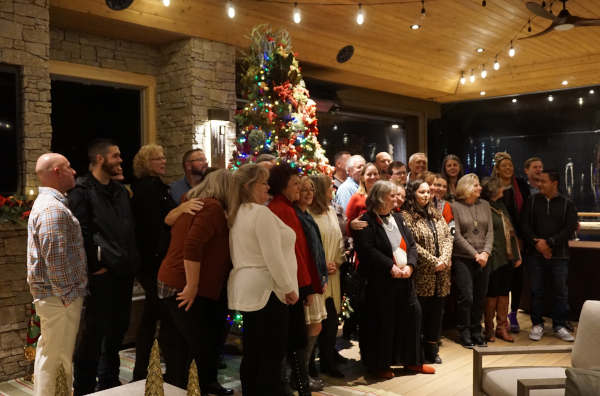
At a Monday evening event held at Bell Haven Resort, Flower Farm and Event Pavilion in Kelseyville, the Wine Alliance held the annual distribution of the proceeds of its signature Wine Auction, held in September.
This year’s Wine Auction brought in record proceeds that provided the funds that will benefit nearly 30 local nonprofit organizations and all five county high schools.
Over its 21-year history, the Wine Auction has encountered tough years — such as during the Great Recession — and cancellations, including in 2015 during the Valley fire.
More recently, the COVID-19 pandemic impacted the event. However, Rob Roumiguiere, the Wine Alliance treasurer and the master of ceremonies, said that the event has come back strong.
“It’s been a long haul,” he said, adding, “The community has been so generous.”
To date, the Wine Alliance has given out about $2.3 million, Rob Roumiguiere said.
“Last year, we set a record,” distributing $250,000, which Roumiguiere said was “mind blowing.”
However, this year’s Wine Auction surpassed even that, making the disbursement on Monday night the biggest yet — with $300,000 in checks handed out, which Roumiguiere was excited to report.
That’s a long way from its inaugural year in 2000, when Roumiguiere said proceeds totaled $31,000.
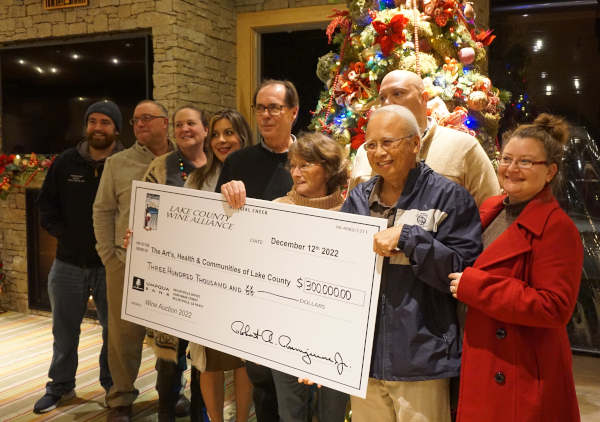
This year, beneficiaries included the Adventist shower project, Worldwide Healing Hands, the county’s senior centers, United Christian Parish, Catholic Charities, First Lutheran Church, Lake County’s five high schools and all four county National FFA Organization programs, Lake County Symphony Association, Lake County Rural Arts Initiative, Konocti Christian Academy, Mountain Vista Middle School, Lake County Channel Cats, Lake County Sheriff’s Activity League, Sheriffs and You Foundation, Woodland Community College, the culinary programs at Lower Lake and Clear Lake high schools, Operation Tango Mike, Totes for Teens, Lake County Young Life, South Lake Alliance Children’s Museum, Give Back Track, Lake County Literacy Foundation, Friends of the Lake County Library, the Lake County Fair Foundation, Lake Family Resource Center, Ely Stage Stop, Hospice Services of Lake County and People Services.
Roumiguiere credited numerous sponsors and volunteers for making the event happen.
He gave special acknowledgement to Clay and Angie Shannon, who hosted the Wine Auction at The Mercantile in Kelseyville in September, along with Congressman Mike Thompson, a longtime supporter; artist John R. Clarke, whose watercolor paintings of Lake County scenery have been featured as the annual Wine Auction poster, with the originals fetching thousands each when auctioned off at the event; Sheriff Brian Martin and businesswoman Jennifer Strong, who were this year’s auctioneers; Beth and Jeff Havrilla of Lake Event Design, who have always managed to set up great events at a variety of venues, from horse barns to wineries; Tom Aiken and Rico Abordo, who help organize volunteers; and the many restaurants and wineries who provide food and wine.
Since 2000, the Wine Auction has been made possible by a host of sponsors, including Adventist Health, Reynolds Systems, Lake County Tribal Health, Six Sigma Ranch and Winery, Congressman Thompson, Pacific Gas and Electric Co., Bella Vista Farming, Shannon Family of Wines, Beckstoffer Vineyards, Sysco Foods, Sutter Health, TricorBraun WinePak, Cork Supply USA, Community First Credit Union, BitSculptor, Lake Co. Winery Association and Shields Construction.
“We collect it all and then we give it all away,” and the disbursement event is the highlight, Roumiguiere said.
Roumiguiere said work is already underway on the 2023 Wine Auction, which takes place Sept. 16.
Email Elizabeth Larson at
LAKEPORT, Calif. — A judge on Monday afternoon sentenced a Clearlake Oaks woman to 50 years to life for the premeditated killing of her ex-boyfriend in his own apartment in July 2021.
Calling her “remorseless,” and saying her attempts to justify the killing as being in self-defense were disproved by the evidence at trial, Judge Andrew Blum handed down the sentence to Tammy Sue Grogan-Robinson.
Following a lengthy trial and less than a day’s worth of deliberations, a six-man, six-woman jury convicted Grogan-Robinson, 58, last month of the shooting death of 56-year-old Charles Vernon McClelland.
The jury convicted Grogan-Robinson of first-degree murder and special allegations of intentionally discharging a firearm causing death, use of a handgun in committing the crime and inflicting great bodily injury or death, as well as a second count of assault with a firearm and a special allegation to that charge of committing great bodily injury on McClelland.
Fifty years to life is the maximum sentence for the crimes of which Grogan-Robinson was convicted, “and that’s what I’m going to impose,” Blum said, after having listened to the victim impact statements of McClelland’s ex-wife, his son, younger brother and uncle.
“This was a coldblooded, premeditated murder. I saw not one indication of the slightest remorse from the defendant through the entire lengthy trial,” even as she sat on the witness stand and described how she shot McClelland as he pleaded for his life, said Blum, who presided over Grogan-Robinson’s trial.
“Her crime,” the judge added, “was absolutely remorseless.”
McClelland, of Rohnert Park, had dated Grogan-Robinson on and off over the course of five years before he finally ended the relationship in March of 2021.
Deputy District Attorney Rich Watson said she would not accept that their relationship was over and continued to try to get McClelland to continue the relationship, which he refused to do. However, McClelland tried to remain friendly with her.
In July of 2021, McClelland came up to what family called his “lake house,” a home in Clearlake Oaks, part of which he rented to Grogan-Robinson, with an apartment he kept for personal use.
Friends came with him for that holiday weekend. After they went home, on July 6, Grogan-Robinson and McClelland had dinner. When she heard him texting with his new girlfriend, she began sending texts to another man saying she planned to kill McClelland, that he couldn’t treat her that way.
Investigators believe that it was early the following morning that Grogan-Robinson shot McClelland several times as he tried to flee from the home, as he pleaded with her to stop and asked her why.
Evidence showed that Grogan-Robinson, who has spent decades working as a surgical technician, then smoked a cigarette and offered McClelland no assistance as he lay dying.
Later that morning, she drove to Clearlake, made some phone calls and reported to her employer, Adventist Health, that she had been sexually assaulted. She was directed to Sutter Lakeside Hospital where a sexual assault examination was done.
She told deputies who responded to the hospital that McClelland had raped her and she shot him in self-defense.
However, the sexual assault exam showed no sign that such an assault had taken place or that they had been intimate, Watson told Lake County News after the trial concluded.
Sheriff Brian Martin was in the courtroom for the sentencing, expected to be the last resolution of a major crime case his agency has handled before his retirement at the end of the month.
Hearing from the victims
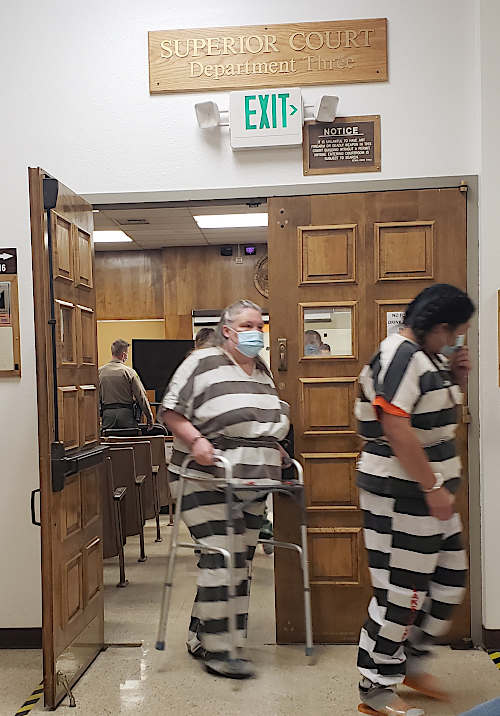
Grogan-Robinson appeared in court in a black and white striped jail jumpsuit, her hands shackled at the wrists and in leg chains. She carried with her a walker when she initially was seated in the jury box before she was moved to the defense table to be seated beside her attorney, Mitchell Hauptman.
McClelland’s family made sure that his death and its destructive impact on them was heard and felt in the courtroom on Monday afternoon.
Sheila McClelland, Charles McClelland’s ex-wife who appeared by Zoom, offered the first victim impact statement, thanking the staff of the District Attorney’s Office, that agency’s Victim Witness Division and the Lake County Sheriff’s Office.
She said it offended her on so many levels that Grogan-Robinson said she had been raped, adding that offense to the crime of his killing. No one who knew him believed that.
“You made my son have to grow up and have to deal with so many responsibilities that someone his age should not have to,” which included him having to clean up the crime scene, fix the bullet holes in the wall and clean up his father’s blood, she said.
The killing robbed McClelland’s mother of her son, his son of his father, and his brother and others of a beloved family member. “Why? Because he didn’t love you anymore? Because he wanted to move on? I guess you’ll be the only one who has the answer to that.”
She said it was an offense to women who have actually been raped that Grogan-Robinson calimed she had been, too.
And after shooting him, Sheila McClelland asked if Grogan-Robinson watched him die. “Obviously you planned your lies out.”
Victim advocate Tatsu Suzuki of Victim Witness read the letter on behalf of Nicholas McClelland, Charles McClelland’s son, who recounted getting the news from his uncle the day after the murder and being unable to believe it. But his first question was if it was Grogan-Robinson.
“It sure was,” his uncle said.
He said she was known to be obsessed with his father. Worse was reading the news story in which it was reported that she accused his father of having sexually assaulted her as justification.
Nicholas McClelland was only 19 when this incident occurred. “My dad was taken away when I needed him the most.” And his father won’t be there for him during the milestones in his life to come.
He recounted having to scrape off, paint over and disinfect his father’s blood in the home where he died.
He said his father was a hardworking man who was qualified for retirement from the job he started when 19. His father’s dream for when he retired was to live at his lake house which he loved so much, the place where he ultimately died.
Grogan-Robinson clearly planned and acted deliberately, out of malice and jealousy, because McClelland had moved on and was happy, his son said.
Nicholas McClelland said Grogan-Robinson should never be free. “The family asks that the court orders the harshest sentence allowed under state law.”
Paul McClelland, Charles McClelland’s younger brother, described getting the news of his brother’s death by a Petaluma Police officer, who directed him to call a Lake County Sheriff’s detective. He immediately asked if Grogan-Robinson had shot his brother. “Of course, the answer was yes.”
But then he asked if she was still alive, because he had thought it might have been a murder-suicide. The detective told him that she had alleged a sexual assault and self-defense.
Paul McClelland remembered how painful it was to tell his nephew the news, and then to break it to his 81-year-old mother.
His brother worked hard for 38 years yet didn’t get to enjoy his retirement. “Tammy took a son, a brother and, most important, a father away from us without regard for our family,” he said.
Paul McClelland called Grogan-Robinson a coldblooded killer and asked for the harshest sentence.
Bill Amatneek, Charles McClelland’s uncle by marriage, recalled getting a call from Paul McClelland about the murder and then going to see Charles McClelland’s mother at her home. She was weeping and saying, “You’re not supposed to outlive your children.”
“No, you’re not,” Amatneek told the court.
In that scene in the McClelland home, “We were all incredulous, disbelieving that this had happened, and yet knowing that it had. It was the saddest room I’ve ever been in,” Amatneek said.
The family was gratified that what might have been a three-month investigation was concluded in five weeks, that Grogan-Robinson was charged with murder and, finally, that she was convicted. “But that gladness lasted seconds. Then we were back with our grief. Charles was still dead and would never reenter our lives,” Amatneek said.
He added, “It has broken this family's heart. Each of us will take this murder to the grave.”
Grogan-Robinson speaks to court, judge hands down sentence
Hauptman told the court that Grogan-Robinson wished to say something. She did not take the stand but instead stayed seated at Hauptman’s side when she spoke.
“I am sorry for your loss,” she said to McClelland’s family.
She said she understands the gravity of the case and takes responsibility for her actions.
However, she maintained that she also was a victim. “Regardless of what anyone thinks, I was raped,” she said, adding it was never investigated.
That statement directly contradicts the evidence presented in the course of the case, which included the fact that the sheriff’s office did investigate her allegations. The evidence from her sexual assault examination and McClelland’s autopsy showed that they had not had sex, and so he had not committed the sexual assault that she had claimed.
She said she had spent 38 years in her profession helping save the lives of others and asked for consideration of that in her sentencing.
Watson joined the family in asking Blum for the harshest sentence, noting that the jury came back with the conviction for first degree murder and enhancements.
He said the evidence proved she had planned the killing the night before. “She slept on that plan and she carried it out the next morning.”
The defense sought the striking of an enhancement for the use of a firearm, which Watson argued against. “I struggle to see how on earth that could be in the furtherance of justice to strike such an enhancement.”
Watson said that Grogan-Robinson used her own firearm, a handgun, to kill McClelland, chasing him through the home, firing as he cried out and asking why she was doing it.
“She executed him at the door as he’s trying to flee,” Watson said. “She then smoked a cigarette and let him die and offered no help.”
Watson said Grogan-Robinson then made up the most heinous story about McClelland, which was completely false and yet which she continues to make to this day. As such, he asked for the maximum sentence under the law.
In response to a memo on the sentencing from Hauptman, Blum agreed that he had to stay a 10-year sentence on the assault with a deadly weapon charge since under Penal Code 654, there cannot be multiple punishments for the same act.
He said the sentence is 25 years to life for first degree premeditated murder and 25 years to life for the firearms enhancement, for the maximum 50 years to life sentence. She will receive 484 days of credit for time served, accounting for the time she’s spent in jail since her August 2021 arrest in Missouri.
However, Blum declined to strike the gun use enhancement, noting that he had heard the trial and remarking on the coldblooded nature of the killing.
Besides that, he said she is still claiming she was raped, which the jury rejected and is clearly not true. Blum also pointed to how she was telling “a near stranger” — the man she was communicating with via text — what she was planning on doing the day before the killing.
“If I could make this life without parole I would do it, but that's not a possible sentence under the law here,” Blum said.
Hauptman said Grogan-Robinson has no money and asked that restitution not be ordered. Blum reserved restitution for McClelland’s estate, ordering her to pay a fine of $300 but staying an additional $400 fine.
Blum advised Grogan-Robinson of her right to appeal, with a 60-day limit that started to run from Monday.
He then remanded her into the custody of the Lake County Sheriff’s Office, to be delivered to the California Department of Corrections and Rehabilitation.
Hauptman had told Lake County News following the jury verdict in November that Grogan-Robinson intends to appeal her conviction.
Email Elizabeth Larson at
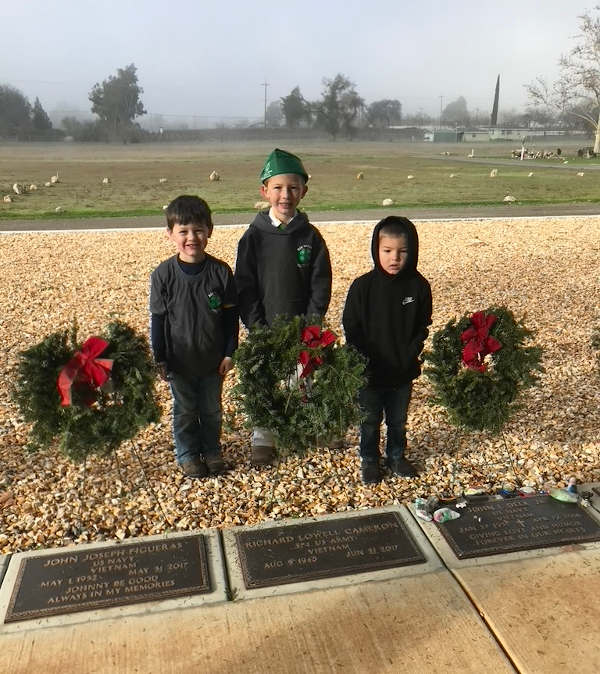
LAKE COUNTY, Calif. — Wreaths Across America ceremonies will take place at five ceremonies across Lake County this weekend.
Everyone is welcome to the events, which will begin at 8:55 a.m. Saturday, Dec. 17, at the Hartley, Kelseyville, Lower Lake, Middletown and St. Mary’s cemeteries.
Lake County will gather together to honor veterans during the holiday season as part of the annual Wreaths Across America Day.
On this brisk December morning, help to show the veterans and families that they will not be forgotten.
This year the theme is “Find A Way to Serve.”
Youth organizations and veteran organizations have volunteered to conduct the Wreaths Across America ceremony this year at the five Lake County cemeteries.
Eight ceremonial wreaths will be placed to remember all soldiers, sailors, airmen and Marines who served, honor their sacrifices and teach our younger generations about the high cost of our freedoms.
Wreaths Across America pursues its mission with nationwide wreath-laying events amid the holiday season, and year-round educational outreach inviting all Americans to appreciate our freedoms and the cost at which they are delivered.
Specially designated wreaths for the Army, Marines, Navy, Air Force, Coast Guard, Merchant Marine, Space Force and POW/MIA will be placed on memorials during a ceremony that will be coordinated simultaneously at over participating locations all across the country and overseas.
In 2021, more than 2.4 million veteran wreaths were placed on headstones at 3,137 participating cemeteries around the country in honor of the service and sacrifices made for our freedoms, with each name said out loud.
More than 525 truckloads of wreaths were delivered across the country by hundreds of volunteer professional truck drivers.
The truck full of Remembrance Wreaths will be arriving in parts of Lake County on Tuesday, Dec. 13. Another truck will arrive in Lakeport on Thursday, Dec. 15, and will be escorted through the city at noon and on to Hartley Cemetery where 800 wreaths will be unloaded.
Join in and watch from the sidewalks along Main Street. Please bring your patriotic spirit to this welcome.
Every person has something to give, whether it is their time, ideas, compassion, or resources. Mother Teresa said it best, “The greatest good is what we do for one another.”
Take an hour amid the hustle and bustle of this holiday season and bring your families to attend one of these heartfelt ceremonies on Saturday, Dec. 17, where we will remember and honor our veterans, teach our children the value of the sacrifices that have been made and help lay the wreaths.
Editor’s note: The time for wreath delivery has been updated.

You saw it at Thanksgiving, and you’ll likely see it at your next holiday feast: piles of unwanted food – unfinished second helpings, underwhelming kitchen experiments and the like – all dressed up with no place to go, except the back of the refrigerator. With luck, hungry relatives will discover some of it before the inevitable green mold renders it inedible.
U.S. consumers waste a lot of food year-round – about one-third of all purchased food. That’s equivalent to 1,250 calories per person per day, or US$1,500 worth of groceries for a four-person household each year, an estimate that doesn’t include recent food price inflation. And when food goes bad, the land, labor, water, chemicals and energy that went into producing, processing, transporting, storing and preparing it are wasted too.
Where does all that unwanted food go? Mainly underground. Food waste occupies almost 25% of landfill space nationwide. Once buried, it breaks down, generating methane, a potent greenhouse gas that contributes to climate change. Recognizing those impacts, the U.S. government has set a goal of cutting food waste in half by 2030.
Reducing wasted food could protect natural resources, save consumers money, reduce hunger and slow climate change. But as an agricultural economist and director of the Ohio State Food Waste Collaborative, I know all too well that there’s no ready elegant solution. Developing meaningful interventions requires burrowing into the systems that make reducing food waste such a challenge for consumers, and understanding how both physical and human factors drive this problem.
Consumers and the squander sequence
To avoid being wasted, food must avert a gauntlet of possible missteps as it moves from soil to stomach. Baruch College marketing expert Lauren Block and her colleagues call this pathway the squander sequence.
It’s an example of what economists call an O-ring technology, harking back to the rubber seals whose catastrophic failure caused the Space Shuttle Challenger disaster in 1986. As in that event, failure of even a small component in the multistage sequence of transforming raw materials into human nutrition leads to failure of the entire task.
MIT economist Michael Kremer has shown that when corporations of many types are confronted with such sequential tasks, they put their highest-skilled staff at the final stages of production. Otherwise the companies risk losing all the value they have added to their raw materials through the production sequence.
Who performs the final stages of production in today’s modern food system? That would be us: frenzied, multitasking, money- and time-constrained consumers. At the end of a typical day, we’re often juggling myriad demands as we try to produce a nutritious, delicious meal for our households.
Unfortunately, sprawling modern food systems are not managed like a single integrated firm that’s focused on maximizing profits. And consumers are not the highly skilled heavy hitters that Kremer envisioned to manage the final stage of the complex food system. It’s not surprising that failure – here, wasting food – often is the result.
Indeed, out of everyone employed across the fragmented U.S. food system, consumers may have the least professional training in handling and preparing food. Adding to the mayhem, firms may not always want to help consumers get the most out of food purchases. That could reduce their sales – and if food that’s been stored longer degrades and becomes less appetizing or safe, producers’ reputations could suffer.
Three paths to squash the squandering
What options exist for reducing food waste in the kitchen? Here are several approaches.
- Build consumer skills.
This could start with students, perhaps through reinvesting in family and consumer science courses – the modern, expanded realm of old-school home economics classes. Or schools could insert food-related modules into existing classes. Biology students could learn why mold forms, and math students could calculate how to expand or reduce recipes.
Outside of school, there are expanding self-education opportunities available online or via clever gamified experiences like Hellman’s Fridge Night Mission, an app that challenges and coaches users to get one more meal a week out of their fridges, freezers and pantries. Yes, it may involve adding some mayo.
Recent studies have found that when people had the opportunity to brush up on their kitchen management skills early in the COVID-19 pandemic, food waste declined. However, as consumers returned to busy pre-COVID schedules and routines such as eating out, wastage rebounded.
- Make home meal preparation easier.
Enter the meal kit, which provides the exact quantity of ingredients needed. One recent study showed that compared to traditional home-cooked meals, wasted food declined by 38% for meals prepared from kits.
Meal kits generate increased packaging waste, but this additional impact may be offset by reduced food waste. Net environmental benefits may be case specific, and warrant more study.
- Heighten the consequences for wasting food.
South Korea has begun implementing taxes on food wasted in homes by requiring people to dispose of it in special costly bags or, for apartment dwellers, through pay-as-you-go kiosks.


A recent analysis suggests that a small tax of 6 cents per kilogram – which, translated for a typical U.S. household, would total about $12 yearly – yielded a nearly 20% reduction in waste among the affected households. The tax also spurred households to spend 5% more time, or about an hour more per week, preparing meals, but the changes that people made reduced their yearly grocery bills by about $170.
No silver bullets
Each of these paths is promising, but there is no single solution to this problem. Not all consumers will seek out or encounter opportunities to improve their food-handling skills. Meal kits introduce logistical issues of their own and could be too expensive for some households. And few U.S. cities may be willing or able to develop systems for tracking and taxing wasted food.
As the National Academies of Science, Engineering and Medicine concluded in a 2020 report, there’s a need for many solutions to address food waste’s large contribution to global climate change and worldwide nutritional shortfalls. Both the United Nations and the U.S. National Science Foundation are funding efforts to track and measure food waste. I expect that this work will help us understand waste patterns more clearly and find effective ways to squelch the squander sequence.
Brian E. Roe, Professor of Agricultural, Environmental, and Development Economics, The Ohio State University
This article is republished from The Conversation under a Creative Commons license. Read the original article.