How to resolve AdBlock issue?
News
Dogs available for adoption this week include mixes of Australian shepherd, border collie, Doberman pinscher, German shepherd, husky, Labrador retriever, mastiff pit bull, shepherd and wire-haired terrier.
Dogs that are adopted from Lake County Animal Care and Control are either neutered or spayed, microchipped and, if old enough, given a rabies shot and county license before being released to their new owner. License fees do not apply to residents of the cities of Lakeport or Clearlake.
The following dogs at the Lake County Animal Care and Control shelter have been cleared for adoption.
Call Lake County Animal Care and Control at 707-263-0278 or visit the shelter online for information on visiting or adopting.

‘Hank’
“Hank” is a 5-year-old male shepherd and mastiff mix with a tricolor coat.
He is in kennel No. 2, ID No. LCAC-A-4249.

‘Daisy’
“Daisy” is a 9-month-old female pit bull terrier with a blue coat.
She is in kennel No. 6, ID No. LCAC-A-4213.
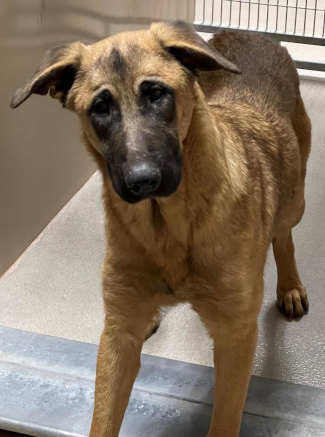
Male German shepherd
This 1-year-old male German shepherd has a short black and tan coat.
He is in kennel No. 8, ID No. LCAC-A-4310.

Female German shepherd
This 2-year-old female German shepherd has a short tricolor coat.
She is in kennel No. 9, ID No. LCAC-A-2855.

Male Labrador retriever
This 1.5 year old male Labrador retriever has a short black coat.
He is in kennel No. 10, ID No. LCAC-A-4273.

Female husky
This 2-year-old female husky has a short brown coat with white markings.
She is in kennel No. 11, ID No. LCAC-A-4269.

Female hound
This 8-month-old female hound has a fawn coat.
She is in kennel No. 17, ID No. LCAC-A-4386.

Female border collie mix
This 4-year-old female border collie mix has a short tricolor coat.
She is in kennel No. 18, ID No. LCAC-A-4285.

‘Daisy’
“Daisy” is a 4-year-old female Australian shepherd with a short red and white coat.
She is in kennel No. 20, ID No. LCAC-A-4330.

Male German shepherd
This 4-year-old male German shepherd has a black and tan coat.
He is in kennel No. 24, ID No. LCAC-A-4371.
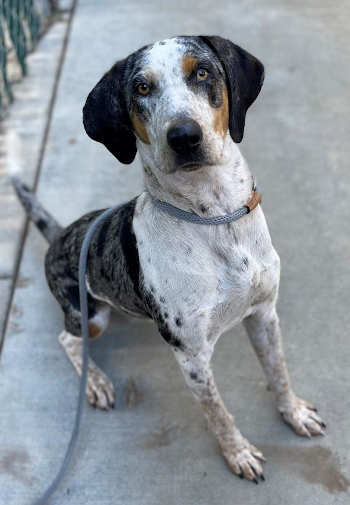
Female hound
This 2-year-old female hound has a tricolor coat.
She is in kennel No. 25, ID No. LCAC-A-4381.

‘Faith’
“Faith” is a 10-year-old female wire-haired terrier with a short black and tan coat.
She is in kennel No. 26, ID No. LCAC-A-4280.

Female husky
This 2-year-old female husky has a short tricolor coat and one blue and one brown eye.
She is in kennel No. 27, ID No. LCAC-A-4257.

Female German shepherd
This 10-month-old female German shepherd has a short light-colored coat.
She is in kennel No. 28, ID No. LCAC-A-4297.

Female Doberman pinscher
This 1-year-old female Doberman pinscher has a short black and tan coat.
She is in kennel No. 29, ID No. LCAC-A-4279.

‘Riley’
“Riley” is a 5-year-old female Siberian husky with a black and white coat.
She is in kennel No. 30, ID No. LCAC-A-4382.
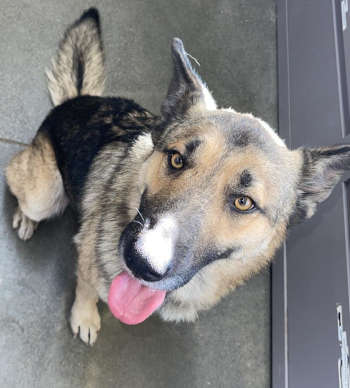
Male shepherd
This 3-year-old male shepherd has a short black and tan coat.
He is in kennel No. 31, ID No. LCAC-A-4312.

Female pit bull
This 1-year-old female pit bull has a short tan coat.
She is in kennel No. 32, ID No. LCAC-A-4283.

Female Labrador retriever
This one and a half year old female Labrador retriever has a short yellow coat.
She is in kennel No. 33, ID No. LCAC-A-4383.

Male American pit bull terrier
This 3-year-old male American pit bull terrier has a short brindle coat.
He is in kennel No. 34, ID No. LCAC-A-4402.
Email Elizabeth Larson at

The International Space Station is no longer the only place where humans can live in orbit.
On Nov. 29, 2022, the Shenzhou 15 mission launched from China’s Gobi Desert carrying three taikonauts – the Chinese word for astronauts. Six hours later, they reached their destination, China’s recently completed space station, called Tiangong, which means “heavenly palace” in Mandarin. The three taikonauts replaced the existing crew that helped wrap up construction. With this successful mission, China has become just the third nation to operate a permanent space station.
China’s space station is an achievement that solidifies the country’s position alongside the U.S. and Russia as one of the world’s top three space powers. As scholars of space law and space policy who lead the Indiana University Ostrom Workshop’s Space Governance Program, we have been following the development of the Chinese space station with interest.
Unlike the collaborative, U.S.-led International Space Station, Tiangong is entirely built and run by China. The successful opening of the station is the beginning of some exciting science. But the station also highlights the country’s policy of self-reliance and is an important step for China toward achieving larger space ambitions among a changing landscape of power dynamics in space.


Capabilities of a Chinese station
The Tiangong space station is the culmination of three decades of work on the Chinese manned space program. The station is 180 feet (55 meters) long and is comprised of three modules that were launched separately and connected in space. These include one core module where a maximum of six taikonauts can live and two experiment modules for a total of 3,884 cubic feet (110 cubic meters) of space, about one-fifth the size of the International Space Station. The station also has an external robotic arm, which can support activities and experiments outside the station, and three docking ports for resupply vehicles and manned spacecraft.
Like China’s aircraft carriers and other spacecraft, Tiangong is based on a Soviet-era design – it is pretty much a copy of the Soviet Mir space station from the 1980s. But the Tiangong station has been heavily modernized and improved.
The Chinese space station is slated to stay in orbit for 15 years, with plans to send two six-month crewed missions and two cargo missions to it annually. The science experiments have already begun, with a planned study involving monkey reproduction commencing in the station’s biological test cabinets. Whether the monkeys will cooperate is an entirely different matter.

Science and a steppingstone
The main function of the Tiangong station is to perform research on life in space. There is a particular focus on learning about the growth and development of different types of plants, animals and microorganisms, and there are more than 1,000 experiments planned for the next 10 years.
Tiangong is strictly Chinese made and managed, but China has an open invitation for other nations to collaborate on experiments aboard Tiangong. So far, nine projects from 17 countries have been selected.
Although the new station is small compared to the 16 modules of the International Space Station, Tiangong and the science done aboard will help support China’s future space missions. In December 2023, China is planning to launch a new space telescope called Xuntian. This telescope will map stars and supermassive black holes among other projects with a resolution about the same as the Hubble Space Telescope but with a wider view. The telescope will periodically dock with the station for maintenance.
China also has plans to launch multiple missions to Mars and nearby comets and asteroids with the goal of bringing samples back to Earth. And perhaps most notably, China has announced plans to build a joint Moon base with Russia – though no timeline for this mission has been set.
Astropolitics
A new era in space is unfolding. The Tiangong station is beginning its life just as the International Space Station, after more than 30 years in orbit, is set to be decommissioned by 2030.
The International Space Station is the classic example of collaborative ideals in space – even at the height of the Cold War, the U.S. and the Soviet Union came together to develop and launch the beginnings of the space station in the early 1990s. By comparison, China and the U.S. have not been so jovial in their orbital dealings.
In the 1990s, when China was still launching U.S. satellites into orbit, concerns emerged that China was accidentally acquiring – or stealing – U.S. technology. These concern in part led to the Wolf Amendment, passed by Congress in 2011, which prohibits NASA from collaborating with China in any capacity. China’s space program was not mature enough to be part of the construction of the International Space Station in the 1990s and early 2000s. By the time China had the ability to contribute to the International Space Station, the Wolf Amendment prevented it from doing so.
It remains to be seen how the map of space collaboration will change in the coming years. The U.S.-led Artemis Program that aims to build a self-sustaining habitat on the Moon is open to all nations, and 19 countries have joined as partners so far. China has also recently opened its joint Moon mission with Russia to other nations. This was partly driven by cooling Chinese-Russian relations but also due to the fact that because of the war in Ukraine, Sweden, France and the European Space Agency canceled planned missions with Russia.
As tensions on Earth rise between China, Russia and the West, and some of that jockeying spills over into space, it remains to be seen how the decommissioning of the International Space Station and operation of the Tiangong station will influence the China-U.S. relationship.
An event like the famous handshake between U.S. astronauts and Russian cosmonauts while orbiting Earth in 1975 is a long way off, but collaboration between the U.S. and China could do much to cool tensions on and above the Earth.
Eytan Tepper, Visiting Assistant Professor of Space Governance, Indiana University and Scott Shackelford, Professor of Business Law and Ethics, Indiana University
This article is republished from The Conversation under a Creative Commons license. Read the original article.
The National Weather Service said the storm is expected to bring both rain and wind to Lake County through the weekend and into the new week.
The forecast calls for gusty winds that will be mostly restricted to high ridge tops in Lake County.
Heavy rain will follow the wind. The National Weather Service said most low elevation locations can expect 2.5 to 3 inches of rain with upper elevation ridges seeing 4.5 to 5.5 inches.
The Lake County forecast predicts winds with gusts of nearly 25 miles per hour on Saturday, and dropping below 10 miles per hour on Sunday and Monday.
Through Sunday night, the forecast expects more than 2 inches of rain on the Northshore and more than 4 inches of rain in the Cobb area.
There is forecast to be a break in the rain on Monday and then chances of more rain through Friday.
Temperatures this weekend and through the end of the new week will range from the low to mid 30s at night and the mid to high 40s during the day.
Email Elizabeth Larson at
The City of Clearlake Animal Association also is seeking fosters for the animals waiting to be adopted.
Call the Clearlake Animal Control shelter at 707-273-9440, or email
Visit Clearlake Animal Control on Facebook or on the city’s website.
The following dogs are available for adoption. New additions are at the top.

‘Atlas’
“Atlas” is a male German shepherd with a black and tan coat.
He has been neutered.
He is dog No. 51331471.
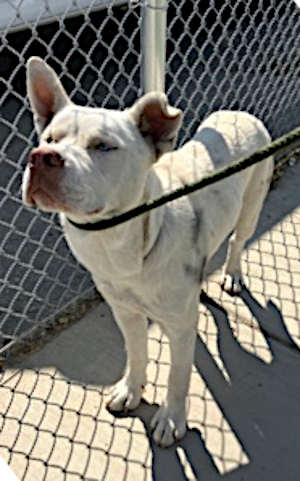
‘Aoki’
“Aoki” is a male Siberian husky mix with a white coat.
He has been neutered.
He is dog No. 50905477.

‘Athena’
“Athena” is a female American pit bull mix terrier with a short brindle coat.
She has been spayed.
She is dog No. 49934476.

‘Babs’
“Babs” is a female Labrador retriever mix with a short black coat.
She has been spayed.
She is dog No. 49505856.

‘Bruce’
“Bruce” is a 2-year-old American pit bull mix with a short gray coat with white markings.
He has been neutered.
He is dog No. 50684304.

‘Buster’
“Buster” is a male pit bull mix with a short tan coat.
He has been neutered.
He is dog No. 50762164.

‘Domino’
“Domino” is a male terrier mix with a short white coat.
He has been neutered.
He is dog No. 50815541.

‘Eros’
“Eros” is a male Rottweiler mix with a short black and tan coat.
He has been neutered.
He is dog No. 50754504.

‘Foxie’
“Foxie” is a female German shepherd with a red, black and white coat.
She has been spayed.
She is dog No. 49702845.

‘Goliath’
“Goliath” is a male Rottweiler mix with a short black and tan coat.
He is dog No. 50754509.

‘Hakuna’
“Hakuna” is a male shepherd mix with a tan coat.
He has been neutered.
He is dog No. 50176912.

‘Herman’
“Herman” is a 7-year-old male American pit bull terrier mix with a brown coat.
He has been neutered.
He is dog No. 51236411.

‘Hondo’
“Hondo” is a male Alaskan husky mix with a buff coat.
He has been neutered.
He’s dog No. 50227693.

‘Jack’
“Jack” is a 9-month-old male terrier mix with a short black and brindle coat.
He has been neutered.
He is dog No. 50992658.

‘Kubota’
“Kubota” is a 4-year-old male German shepherd with a short brown coat.
He has been neutered.
He is dog No. 50184421.

‘Little Boy’
“Little Boy” is a male American pit bull terrier mix with a short tan coat.
He has been neutered.
He is dog No. 50075256.

‘Luciano’
“Luciano” is a male Siberian husky mix with a short black and white coat.
He has been neutered.
He is dog No. 50596272.

‘Mamba’
“Mamba” is a male Siberian husky mix with a gray and cream-colored coat.
He has been neutered.
He is dog No. 49520569.

‘Matata’
“Matata” is male shepherd mix with a tan coat.
He has been neutered.
He is dog No. 50176912.

‘Maverick’
“Maverick” is a male pit bull-border collie mix with a short black and white coat.
He has been neutered.
He is dog No. 51027806.
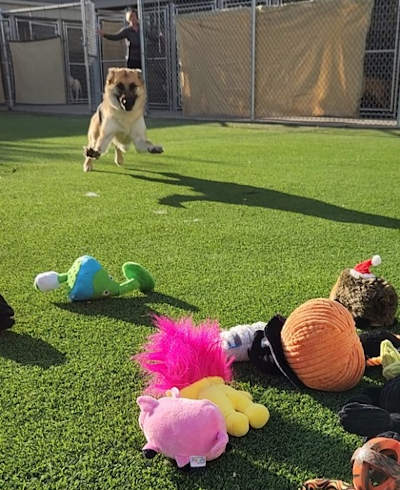
‘Maya’
“Maya” is a female German shepherd with a black and tan coat.
She has been spayed.
She is dog No. 50428151.

‘Mikey’
“Mikey” is a male German shepherd mix with a short brown and tan coat.
He has been neutered.
He is dog No. 51012855.
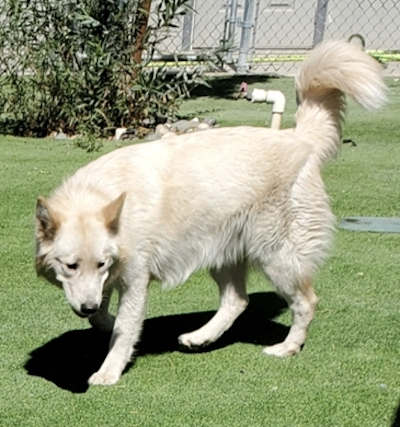
‘Molly’
“Molly” is a female Samoyed mix with a long white coat.
She has been spayed.
She is dog No. 50933031.

‘Noah’
“Noah” is a male pit bull terrier mix with a short white coat.
He has been neutered.
He is dog No. 51286102.

‘Paige’
“Paige” is a female American pit bull mix with a short brown coat.
She has been spayed.
She is dog No. 51194668.

‘Poppa’
“Poppa” is a 3-year-old male American pit bull terrier mix with a short red and white coat.
He has been neutered.
He is dog No. 50773597.

‘Rascal’
“Rascal” is a male shepherd mix with a black and brown coat.
He has been neutered.
He is dog No. 50806384.
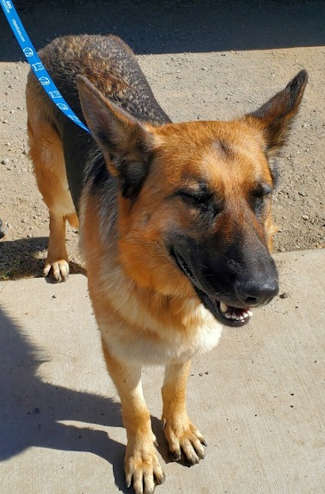
‘Reese’
“Reese” is a female German shepherd with a black and an coat.
She has been spayed.
She is dog No. 50884542.

‘Snowball’
“Snowball is a 1 and a half year old male American Staffordshire terrier mix with a short white coat.
He has been neutered.
He is dog No. 49159168.

‘Terry’
“Terry” is a handsome male shepherd mix with a short brindle coat.
He gets along with other dogs, including small ones, and enjoys toys. He also likes water, playing fetch and keep away.
Staff said he is now getting some training to help him build confidence.
He is dog No. 48443693.

‘Trike’
“Trike” is a male border collie-Australian shepherd mix with a black and white coat and blue eyes.
He has been neutered.
He is dog No. 51029972.

‘Willie’
“Willie” is a male German shepherd mix with a black and tan coat.
He has been neutered.
He is dog No. 50596003.
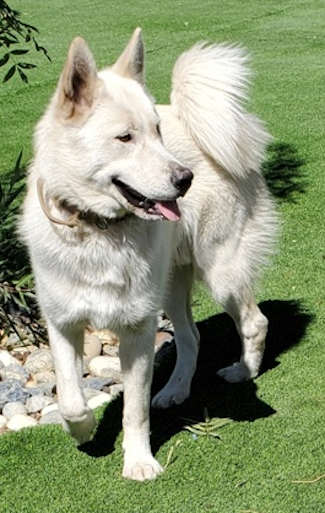
‘Zeus’
“Zeus” is a male Samoyed mix with a long white coat.
He has been neutered.
He is dog No. 50933068.
Email Elizabeth Larson at

Every year somewhere between 25 million and 30 million Christmas trees are sold in the United States. If you’re one of the people who decorate for the holiday with a freshly cut Christmas tree, you might be wondering how to keep it looking good all the way through Santa’s visit – and maybe even a little beyond.
Curtis VanderSchaaf is a forestry specialist at the Mississippi State University Extension Service who knows a thing or two about conifers. The Conversation U.S. asked him for guidance on how to keep a fresh green Christmas tree from becoming a giant pile of brown needles, for as long as possible. Whether you end up with a Douglas fir, a Scotch pine, a Leyland cypress, a piñon or any other evergreen, he says the quality of care you provide is a major factor in the prolonged freshness of your tree.
What to consider when choosing a tree
Select a tree that looks fresh and whose needles are not brittle. You want one that has a strong fragrance and a dark natural green color. Avoid bored holes in the wood, signs of bugs – like spider egg sacs – and other marks of pest damage. This advice holds whether you’re chopping down your own tree or buying it from a retailer.
Different species of trees have various colors, shapes, branching habits, needle types, scent and even bark type. Depending on what’s available to you, this comes down to personal preference.
If you can, pick a tree that’s been harvested as recently as possible and been watered and kept cool. Often a tree’s freshness is directly related to the moisture content of its needles. If the stump – where the tree’s trunk was cut – is sticky with sap, that’s a good sign.
Give the tree a good shake, even a hard pound on the ground. That will dislodge any animal stowaways. If a ton of dead needles or dry limbs fall out, keep looking.

Getting your tree home
Tree farms and retail lots will net your tree. It’s a lot easier to transport with the branches tucked in. If you’re going to bring it home on top of your car, consider using a tarp to keep scratches and sap off your vehicle. Make sure the tree is securely tied down, with the trunk facing forward to reduce wind damage to the branches. Take it easy on the road.
If you’re not bringing your tree indoors right away, store it in a cool, damp area that is blocked from wind and out of the sun.
Make a fresh, straight-across cut on the butt of the tree about a half-inch to 1 inch (1 to 3 centimeters) above the original cut. After any cut, a tree tries immediately to seal off, or compartmentalize, the injury, which makes it hard for the tree to take up water. So as soon as you make the new cut, place the tree in a bucket of warm water. Make sure it stays full as the tree drinks.
If you have allergies, you may want to spray the tree with a garden hose to remove residual pollen or dust – as long as the weather’s not freezing.
Setting up your tree inside
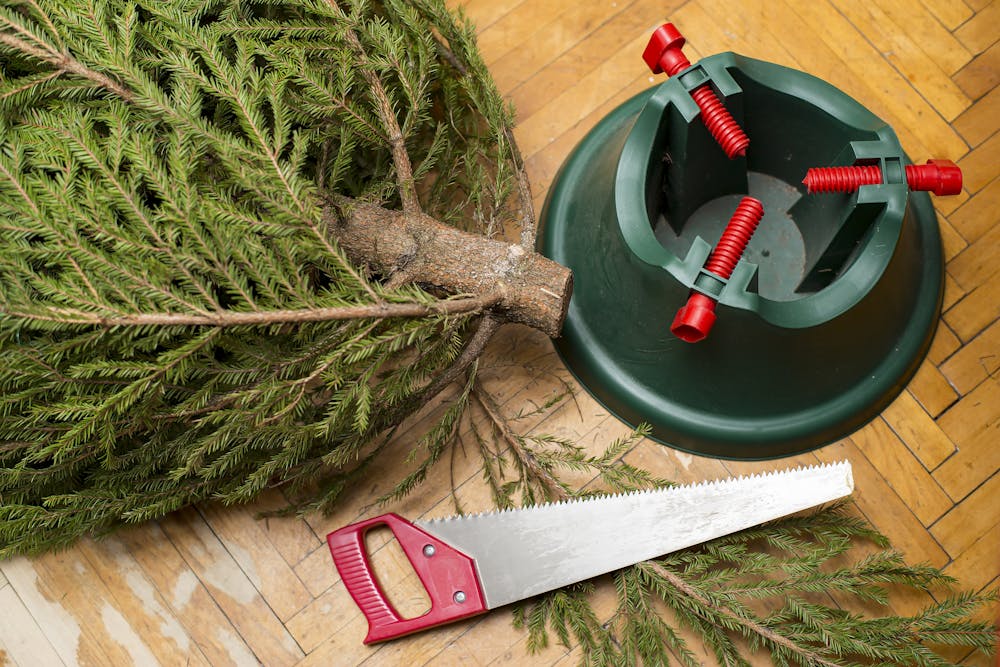
To keep a cut tree fresh you need to provide adequate water. Use a tree stand with a built-in reservoir, and make sure it’s always filled. A rule of thumb is 1 quart of water per inch of stem diameter. A freshly cut tree may use one-half to 2 gallons of water the first day, but this amount will taper as the tree acclimates to its indoor environment.
You don’t need to worry about adding anything to the water. It seems to just be an old wives’ tale that anything – including corn syrup, aspirin, vodka, soda pop, sugar or any specialized preservatives or gels – beyond H₂0 helps prolong the freshness of the tree. No special temperature is necessary either, just not freezing cold or boiling hot.
Do not drill a hole in the bottom of the tree trunk thinking it will improve water uptake – it doesn’t.
If you have to whittle down the sides of the trunk to fit, the tree is too large for your stand. It’s the outer layers of wood that take up most of the water, so if you shave them off your tree will be in trouble.
Secure the tree in its stand, ensuring the freshly cut stump is submerged. If it’s ever out of the water for more than about a quarter-hour or so, the cut starts the healing and sealing process and you should think about making a new cut.

Keeping the tree fresh into the New Year
Once your tree is all set up, your goal is to keep it from drying out. Remember, you want your tree to be fresh, but more importantly you don’t want to create a fire hazard.
Keep the tree at least 3 feet (1 meter) from any heat source and minimize direct sun exposure. Lowering the temperature in the room may also help to maintain freshness.
Make sure any lights and their cords are in good condition and turn them off when you aren’t present. Unplug completely if you are leaving the house or going to bed. Occasional breaks from using the lights may help slow the tree’s drying-out process. And make sure your smoke detectors work and you have a fire extinguisher on hand just in case.
If properly cared for, a fresh tree will last for three to four weeks, often even five. If it starts to get dry at any point, the safest move is to get rid of it. Chipping it for compost is the most environmentally sustainable option when it’s time for the tree to go.
Then you can start enjoying the lengthening days and look forward to the next holiday on your calendar.
Curtis VanderSchaaf, Assistant Professor of Forestry, Mississippi State University
This article is republished from The Conversation under a Creative Commons license. Read the original article.
Aside from a tapestry of glittering stars, and the glow of the waxing and waning Moon, the nighttime sky looks inky black to the casual observer. But how dark is dark?
To find out, astronomers decided to sort through 200,000 images from NASA's Hubble Space Telescope and made tens of thousands of measurements on these images to look for any residual background glow in the sky, in an ambitious project called SKYSURF.
This would be any leftover light after subtracting the glow from planets, stars, galaxies, and from dust in the plane of our solar system (called zodiacal light).
When researchers completed this inventory, they found an exceedingly tiny excess of light, equivalent to the steady glow of 10 fireflies spread across the entire sky. That's like turning out all the lights in a shuttered room and still finding an eerie glow coming from the walls, ceiling, and floor.
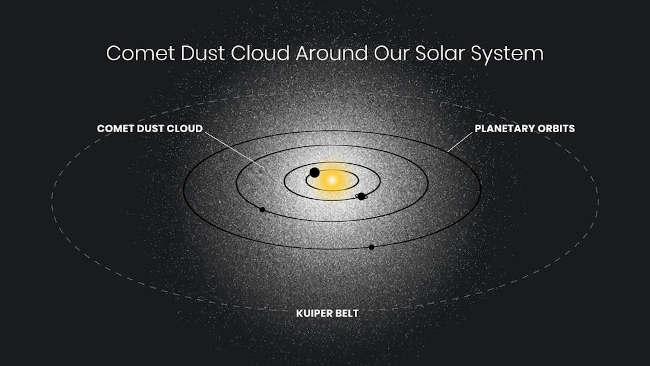
The researchers say that one possible explanation for this residual glow is that our inner solar system contains a tenuous sphere of dust from comets that are falling into the solar system from all directions, and that the glow is sunlight reflecting off this dust. If real, this dust shell could be a new addition to the known architecture of the solar system.
This idea is bolstered by the fact that in 2021 another team of astronomers used data from NASA's New Horizons spacecraft to also measure the sky background. New Horizons flew by Pluto in 2015, and a small Kuiper belt object in 2018, and is now heading into interstellar space. The New Horizons measurements were done at a distance of 4 billion to 5 billion miles from the Sun. This is well outside the realm of the planets and asteroids where there is no contamination from interplanetary dust.
New Horizons detected something a bit fainter that is apparently from a more distant source than Hubble detected. The source of the background light seen by New Horizons also remains unexplained. There are numerous theories ranging from the decay of dark matter to a huge unseen population of remote galaxies.
"If our analysis is correct there's another dust component between us and the distance where New Horizons made measurements. That means this is some kind of extra light coming from inside our solar system," said Tim Carleton, of Arizona State University (ASU).
"Because our measurement of residual light is higher than New Horizons we think it is a local phenomenon that is not from far outside the solar system. It may be a new element to the contents of the solar system that has been hypothesized but not quantitatively measured until now," said Carleton.
Hubble veteran astronomer Rogier Windhorst, also of ASU, first got the idea to assemble Hubble data to go looking for any "ghost light."
"More than 95% of the photons in the images from Hubble's archive come from distances less than 3 billion miles from Earth. Since Hubble's very early days, most Hubble users have discarded these sky-photons, as they are interested in the faint discrete objects in Hubble's images such as stars and galaxies," said Windhorst. "But these sky-photons contain important information which can be extracted thanks to Hubble's unique ability to measure faint brightness levels to high precision over its three decades of lifetime."
A number of graduate and undergraduate students contributed to project SKYSURF, including Rosalia O'Brien, Delondrae Carter and Darby Kramer at ASU, Scott Tompkins at the University of Western Australia, Sarah Caddy at Macquarie University in Australia, and many others.
The team's research papers are published in The Astronomical Journal and The Astrophysical Journal Letters.
The Hubble Space Telescope is a project of international cooperation between NASA and ESA. NASA's Goddard Space Flight Center in Greenbelt, Maryland, manages the telescope. The Space Telescope Science Institute (STScI) in Baltimore, Maryland, conducts Hubble and Webb science operations. STScI is operated for NASA by the Association of Universities for Research in Astronomy, in Washington, D.C.