 How to resolve AdBlock issue?
News
LAKE COUNTY, Calif. — Several key employees in the Lake County Health Services Department have written to the Board of Supervisors to state that they have no confidence in the performance of the agency’s director.
The letter, dated Dec. 5, faulted the performance of Jonathan Portney, hired a year ago to head the department that’s been tasked with leading the response to the COVID-19 pandemic.
“Over the past several months, we have been disheartened by the actions of Director Portney. He has tested our willpower and confidence in his skill and ability to adequately lead this department. Under his leadership, morale has plummeted to depths never before seen at this Agency,” the three-page letter from the Health Services employees said.
The letter noted that during Portney’s “short, one-year tenure, the examples of poor leadership are almost too numerous to recall. He has alienated several of our community partners by being too arrogant to learn of our community ‘ecosystem’ and our unique qualities,” referring to those community partners as fire departments, the sheriff’s office, Social Services and Behavioral Health.
County Administrative Office staff confirmed to Lake County News that they are aware of the letter, which was circulated to the Board of Supervisors earlier this week.
“As you will appreciate, any Board response would be expected to encompass confidential personnel matters. As such, it is not appropriate to comment further at this time,” the county said in reply to Lake County News’ inquiry on the matter.
Asked to respond to the letter by Lake County News, Portney on Thursday noted that nine staffers out of more than 70 had signed the letter and that he is committed to understanding their concerns.
The Board of Supervisors hired Portney at the end of November 2021, nearly two months after they had forced the previous director, Denise Pomeroy, to resign just days ahead of the death of her husband following a lengthy illness.
The county’s action against Pomeroy outraged Health Services staff, some of whom contacted Lake County News to raise concerns about it and its negative impacts on the department as a whole.
Then-County Administrative Officer Carol Huchingson, who appeared to have been responsible for forcing Pomeroy out and was subsequently named interim Health Services director, pumped her fist in the air at the Nov. 30, 2021, meeting after the board took the unanimous vote to hire Portney.
The board highlighted Portney’s experience with pandemic response as executive director of Daly City Health Center, and prior to that his work as director of the Community Health Ambassador Program for San Francisco’s Urban Services YMCA, director of the Hospital Family Resource Center and Rural Mobile Clinic for Waterloo Adventist Hospital in Sierra Leone.
Portney began the job as Lake County’s Health Services director on Jan. 10.
Portney sends out email about letter
On Thursday morning, Portney himself sent out the no confidence letter attached to an email to Health Services Department staff, along with what he termed as “community” and “partners.” Of the approximately 64 emails to which he sent the message, only three were not county of Lake government email addresses.
Recipients included the five members of the Board of Supervisors, County Administrative Officer Susan Parker and interim Public Health Officer Dr. Karl Sporer.
In it, Portney said Cal Fire Chief Paul Duncan — who was among those who received the email — submitted the letter on behalf of Lake County Health Department staff to the Board of Supervisors.
The staffers who signed the letter are Charlene Ellis, Eileen “Chris” McSorley, Amanda Frazell, Lynn Brookes, Carol Morgan, Danielle Woodford, Cindy Silva-Brackett, Liberty Perry and Celia Pulido. Portney also named them in his email.
“I want to share this with you because I believe in transparency. My continued goal will be to support all Lake County Health Department employees, partners, and the community,” Portney wrote.
“My open-door policy will remain in place. Please feel confident in reaching out to talk about any questions, comments, or future concerns you may have. I will work with the Lake County Health Department team to ensure that the necessary support is provided to continue the needed work for Lake County residents,” his email concluded.
Duncan had no comment when contacted by Lake County News and referred questions to Lake County Fire Protection District Chief Willie Sapeta, who also had no comment.
On Thursday night, Portney responded to an email from Lake County News earlier in the day to ask for his response to the Health Services’ employees concerns about his leadership.
“The Lake County Health Department (LCHD) has approximately 73 positions, and of these positions, 9 staff members have signed a Letter of No Confidence,” Portney said.
“My purpose is to ensure that all staff members at the LCHD are supported. Furthermore, my mission is to ensure that all community residents receive quality care and services in partnership with essential stakeholders,” Portney continued. “I am eager to seek further understanding from concerned staff and/or community members. To highlight my commitment in addressing their concerns, discussions are already underway to secure the necessary resources.”
The letter against Portney comes as he is facing potential prosecution for a driving under the influence case in Sonoma County.
On July 11, he was arrested by the California Highway Patrol’s Santa Rosa office on three charges — driving under the influence of alcohol, driving under the influence of alcohol with a blood alcohol content level of .08 or above and excessive blood alcohol.
The Sonoma County District Attorney’s Office told Lake County News on Thursday that the case has not yet formally been charged.
Rather, it’s in review status and set to go back to court on Dec. 14, the agency said.
Because the case is still under review and pending a decision on whether it will be charged, the Sonoma County District Attorney’s Office would not discuss the circumstances of the case.
The agency also said that every single case is reviewed in this manner.
Lake County News’ email to Portney asked about the DUI case, but in his Thursday night response email, beyond his statement about the no confidence letter, he said, “I have no further comments,” and he directed inquiries to the Lake County Counsel’s Office.
Earlier in the day, Lake County News did email Lake County Counsel Anita Grant as well as the County Administrative Office to ask questions about the DUI case.
July 11 was a Monday, so Lake County News has submitted information requests to the County Administrative Office and Grant to ascertain whether Portney was on county business and driving a county vehicle at the time of the arrest.
As of Thursday night, the county had not responded to those questions.
Staff outlines concerns
The letter criticizing Portney said his door is not as open to staff as his Thursday email claimed.
“He has never walked the halls to acknowledge Staff in the morning or to check in. He rarely has his door open, and the whiteboard on the closed door rarely indicates that he is available to ‘Deal with us.’,” the letter said.
Staff said Portney also moved his office to a corner of the building where he can enter and exit without being seen by employees.
The staff emphasized in their letter that “we are not troublemakers, malcontents, or disgruntled employees. We are the members of the County of Lake Department of Health Services and Community Partners who have given our hearts and souls to the residents of Lake County.”
The letter faulted Portney’s remote work practices, constant changes in command and department supervisors, his leadership style, his targeting of staff, and a lack of understanding of funding streams or the programs his department is running.
“He has not taken the initiative to learn,” the letter said.
Perhaps most concerning is what the letter alleged about Portney’s impact on key partnerships with emergency responders.
“This department has a long history of cooperation with law enforcement and fire departments. Our County's State of Emergencies with Destructive Wildland Fires, COVID, PSPS etc, over the last 5-6 years, had built a team of cooperation, respect, and ‘Doing the Right Thing’ for the safety of all county residents. Director Portney has all but destroyed these relationships,” the letter said.
It also referred to his action earlier this year regarding jail medical services which led to a clash with Sheriff Brian Martin.
The letter said Portney “did not feel that it was Health Services' responsibility to assist with the ‘Jail Medical’ Program. He didn't think he needed to be part of that and refused to sign. When it comes to Public Health, isn't a group of incarcerated individuals one of our most needy populations?”
The letter said Portney has alienated the county’s fire departments, most of which do not trust him and have agreed that a vote of no confidence “is relevant and necessary.”
Then there are issues with state licensure that the letter raised.
“Most recently, he has ordered nurses with a certain level of licensure to report to a supervisor that does not currently carry the credentials to supervise them. These nurses are licensed by the state of California, and following Director Portney's directive is not in alignment with state regulations and could jeopardize their licenses. This is the picture of clear mismanagement and lack of knowledge regarding governmental agencies,” the letter explained.
The staffers who signed the letter said they also fear retaliation if the Board of Supervisors takes no action to address the situation.
The Board of Supervisors typically conducts performance evaluations once a year, sometimes more often during the first year of employment. More frequent evaluations usually precede a department head’s departure.
So far this year, the board has scheduled several closed session performance evaluations of Portney, based on a review of county records. They included evaluations that were scheduled or took place on March 8, Nov. 22 and this past Tuesday, Dec. 6.
Deputy County Administrative Officer Matthew Rothstein said no reportable action was taken from Tuesday’s closed session performance evaluation of Portney.
That evaluation took place on Dec. 6, the day after the no confidence letter was dated.
“Tuesday’s item was an evaluation based on standard practices, and not responsive to any specific event. It had been rescheduled from a previous week,” Rothstein said on Thursday.
On Thursday afternoon, the Board of Supervisors’ agenda for the Dec. 13 meeting was released. It includes another closed session performance evaluation of Portney.
The full no confidence letter is published below.
Dear Chairman of Lake County BOS Supervisor Crandell, and Supervisors Green, Pyska, Sabatier & Simon;
We, the undersigned, proudly serve the residents of Lake County; we respectfully submit this letter as our official notice regarding a Vote of No Confidence in County of Lake Health Services Director Jonathan Portney.
We, the County of Lake Health Services employees, write this letter in great hesitation and only after much discussion and contemplation. We hesitate because we consider ourselves a team of dedicated, educated individuals, and it goes against our nature to break the chain of
command. We also hesitate because we fully believe that if this letter does not have the desired result and we continue to work under the current administration, there will most certainly be retaliation, be it overt or subtle. We will ultimately pay a high price for doing what we know in our hearts is the right thing for the County of Lake, its residents, and its employees. We have already experienced bits and pieces of this feared behavior throughout our day-to-day interactions with Director Portney.
Over the past several months, we have been disheartened by the actions of Director Portney. He has tested our willpower and confidence in his skill and ability to adequately lead this department. Under his leadership, morale has plummeted to depths never before seen at this agency.
We call into question the leadership qualities of Director Portney. During his short, one-year tenure, the examples of poor leadership are almost too numerous to recall. He has alienated several of our community partners by being too arrogant to learn of our community "ecosystem" and our unique qualities. (Fire Depts. /Sheriff's Dept/Social Services/Behavioral Health to start) He moved his office to a corner of the building where he can enter & exit without being seen by employees. He has never walked the halls to acknowledge Staff in the morning or to check in. He rarely has his door open, and the whiteboard on the closed door rarely indicates that he is available to "Deal with us". Mostly scribbled "DND" or 'Off-Site". He does not share when in the office, off or remote. By employees and other management not knowing his schedule, he is not held responsible for using accruals during time off.
His "Remote" work style is not conducive to a smooth running department especially when he has not issued an updated Org chart and claims "he has a plan" but won't elaborate even after many verbal and written requests. Many of the Staff do not know who they are responsible to report to as well as supervisors not knowing who reports to them. He haphazardly jumps in and out of the "Chain of Command," Directing Staff who are assigned to other Supervisors oftentimes resulting in confusion regarding tasks assigned or in wasted time by duplicating tasks, mostly without the supervisors knowledge.
When dealing with the state on many levels, he has shown his lack of proper leadership. He was in an email thread with general questions regarding Monkey Pox from the state; Deputy Director Jen Baker responded to the email with a "Respond All" and Director Portney in that thread. Nevertheless, Director Portney responded to the email a day later, saying almost exactly what Deputy Director Baker had said … it made us look inept and showed that this man gets lost in details.
Another instance of lack of attention to detail is the fact that he sent an email to advise Staff that the Deputy Director was no longer on Staff and then continued that "thread" while congratulating another employee on a promotion. The "Fired" staff member remains on his list of recipients for these "happy announcements" and even a "Happy Holiday/Thanksgiving Greeting". The fact that the majority of his emails have the "disclaimer" of "sent from my iPhone" speaks to the problem of him not being FULLY ENGAGED in his important duties. Let it also be noted that after the "firing" of Deputy Baker he was heard whistling a happy tune in his office.
This last week Director Portney targeted certain Staff. He issued an order for all employees working at the "858" building to come to the Bevins building for a group meeting regarding "transition from 858 back to Bevins". The group meeting was actually 2:1s with HR Director Pam Samac at his side. He did not stick to his "Proposed Agenda" and even called in another employee to address "Complaints" he had allegedly received of said employee being "unfriendly, not a team player and not open to communication" but wouldn't provide any instances of such said behavior. Please note that none of these employees are his "direct reports," and he chose to do this meeting when these employees' supervisors were all at out-of-town trainings and had no idea that he was doing this or that there were even performance issues with said employee. One staff member was feeling so targeted that she requested that the meeting be stopped and she have a union representative with her for a continuation of the meeting. During the second meeting, the focus again changed; it was not about "transitioning" all employees, just this one individual. Her job is handling the largest sum of money that has been granted to our department, and she is being moved from a quiet and secure office to a cubical right outside of his office with the most foot traffic. This cubical is open to the main hallway, restroom and exit. He even discarded the option that several other workstations are available, including one with other fiscal Staff.
Director Portney does not understand our funding streams or the programs that this department is running. He has not taken the initiative to learn. He has claimed that payments are ours when in fact, they are not and belong to other county agencies.
This department has a long history of cooperation with law enforcement and fire departments. Our County's State of Emergencies with Destructive Wildland Fires, COVID, PSPS etc, over the last 5-6 years, had built a team of cooperation, respect, and "Doing the Right Thing" for the safety of all county residents. Director Portney has all but destroyed these relationships. He said that he did not feel that it was Health Services' responsibility to assist with the "Jail Medical" Program. He didn't think he needed to be part of that and refused to sign. When it comes to Public Health, isn't a group of incarcerated individuals one of our most needy populations? Conjugal living having the highest risk of spread of communicable diseases.
He incorrectly handled the RFP process for LEMSA. He has alienated the EMS/Fire & ambulance departments. Most of the fire departments do not TRUST Director Portney and have agreed that a vote of No Confidence is relevant and necessary.
On many occasions, he has given Staff verbal directives but when it comes time for approving the action, there become extreme issues, and approval can't be given, so much time and effort is wasted.
Most recently, he has ordered nurses with a certain level of licensure to report to a supervisor that does not currently carry the credentials to supervise them. These nurses are licensed by the state of California, and following Director Portney's directive is not in alignment with state regulations and could jeopardize their licenses. This is the picture of clear mismanagement and lack of knowledge regarding governmental agencies.
In closing, we would like to remind you that we are not troublemakers, malcontents, or disgruntled employees. We are the members of the County of Lake Department of Health Services and Community Partners who have given our hearts and souls to the residents of Lake County. Our dedication to the residents of Lake County and to our members of the department gives us the courage to write this very difficult letter. Our agenda is strictly based in the wellbeing of our County so that we may provide the greatest level of service to all of the much deserving members of this community.
Signed:
Charlene Ellis
Chris McSorley
Amanda Frazell
Lynn Brookes
Carol Morgan
Danielle Woodford
Cindy Silva-Brackett
Liberty Perry
Celia Pulido
Email Elizabeth Larson at
At the start of the meeting, Councilwoman Joyce Overton presented Mayor Dirk Slooten with a plaque for his service as mayor over the past two years.
Slooten said he was honored to have served the city as mayor.
Later in the meeting, City Clerk/Administrative Services Director Melissa Swanson presented Resolution No. 2022-75, which accepts the results of the Nov. 8 municipal election, which was consolidated as part of the general election.
“This afternoon we received the certification from the Registrar of Voters, which you have before you,” Swanson said.
She said there were 6,981 registered Clearlake voters for this election with 2,784 ballots cast, for a 39.88% turnout.
In the city council election, Slooten and Councilman Russ Cremer ran unopposed for reelection.
Swanson said Cremer received 1,604 votes and Slooten, received 1,515 votes.
There were no qualified city treasurer candidates, she said. The council is expected to appoint City Manager Alan Flora to fill that post once again.
Swanson said it was appropriate for the council to adopt the resolution seating Cremer and Slooten, after which she would administer the oath of office.
Councilman David Claffey moved to approve the resolution, Overton seconded and the council voted 5-0.
Swanson then administered the oath of office to both men.
After they were sworn in and returned to the dais, the council selected its leadership for the coming year.
Overton moved to select Vice Mayor Russell Perdock as the next mayor, which Cremer seconded and the council approved unanimously.
Slooten followed up by nominating Claffey, who is in his first term, as vice mayor. Cremer also seconded that motion, which received another unanimous council vote.
“I want to thank everybody. I think we’ve had a very successful year this year,” said Slooten. “We’ve gotten all kinds of projects going,” and appointed several new department heads.
Cremer thanked Slooten for his efforts, including many that took place behind the scenes to push forward projects. Those include the commercial development at the former airport, which Cremer said he believes is further along than it’s ever been.
In other business, the council authorized an amendment to the Clearlake Police Officers Association memorandum of understanding to modify the salary amounts, adopted Resolution 2022-74 to approve and implement the Cannabis Equity Program and approved Resolution No. 2022-73 to provide grant funds to Chelsea Investment Corp. for its affordable housing development at 15837 18th Ave.
With Thursday night’s meeting being the last council meeting of the year, as well as the last meeting for Police Chief Andrew White before he leaves for his new job in Martinez in January, the council thanked him for his service.
Overton praised him for his leadership of the police department and the training he introduced, which she said was “above and beyond anything we’ve ever done.”
“You’ve shown us what a great leader looks like,” said Claffey.
Cremer said he’s still in denial that White is leaving, and thanked him for his work, including also filling the finance director job and bringing the city’s technology into the 21st century.
Perdock thanked him and wished him well in his future endeavors.
Slooten said white made both the city and the police department better.
Flora said there will be a farewell reception for White on Monday, Dec. 19, at City Hall.
Slooten wished the community a Merry Christmas and Happy New Year before adjourning the meeting, which ran just under and hour and a half.
Email Elizabeth Larson at
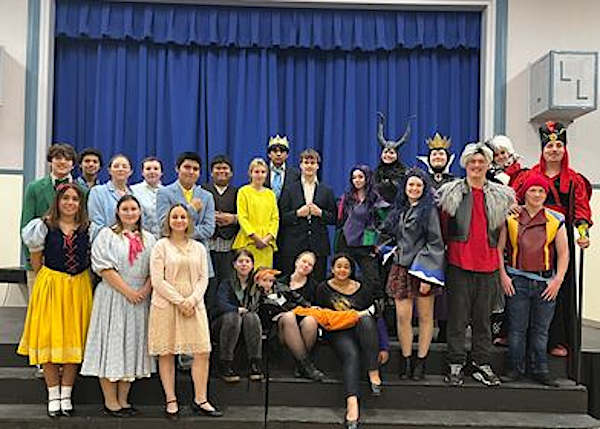
LOWER LAKE, Calif. — This weekend, Lower Lake High School is presenting its winter production, “The Descendants.”
The play will be happening Friday, Dec. 9; Saturday, Dec. 10; and Sunday, Dec. 11.
“We have many fan favorite actors returning in this production and lots of new faces to look forward to,” said drama teacher and director Tracy Lahr.
“Hard work and dedication are the main characteristics of our drama members, come see for yourself in a live performance fun for the whole family!” she said.
The cast includes Riley Watson, Evelyn Campbell, Damien Bryant, Shane Bishop, Ariana Covarrubius, Cami Yapelli, Ryn Hare, Pierce Edwards, Kaycie Meckfessel, Adam Viramontes, Erick Cruz Perez, Marissa Roberts, Madison Hershwitsky, Aubrey Weese, Victor Silva, Giulia Ragone, Noah Fortanel, Bridget Ruhle, Opal Patton, Gabe Arpia, Izeah Patterson, Arabella Guillermo Rubio, Lena Guillory and Johnnie Lindsey.
“It’s a wonderful cast,” said Lahr. “I can’t wait for the audience to watch them shine!”
Lahr gave a special shout out to alumni Abby Tucker for the choreography.
Ticket prices are $8 for students, $9 for adults, and $10 for senior citizens which can be purchased at the door.
Friday and Saturday night showings are at 7 p.m. and Sunday's matinee is at 2 p.m. at Lower Lake High School in the multipurpose room.
Northern California has some of the strongest offshore winds in the U.S., with immense potential to produce clean energy. But it also has a problem. Its continental shelf drops off quickly, making building traditional wind turbines directly on the seafloor costly if not impossible.
Once water gets more than about 200 feet deep – roughly the height of an 18-story building – these “monopile” structures are pretty much out of the question.
A solution has emerged that’s being tested in several locations around the world: wind turbines that float.
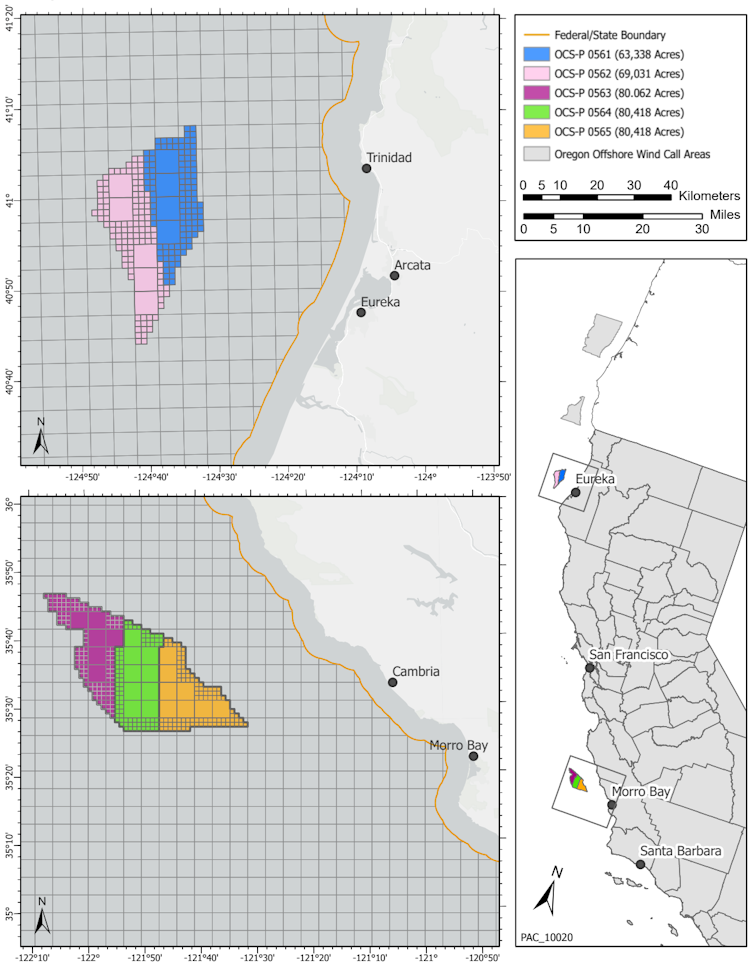
In California, where drought has put pressure on the hydropower supply, the state is moving forward on a plan to develop the nation’s first floating offshore wind farms. On Dec. 7, 2022, the federal government auctioned off five lease areas about 20 miles off the California coast to companies with plans to develop floating wind farms. The bids were lower than recent leases off the Atlantic coast, where wind farms can be anchored to the seafloor, but still significant, together exceeding US$757 million.
So, how do floating wind farms work?
Three main ways to float a turbine
A floating wind turbine works just like other wind turbines – wind pushes on the blades, causing the rotor to turn, which drives a generator that creates electricity. But instead of having its tower embedded directly into the ground or the seafloor, a floating wind turbine sits on a platform with mooring lines, such as chains or ropes, that connect to anchors in the seabed below.
These mooring lines hold the turbine in place against the wind and keep it connected to the cable that sends its electricity back to shore.
Most of the stability is provided by the floating platform itself. The trick is to design the platform so the turbine doesn’t tip too far in strong winds or storms.

There are three main types of platforms:
-
A spar buoy platform is a long hollow cylinder that extends downward from the turbine tower. It floats vertically in deep water, weighted with ballast in the bottom of the cylinder to lower its center of gravity. It’s then anchored in place, but with slack lines that allow it to move with the water to avoid damage. Spar buoys have been used by the oil and gas industry for years for offshore operations.
-
Semisubmersible platforms have large floating hulls that spread out from the tower, also anchored to prevent drifting. Designers have been experimenting with multiple turbines on some of these hulls.
-
Tension leg platforms have smaller platforms with taut lines running straight to the floor below. These are lighter but more vulnerable to earthquakes or tsunamis because they rely more on the mooring lines and anchors for stability.
Each platform must support the weight of the turbine and remain stable while the turbine operates. It can do this in part because the hollow platform, often made of large steel or concrete structures, provides buoyancy to support the turbine. Since some can be fully assembled in port and towed out for installation, they might be far cheaper than fixed-bottom structures, which require specialty vessels for installation on site.

Floating platforms can support wind turbines that can produce 10 megawatts or more of power – that’s similar in size to other offshore wind turbines and several times larger than the capacity of a typical onshore wind turbine you might see in a field.
Why do we need floating turbines?
Some of the strongest wind resources are away from shore in locations with hundreds of feet of water below, such as off the U.S. West Coast, the Great Lakes, the Mediterranean Sea and the coast of Japan.

The U.S. lease areas auctioned off in early December cover about 583 square miles in two regions – one off central California’s Morro Bay and the other near the Oregon state line. The water off California gets deep quickly, so any wind farm that is even a few miles from shore will require floating turbines.
Once built, wind farms in those five areas could provide about 4.6 gigawatts of clean electricity, enough to power 1.5 million homes, according to government estimates. The winning companies suggested they could produce even more power.
But getting actual wind turbines on the water will take time. The winners of the lease auction will undergo a Justice Department anti-trust review and then a long planning, permitting and environmental review process that typically takes several years.
Globally, several full-scale demonstration projects with floating wind turbines are already operating in Europe and Asia. The Hywind Scotland project became the first commercial-scale offshore floating wind farm in 2017, with five 6-megawatt turbines supported by spar buoys designed by the Norwegian energy company Equinor.
Equinor Wind US had one of the winning bids off Central California. Another winning bidder was RWE Offshore Wind Holdings. RWE operates wind farms in Europe and has three floating wind turbine demonstration projects. The other companies involved – Copenhagen Infrastructure Partners, Invenergy and Ocean Winds – have Atlantic Coast leases or existing offshore wind farms.
While floating offshore wind farms are becoming a commercial technology, there are still technical challenges that need to be solved. The platform motion may cause higher forces on the blades and tower, and more complicated and unsteady aerodynamics. Also, as water depths get very deep, the cost of the mooring lines, anchors and electrical cabling may become very high, so cheaper but still reliable technologies will be needed.
But we can expect to see more offshore turbines supported by floating structures in the near future.
This article was updated with the first lease sale.
Matthew Lackner, Professor of Mechanical Engineering, UMass Amherst
This article is republished from The Conversation under a Creative Commons license. Read the original article.

LAKE COUNTY, Calif. — This week several local tribes and an environmental group that has advocated for protections for the Clear Lake hitch asked the U.S. Fish and Wildlife Service to provide emergency protections to the fish.
The Big Valley Band of Pomo Indians, Robinson Rancheria of Pomo Indians, Habematolel Pomo of Upper Lake, the Scotts Valley Band of Pomo Indians and the Center for Biological Diversity are seeking the help for the hitch, a native minnow found only in Clear Lake.
Separately, the tribes are holding a summit with state and federal agencies on Thursday to discuss immediate protections with the state, said Sarah Ryan, the environmental director and emergency management director for the Big Valley Pomo.
This week’s request under the Endangered Species Act notes that the imperiled California fish’s numbers have plummeted in recent years. Extinction is now a distinct possibility if swift action isn’t taken.
The hitch has great cultural significance and has been a primary food source that has sustained the Tribes for generations.
“Our tribe expects and relies on the state and federal agencies to carry out their responsibilities for managing land, water, and all the fish and wildlife,” said Philip Gomez, chairman of the Big Valley Band of Pomo Indians. “We have come to a point where we know that the agencies must try harder, and they must welcome the Tribes to co-manage our land and waters. We call out to Secretary of the Interior Deb Haaland to authorize emergency listing of the chi/Clear Lake hitch immediately, so they can be protected for their spawning a few months from now. None of us want this fish to go extinct on our watch, as tribal leaders.”
“We are talking about extinction,” said Meg Townsend, senior freshwater attorney at the Center for Biological Diversity. “The hitch can’t withstand one more year of failed spawning. The Fish and Wildlife Service’s failure to protect this severely imperiled fish for more than a decade is shocking and unacceptable. Only emergency protections can correct this grievous error and give the hitch a fighting chance.”
The last successful spawning of Clear Lake hitch was observed in 2017. The following year, extremely few juvenile hitch were collected. Almost no juvenile hitch have been observed since. Adult hitch are now also in steep decline. With an estimated six-year lifespan, the hitch can’t survive many more years of failed spawning without disappearing forever.
The primary threat to Clear Lake hitch is a lack of spring flows in lake tributaries used for spawning. This is caused by water over-withdrawal, both legal and illegal, that is being worsened by climate change-driven drought. The hitch is also threatened by fish-passage barriers, habitat degradation, pollution, and predation and competition from invasive, stocked fish, including carp and bass.
The Center for Biological Diversity petitioned the Service in 2012 to protect the hitch under the Endangered Species Act. After eight years of delay and a lawsuit by the center, the agency finally issued a decision, but, in a bizarre move, denied the fish protections.
The center challenged this decision in federal court, leading the agency to reconsider listing the hitch, but no new decision will be made until 2025.
“As President Biden highlighted this week at the White House Tribal Nations Summit, Indigenous Knowledge is to be considered in policy and agency decision making,” said Sherry Treppa, chairperson of the Habematolel Pomo of Upper Lake. “The service needs to respect not only Tribal Nations but the president and take immediate action otherwise years of research, preservation and repopulation efforts by local tribal nations and county will be for naught.”
“The Clear Lake hitch — the chi — is an important part of our tribe’s culture that sustained our families for generations,” said Jesse Gonzalez, vice chair of Scotts Valley Band of Pomo Indians. “We as Indian people have lost so much of our ways and our culture at the hands of others, and now we’re trying so hard to hold on to what’s left, for ourselves, for our families, and for our future. I remember catching chi as a young boy and now can only hope that my children will one day have that same experience. If the U.S. Fish and Wildlife Service doesn’t give the chi emergency endangered species protections, we fear that our future generations will never have that opportunity.”
The hitch needs immediate action, including captive rearing, enforcement action against illegal water withdrawals by cannabis growers and others, control of invasive predatory fish in the lake, and work with legal water rights holders to maintain instream flows. Emergency protection under the Endangered Species Act would help ensure these things happen.
On Nov. 3, the California Fish and Game Commission took the unprecedented step of writing to the Service to request emergency listing of the hitch under the act.
The service has only given emergency listings to two species in the past two decades. Such listings take effect immediately upon publication in the Federal Register and last for 240 days. Simultaneously, the service must publish a proposed rule to extend the listing beyond the initial period.
“The Clear Lake hitch is on the verge of extinction unless action is taken now,” said Michael Y. Marcks, vice-chairperson of the Habematolel Pomo of Upper Lake. “Tribes are united in seeking protection of the hitch, which is culturally significant to The Habematolel Pomo of Upper Lake. Our tribe has strong connections and traditions to our land, and we constantly strive to conserve, preserve, and protect all our natural resources. The U.S. Fish and Wildlife Service must use its emergency authority to protect and preserve the hitch for future generations.”
“In 2004, Robinson Rancheria started the efforts for the first petition to U.S Fish and Wildlife for the hitch to be listed under the Federal Endangered Species Act,” said Irenia Quitiquit, secretary treasurer of the Robinson Rancheria of Pomo Indians Citizens Business Council. “Because of Robinson Rancheria’s peoples’ strong ties to the hitch, culturally and for subsistence, an emergency listing would be a great victory toward saving the hitch from extinction. Robinson Rancheria’s Tribal efforts over the past 18 years has been documented through many federal grants and tribal support efforts to continue studying the hitch. Research has proven to be effective in this hopeful goal — having the hitch listed as a federally endangered species. All Lake County California Tribes look forward to continuing the meaningful work to save the hitch.”
The California Department of Public Health said this week that statewide flu activity has reached high levels across the state.
Dr. Karl Sporer told the supervisors that flu activity also is rising in Lake County, along with COVID-19.
He noted that he had last visited the board two months ago to say how nice everything was. “Now, it’s not so nice.”
Sporer said health officials are seeing a “triple epidemic” involving flu, COVID-19 and respiratory syncytial virus, or RSV.
“We’re holding our own at the two hospitals,” he said.
RSV is causing a lot of pediatric hospitalizations nationwide. However, Sporer — who noted county health officials meet with the two hospitals every two weeks — said there have only been two RSV patient cases that needed to be transferred out and they were able to find rooms for them.
“It hasn’t impacted our community at this point,” Sporer said.
Sporer said he thinks RSV will peak in the next couple of weeks and then it will go down.
At the same time, Sporer said probably one of the worst flu seasons in 15 years is now taking place, and he’s recommending people get vaccinations.
The flu is causing a 25% increase across admissions in hospitals, Sporer said. “We’re going to see some strain here as we get into the new year.”
At the same time, he is starting to see a 10 to 15% increase in COVID-19 and coronavirus across the country, and more people are being admitted to hospitals with the illness.
He said he’s concerned about the flu and COVID together, causing hospitalizations to go up.
Sporer doesn’t expect the situation to get as bad as it was in New York City three years ago, “But I think it’ll be a tough winter to get through.”
He said the county will work with the local hospitals to get through the situation.
The county also is working with the state, with Sporer noting that the state’s COVID state of emergency will end at the end of February.
During the discussion, Supervisor Jessica Pyska said that Adventist Health is opening an urgent care clinic the second week in January. It will be the only such clinic in Lake County.
Supervisor Bruno Sabatier asked about capacity at Lake County’s hospitals.
Sporer said they are seeing a little bit of an increase in interfacility transports out of the county.
There are eight intensive care unit beds in Lake County, two of which were empty as of Tuesday, he said.
“So we’re handling it at this point,” Sporer said.
Email Elizabeth Larson at