 How to resolve AdBlock issue?
News
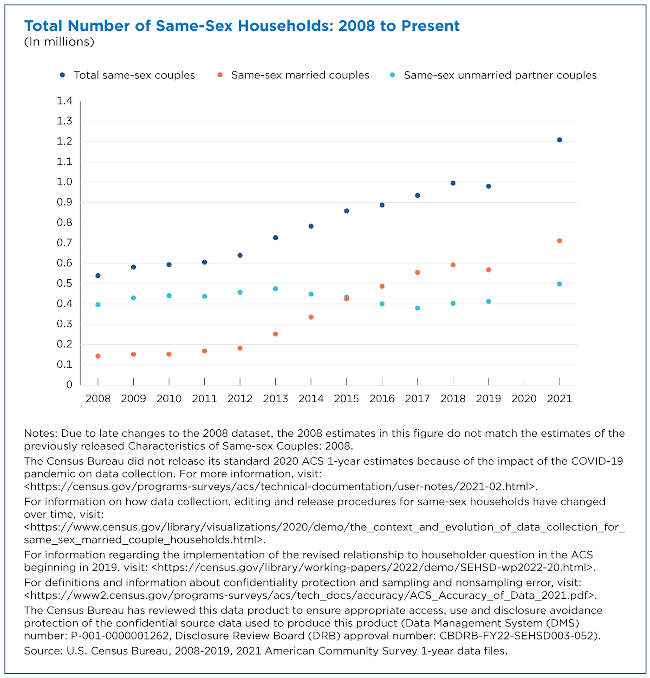
Roughly 710,000 of the same-sex couple households were married and about 500,000 were unmarried.
These and many other estimates can be found in the Census Bureau’s recently released package of tables and graphics about the characteristics of same-sex couple households, which are based on American Community Survey (ACS) data.
The package, which shows estimates from 2005 through 2021, was not released in 2020 due to the impact of COVID-19 on ACS data collection.
Other highlights from the release:
• The average age of householders in same-sex married couples (48.9 years) was lower than in opposite-sex married couples (52.8 years). But the average age of householders in same-sex unmarried couples (42.0 years) was higher than in opposite-sex unmarried couples (39.9 years).
• The share of female-female and male-male couples with both partners employed did not differ significantly, though median household income in female same-sex couple households ($92,470) was lower than in male same-sex couple households ($116,800).
• Both partners had at least a bachelor’s degree in a larger share of same-sex (29.6%) than opposite-sex (18.1%) unmarried couples.
• A larger share of same-sex (31.6%) than opposite-sex (18.4%) married couples were interracial.
• The District of Columbia (2.5%) had the highest percentage of same-sex couple households of any state or state equivalent.
This is the second time the Census Bureau has released ACS estimates of same-sex couple households since revising the survey’s relationship to householder question to more accurately capture same-sex relationships.
The ACS does not identify all couples living together since it only collects information about each household member’s relationship to the householder, rather than about the relationships among all household members.
Further information regarding ways the Census Bureau has changed how it collects information about same-sex couples over time is available.
Zachary Scherer is a statistician in the Census Bureau’s Social, Economic, and Housing Statistics Division.
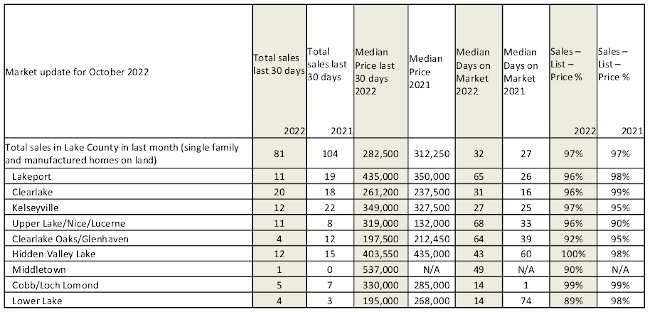
Over the month of October, the total homes sold through the multiple listing service last month totaled 81, compared to 104 during the same time last year.
These include traditionally built “stick-built” houses as well as manufactured homes on land.
There were six sales of mobile homes in parks compared to seven for the same time last year, and 24 bare land (lots and acreage) sales, compared with 26 for the same time in 2021.
There are 412 homes on the market now. If the rate of sales stays the same at 63 homes sold per month, there are currently five months of inventory on the market at the moment compared to 4.4 months of inventory a month ago.
That means that if no new homes are brought to the market for sale, in five months all of these homes would be sold and there would be none available.
Less than six months of inventory is generally considered to be a “sellers’ market” while more than six months of inventory is often called a “buyers’ market.
The inventory has been growing steadily over the past several months, with more homes being brought to market with fewer buyers.
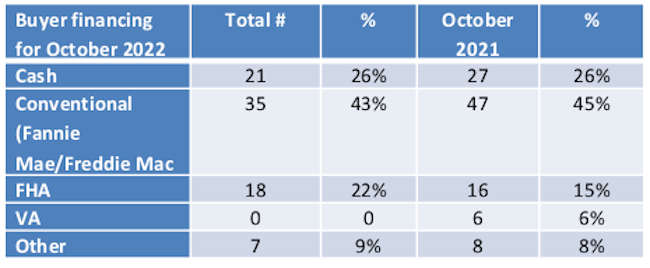
The total percentage of homes bought for all cash in October was 26%, the same amount as in October 2021.
Of those, 43% were financed by Fannie Mae or Freddie Mac (“conventional loans”) compared to 45% for the same time last year; 22% were financed by FHA compared to 15% for this time last year); and 0% were financed by the VA or CalVet (compared to 6% for this time last year) 9% had other financing such as private loans or seller financed notes (compared to 8% last year at this time).
Most homes were selling very close to the asking price, at an average of 97% of the asking price. This is in contrast to other areas, where homes still sell for more than the asking price.
The median time on the market last month was 32 days, compared to 27 days for this time last year.
The median sale price of a single family home in Lake County over the last 30 days was $282,500, lower than $312,250 during this time period last year.
In the past 30 days, 48% of homes sold had seller concessions for an average of $9,035; a year ago 38% of homes sold had an average seller concession of $7,817.

KELSEYVILLE, Calif. — National nonprofit Wreaths Across America announced that the Kelseyville Cemetery has once again joined in the mission to “Remember, Honor, Teach” as an official location for 2022.
Wreaths Across America started as a simple gesture of thanks that has grown into a national movement of dedicated volunteers and communities coming together to not only remember the nation’s fallen and honor their service, but to teach the next generation about the sacrifices made for us to live freely.
This year, there will be more than 3,100 participating locations placing veterans’ wreaths on National Wreaths Across America Day — at 9 a.m. Saturday, Dec. 17 — with more than two million volunteers coming together.
The goal for The Kelseyville Cemetery is to raise enough funds to place 519 sponsored veterans’ wreaths on the headstones of all the local heroes laid to rest there, to ensure that the individuals who served to protect the freedoms of our country never be forgotten and to bring the community together in patriotic commemoration.
Girl Scout Troop 10145 and 10490 have been working diligently all year long to raise sponsorships for the wreaths.
Both Girl Scout Troops 10145 and 10490 along with Blue Heron and Big Valley 4-H will be facilitating the brief ceremony and placing wreaths on veterans graves.
Organizers invite the community to join them from 9 to 10 a.m. Saturday, Dec. 17, to remember and honor our local heroes.
The ceremony is free and open to the public.
“We are grateful for the opportunity to support the Wreaths Across America initiative at Kelseyville Cemetery where we take pride in honoring our Veterans and teaching our youth the value and cost of our freedom,” said event coordinator Allison Panella.
Those interested in volunteering for Wreaths Across America or sponsoring a wreath for the Kelseyville Cemetery are invited to visit this site for more information.

The forecast calls for light rain across low elevation areas and light snow across high mountainous terrain through Monday, with cold temperatures developing on Tuesday morning, when widespread frost is expected.
The National Weather Service said a multi-inch rainfall event is forecast to occur across northwest California Wednesday evening through Thursday evening.
Conditions on Thursday could lead to snow levels falling below the 2,000-foot elevation level for a time.
Rain is forecast to decrease Thursday night through Friday afternoon.
The Lake County forecast calls for frost early on Monday and Tuesday mornings, and chances of rain from Wednesday through Sunday. Up to three quarters of an inch of rain could fall on Wednesday.
There also is the chance for both rain and snow in higher elevations on Friday night.
Temperatures this week are forecast to be in the low 40s to high 40s during the days and into the low 30s at night.
Winds of up to 13 miles per hour also are in the forecast for Monday.
Email Elizabeth Larson at

The planet is heating up as greenhouse gas emissions rise, contributing to extreme heat waves and once-unimaginable flooding. Yet despite the risks, countries’ policies are not on track to keep global warming in check.
The problem isn’t a lack of technology. The International Energy Agency recently released a detailed analysis of the clean energy technology needed to lower greenhouse gas emissions to net zero globally by 2050. What’s needed, the IEA says, is significant government support to boost solar and wind power, electric vehicles, heat pumps and a variety of other technologies for a rapid energy transition.
One politically popular tool for providing that government support is the subsidy. The U.S. government’s new Inflation Reduction Act is a multibillion-dollar example, packed with financial incentives to encourage people to buy electric vehicles, solar panels and more.
But just how big do governments’ clean energy subsidies need to be to meet their goals, and how long are they needed?
Our research points to three important answers for any government considering clean energy subsidies – and for citizens keeping an eye on their progress.
Why subsidize at all?
An obvious first question is: Why should governments subsidize clean energy at all?
The most direct answer is that clean energy helps to reduce harmful emissions – both of gases that cause local pollution and of those that warm the planet.
Reducing emissions helps to lower both public health costs and damage from climate change, which justifies government spending. Reports have estimated that the U.S. spends US$820 billion a year just on health costs associated with air pollution and climate change. Globally, the World Health Organization estimated that the costs reached $5.1 trillion in 2018. Taxing and regulating polluting industries can also cut emissions, but carrots are often more politically popular than sticks.

A less obvious reason for subsidies is that government support can help a new and initially expensive technology become competitive in the market.
Governments have been central to the development of many technologies that are pervasive today, including microchips, the internet, solar panels and GPS. Microchips were fantastically expensive when first developed in the 1950s. Demand from the U.S. military and NASA, which could pay the high price, fueled the growth of the industry, and costs eventually dropped enough that they’re now found in everything from cars to toasters.
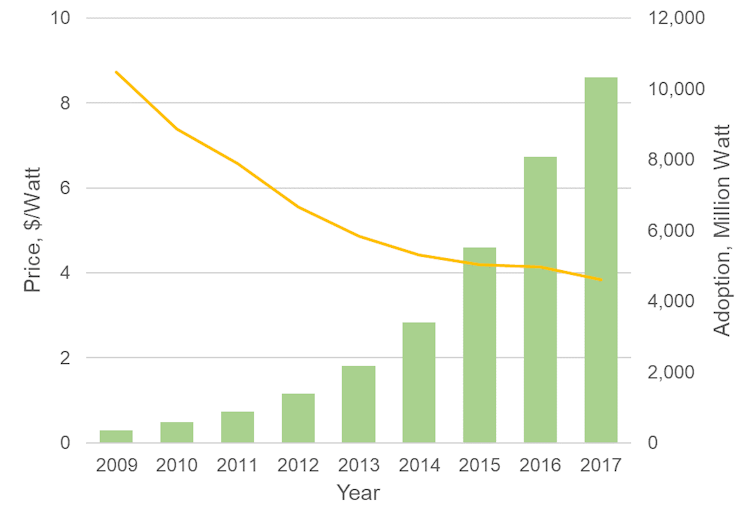
Government support has also helped to bring down the cost of solar power. Rooftop solar system costs fell 64% from 2010 to 2020 in the U.S. because cells became more efficient and higher volumes drove prices down.
How much money?
So, subsidies can work, but what’s the right amount?
Too low, and a subsidy has no effect. Giving everyone a coupon for $1 off an electric car won’t change anyone’s buying plans. But subsidies can also be set too high.
The government doesn’t need to spend money persuading consumers who already plan to buy an electric car and can afford one, yet studies show clean energy subsidies disproportionately go to richer people. When people who would have purchased the item anyway receive subsidies, they’re known as “free riders.”
The ideal subsidy attracts new buyers while avoiding free riders and overspending on people who are already convinced. The subsidy can only work when it convinces a previously uninterested consumer to buy a product.
How long should subsidies last?
Timing is also important when thinking about the size of subsidies. When a promising technology is new and expensive, free riders are less of an issue. A large subsidy may be needed to attract even a few buyers, build out the emerging market and support the industry’s growth.
Solar power is a good example: In 2005, solar was several times more expensive than traditional electricity sources. Subsidies, like the 30% Investment Tax Credit established that year, helped lower the cost, and today’s solar is about one-tenth the price and cost-competitive with other electricity sources.
Once a clean technology is competitive, subsidies can still play an important role in speeding up the energy transition, but at a lower level than in the past.
In our research on residential solar panels, we estimate that the ideal subsidy for rooftop solar should have been initially higher than the actual federal tax credit but fall more quickly, declining to zero after 14 years from its start date.
By starting the subsidy about 20% higher, our models found that it would have boosted production faster, which would cut costs faster and reduce the need for high future subsidies.
Should subsidies eventually disappear?
It makes sense for subsidies to disappear altogether once a technology is sufficiently cost-competitive. However, even if a technology is competitive, it might be worth further subsidy if the speed of adoption is important.
The argument for continuing a subsidy depends on whether the additional adoption it stimulates is cost-effective in reducing emissions. Wind power is cheaper than fossil fuel power in many parts of the country. Even so, we found that continuing subsidies for wind power would lead to valuable emission benefits.
That said, sometimes subsidies stick around when they shouldn’t.
Fossil fuels have been heavily subsidized for decades, despite their harm to human health, the environment and the climate, all of which raise public costs. Governments globally spent almost $700 billion on fossil fuel subsidies in 2021. The U.S. government, in recent years, has spent more on renewable energy tax credits than fossil fuels, which is a promising transition of government support.
Global impact
While the U.S. was the focus of our solar subsidy research, this way of thinking – balancing the costs and benefits of subsidies – can be applied in other nations to design better subsidies for clean energy technologies.
The subsidy is just one policy tool, but it is an important one for both stimulating early-stage technologies and accelerating deployment of more competitive options. As the world attempts the fastest energy transition in history, today’s energy subsidy decisions will affect its ability to succeed.
Eric Hittinger, Associate Professor of Public Policy, Rochester Institute of Technology; Eric Williams, Professor of Sustainability, Rochester Institute of Technology; Qing Miao, Associate Professor of Public Policy, Rochester Institute of Technology, and Tiruwork B. Tibebu, Ph.D. Student, Rochester Institute of Technology
This article is republished from The Conversation under a Creative Commons license. Read the original article.
Call Lake County Animal Care and Control at 707-263-0278 or visit the shelter online at http://www.co.lake.ca.us/Government/Directory/Animal_Care_And_Control.htm for information on visiting or adopting.
The following cats at the shelter have been cleared for adoption.

Male domestic shorthair
This 3-year-old male domestic shorthair cat has an orange tabby coat.
“This guy can be shy at first, but once he knows that you are all about the pets, he will roll right over and start his purr machine. He has a unique curly tail which he flicks around when curious,” shelter staff said.
He is in cat room kennel No. 13, ID No. LCAC-A-4021.

Male domestic shorthair
This 8-year-old male domestic shorthair cat has an orange tabby coat.
He is in cat room kennel No. 47, ID No. LCAC-A-4319.

‘Sampson’
“Sampson” is a male domestic shorthair with a black coat.
He is in cat room kennel No. 77, ID No. LCAC-A-4317.
Email Elizabeth Larson at