 How to resolve AdBlock issue?
News

Dear Lady of the Lake,
I wrote to you before and asked about the current state of the Hitch. Thank you for writing a column about them. Now my question is, what does it mean if the fish becomes “listed” or not? What does a federal listing do anyway?
Thanks,
- Hans asking (again) about the Hitch
HI Hans,
Thanks for that great question. I will actually divide up the response to this question, since the answer is very large, complicated, and deserves more than one column.
So, today we will focus on the Endangered Species Act (ESA), implemented and enforced by the US Fish and Wildlife Service (USFWS), and what it means for a species to be “listed”, and the economic costs for a species to be listed, and I will end with a case study from my time working in a stream with a listed species.
As you mentioned Hans, I previously wrote about the hitch (or chi) in my column, "How about the Hitch," from Jan. 16, 2022.
Today I will not go into description, life history, or research on the hitch, as those can all be found in my previous column.
You can also view the Water Quality Wednesday How About the Hitch video, from Jan. 16, 2022 here.
You can also check out the new Clear Lake Hitch / Chi website on the County of Lake Water Resources Department.
Secondly, current status of the hitch, and other hitch populations, can be accessed in this video of the Board of Supervisors meeting from Feb. 7, where federal agencies studying the hitch, provided current data and condition information. This video is also available on the County of Lake YouTube Channel.
Lastly, the emergency proclamation for the hitch text can be found in this Lake County News article from Feb. 8. Basically, the proclamation outlines background precedents for why a declaration is needed, and that the hitch is important to lake county pomo culture and practice, and that various agencies increase efforts on protecting hitch lake and stream habitats, stream flows, and conservation measures to protect habitat and prevent further species loss.
The emergency proclamation was approved unanimously by the Board on Feb. 7.
What is the ESA?
When a species becomes “listed,” it means they are placed on a list that is applicable to the Federal US Fish and Wildlife Endangered Species Act, or ESA.
The ESA was enacted in 1973 by the 108th Congress, and is housed under the Department of Interior, and it’s the responsibility of the USFWS to implement and manage.
The first line in the ESA declares that plants, fish, and wildlife have become extinct because “economic growth and development untempered by adequate concern and conservation.”
Therefore, it's clear, based on the ESA, that any efforts to reduce extinctions and habitat loss, for target species, is to implement smarter economic development and account for species impacts, and protect “critical habitat” or areas, or range, that are necessary to sustain the target species numbers.
The ESA lists species classified as either threatened and endangered species, with the definitions being that “Threatened” identifies a species as likely to become endangered within the foreseeable future and “Endangered” identifies a species that is in danger of extinction throughout all or a significant portion of its range.
Some species that have been listed as endangered, ended up existing in a wider area than previously monitored prior to listing, and then were moved down the list from endangered to threatened. Others, who were thought to be extinct, were discovered in large populations and put back on the endangered list, such as the Iowa Pleistocene Snail, found in only north-facing slopes in certain regions of Iowa and Illinois.
Likewise, species can be removed from the list, or delisted, when they are declared extinct, such as the Ivory-billed Woodpecker, last seen in the Tensas River, LA in 1944, the Scioto madtom, freshwater fish last observed in Ohio in 1957, and about 21 other fish and wildlife species since 2021.
The best result is when species become fully “delisted” when their numbers and habitats fully rebound and are deemed to no longer need the protection of the ESA. Examples of this are the Steller Sea Lion, listed in 1990, delisted in 2003, and the Eastern Northern Pacific Grey Whale was listed in 1970 and considered recovered, and delisted in 1994.
What does the ESA do, exactly?
The purpose, as listed on page one of the ESA, states that, “The purposes of this Act are to provide a means whereby the ecosystems upon which endangered species and threatened species depend may be conserved, to provide a program for the conservation of such endangered species and threatened species”.
ESA, as defined on the FWS website, “The Endangered Species Act establishes protections for fish, wildlife, and plants that are listed as threatened or endangered; provides for adding species to and removing them from the list of threatened and endangered species, and for preparing and implementing plans for their recovery; provides for interagency cooperation to avoid take of listed species and for issuing permits for otherwise prohibited activities…”
This means that to comply with ESA, the target species has to have habitat necessary to live and sustain a population. In other words, a species has to be able to live in their “natural habitat” and not just inside a zoo, wildlife park, fish farm, hatchery, or other type of facility that is sustaining their livelihood.
Population supplementation (like fish hatcheries) can be used to maintain populations that live in their wild habitat, but the habitat has to be maintained to support the natural and supplemented populations. This would also imply that the habitat must support the species reproduction and recruitment within the remaining population. So, the ESA is really about preserving enough habitat and wildlands that can support healthy, sustaining populations of fish, plants, and animals and that nothing is causing death or “harm” to the individuals of those populations.
Some species can even be declared extinct in the wild, but then be reclassified to critically endangered, if repopulation efforts are successful. This scenario applies to the California Condor, which now has several wild established populations in several western states, but at one time there were only a few individuals in parks.
Since about 1850, more than 100 years prior to the ESA, there were several acts that protected wildlife and implemented federal conservation laws. The Lacey Act of 1900 prevented commercial hunting and interstate trade of certain plants and animals. The Migratory Bird Treaty Act of 1918 made it illegal to pursue, take, hunt, capture, kill, or sell birds migrating between the United States and Canada and the The Bald and Golden Eagle Protection Act of 1940 prohibited the taking of a bald or golden eagle.
In 1966, the Endangered Species Preservation Act was passed by Congress, which created a federal list of endangered animals and prohibited the take of listed animal species on all national wildlife refuges. This law was later modified in 1969 to prohibit the selling or importing of animals from around the world that were facing extinction.
Then in 1972, Congress passed the Marine Mammal Protection Act, which prohibits the take of all marine mammals, including whales, dolphins, sea lions, sea otters, and polar bears, within waters of the US. This last law was implemented by US National Oceanic and Atmospheric Administration (NOAA), and remained responsible for marine mammal protection after the 1973 ESA enaction.
You can see there is a long history of federal fish and wildlife protection, as ESA deems it necessary “to better safeguard, for the benefit of all citizens, the Nation’s heritage in fish, wildlife, and plants.”[1]
Believe it or not, the ESA was signed into law by then president Richard Nixon, and one of the law’s authors was the first head of the White House’s Office of Environmental Quality, Russel Train (and would later become the second administrator of the US EPA), and the law passed the house 320-12, and the senate with a vote of 92-0, a large margin in favor. This act was highly popular with everyone.
The ESA has been amended several times, in 1978, 1982, 1988, and lastly in 2004. A push to remove the ESA completely, with a clear sunset clause to end the act by 2015, was proposed in 2005 but never made it to the house floor.
The last item of note, especially as it related to a potential ESA listing of the hitch, the ESA as stated in its second purpose, “ It is further declared to be the policy of Congress that Federal agencies shall cooperate with State and local agencies to resolve water resource issues in concert with conservation of endangered species.”
Limiting or eliminating take
Throughout the above section, and when reading any ESA legislation, website, account, or listing description, the phrase “take of the species” [prohibited Acts, page 25] is commonly occurring. This is really the meat and potatoes of the ESA when it comes to the boots-on-the-ground protections of a species.
In the ESA list of definitions [page 3], The term “take” means to harass, harm, pursue, hunt, shoot, wound, kill, trap, capture, or collect, or to attempt to engage in any such conduct. The “harm” clause is the most important here, as any negative impact to ecosystems or habitat, could consequently, harm the target species.
Therefore, any activity by any person that might cause, or lead to, “take/harm” of the listed species, is considered in violation of the ESA, and against the law.
It’s worthy to note, that in the ESA definitions [page 3], the term “persons” applies to means an “individual, corporation, partnership, trust, association, or any other private entity; or any officer, employee, agent, department, or instrumentality of the Federal Government, of any State, municipality, or political subdivision of a State, or of any foreign government; any State, municipality, or political subdivision of a State; or any other entity subject to the jurisdiction of the United States.”
To put it bluntly, any activity or action that an individual or a city, county, state, conducts that might lead to take/harm of an ESA species, is in violation of the law and has to be responsible for the protection of that species through that activity or action.
Failure to comply with ESA can lead to citizen suits, and civil and criminal penalties. Civil violations of major provisions can result in $12,000 - $25,000 fines. Some criminal violations can lead to imprisonment and a fine up to $50,000.
The cost of the ESA
When a species is declared endangered or threatened, there are associated costs, specifically to file the paperwork, assign staff, and to initiate a turn of events that start the process of protection, conservation, monitoring, and reporting, and collaborative and cooperative efforts by federal, trial,state, local, private, and commercial persons or entities. There are also costs that trickle down to state, local, and private partners, that ensure protection of critical habitat and prevention of take of the species.
Listed species, and likewise their habitats, are leveraged to access ESA funds for protection measures such as habitat acquisitions and restoration projects. But some costs, like mitigation, have to be borne by private parties or local or regional agencies. Costs to implement ESA requirements are notoriously expensive.
One of the tasks that are required when a species is listed, is for the USFWS to estimate the cost for a recovery of that species. For example, described in a 414-page plan to recover California Clapper rail bird, the salt marsh harvest mouse, and three plants, which all share a similar niche habitat of Salt marshes of the San Francisco bay Delta, is a total estimate recovery cost of $1,242,501,640 (you read that right, it’s $1.2 billion). This plan describes recovery costs through 2063 and also adds a caveat that “additional costs that could not be estimated at this time” of which, footnotes indicate these additional costs include obvious items such as the cost to “acquire / protect currently unprotected habitat”.
Some listed species, like the loggerhead turtle, do not have a total cost estimate for recovery, but within their recovery plan, indications that the cost would exceed $1 billion is obscurely suggested, but is also probably the best case scenario, especially considering the turtle's habitat and international complications.
However, there is a local cost that must be borne to ensure the recovery of an ESA-listed species. The concept that previous protection was missing, and actions were allowed without consideration of take or harm to a species, is the cause of the species needing to be listed in the first place. There is a reason the species is being listed, and of course it will cost a lot to recover it, and there really is no way around that conclusion.
Revisiting the first line of the ESA, unfettered economic development, without consideration of take of a species, or impact to the habitat that species relies on, is the cause of that species potentially going extinct.
In addition, USFWS uses a broadly interpreted term for “harm”, to include activities that can modify a species’ habitat in a matter that somehow harms the species.
Local or private party costs are those that come in the form of regulatory costs imposed upon those operating in, managing, or conducting activities in the habitats and ecosystems that house the listed species. The regulatory mechanisms through the ESA that operate here are the prohibition against “take/harm” and the requirements for consultation (section 7).
For Lake County, if the Clear Lake hitch becomes listed, this would mean that any project that occurs in, on, or near hitch habitat, would require both consultation to ensure the project won’t damage or negatively impact hitch habitat, and requirements to prevent or eliminate possibility of take or harm, such at mitigation or alternative designs, both of which could cost more on the ground and take longer to implement, but would in fact protect the species more effectively then the status quo.
Therefore, it’s expected that the local economic burden when a species becomes listed will not be small and in fact can be significant, and drastically change the way many types of projects are planned and completed.
For example, the Lucerne Harbor dredging project has undergone significant state and tribal consultation, but if the hitch was listed now, then additional federal consultations and review would also be required, adding another complicated step to the planning process before a single scoop of dirt can be dredged. The same additional steps would apply to any bridge project that covers a stream identified as historic hitch spawning ground, which in Clear Lake, includes all of them. But these actions could go a long way in protecting the species habitat and providing recovery.
It’s also important to note that the ESA is relatively benign on requirements for Indian Trust lands, because the ESA applies to lands of the US, and tribal trust lands are sovereign and tribes are sovereign governments, with their own conservation laws and practices.
To consolidate compliance with ESA however, there is a Secretarial Order 3206 (SO 3206), entitled “American Indian Tribal Rights, Federal-Tribal Trust Responsibilities, and the Endangered Species Act.” SO 3206 was established to help harmonize the government-to-government relations as they pertain to ESA in creating critical habitat and species conservation plans.
The Department of Interior Indian Affairs Endangered Species Program does provide funding to encourage tribes to comply with the consultation provisions under ESA section 7, or for species recognized as tribally-significant on tribal lands, even if the species is not yet listed.
Tribes in Lake County could currently be applying for and receiving ESA funds for hitch protection projects, as this species qualifies as tribally-significant.
External cost of ESA Listing: Red Legged Frog Case Study
However, there are other unforeseen, or external, costs to the ESA, especially for natural resource managers, that sometimes are not considered until well after a species is listed, and in this I have personal experience which I want to share.
About six years ago, I worked in the Los Virgenes stream system in Southern California, in the Santa Monica Mountains, with a nonprofit environmental trust organization. We conducted invasive red swamp crayfish management and control in streams. Specifically we trapped half a million crayfish a year from these streams, just to maintain stream habitat conditions so native and sensitive species such as Pacific Tree Frog and Arroyo Chub could sustain their populations, as fish and amphibians are key prey to invasive crayfish.
One particular stream section we heavily managed was designated locally extirpated habitat of the Federally Listed as threatened California Red Legged Frog (Rana draytonii), meaning historically red legged frogs had lived there, but were considered locally extinct due to crayfish predation and habitat modification from urban development.
However, in 2016, because we had been so successful in trapping and managing the invasive red swamp populations, we had discovered California Red Legged Frogs, eggs, and tadpoles, in this particular reach of stream. What a great success for an invasive species manager! Species recovery realized in our own stream!
However, once USWFW, and state agencies, learned that the stream was now home (again) to red legged frogs, we had to stop using our traps because the chance of “incidental take” of the frogs getting stuck in the traps, was too high for the USFWS to risk.
So, let’s review. The act of trapping and removing invasive frogs from a stream allowed the listed frog species to return to the reach, repopulate, and even reproduce. But, according to ESA regulations, the act of trapping was deemed too risky, and could cause “harm” to the red legged frogs, who had only recently returned. Additionally, there was a risk of “take,” if a few individual frogs or tadpoles got stuck in a trap.
But, termination of a trapping program would lead to increases in crayfish in the reach, which would prey upon the frogs, and cause local extirpation, again.
We proposed to alter soak times and modify traps, to still catch crayfish effectively, but limit the bycatch, but because there was no previous research existing that modified traps wouldn’t cause take, the USFWS wouldn’t accept that as a solution.
So we were stuck, with a special species on the brink and an extremely invasive species out of control. Our solution was to conduct some experiments with modified traps, in a similarly structured, nearby stream, to demonstrate effective trapping with minimal to no bycatch.
We published this study, otherwise, USFWS wouldn’t consider the study valid, and its available as open access in the Journal of Management of Biological Invasions, 2020 Volume 11, issue 1.
Then, we even refined our study to focus on even more specific type of traps and designs. We also published that study, again as open access, in the Journal of Freshwater Science, 2021 Volume 40, Issue 3.
Now, USFWS can use the information gathered during these field experiments to allow managers to expand their tool box for both effectively managing invasives while protecting native, sensitive, and listed species.
What this means for the hitch
If we want to determine what can or can not cause harm or cause the Hitch, more research is needed, although we probably don’t have time or resources to conduct and publish many experimental studies, especially with so few members of the population left.
However, all research, even if it doesn’t directly provide answers for the issues currently plaguing the hitch now, can indicate information useful for future management of the hitch or other species, or their habitat, whether the fish becomes listed or not.
Based on what I have provided you today, and my personal experience working in aquatic systems with ESA-listed species, I think that the emergency proclamation passed by the Board of Supervisors is a really, really good thing. This commitment and communication to conservation indicates that local governments, elected by the local community, are serious about saving and protecting the hitch.
This is key when it comes to a listing decision, as local support for species preservation indicates that the local community is invested in prioritizing conservation and willing to enact and participate in measures that will conserve the species, even before being enforced by the federal government. Even a local declaration can provide funding opportunities and advantages that might otherwise not be accessible.
Contrast this action with a community that takes no action, or does nothing in the face of an extinction, the USFWS might deem it more prudent to step in and make conservation a priority on behalf of the species.
Again, thank you for the continued question and interest, Hans! While this is only part 1, I will continue to cover the hitch conservation and ESA listing topic over the next few years, especially with a listing decision pending and probably decided in early 2025.
Additionally, and this is only my opinion on this issue, while I think listing has a place, I think the ultimate goal is to not have a listed species in Clear Lake. Ideally, we would want to see a recovery of the species without having to be listed. Clear Lake doesn’t need another negative label, we are already stamped with 303(d) listed impaired waterbody and have a Superfund site (Sulfur Bank Mercury Mine) located on our shores.
We all want to see a swift and sustainable recovery of the hitch before the species can be listed. This goal, although high, is not unattainable but will require significant and major work by all parties interested in seeing this species recover - and also those who could care less, because the impacts of complying with ESA are far reaching, expensive, and long-lasting, and will no doubt impact on everyone in the County on some level.
Remember some species take 50 years to be delisted due to recovery, but this has only happened a handful of times in the last 30 years. To prevent a federal hand down of conservation, let’s all work together, from the bottom up, to improve conditions now, so that we can see this species survive.
Sincerely,
Lady of the Lake
Angela De Palma-Dow is a limnologist (limnology = study of fresh inland waters) who lives and works in Lake County. Born in Northern California, she has a Master of Science from Michigan State University. She is a Certified Lake Manager from the North American Lake Management Society, or NALMS, and she is the current president/chair of the California chapter of the Society for Freshwater Science. She can be reached at
The wind advisory will be in effect from 1 p.m. Monday to 4 a.m. Tuesday.
The forecast calls for northwest winds from 15 to 25 miles per hour with gusts of up to 50 miles per hour.
The week will start off with milder conditions before colder temperatures arrive later in the week.
Daytime temperatures on Sunday and Monday will be in the low to mid 60s, dropping into the 40s at night on Sunday night and low 30s on Monday night.
On Tuesday, temperatures will be in the mid 40s during the day and low 30s at night, with Wednesday seeing daytime temperatures in the low 50s but nighttime conditions like those on Tuesday.
Thursday and Friday will again see temperatures in the 40s during the day and low 30s at night.
There also is a slight chance of rain on Friday and Friday night before sunny conditions are forecast to return on Saturday.
Email Elizabeth Larson at
Dogs available for adoption this week include mixes of border collie, boxer, chow chow, German shepherd, hound, husky, Labrador retriever, Pekingese, pit bull, shepherd, treeing walker coonhound and terrier.
Dogs that are adopted from Lake County Animal Care and Control are either neutered or spayed, microchipped and, if old enough, given a rabies shot and county license before being released to their new owner. License fees do not apply to residents of the cities of Lakeport or Clearlake.
The following dogs at the Lake County Animal Care and Control shelter have been cleared for adoption.
Call Lake County Animal Care and Control at 707-263-0278 or visit the shelter online for information on visiting or adopting.

“Samantha” is an 8-year-old pit bull terrier mix with a short tan and white coat.
She is in kennel No. 4, ID No. LCAC-A-4703.

Border collie-Labrador mix puppy
This 2-month-old male border collie-Labrador mix puppy has a short brown and white coat.
He is in kennel No. 7, ID No. LCAC-A-4672.

Male German shepherd
This 9-month-old male German shepherd has a short fawn coat.
He is in kennel No. 8, ID No. LCAC-A-4684.

Male German shepherd
This 6-month-old male German shepherd has a black and tan coat.
He is in kennel No. 10, ID No. LCAC-A-4689.

Female pit bull
This 6-year-old female pit bull has a short white coat with gray markings.
She is in kennel No. 11, ID No. LCAC-A-4677.

‘Oreo’
“Oreo” is a 2-year-old male treeing walker coonhound with a short tricolor coat.
He is in kennel No. 13, ID No. LCAC-A-4738.

‘Ducky’
“Ducky” is a 6-month-old male terrier with a short black coat.
He is in kennel No. 14, ID No. LCAC-A-4596.

‘Teddy’
“Teddy” is a 2-year-old male Pekingese with a long brown and white coat.
He is in kennel No. 15, ID No. LCAC-A-4700.
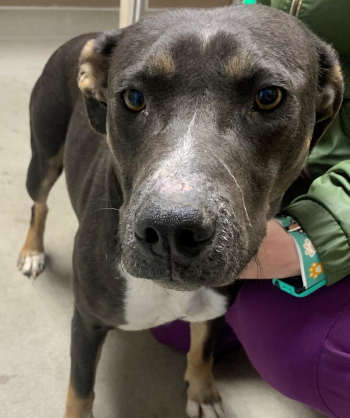
Female pit bull-Labrador retriever mix
This female pit bull-Labrador retriever mix has a short tricolor coat.
She is in kennel No. 17, ID No. LCAC-A-4692.

Female pit bull
This 4-year-old female pit bull has a short white coat with gray markings.
She is in kennel No. 19, ID No. LCAC-A-4676.

Male husky-pit bull mix puppy
This 3-month-old male husky-pit bull mix puppy has a short gray and white coat.
He is in kennel No. 20, ID No. LCAC-A-4714.

Female German shepherd
This 1-year-old female German shepherd has a black and tan coat.
She is in kennel No. 23, ID No. LCAC-A-4715.

Female shepherd-pit bull mix
This 2-month-old female shepherd-pit bull mix has a short tricolor coat.
She is in kennel No. 24a, ID No. LCAC-A-4693.

Female shepherd-pit bull mix
This 2-month-old female shepherd-pit bull mix has a short tricolor coat.
She is in kennel No. 24b, ID No. LCAC-A-4694.

Female shepherd-pit bull mix
This 2-month-old female shepherd-pit bull mix has a short tricolor coat.
She is in kennel No. 24c, ID No. LCAC-A-4695.

Male boxer-pit bull mix
This 8-year-old male boxer-pit bull mix has a short brown brindle coat.
He is in kennel No. 26, ID No. LCAC-A-4678.

‘Lola’
“Lola” is a 2-year-old female border collie mix with a red and white coat.
She is in kennel No. 27, ID No. LCAC-A-4729.

Male shepherd-pit bull mix
This 2-month-old male shepherd-pit bull mix has a short tricolor coat.
He is in kennel No. 28a, ID No. LCAC-A-4696.

Male shepherd-pit bull mix
This 2-month-old male shepherd-pit bull mix has a short tricolor coat.
He is in kennel No. 28b, ID No. LCAC-A-4697.

Male shepherd-pit bull mix
This 2-month-old male shepherd-pit bull mix has a short tricolor coat.
He is in kennel No. 28c, ID No. LCAC-A-4698.

Male German shepherd
This 1-year-old male German shepherd has a short black and tan coat.
He is in kennel No. 29, ID No. LCAC-A-4710.

‘Diesel’
“Diesel” is a 2-year-old male pit bull terrier with a short white coat with black markings.
He’s in kennel No. 31, ID No. LCAC-A-4549.

Male bulldog
This 3-year-old male bulldog has a short brown coat.
He is in kennel No. 32, ID No. LCAC-A-4745.

Chow chow-Labrador mix
This 1-year-old male chow chow-Labrador retriever mix has a short black coat.
He is in kennel No. 33, ID No. LCAC-A-4713.
Email Elizabeth Larson at

Do you think that creativity is an innate gift? Think again.
Many people believe that creative thinking is difficult – that the ability to come up with ideas in novel and interesting ways graces only some talented individuals and not most others.
The media often portrays creatives as those with quirky personalities and unique talent. Researchers have also identified numerous personality traits that are associated with creativity, such as openness to new experiences, ideas and perspectives.
Together, they seem to paint a dire picture for those who consider themselves conventional thinkers, as well as those who do not work in creative occupations – including roles that are often considered traditional and noncreative, such as accountants and data analysts.
These beliefs miss a key part of how creativity works in your brain: Creative thinking is actually something you engage in every day, whether you realize it or not.
Moreover, creativity is a skill that can be strengthened. This matters even for people who don’t consider themselves creative or who aren’t in creative fields.
In research that I recently published with organization and management scholars Chris Bauman and Maia Young, we found that simply reinterpreting a frustrating situation can enhance the creativity of conventional thinkers.
Using creative thinking to cope with emotions
Creativity is often defined as the generation of ideas or insights that are novel and useful. That is, creative thoughts are original and unexpected, but also feasible and useful.
Everyday examples of creativity are plentiful: combining leftover food to make a tasty new dish, coming up with a new way to accomplish chores, mixing old outfits to create a new look.
Another way you do this is when you practice what’s called “emotional reappraisal” – viewing a situation through another lens to change your feelings. There is an element of creativity to this: You’re breaking away from your existing perspectives and assumptions and coming up with a new way of thinking.
Say you’re frustrated about a parking ticket. To alleviate the bad feelings, you can think of the fine as a learning moment.
If you’re anxious about a presentation for work, you can cope with the anxiety by framing it as an opportunity to share ideas, rather than as a high-stakes performance that could result in demotion if handled poorly.
And if you’re angry that someone seemed unnecessarily combative in a conversation, you might reevaluate the situation, coming to view the behavior as unintentional rather than malicious.
Training your creative muscles
To test the link between creative thinking and emotional reappraisal, we surveyed 279 people. Those who ranked higher on creativity tended to reappraise emotional events more often in their daily life.
Inspired by the link between emotional reappraisal and creative thinking, we wanted to see whether we could use this insight to develop ways to help people be more creative. In other words, could emotional reappraisal be practiced by people in order to train their creative muscles?
We ran two experiments in which two new samples of participants – 512 in total – encountered scenarios designed to provoke an emotional response. We tasked them with using one of three approaches to manage their emotions. We told some participants to suppress their emotional response, others to think about something else to distract themselves and the last group to reappraise the situation by looking at it through a different lens. Some participants were also given no instructions on how to manage their feelings.
In a seemingly unrelated task that followed, we asked the participants to come up with creative ideas to solve a problem at work.
In the experiments, conventional thinkers who tried reappraisal came up with ideas that were more creative than other conventional thinkers who used suppression, distraction or received no instructions at all.
Cultivating flexible thinking
Negative emotions are inevitable in work and life. Yet people often hide their negative feelings from others, or use distraction to avoid thinking about their frustrations.
Our findings have implications for how managers can think about how to best leverage the skills of their workers. Managers commonly slot job candidates into creative and noncreative jobs based on cues that signal creative potential. Not only are these cues shaky predictors of performance, but this hiring practice may also limit managers’ access to employees whose knowledge and experience can play major roles in generating creative outcomes.
The result is that the creative potential of a significant part of the workforce may be underutilized. Our findings suggest that supervisors can develop training and interventions to cultivate creativity in their employees – even for those who might not seem predisposed to creativity.
Our research also indicates that people can practice flexible thinking every day when they experience negative emotions. Although people may not always have control over the external circumstances, they do have the liberty to choose how to cope with emotional situations – and they can do so in ways that facilitate their productivity and well-being.
Lily Zhu, Assistant Professor of Management, Information Systems and Entrepreneurship, Washington State University
This article is republished from The Conversation under a Creative Commons license. Read the original article.
When NASA’s Curiosity rover arrived at the “sulfate-bearing unit” last fall, scientists thought they’d seen the last evidence that lakes once covered this region of Mars.
That’s because the rock layers here formed in drier settings than regions explored earlier in the mission. The area’s sulfates – salty minerals – are thought to have been left behind when water was drying to a trickle.
So Curiosity’s team was surprised to discover the mission’s clearest evidence yet of ancient water ripples that formed within lakes. Billions of years ago, waves on the surface of a shallow lake stirred up sediment at the lake bottom, over time creating rippled textures left in rock.
“This is the best evidence of water and waves that we’ve seen in the entire mission,” said Ashwin Vasavada, Curiosity’s project scientist at NASA’s Jet Propulsion Laboratory in Southern California. “We climbed through thousands of feet of lake deposits and never saw evidence like this – and now we found it in a place we expected to be dry.”
Layers of history
Since 2014, the rover has been ascending the foothills of Mount Sharp, a 3-mile-tall (5-kilometer-tall) mountain that was once laced with lakes and streams that would have provided a rich environment for microbial life, if any ever formed on the Red Planet.
Mount Sharp is made up of layers, with the oldest at the bottom of the mountain and the youngest at the top. As the rover ascends, it progresses along a Martian timeline, allowing scientists to study how Mars evolved from a planet that was more Earth-like in its ancient past, with a warmer climate and plentiful water, to the freezing desert it is today.
Having climbed nearly a half-mile above the mountain’s base, Curiosity has found these rippled rock textures preserved in what’s nicknamed the “Marker Band” – a thin layer of dark rock that stands out from the rest of Mount Sharp.
This rock layer is so hard that Curiosity hasn’t been able to drill a sample from it despite several attempts. It’s not the first time Mars has been unwilling to share a sample: Lower down the mountain, on “Vera Rubin Ridge,” Curiosity had to try three times before finding a spot soft enough to drill.
Scientists will be looking for softer rock in the week ahead. But even if they never get a sample from this unusual strip of rock, there are other sites they’re eager to explore.
Martian clues
Far ahead of the Marker Band, scientists can see another clue to the history of Mars’ ancient water in a valley named Gediz Vallis. Wind carved the valley, but a channel running through it that starts higher up on Mount Sharp is thought to have been eroded by a small river.
Scientists suspect wet landslides also occurred here, sending car-size boulders and debris to the bottom of the valley.
Because the resulting debris pile sits on top of all the other layers in the valley, it’s clearly one of the youngest features on Mount Sharp. Curiosity got a glimpse of this debris at Gediz Vallis Ridge twice last year but could only survey it from a distance. The rover team hopes to have another chance to view it later this year.
One more clue within the Marker Band that has fascinated the team is an unusual rock texture likely caused by some sort of regular cycle in the weather or climate, such as dust storms. Not far from the rippled textures are rocks made of layers that are regular in their spacing and thickness. This kind of rhythmic pattern in rock layers on Earth often stems from atmospheric events happening at periodic intervals. It’s possible the rhythmic patterns in these Martian rocks resulted from similar events, hinting at changes in the Red Planet’s ancient climate.
“The wave ripples, debris flows, and rhythmic layers all tell us that the story of wet-to-dry on Mars wasn’t simple,” Vasavada said. “Mars’ ancient climate had a wonderful complexity to it, much like Earth’s.”
The Curiosity mission is led by NASA’s Jet Propulsion Laboratory, which is managed by Caltech in Pasadena, California. JPL leads the mission on behalf of NASA’s Science Mission Directorate in Washington. Malin Space Science Systems in San Diego built and operates Mastcam.
For more about Curiosity, visit http://mars.nasa.gov/msl.
On Feb. 10, at approximately 2:57 p.m., deputies from the Lake County Sheriff’s Office were dispatched to Kelseyville Elementary School for a report of a subject on their way to shoot up the school, said sheriff’s public information officer Lauren Berlinn.
Out of an abundance of caution the school district placed all schools in the area on lockdown. Berlinn said the first deputy arrived on scene at approximately 3:03 p.m.
Due to the potential seriousness of the incident, several other deputies, detectives, members of the California Highway Patrol, Lake County Probation and California State Parks also responded, Berlinn said.
Once on scene, Berlinn said detectives from the Lake County Sheriff’s Office Major Crimes Unit assumed the investigation.
During the course of the investigation, a juvenile suspect was identified, Berlinn said. A search warrant was authored and later served at approximately 9:45 p.m.
The juvenile suspect was located and the threat was determined to be a prank call. Berlinn said no weapons were located during the search of the residence and the juvenile was ultimately arrested.
Berlinn said the juvenile was later transported to the Lake County Probation Department for booking.
“The Lake County Sheriff’s Office takes these types of investigations very seriously and urges the public to report any type of threat to schools or children,” Berlinn said.
Berlinn said detectives are asking anyone with additional information regarding this investigation to contact Det. Antonio Castellanos by email at
The Lake County Sheriff’s Office thanked the agencies that responded for assistance during this incident and their commitment to the safety of the community’s schools and children.