 How to resolve AdBlock issue?
News
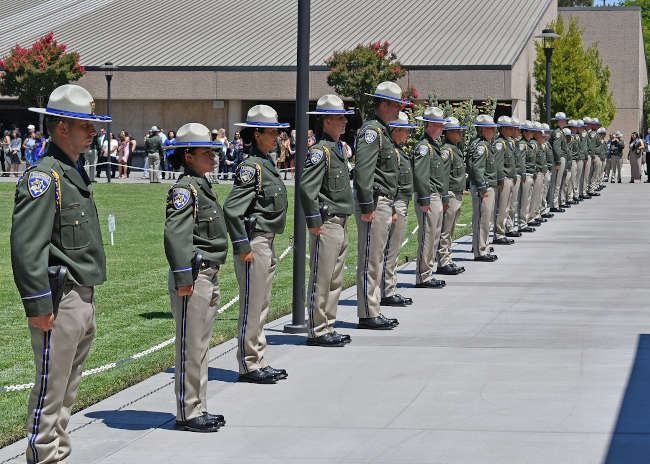
The California Highway Patrol welcomed 82 new officers to the CHP family, during Friday’s graduation ceremony at the CHP Academy in West Sacramento.
Less than one year ago, the CHP launched its “Join the CHP 1,000” campaign, with the goal of hiring 1,000 new officers.
These newly graduated officers bring the CHP closer to attaining its goal.
“It’s my honor to welcome these officers to the CHP and thank them for stepping up to serve our state,” said Gov. Gavin Newsom. “With a goal of hiring 1,000 new CHP officers in the coming years, we’re investing in outreach to a diverse pool of candidates committed to protecting their fellow Californians and making a positive impact in our communities.”
“The women and men of the CHP take great pride in the level of service we provide to the community,” said Commissioner Sean Duryee. “It is imperative we bring on the next generation of exemplary officers to continue that tradition.”
For more information about the “Join the CHP 1,000” campaign, or to apply, visit www.JoinTheCHP1000.com or call the statewide Recruitment Unit at 916-843-4300.


Over the past century, the Earth’s average temperature has swiftly increased by about 1 degree Celsius (1.8 degrees Fahrenheit). The evidence is hard to dispute. It comes from thermometers and other sensors around the world.
But what about the thousands of years before the Industrial Revolution, before thermometers, and before humans warmed the climate by releasing heat-trapping carbon dioxide from fossil fuels?
Back then, was Earth’s temperature warming or cooling?
Even though scientists know more about the most recent 6,000 years than any other multimillennial interval, studies on this long-term global temperature trend have come to contrasting conclusions.
To try to resolve the difference, we conducted a comprehensive, global-scale assessment of the existing evidence, including both natural archives, like tree rings and seafloor sediments, and climate models. Our results, published Feb. 15, 2023, suggest ways to improve climate forecasting to avoid missing some important slow-moving, naturally occurring climate feedbacks.
Global warming in context
Scientists like us who study past climate, or paleoclimate, look for temperature data from far back in time, long before thermometers and satellites.
We have two options: We can find information about past climate stored in natural archives, or we can simulate the past using climate models.
There are several natural archives that record changes in the climate over time. The growth rings that form each year in trees, stalagmites and corals can be used to reconstruct past temperature. Similar data can be found in glacier ice and in tiny shells found in the sediment that builds up over time at the bottom of the ocean or lakes. These serve as substitutes, or proxies, for thermometer-based measurements.
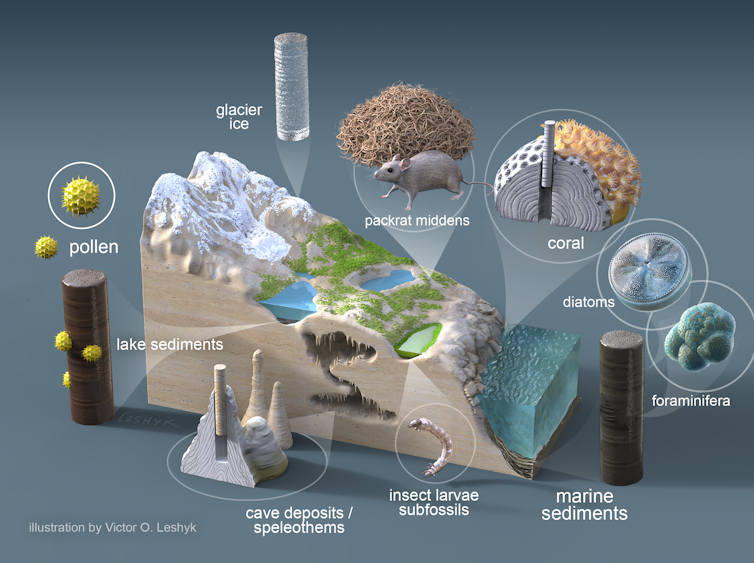
For example, changes in the width of tree rings can record temperature fluctuations. If temperature during the growing season is too cold, the tree ring forming that year is thinner that one from a year with warmer temperatures.
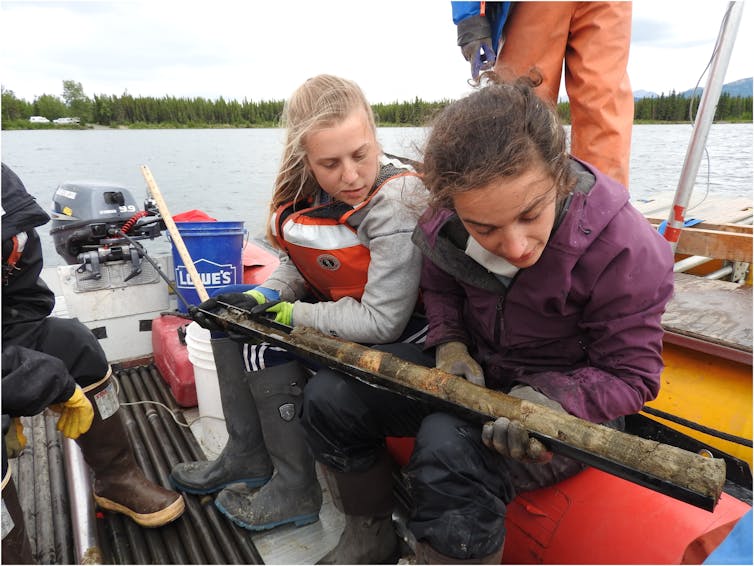
Another temperature proxy is found in seafloor sediment, in the remains of tiny ocean-dwelling creatures called foraminifera. When a foraminifer is alive, the chemical composition of its shell changes depending on the temperature of the ocean. When it dies, the shell sinks and gets buried by other debris over time, forming layers of sediment at the ocean floor. Paleoclimatologists can then extract sediment cores and chemically analyze the shells in those layers to determine their composition and age, sometimes going back millennia.
Climate models, our other tool for exploring past environments, are mathematical representations of the Earth’s climate system. They model relationships among the atmosphere, biosphere and hydrosphere to create our best replica of reality.
Climate models are used to study current conditions, forecast changes in the future and reconstruct the past. For example, scientists can input the past concentrations of greenhouse gases, which we know from information stored in tiny bubbles in ancient ice, and the model can use that information to simulate past temperature. Modern climate data and details from natural archives are used to test their accuracy.
Proxy data and climate models have different strengths.
Proxies are tangible and measurable, and they often have a well-understood response to temperature. However, they are not evenly distributed around the world or through time. This makes it difficult to reconstruct global, continuous temperatures.
In contrast, climate models are continuous in space and time, but while they are often very skillful, they will never capture every detail of the climate system.
A paleo-temperature conundrum
In our new review paper, we assessed climate theory, proxy data and model simulations, focusing on indicators of global temperature. We carefully considered naturally occurring processes that affect the climate, including long-term variations in Earth’s orbit around the Sun, greenhouse gas concentrations, volcanic eruptions and the strength of the Sun’s heat energy.
We also examined important climate feedbacks, such as vegetation and sea ice changes, that can influence global temperature. For example, there is strong evidence that less Arctic sea ice and more vegetation cover existed during a period around 6,000 years ago than in the 19th century. That would have darkened the Earth’s surface, causing it to absorb more heat.


Our two types of evidence offer different answers regarding the Earth’s temperature trend over the 6,000 years before modern global warming. Natural archives generally show that Earth’s average temperature roughly 6,000 years ago was warmer by about 0.7 C (1.3 F) compared with the 19th century median, and then cooled gradually until the Industrial Revolution. We found that most evidence points to this result.
Meanwhile, climate models generally show a slight warming trend, corresponding to a gradual increase in carbon dioxide as agriculture-based societies developed during the millennia after ice sheets retreated in the Northern Hemisphere.
How to improve climate forecasts
Our assessment highlights some ways to improve climate forecasts.
For example, we found that models would be more powerful if they more fully represented certain climate feedbacks. One climate model experiment that included increased vegetation cover in some regions 6,000 years ago was able to simulate the global temperature peak we see in proxy records, unlike most other model simulations, which don’t include this expanded vegetation.
Understanding and better incorporating these and other feedbacks will be important as scientists continue to improve our ability to predict future changes.
Ellie Broadman, Postdoctoral Research Associate in Climate Science, University of Arizona and Darrell Kaufman, Professor of Earth and Environmental Sciences, Northern Arizona University
This article is republished from The Conversation under a Creative Commons license. Read the original article.

A not uncommon estate planning scenario is an elderly parent who lives with an adult child, either at the parent(s)’s home or at the child’s home.
This scenario requires more considered estate planning to protect the arrangement in the event of the parent’s incapacity (e.g., dementia) and what happens when the parent moves out (e.g., into a nursing home) or dies.
If the child cares for the parent at the parent’s home then the parent’s estate planning often permits the caregiver child to remain at the parent’s residence, and perhaps to utilize the parent’s bank accounts, even if the parent were mentally incapacitated. If appropriate, that should be expressly provided.
Otherwise, once the parent loses the mental capacity to permit the living arrangement and finances, unintended problems may arise; such as, potential disagreement between the caregiver child and another family member. Allegations of elder abuse, especially regarding finances, may occur.
The agreed-upon terms of any living arrangement, including finances, should be included in the parent’s appropriate estate planning documents.
If the parent has a living trust, then the trust may permit the child to remain in the residence and state the terms of the living arrangement.
If the parent’s home is a rental property, however, then the parent’s power of attorney may authorize the child’s continued occupancy and continued use of parent’s money to pay the household expenses; the rental agreement also would need to include the child as a tenant.
Alternatively, if the parent lives in the child’s residence, the child’s estate plan similarly would need to say whether, and on what terms, the parent can remain in the child’s residence if the child were to become temporarily or permanently incapacitated. Moreover, consideration would need to be given to how the parents are cared for.
When the parent dies or moves out (e.g., moves into a nursing home) or when the child moves out, the arrangement ends. What happens then depends on the circumstances: (1) does the parent leave the residence to the adult care giver child; (2) how are the expenses (including mortgage) to be paid; and (3) is there an express transition period before the child moves-out.
If the parent intends to leave the residence to the adult care-giver child, then the parent's relevant estate planning documents need to gift the residence.
That could include lifetime gifting if the parent moves out due to incapacity or it might entail renting the residence to provide income for the parent’s needs.
If the parent has other children, or a spouse from a second marriage, then the parent’s estate planning needs to say whether, and if so how, other family members participate in the residence.
Perhaps the parent wants to gift the residence to all children subject to an exclusive life estate for the care-giver child to live in the residence.
Once the caregiver child dies, the residence is typically sold and sale proceeds are divided amongst the parent’s then living descendants.
If the caregiver child is more favorably treated with respect to the parent’s residence, and perhaps other assets, then the parent should anticipate possible objections.
While the parent is entitled to devise an estate plan of her own choosing, that does not itself prevent a disgruntled child from objecting at the parent’s incapacity or death; a possibility to be discussed and considered between the parent and the estate planning attorney.
Without appropriate and timely estate planning, however, a conservatorship may become necessary at the parent’s incapacity and a probate may become necessary at the parent’s death. Such expensive court supervised administrations, and their end results, may not necessarily agree with what the parent would have wanted if his or her affairs had been in order.
The foregoing is not legal advice. Consult an attorney for guidance.
Dennis A. Fordham, attorney, is a State Bar-Certified Specialist in estate planning, probate and trust law. His office is at 870 S. Main St., Lakeport, Calif. He can be reached at
Members of the Ham Radio Science Citizen Investigation, or HamSCI, will be making radio contacts during the 2023 and 2024 North American eclipses, probing the Earth’s ionosphere.
It will be a fun, friendly event with a competitive element — and you’re invited to participate.
Both amateur and professional broadcasters have been sending and receiving radio signals around the Earth for over a century.
Such communication is possible due to interactions between our Sun and the ionosphere, the ionized region of the Earth’s atmosphere located roughly 80 to 1000 km overhead.
The upcoming eclipses (October 14, 2023, and April 8, 2024) provide unique opportunities to study these interactions.
As you and other HamSCI members transmit, receive, and record signals across the radio spectrum during the eclipse, you will create valuable data to test computer models of the ionosphere.
For more information, go to https://hamsci.org/festivals-eclipse-ionospheric-science.
For more about solar eclipses https://solarsystem.nasa.gov/eclipses/home/.
Council members began their work Thursday evening with a half-hour workshop in which they discussed with staff projected changes to the current fiscal year budget.
At the start of the regular meeting, which convened at 6 p.m., Mayor Russell Perdock presented a proclamation in honor of Black History Month to the Lake County Branch of the NAACP.
Branch President Rick Mayo, accompanied by Branch Secretary Greta Zeit, praised city staff and council members for their efforts, but said there is still a lot of work yet to do, pointing to the fact that the city has one of the largest disabled populations in the county.
In other business on Thursday, City Manager Alan Flora asked the council to approve an application to the county of Lake for direct sale of various tax defaulted properties for up to $150,000.
“One of the best things that’s happened this year is a new tax collector,” said Flora, referring to the departure of Treasurer-Tax Collector Barbara Ringen, whose performance in relation to tax defaulted property sales had resulted in the city suing the county.
Ringen, who retired at the end of her term, was succeeded by Patrick Sullivan at the start of the year, and Flora reported that the city already is making progress in working with Sullivan.
Sullivan is willing to work with the city and has strategies to work on issues with such tax defaulted properties not just in Clearlake but throughout the county, Flora said.
Flora reported that state law allows taxing agencies such as the city to negotiate directly with the county on defaulted properties without having to go through the auction process. He added that, for some time, the city has wanted to pursue such a direct sales agreement with the county.
There are 20 to 25 properties that Flora said it would be within the city’s interest to purchase in order to “break the cycle” of ongoing problems that include blight.
Flora said he didn’t want to publicly disclose the list of properties at this time.
Sullivan is moving forward on the work for a tax sale in May and Flora wanted to prepare the application, outlined in a process by the State Controller’s Office, to buy those roughly two dozen properties, spending up to $150,000.
Flora said some of the parcels he thinks the city should purchase are not well suited to development. However, the city has advantages in being able to merge properties and prepare them for sale.
Councilwoman Joyce Overton asked about homes that could be rehabilitated. Flora said two of the properties have such homes, one of them is very blighted and in a high visibility area so it makes sense to put effort into fixing it and offering more quality housing.
Councilman Russell Cremer moved to approve the application to purchase the properties, with Councilman David Claffey seconding and the council approving the motion 5-0.
Also on Thursday, the council voted unanimously to approve a resolution approving a joint exercise of powers agreement among the cities of Clearlake and Lakeport, and the county of Lake to form the Lake County Recreation Agency.
The agency’s creation developed from a series of discussions with interested parties that began in 2019 to to discuss the possibilities of improving recreational opportunities in Lakeport. The interest later expanded to include groups from around the county and has become known as the Lake County Recreation Task Force.
The council appointed Claffey and Councilman Dirk Slooten to serve on the new agency’s board.
The council also heard the 2022 Clearlake Police report from new Chief Tim Hobbs, approved updates to its norms and procedures, and held the first reading of an ordinance amending the municipal code relating to the method of service for property maintenance, nuisance and vehicle abatement, which City Attorney Ryan Jones said would fix existing issues within city code.
Email Elizabeth Larson at
Clearlake Police Lt. Martin Snyder, who oversees the shelter, along with Alyssa Terry, a shelter animal care technician, gave the Clearlake City Council an update on operations at the council’s Thursday night meeting.
They also introduced “Maya,” a beautiful black and tan female German shepherd that is housed with Terry, another shepherd waiting for a home.
While not a fit with cats, Maya loves to cuddle in your lap, is spayed and up to date on all vaccinations, and is “the perfect amount of energy and calm,” Terry said.
The city of Clearlake contracts with North Bay Animal Services for animal control.
Terry said that on Feb. 1, 23 animals were transferred, including 12 dogs — four adult dogs and eight puppies — and all 11 of the cats that had been at the Clearlake shelter to North Bay Animal Services’ Petaluma shelter.
“The cat room is empty and we’re working on the dogs,” Terry said.
She said the Petaluma shelter is a no-kill facility and has more adoptions than Clearlake, so whenever possible Clearlake transfers animals there.
She said “Babs,” a longtime resident at the shelter, has a new family of her own thanks to being adopted on Jan. 30.
The shelter is continuing to improve its spaying and neutering services to the animals in its care, with one spay and one neuter and one to two exams taking place every Wednesday, depending on injuries and medical issues. Terry said the shelter has partnered with Clearlake Veterinary Clinic.
Terry said there also have been siding improvements to shop building at the shelter facility to make it warmer and more comfortable for the dogs.
Snyder said that since the start of 2023, there have been 108 dogs brought into the shelter. Of those, 35 left the shelter — 16 to rescues, 15 were returned to their owners and three were adopted. Snyder said one died or was lost in care. While he did not have information on that case, he said sometimes the dogs will get out and escape.
Overall, the shelter is at a 100% live release rate, Snyder said.
While there has been good news about dogs moving out of the shelter, Snyder said the shelter remains at capacity, with 70 dogs now in care.
Anyone looking for a new best friend is invited to come down to the shelter at 6820 Old Highway 53.
For more information, call the shelter at 707-762-6227, email
This week’s adoptable dogs are featured below.
Email Elizabeth Larson at