 How to resolve AdBlock issue?
News
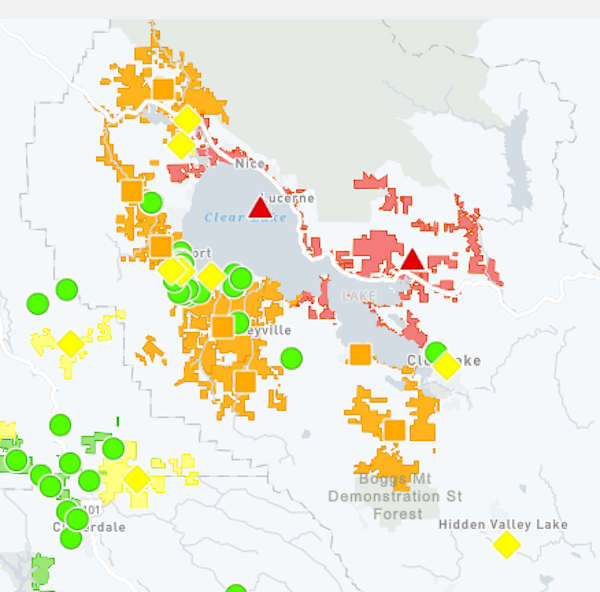
LAKE COUNTY, Calif. — Heavy snow and downed trees contributed to numerous power outages across Lake County on Thursday night and early Friday.
Tens of thousands of Pacific Gas and Electric customers were out of power by early Friday morning as a result of the winter weather conditions, according to the company’s online outage map.
The majority of those outages did not have estimated restoration times or causes.
Late Thursday, the power went off briefly in Lucerne twice before going off and staying off for a third time shortly after midnight.
Radio traffic on Thursday night and early Friday recounted downed trees or trees into power lines across the county. One fallen tree on 11th Street in Lakeport blocked both lanes of traffic shortly at about 11:45 p.m.
PG&E is urging its customers to be prepared for outages. Tips for preparedness can be found here.
Email Elizabeth Larson at

CLEARLAKE, Calif. — If you’re looking for a new canine friend, Clearlake Animal Control has a full house of dogs ready to join your family.
There currently are 34 adoptable dogs at the shelter available to be adopted into new homes.
They include “Noah,” a male American pit bull terrier mix, and “Goliath,” a 6-year-old male Rottweiler mix.

The shelter is located at 6820 Old Highway 53. It’s open from 9 a.m. to 6 p.m. Tuesday through Saturday.
For more information, call the shelter at 707-762-6227, email
This week’s adoptable dogs are featured below.
Email Elizabeth Larson at
City Manager Kevin Ingram presented to the council a resolution to approve a joint exercise of powers agreement, or JPA, that creates the Lake County Recreation Agency.
The Clearlake City Council approved the agreement at its meeting last Thursday and appointed members David Claffey and Dirk Slooten to be its two representatives on the JPA board. Ingram said the Board of Supervisors is expected to consider the JPA at a meeting in March.
A written report to the council from Ingram and Assistant City Manager Nick Walker explained that a group of interested parties began meeting regularly in 2019 to discuss the possibilities of improving recreational opportunities in Lakeport.
Interest expanded to include parties countywide, with the group becoming known as the Recreation Task Force. The city of Lakeport assisted the task force in October 2020 with issuing a request for proposal from qualified consulting firms to prepare a needs assessment and feasibility study so the task force “could determine whether to proceed with planning, funding and creating an indoor/outdoor multi-generational Recreation Center or Centers,” the report explained.
The task force worked with Studio W architects and their subconsultants for a year and a half to complete two phases of a feasibility study that were presented in 2021 and 2022 to local government bodies and the public.
“The feasibility work included public input, site selection, development scope, conceptual design, programmatic options, capital and operating cost estimates, management structures and partnership opportunities,” the report explained.
Following a meeting in October, representatives from the cities and the county reached consensus to hire bond counsel firm Jones Hall to form the JPA. A proposal review committee hired the firm FM3 to conduct polling. The report said the city of Lakeport has contracted Jones Hall and FM3 with cost sharing agreements with the city of Clearlake and the county of Lake.
Developing and maintaining recreation and aquatics centers is expected to cost tens of millions of dollars. The options presented by Studio W at public meetings in August 2021 put the cost of a new aquatic center at more than $21 million based on configurations.
Ingram and Walker’s report said that the task force members have discussed ways of covering those costs, which include contributions from local, state and federal governments, grants, donations and a JPA.
Even with those sources, the report noted there is likely to be a funding gap, which is why the JPA could form a community facility district and place a special tax on the ballot to pay for debt service on authorized bonds and operation costs associated with new recreation and aquatics facilities.
City and county officials are now looking at placing such a revenue measure before voters on the March 2024 ballot, which would be the presidential primary.
Ingram told the council on Tuesday that many groups — the cities, the county, school districts, hospitals and tribes — “seem to be on the same page that this needs to be a regional effort.”
It’s not just about financing and operations, but “what is the mission going to be?” Ingram said.
It wouldn’t just be a pool or recreation center but also could involve a trails system and other amenities. In that sense, there are a lot of options and it’s exciting, said Ingram, noting that the bad news also is that there are a lot of options.
Although Clearlake already has appointed its two members to sit on the seven-member JPA board — which will include two members each from the cities and the county, and one at-large member — Ingram said Lakeport’s appointments would take place at a future time and would be done by the mayor.
He expected the newly formed recreation agency will have more frequent meetings at first as it is getting off the ground. “This is very exciting,” Ingram said.
Ingram said they have seen exciting plans for facilities that include the “Ferrari model” — a reference to the extremely expensive options that have been presented previously. Decisions on just what models to pursue will have to be made, he added.
“Overall, moving together as a region is absolutely the right way of handling this,” Ingram said.
Councilmember Kim Costa asked what other public agencies might join the agency. Ingram said there is a lot of room for different entities, but that for now it’s starting with the cities and county.
City Attorney David Ruderman said any public entity can form a JPA. The way this new JPA’s formation documents are written, it’s up to the new recreation agency who gets to take part.
Councilmember Brandon Disney said most people would love to see the dream vision come about, but he noted that tax ballot measures aren’t always popular.
“Is there a fallback if the tax measure doesn’t come to fruition?” Disney asked.
Ingram said he thought that at this point it’s still completely in the exploration phase, with polling of the electorate to take place regarding their feelings about the financing mechanism.
There was no public comment on the new JPA’s formation.
Councilman Kenny Parlet recalled previously trying to work with the county to share costs of the city’s now-closed Westshore Pool, and the county refusing to do so.
He said he was very concerned about estimated maintenance costs of about $250,000.
Councilman Michael Froio said he and Mayor Stacey Mattina have met with the city of Clearlake and an ad hoc group appointed by the Board of Supervisors, there is enthusiasm all around.
“We have a different group of people,” he said in response to Parlet’s concerns.
Mattina said the tax measure would help with maintaining the centers.
Froio said bringing a pool to Lakeport is an outstanding idea.
Ingram said they have looked at their sister city of Fort Bragg, which built a beautiful pool but was forced by maintenance costs to eventually put a sales tax measure before voters.
“We’ve kept our eyes open all the way,” Ingram said.
Ingram said they are getting to the point where people will need to show what they are willing to put up in terms of support, noting they will need to “rap on the door” of Congressman Mike Thompson and state legislators.
“The maintenance plans need to be in place with any potential project,” Ingram said.
Disney moved to adopt the resolution, with Parlet seconding and the council voting 5-0.
During the hour-and-15-minute-long meeting, Ruderman also gave the council a presentation on ethics regulations and best practices, as well as recent law changes.
Email Elizabeth Larson at

LAKE COUNTY, Calif. — On Feb. 4, Habitat for Humanity Lake County was excited to celebrate with the Solorio family as they were welcomed into Habitat’s 40th home in Lake County.
Ana Solorio celebrated with family and friends and Habitat staff and volunteers as Father Marlon of Queen of Peace Catholic Church offered prayers, blessings and cleansing of the home.
“I still feel like I’m dreaming,” said Solorio, blinking away emotional tears. “I’m happy I didn’t give up … and so thankful for all of the work that went into this home and getting me into it. Having a place where my family can be safe and call ours is something I didn’t think would ever happen.”
If you are interested in Habitat’s Homeownership program or know someone you think would qualify, you are encouraged to contact the office at 707-994-1100, Extension 106, or stop by for an application at 15312 Lakeshore Dr. Clearlake, behind Foods, Etc.
DWR now expects to deliver 35% of requested water supplies, up from 30% forecasted in January, to the 29 public water agencies that serve 27 million Californians. That would translate to an additional 210,000 acre-feet of water.
Record-breaking atmospheric rivers that pounded the state in January gave way to a mostly dry February that saw less than an inch of precipitation statewide to this point.
“We’re hopeful that more storms this week are a sign that the wet weather will return, but there remains a chance that 2023 will be a below average water year in the northern Sierra.” said DWR Director Karla Nemeth. “Careful planning and the use of advanced forecasting tools will enable the Department to balance the needs of our communities, agriculture, and the environment should dry conditions continue this spring and into next year.”
The State Water Project, or SWP, will continue to optimize water storage in Lake Oroville to support environmental needs in the summer and allow for carry-over storage for next year if the spring becomes extremely dry.
Additionally, the forecasted allocation could be adjusted back down if extreme dry conditions warrant.
The 35% allocation forecast announced Wednesday takes into account snowpack and reservoir storage from those storms, current hydrology conditions, spring runoff forecasts, and an anticipation of dry conditions ahead.
The updated SWP forecast is on par with the Central Valley Project, or CVP, initial allocations announced Wednesday by the U.S. Bureau of Reclamation.
In addition to optimizing water storage, California continues to accelerate investments in habitat restoration, including $52 million in grants announced last week to help restore and protect fish and wildlife habitat throughout California.
Wednesday’s updated SWP delivery forecast takes into account new snowmelt runoff data, known as Bulletin 120.
This report provides a forecast of snowmelt runoff and is a key tool for water managers across the state to understand how the melting snow in the Sierra Nevada will reach streams, rivers and eventually California reservoirs.
Bulletin 120 offers a range of possibilities to allow water managers to prepare for spring runoff and eventual summer water supply. The forecast is updated regularly throughout the winter and spring.
DWR uses advanced forecasting tools that include Airborne Snow Observatory surveys which are now underway to collect snow measurements farther upslope of the Sierra Nevada. The data from these flights, which use LiDAR and spectrometer technology to measure snowpack across broad swathes of key watersheds, is used by DWR to get a more accurate account of California’s snowpack and possible spring runoff.
More than a month still remains in the state’s wet season, but there’s uncertainty about a return to warm and dry conditions prior to April 1, typically when the state’s snowpack peaks and begins to melt.
DWR is scheduled to conduct the next two snow surveys at Phillips Station on March 1 and April 3. Dates are subject to change depending on weather conditions and DWR will provide updates as the date approaches.
Conditions in the Colorado River Basin and California’s groundwater basins continue to have an impact on available water supply. Californians should continue to use water wisely to help the state adapt to a hotter, drier future.
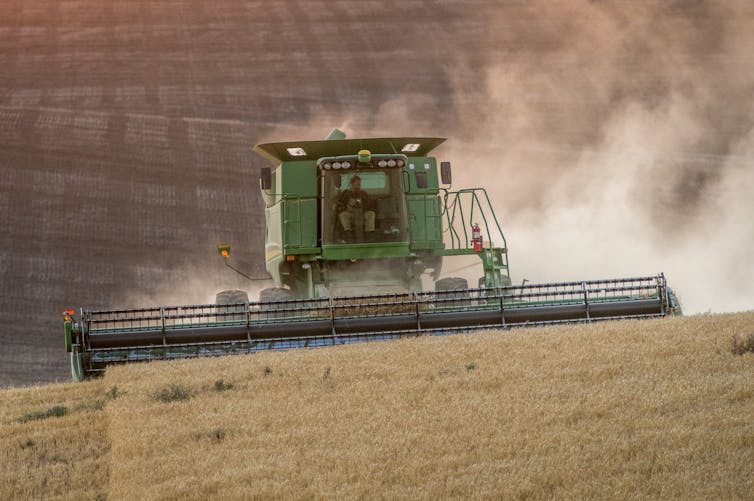
As tractors became more sophisticated over the past two decades, the big manufacturers allowed farmers fewer options for repairs. Rather than hiring independent repair shops, farmers have increasingly had to wait for company-authorized dealers to arrive. Getting repairs could take days, often leading to lost time and high costs.
A new memorandum of understanding between the country’s largest farm equipment maker, John Deere Corp., and the American Farm Bureau Federation is now raising hopes that U.S. farmers will finally regain the right to repair more of their own equipment.
However, supporters of right-to-repair laws suspect a more sinister purpose: to slow the momentum of efforts to secure right-to-repair laws around the country.
Under the agreement, John Deere promises to give farmers and independent repair shops access to manuals, diagnostics and parts. But there’s a catch – the agreement isn’t legally binding, and, as part of the deal, the influential Farm Bureau promised not to support any federal or state right-to-repair legislation.
You can listen to more articles from The Conversation narrated by Noa.
The right-to-repair movement has become the leading edge of a pushback against growing corporate power. Intellectual property protections, whether patents on farm equipment, crops, computers or cellphones, have become more intense in recent decades and cover more territory, giving companies more control over what farmers and other consumers can do with the products they buy.
For farmers, few examples of those corporate constraints are more frustrating than repair restrictions and patent rights that prevent them from saving seeds from their own crops for future planting.
How a few companies became so powerful
The United States’ market economy requires competition to function properly, which is why U.S. antitrust policies were strictly enforced in the post-World War II era.
During the 1970s and 1980s, however, political leaders began following the advice of a group of economists at the University of Chicago and relaxed enforcement of federal antitrust policies. That led to a concentration of economic power in many sectors.
This concentration has become especially pronounced in agriculture, with a few companies consolidating market share in numerous areas, including seeds, pesticides and machinery, as well as commodity processing and meatpacking. One study in 2014 estimated that Monsanto, now owned by Bayer, was responsible for approximately 80% of the corn and 90% of the soybeans grown in the U.S. In farm machinery, John Deere and Kubota account for about a third of the market.

Market power often translates into political power, which means that those large companies can influence regulatory oversight, legal decisions, and legislation that furthers their economic interests – including securing more expansive and stricter intellectual property policies.
The right-to-repair movement
At its most basic level, right-to-repair legislation seeks to protect the end users of a product from anti-competitive activities by large companies. New York passed the first broad right-to-repair law, in 2022, and nearly two dozen states have active legislation – about half of them targeting farm equipment.
Whether the product is an automobile, smartphone or seed, companies can extract more profits if they can force consumers to purchase the company’s replacement parts or use the company’s exclusive dealership to repair the product.
One of the first cases that challenged the right to repair equipment was in 1939, when a company that was reselling refurbished spark plugs was sued by the Champion Spark Plug Co. for violating its patent rights. The Supreme Court agreed that Champion’s trademark had been violated, but it allowed resale of the refurbished spark plugs if “used” or “repaired” was stamped on the product.
Although courts have often sided with the end users in right-to-repair cases, large companies have vast legal and lobbying resources to argue for stricter patent protections. Consumer advocates contend that these protections prevent people from repairing and modifying the products they rightfully purchased.
The ostensible justification for patents, whether for equipment or seeds, is that they provide an incentive for companies to invest time and money in developing products because they know that they will have exclusive rights to sell their inventions once patented.
However, some scholars claim that recent legal and legislative changes to patents are instead limiting innovation and social benefits.
The problem with seed patents
The extension of utility patents to agricultural seeds illustrates how intellectual property policies have expanded and become more restrictive.
Patents have been around since the founding of the U.S., but agricultural crops were initially considered natural processes that couldn’t be patented. That changed in 1980 with the U.S. Supreme Court decision Diamond v. Chakrabarty. The case involved genetically engineered bacteria that could break down crude oil. The court’s ruling allowed inventors to secure patents on living organisms.
Half a decade later, the U.S. Patent Office extended patents to agricultural crops generated through transgenic breeding techniques, which inserts a gene from one species into the genome of another. One prominent example is the insertion of a gene into corn and cotton that enables the plant to produce its own pesticide. In 2001, the Supreme Court included conventionally bred crops in the category eligible for patenting.
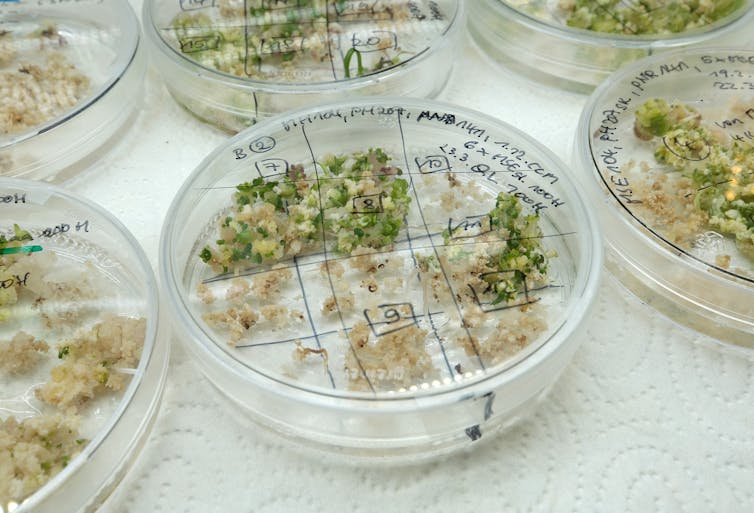
Historically, farmers would save seeds that their crops generated and replant them the following season. They could also sell those seeds to other farmers. They lost the right to sell their seeds in 1970, when Congress passed the Plant Variety Protection Act. Utility patents, which grant an inventor exclusive right to produce a new or improved product, are even more restrictive.
Under a utility patent, farmers can no longer save seed for replanting on their own farms. University scientists even face restrictions on the kind of research they can perform on patented crops.
Because of the clear changes in intellectual property protections on agricultural crops over the years, researchers are able to evaluate whether those changes correlate with crop innovations – the primary justification used for patents. The short answer is that they do not.
One study revealed that companies have used intellectual property to enhance their market power more than to enhance innovations. In fact, some vegetable crops with few patent protections had more varietal innovations than crops with more patent protections.
How much does this cost farmers?
It can be difficult to estimate how much patented crops cost farmers. For example, farmers might pay more for the seeds but save money on pesticides or labor, and they might have higher yields. If market prices for the crop are high one year, the farmer might come out ahead, but if prices are low, the farmer might lose money. Crop breeders, meanwhile, envision substantial profits.
Similarly, it is difficult to calculate the costs farmers face from not having a right to repair their machinery. A machine breakdown that takes weeks to repair during harvest time could be catastrophic.
The nonprofit U.S. Public Interest Research Group calculated that U.S. consumers could save US$40 billion per year if they could repair electronics and appliances – about $330 per family.
The memorandum of understanding between John Deere and the Farm Bureau may be a step in the right direction, but it is not a substitute for right-to-repair legislation or the enforcement of antitrust policies.
Leland Glenna, Professor of Rural Sociology and Science, Technology, and Society, Penn State
This article is republished from The Conversation under a Creative Commons license. Read the original article.