 How to resolve AdBlock issue?
News
World Hearing Day acknowledges the millions of Americans who are facing disabling hearing loss, brings awareness to the different causes of deafness, and promotes finding solutions in preventing hearing loss.
“I am proud to introduce this bipartisan resolution to designate March 3 as World Hearing Day,” said Thompson. “The resolution recognizes the millions of Americans who experience disabling hearing loss and provides an opportunity to come together and push for policies that support ear and hearing care and pursue cures to various causes of deafness. On World Hearing Day, I am committed to working with Rep. Fitzpatrick and my colleagues to support those with disabling hearing loss and advance research into hearing care.”
“Forty-eight million Americans are currently suffering with hearing loss,” said Fitzpatrick. “That is why I am proud to support this bipartisan resolution which raises awareness of those suffering and recognizes the need for increased access to care.”
"The American Speech-Language-Hearing Association applauds Representatives Thompson and Fitzpatrick for introducing today’s resolution supporting the goals and ideals of World Hearing Day," said 2023 ASHA President Robert M. Augustine, PhD, CCC-SLP. "ASHA looks forward to continued work with Reps. Thompson and Fitzpatrick to increase access to hearing health care and technology to improve quality of life for all individuals living with hearing loss.”
The full text of the resolution can be found below.
Thompson represents California’s Fourth Congressional District, which includes all or part of Lake, Napa, Solano, Sonoma and Yolo counties.
Whereas the World Health Organization (WHO) has designated March 3 as World Hearing Day;
Whereas the theme for World Hearing Day 2023 is ‘‘Ear and Hearing Care for All’’;
Whereas approximately 466 million people worldwide, including 34 million children, have disabling hearing loss;
Whereas the WHO estimates that by 2050 over 900 million people—1 in every 10—will have disabling hearing loss;
Whereas approximately 48 million Americans have some degree of hearing loss and people with hearing impairments wait on average 7 years before seeking help;
Whereas hearing issues are the most common service-connected disability among American veterans;
Whereas the number of adults in the United States 20 years or older with hearing loss is expected to increase from 44.1 million in 2020 to 73.5 million by 2060;
Whereas individuals with mild hearing loss are 3 times more likely to experience a fall, and falls are the leading cause of fatal injury for Americans over 65;
Whereas seniors with hearing loss are more likely to develop cognitive problems and experience cognitive decline up to 40 percent faster than those without hearing loss;
Whereas untreated hearing loss can lead to depression, anxiety, and social isolation, especially during the coronavirus (COVID–19) pandemic;
Whereas uneven coverage of and access to hearing technology and services contribute to significant disparities in hearing care; and
Whereas timely access to diagnosis and treatment for hearing and vestibular conditions by qualified hearing health care professionals can improve outcomes and reduce overall
cost of care: Now, therefore, be it
Resolved, That the House of Representatives — (1) supports the goals and ideals of ‘‘World Hearing Day’’; (2) encourages awareness about ways to prevent deafness and hearing loss and promote ear and hearing care; and (3) supports efforts to improve access to hearing health care and technology for all individuals.
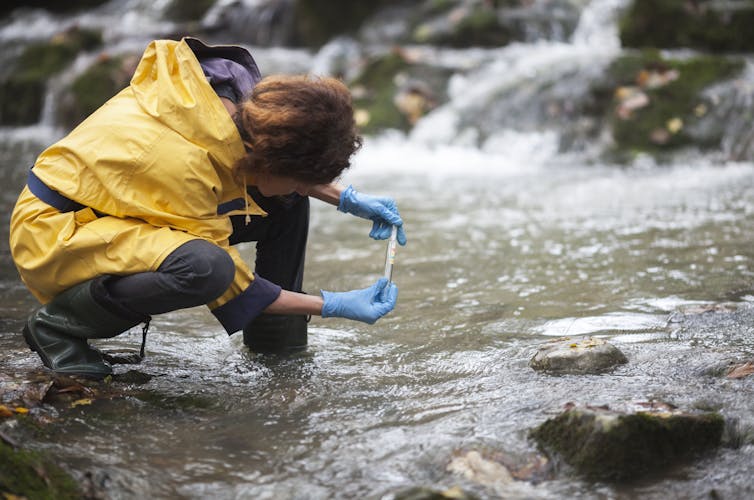
You’ve probably been hearing the term PFAS in the news lately as states and the U.S. government consider rules and guidelines for managing these “forever chemicals.”
Even if the term is new to you, chances are good that you’re familiar with what PFAS do. That’s because they’re found in everything from nonstick cookware to carpets to ski wax.
PFAS stands for per- and polyfluoroalkyl substances, which are a large group of human-made chemicals – currently estimated to be around 9,000 individual chemical compounds – that are used widely in consumer products and industry. They can make products resistant to water, grease and stains and protect against fire.
Waterproof outdoor apparel and cosmetics, stain-resistant upholstery and carpets, food packaging that is designed to prevent liquid or grease from leaking through, and certain firefighting equipment often contain PFAS. In fact, one recent study found that most products labeled stain- or water-resistant contained PFAS, and another study found that this is even true among products labeled as “nontoxic” or “green.” PFAS are also found in unexpected places like high-performance ski and snowboard waxes, floor waxes and medical devices.
At first glance, PFAS sound pretty useful, so you might be wondering “what’s the big deal?”
The short answer is that PFAS are harmful to human health and the environment.
Some of the very same chemical properties that make PFAS attractive in products also mean these chemicals will persist in the environment for generations. Because of the widespread use of PFAS, these chemicals are now present in water, soil and living organisms and can be found across almost every part of the planet, including Arctic glaciers, marine mammals, remote communities living on subsistence diets, and in 98% of the American public.
The Environmental Protection Agency recently issued new warnings about their risk in drinking water even at very low levels.
Health risks from PFAS exposure
Once people are exposed to PFAS, the chemicals remain in their bodies for a long time – months to years, depending on the specific compound – and they can accumulate over time.
Research consistently demonstrates that PFAS are associated with a variety of adverse health effects. A recent review by a panel of experts looking at research on PFAS toxicity concluded with a high degree of certainty that PFAS contribute to thyroid disease, elevated cholesterol, liver damage and kidney and testicular cancer.

Further, they concluded with a high degree of certainty that PFAS also affect babies exposed in utero by increasing their likelihood of being born at a lower birth weight and responding less effectively to vaccines, while impairing women’s mammary gland development, which may adversely impact a mom’s ability to breastfeed.
The review also found evidence that PFAS may contribute to a number of other disorders, though further research is needed to confirm existing findings: inflammatory bowel disease, reduced fertility, breast cancer and an increased likelihood of miscarriage and developing high blood pressure and preeclampsia during pregnancy. Additionally, current research suggests that babies exposed prenatally are at higher risk of experiencing obesity, early-onset puberty and reduced fertility later in life.
Collectively, this is a formidable list of diseases and disorders.
Who’s regulating PFAS?
PFAS chemicals have been around since the late 1930s, when a DuPont scientist created one by accident during a lab experiment. DuPont called it Teflon, which eventually became a household name for its use on nonstick pans.
Decades later, in 1998, Scotchgard maker 3M notified the Environmental Protection Agency that a PFAS chemical was showing up in human blood samples. At the time, 3M said low levels of the manufactured chemical had been detected in people’s blood as early as the 1970s.
Despite the lengthy list of serious health risks linked to PFAS and a tremendous amount of federal investment in PFAS-related research in recent years, PFAS haven’t been regulated at the federal level in the United States.
The EPA has issued advisories and health-based guidelines for two PFAS compounds – PFOA and PFOS – in drinking water, though these guidelines are not legally enforceable standards. And the Agency for Toxic Substances and Disease Registry has a toxicological profile for PFAS.
Federal rules could be coming. Congress is considering legislation to ban PFAS in some food packaging. The EPA has a road map for PFAS regulations it is considering, including regulations involving drinking water. The Biden administration has said it also expects to list PFOA and PFOS as hazardous substances under the Superfund law, a move that worries utilities and businesses that use PFAS-containing products or processes because of the expense of cleanup.
States, meanwhile, have been taking their own actions to protect residents against the risk of PFAS exposure.
At least 23 states have laws targeting PFAS in various uses, such as in food packaging and carpets. But relying on state laws places burdens on state agencies responsible for enforcing them and creates a patchwork of regulations which, in turn, place burdens on business and consumers to navigate regulatory nuances across state lines.
So, what can you do about PFAS?
Based on current scientific understanding, most people are exposed to PFAS primarily through their diet, though drinking water and airborne exposures may be significant among some people, especially if they live near known PFAS-related industries or contamination.
The best ways to protect yourself and your family from risks associated with PFAS are to educate yourself about potential sources of exposures.
Products labeled as water- or stain-resistant have a good chance of containing PFAS. Check the ingredients on products you buy and watch for chemical names containing “fluor-.” Specific trade names, such as Teflon and Gore-Tex, are also likely to contain PFAS.
Check whether there are sources of contamination near you, such as in drinking water or PFAS-related industries in the area. Some states don’t test or report PFAS contamination, so the absence of readily available information does not necessarily mean the region is free of PFAS problems.
For additional information about PFAS, check out the Agency for Toxic Substances and Disease Registry, EPA and U.S. Centers for Disease Control and Prevention websites or contact your state or local public health department.
If you believe you have been exposed to PFAS and are concerned about your health, contact your health care provider. The Agency for Toxic Substances and Disease Registry has a succinct report to help health care professionals understand the clinical implications of PFAS exposure.
This article was updated July 8, 2022, with new legislation signed in Rhode Island and Hawaii.
Kathryn Crawford, Assistant Professor of Environmental Health, Middlebury
This article is republished from The Conversation under a Creative Commons license. Read the original article.
The council will hold a police leadership reception at 5 p.m. before the regular meeting begins at 6 p.m. March 2, in the council chambers at Clearlake City Hall, 14050 Olympic Drive.
The meeting will be broadcast live on the city's YouTube channel or the Lake County PEGTV YouTube Channel. Community members also can participate via Zoom or can attend in person.
The agenda can be found here.
Comments and questions can be submitted in writing for City Council consideration by sending them to City Clerk Melissa Swanson at
To give the council adequate time to review your questions and comments, please submit your written comments before 4 p.m. Thursday, March 2.
Each public comment emailed to the city clerk will be read aloud by the mayor or a member of
staff for up to three minutes or will be displayed on a screen. Public comment emails and town hall public comment submissions that are received after the beginning of the meeting will not be included in the record.
At the start of the meeting, the council will hold a formal swearing in for newly appointed Police Chief Tim Hobbs and Lt. Ryan Peterson.
The council also will present a proclamation declaring March 2023 as March for Meals Month.
Under business, council members will consider appointments for two seats on the Clearlake Planning Commission for terms ending in March 2027.
The seats in question currently are held by Lisa Wilson and Erin McCarrick. Wilson does not plan to seek reappointment but McCarrick has submitted a letter asking to be reappointed.
In addition to McCarrick, applicants for the seats include Jamie DeWalt; Chris Jennings; Christopher Inglis; Carlos Eduardo Ramos; and Jack Smalley.
The council also will consider a resolution opposing voter initiative 21-0042A1 proposed by the California Business Roundtable.
“The Taxpayer Protection and Government Accountability Act would amend the California Constitution with provisions that limit voters’ authority and input, adopt new and stricter rules for raising taxes and fees, and may make it more difficult to impose fines and penalties for violation of state and local laws,” City Manager Alan Flora’s report explained/
“The measure puts billions of local government tax and fee revenues at risk statewide with related core public service impacts. The measure would have significant negative impacts on City of Clearlake operations and core service delivery,” Flora added.
On the meeting's consent agenda — items that are considered routine in nature and usually adopted on a single vote — are warrants; authorization for payment of connection fees to Highlands Mutual Water Co. in the amount of $35,221.25 for a water tie-in related to the Burns Valley Development and Public Works Yard; and second reading of Ordinance No. 268-2023 Amending Chapter X, Section 10-1.12 of the Clearlake Municipal Code relating to method of service for property maintenance, nuisance and vehicle abatement.
The council also will hold a closed session following the public portion of the meeting to discuss property negotiations for 6820, 6840 and 6860 Old Highway 53; a case of existing litigation, City of Clearlake v. Testate & Intestate Successors of Bailey Lumbers Co., et al., Lake County Superior Court; and a potential case of litigation.
Email Elizabeth Larson at
The grant was created to encourage the formation of fire safety councils around California by providing funds to support capacity building, including media and communication as well as volunteer management.
The Konocti Fire Safe Council, or KFSC, competed successfully for one of the 14 projects funded statewide.
Funding for this grant program is also provided by Edison International and the California Department of Conservation as part of the Regional Forest and Fire Capacity Program.
The Konocti Fire Safe Council was formed in an effort to unite residents in the Soda Bay corridor area to meet the challenges of living in a location that is highly vulnerable to wildfire.
The mission of the Konocti Fire Safe Council is to increase community wildfire preparedness and survivability through education, project and resource development, evacuation readiness and hazardous fuel reduction.
The $20,000 grant will be used to purchase equipment that will help expand the council’s community outreach program, upgrade communication technologies, and provide development of fire safety and mitigation projects, said Phil Hartley, vice president of the KFSC Board of Directors.
The geographic coverage of the Konocti Fire Safe Council encompasses eight designated Zonehaven zones — KEL-E103, KEL-108, KEL-E117, KEL-E120, KEL-E122, KEL-134, KEL-E146 and KEL-E152 — that include Gaddy Lane, along Soda Road to the intersection of Kit’s Corner and Highway 29, Point Lakeview Road and State Route 281.
The KFSC represents such communities as Soda Bay, Kelseyville Riviera, Riviera Estates, Lakeview Estates, Konocti Shores, Riviera West, Buckingham, Riviera Heights and numerous mobile home parks, private homes and businesses along the Soda Bay Road corridor.
If you would like the Konocti Fire Safe Council outreach committee to visit your neighborhood or to request additional information, please contact them at 707-279-2245 or visit www.KonoctiFireSafe.org.
Nearly 51% of the U.S. population age 16 and over, or 124.7 million people, informally helped their neighbors between September 2020 and 2021 at the height of the pandemic, according to the latest Volunteering and Civic Life in America research.
In response to a separate question, more than 23% of people in that age group, or 60.7 million, said they formally volunteered through an organization during the same period.
Conducted by the U.S. Census Bureau and AmeriCorps, the 2021 data show trends in formal volunteering, informal helping, and other civic behaviors nationally, at the state level, and within the 12 largest metro areas.
The research, released every two years, shows that those who formally volunteered gave more than 4.1 billion hours of service with an estimated economic value of $122.9 billion.
The 2021 Civic Engagement and Volunteering Supplement is the most comprehensive data on U.S. volunteering and civic engagement assembled.
The research reveals that despite the devastating impact of the COVID-19 pandemic, the U.S. population continued to serve each other and their communities — giving their time and talent to help others at a time of unprecedented need.
They helped neighbors by doing favors like watching each other’s children, running errands, and other activities to lend a hand.
People also found new ways to help their communities during the pandemic by supporting COVID-19 testing, immunization and other public health efforts; conducting wellness checks on isolated seniors; supporting food banks; and providing virtual tutoring and mentoring to help students stay on track in school.
2021 Civic Engagement and Volunteering Supplement
The goal of the research sponsored by AmeriCorps is to collect information on the extent to which our nation’s communities are places where individuals are civically active.
A comprehensive view on national and state formal volunteering and informal helping rates research includes:
• A national look at both formal and informal volunteering and civic engagement.
• Snapshots of formal volunteering and informal helping rates by demographic groups.
• Highlights of all 50 states and the District of Columbia’s formal volunteering and informal helping rates.
• Formal volunteering and informal helping rates for the 12 largest metropolitan areas.
National demographics
While formal volunteering rates dropped from 2019 to 2021 in every demographic group, informal helping rates largely remained steady.
Trends in formal volunteering 2019-2021:
• The rate drop was substantially larger for women (8 percentage points) than men (5 percentage points) but women continued to volunteer at a higher rate.
• Generation X (ages 41 to 56 in 2021) had the highest rate of all generations.
• People ages 16-17 had the highest rate of all age groups at 28%, followed by people ages 45 to 54 at 27%.
• Parents with children under 18 formally volunteered at a higher rate (30%) than those without children in their household (21%).
How many helped informally:
• Baby boomers had the highest rate (59%) of all generations.
• Veterans helped their neighbors at a rate of 59%, 8 percentage points higher than nonveterans.
• People with children under age 18 helped at a higher rate (58%) than those without children in their household (49%).
Top states and metro areas for volunteering and civic engagement
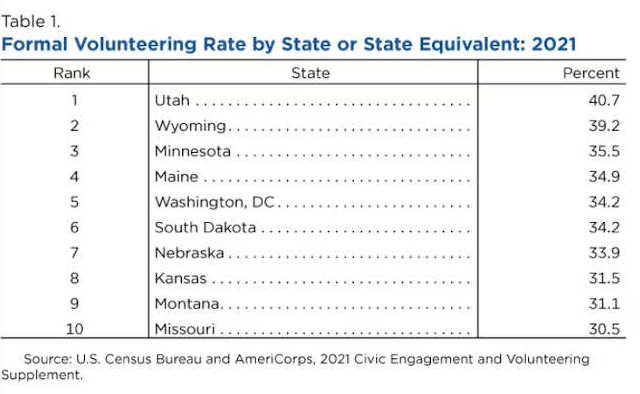
Utah (40.7%) and Wyoming (39.2%) topped the list of states with the highest formal volunteering rates in 2021 (Table 1).
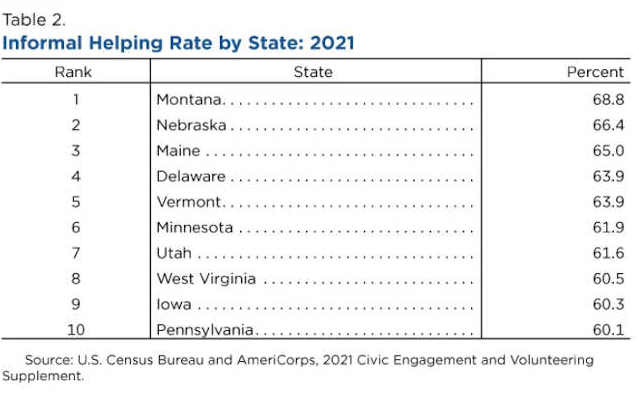
Montana (68.8%) and Nebraska (66.4%) had the highest rates of informal helping, which includes helping others outside of an organizational context like doing favors for neighbors (Table 2).
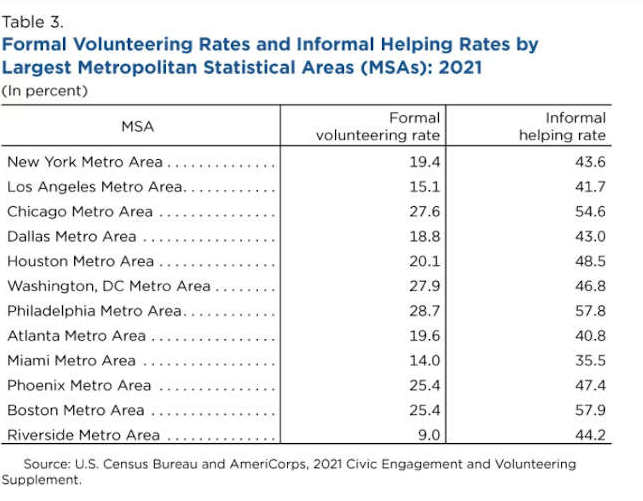
Among the 12 largest metropolitan areas, Philadelphia had the highest rate of formal volunteering (28.7%) and Boston had the highest informal helping rates (57.9%) (Table 3).
Volunteering and Civic Engagement in America complements a large body of other AmeriCorps’ research demonstrating a substantial return on investment in national service for both the government and the communities served, such as improved employment outcomes and mental and physical health benefits for those who volunteer.
AmeriCorps will release additional analyses of Civic Engagement and Volunteering Supplement data in the coming months.
Erin Schneider is content manager in AmeriCorps’ Office of External Affairs. Tim J. Marshall is assistant survey director for the U.S. Census Bureau’s Current Population Survey.

For most of human history, the stars blazed in an otherwise dark night sky. But starting around the Industrial Revolution, as artificial light increasingly lit cities and towns at night, the stars began to disappear.
We are two astronomers who depend on dark night skies to do our research. For decades, astronomers have been building telescopes in the darkest places on Earth to avoid light pollution.
Today, most people live in cities or suburbs that needlessly shine light into the sky at night, dramatically reducing the visibility of stars. Satellite data suggests that light pollution over North America and Europe has remained constant or has slightly decreased over the last decade, while increasing in other parts of the world, such as Africa, Asia and South America. However, satellites miss the blue light of LEDs, which are commonly used for outdoor lighting – resulting in an underestimate of light pollution.
An international citizen science project called Globe at Night aims to measure how everyday people’s view of the sky is changing.
Measuring light pollution over time
Relying on citizen scientists makes it much easier to take multiple measurements of the night sky over time from many different places.
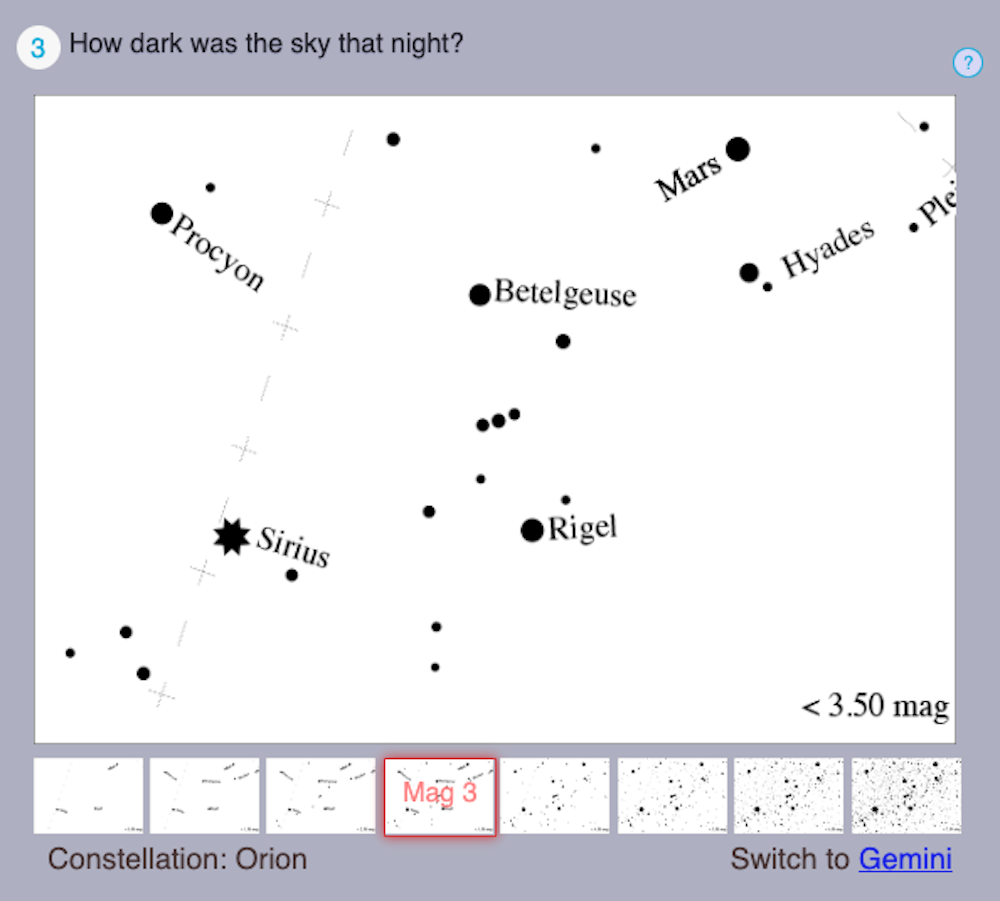
To provide data to the project, volunteers enter the date and time, their location and local weather conditions into an online reporting page anytime an hour or more after sunset on certain nights each month. The page then shows eight panels, each displaying a constellation visible at that time of year – like Orion in January and February, for example. The first panel, representing a light-polluted night sky, only shows the few brightest stars. Each panel shows progressively more and fainter stars, representing darker and darker skies. The participant then matches what they see in the sky with one of the panels.
The Globe at Night team launched the report page as an online app in 2011, just at the beginning of widespread adoption of LEDs. In the recent paper, the team filtered out data points taken during twilight, when the Moon was out, when it was cloudy or when the data was unreliable for any other reason. This left around 51,000 data points, mostly taken in North America and Europe.
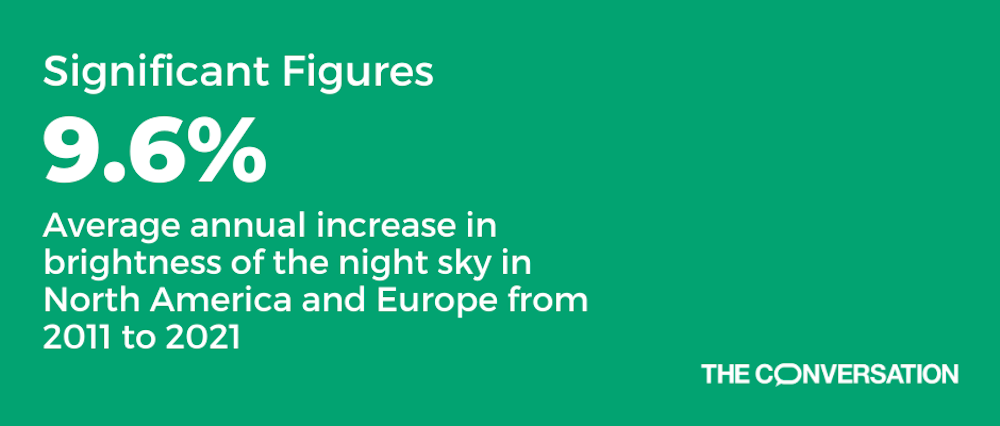
The data shows that the night sky got, on average, 9.6% brighter every year. For many people, the night sky today is twice as bright as it was eight years ago. The brighter the sky, the fewer stars you can see.
If this trend continues, a child born today in a place where 250 stars are visible now would only be able to see 100 stars on their 18th birthday.
Causes, impacts and solutions
The main culprits driving increasing brightness of the night sky are urbanization and the growing use of LEDs for outdoor lighting.
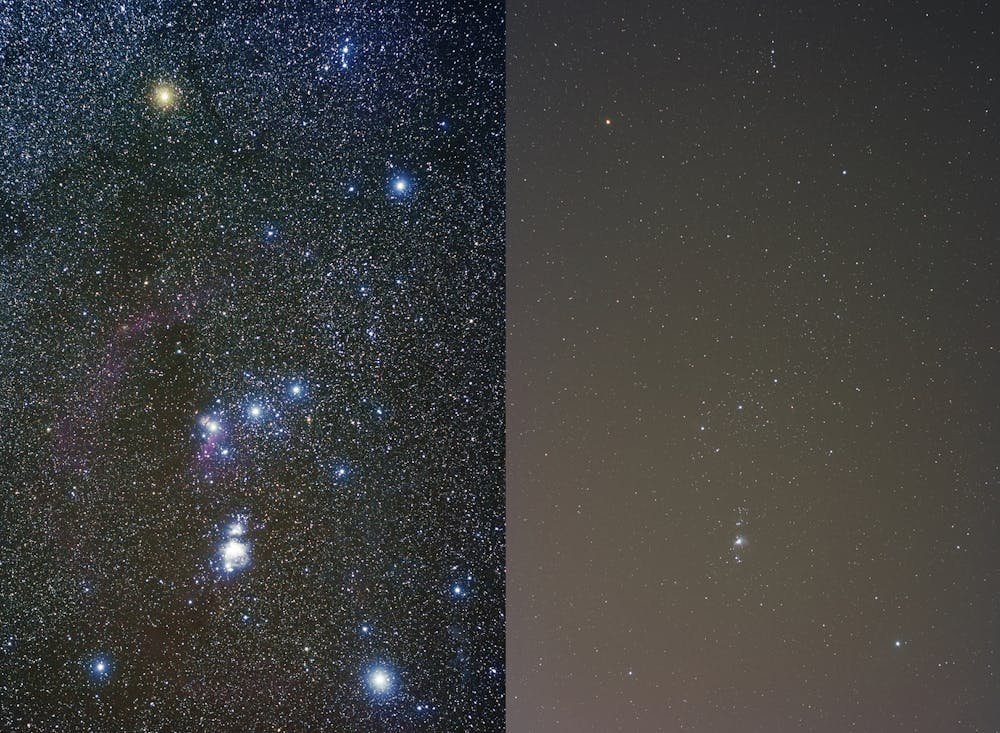
The loss of dark skies, both from light pollution and also from increasing numbers of satellites orbiting Earth, threatens our ability as astronomers to do good science. But everyday people feel this loss too, as the degradation of dark skies is also a loss of human cultural heritage. Starry night skies have inspired artists, writers, musicians and philosophers for thousands of years. For many, a star-filled sky provides an irreplaceable sense of awe.
Light pollution also interferes with the daily cycle of light and dark that plants and animals use to regulate sleep, nourishment and reproduction. Two-thirds of the world’s key biodiversity areas are affected by light pollution.
Individuals and their communities can make simple changes to reduce light pollution. The secret is using the right amount of light, in the right place and at the right time. Shielding outdoor light fixtures so they shine downward, using bulbs that emit more yellow-colored light instead of white light and putting lights on timers or motion sensors can all help reduce light pollution.
The next time you are far away from a major city or another source of light pollution, look up at the night sky. A view of the roughly 2,500 stars you can see with the naked eye in a truly dark sky might convince you that dark skies are a resource worth saving.
Chris Impey, University Distinguished Professor of Astronomy, University of Arizona and Connie Walker, Scientist, National Optical-Infrared Astronomy Research Laboratory
This article is republished from The Conversation under a Creative Commons license. Read the original article.