How to resolve AdBlock issue?
News

Do you think that creativity is an innate gift? Think again.
Many people believe that creative thinking is difficult – that the ability to come up with ideas in novel and interesting ways graces only some talented individuals and not most others.
The media often portrays creatives as those with quirky personalities and unique talent. Researchers have also identified numerous personality traits that are associated with creativity, such as openness to new experiences, ideas and perspectives.
Together, they seem to paint a dire picture for those who consider themselves conventional thinkers, as well as those who do not work in creative occupations – including roles that are often considered traditional and noncreative, such as accountants and data analysts.
These beliefs miss a key part of how creativity works in your brain: Creative thinking is actually something you engage in every day, whether you realize it or not.
Moreover, creativity is a skill that can be strengthened. This matters even for people who don’t consider themselves creative or who aren’t in creative fields.
In research that I recently published with organization and management scholars Chris Bauman and Maia Young, we found that simply reinterpreting a frustrating situation can enhance the creativity of conventional thinkers.
Using creative thinking to cope with emotions
Creativity is often defined as the generation of ideas or insights that are novel and useful. That is, creative thoughts are original and unexpected, but also feasible and useful.
Everyday examples of creativity are plentiful: combining leftover food to make a tasty new dish, coming up with a new way to accomplish chores, mixing old outfits to create a new look.
Another way you do this is when you practice what’s called “emotional reappraisal” – viewing a situation through another lens to change your feelings. There is an element of creativity to this: You’re breaking away from your existing perspectives and assumptions and coming up with a new way of thinking.
Say you’re frustrated about a parking ticket. To alleviate the bad feelings, you can think of the fine as a learning moment.
If you’re anxious about a presentation for work, you can cope with the anxiety by framing it as an opportunity to share ideas, rather than as a high-stakes performance that could result in demotion if handled poorly.
And if you’re angry that someone seemed unnecessarily combative in a conversation, you might reevaluate the situation, coming to view the behavior as unintentional rather than malicious.
Training your creative muscles
To test the link between creative thinking and emotional reappraisal, we surveyed 279 people. Those who ranked higher on creativity tended to reappraise emotional events more often in their daily life.
Inspired by the link between emotional reappraisal and creative thinking, we wanted to see whether we could use this insight to develop ways to help people be more creative. In other words, could emotional reappraisal be practiced by people in order to train their creative muscles?
We ran two experiments in which two new samples of participants – 512 in total – encountered scenarios designed to provoke an emotional response. We tasked them with using one of three approaches to manage their emotions. We told some participants to suppress their emotional response, others to think about something else to distract themselves and the last group to reappraise the situation by looking at it through a different lens. Some participants were also given no instructions on how to manage their feelings.
In a seemingly unrelated task that followed, we asked the participants to come up with creative ideas to solve a problem at work.
In the experiments, conventional thinkers who tried reappraisal came up with ideas that were more creative than other conventional thinkers who used suppression, distraction or received no instructions at all.
Cultivating flexible thinking
Negative emotions are inevitable in work and life. Yet people often hide their negative feelings from others, or use distraction to avoid thinking about their frustrations.
Our findings have implications for how managers can think about how to best leverage the skills of their workers. Managers commonly slot job candidates into creative and noncreative jobs based on cues that signal creative potential. Not only are these cues shaky predictors of performance, but this hiring practice may also limit managers’ access to employees whose knowledge and experience can play major roles in generating creative outcomes.
The result is that the creative potential of a significant part of the workforce may be underutilized. Our findings suggest that supervisors can develop training and interventions to cultivate creativity in their employees – even for those who might not seem predisposed to creativity.
Our research also indicates that people can practice flexible thinking every day when they experience negative emotions. Although people may not always have control over the external circumstances, they do have the liberty to choose how to cope with emotional situations – and they can do so in ways that facilitate their productivity and well-being.
Lily Zhu, Assistant Professor of Management, Information Systems and Entrepreneurship, Washington State University
This article is republished from The Conversation under a Creative Commons license. Read the original article.
Like a sports photographer at an auto-racing event, NASA's Hubble Space Telescope captured a series of photos of asteroid Dimorphos when it was deliberately hit by a 1,200-pound NASA spacecraft called DART on September 26, 2022.
The primary objective of DART, which stands for Double Asteroid Redirection Test, was to test our ability to alter the asteroid's trajectory as it orbits its larger companion asteroid, Didymos.
Though neither Didymos nor Dimorphos poses any threat to Earth, data from the mission will help inform researchers how to potentially divert an asteroid's path away from Earth, if ever necessary.
The DART experiment also provided fresh insights into planetary collisions that may have been common in the early solar system.
Hubble's time-lapse movie of the aftermath of DART's collision reveals surprising and remarkable, hour-by-hour changes as dust and chunks of debris were flung into space. Smashing head on into the asteroid at 13,000 miles per hour, the DART impactor blasted over 1,000 tons of dust and rock off of the asteroid.
The Hubble movie offers invaluable new clues into how the debris was dispersed into a complex pattern in the days following the impact. This was over a volume of space much larger than could be recorded by the LICIACube cubesat, which flew past the binary asteroid minutes after DART's impact.
"The DART impact happened in a binary asteroid system. We've never witnessed an object collide with an asteroid in a binary asteroid system before in real time, and it's really surprising. I think it's fantastic. Too much stuff is going on here. It's going to take some time to figure out," said Jian-Yang Li of the Planetary Science Institute in Tucson, Arizona.
The study, led by Li along with 63 other DART team members, was published on March 1 in the journal Nature.
The movie shows three overlapping stages of the impact aftermath: the formation of an ejecta cone, the spiral swirl of debris caught up along the asteroid's orbit about its companion asteroid, and the tail swept behind the asteroid by the pressure of sunlight (resembling a windsock caught in a breeze).
The Hubble movie starts at 1.3 hours before impact. In this view both Didymos and Dimorphos are within the central bright spot; even Hubble can't resolve the two asteroids separately.
The thin, straight spikes projecting away from the center (and seen in later images) are artifacts of Hubble's optics.
The first post-impact snapshot is 2 hours after the event. Debris flies away from the asteroid, moving with a range of speeds faster than four miles per hour (fast enough to escape the asteroid's gravitational pull, so it does not fall back onto the asteroid). The ejecta forms a largely hollow cone with long, stringy filaments.
At about 17 hours after the impact the debris pattern entered a second stage. The dynamic interaction within the binary system starts to distort the cone shape of the ejecta pattern. The most prominent structures are rotating, pinwheel-shaped features. The pinwheel is tied to the gravitational pull of the companion asteroid, Didymos.
"This is really unique for this particular incident," said Li. "When I first saw these images, I couldn't believe these features. I thought maybe the image was smeared or something."
Hubble next captures the debris being swept back into a comet-like tail by the pressure of sunlight on the tiny dust particles. This stretches out into a debris train where the lightest particles travel the fastest and farthest from the asteroid. The mystery is compounded later when Hubble records the tail splitting in two for a few days.
A multitude of other telescopes on Earth and in space, including NASA's James Webb Space Telescope and Lucy spacecraft, also observed the DART impact and its outcomes.
This Hubble movie is part of a suite of new studies published in the journal Nature about the DART mission. See NASA’s DART Data Validates Kinetic Impact as Planetary Defense Method to learn more.
The Hubble Space Telescope is a project of international cooperation between NASA and ESA. NASA's Goddard Space Flight Center in Greenbelt, Maryland, manages the telescope. The Space Telescope Science Institute (STScI) in Baltimore, Maryland, conducts Hubble and Webb science operations. STScI is operated for NASA by the Association of Universities for Research in Astronomy, in Washington, D.C.
Christopher Inglis and Jack Smalley were selected in a unanimous vote to serve four-year terms on the commission.
They will join the five-member commission, whose other members are Robert Coker, Terry Stewart and Fawn Williams.
Inglis and Smalley succeed Lisa Wilson and Erin McCarrick on the commission.
Wilson had previously indicated she did not intend to seek another term. On Thursday evening, McCarrick clarified for the city — which had reported that she was seeking another term — that she also did not intend to return to the commission.
The city received five applications for the two seats. In addition to Inglis and Smalley, applicants were Jamie DeWalt, Chris Jennings and Carlos Eduardo Ramos.
Jennings pulled out of the running before the meeting and Ramos did not appear for the interviews.
The council asked a series of questions of each candidate. DeWalt went first, and the others were asked to wait outside of the council chambers during her interview.
DeWalt works for a bank, Inglis is a certified financial planner and Smalley works for the county of Lake as a plans examiner. While DeWalt and Smalley both have lived in the county for more than 25 years, Inglis is a relative newcomer.
All of the interviewees noted interest in city growth and housing.
Smalley, in particular, noted that he felt that the housing issue is a major one for the whole state, and that Clearlake is going in a good direction with its effort to develop more housing.
“Getting people off the street should be a major objective,” he said.
Following the interviews, the council voted by ballot and City Clerk Melissa Swanson conducted the tabulation. Smalley received the most votes, followed by Inglis, DeWalt and Ramos.
During public comment, Rick Mayo, the Lake County NAACP Branch president and co-founder, who also is a former city planning commissioner, said he was glad to see how the council was handling the appointments for the very important position.
“It’s a big job,” Mayo said.
Councilman Dirk Slooten moved to appoint Smalley and Inglis, with Councilman David Claffey seconding and the council approving the motion 5-0.
Councilman Russell Cremer said it was a tough vote, noting that DeWalt also is qualified.
Mayor Russell Perdock asked DeWalt to apply again as he wanted to encourage community members to participate.
Claffey called them “three incredible candidates,” adding that there is a lot of need within the community for people like them.
The Clearlake Planning Commission is next set to meet on March 14.
Email Elizabeth Larson at

No one can blame parents for being spooked by new research finding that tweens’ risk of suicidal behavior increases with their amount of screen time.
However, lead researcher Jason Nagata, MD, of UCSF Benioff Children Hospitals, says that caregivers should view these findings mostly as a reminder to ingrain healthy screen use habits in their kids as early as possible.
So your study found that screen use increases suicide risk?
The more time kids spend using screens from ages 9 to 11 years old, the higher their odds of suicidal behaviors two years later, at ages 11 to 13. Specifically, each additional hour of screen time increased the risk by 9%. The risk was highest with texting, followed by video chatting, watching videos, and playing video games. Social media didn’t show an effect, but that may be because, technically, kids aren’t allowed to be on social media platforms until they are 13 (though some still are), so we didn’t have as much data there.
What does “suicidal behavior” mean?
It means thinking about suicide, with or without a specific plan, as well as attempting suicide. We weren’t able to separate attempts versus types of thoughts in this study. I should also note that, overall, suicidal behavior was uncommon in these young kids, occurring in just 1.38% of the 11,633 kids we studied. The risk of suicidal behavior tends to increase with age, so this could be seen as an early warning sign.
Why does screen time increase suicidal behavior?
Time spent on screens often displaces time spent on in-person socializing, physical activity and sleep – all of which are good for mental health. Screen usage can lead to cyberbullying, poor eating habits, isolation and disrupted sleep – all of which can worsen mental health. It also increases exposure to potentially anxiety-provoking or otherwise distressing content.
Is all screen time bad for tweens?
Screens can be helpful in some cases, like for kids who, say, are LGBTQ and don’t have real-life access to support, and to stay in touch with friends and family who live far away. I’d say it’s about being thoughtful about how kids engage with screens and keeping an eye on what they consume.
What can parents do to help kids use screens safely?
It’s important for parents to do what’s developmentally appropriate. For older teens, it’s about giving advice. With younger children, preteens and young teens, it makes sense to have a more hands-on approach, like using parental controls and keeping them off social media until they are 13. This time, during early adolescence, is when you set the behaviors that will help kids develop healthy screen habits later on.
What healthy screen habits do you recommend for tweens?
• Avoid screens before bedtime. We know screen use interferes with sleep, and good sleep is so important for mental health.
• Avoid snacking while using screens, to make eating more intentional; and no use of screens during family meals. That helps keep family time about connection, and also helps parents monitor their kids’ eating, which is important because screen overuse is connected to disordered eating, a mental health issue.
• Parents can also establish screen-free zones, like bathrooms and bedrooms. Kids are less likely to get into violent or harmful content in public spaces in the home.
• Parents should try to model all these behaviors for their kids, which can be the hardest part.
What questions are you still trying to answer about screen time and suicide risk?
One is whether screen use causes suicidality, or whether the increased odds of suicide is because kids who are already depressed are more prone to using screens. With this paper, we see a little more evidence that it’s screens leading to suicidal behavior, because we adjusted for mental health at baseline and we looked at the kids two years later.
Another question is, how can we identify the 1% of kids who might tip into suicidality? We need to learn more about the type of content they consume and how it might play a role.
Jess Berthold writes for the University of California San Francisco News Center.
There are frequently asked questions that people have about revocable living trusts, wills, supported decision making agreements (new), powers of attorney and advance health care directives.
Basically it is what do these documents accomplish and how do they work?
California’s new Supported Decision Making, or SDM, law allows adults with disabilities to authorize trusted persons (e.g., family and friends) to assist them in understanding, making, communicating and implementing their own informed choices, and to have supporters present at important meetings.
A disabled person’s capacity to engage in a wide range of activities is to be determined with such decision making supports in place.
A SDM agreement can authorize supporters to assist a disabled person in estate planning and much more.
A decedent’s will nominates an executor to administer the decedent’s estate, including the distribution of specific gifts and other assets.
A person can execute a simple handwritten will, a statutory will, or have a professional draft a will. Any will, other than a handwritten will, must be witnessed by two disinterested witnesses (i.e., who have no interest under the will).
At death, a will only applies to assets that are not otherwise transferred under a trust, a designation of death beneficiary form or a joint tenancy title.
A trust controls and manages trust assets during a person’s life and at death. Assets held in a living trust avoid conservatorships (during the settlor’s disability) and probate (at the settlor’s death).
Assets transferred into a living trust must belong to the settlor(s) who established the trust. A married couple may together establish a joint (two settler) trust to receive their community property assets.
Each spouse may choose to transfer his or her own separate property assets into a joint trust or else keep their separate property assets in a separate property trust.
Trust assets are titled – for ownership and control — to the trustee(s). Trustee(s) are fiduciaries, i.e., the legal representative of the trust, who administer the provisions in the trust as written, unless unenforceable (i.e., contrary to law or to strong public policy). When a trust is silent on an issue the trustee follows the California Probate Code.
Successor trustees nominated in the trust take office when the last initial trustee(s) resigns, is incapacitated or dies. When and how the transfer occurs is stated in the trust. Some trusts also include a method to fill a trustee vacancy if no nominated successor trustees accepts.
Living trusts can be amended by the settlor(s) as stated in the trust instrument or in the Probate Code. The incapacity or the death of the settlor make the trust irrevocable. A joint trust, however, sometimes allows either settlor acting alone to amend the living trust, in some or all particulars.
Next a power of attorney, or POA, allows a person (i.e., the principal) to authorize another person (i.e., the agent) to act as a fiduciary (representative) over some or all of the principal’s own legal, property and financial affairs; but not the assets held in a trust.
A POA can either be effective upon signing or upon incapacity of the principal. If used to transfer title to real property, a power of attorney must be recorded with the county recorder.
Lastly, advanced health care directive, or AHCD, like a POA, delegates authority to an agent to act in a fiduciary capacity, but with respect to the principal’s health care only.
An AHCD is needed when the principal is unable to make health care decisions, most notably at the end of life.
The foregoing discussion is not legal advice. Consult an attorney for legal advice.
Dennis A. Fordham, attorney, is a State Bar-Certified Specialist in estate planning, probate and trust law. His office is at 870 S. Main St., Lakeport, Calif. He can be reached at

Earth and Venus are rocky planets of about the same size and rock chemistry, so they should be losing their internal heat to space at about the same rate.
How Earth loses its heat is well known, but Venus’ heat flow mechanism has been a mystery.
A study that uses three-decade-old data from NASA’s Magellan mission has taken a new look at how Venus cools and found that thin regions of the planet’s uppermost layer may provide an answer.
Our planet has a hot core that heats the surrounding mantle, which carries that heat up to Earth’s rigid outer rocky layer, or lithosphere. The heat is then lost to space, cooling the uppermost region of the mantle.
This mantle convection drives tectonic processes on the surface, keeping a patchwork of mobile plates in motion. Venus doesn’t have tectonic plates, so how the planet loses its heat and what processes shape its surface have been long-running questions in planetary science.
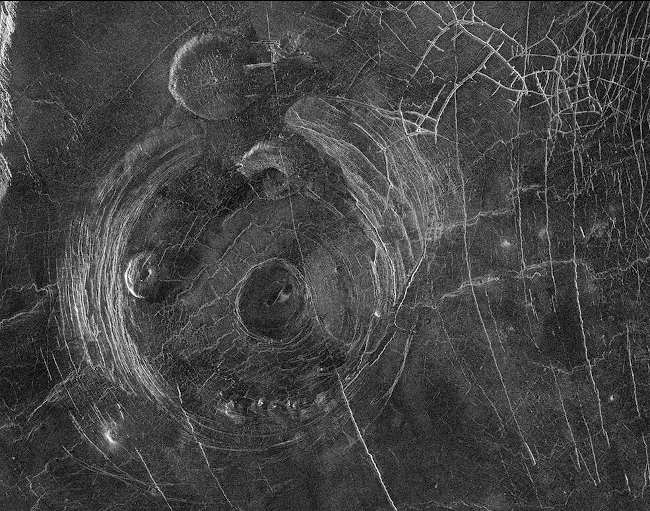
The study looks at the mystery using observations the Magellan spacecraft made in the early 1990s of quasi-circular geological features on Venus called coronae.
Making new measurements of coronae visible in the Magellan images, the researchers concluded that coronae tend to be located where the planet’s lithosphere is at its thinnest and most active.
“For so long we’ve been locked into this idea that Venus’ lithosphere is stagnant and thick, but our view is now evolving,” said Suzanne Smrekar, senior research scientist at NASA’s Jet Propulsion Laboratory in Southern California, who led the study published in Nature Geoscience.
Just as a thin bedsheet releases more body heat than a thick comforter, a thin lithosphere allows more heat to escape from the planet’s interior via buoyant plumes of molten rock rising to the outer layer. Typically, where there’s enhanced heat flow, there’s increased volcanic activity below the surface. So coronae likely reveal locations where active geology is shaping Venus’ surface today.
The researchers focused on 65 previously unstudied coronae that are up to a few hundred miles across. To calculate the thickness of the lithosphere surrounding them, they measured the depth of the trenches and ridges around each corona.
What they found is that ridges are spaced more closely together in areas where the lithosphere is more flexible, or elastic.
By applying a computer model of how an elastic lithosphere bends, they determined that, on average, the lithosphere around each corona is about 7 miles (11 kilometers) thick — much thinner than previous studies suggest.
These regions have an estimated heat flow that is greater than Earth’s average, suggesting that coronae are geologically active.
“While Venus doesn’t have Earth-style tectonics, these regions of thin lithosphere appear to be allowing significant amounts of heat to escape, similar to areas where new tectonic plates form on Earth’s seafloor,” said Smrekar.

A window into Earth’s past
To calculate how old a celestial body’s surface material is, planetary scientists count the number of visible impact craters.
For a tectonically active planet like Earth, impact craters are erased by the subduction of continental plates and covered by molten rock from volcanoes.
If Venus lacks tectonic activity and the regular churn of Earth-like geology, it should be covered in old craters. But by counting the number of Venusian craters, scientists estimate that the surface is relatively young.
Recent studies suggest the youthful appearance of Venus’ surface is likely due to volcanic activity, which drives regional resurfacing today. This finding is supported by the new research indicating higher heat flow in coronae regions – a state that Earth’s lithosphere may have resembled in the past.
“What’s interesting is that Venus provides a window into the past to help us better understand how Earth may have looked over 2.5 billion years ago. It’s in a state that is predicted to occur before a planet forms tectonic plates,” said Smrekar, who is also the principal investigator of NASA’s forthcoming Venus Emissivity, Radio science, InSAR, Topography, And Spectroscopy (VERITAS) mission.
VERITAS will pick up where Magellan left off, improving upon that mission’s data, which is low resolution and comes with large margins of error. Targeting launch within a decade, the mission will use a state-of-the-art synthetic aperture radar to create 3D global maps and a near-infrared spectrometer to figure out what the surface is made of. VERITAS will also measure the planet’s gravitational field to determine the structure of Venus’ interior. The instruments will together fill in the story of the planet’s past and present geologic processes.
“VERITAS will be an orbiting geologist, able to pinpoint where these active areas are, and better resolve local variations in lithospheric thickness. We’ll be even be able to catch the lithosphere in the act of deforming,” said Smrekar. “We’ll determine if volcanism really is making the lithosphere ‘squishy’ enough to lose as much heat as Earth, or if Venus has more mysteries in store.”