 How to resolve AdBlock issue?
News
The funding is provided through the federal Highway Safety Improvement Program, or HSIP.
“Safety is always Caltrans’ top priority,” said Caltrans Director Tony Tavares. “These projects will enhance systemwide safety features, including enhancing safety for people who walk and bike, and move us closer to our vision of reaching zero fatalities and serious injuries on roadways throughout the state by 2050.”
In Lake County, three projects will be funded:
— Pedestrian crossing improvements including installing solar powered rectangular rapid flashing beacons and LED enhanced crosswalk signs, speed tables, lighting and pavement markings at 12 locations including, Upper Lake, North Lakeport, Lucerne, Lower Lake, Hidden Valley, Middletown and Kelseyville.
— Install solar powered dynamic speed warning signs at 22 locations including Soda Bay Road, Butts Canyon Road, Nice-Lucerne Cutoff Road, Lakeshore Boulevard, Morgan Valley Road, Sulphur Bank Drive, Bottle Rock Road, Scotts Valley Road, New Long Valley Road, Seigler Canyon Road and Spruce Grove Road.
— Robinson Rancheria street sign and guardrail replacement including new street signage with regulatory, warning and information. Upgrades to guardrails on Acorn Drive and crosswalk improvements on Pomo Way.
Other city and county road projects around the North Coast approved for funding in Caltrans District 1 include the following.
Eureka: Install LED stop signs, dynamic speed warning signs, curb extensions, rectangular rapid flashing beacons for pedestrians and sidewalks on Buhne Street between Fairfield and Dean streets.
Humboldt County: Guardrail repair and replacement at various locations on roadways and bridges.
Humboldt County: In Willow Creek, install a pedestrian activated flashing beacon crosswalk at the intersection of County Club Road and Terrance Road and a warning flashing sign on Country Club Road.
Humboldt County: Install fog lines on rural roads in Humboldt County that are utilized by the Hoopa Valley, Karuk and Yurok Tribes.
Crescent City: Pedestrian crossing improvement projects at various locations, including sidewalks with ADA curb ramps, rectangular rapid flashing beacons, road signs, and updated pavement markings.
Ukiah: Traffic signal improvements along with signal re-timing and provide protected left-turn phases at various intersections of State Street, Perkins Street at South Orchard Avenue, East Gobbi Street at South Orchard Avenue and Airport Park Boulevard at Talmage Road.
Willits: Install and upgrade regulatory warning signs, new dynamic speed warning signs and center and edge lines on nine roadway segments including portions of North Main Street, Sherwood Road, East Commercial Street, McKinley Street, East San Francisco Avenue and Hazel Street.
Willits: Pedestrian safety improvements including upgrades to signal hardware, install and upgrade signs and crosswalks and pavement markings, Accessible Pedestrian Signal buttons and upgrade controllers and ped signal head mounts along Main St at East San Francisco Street, West Valley Road and Commercial Street.
Mendocino County: Upgrades and replaces existing guardrails and end treatments along roadway segments on East Side Potter Valley Road, Point Cabrillo Drive, Babcock Lane, Primrose Drive and Comptche-Ukiah Road.
Mendocino County: Installation of advance curve warning signs, pedestrian sidewalks, pathways and crossing improvements at Branscomb Road, Kenny Creek Road, Eastside Calpella Road/Marina Drive-Route 20 on/off ramp, Comptche Ukiah Road/Route 1-Mendocino Headlands State Park, Mountain View Road between Manchester and Boonville, Crawford Road, Foothill Blvd, and South State Street, Laws Avenue and Beacon Lane.
Mendocino County: Installation and upgrade of regulatory and warning signs with fluorescent sheeting and the installation of curve signs on horizontal curves, delineators, reflectors, and object markers on roadway segments along Branscomb Road, Eastside Calpella Road, North and South State Street, Sherwood Road, Comptche Ukiah Road, Simpson Lane, Vichy Springs Road, Valley Road, Mountain View Road, Pudding Creek Road, Eel River Road and Henderson Lane.
Fort Bragg: Install and upgrade larger stop signs along with intersection warning and regulatory signs, and upgrade pedestrian crossings improvements with enhanced safety features including rectangular rapid flashing beacons at Route 20 at Boatyard Drive, Route 1 at Pine Street, Pudding Creek, at Noyo Point/Harbor and Harold at Oak.
Fort Bragg: Pedestrian safety improvements including high visibility crosswalks, bulb-outs, warning signs and ADA curb ramps at nine intersections and connecting segments on Harold Street between Fir Street and Maple Street.
"While Caltrans continues to prioritize safety and sustainability on state highways, the Department also recognizes the importance of the local roads connected to those highways," said Caltrans District 1 Director Matt Brady. "We're excited to serve a role in helping to fund these improvements for counties and incorporated areas in Del Norte, Humboldt, Mendocino and Lake counties."
A total of 282 projects from 155 local agencies will receive HSIP funds for safety enhancements that include pedestrian crossing enhancements, bike safety improvements and new traffic signals, roundabouts, turn lanes, rumble strips and guardrails. Caltrans awards these grants every other year to cities, counties and tribal governments.
Caltrans is using the Safe System approach — which emphasizes multiple layers of protection, including safer road designs — to achieve its goal of reducing to zero the number of fatalities and serious injuries on state roadways by 2050.
Caltrans’ adoption of the Safe System approach builds on its ongoing work to embed safety in the state’s transportation system, and for that reason all transportation projects the department funds or oversees now must include “complete street” features that provide safe and accessible options for people walking, biking and taking transit.
More information on the program is available at Caltrans’ HSIP page, including a full list of approved projects.
The flood watch will remain in effect until 10 p.m. Friday.
National Weather Service observation stations showed that more than 2 inches of rain fell in parts of Lake County on Thursday.
Heavy rain fell late Thursday night in areas including the Northshore.
Another inch and a half of rain could fall through Sunday night, the forecast said, and still more rain is predicted through next weekend.
Windy conditions also are in the forecast through Sunday, with gusts of up to 30 miles per hour.
Daytime conditions this week see temperatures topping out in the low 50s, with nighttime temperatures into the high 30s.
Email Elizabeth Larson at
With storms forecasted to continue through mid-March, the governor on Wednesday proclaimed a state of emergency in 21 counties — including Lake — to support disaster response and relief efforts, following the state of emergency he proclaimed in an initial 13 counties earlier this month.
“California is deploying every tool we have to protect communities from the relentless and deadly storms battering our state,” said Gov. Newsom. “In these dangerous and challenging conditions, it is crucial that Californians remain vigilant and follow all guidance from local emergency responders.”
If approved, the emergency declaration would enable impacted counties to immediately access direct federal assistance to help protect public safety and property.
The request for direct federal assistance includes generators, road clearance equipment and potential sheltering and mass care assistance.
California is mobilizing personnel and resources to storm-impacted communities throughout the state.
The following resources are being deployed.
Cal Fire and partner agencies:
• 43 crews active statewide, 12 of which are committed to the San Bernardino storm incident (includes crews from California National Guard, California Conservation Corps, and California Department of Corrections and Rehabilitation).
• Two helicopters, two dozers and an incident management team, among other resources.
California National Guard.
• The California National Guard is pre-positioning high water vehicles and aircraft in preparation for flood response operations.
California Department of Transportation:
• Mobilized more than 4,000 crew members to hundreds of incidents statewide, working 24/7 in shifts.
• In San Bernardino County, more than 57 Caltrans employees operating 40 high-powered pieces of equipment, including snowplows, graders, loaders and dump trucks, have removed more than 12.6 million cubic yards of snow off state highways as of March 8, which equates to more than 3,800 Olympic-size swimming pools.
California Highway Patrol:
• Increasing resources in targeted areas to help address storm-related needs – including ensuring full staffing for air operation missions, ready to deploy as needed.
• CHP and Caltrans escorts have been deployed to ensure the safe delivery of food and fuel to the Big Bear and west mountain communities.
Cal OES and partner agencies:
• Opened 8 shelters in the counties of San Bernardino, Stanislaus, Madera, Merced, Fresno, Butte and Nevada, and facilitated food donations through the California Grocers Association to provide meal kits in San Bernardino County.
• Cal OES has sent 120 operators and over 60 pieces of heavy-duty snow removal equipment to dig out the snow-locked communities of San Bernardino. These resources are removing massive amounts of snow from public roads and other sites to help residents get access to needed supplies.
• Prepositioned 20 swiftwater rescue and urban search and rescue teams, more than 50 fire engines, and over 60 personnel to provide aid to communities impacted by the extreme weather.
Safety tips for Californians
Emergency alerts
Californians can dial 2-1-1 or 3-1-1 to get help or ask questions. If you have a critical emergency, call 9-1-1.
Stay informed by signing up for emergency alerts including warnings and evacuation notices. Go to CalAlerts.org to sign up to receive alerts from your county officials.
Driving and road closures
Avoid non-essential travel during the peak of the storm through Saturday. If you must drive, download the QuickMap app or visit QuickMap.dot.ca.gov to learn up-to-the-minute information on road conditions, traffic, closures, chain control and more.
Power outages
Take inventory of the items you need that rely on electricity. Plan for batteries and other alternative power sources to meet your needs if the power goes out such as a portable charger or power bank. Have flashlights for every household member. Determine whether your home phone will work in a power outage and how long battery backup will last.
Flood risk
If you are under a flood warning:
• Find safe shelter right away.
• Do not walk, swim or drive through flood waters. Turn Around, Don’t Drown!
• Remember, just 6 inches of moving water can knock you down, and one foot of moving water can sweep your vehicle away.
• Stay off bridges over fast-moving water.
• Know your medical needs
Talk to your medical provider about a power outage plan for medical devices powered by electricity and refrigerated medicines. Know how long your medications can be stored at higher temperatures and get specific guidance for any medications that are critical for life.
Generator safety
Portable back-up generators produce the poison gas carbon monoxide, or CO. CO is an odorless, colorless gas that kills without warning. It claims the lives of hundreds of people every year and makes thousands more ill. Follow these steps to keep your family safe.
When using portable generators:
• Never use a generator inside your home or garage, even if doors and windows are open.
Only use generators outside, more than 20 feet away from your home, doors, and windows.
CO detectors
• Install battery-operated or battery back-up CO detectors near every sleeping area in your home.
• Check CO detectors regularly to be sure they are functioning properly.
Food storage
Have enough nonperishable food and water for every member of your household for three days. Open freezers and refrigerators only when necessary. Your refrigerator can keep food cold for four hours without power. A full freezer will maintain temperature for two days. Use coolers with ice if necessary. Monitor temperatures with a thermometer. Throw out food if temperatures reach 40 degrees or higher.

As people in the U.S. prepare to set their clocks ahead one hour on Sunday, March 12, 2023, I find myself bracing for the annual ritual of media stories about the disruptions to daily routines caused by switching from standard time to daylight saving time.
About one-third of Americans say they don’t look forward to these twice-yearly time changes. And nearly two-thirds would like to eliminate them completely, compared to 21% who aren’t sure and 16% who would like to keep moving their clocks back and forth.
But the effects go beyond simple inconvenience. Researchers are discovering that “springing ahead” each March is connected with serious negative health effects, including an uptick in heart attacks and teen sleep deprivation. In contrast, the fall transition back to standard time is not associated with these health effects, as my co-authors and I noted in a 2020 commentary.
I’ve studied the pros and cons of these twice-annual rituals for more than five years as a professor of neurology and pediatrics and the director of Vanderbilt University Medical Center’s sleep division. It’s become clear to me and many of my colleagues that the transition to daylight saving time each spring affects health immediately after the clock change and also for the nearly eight months that Americans remain on daylight saving time.
The strong case for permanent standard time
Americans are split on whether they prefer permanent daylight saving time or permanent standard time.
However, the two time shifts – jolting as they may be – are not equal. Standard time most closely approximates natural light, with the sun directly overhead at or near noon. In contrast, during daylight saving time from March until November, the clock change resulting from daylight saving time causes natural light to be present one hour later in the morning and one hour later in the evening according to clock time.
Morning light is essential for helping to set the body’s natural rhythms: It wakes us up and improves alertness. Morning light also boosts mood – light boxes simulating natural light are prescribed for morning use to treat seasonal affective disorder.
Although the exact reasons why light activates us and benefits our mood are not yet known, this may be due to light’s effects on increasing levels of cortisol, a hormone that modulates the stress response or the effect of light on the amygdala, a part of the brain involved in emotions.
Adolescents also may be chronically sleep deprived due to school, sports and social activities. For instance, many children start school around 8 a.m. or earlier. This means that during daylight saving time, many young people get up and travel to school in pitch darkness.
The body of evidence makes a good case for adopting permanent standard time nationwide, as I testified at a March 2022 Congressional hearing and argued in a recent position statement for the Sleep Research Society. The American Medical Association recently called for permanent standard time. And in late 2022, Mexico adopted permanent standard time,, citing benefits to health, productivity and energy savings.

The biggest advantage of daylight saving time is that it provides an extra hour of light in the late afternoon or evening, depending on time of year, for sports, shopping or eating outside. However, exposure to light later into the evening for almost eight months during daylight saving time comes at a price. This extended evening light delays the brain’s release of melatonin, the hormone that promotes drowsiness, which in turn interferes with sleep and causes us to sleep less overall.
Because puberty also causes melatonin to be released later at night, meaning that teenagers have a delay in the natural signal that helps them fall asleep, adolescents are particularly susceptible to sleep problems from the extended evening light. This shift in melatonin during puberty lasts into our 20s.
The ‘western edge’ effect
Geography can also make a difference in how daylight saving time affects people. One study showed that people living on the western edge of a time zone, who get light later in the morning and later in the evening, got less sleep than their counterparts on the eastern edge of a time zone.
This study found that western-edge residents had higher rates of obesity, diabetes, heart disease and breast cancer, as well as lower per capita income and higher health care costs. Other research has found that rates of certain other cancers are higher on the western edge of a time zone.
Scientists believe that these health problems may result from a combination of chronic sleep deprivation and “circadian misalignment.” Circadian misalignment refers to a mismatch in timing between our biological rhythms and the outside world. In other words, the timing of daily work, school or sleep routines is based on the clock, rather than on the sun’s rise and set.
A brief history of daylight saving time
Congress instituted year-round daylight saving time during World War I and World War II, and once again during the energy crisis of the early 1970s.
The idea was that having extra light later into the afternoon would save energy by decreasing the need for electric lighting. This idea has since been proved largely inaccurate, as heating needs may increase in the morning in the winter, while air conditioning needs can also increase in the late afternoon in the summer.
Another pro-daylight saving argument has been that crime rates drop with more light at the end of the day. While this has been proved true, the change is very small, and the health effects appear to outweigh the benefits to society from lower rates of crime.
After World War II, designating the start and end dates for daylight saving time fell to state governments. Because this created many railroad scheduling and safety problems, however, Congress passed the Uniform Time Act in 1966. This law set the nationwide dates of daylight saving time from the last Sunday in April until the last Sunday in October. In 2007, Congress amended the act to expand the period in which daylight saving time is in effect from the second Sunday in March to the first Sunday in November – dates that remain in effect today.
The Uniform Time Act allows states and territories to opt out of daylight saving time, however. Arizona and Hawaii are on permanent standard time, along with Puerto Rico, the U.S. Virgin Islands, Northern Mariana Islands, Guam and American Samoa.
Now, many other states are considering whether to stop falling back and springing ahead. Several U.S. states have legislation and resolutions under consideration to support permanent standard time, while many others have been or are considering permanent daylight saving time. Legislation and resolutions for permanent standard time have increased from 15% in 2021 to 31% in 2023.
In March 2022, the U.S. Senate passed the Sunshine Protection Act in a bid to make daylight saving time permanent. But the House did not move forward with this legislation. Florida Sen. Marco Rubio reintroduced the bill on March 1, 2023.
The spike in activity among states seeking to break from these twice-yearly changes reflects how more people are recognizing the downsides of this practice. Now, it’s up to legislators to decide whether we end the time shift altogether, and to choose permanent standard or daylight saving time.
This is an updated version of an article originally published on March 10, 2022.
Beth Ann Malow, Professor of Neurology and Pediatrics, Vanderbilt University
This article is republished from The Conversation under a Creative Commons license. Read the original article.
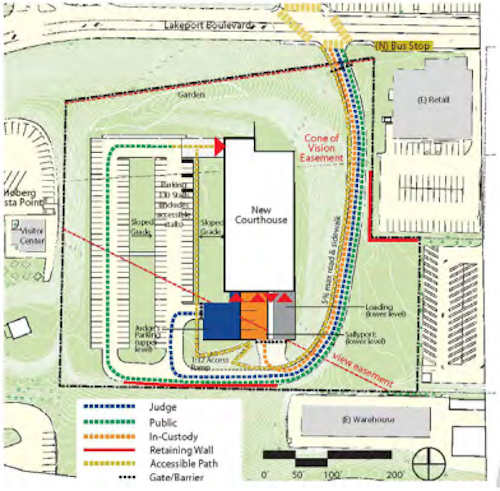
LAKE COUNTY, Calif. — With the construction of Lakeport’s new courthouse set to start early next year, the Lakeport City Council held a discussion on Tuesday about possible traffic improvements to facilitate the higher traffic volumes expected in the project area.
The 45,300 square foot courthouse will be built on a five-acre site at 675 Lakeport Blvd. The cost is $73.1 million.
The Judicial Council of California reported that the project is now in the design-build phase, with construction expected to begin in February 2024 and to be completed in October 2025.
City Manager Kevin Ingram updated the council on the courthouse project and asked for direction on which traffic improvement options to take in Lakeport Boulevard.
Those improvements will be focused mainly on the area around the intersection with Larrecou Lane, which also is an access street to the Lakeport Senior Center and the city’s corporation yard.
Ingram said the main access to the courthouse site is a private driveway from the top of the hill along the eastern boundary of the property to Lakeport Boulevard near the intersection with Larrecou Lane.
“That was not originally the city’s preference” for the site access, but Ingram said that’s the direction the state’s studies are taking them.
Initially, the city wanted the Judicial Council to consider changing the access to the west side of the property, which would go around the county-owned agriculture building. However, he said the state has not been open to that option.
Now, the state is picking up the pace on the courthouse project, and the state’s traffic studies are showing minimal impact on traffic. Over the years, Ingram said the city has expressed its dissatisfaction with those findings.
With the state telling the city that it only has a small amount of money for roadway improvements, Ingram said the city has looked at the Lakeport Boulevard corridor and developed four options.
The first option, which Ingram said city staff didn’t support, is a traffic signal at Lakeport Boulevard at Larrecou Lane.
Ingram said there are no stoplights in Lakeport now, explaining they require maintenance estimated at $150,000 to keep them calibrated.
In addition to that ongoing cost that the city would have to absorb, Ingram said a traffic signal would be obtrusive to the corridor and its businesses — which include two grocery stores — especially on the east side.
The second option, and a less obtrusive one, is a small roundabout at the Lakeport Boulevard and Larrecou Lane intersection, Ingram said.
Ingram said the main problem with the roundabout option is expense due to acquiring the right of way. As a result, it’s likely to exceed the $500,000 for intersection improvements the Judicial Council has tentatively offered.
The third option is a two-way stop, with controlled access. Ingram said a new stop sign would be placed at the bottom of the courthouse driveway, across from the existing stop sign on Larrecou.
Ingram said that option likely would require some geometric redesign of Lakeport Boulevard. It would need a deceleration lane and a dedicated turn lane to turn into the site. A challenge would be pedestrian access, with city staff having discussed a lighted crosswalk.
The fourth option is a four-way stop. “That would certainly meet the needs when the court is in session,” said Ingram, but it would stop traffic along that entire traffic corridor around the clock, seven days a week.
Ingram said the third and fourth options could fit into the state’s $500,000 proposed budget, while the city would have to fund the traffic signal and roundabout options.
Councilman Kenny Parlet raised an issue with why the city should pick up the entire tab for the road improvements, since it’s a county courthouse. Ingram said it was a valid point, and that the county hasn’t yet been asked to contribute.
Councilman Michael Froio said they don’t want to see the courthouse leave the city. He said the city needed to try to plan for the future and determine the best ingress and egress, as the state is determined to build the courthouse in that location.
Councilmember Kim Costa pointed out the potential traffic challenges with vehicles coming off the overpass a block away.
Mayor Stacey Mattina said the additional traffic would mean that left hand turns to get out of store parking lots would be very difficult, forcing vehicles to turn right toward Main Street.
Froio pointed to the “Lakeport Hub” project, consisting of a new hotel, stores, restaurants and a gas station, that’s proposed to be built at 1842 Todd Road.
With all of that new development going on in the area and impacting traffic, “This thing is looking like a mess,” Froio said.
Ingram said there are positive aspects for traffic flow by having a roundabout at the intersection with Lakeport Boulevard and Bevins Street
He said he believes the court is underestimating the amount of money that will be required to dig into the hill to do the deceleration lane for the courthouse driveway.
While he said the Bevins Street and Lakeport Boulevard intersection is a critical piece for developing the traffic corridor, the state has made it clear that it’s off the table in connection to the courthouse project.
Costa moved to direct city staff to work with a traffic engineering consultant to develop preliminary design and detailed cost estimates for the two options the council favored following discussion — a roundabout and a two-way stop.
Parlet seconded and the council voted 5-0.
Ingram said city staff would get to work on that process and return to the council with options to review in a few months.
On Tuesday the council also welcomed new Community Development Department Administrative Specialist Mel Olea.
An MIT graduate who grew up in Lake County and has worked in the Bay Area, Olea told the council, “I’m really happy to be back to where I have roots.”
He said his family and friends are here, “And now my work family's here.”
Mattina quipped that Parlet nearly fell out of his seat when he heard Olea had attended MIT.
In other business on Tuesday, the council approved setting a public hearing next month for the purpose of certifying a mitigated negative declaration with a mitigation monitoring and reporting program, adopting a general plan amendment and zone change to revise the zoning associated with the Martin Street Phase III Residential Project.
That 40-unit project will be built by AMG & Associates LLC at 519 S. Smith St., next to the Phase I and II of the Martin Street Apartments, also built by AMG.
Council members also approved authorizing Ingram to execute the professional services agreement with Community Development Services for federal grant business financial assistance program services, and conditionally awarded a construction contract to James Day Construction Inc. dba Coastal Mountain Electric for the Silveira Community Center Electrical and HVAC Project.
Email Elizabeth Larson at
Those counties are Butte, El Dorado, Fresno, Humboldt, Imperial, Inyo, Lake, Mendocino, Merced, Monterey, Napa, Placer, Plumas, Sacramento, San Francisco, San Mateo, Santa Clara, Santa Cruz, Stanislaus, Tuolumne and Yuba.
The governor last week proclaimed a state of emergency in 13 counties due to storms, and activated the California Guard and State Operations Center to bring state support to county-led emergency response efforts and coordinate mutual aid from neighboring jurisdictions.
“The state is working around the clock with local partners to deploy life-saving equipment and first responders to communities across California,” said Gov. Newsom. “With more dangerous storms on the horizon, we’ll continue to mobilize every available resource to protect Californians.”
The state has significant staffing and equipment resources from the Governor’s Office of Emergency Services, or Cal OES, along with Caltrans, the California Highway Patrol, Cal Fire and the California National Guard on the ground in impacted areas.
Cal Fire and partner agencies have 43 crews active statewide, 12 of which are committed to the San Bernardino storm incident, as well as two helicopters, two dozers and an Incident Management Team, among other resources.
The California Guard is pre-positioning high water vehicles in preparation for flood response operations.
Caltrans has mobilized more than 4,000 crew members to hundreds of incidents statewide, working 24/7 in shifts.
In San Bernardino County, more than 57 Caltrans employees operating 40 high-powered pieces of equipment, including snowplows, graders, loaders and dump trucks, have removed more than 12.6 million cubic yards of snow off state highways as of March 8, which equates to more than 3,800 Olympic-size swimming pools.
CHP is increasing resources in targeted areas to help address storm-related needs – including ensuring full staffing for air operation missions, ready to deploy as needed.
Cal OES has coordinated with the Department of Developmental Services to open six shelters in the counties of San Bernardino, Stanislaus, Madera, Butte and Nevada, and has facilitated food donations through the California Grocers Association to provide meal kits in San Bernardino County.
Visit CalAlerts.org to sign up for local wireless emergency alerts and QuickMap to check road conditions in your area.