 How to resolve AdBlock issue?
News
The board will meet beginning at 9 a.m. Tuesday, March 14, in the board chambers on the first floor of the Lake County Courthouse, 255 N. Forbes St., Lakeport.
The meeting can be watched live on Channel 8, online at https://countyoflake.legistar.com/Calendar.aspx and on the county’s Facebook page. Accompanying board documents, the agenda and archived board meeting videos also are available at that link.
To participate in real-time, join the Zoom meeting by clicking this link.
The meeting ID is 963 7925 2573, pass code 161535. The meeting also can be accessed via one tap mobile at +16699006833,,96379252573#,,,,*161535#.
All interested members of the public that do not have internet access or a Mediacom cable subscription are encouraged to call 669-900-6833, and enter the Zoom meeting ID and pass code information above.
In an untimed item on Tuesday, the board will consider rescinding the resolution that began the COVID-19 health emergency three years ago.
Originally declared by then-Lake County Public Health Office Gary Pace in March of 2020, Resolution No. 2020-22 has been renewed since then in order to continue the local health emergency related to the 2019 Coronavirus.
The state’s COVID-19 emergency ended in February and now local jurisdictions are following suit.
In another untimed item, the supervisors, sitting as the Board of Directors of the Lake County Watershed Protection District, will consider a purchase agreement with Eric Seely for property within the Middle Creek Flood Damage Reduction and Ecosystem Restoration project in the amount of $1,206,900.
The full agenda is here.
CONSENT AGENDA
5.1: Adopt proclamation commending Operation Tango Mike for 20 years of support for military personnel and their families.
5.2: Adopt proclamation designating the month of March 2023 as March for Meals Month.
5.3: Adopt proclamation commending Director of Behavioral Health Todd Metcalf for his 11 years of service to Lake County.
5.4: Adopt proclamation designating the month of March 2023 as Women's History Month in Lake County.
5.5: Adopt proclamation designating March 8, 2023, as International Women's Day in Lake County.
5.6: Adopt proclamation recognizing March 12 to 18, 2023, as All AmeriCorps Week.
5.7: Approve letter of support for the Tree Mortality Mitigation and Public Safety in Lake County - 22-WP-LNU 47229043.
5.8: Adopt resolution pertaining to tax revenue exchange for annexation to CSA #20 - Soda Bay Water (Annexation - LAFCo Project #2022-0001).
5.9: Approve agreement between county of Lake and Santa Rosa Behavioral Healthcare Hospital for acute inpatient psychiatric hospital services and professional services associated with acute inpatient psychiatric hospitalizations in the amount of $50,000 for fiscal year 2022-23 and authorize the board chair to sign.
5.10: Approve Board of Supervisors minutes for Jan. 10, 2023.
5.11: (a) Approve purchase of vehicle equipment from Precision Wireless in an amount not to exceed $175,000 from the Sheriff/Coroner budget 2201 Object Code 28.30; and (b) authorize the sheriff/coroner or his designee to issue a purchase order.
5.12: (a) Approve mortuary services agreement between the county of Lake and Chapel of the Lakes Mortuary, and authorize the chair to sign; (b) approve the first amendment to facility agreement for autopsy services between the county of Lake and Chapel of the Lakes Mortuary to be effective Feb. 1, 2023, and authorize the chair to sign; (c) approve the first amendment to mortuary services agreement between the county of Lake and Jones Mortuary, to be effective Feb. 1, 2023, and authorize the chair to sign; (d) approve the first amendment to mortuary services agreement between the county of Lake and Jones and Lewis Mortuary, to be effective Feb. 1, 2023, and authorize the chair to sign.
TIMED ITEMS
6.2, 9:07 a.m.: Presentation of proclamation commending Operation Tango Mike for 20 years of support for military personnel and their families.
6.3, 9:08 : Presentation of proclamation designating the month of March 2023 as March for Meals Month.
6.4, 9:09 a.m.: Presentation of proclamation designating the month of March 2023 as Women's History Month in Lake County.
6.5, 9:10 A.M.: Presentation of proclamation designating March 8, 2023 as International Women's Day in Lake County.
6.6, 9:11 a.m.: Presentation of proclamation commending Director of Behavioral Health Todd Metcalf for his 11 years of service to Lake County.
6.7, 9:12 a.m.: Proclamation recognizing March 12 to 18, 2023, as All AmeriCorps Week.
6.8, 9:15 a.m.: Erratum, (a) Consideration of priorities for FY 2024 Community Project Funding; (b) consideration of resolutions confirming Lake County’s highest priority projects for submittal for FY 2024 Community Project Funding, including (1) Big Valley Fish Habitat Improvement and Groundwater Recharge Project, (2) pre-development support for a recreation center and aquatic/community swim center, and (3) regional navigation center pre-development support.
6.9, 10:15 a.m.: Consideration of update on the parks, recreation and trails master plan.
6.10, 10:45 a.m.: Consideration of a joint powers agreement to form the Lake County Recreation Agency.
UNTIMED ITEMS
7.2: Consideration and discussion of rescinding Resolution No. 2020-22, approve continuation of a local health emergency related to the 2019 Coronavirus (COVID-19) as proclaimed by the Lake County Public Health officer.
7.3: Discussion and consideration of potential funding source for Mike Marsh EMS Consulting in the amount of $20,000 for emergency ambulance strike team support through Regional Disaster Management Services Association (resource order request) to decompress two overwhelmed hospitals during emergency proclamation (winter storm).
7.4: Consideration of Contract Change Order No. 1 for the Hill Road Correctional Facility Standby Generator Project, Bid No. 22-08.
7.5: Sitting as the Board of Directors of the Lake County Watershed Protection District, consideration of the purchase agreement with Eric Seely for Property within the Middle Creek Flood Damage Reduction and Ecosystem Restoration project in the amount of $1,206,900.00 and authorize the chair of the board of directors to sign the agreement.
CLOSED SESSION
8.1: Public employee appointment pursuant to Gov. Code Section 54957(b)(1): Interviews for interim Behavioral Health director appointment of interim Behavioral Health director.
8.2: Public employee appointment pursuant to Gov. Code Section 54957(b)(1): Interviews for county counsel; appointment of county counsel.
8.3: Conference with legal counsel: Existing litigation pursuant to Gov. Code section 54956.9 (d)(1) - City of Clearlake v. Testate and Intestate Successors of Bailey Lumber Co, et al.
8.4: Public employee evaluation: County librarian.
8.5: Public employee evaluation: County counsel.
Email Elizabeth Larson at
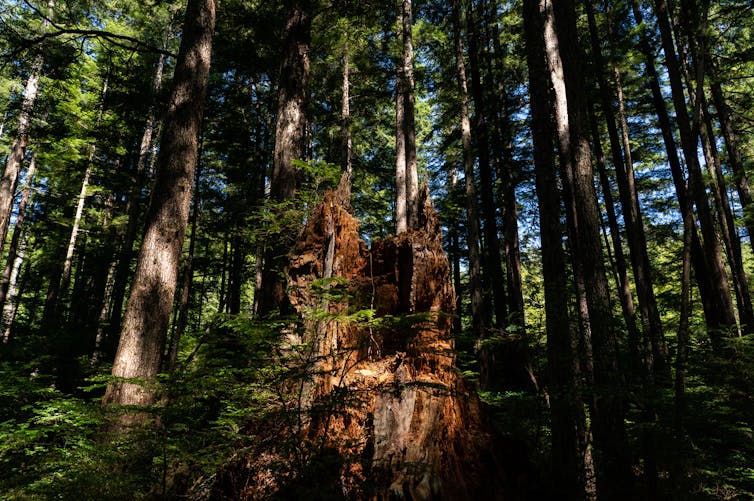
Forests are critically important for slowing climate change. They remove huge quantities of carbon dioxide from the atmosphere – 30% of all fossil fuel emissions annually – and store carbon in trees and soils. Old and mature forests are especially important: They handle droughts, storms and wildfires better than young trees, and they store more carbon.
In a 2022 executive order, President Joe Biden called for conserving mature and old-growth forests on federal lands. Recently Biden protected nearly half of the Tongass National Forest in Alaska from road-building and logging.
The Biden administration is compiling an inventory of mature and old-growth forests on public lands that will support further conservation actions. But at the same time, federal agencies are initiating and implementing numerous logging projects in mature and old forests without accounting for how these projects will affect climate change or forest species.
As scientists who have spent decades studying forest ecosystems and climate change impacts, we find that to effectively slow climate change, it is essential to increase carbon storage in these forests, not reduce it. A first step toward this goal would be to halt logging federal forests with relatively high-biomass carbon per acre until the Biden administration develops a plan for conserving them.
Balancing timber and climate change
Many of the 640 million acres that the federal government owns and manages are used for multiple purposes, including protecting biodiversity and water quality, recreation, mining, grazing and logging. Sometimes these uses conflict with one another.
Legal mandates to manage land for multiple uses do not explicitly mention climate change, and federal agencies have not consistently factored climate change science into their plans. However, at the beginning of 2023, the White House Council on Environmental Quality directed federal agencies to consider the effects of climate change when they propose major federal actions that significantly affect the environment.
Some logging projects fall into this category. But many large logging projects that affect thousands of acres have been legally exempted from such analysis.
What’s lost when old trees are cut
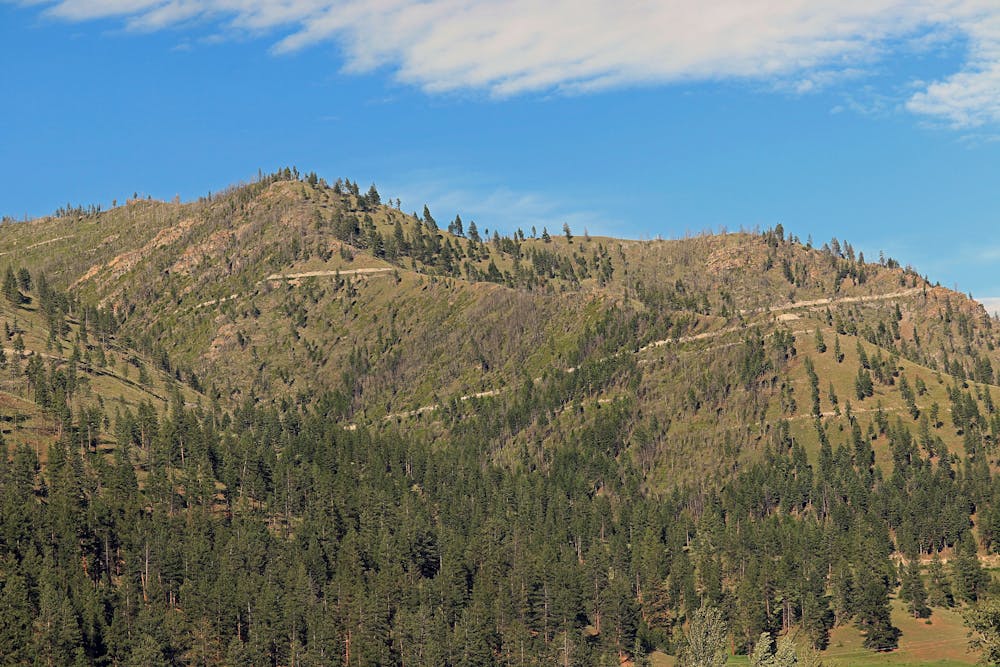
Most forests in the continental U.S. have been harvested multiple times. Today, fewer than 5% of these forests are more than 100 years old. Old, very large trees are the ones that hold the most carbon, and harvesting forests is the main driver of forest carbon loss.
For example, in Oregon’s national forests east of the Cascades crest, a 1990s policy formerly spared trees larger than 21 inches in diameter – but the rule was rolled back in 2021 so that large trees could be cut. A recent analysis found that these larger trees comprised just 3% of all trees in the six national forests, but accounted for 42% of living tree carbon.
In the Green Mountain National Forest in Vermont, federal officials have approved 40,000 acres of harvest since 2016, targeting many mature and old trees. One 14,270-acre area that was approved for harvest in 2019 contained more than 130 stands older than 100 years. This project required the construction of 25 miles of logging roads, which can have harmful effects, including fragmenting forests, polluting streams and making forests more vulnerable to human-caused wildfires.
Canada is also allowing large, mature trees to be harvested. In British Columbia, mature forests that include old-growth trees historically absorbed more carbon than they released to the atmosphere, resulting in a net carbon sink annually. But since 2002, these tracts have emitted more carbon than they removed from the atmosphere, primarily because of logging, beetle attacks and wildfires. According to British Columbia’s greenhouse gas emissions inventory, these forests now emit more carbon than the province’s energy sector.
In eastern Canada, the Pacific Northwest and the southeastern U.S., timber companies have removed many old trees and replaced them with plantations that contain just one or two tree species. This shift has reduced the structural diversity of the forest canopy – the ecologically important layer formed by the crowns of trees – and the diversity of tree species. Losing old-forest habitat has also caused broad-scale population declines among many forest bird species in eastern Canada, and is likely having the same effect in the U.S.
More harvesting releases more carbon
One argument forest product companies make to support logging is that wood can be regrown, and it releases less carbon dioxide to the atmosphere than other building materials. Such claims often make optimistic assumptions that overstate the carbon benefits of harvesting trees by factors of 2 to 100.
Some studies indicate that thinning forests by harvesting some trees and reintroducing low-intensity fires can reduce the intensity of future wildfires, leaving more carbon stored in trees. But these studies don’t account for the large amount of carbon that is released to the atmosphere after trees are cut.
In a review published in 2019, we worked with colleagues to estimate how much carbon was contained in trees that were harvested in Washington, Oregon and California from 1900 through 2015, and what happened to it after the trees were logged. We calculated that just 19% of the harvested carbon was in long-lived wood products like timber in buildings. Another 16% was in landfills, and the remaining 65% was released into the atmosphere as carbon dioxide.
In contrast, in 2011 the Australian state of Tasmania suspended logging on half of its old-growth forest area. Within less than a decade, Tasmania was storing more carbon than it released because it was avoiding harvest emissions and the mature trees it saved were accumulating so much carbon.
In the U.S. Pacific Northwest, implementation of the 1994 Northwest Forest Plan, which the Clinton administration developed to protect endangered species in old-growth forests on public lands, significantly increased carbon storage over the next 17 years. In contrast, privately managed lands in the region accumulated virtually no additional carbon after accounting for losses from wildfire and harvesting.

The cheapest and simplest way to capture carbon
President Biden has set a goal of reducing U.S. greenhouse gas emissions to net-zero by 2050 to avoid catastrophic climate change. To reach that goal, U.S. forests, lands and oceans will have to remove as much carbon dioxide from the atmosphere as the nation emits from fossil fuels, industry and agriculture.
In the western U.S., our research shows that protecting half of the mature carbon-dense forests in zones that are relatively less vulnerable to drought and fire could triple carbon stocks and accumulation on protected forests by 2050. A majority of these forests are on public lands.
The carbon dioxide that human activities are releasing into the atmosphere today will elevate global temperatures and raise sea levels for 1,000 years or more, unless societies can find ways to remove it. In its 2022 climate assessment report, the Intergovernmental Panel on Climate Change concluded that protecting existing natural forests was “the highest priority for reducing greenhouse gas emissions.”
Conserving forests is one of the lowest-cost options for managing carbon dioxide emissions, and it doesn’t require expensive or complex energy-consuming technologies. In our view, sufficient science exists to justify a moratorium on harvesting mature trees on federal lands so that these forests can keep performing their invaluable work.
Beverly Law, Professor Emeritus of Global Change Biology and Terrestrial Systems Science, Oregon State University and William Moomaw, Professor Emeritus of International Environmental Policy, Tufts University
This article is republished from The Conversation under a Creative Commons license. Read the original article.

Did you know that one of California’s top 10 invasive species lives right outside your door?
In fact, you can hear its distinctive call in the early evenings. It sounds a bit like a humming cow which is maybe why it has “bull” in its name.
It is the American Bullfrog or Lithobates catesbeianus.
The native habitat of the American Bullfrog is eastern North America. However, the American Bullfrog is invasive in the West.
Here in California, it was introduced by the gold miners in the late 1800s and early 1900s as a food source, but it quickly spread to aquatic and semi aquatic biomes throughout California.
The bullfrog is a carnivore, or a secondary consumer. It eats mainly primary consumers like small fish, baby birds, small mammals, other amphibians, tadpoles and lots of insects; basically, whatever it can fit in its very large mouth.
It can grow up to 8 inches long and can weigh up to one pound. It has large and powerful legs and in the winter months can travel up to a mile per day looking for food.
This massive frog is a dangerous predator here in California and has been decimating our native amphibian populations since it arrived, most specifically the vulnerable red-legged frog (Rana draytonii) and the endangered foothill yellow legged frog (Rana boylii) who lives here in our local watershed.
In fact, red-legged frogs were the basis for Mark Twain’s famed short story “The Celebrated Jumping Frog of Calaveras County”, but they are now so scarce that bullfrogs are used for the competition instead.
There are three main reasons why the bullfrog is threatening our native ecosystems.

First, at several stages in its life cycle the American Bullfrog preys upon our native frogs. Although the bullfrog tadpoles are mostly herbivorous, they will occasionally eat smaller, native frog tadpoles and insect larvae.
Further, as adults the American Bullfrog both competes with and eats native amphibians in such high amounts that one study done by a UC Davis ecologist in San Joaquin County showed a survival rate of just 5% of native red legged frogs in areas with bullfrogs compared to areas without.
Second, the bullfrog reproduces at a rate 10 times higher than the native frog population and can lay 20,000 eggs per clutch and two clutches per year compared to the native frogs which average 2,000 to 3,000 eggs per year.
This high reproduction rate combined with its ability to travel and quickly invade new water systems makes the bullfrog hard to eradicate completely and a dangerous competitor.
Finally, the bullfrog carries the chytrid fungus (Batrachochytrim dendrobatidis) but is not affected by it.
The chytrid fungus is a severe skin disease that causes death in susceptible native species. It disrupts the function of the skin in both the tadpole and adult frogs and specifically affects the native Californian mountain yellow legged frog.
This fungus has caused the extinction of 100 amphibian species worldwide since 1970.
So, what can we do about this voracious, opportunistic predator?
California allows the importation of bullfrog tadpoles as pets and adults for food. Approximately 2 million are brought here annually and many of them are released or escaped to wreak havoc on native ecosystems. Banning importation or increasing permit fees can help limit the negative impacts.
Also, we as residents can help! We can report bullfrogs when we see them and not keep them as pets.
If you are on a hike or see a bullfrog in your neighborhood you can report it to the CDFW Invasive Species Program or email to
Callum is a 13 year old student in Davis, California.
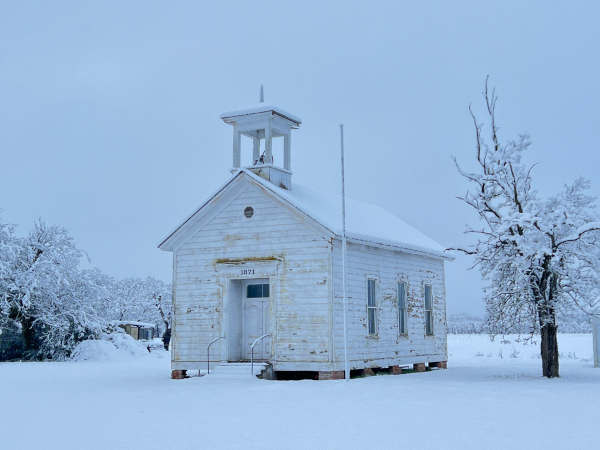
LAKE COUNTY, Calif. — The organization leading the restoration of the historic Kelsey Creek Schoolhouse in Finley has received a grant from a nationwide program dedicated to the preservation of America’s unique history.
Americana Corner, an online resource focused on the founding of our nation, announced the 2023 awardees of its Preserving America Grant Program.
Among them was the Lucerne Area Revitalization Association, or LARA, which will receive $5,000 for its schoolhouse restoration project.
“We are so excited and grateful to Americana Corner and its founder, Tom Hand,” said Elizabeth Larson, co-founder of LARA and publisher and editor of Lake County News. “This award moves us closer to starting on a critical phase of the schoolhouse’s restoration — the complete removal of decades of lead paint on the building’s interior and exterior.”
LARA is among 119 organizations in 35 states that will receive grant awards totaling $835,500 from the Americana Corner Fund at DonorsTrust.
The Americana Corner program was established to help other organizations tell the incredible story of America from its founding era through its first century as a nation.
These grants will help fund a diverse range of projects, including restoring historical objects, creating educational displays, and making improvements to historic sites that will enhance the visitor experience.
Among the grant recipients are numerous projects focused on Civil War and Revolutionary War history and artifacts, as well as improvements to the homes of U.S. presidents James K. Polk, James Monroe and Ulysses S. Grant, and at Valley Forge.
Due to overwhelming interest and the historic significance of the projects that sought funding, Americana Corner will award $835,500 in total grant funding for 2023, nearly double last year’s commitment of $446,000.
“I am thrilled to be able to help others across America tell our country’s wonderful story,” said Tom Hand, founder of Americana Corner.
The Kelsey Creek Schoolhouse, also known as the Hells Bend Schoolhouse, was built in 1871 and moved to its current location in 1882. There, it remained in operation as a school until July 1920.
In 2021, the Kelseyville Unified School District granted LARA the Kelsey Creek Schoolhouse following a public process that involved a request for proposals. LARA and the school district entered into a 50-year lease for the property where the schoolhouse sits in Finley.
LARA launched a fundraising campaign on Giving Tuesday in November in order to begin the renovations this year, with initial work to focus on removing the lead paint.
Larson thanked the many community members who donated to the effort, and offered special mention to Lake County Fair Chief Executive Officer Sheli Wright who pointed her toward the Americana Corner grant in late 2022.
LARA is pursuing the final piece of funding to begin the lead removal project. The total project is expected to cost about $20,000, and so far they’ve raised about $12,000 of that amount.
Tax-deductible donations for the Kelsey Creek Schoolhouse project can be made through LARA’s online donation platform or mailed to LARA, P.O. Box 1792, Lucerne, CA 95458-1792.
LARA’s project is one of three in California approved in this year’s round of funding. The other two projects are the Gold Discovery Park Association’s plans to replace and create interpretive signage throughout Marshall Gold Discovery State Historic Park in Coloma and the Mare Island Historic Park Foundation in Vallejo’s plan to upgrade the audio visual system in St. Peter's Chapel, the oldest naval chapel in the nation.
The full list of 2023 Americana Corner grant awardees include the following:
• 1st Virginia Regiment of Continental Line to repair a three-pound brass "Grasshopper" cannon.
• Acadian Heritage and Culture Foundation for an exhibit on the role of Acadians and Spanish in the American Revolution.
• Adams County Historical Society for a Civil War photo exhibit.
• Alabama Historic Ironworks Foundation to restore the historic Fowler House.
• American Civil War Museum to help restore the White House of the Confederacy.
• Andrew Jackson Foundation for ongoing educational and preservation projects.
• Avoca Museum and Historical Society to restore two outbuildings on the property, Smokehouse and Milkhouse.
• Battle of Rhode Island Association to restore visitor trails at the Butts Hill Fort.
• Bedford Heritage Trust to complete the "fort-era" exhibit on Fort Bedford.
• Bergen County Historical Society to build a display case for a restored musket
• Brandywine Battlefield Park Associates to provide living history programs to the public.
• Camp Blount Historical Site Association to recreate historic Joseph Greer House.
• Citizenship Trust American Village to help refurbish the Visitor Center.
• Clarke County Historical Museum to restore the Alston-Cobb House.
• Colonial Williamsburg Foundation to help restore the Peyton-Randolph Stable.
• Connecticut Landmarks to improve exhibits and displays at the Nathan Hale Homestead.
• Constituting America to promote a 90-day study on America's First Principles.
• Cortland County Historical Society to preserve four 1820s maps produced by young women.
• Delaware Company of NY for a permanent museum display on civil conflict in the Upper Delaware Valley.
• Discovery Expedition of St. Charles to add costumed historical interpreters for visitors.
• Fort Adams Trust for the restoration of the Southeast Demi-Bastion Terreplein and adjacent inboard parade grounds.
• Fort LeBoeuf Historical Society to expand existing historic garden; develop living history curriculum; and build a soldier's hut.
• Fort Ligonier to design and print 50,000 site maps for visitors.
• Fort Loudoun Historical Society to purchase a gun carriage for British one-pounder cannon.
• Fort Randolph Committee for media handouts such as rack cards; hands-on materials for visitors; and a stipend for costumed interpreters.
• Fraunces Tavern Museum to conserve Martha Washington slipper shoe.
• Friends of Fort Frederick State Park for new period costumes for living history interpreters.
• Friends of Kaw Point Park to develop informational signage on the Corps of Discovery at Kaw Point; restore native gardens; and guided tours.
• Friends of Maxwell Hall to create educational signage at Maxwell Hall on the Patuxent River.
• Friends of Minute Man National Park for a battlefield restoration project at Elm Brook Hill associated with the Battle of Lexington and Concord.
• Friends of the Longfellow House‚ÄìWashington's Headquarters to restore window seat cushions in Henry Wadsworth Longfellow's study.
• Friends of the Monterey Pass Battlefield to interpret the Great Philadelphia Wagon Road at Monterey Pass Battlefield.
• Friends of U.S. Grant Cottage to design, construct and install two interpretive panels on the Eastern Overlook at Grant Cottage.
• Friends of Washington Crossing Park to create six "76 Seconds of History" videos on Washington Crossing.
• Furnace Town Foundation to help restore the circa 1830 Nassawango Iron Furnace.
• Georgia Salzburger Society to replace authentic shingles on the roof of the Fail House at Ebenezer historic site.
• Gettysburg Foundation to help fund the Children of Gettysburg 1863 educational program.
• Gold Discovery Park Association to replace and create interpretive signage throughout Marshall Gold Discovery State Historic Park.
• Gordon-Wascott Historical Society to create a historical park at site of the 1858 Antoine Gordon trading post in northern Wisconsin.
• Grout Museum to help complete repairs to the Rensselaer-Russell House.
• Hart Square Foundation to restore the circa 1850 Hoyle Dogtrot cabin at Hart Square Village.
• Heritage Foundation of Williamson County to digitally map and record all cemeteries in Williamson County focusing on American Revolution and Civil War veterans cemeteries.
• Heritage Frederick to design and develop exhibits on 19th-century Frederick, Maryland.
• Highlanders Chapter to build a monument to American Revolution soldiers.
• Hillsdale County Historical Society to restore interior of the Will Carleton poorhouse.
• Historic Albany Foundation to restore original roof of oldest house in Albany, Ostrande-Radliff House, circa 1728.
• Historic Camden Foundation to build an 18th-century limber and artillery carriage for "La Populaire" cannon surrendered at YorkTown.
• Historic Fallsington to replace cedar roof on historic Burges-Lippincott House.
• Historic Harmony to replace roof on Harmony Museum circa 1825 log cabin.
• Historic Huguenot Street to develop videos of the Historic Huguenot Street historic site.
• Historic Rock Ford for funding an exhibit in the Snyder Gallery called “The Market Town and the Metropolis.”
• Historic Southwest Ohio - Heritage Village Museum & Educational Center to create a working tinsmith and blacksmith shop.
• Historic Trappe to restore porch of Frederick Muhlenberg home.
• Historic Village at Allaire to restore the 1840s-era Star and Eagle flag.
• Hull House Foundation to build a working early 19th-century outdoor fireplace, hearth, and bake oven to demonstrate period cooking and baking techniques.
• James K Polk Home & Museum to update the James K. Polk House Museum.
• James Monroe Memorial Foundation to restore landscaping at the James Monroe Presidential Birthplace site.
• Jamestown-Yorktown Foundation to support a photography initiative to digitized the museum's historic objects.
• Lancaster NY Historical Society to help restore a circa 1868 one room school house.
• Lawrence County Civic Center and Regional History Museum to restore circa.1805 canoe and circa 1850 wagon wheels for display in the Lawrence County Regional History Museum
• Lewis and Clark Trail Heritage Trail Foundation for the reproduction of historic artifacts such as trade goods, furs, and period furniture at Fort Osage
• Lucerne Area Revitalization Association to restore historic circa 1871 Kelsey Creek Schoolhouse.
• Main Street Perryville to restore the home of Civil War doctor, Dr. J.J. Polk.
• Maine's First Ship to fund necessary equipment so the historic ship Virginia, Maine's first ship, can sail.
• Mare Island Historic Park Foundation to upgrade a/v system in St. Peter's Chapel, the oldest naval chapel in the nation.
• Moffatt-Ladd House & Garden to restore the Yellow Room in the Moffatt-Ladd House to its 1763 condition.
• Monmouth County Historical Association for the restoration of the circa 1752 Covenhoven House.
• Mount Vernon Ladies Association to create online educational resources to be used in classrooms.
• Museum of the American Revolution to preserve a collection of 18th and 19th century documents and letters.
• Muskingum County History for the repair and maintenance of the Stone Academy Museum.
• Musee de Venoge to create a visitor center video on how early settlers to the area impacted the settlement of Indiana and the western expansion of the United States.
• National Road Heritage Foundation to create the “Engineering, Paving, and Maintenance” exhibit at new National Road Museum.
• Neenah Historical Society to create an exhibit to celebrate the 150th anniversary of founding of "Twin Cities" Neenah and Menasha.
• Nolensville Historical Society to restore circa 1870 Morton-Brittain house.
• Northern Central Railway to fund an 1860s steam engine replica restoration project.
• Old Stone House Museum & Historic Village to restore historically significant Cyrus Eaton House in the Old Stone House Museum and Historic Village.
• Pejepscot History Center for the restoration and preservation of 14 regimental battle flags from the Grand Army of the Republic.
• Pendleton HIstoric Foundation to restore circa 1837 Historic Jenkins Home in Pendleton, South Carolina.
• Plimoth Patuxet Museums to upgrade and repair period clothing for living history interpreters.
• Preservation Virginia to create signage for Patrick Henry’s home at Scotchtown.
• Princeton Battlefield Society to design, manufacture and install new multi-panel sign on the Battle of Princeton at Princeton Battlefield State Park.
• Randolph County Heritage Museum/Five Rivers Historic Preservation for an exhibit on the founders of Randolph County.
• Revolutionary Spaces to create an exhibit commemorating the Boston Tea Party.
• Seminary Ridge Historic Preservation Foundation for updating the “Voices of Duty and Devotion” display.
• Shepherd University Foundation and the George Tyler Moore Center for the Study of the Civil War to create the “Crossroads: Shepherdstown in the American Civil War” exhibit.
• Shippensburg History Center to purchase period clothing for living history program and create an exhibit showcasing Shippensburg’s role in American history.
• Shirley Plantation Foundation to fund additional living history interpreters.
• Smoky Hills Trail Association to purchase limestone Butterfield Overland Despatch markers for the Smoky Hill Trail.
• South Dakota Historical Society Foundation for the videography and still photography of 25 key archival and museum artifacts.
• St. John's Church Foundation to fund reenactments at Historic St. John's Church, site of Patrick Henry's “Give me liberty or give me death” speech.
• Stratford Hall to preserve extraordinary documents in Stratford Hall’s collection, including the original Terms of Surrender signed by Generals Lee and Grant.
• The Belle W. Baruch Foundation to restore two Currier & Ives prints.
• The Boyertown Area Historical Society to restore cupola of historic Bahr's mill.
• The Cairo Historical Preservation Project to restore 1869 Magnolia Manor.
• The Catoctin Furnace Historical Society to restore 1800s blacksmith bellows.
• The Charles Hall Museum for an exhibit on the history of the Tellico Iron Works.
• The Conococheague Institute for educational programs on the frontier.
• The Fort Ticonderoga Association to update interpretive signage at Fort Ticonderoga.
• The Friends of Perryville Battlefield to develop wayside informational signs on the Battle of Perryville.
• The Lewes Historical Society to create signage for 14 historic buildings curated by the Lewes Historical Society.
• The Library of Virginia for the conservation of documents from the Virginia Convention of 1776.
• The National Civil War Museum to upgrade lighting in the museum to enhance the visitor experience.
• The Pursuit of History to fund a series of videos that put important historical sites in context and show the connections between various events and sites.
• Thomasville History Center to restore a painting of Archibald Thompson MacIntyre, Thomas County resident and member of the U.S. House of Representatives.
• Tioga Point Museum for the digitization and display of historic rare books, documents, and maps related to the early history of northern Pennsylvania.
• Tipton-Haynes Historical Association to purchase and install privacy fence to protect historic viewshed from nearby development.
• Travelers' Rest Connection to create an exhibit on the Corps of Discovery (Lewis and Clark expedition).
• United Daughters of the Confederacy — Kentucky to enhance access to a War Memorial to the Immortal 600 at the Meade County Historical Museum.
• United Daughters of the Confederacy — Virginia to restore a historic library and books damaged by fire.
• Valley Forge Park Alliance to restore historic Maurice Stevens House at Valley Forge.
• Virginia Commemorations to fund collaboration efforts to enhance the visitor experience at Virginia historic sites in the runup to our nation's 250th birthday.
• Virginia Museum of History & Culture to support the creation of Civil War and Reconstruction era classroom materials.
• Washington Association of New Jersey to furnish new window treatments at the Ford mansion where General Washington spent the winter of 1779-80.
• Washington Memorial Heritage for signage for the Washington Memorial Chapel and its 40-acre site.
• Washington’s Trail – 1753 for signage for the trail George Washington took on his 1753 military diplomatic mission to Fort LeBoeuf.
• West Jersey Artillery to build artillery limber for a bronze three-pounder cannon.
• West Point Association of Graduates to produce an interactive digital map related to the Battle of New York in 1776.
• Wisconsin Historical Foundation to preserve a 20-star Loyalty flag from the Civil War.
• Ximenez-Fatio House Museum for the restoration of authentic wooden-framed, old glass-paned windows on the Ximenex-Fatio House.
Americana Corner was founded by Tom Hand in 2020 as an online resource to help others rediscover America’s incredible founding and first century of expansion.
From the American Revolution to the settlement of the American West, from the Declaration of Independence to the Emancipation Proclamation, and from George Washington to Abraham Lincoln, Americana Corner contains positive stories of the great events, founding documents, and inspirational leaders who helped create and shape our country.
Perhaps most importantly, Hand discusses why all those events and people from so long ago still matter to us today.
For more information, visit www.americanacorner.com/grant-recipients.
Dogs available for adoption this week include mixes of border collie, boxer, German shepherd, German shorthaired pointer, Great Pyrenees, hound, Labrador retriever, mastiff, pit bull, shepherd, treeing walker coonhound and terrier.
Dogs that are adopted from Lake County Animal Care and Control are either neutered or spayed, microchipped and, if old enough, given a rabies shot and county license before being released to their new owner. License fees do not apply to residents of the cities of Lakeport or Clearlake.
The following dogs at the Lake County Animal Care and Control shelter have been cleared for adoption.
Call Lake County Animal Care and Control at 707-263-0278 or visit the shelter online for information on visiting or adopting.

Female pit bull terrier puppy
This 3-month-old female American pit bull terrier puppy has a short brindle coat.
She is in kennel No. 4a, ID No. LCAC-A-4787.

Female pit bull terrier puppy
This 3-month-old female American pit bull terrier puppy has a short black and white coat.
She is in kennel No. 4b, ID No. LCAC-A-4788.

This 1-year-old male Labrador retriever mix has a short black coat with white markings.
He is in kennel No. 6, ID No. 4841.

‘Able’
“Able” is a 6-year-old male coonhound mix with a short black and tan coat.
He is in kennel No. 7, ID No. LCAC-A-4773.

Male German shorthaired pointer puppy
This 5-month-old male German shorthaired pointer puppy has a short red and white coat.
He is in kennel No. 9, ID No. LCAC-A-4769.

‘AxxelRose’
“AxxelRose” is a 5-year-old male terrier with a long blond coat.
He is in kennel No. 10a, ID No. LCAC-A-4807.

‘Luigi’
“Luigi” is a 2-year-old male pit bull terrier with a short red and white coat.
He is in kennel No. 12, ID No. LCAC-A-4742.

‘Oreo’
“Oreo” is a 2-year-old male treeing walker coonhound with a short tricolor coat.
He is in kennel No. 13, ID No. LCAC-A-4738.

Male German shepherd mix
This 2-year-old male German shepherd mix has a red and white coat.
He is in kennel No. 16, ID No. LCAC-A-4835.

Female pit bull-Labrador retriever mix
This female pit bull-Labrador retriever mix has a short tricolor coat.
She is in kennel No. 17, ID No. LCAC-A-4692.

‘Bruno’
“Bruno” is a 9-month-old male mastiff-pit bull mix with a short tan coat.
He is in kennel No. 23, ID No. LCAC-A-4789.

Male boxer-pit bull mix
This 8-year-old male boxer-pit bull mix has a short brown brindle coat.
He is in kennel No. 26, ID No. LCAC-A-4678.

Male Great Pyrenees
This 2-year-old male Great Pyrenees has a long white coat.
He is in kennel No. 28, ID No. LCAC-A-4821.

Male German shepherd
This 1-year-old male German shepherd has a short black and tan coat.
He is in kennel No. 29, ID No. LCAC-A-4710.

Male border collie puppy
This 3-month-old male border collie puppy has a short black coat with white markings.
He is in kennel No. 32, ID No. LCAC-A-4783.
Email Elizabeth Larson at

It may come as a surprise to fellow land-dwellers, but the ocean actually accounts for most of the habitable space on our planet. Yet a big chunk of it has been left largely unmanaged. It’s a vast global common resource, and the focus of a new treaty called the biodiversity beyond national jurisdiction (BBNJ) agreement.
For 15 years, UN member states have been negotiating rules that will apply to the ocean lying more than 200 nautical miles from coastlines, including the seabed and the air space above, referred to as the “high seas”.
Covering nearly half the Earth’s surface, the high seas are shared by all nations under international law, with equal rights to navigate, fish and conduct scientific research. Until now, only a small number of states have taken advantage of these opportunities.
This new agreement is supposed to help more countries get involved by creating rules for more fairly sharing the rewards from new fields of scientific discovery. This includes assisting developing countries with research funding and the transfer of technology.
Countries that join the treaty must also ensure that they properly assess and mitigate any environmental impacts from vessels or aircraft in the high seas under their jurisdiction. This will be especially relevant for novel activities like removing plastic.
Once at least 60 states have ratified the agreement (this may take three years or more), it will be possible to establish marine protected areas (MPAs) in high sea locations of special value.
This could protect unique ecosystems like the Sargasso Sea: a refuge of floating seaweed bounded by ocean currents in the north Atlantic which offers breeding habitat for countless rare species. By restricting what can happen at these sites, MPAs can help marine life persevere against climate change, acidification, pollution and fishing.
There are obstacles to all nations participating in the shared enjoyment and protection of the high seas, even with this new treaty. Nations joining the new agreement will need to work with existing global organisations such as the International Maritime Organization (IMO), which regulates shipping, as well as regional fisheries management organisations.
The new treaty encourages consultation and cooperation with existing bodies, but states will need to balance their commitments with those made under other agreements. Already, some departments within governments work against each other when implementing broad, international treaties. For example, one division may chafe at greenhouse gas pollution regulations imposed at the IMO while a sister agency advocates for more stringent climate change measures elsewhere.
A new research frontier
A key element of the new treaty addresses the disproportionate ability of developed countries to benefit from the scientific knowledge and commercial products derived from genetic samples taken from the high seas. More than 40 years ago, when the law of the sea convention was being negotiated, the same issue arose over seabed minerals in areas beyond national jurisdiction.
Industrialised nations had the technology to explore and intended to eventually mine these minerals, while developing countries did not. At that time, nations agreed that these resources were part of the “common heritage of humankind” and created the International Seabed Authority to manage a shared regime for exploiting them.
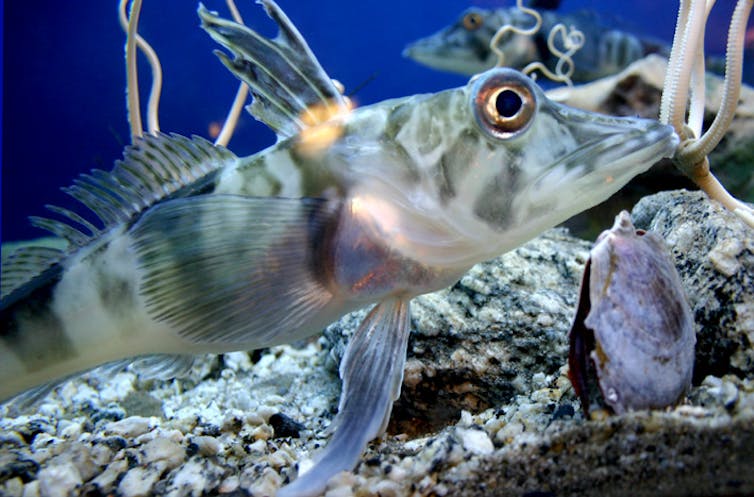
The extreme conditions for life in the open ocean have nurtured a rich diversity of survival strategies, from the bacteria that thrive in the extremely hot hydrothermal vents of the deep sea to icefish that breed in the intense cold of the Southern Ocean off Antarctica. These life forms carry potentially valuable information in their genes, known as marine genetic resources.
This new agreement provides developing states, whether coastal or landlocked, with rights to the benefits of marine genetic resources. It does not establish an administrative body comparable to that created for seabed mining, however. Instead, non-monetary benefits, such as access to samples and digital sequence information, will be shared and researchers from all countries will be able to study them for free.
Economic inequality between countries will still determine who can access these samples to a large extent, and sharing DNA sequencing data will be further complicated by the convention on biological diversity, another global treaty. The BBNJ agreement will establish a financial mechanism for sharing the monetary benefits of marine genetic resources, though experts involved in the negotiations are still parsing what it will eventually look like.
The best hope for robust marine protected areas and equitable use of marine genetic resources lies in rapid implementation of the BBNJ agreement. But making it effective will depend on how its provisions are interpreted in each country and what rules of procedure are established. In many ways, the hard work is beginning.
Although areas beyond national jurisdiction are remote for most people they generate the air you breathe, the food you eat and moderate the climate. Life exists throughout the ocean, from the surface to the seabed. Ensuring it benefits everyone living today, as well as future generations, will depend on this next phase of implementing the historic treaty.

Don’t have time to read about climate change as much as you’d like?
Get a weekly roundup in your inbox instead. Every Wednesday, The Conversation’s environment editor writes Imagine, a short email that goes a little deeper into just one climate issue. Join the 10,000+ readers who’ve subscribed so far.
Cymie Payne, Associate Professor of Human Ecology and Law, Rutgers University and Robert Blasiak, Research Fellow in Ocean Management, Stockholm University
This article is republished from The Conversation under a Creative Commons license. Read the original article.