 How to resolve AdBlock issue?
News
Lake County residents are invited to attend the following events at no cost.
Free copies of the book, “Postcolonial Love Poem” by Natalie Diaz, are available at each library branch and at all events while supplies last.
Big Read 2023 author events
Saturday, March 18: 1 to 3 p.m.
In-person and virtual. Join the Lake County Library and Lake County Friends of Mendocino College in welcoming the author of “Postcolonial Love Poem,” Natalie Diaz, for a virtual poetry reading, discussion, and question and answer session.
This event will take place on Zoom and will be livestreamed from the Mendocino College Lake Campus Round Room and all four branches of the Lake County Library.
Lake County residents can also tune in from home by clicking on the following link at the time of the event: https://lakecounty.zoom.us/s/94859414760. Webinar ID: 948 5941 4760 (no pass code needed).
Location: Zoom and Mendocino College, 2565 Parallel Drive, Lakeport
Museums of Lake County Family History Presentation
Wednesday, March 22, 5:30 to 7 p.m.
In-person. Come learn about preserving family history with our County Museum curators, and how it all relates to “Postcolonial Love Poem.”
Location: Historic Courthouse Museum, 255 N. Main St., Lakeport
Creative Club Sensory Writing Workshop
Saturday, March 25, 10 a.m. to noon
In-person. Join the Library Creative Club for an all ages sensory writing workshop. They will explore different tools for writing including natural inks, paints and more.
Inspired by the poem Ink-Light featured in the book in which Natalie Diaz writes, “Four strokes of dusk. Carbon black, Lamp black, Bone black, Hide glue—: I am the alchemist of ink. She answers me, "Quicksilver.”
Location: Lakeport Library, 1425 N. High St., Lakeport
Poets Laureate Reading
Saturday, March 25, 1 to 2 p.m.
In-person. Join Lake County's Poet Laureate Georgina Marie Guardado for a poetry reading featuring California's new State Poet Laureate Lee Herrick, Ukiah Poets Laureate Emeriti Linda Noel and Jabez Churchill, Alameda Poet Laureate Kimi Sugioka and Kansas State Poet Laureate Emerita Denise Low for a reading of original work and select poems by Natalie Diaz.
Location: Lakeport Library, 1425 N. High St., Lakeport
The National Endowment for the Arts Big Read, a partnership with Arts Midwest, broadens our understanding of our world, our communities, and ourselves through the joy of sharing a good book.
Since 2006, the National Endowment for the Arts has funded more than 1,700 NEA Big Read programs, providing more than $24 million to organizations nationwide.
In addition, NEA Big Read activities have reached every Congressional district in the country.
Visit https://www.arts.gov/initiatives/nea-big-read for more information about the NEA Big Read. Organizations interested in applying for an NEA Big Read grant in the future should visit Arts Midwest’s at https://artsmidwest.org/ for more information.
Georgina Marie Guardado is the Lake County Poet Laureate and Lake County’s Literacy Program coordinator.

LAKEPORT, Calif. — A Lakeport man has been taken into custody following a search warrant service this week that uncovered his possession of weapons and ammunition he is prohibited to have.
Paul Kenneth Jones, 57, was arrested on Thursday, according to the Lakeport Police Department.
Early that morning, Lakeport Police officers, with the assistance of the Lake County Probation Department, served a search warrant on Jones’ residence.
During the search of the residence, police said two loaded handguns and hundreds of rounds of ammunition were found and seized.
Jones is prohibited from the possession of firearms and ammunition, police said.
He was booked into the Lake County Jail with a $1,000 bail.
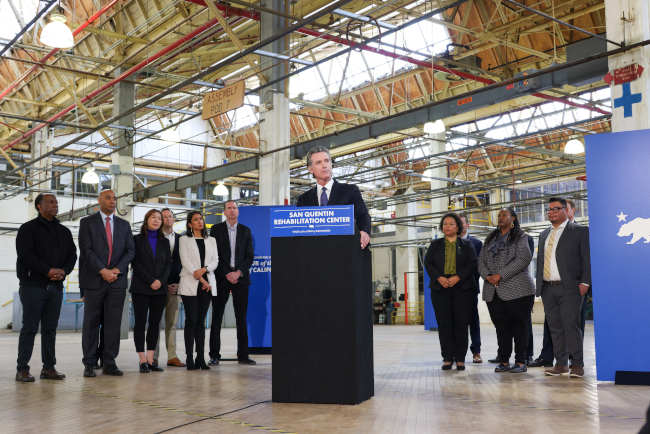
One of California's main prisons is about to undergo a major transformation.
On Friday, Gov. Gavin Newsom, alongside state legislators, survivors of crime and victim advocates, and civil rights leaders, announced that San Quentin State Prison — the oldest and most notorious prison in California and home to the largest “death row” in the United States — will be transformed from a maximum-security prison into a one-of-a-kind facility focused on improving public safety through rehabilitation and education.
The prison, which will be renamed “San Quentin Rehabilitation Center,” will be transformed in part under the direction of an advisory group composed of state and world-renowned rehabilitation and public safety experts.
The historic effort at San Quentin, never pursued at this scale in the United States, will serve as a nationwide evidence-backed model to advance a more effective justice system that builds safer communities.
“California is transforming San Quentin — the state’s most notorious prison with a dark past — into the nation’s most innovative rehabilitation facility focused on building a brighter and safer future,” said Gov. Newsom at the Friday event. “Today, we take the next step in our pursuit of true rehabilitation, justice, and safer communities through this evidenced-backed investment, creating a new model for safety and justice — the California Model — that will lead the nation.”

“San Quentin has long challenged the status quo: In the 1940s, the warden closed the dungeons once ubiquitous to incarceration, and launched educational and vocational programs in their place,” said Advisory Group Co-Chair and San Quentin Warden Ron Broomfield. “Today, we again challenge the status quo as we re-imagine San Quentin and create an environment where people are empowered to discover their full potential while pursuing educational and vocational opportunities that will prepare them for a successful future — and make our communities safer.”
“By transforming San Quentin into a place that promotes health and positive change, California is making a historic commitment to redefining the institution’s purpose in our society,” said Advisory Group Co-Chair and Professor of Medicine at the UCSF Center for Vulnerable Populations Dr. Brie Williams. “I look forward to lifting the voices of people who have lived or worked in prisons to imagine a center for healing trauma, repairing harm, expanding knowledge, restoring lives, and improving readiness for community return.”
The governor’s 2023-24 budget proposal allocates $20 million to begin the reimagining and repurposing of the facility.
The transformation will be led in part by an advisory group composed of criminal justice, rehabilitation, and public safety experts from around the state, nation, and world, as well as representatives of crime victims and survivors, formerly incarcerated individuals, staff, key state-level stakeholders, advocates, and volunteers.
Both the existing condemned row housing unit, which is being shut down — and those housed there safely moved to other prisons to serve their sentences — and a Prison Industry Authority warehouse will be transformed into a center for innovation focused on education, rehabilitation and breaking cycles of crime.
Since taking office, the governor has placed a moratorium on the death penalty, bolstered support for victims and survivors of crime, ended the state’s use of private for-profit prisons, taken action to disrupt the school-to-prison pipeline, announced sweeping reforms to end juvenile imprisonment, advanced jury representation, expanded the number of Board of Parole commissioners, signed legislation to build trust between communities and law enforcement, and announced record-level funding to bolster public safety, including through the Real Public Safety plan.

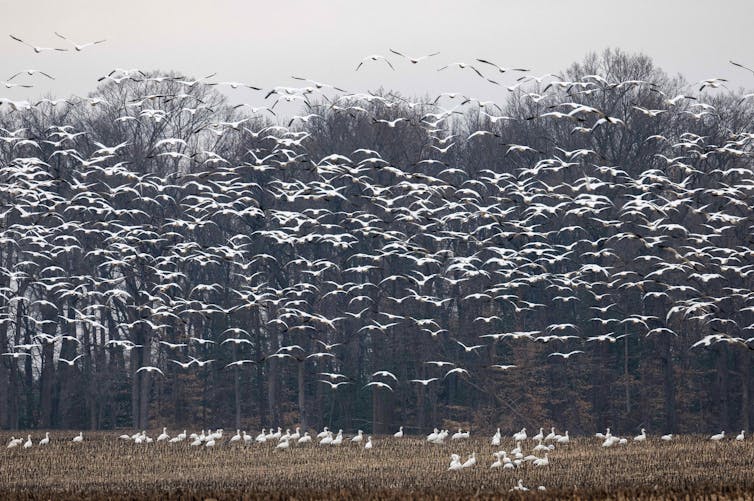
An outbreak of H5N1 avian influenza that started in 2021 has become the largest bird flu outbreak in history, both in the U.S. and worldwide. In the U.S. the virus has led to the destruction of millions of commercially raised chickens, turkeys, ducks and geese, and has killed thousands of wild birds.
Many virologists are concerned that this virus could spill over to humans and cause a new human pandemic. University of Colorado Boulder virologists Sara Sawyer, Emma Worden-Sapper and Sharon Wu summarize the compelling story of H5N1 and why scientists are closely watching the outbreak.
1. Is this virus a serious threat to humans?
H5N1 is a specific type of influenza virus, predominantly harbored by birds, that was first detected on a goose farm in China in 1996. Recently it has begun infecting an exploding diversity of bird and mammalian species around the globe.
The virus is highly pathogenic to birds, meaning that infections often cause extreme symptoms, including death. But its impact on humans is complicated. There have been relatively few human infections detected – fewer than 900 documented globally over several decades – but about half of those infected individuals have died.
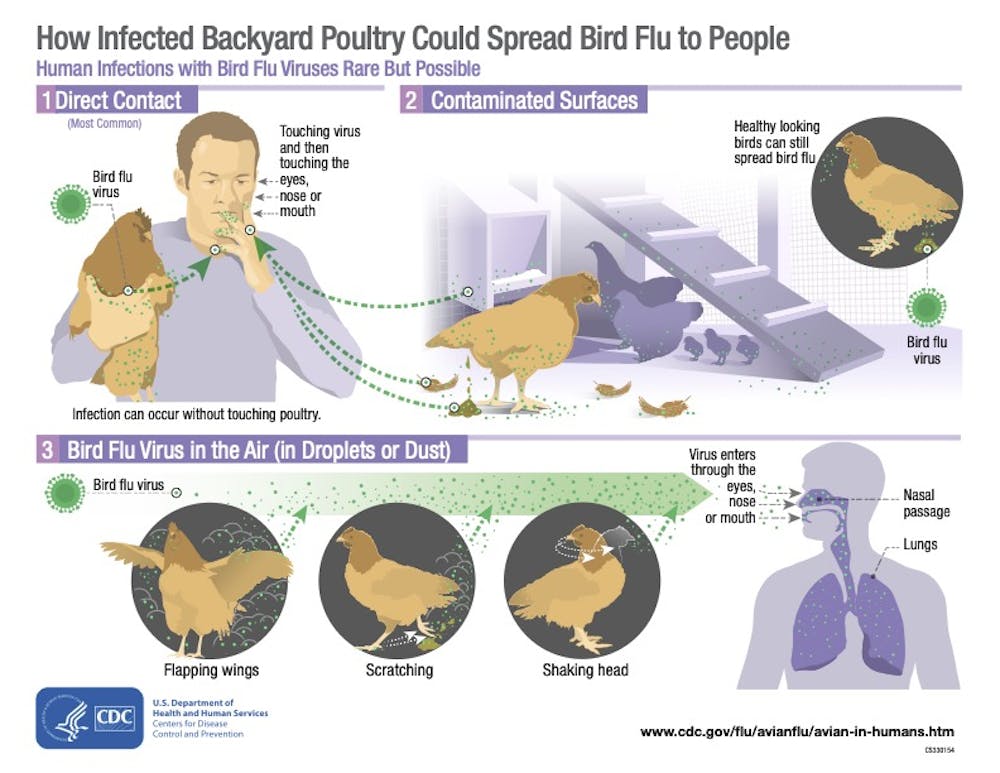
The good news about H5N1 for humans is that it currently doesn’t spread well between people. Most people who have contracted H5N1 have gotten it directly from interacting with infected poultry – specifically chickens, turkeys, ducks and geese, which often are raised in close quarters on large commercial farms.
There are only a small handful of examples of human-to-human spread. Because H5N1 doesn’t spread well between people, and because direct infection of humans by infected birds is still relatively rare, H5N1 has not yet erupted into a human epidemic or pandemic.
2. Why is this outbreak suddenly getting so much attention?
The first reason that so much attention is being paid to bird flu right now is that currently H5N1 is causing the largest “bird pandemic” ever recorded. A certain viral variant that arose in 2020, called H5N1 2.3.4.4b, is driving this outbreak.
In agricultural poultry flocks, if a few birds test positive for H5N1, the whole flock is killed regardless of symptoms or infection status. Higher prices for eggs and poultry meat in the U.S. are one result. The Biden administration is considering vaccinating farmed poultry flocks, but the logistics could be quite complicated.
The second reason for increased attention is that H5N1 is now infecting more bird and mammalian species than ever before. The virus has been detected in a broad array of wild birds and in diverse mammals, including badgers, black bears, bobcats, coyotes, ferrets, fisher cats, foxes, leopards, opossums, pigs, skunks and sea lions.
As H5N1 infects more species, it also increases its geographical range and produces more viral variants that could have new biological properties.
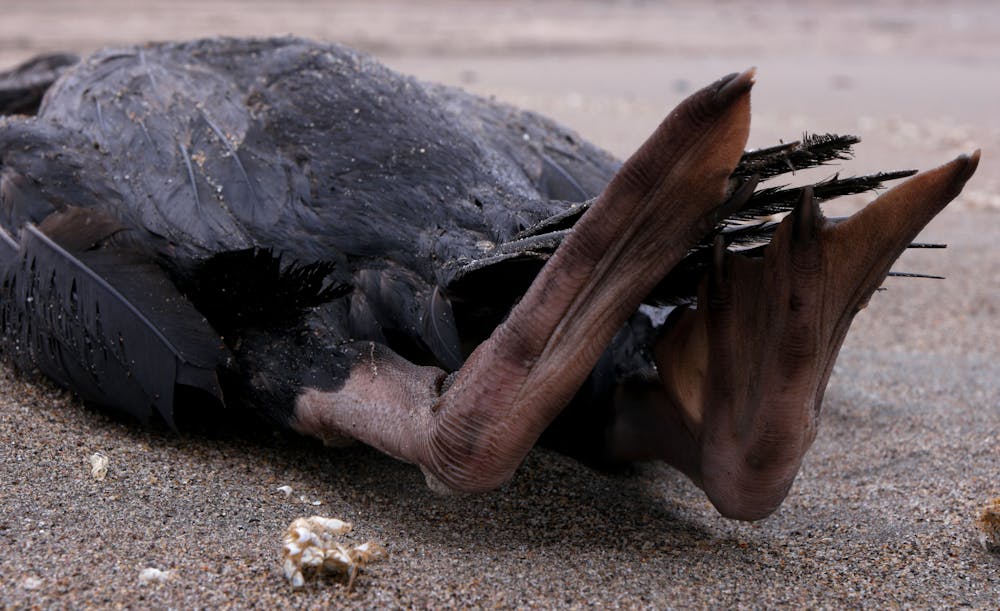
The third and most worrisome reason that this virus is getting so much press is that H5N1 now seems to be transmitting well between individuals of at least one mammalian species. In late 2022, mammal-to-mammal spread occurred in Spain in farmed minks. H5N1 spread very efficiently between the minks and caused clinical signs of illness and death in the mink populations where it was detected.
Sea lions in Peru are also succumbing to H5N1 virus in massive numbers. It hasn’t been confirmed definitively whether the sea lions are spreading the virus to each other or are contracting it from birds or H5N1-infected water.
Here’s the key question: If H5N1 can achieve spread in minks and possibly sea lions, why not humans? We are also mammals. It is true that the farmed minks were confined in close quarters, like chickens on a poultry farm, so that may have contributed. But humans also live in high densities in many cities around the world, providing the virus similar tinder should a human-compatible variant arise.
3. What features could help H5N1 spread well in humans?
Birds experience influenza as a gastrointestinal infection and spread flu predominantly through defecating in water. By contrast, humans experience influenza as a respiratory infection and spread it by breathing and coughing.
Over the centuries, some of these avian influenza viruses have been passed from birds to humans and other mammalian species, although this is a relatively rare event.
This is because bird influenza viruses must mutate in several ways to infect mammals efficiently. The most important mutational changes affect the tissue tropism of the virus – its ability to infect a specific part of the body.
Avian flu viruses have evolved to infect cells of the intestine, while human flu viruses have evolved to infect cells of the respiratory tract. However, sometimes a flu virus can acquire mutations that allow it to infect cells in a different part of the body.
Which cells influenza infects is partially dictated by the specific receptor that it binds. Receptors are the molecules on the surface of host cells that a virus exploits to enter those cells. Once viruses are in cells, they may be able to produce copies of themselves, at which point an infection has been achieved.
Both human and bird influenza viruses use receptors called sialic acids that are common on the surfaces of cells. Bird influenza viruses, such as H5N1, use a version called α2,3-linked sialic acid, while human flu viruses use α2,6-linked sialic acid – the predominant variant in the human upper respiratory tract. Thus, to become efficient at infecting humans, H5N1 would likely need to mutate to use α2,6-linked sialic acid as its receptor.
This is a concern because studies have shown that only one or two mutations in the viral genome are enough to switch receptor binding from α2,3-linked sialic acid to the human α2,6-linked sialic acid. That doesn’t seem like much of a genetic obstacle.
4. Why don’t we make a vaccine just in case?
With avian influenza viruses, it is not possible to make effective human vaccines in advance, because we don’t know exactly what the genetics of the virus will be if it starts to spread well in humans. Remember that the seasonal flu vaccine must be remade every year, even though the general types of flu viruses that it protects against are the same, because the specific genetic variants that affect humans change from year to year.
Right now, the best way people can protect themselves from H5N1 is to avoid contact with infected birds. For more information about prevention, especially for people who keep domesticated birds or are bird-watching hobbyists, the Centers for Disease Control has a list of guidelines for avoiding H5N1 and other bird flu viruses.
Sara Sawyer, Professor of Molecular, Cellular and Developmental Biology, University of Colorado Boulder; Emma Worden-Sapper, PhD Student in Molecular, Cellular and Developmental Biology, University of Colorado Boulder, and Sharon Wu, PhD Student in Interdisciplinary Quantitative Biology and Molecular, Cellular, and Developmental Biology, University of Colorado Boulder
This article is republished from The Conversation under a Creative Commons license. Read the original article.

An executor bond is a type of probate bond that guarantees that if an executor or an administrator of a decedent’s estate fails to fulfill his or her duties as the personal representative — and harms the estate — that the estate can recover its damages against the value of the bond.
A bond, therefore, is similar to, but is not the same as, insurance.
It is not the same as insurance: If a bond company pays out to the estate, the bond company can try to recover what it pays the estate by going after the personal assets of the executor or administrator. Thus, the point of a bond is to protect the decedent’s beneficiaries but not to protect the administrator or executor who damaged the estate.
In California, generally, a personal representative of a decedent’s probate estate is required to file a probate bond with the court before the court issues the letters of administration or letters testamentary, as relevant, authorizing the personal representative to administer the decedent’s estate.
The probate bond requirement may be, and very often is, waived in the decedent’s will (if a will exists). Otherwise, the bond requirement may also be waived if all the decedent’s heirs are adults and they all sign waivers of bond.
Of course, a decedent’s will, if relevant, may actually require a bond and prohibit a waiver. Moreover, when the personal representative is a resident of another state, the probate court may still require a small bond because the court lacks personal jurisdiction over an out of state representative.
Accordingly, a person petitioning to be appointed as the personal representative of a decedent’s estate must be “bondable” unless the requirement is waived. This reality needs to be considered when a person does a will or when a person petitions to be appointed as personal representative.
Bonds are sold by private bond companies, which set their own prices and standards regarding the issuance of a bond. To be bondable, a person must usually have a sufficient combination of “net worth,” “income,” “credit worthiness” and a “clean criminal record.”
A person with insufficient assets and/or a bad criminal record may not be bondable. No bond company wants to take the risk of a wrongful act occurring and the personal representative having insufficient personal assets against which to recover the bond amount.
The required bond amount is determined by the total value of the estate’s assets and its yearly income. The bond’s annual cost (price) is determined both by the bond amount and the bond applicant’s individual creditworthiness (risk). It is an annual cost and can be paid by (or reimbursed by) the estate itself.
For example, if a probate bond charges 1% annually of the bond price and the amount of the estate and annual income is $500,000 combined, then the bond price for one year is $500.
The initial bond amount is based, in part, on what the bond applicant self-reports as the value of the estate’s assets and its yearly income. After the probate commences, the value of the estate is determined by the probate referee and reported on the estate’s inventory. The bond amount is then adjusted to the reported amount (value) of the estate.
Once a probate goes past 12 months the bond is renewed. The bond can only be discharged (terminated) when the probate court has issued an order to close the probate estate, i.e., which order is granted after all assets are distributed and the business of the probate estate is completed.
The foregoing discussion is a simplified overview and not legal advice. Consult an attorney.
Dennis A. Fordham, attorney, is a State Bar-Certified specialist in estate planning, probate and trust law. His office is at 870 S. Main St., Lakeport, Calif. He can be reached at
Supplies for the clean-up will be provided — trash bags, trash grabbers, gloves and safety vests for the public to use.
The Rotary is working in partnership with the county of Lake.
All the collected trash will be hauled to the dump. Community volunteers are welcome to join in this effort.
The Rotary Club of Kelseyville Sunrise is participating in the cleanup event organized by Lake County Water Resources.
Club members and community volunteers will work on cleaning up our waterways by picking up trash/tires/anything that doesn’t belong. There will be a site host at two locations, Kelseyville mini park, and Highland Springs, from 9 a.m. to noon.
The Rotary Club of Middletown will be participating in the Clean California Community Day Spring into Action Caltrans sponsored event at two separate locations in South Lake County.
At 9 a.m., the group will meet at the Trailside Park off Dry Creek Cut-off on the outskirts of town. Trailside Park is the home of the EcoArts Sculpture Walk and, in the past, was the site for the High School Cross Country Team training and competition meets.
Rotary Club members will clean up the parking lot area and roadside locations along Dry Creek Cut-off.
At 10 a.m., the group will relocate to Hidden Valley Lake and meet at the Mountain High Coffee Shop in the Hardester’s Market Shopping Plaza.
The group will remove trash and litter along Hartmann Road and along the side road of the shopping plaza that leads to Coyote High School.
After the Middletown event, the group will head to Rock ‘n Rolled Ice-Cream for lunch and/or dessert in support of local small businesses. Rock ‘n Rolled Ice-Cream owner Baylee Grove was the first place winner in the Startup Business Category of the 2022 1Team1Dream Third Annual ‘Hands Up’ Lake County Small Business Competition.
For more information regarding Clean California Lake County projects contact Terry Dereniuk, Rotary of Kelseyville Club president, at