 How to resolve AdBlock issue?
News
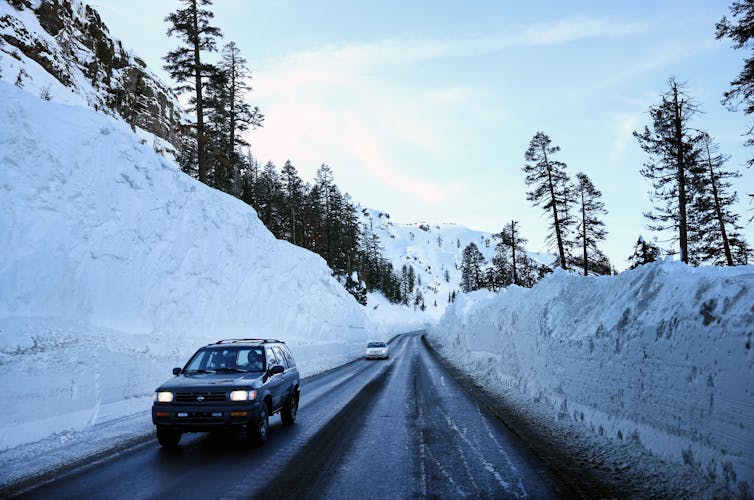
After three years of extreme drought, the Western U.S. is finally getting a break. Mountain ranges are covered in deep snow, and water reservoirs in many areas are filling up following a series of atmospheric rivers that brought record rain and snowfall to large parts of the region.
Many people are looking at the snow and water levels and asking: Is the drought finally over?
There is a lot of nuance to the answer. Where you are in the West and how you define “drought” make a difference. As a drought and water researcher at the Desert Research Institute’s Western Regional Climate Center, here’s what I’m seeing.
How fast each region recovers will vary
The winter of 2023 has made a big dent in improving the drought and potentially eliminating the water shortage problems of the last few summers.
I say “potentially” because in many areas, a lot of the impacts of drought tend to show up in summer, once the winter rain and snow stop and the West starts relying on reservoirs and streams for water. Spring heat waves like the ones we saw in 2021 or rain in the mountains could melt the snowpack faster than normal.
California and the Great Basin
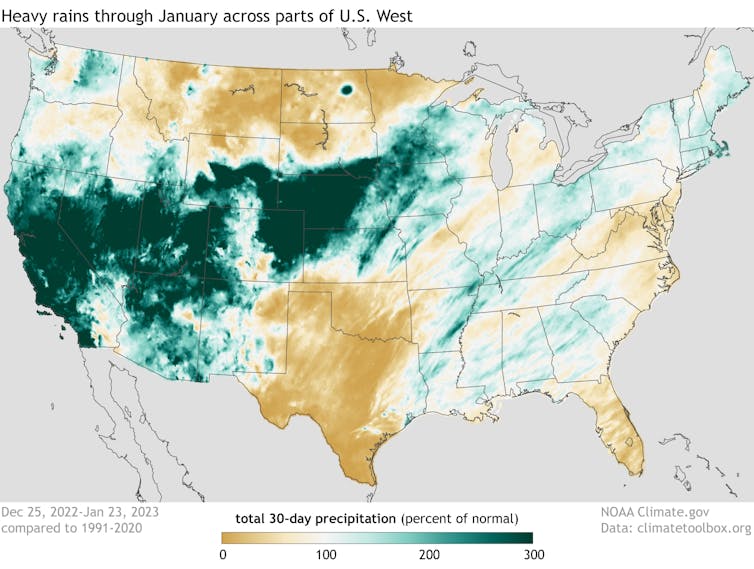
In California, the state’s three-year precipitation deficit was just about erased by the atmospheric rivers that caused so much flooding in December and January. By early March, the snowpack across the Sierra Nevada was well above the historical averages – and more than 200% of average in some areas. The Metropolitan Water District of Southern California announced it was ending emergency water restrictions for nearly 7 million people on March 15.
It seems as though most of the surface water drought – drought involving streams and reservoirs – could be eliminated by summer in California and the Great Basin, across Nevada and western Utah.
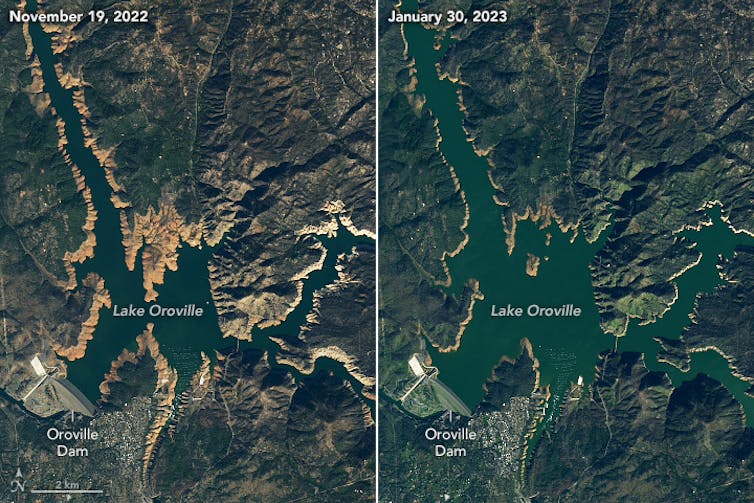
But that’s only surface water. Drought also affects groundwater, and those effects will take longer to alleviate.
Studies in California have shown that, even after wet years like 2017 and 2019, the groundwater systems did not fully recover from the previous drought, in part because of years of overpumping groundwater for agriculture, and the aquifers were not fully recharging.
In that sense, the drought is not over. But at the broader scale for the region, a lot of the drought impacts that people experience will be lessened or almost gone by this summer.
The Colorado River Basin
Similar to the Sierra Nevada, the Upper Colorado River Basin – Wyoming, Colorado, Utah and northwestern New Mexico – has a healthy snowpack this year, and it’s looking like a very good water year there.
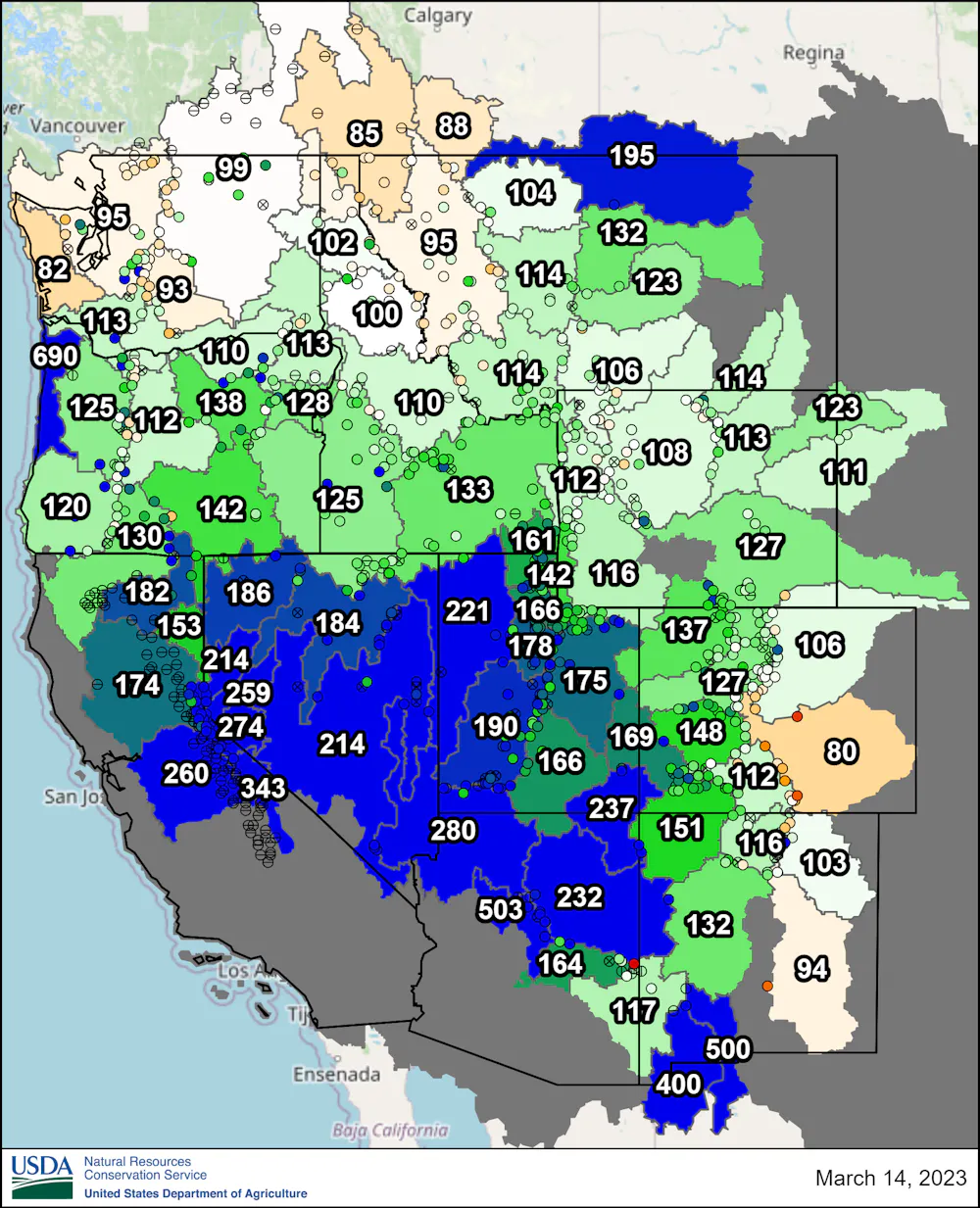
But one single good water year is not going to fill Lake Mead and Lake Powell. Most of the region relies on those two reservoirs, which have declined to worrying levels over the past two decades. NOAA’s seasonal drought outlook released on March 16 noted that both remained low.
Two good water years won’t do it either. Over the next decade, most years will have to be above average to begin to fill those giant reservoirs. Rising temperatures and drying will make that even harder.
So, that system is still going to be dealing with a lot of the same long-term drought impacts that it has been seeing. The reservoirs will likely rise some, but nowhere close to capacity.
The Pacific Northwest
The Pacific Northwest isn’t having as much rain and snow, and it’s a little drier there. But it’s close to average, so there’s not a huge concern there, at least not right now.
Forests, range land and the fire risk
Drought can also have longer-term impacts on ecosystems, particularly forest health.
The Sierra Nevada range has seen large-scale tree die-offs with the drought in recent years, including in northern areas around Lake Tahoe and Reno that weren’t as affected by the previous drought. Whether the recent die-offs there are due to the severity of the current drought or lingering effects from the past droughts is an open question.
Even with a wet winter, it’s not clear how soon the forests will recover.
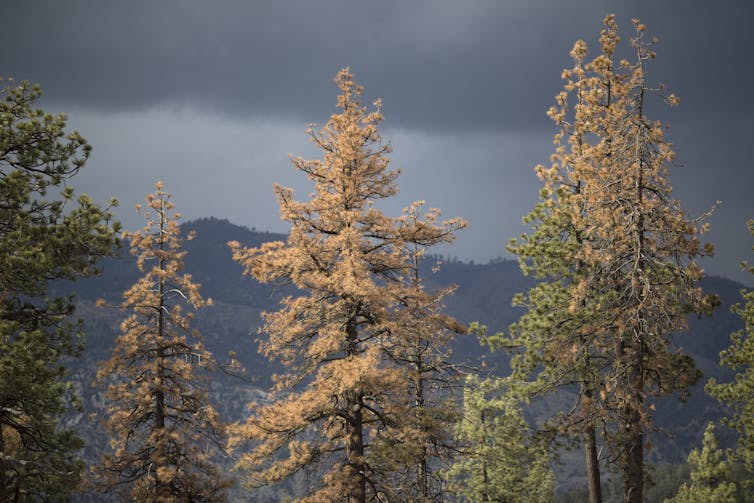
Rangelands, since they are mostly grasses, can recover in a few months. The soil moisture is really high in a lot of these areas, so range conditions should be good across the West – at least going into summer.
If the West has another really hot, dry summer, however, the drought could ramp up again, particularly in the Northwest and California. And then communities will have to think about fire risk.
Right now, there’s a below-normal likelihood of big fires in the Southwest for early spring due to lots of soil moisture and snowpack.
In the higher-elevation mountains and forests, the above-average snowpack is likely to last longer than it has in recent years, so those regions will likely have a later start to the fire season. But lower elevations, like the Great Basin’s shrub- and grassland-dominated ecosystem, could see fire danger starting earlier in the year if the land dries out.
Long-term outlooks aren’t necessarily reliable
By a lot of atmospheric measures, California appears to be coming out of drought, and the drought feels like it’s ending elsewhere. But it’s hard to say when exactly the drought is over. Studies suggest the West’s hydroclimate is becoming more variable in its swings from drought to deluge.

Drought is also hard to forecast, particularly long term. Researchers can get a pretty good sense of conditions one month out, but the chaotic nature of the atmosphere and weather make longer-range outlooks less reliable.
We saw that this year. The initial forecast was for a dry winter 2023 in much of the West. But in California, Arizona and New Mexico, the opposite happened.
Seasonal forecasts tend to rely heavily on whether it’s an El Niño or La Niña year, involving sea surface temperatures in the tropical Pacific that can affect the jet stream and atmospheric conditions around the world. During La Niña – the pattern we saw from 2020 until March 2023 – the Southwest tends to be drier and the Pacific Northwest wetter.
But that pattern doesn’t always set up in exactly the same way and in the same place, as we saw this year.
There is a lot more going on in the atmosphere and the oceans on a short-term scale that can dominate the La Niña pattern. This year’s series of atmospheric rivers has been one example.
Dan McEvoy, Associate Research Professor in Climatology, Desert Research Institute
This article is republished from The Conversation under a Creative Commons license. Read the original article.

CLEARLAKE, Calif. — Despite having a large number of dogs waiting for new homes, Clearlake Animal Control continues to maintain a high live release rate.
At Thursday’s Clearlake City Council meeting, Alyssa Terry, a shelter animal care technician, and Lt. Ryan Peterson of the Clearlake Police Department offered the monthly shelter update.
They brought with them Mila, a female shepherd mix who Terry said loves everybody and is in need of a home.
Mila, who is in foster care, is very polite, likes to sit in laps and get tummy rubs, knows commands, is house- and crate-trained, and would probably be OK with cats with a proper introduction, Terry said.
Terry also said Mila is spayed and vaccinated.
She said another 10 dogs have been transferred to North Bay Animal Services’ Petaluma shelter last week. North Bay Animal Services provides animal control services for the city.
“Our volunteers rock,” said Terry, explaining that they come in daily to exercise the dogs and to help with dishes and laundry.

Lt. Peterson said that, as of Thursday, 108 dogs had come into the shelter since the start of the year.
Of those, 56 dogs have left — 27 were rescued, 23 were returned to owners, five adopted, one died or was lost, he said.
Peterson said none have been euthanized, giving the city a 99.9% live release rate.
There continue to be 33 adoptable dogs on the website, with another 19 in the shelter that are expected to be listed soon.
The shelter is located at 6820 Old Highway 53. It’s open from 9 a.m. to 6 p.m. Tuesday through Saturday.
For more information, call the shelter at 707-762-6227, email
This week’s adoptable dogs are featured below.
Email Elizabeth Larson at
The newly created California Tobacco Control Program funded anti-tobacco media campaigns and community programs to try to improve public health, but some questioned whether the efforts were worth the cost.
Now comes an answer: For every dollar California spent on smoking control, health care costs fell by $231.
Over three decades that witnessed historic lawsuits and expanding smoking bans, California’s smoking population fell from 21.8% in 1989 to 10% in 2019. Its anti-tobacco program accounted for 2.7 of those percentage points, which may seem small but yielded large savings.
Those who didn’t quit ended up cutting back by an average of 119 packs per year in response to the program, according to the study, which appears March 16 in PLoS One.
Senior author Stanton Glantz, PhD, the recently retired founding director of the UCSF Center for Tobacco Control Research and Education, summed up the findings this way: “Tobacco control programs save a fortune.”
Over the 30-year history of the program, Californians pocketed $51.4 billion they would otherwise have spent on cigarettes. Total health care savings came to $816 billion.
“The return on investment is gigantic,” Glantz said. “These programs aren’t just saving lives and making people feel better, they’re also saving people money.”
Shaping anti-tobacco policy
Doing the econometric work to track the relationship between three types of spending — state tobacco control, consumer tobacco purchasing and health care expenses — over three decades were lead author James Lightwood, PhD, a UCSF associate professor of clinical pharmacy, and Steve Anderson, a financial industry forecasting expert.
They developed a predictive variation of a model that Lightwood and Glantz first developed using 1989-2008 data and updated estimates of the program effect.
The model has held up over 30 years, almost 10 years beyond the original sample, through changing economic conditions and levels of California tobacco control spending, according to Lightwood.
“This paper significantly strengthens the case that there is a causal relation between tobacco control and smoking reduction,” Lightwood said.
The authors said the modeling results can help shape tobacco policy in states considering tobacco control measures and in those where support for existing programs may be wavering. The forecasting methods used in the paper are very much like those that large businesses use to inform major business decisions, Anderson said.
“Any state with a high level of smoking that launches a substantial, long-term program should get results similar to California’s,” Lightwood said. “But public policy has unique challenges. The political expediency of short-term thinking dogs many tobacco-control efforts.”
California is large and diverse, spanning rural and urban areas, and its population includes many races and ethnicities across the socioeconomic spectrum.
“California is so big that it can be considered average in many ways relevant to the evaluation of a tobacco control program,” Lightwood said.
Benefits grow over time
In previous research, Lightwood and Glantz have shown short-term cost benefits of tobacco reduction — heart attacks, strokes and low birthweight decline quickly. The current paper models both the short and long-term effects of state programs, which also reflect declines in slower-to-emerge diseases, such as lung cancer.
“The benefits grow over time as more and more diseases are prevented,” Lightwood said. “If you do a less comprehensive program for four or five years, then it’s hard to detect much change in the face of year-to-year variability and the program is vulnerable to attack. But, when the program is large, long-term and comprehensive, like California’s, we can confidently conclude that there are large and immediate benefits that grow with time.”
The new findings confirm that tobacco control efforts spur smoking reductions and that even a seemingly small reduction in smoking contributes to the state’s tobacco control program, quickly and significantly driving down health care expenses.
“Tobacco control,” Glantz said, “is one of the strongest things you can do for medical care cost containment.”
Laura Kurtzman writes for the University of California San Francisco.
Emerging from a late afternoon closed session, the board voted unanimously to appoint Lloyd Guintivano, a senior deputy county counsel, to succeed County Counsel Anita Grant, effective March 25.
Grant submitted a resignation letter to the board on Jan. 25, notifying the supervisors that her last day at work will be March 24.
The letter explained that well over a year ago, Grant had made the board aware of her intention to retire.
“I have been reluctant to select a date because I love this County and serving it has been the privilege of my life. Nonetheless, after thirty-one years in the County Counsel’s Office, seventeen of which as County Counsel, it is time,” Grant wrote.
She thanked her staff, noting she leaves with full confidence in their abilities. Grant also said she was thankful to have worked with many outstanding county employees and was grateful to the Board of Supervisors’ past and present members “for the wonderful opportunity to work here.”
The county opened a recruitment after Grant’s retirement announcement which closed on Feb. 16.
During recent board meetings, both Guintivano and another deputy county counsel, Carlos Torrez, had taken turns sitting in Grant’s place and advising the board.
The board then held special meetings on March 6 and 10 to interview the four applicants. Another interview meeting had been set for this Friday.
The resume on Guintivano’s LinkedIn account says he holds a Bachelor of Arts degree in English and Philosophy from the University of California, Berkeley, and received his Juris Doctor from the University of Nebraska College of Law.
He was admitted to the State Bar of California on June 1, 2006.
Guintivano, who has worked for the county of Lake since June of 2008, will begin at step one on the salary scale. The base annual salary for the county counsel’s job is $168,132, topping out at $204,360.
Out of the same Tuesday afternoon closed session came another department head appointment, although an interim one.
The board voted unanimously to appoint Assistant County Administrative Officer Stephen Carter as interim Behavioral Health Services director, subject to the approval of the California Department of Health Care Services.
Carter will maintain his existing salary, which has an annual range of $137,988 to $167,736 annually.
Earlier in the day, the board gave outgoing Behavioral Health Services Director Todd Metcalf a sendoff that included a proclamation thanking him for his 11 years of work with the county. He’s served as Behavioral Health Services director since December 2016.
Metcalf notified the board in a Feb. 17 email that his last day with the county will be Friday, March 17.
Metcalf is moving to the Big Island of Hawaii to retire soon. “In the meantime, I have accepted a position in Hawai’i County’s Housing and Community Development Department to address homeless and housing issues on the Big Island,” he wrote.
At its Feb. 28 meeting, the board agreed by consensus to accept staff’s proposal to hire a firm specializing in behavioral and medical health position recruitments in order to find Metcalf’s longterm replacement.
Email Elizabeth Larson at
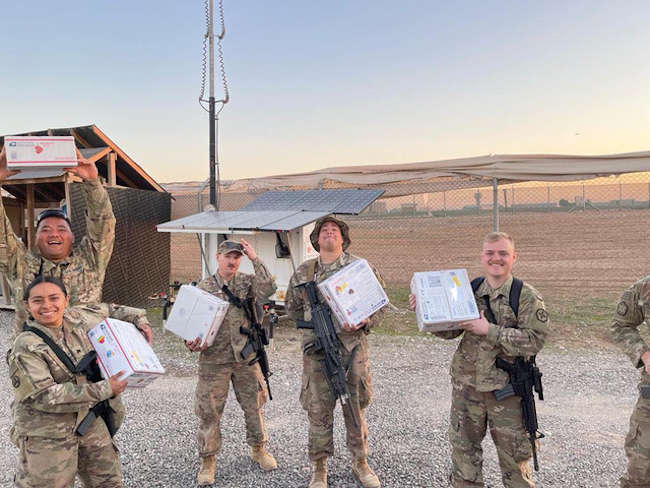
LAKEPORT, Calif. — What began as a gesture to show support to a few friends deployed to Afghanistan in 2003, became a twenty year effort and has supported thousands of military personnel, Operation Tango Mike.
Operation Tango Mike translates from military jargon to Operation Thanks Much. The organization is an all volunteer 501(c)3 nonprofit.
The Board of Supervisors honored the group with a proclamation in honor of its 20 years of services on Tuesday morning.
Currently, 85 to 100, and sometimes more, care packages are sent every month to troops in the Middle East, Africa, aboard ships and in many other countries.
Military families are supported as well. Many volunteers that support Operation Tango Mike have volunteered their assistance with home repairs, transportation and more.
With no base or military installation in the local area, folks who wish to support troops and their families gather via Operation Tango Mike. Military families are welcomed and are provided with emotional support, knowing that they and their loved ones are appreciated.
On the third Thursday of every month, volunteers gather at 6 p.m. at Umpqua Bank, 805 11th St., Lakeport, to prepare care packages for deployed military personnel.
The annual exception comes every March, when Operation Tango Mike hosts an open house at 5 p.m. The community is invited to visit and become acquainted with what the group does, and longtime supporters are encouraged to join in the festivities.
Monthly shipping costs of $2,000, and items for care packages, are all covered through donations and fundraising. No government funding is provided for shipping or goods.
“Forget politics, support our troops,” is the mantra that has helped ensure that all are welcomed and appreciated at Operation Tango Mike functions. The effort does not involve politics and exists to support our troops and their families.
Packing parties are family friendly and children are encouraged to participate. Every care package is decorated with stickers and artwork by “the world’s greatest decorating crew” of children.
Troops express appreciation in thank you messages that are sent to Operation Tango Mike.
Staff Sergeant Landerman recently wrote, “I wanted to say thank you! All of us here really do appreciate what the members of Operation Tango Mike have done for us. Especially during this holiday season. I know many of the airmen living in the dorms with no family here especially appreciated it. I remember being that airman. Deployed during the holidays surrounded by people I’ve just met. Far from home and feeling lonely. I know the airmen here felt the same way I did. But it’s people like you and the members of Operation Tango Mike that show us someone cares and appreciates what we’re doing. So again, thank you.”
The public is invited and encouraged to help celebrate and commemorate twenty years of community effort. To date, more than 25,000 care packages have been shipped.
On Thursday, March 16, at 5 p.m., there will be an open house at Umpqua Bank, 805 11th Street, Lakeport. It will be an opportunity to pay a visit and learn more about Operation Tango Mike, read letters from troops, browse photos and get acquainted.
Delicious food will be served. Catering is generously being donated by Rosemary Martin of Rosey Cooks, LLC.
The regular monthly packing party will take place following the open house, and as holiday items are shipped one month in advance to ensure timely delivery, the March care packages will be Easter boxes. You are invited to bring along any special treats, candies, correspondence or items you would like to include in care packages.
For further information or to add someone to the care package recipient list, please call 707-349-2838 or e-mail
The event will be held in-person on Saturday, March 18, from 1 to 3 p.m. at the Mendocino College Lake Center Round Room in Lakeport, with Diaz attending virtually from her home state of Arizona.
To ensure the event is accessible to all Lake County residents, the event will also be live streamed from each library branch in Lakeport, Clearlake, Middletown and Upper Lake.
Lake County residents may also join the Zoom webinar from home by visiting the following link at the time of the event: https://lakecounty.zoom.us/s/94859414760.
Winner of the 2021 Pulitzer Prize in Poetry, “Postcolonial Love Poem” is a collection of poetry by Arizona poet Natalie Diaz — who is Mojave, an enrolled member of the Gila River Indian Tribe, Latinx and queer.
The poems push against the forces of racism, environmental destruction, addiction and mental illness with the power of desire, love and language.
From publisher Gray Wolf Press, “Postcolonial Love Poem is an anthem of desire against erasure. Natalie Diaz’s brilliant second collection demands that every body carried in its pages — bodies of language, land, rivers, suffering brothers, enemies, and lovers — be touched and held as beloveds.”
This NEA Big Read 2023 author event is sponsored by the Lake County Friends of Mendocino College, and Mendocino College Lake Center, which is celebrating its 50th anniversary.
Mendocino College program offerings and services have grown to reflect the changing nature and needs of our communities.
Continuing to make a significant impact on the economy in our region year after year, the college supports a vibrant performing arts venue, targeting training in emergency services, firefighting, construction, and other technical careers; and advanced higher educational opportunities for all.
To view the full schedule of NEA Big Read events, go to http://www.lakecountybigread.com/.
Follow the Big Read on Facebook by visiting https://www.facebook.com/LakeCountyBigRead/.
The NEA Big Read is a program of the National Endowment for the Arts in partnership with Arts Midwest, which seeks to broaden our understanding of our world, our communities, and ourselves through the joy of sharing a good book.
The NEA Big Read showcases a diverse range of contemporary titles that reflect many different voices and perspectives, aiming to inspire conversation and discovery.
Visit arts.gov/neabigread for more information about the NEA Big Read. Organizations interested in applying for an NEA Big Read grant in the future should visit Arts Midwest’s at https://artsmidwest.org/ for more information.
Georgina Marie Guardado is Lake County's poet laureate.