 How to resolve AdBlock issue?
News
The pandemic began in the United States following a period of rising home prices and declining interest and vacancy rates. These pressures increased during the pandemic, contributing to higher home prices and rents.
The percentage of household income renter households spent on gross rent (rent plus utilities) — the housing cost ratio — increased nationwide from 2019 to 2021, according to recently released data from the U.S. Census Bureau’s 2021 American Community Survey (ACS).
But renter households with the lowest annual incomes, a population that traditionally has less income available for other essential goods, experienced the largest percentage point increases.
Renters spent more on rent since 2019
The U.S. Census Bureau calculates housing cost ratios for all renter-occupied units that pay cash rent and have positive household income.
When a household has a cost ratio of over 30%, it is considered cost-burdened, according to the Department of Housing and Urban Development (HUD). Severely cost-burdened households have cost ratios of over 50%.
Cost-burdened households have less money to spend on other critical needs such as food, transportation and child care.
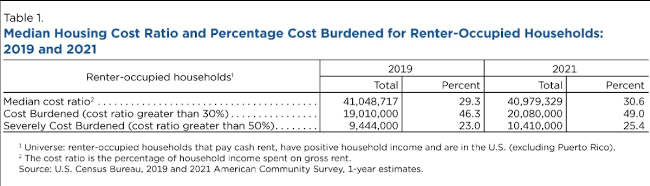
The median cost ratio for all renter-occupied households increased from 29.3% in 2019 to 30.6% in 2021 (Table 1).
This increase shifted the number of households considered cost burdened from 46.3% to 49.0% of all renter-occupied units. That means just under half of all renter-occupied households in the United States were cost burdened in 2021.
In 2021, 20.1 million renter-occupied households met the over 30% income threshold and were cost burdened, an increase of about 1 million households since 2019.
The number of severely burdened households rose to 25.4% (about 10.4 million renter-occupied units) from 23.0% in 2019 (9.4 million).
Renters’ household incomes lower than homeowners
Renter-occupied households historically have lower household incomes than owner-occupied households and may be more affected by changes in household income and rental prices.
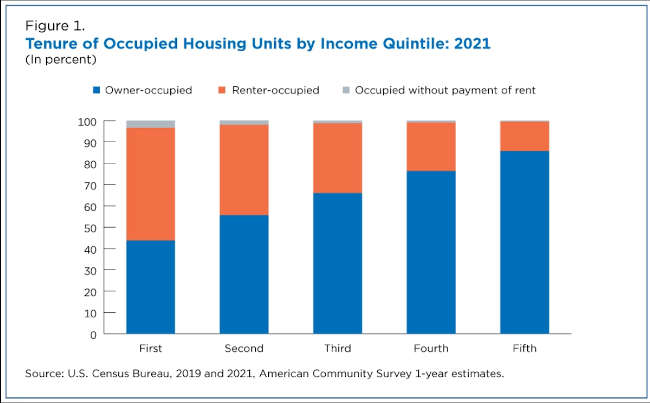
Categorizing households into five equally sized groups (known as quintiles) from those with the lowest to highest incomes showed that renter-occupied households were more likely than owner-occupied households to be in the lowest income quintiles (Figure 1).
Renter-occupied households made up 52.9% of households in the lowest income quintile and 42.4% of households in the second lowest income quintile. In contrast, only 13.8% of households in the top income quintile were in renter-occupied units.
Low-income renters hardest hit
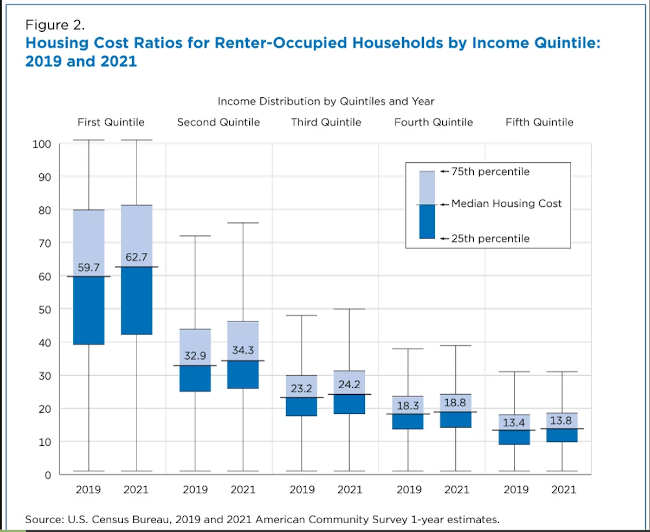
Renter-occupied households in the lowest income quintile had a median cost ratio of 62.7% in 2021. That means that half of the renter-occupied households in this quintile paid gross rent that was more than 62.7% of their total household income, 3 percentage points higher than in 2019. (A cost ratio of 62.7% is over twice the HUD cost burden threshold.)
This was the largest percentage-point increase in median rental cost ratio of any income quintile (Figure 2). The second income quintile went up 1.4 percentage points and the third income quintile by 1.0 point. The top two income quintiles had the smallest increases (0.6 and 0.4 percentage points).
For low-income renter households, even a small change in rental costs can have a significant impact on their cost ratios.
For example, while the median housing cost ratio was higher for renter households in the lowest income quintile, the cost ratios were also much more variable for this group than the higher-income quintiles (Figure 2).
This variability reflects the outsized impact of small changes in housing costs and incomes on the cost ratio for those in the lowest-income group compared to those in higher-income groups.
Renter households at all income levels more likely to be cost burdened
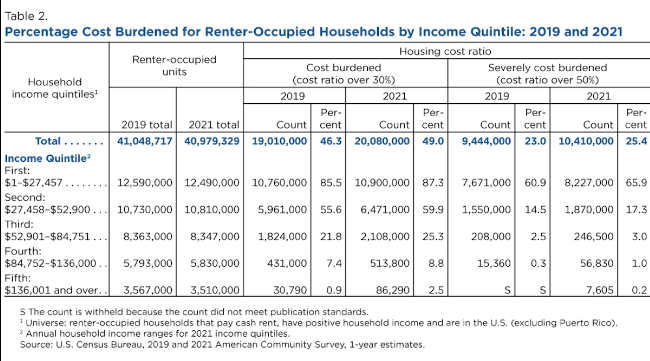
Statistics on the number of renter households cost burdened, in addition to the median housing cost ratio, are useful because renters who meet or exceed these thresholds may face hardships meeting basic needs (Table 2).
The lowest-income quintile had the largest number (10.8 million) of cost-burdened renter occupied households, which climbed from 85.5% in 2019 to 87.3% or 10.9 million in 2021.
The numbers were even more striking for the severely cost burdened with a substantial increase in renters in the lowest income quintile paying more than half their income for rent. In 2021, 65.9% of renter-occupied households in the lowest-income quintile were severely cost burdened, an increase of over 500,000 households from 60.9% in 2019.
In addition, 59.9% of renter-occupied households in the second quintile were cost burdened in 2021, up from 55.6% in 2019; 17.3% of them were severely burdened, up from 14.5% in 2019.
In the third quintile, 25.3% were cost burdened, up from 21.8%. Only 3.0% of households in the third income quintile were severely cost burdened in 2021, but that was still higher than the 2.5% in 2019.
Though renter-occupied households in the top income groups were far less likely to be cost burdened, they still experienced significant increases.
The fourth quintile went from 7.4% burdened in 2019 to 8.8% in 2021, and the fifth quintile went from 0.9% to 2.5%. But renter-occupied households in the fourth and fifth income quintiles were rarely severely cost burdened.
Peter J. Mateyka is a statistician and Jayne Yoo is an economist in the Census Bureau’s Social, Economic, and Housing Statistics Division.
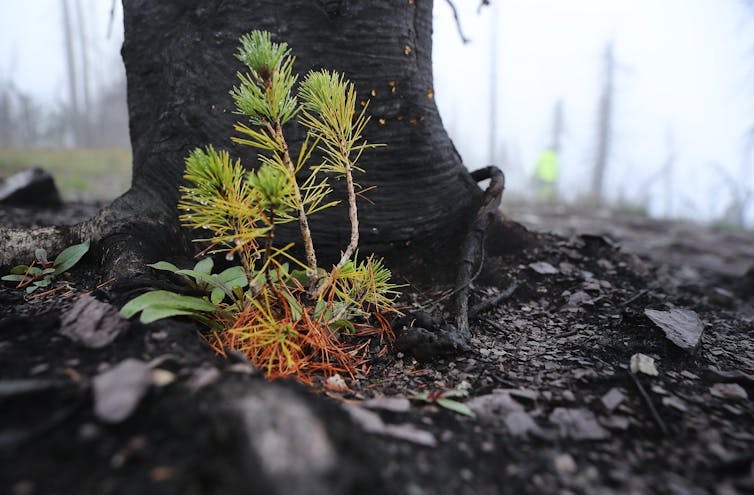
Wildfires and severe drought are killing trees at an alarming rate across the West, and forests are struggling to recover as the planet warms. However, new research shows there are ways to improve forests’ chances of recovery – by altering how wildfires burn.
In a new study, we teamed up with over 50 other fire ecologists to examine how forests have recovered – or haven’t – in over 10,000 locations after 334 wildfires.
Together, these sites offer an unprecedented look at how forests respond to wildfires and global warming.
Our results are sobering. We found that conifer tree seedlings, such as Douglas-fir and ponderosa pine, are increasingly stressed by high temperatures and dry conditions in sites recovering from wildfires. In some sites, our team didn’t find any seedlings at all. That’s worrying, because whether forests recover after a wildfire depends in large part on whether new seedlings can establish themselves and grow.
However, our team also found that if wildfires burn less intensely, forests will have a better shot at regrowing. Our study, published March 6, 2023, highlights how proactive efforts that modify how wildfires burn can help buffer seedlings from some of the biggest stressors of global warming.
Intense fires overwhelm trees’ protective traits
Forests and wildfire have coexisted in the West for millennia.
Typically, forests have regrown after wildfires, thanks to an amazing set of traits that trees possess. Lodgepole pine, for example, stores thousands of seeds in closed cones sealed with resin, that only open in the presence of high heat from flames, triggering abundant regrowth. Other tree species, like ponderosa pine, have thick bark that helps them survive low-intensity wildfires.
Intense or very large “megafires” can overwhelm those traits, though. Most conifer tree species in the West depend on seeds from surviving trees to jump-start recovery following wildfire. So when intense wildfires kill most of the trees, entire expanses of forest can be lost.
Even if some trees do survive a wildfire and can provide seeds, seedlings require favorable climate conditions to establish and grow. Unlike adult trees with deep root systems, seedlings have short roots that only reach water in the top layer of soil. Seedlings are also more sensitive to summer temperatures because hot temperatures can actually kill their live cells.
Seedlings struggling to establish after wildfires
Hotter and drier conditions due to global warming are leading to more area burning. Global warming is also interacting with over a century of wildfire suppression and restrictions on Indigenous fire stewardship, which has left denser forests and more underbrush as fuel. And that is leading to more severe wildfires.
It’s also becoming harder for seedlings to establish and grow after wildfires.
We found that from 1981 to 2000, 95% of our study region had climate conditions suitable for seedlings to establish and grow after wildfires. Fast forward to 2050 and this decreases to 74%, even under modest warming where global average temperatures increase by around 2 degrees Fahrenheit (1.1 Celsius).
How these changes unfold varies across the West. Today, seedlings are least likely to establish and grow after wildfires in the Southwest and California. However, the wetter and cooler regions of the northern Rocky Mountains and Pacific Northwest still support seedling establishment and growth.
Survivor trees are crucial for sheltering seedlings
By studying both how severely wildfires burn – for example, how many trees are killed – and how climate conditions after a wildfire affect new seedlings, our team found a surprising and hopeful result.
Even when summers are hotter and drier after a wildfire than in the past, just having trees around that survived a fire helps new seedlings establish and grow.
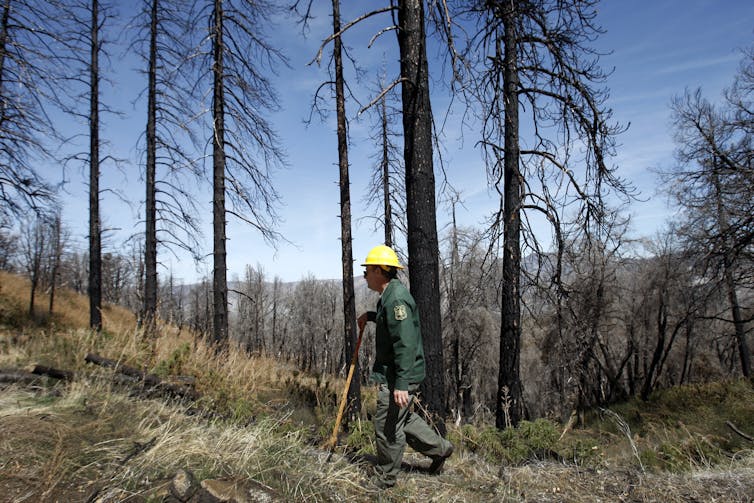
Besides providing seeds, surviving trees reduce temperatures on the ground, where it matters most to seedlings. In some cases, temperatures can be 4 to 5 degrees Fahrenheit cooler (2.2 to 2.8 C) around surviving trees, giving seedlings the edge needed to germinate and survive.
In our study, projections of future forests varied dramatically, depending on how many trees we assumed survived future wildfires.
Altering how wildfires burn can boost recovery
This means there is an opportunity to help offset some climate-driven declines in tree recovery – by reducing the number of trees killed in wildfires.
Reversing global warming is a long-term challenge for society, and some near-term impacts are already irreversible. But reducing the number of trees killed in wildfires can help maintain future forests. In regions where seedlings are already struggling after wildfire, such actions are needed sooner rather than later.
Science supports the use of a number of tools, or forest treatments, that can help decrease the number of trees killed by wildfires.
Controlled burning with forest thinning or cultural burning by local Indigenous groups removes small trees and brush. That leads to fewer trees killed in subsequent fires, especially in forests that historically burned frequently. In high-elevation forests that historically experienced less frequent but more severe wildfires, planting trees after wildfires can help jump-start forest recovery.
Although forest treatments are effective, wildfires burn much more area than can be feasibly treated. Given this, fire scientists suggest letting some wildfires burn when conditions are safe and more likely to leave surviving trees on the landscape.
Expanding the use of wildfires and controlled burning as management tools is challenging, but the evidence suggests it may be one of the most effective and economical ways to reduce the number of trees killed by future wildfires.
There are clear ways to lessen the impacts of global warming and wildfires on seedlings and future forests. But in some areas, even as we work to reverse global warming, the window of opportunity is short. In these areas, forest treatments that modify wildfire or jump-start recovery will be most effective in the next few decades, setting up seedlings to better withstand near-term warming.
Kimberley Davis, Research Ecologist, United States Forest Service; Jamie Peeler, Postdoctoral Research Fellow, University of Montana, and Philip Higuera, Professor of Fire Ecology, University of Montana
This article is republished from The Conversation under a Creative Commons license. Read the original article.
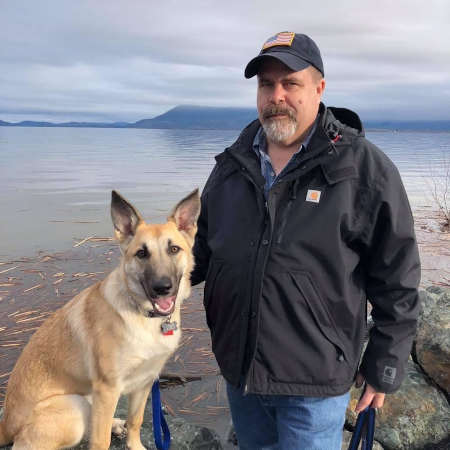
LAKE COUNTY, Calif. — Lakeport’s police chief on Tuesday officially threw his hat into the ring to pursue another local job — that of county supervisor.
Chief Brad Rasmussen said he plans to run for the District 4 supervisor position in the 2024 election.
A longtime Lake County resident, Rasmussen, 53, said he’s excited about the prospect of pursuing the supervisor’s job, which — if he won — he would take over at the start of 2025, after retiring.
Because of the presidential primary, the election will come sooner than in most years. Super Tuesday primaries in California fall in March, not June.
That means the election is just a year away — March 5.
He’ll challenge Supervisor Michael Green, appointed in October by Gov. Gavin Newsom to replace Tina Scott, who stepped down in July to take a job with the Lakeport Unified School District.
“I was surprised but also pleased to hear of Brad Rasmussen’s decision to run for District 4 supervisor in 2024,” Green said in a statement released on Lake County News on Tuesday evening. “I was privileged to work with Brad while serving on the Lakeport City Council, and his decades-long commitment to public safety and community-oriented policing speaks for itself. Suffice to say he will be a strong supervisorial candidate in the March 5, 2024, primary election.”
Green’s statement continued, “Brad’s announcement naturally raises questions about my own plans, but I’m not going to answer such questions on short notice. To my knowledge, the candidate filing period will not open for six months or more, and it’s not only possible but probable that other highly qualified candidates may enter the race. In particular, I want to encourage women, LGBTQ, LatinX and people of color to consider running for county office. There is still plenty of time to nominate a slate of strong, diverse candidates so District 4 voters have a real choice when electing their next supervisor.“
One other candidate already has confirmed to Lake County News that he will also enter the race.
Scott Barnett, who serves on the Lakeport Planning Commission, said Tuesday he will run for the supervisorial seat.
Barnett also had applied to the Governor’s Office for the District 4 seat last year but said the state didn’t interview him for the office and didn’t even acknowledge his application. Other applicants reported the same issues with the governor’s appointment process.
He said he saw Rasmussen’s Facebook announcement “and I'm even more motivated to run.”
Rasmussen said he’s been considering a run for supervisor for “quite a few months.”
The first person he talked to about it was wife, Karyn, to get her support.
They have two grown daughters, both of whom grew up in Lakeport and went to Lakeport schools: Stephanie, who is a doctor who graduated with honors in June 2022 from the University of California, Davis, School of Medicine, and Savannah, who received her Master of Science in behavioral psychology from Pepperdine University in May 2022 and is a Board Certified Behavior Analyst.
Brad Rasmussen said he has so far not set a retirement date but that it won’t be before the March 2024 primary.
He said any campaigning will take place well outside of work hours.
“I’m 100% committed to my job,” said Rasmussen. “I’m going to do my job like I always have.”
He hasn’t given the city of Lakeport a letter announcing his retirement, although he has spoken to City Manager Kevin Ingram about his plans to run for supervisor.
The announcement was not mentioned during the Lakeport City Council’s Tuesday evening meeting.
When he does set a retirement date, Rasmussen said he will give the city plenty of time to find his successor.
By the time he expects to retire next year, he will have served for 34 years with the Lakeport Police Department. He’s been chief since May of 2011.
As for his reasons for running for supervisor, Rasmussen said, “I’ve had a great career in police work but I’ve been in here a long time.”
He said he wants to transition to something else but also wants to continue to serve the community in a different way.
Rasmussen said he can use his skills and knowledge to benefit District 4 and the rest of the county.
What’s been the reaction to his announcement?
“So far, everything I’ve gotten has been positive reaction and support,” he said.
Those congratulating him on his Facebook announcement included retired Sheriff Brian Martin, Chief Probation Officer Wendy Mondfrans and Greg Folsom, Clearlake’s former city manager who now is city manager of Suisun City.
By seeking to hold elected office, Rasmussen will follow in the footsteps of another Lakeport Police chief who also was his mentor — Tom Engstrom.
Engstrom, who retired in 2005 after 11 years at top cop in Lakeport, served one term on the Lakeport City Council from 2010 to 2014.
Rasmussen’s late father-in-law, Arlin Pischke, also held elected office, serving on the Lakeport City Council from 1982 to 1990, serving twice as Lakeport’s mayor.
In 1984 Pischke ran for the District 4 supervisorial seat amidst a large field but lost to Karan Mackey, who held the seat for 16 years.
Rasmussen’s Facebook post from Tuesday morning is published below in its entirety.
Dear Fellow Citizens of District 4 in Lake County, CA,
I am writing to announce my intent to run for the position of District 4 Supervisor in the 2024 election. I am excited about the opportunity to serve my community and represent the interests of the residents of District 4.
As a longtime resident of Lake County, I have a deep commitment to our community and its future. I believe that my experience, qualifications, and dedication make me the ideal candidate for this important role.
Over the years, I have worked tirelessly to improve our community and enhance the quality of life for all residents. In addition to over three decades in local government I have served on various local organizations and nonprofit groups including Kiwanis and Lions Clubs.
If elected as your District 4 Supervisor, I will bring this same level of commitment and dedication to the job. My top priorities will include promoting economic growth and development, protecting our natural resources, improving our schools, and ensuring that our local government is transparent and accountable to the people it serves.
I believe that by working together, we can achieve great things for our community. I am committed to listening to your concerns, representing your interests, and working hard to make District 4 an even better place to live, work, and raise a family.
I am honored to currently work as Lakeport’s Chief of Police. As I near retirement, this position provides the perfect opportunity to continue to serve our community.
I hope to earn your support in the upcoming election. Thank you to my family and community members who have encouraged me to run.
Sincerely,
Brad Rasmussen
Email Elizabeth Larson at
MATH will meet at 7 p.m. Thursday, March 9, in the Middletown Community Meeting Room/Library at 21256 Washington St., Middletown. The meeting is open to the public.
To join the meeting via Zoom click on this link; the meeting ID is 331 855 4843. Call in at 669-900-6833.
On the agenda is a presentation by county Chief Climate Resiliency Officer Terre Logsdon, who will give a brief presentation about the Office of Climate Resiliency and get feedback on a survey.
The group also will host Andrew Amelung, Cannabis Task Force Committee Program manager for the Lake County Community Development Department. Amelung will provide a brief update on the progress of the Cannabis Task Force meetings.
Also on Thursday, MATH will consider a proposed letter to Cal Fire in response to the proposed “State Responsibility Area Fire Hazard Severity Zones.”
MATH also has been asked to consider a support letter for Heart Consciousness Church, also known as Harbin Hot Springs, in its time sensitive application for a wildfire prevention grant.
In other business, MATH will have a Brown Act training.
The MATH Board includes Chair Monica Rosenthal, Vice Chair Todd Fiora, Secretary Ken Gonzalez, and alternates Julia Bono and Tom Darms.
MATH — established by resolution of the Lake County Board of Supervisors on Dec. 12, 2006 — is a municipal advisory council serving the residents of Anderson Springs, Cobb, Coyote Valley (including Hidden Valley Lake), Long Valley and Middletown.
For more information email
Email Elizabeth Larson at
The Lake County Sheriff’s Office of Emergency Services and Lake County Community Development Department are requesting damage reports for residential and commercial buildings that sustained structural damage in the storms.
Sheriff Rob Howe proclaimed a local emergency on Feb. 24 due to impacts from the low elevation snow storm.
Officials said this damage assessment is needed to identify potential pathways for assistance from the State of California and/or federal government.
If your home or business sustained moderate to major damage, please report damages as soon as possible and no later than Friday, March 24.
Damage can be reported at the sheriff’s website or by calling 707-263-2382 Monday through Friday from 8 a.m. to 5 p.m.
County officials said this is not an application for assistance, and it is possible that no assistance will become available.
The information gathered may also be used for various post-incident reports and future emergency planning.
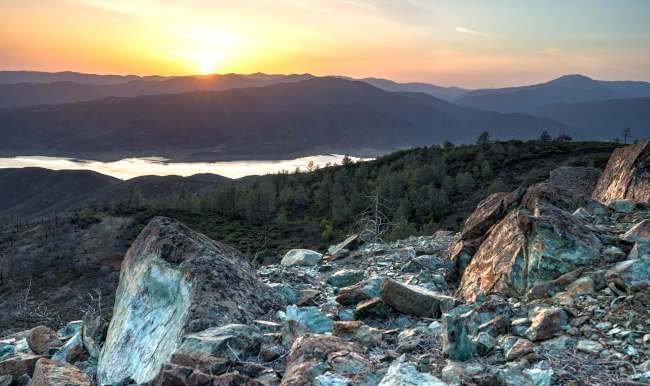
On Tuesday, area tribal and conservation leaders applauded U.S. Senators Alex Padilla (D-CA) and Dianne Feinstein (D-CA) and Representatives John Garamendi (D-CA) and Mike Thompson (D-CA) for reintroducing the Berryessa Snow Mountain National Monument Expansion Act, which would permanently protect part of Molok Luyuk (Condor Ridge) adjacent to the existing Berryessa Snow Mountain National Monument in Northern California.
The expansion of Berryessa Snow Mountain National Monument would safeguard public lands that are sacred to the Yocha Dehe Wintun Nation and that are critically important to protect in the face of a changing climate.
The legislation would add 3,925 acres to the current monument, support tribal co-management, and change the name of the additional wildlands from “Walker Ridge” to Molok Luyuk — Patwin for “Condor Ridge” — a name the Yocha Dehe Wintun Nation provided.
“Many of the plant and animal species within Molok Luyuk are traditionally important to the lifeways of the Patwin people, and we consider their protection and stewardship to be part of our sacred responsibility to the land,” said the Tribal Council of the Yocha Dehe Wintun Nation. “Molok Luyuk, or Condor Ridge in the Patwin language, was home to California Condors as well as Bald Eagles, Golden Eagles, and Peregrine Falcons, and provides wildlife corridors and vital habitat for other culturally important species. The recent reintroduction of the California Condor to the north of Molok Luyuk gives hope that condors will once again soar over the ridge.”
The current monument stretches from Napa County in the south to Mendocino County in the north, encompassing 330,780 acres of public lands managed by the Bureau of Land Management (BLM) and the U.S. Forest Service, or USFS.
President Obama designated the national monument in 2015, responding to a call from Representatives Thompson and Garamendi, then-Sen. Barbara Boxer, other members of California’s Congressional delegation, and community leaders to permanently protect these lands.
The bill reintroduction reflects growing momentum for the effort to protect additional public lands around the monument. Last fall, legislative leaders joined the call from tribal and community leaders for President Biden to expand the national monument using his authority under the Antiquities Act.
The Antiquities Act is a 1906 law that grants presidents the ability to designate federal public lands, waters, and cultural and historical sites as national monuments to permanently conserve them.
“Molok Luyuk is a special and sacred place for area tribes and for many local residents who enjoy recreation activities like hiking and mountain biking,” added Lake County Supervisor E.J. Crandell, a member of the Robinson Rancheria Tribe. “The natural beauty of our home also drives tourism, which is key to the economic vitality of the region. Protecting these beautiful lands would be a gift to future generations.”
The Yocha Dehe Wintun Nation, which strongly supports the expansion, has a long and significant connection to Molok Luyuk, stretching back thousands of years. The ridge includes areas where religious ceremonies are practiced and sites that were central to vital trading routes.
A key goal of this effort is also to establish co-management with federally recognized Tribes and to return to an Indigenous name for these lands.
Molok Luyok is located on the eastern edge of the existing monument and is home to great biodiversity, including oak woodlands, rocky outcroppings, wildflower meadows, the world’s largest stand of McNab cypress, and dozens of rare plant species.
“Molok Luyuk is a ‘must protect’ area in the midst of a changing climate,” said Mary Creasman, chief executive officer, California Environmental Voters. “These public lands serve as a critical wildlife corridor for species such as tule elk, mountain lions and bears. It’s also home to imperiled wildlife such as bald and golden eagles and many rare plants. Protecting this habitat would help preserve critically important biodiversity.”
The proposed national monument expansion would improve outdoor access for the region’s residents and help the state of California and the federal government meet their shared goals to protect 30% of lands and waters by 2030 as part of the international effort to address the impacts of climate change and alarming rates of extinction.
“Molok Luyuk is a rare treasure of rich cultural heritage and sacred history, diverse wildlife and rare plants, and stunning natural beauty and accessible recreational activities,” said Sandra Schubert, executive director of Tuleyome, a regional conservation organization. “We are deeply grateful to our Congressional champions Reps. Garamendi and Thompson and Sens. Padilla and Feinstein for shepherding this effort. We encourage President Biden to expand the existing monument and permanently protect Molok Luyuk.”
Incorporating the adjacent federally owned land into the existing national monument would improve land management, bring additional resources for trail construction and maintenance, help improve public access, and protect sensitive wildlife, prime habitat areas, and cultural resources. Improving the public’s access to nature, especially for historically marginalized communities, is an important goal for the State of California, as reflected in Gov. Newsom’s October 2020 Executive Order N-82-20 and the State’s Outdoors for All initiative.
“Nature can be such a valuable reprieve for so many, yet there continue to be deep inequities in access to the outdoors,” said Shanna Edberg, Conservation Program director for the Hispanic Access Foundation. “In fact, our research found that in California, Latinos and other people of color are two times more likely to be deprived of nearby nature than white people. Protecting Molok Luyuk will help to ensure equitable access to the outdoors in a county where 22% of residents identify as Hispanic or Latino.”
Popular recreation activities on these lands include hiking, mountain biking, photography, camping, horseback riding, and off highway vehicle, or OHV, use on designated routes.
“As an avid OHV recreationist, I strongly support expanding Berryessa Snow Mountain National Monument to include Molok Luyuk,” said Don Amador, government affairs, American Motorcyclist Association District 36. “The permanent protection of Molok Luyuk will improve the management of these lands and increase public access to recreation opportunities. This is a win-win for our community and I add my voice in support of expanding the monument.”
In October, President Biden created his first national monument: the Camp Hale-Continental Divide National Monument in Colorado.
“Our national monuments are a part of our country’s outdoor heritage and must be passed down to future generations,” said Janessa Goldbeck, chief executive officer of Vet Voice Foundation. “Veterans advocated for the designation of Berryessa Snow Mountain National Monument and we’re proud to support the expansion of the monument to include Molok Luyuk."
To learn more about this effort and to sign a petition in support of the expansion of the Berryessa Snow Mountain National Monument, visit www.expandberryessa.org.