 How to resolve AdBlock issue?
News
Programs over the years have included rock climbing, cooking, dance, sewing, Jr. Giants baseball and softball, kayaking, archery, girls’ wrestling camp, basketball, tutoring, and activities that promote social skills and leadership.
Funding has been provided by grants and donations including awards from the Lake County Wine Alliance and Lake County Tribal Health.
All activities are held in community spaces such as public schools, churches and parks.
Kelseyville Presbyterian Church has provided space for the boxing program for many years.
Members from the Lakeport Elks and staff from the Lake County Sheriff’s Office have volunteered their time to help support the various programs.
The Sheriff’s Activities League is composed of 100% volunteers including board members.
Volunteers receive a background check and orientation to agency requirements.
Each year the Kelseyville Lions Club hosts a breakfast fundraiser for the Sheriff’s Activities League.
This year’s breakfast will be held on Sunday, March 12, at the Kelseyville Lions Club on Sylar Lane in Kelseyville.
The breakfast begins at 8 a.m. and ends at 11 a.m.
Tickets are $9 per person at the door.
There will be raffle prizes.
Come out and enjoy a great breakfast and support the provision of worthwhile activities that are provided at no cost to families.

Even after heavy snow and rainfall in January, western states still face an ongoing drought risk that is likely to grow worse thanks to climate change. A whopping snowpack is good news, but it doesn’t reduce the need for long-term planning.
Confronted with a shrinking supply of water for agriculture, industry and residential uses, water agencies have pursued different strategies to encourage water conservation. They have nudged customers to reduce water use, limited outdoor watering and offered incentives to rip out lawns. On the supply side, there are innovative ideas about using heavy rains to recharge groundwater.
Basic economics teaches us that a higher price for water would encourage conservation. Up until now, however, concerns about harming low-income households have limited discussions about raising water prices to reduce demand.
We know that it’s hard to pay more for essential goods such as food, energy and water, especially for lower-income households. Rather than raising everyone’s water prices, we propose a customized approach that lets individual consumers decide whether to pay higher prices.
Who is most able and willing to conserve?
One of the most common challenges involved in making markets work well is what economists call asymmetric information – when one party has more access to relevant information than the other party. Think about buying or selling a car before online tools like Carfax were available. Owners and dealers knew more about what each car was really worth, so they had greater bargaining power than buyers.
The West has millions of water users with a broad range of incomes who consume water at widely varying levels. These consumers, including urban households, businesses and farmers, know more than water agencies do about how readily they can conserve water.
For example, a person who owns a home with a large green lawn and who is conservation-minded may need only a small incentive to switch to native, low-water plants. Some farmers may need only a small incentive to replace water-intensive alfalfa production with a less water-intensive crop.
Water agencies could elicit this private information by making a “take it or leave it” offer to water consumers. Some of California’s electric utilities have already experimented with this opt-in approach to encourage energy conservation.

Target the big users
Every western water district has access to customer-level big data on monthly and even daily water consumption. Agencies could use this information to identify the top 10% of water consumers in their territories, based on volume used – like the household in the Bel Air neighborhood of Los Angeles that used 11.8 million gallons of water in 2014.
Water agencies could randomly select customers among the largest water users in their service areas to participate in a small pilot study. Each invitee would receive an opt-in contract offering to pay them an annual fee for enrolling for three years in a water conservation program. In return, the price the consumer paid for each gallon of water would triple. This approach would give the consumer a guaranteed payment for participating and a clear incentive to use less water.
Data scientists would collect information on who accepted the offer and could survey invitees to learn how they decided whether or not to participate. Combining these two data sets would make it possible to test hypotheses about which factors determined willingness to accept the opt-in offer.
Using customer-level water consumption data over time, water agencies could track usage and compare customers who participated in the price increase program with others who turned down the offer. This would make it possible to estimate the water conservation benefits of introducing customized water prices.
There are many different ways in which water users could cut back, including swapping out old appliances or watering their gardens less often. Farmers could install more efficient irrigation systems. Customers who chose the payment in return for higher prices would decide which conservation strategies worked best for them.

Big potential insights
Conducting a pilot study using a randomly chosen sample of high-usage customers is a low-stakes strategy. If it fails to promote water conservation at a low cost, then a valuable lesson has been learned. If it succeeds, the same opt-in offer could be made to more high-usage customers.
Water agencies would need funds to support the pilot study, possibly from state or federal sources. Since pumping, treating and heating water uses energy, and thus creates greenhouse gas emissions, funds from the Inflation Reduction Act might be an option. Successful water conservation would help to slow climate change.
Today, most water agencies don’t know how responsive individual customers would be to higher prices. By conducting the type of pilot study that we have described, agencies could answer that question without raising prices for vulnerable households. If such initiatives succeeded, they could be replicated in other drought-prone areas of the West. Since farms consume the largest share of water in western states, it is especially important to learn more about farmers’ willingness to conserve.
Water is essential for life, but westerners have different abilities and willingness to conserve it. We recommend a strategy that rewards those who are most able to reduce their usage without punishing those who are least able.
Matthew E. Kahn, Provost Professor of Economics and Spatial Sciences, USC Dornsife College of Letters, Arts and Sciences and Bhaskar Krishnamachari, Ming Hsieh Faculty Fellow and Professor of Electrical and Computer Engineering, University of Southern California
This article is republished from The Conversation under a Creative Commons license. Read the original article.
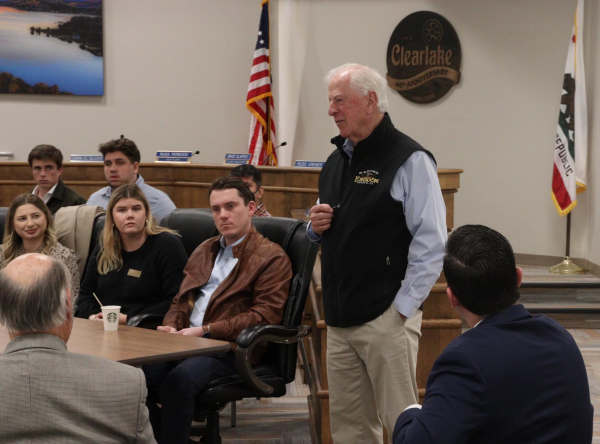
CLEARLAKE, Calif. — On Wednesday, Rep. Mike Thompson (CA-04) and his entire staff team met with members of the Lake County community.
The meeting came as part of a listening tour by Congressman Thompson and his team from both the district and his Washington D.C. office.
“After redistricting changed the boundaries of our district to include all of Lake County, I brought my staff team to Lake County to hear directly from our community,” said Thompson. “Our district is my top priority, and hearing directly from the people is the best way that me and my staff will be able to serve our district. It was great to meet with elected leaders, business leaders, community leaders, and others from Lake County and talk about how we can best work together to support our community and deliver on our shared priorities.
“Over the next two years, I am focused on ensuring that my office is a resource for all of our district, and meetings like this will provide my staff with the hands-on experience needed to understand the local issues and connect with those we represent.”
Rep. Thompson is a senior member of the House Committee on Ways and Means and serves as the ranking member of the Subcommittee on Tax.
Following the 2020 Census, Rep. Thompson’s district now includes all of Lake County.
Thompson represents California’s 4th Congressional District, which includes all or part of Lake, Napa, Solano, Sonoma and Yolo counties.
There has been an increase in license plate thefts throughout the county, the agency reported.
The stolen plates are being affixed to stolen vehicles or switched for plates from stolen vehicles, and some vehicle owners are not aware that they are falling victim to this until they are pulled over by police.
License plates are often stolen from those vehicles that closely resemble a stolen vehicle. Reporting your stolen license plate to law enforcement is not enough to combat these trends.
Stolen license plates that are reported to law enforcement are entered into the same database that is checked by Automated License Plate Reading cameras.
If you are still driving your vehicle with that one remaining plate, you are alerting these cameras every time you drive by them.
Car thieves are counting on this to draw attention away from them, police said.
How well do you know your license plate number? If you don't know it, you might want to check yours to ensure they belong to your vehicle.
It is important for vehicle owners to know what their license plate number is and to ensure that their front and rear license plates are for their vehicle.
You can also help by replacing that one remaining plate with a new set of license plates from the DMV.
The Lakeport Police Department said it will soon begin strictly enforcing California's two license plate requirement to better protect vehicles from theft, and speed up the recovery of vehicles that are ultimately stolen.
The Clear Lake hitch or chi is a large, native minnow found only in Clear Lake and its tributaries within Lake County.
Since 2014, the fish has been listed as threatened under the California Endangered Species Act.
An important cultural resource for Native American tribes within Lake County, Clear Lake hitch populations used to be seen in runs numbering in the tens of thousands.
Through permitting and $177,872 in grant funding from CDFW, Robinson Rancheria is leading the pilot research effort to study the effectiveness and benefits of removing nonnative carp and goldfish from Clear Lake.
The Robinson Rancheria contracted with the Minneapolis-based WSB engineering and environmental consulting firm to seine sections of Clear Lake from Feb. 3 through Feb. 11, to catch carp and goldfish.
Some of the carp and goldfish were kept for biological testing but most of the fish — including all nontarget sport fish — were returned to the lake unharmed as part of the feasibility study.
The timing of the project was chosen to coincide with the period when carp and goldfish form large aggregations in preparation for spawning for more efficient collection of target species and to minimize bycatch of other fishes. CDFW was on the water monitoring the effort.
Other partners include the Big Valley Band of Pomo Indians and the Lake County Water Resources Department.
Carp and goldfish are detrimental to Clear Lake hitch and their habitat in several ways, including predating on Clear Lake hitch eggs; disturbing and circulating nutrients in the lake that can reduce water clarity and foster harmful algal blooms in the summer; and inhibiting tule growth. Tule provide important rearing habitat for juvenile Clear Lake hitch.
Deshawn Mills, 13, was reported to have returned home on Wednesday.
He had last been seen on Tuesday, which triggered a police report and authorities asking for the community’s help to locate him.