 How to resolve AdBlock issue?
News

CLEARLAKE, Calif. — The Clearlake Police Department is attempting to locate a missing man.
Colten Grauman, 29, was last seen at Adventist Health Clear Lake Hospital.
He is a white male adult, with dark hair and blue eyes, stands about 5 feet 6 inches to 5 feet 7 inches tall, and is 140 to 150 pounds.
Police did not have details on the clothing Grauman was last seen wearing.
If you have any information regarding his whereabouts, please contact Clearlake Police Department at 707-994-8251, Extension 1.
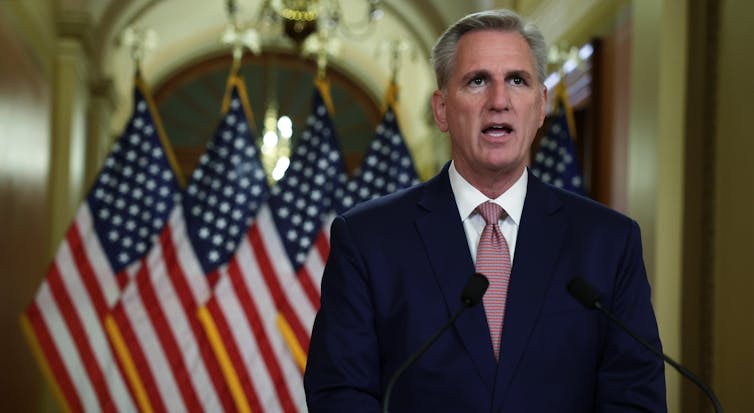
The legislative package the U.S. House of Representatives passed on April 26, 2023, by a narrow margin would pare federal spending over the next decade while also raising the debt ceiling. One important measure in the Republican-backed bill would restrict access to Medicaid for millions of Americans.
About 1 in 4 Americans have health coverage through the program, which primarily serves low-income and disabled people and which is funded jointly by the federal government and the states. Should the Republican-backed legislation prevail, the federal government would require adults insured by Medicaid who are 19 to 55 years old and don’t have children or other dependents to spend 80 hours a month doing paid work, job training or community service.
The Conversation asked Simon F. Haeder, a public health scholar, to explain what the proposed work requirements would do and why the Republican effort to institute them matters for the millions of Americans who rely on Medicaid.
What would change if this policy took effect?
Unlike some other government programs that assist low-income Americans, including the Supplemental Nutrition Assistance Program, or SNAP, and Temporary Assistance for Needy Families, Medicaid currently has no work requirements.
The package the House recently passed would require all states to implement this policy. An estimated 15 million Americans with Medicaid would need to comply with the requirements.
This change would dramatically increase bureaucratic hassles for Medicaid beneficiaries who are disproportionately low-income, disabled and nonwhite. KFF, a health care research nonprofit, estimates that 1.7 million people would lose federal coverage. However, states have the option to continue to pay for these individuals solely with state funds.
Those who would be subject to the new rules would not be the only ones at risk. It is well known that many of the exempt populations, including the aged and disabled, struggle to complete paperwork or fail to understand complex bureaucratic rules. Many experts predict that coverage losses could be even higher among these demographics, as states would consider them to be out of compliance with work requirements.
Are there precedents for this policy?
This is not the first time that Republicans sought to make access to Medicaid contingent on meeting work requirements for at least some beneficiaries. The Trump administration worked with various Republican-led states to use what are known as 1115 demonstration waivers for that purpose. These waivers allow states to make temporary changes to their Medicaid programs that depart from certain statutory requirements. However, those efforts were quickly blocked in court. Most were never even piloted before the Biden administration rescinded them.
One exception is Arkansas.
Arkansas began imposing work requirements on Medicaid recipients on adults ages 30 to 49 starting in June 2018. As a result, about 1 in 4 Arkansans subject to that policy ended up losing their coverage by the end of that year before courts deemed it unlawful.
The Arkansas experience, which was particularly burdensome for beneficiaries, reaffirmed many concerns of those who oppose work requirements. Importantly, the reason many lost coverage was not that they failed to complete the required hours of paid work, job training or community service, but that they struggled to overcome bureaucratic challenges.
Efforts are also underway in Georgia to impose work requirements on Medicaid beneficiaries despite legal hurdles and the Biden administration’s objections. With President Joe Biden in office, it’s going to remain difficult to experiment with this policy unless Congress approves a measure like the one in the House package.

What would be different this time?
States had to actively seek out those waivers that Republicans embraced when former President Donald Trump was in the White House. That meant that Medicaid beneficiaries in states with Democratic leadership, such as California, were unlikely to ever confront them.
The proposed changes in the House legislation would force all states to implement work requirements for adults from 18 to 55 without dependents. Failure to comply would put states at risk of losing federal funding, so even Democratic-led states would have to adopt these rules. The proposed changes would also circumvent many of the legal concerns that previously prevented the widespread implementation of Medicaid work requirements.
Importantly, this policy change would coincide with ongoing upheaval for Medicaid beneficiaries. This is because millions of Medicaid beneficiaries are already losing coverage because of the expiration of the COVID-19 public health emergency declaration on May 11 and states’ restarting eligibility determinations of Medicaid beneficiaries on April 1. As long as the government’s continuous enrollment policy was in effect, states couldn’t kick anyone off of Medicaid.
The number of people covered by the program soared to 93 million as of January 2023.
Is this policy compatible with the purpose of Medicaid?
The point of Medicaid has always been providing eligible low-income people with access to comprehensive health coverage for as long as they need it. That is, Medicaid is exclusively a health insurance program.
Some other safety net programs are supposed to achieve multiple goals. For example, the official mission of Temporary Assistance for Needy Families is to “end the dependence of needy parents on government benefits by promoting job preparation, work and marriage,” rather than just to help those needy parents make ends meet.
At the same time, there is evidence that Medicaid leads to greater workforce participation, because it provides affordable health coverage as well as access to needed medical care. If you have an illness, it can be much easier to stay on the job if you’re getting the treatment your condition requires. Indeed, most able-bodied adults on Medicaid are employed.
Ironically, pushing people off Medicaid, either for failing to fulfill work requirements or because they struggle with navigating the bureaucracy, would likely reduce the number of people who work.
Why is this significant?
It seems unlikely that Medicaid work requirements will become law in 2023 or 2024, because Democrats have steadfastly opposed their implementation and the party commands a majority in the Senate. However, given the potentially dramatic implications of defaulting on the federal debt, some Democrats may be willing to compromise.
For now, I think it’s far more likely that the Republicans in Congress are setting the stage for future efforts to make more public assistance programs contingent on complying with work requirements, especially the next time a Republican becomes the president of the United States.
If measures like the one the House passed as part of the Republican debt-ceiling package were to become law, even states with entrenched Democratic leadership could have little recourse to fight back.
Simon F. Haeder, Associate Professor of Public Health, Texas A&M University
This article is republished from The Conversation under a Creative Commons license. Read the original article.
The fire district board will meet at 5 p.m. Tuesday, May 9, in the boardroom at headquarters Station 50, 445 N. Main St.
Under the board’s action items is a proposed no confidence letter aimed at Health Services Director Jonathan Portney.
Portney, who has been in the job since January of 2022, has clashed with the sheriff’s office, fire districts and his own employees over his management of the department.
A draft of the letter was not available by press time.
District staff said the item could be pulled from the agenda. If it remains on the agenda, the letter will be presented at the meeting.
At its last meeting on April 11, the board asked to have the item agendized for this meeting.
This wouldn’t be the first time a no confidence letter has been aimed at Portney.
Nine Health Services Department employees signed a Dec. 5 letter that faulted Portney for leadership failures that have led to plummeting morale and alienating community partners that they said included the fire departments, the sheriff’s office, Social Services and Behavioral Health.
In March, Lakeport Fire Chief Patrick Reitz and Northshore Fire Chief Mike Ciancio took issue with a news release that Portney issued that they said contained inaccurate information about their districts’ staffing and suggested that they were not responding to emergency calls, which Reitz said was untrue. Ciancio went so far as to tell his board that the news release was filled with “lies.”
Both Ciancio and Reitz said Portney made the inaccurate public statements without even consulting with them first, and Ciancio believed he used as the basis of the letter secondhand information that had come from a discussion during a fire chiefs meeting at which a Health Services Department representative was not present.
Portney has been the subject of numerous closed session performance evaluations with the Board of Supervisors since he became Health Services director 16 months ago.
Over the years, it’s been the case that a county department head who has more than two to three such evaluations a year typically leaves the county’s employment.
Portney has had eight such evaluations, the last one on May 2, based on county records.
Email Elizabeth Larson at
MATH will meet at 7 p.m. Thursday, May 11, in the Middletown Community Meeting Room/Library at 21256 Washington St., Middletown. The meeting is open to the public.
To join the meeting via Zoom click on this link; the meeting ID is 832 1989 2440. Call in at 669-900-6833.
At 7:15 p.m., there will be an open discussion of MATH membership on community concerns, ideas and activities.
The group also will plan for upcoming meetings. In June, they will hear from Lake County Sheriff Rob Howe and will get an update on the Maha Guenoc resort plan from representative Chris Meredith in July.
MATH’s next meeting will take place on June 8.
The MATH Board includes Chair Monica Rosenthal, Vice Chair Todd Fiora, Secretary Ken Gonzalez, Rosemary Córdova and Bill Waite, and alternates Julia Bono and Tom Darms.
MATH — established by resolution of the Lake County Board of Supervisors on Dec. 12, 2006 — is a municipal advisory council serving the residents of Anderson Springs, Cobb, Coyote Valley (including Hidden Valley Lake), Long Valley and Middletown.
For more information email
Email Elizabeth Larson at
The committee, or LEDAC, will meet from 7:30 to 9 a.m. Wednesday, May 10, in the council chambers at Lakeport City Hall, 225 Park St.
The meeting is open to the public.
Agenda items include updates on city projects and City Council priorities.
There also will be discussion of the LEDAC action plan for fiscal year 2023-24, member reports, citizen input and announcements.
LEDAC’s next meeting will be July 12.
LEDAC advocates for a strong and positive Lakeport business community and acts as a conduit between the city and the community for communicating the goals, activities and progress of Lakeport’s economic and business programs.
Members are Chair Wilda Shock, Vice Chair Denise Combs and Secretary JoAnn Saccato, along with Bonnie Darling, Jeff Davis, Candy De Los Santos, Bill Eaton, Monica Flores, Barbara Flynn, Pam Harpster, Laura McAndrews Sammel, Bob Santana and Tim Stephens. City staff who are members include City Manager Kevin Ingram and Community Development Department representatives.
Email Elizabeth Larson at

For the 20th time since 1933, Congress is writing a multiyear farm bill that will shape what kind of food U.S. farmers grow, how they raise it and how it gets to consumers. These measures are large, complex and expensive: The next farm bill is projected to cost taxpayers US$1.5 trillion over 10 years.
Modern farm bills address many things besides food, from rural broadband access to biofuels and even help for small towns to buy police cars. These measures bring out a dizzying range of interest groups with diverse agendas.
Umbrella organizations like the American Farm Bureau Federation and the National Farmers Union typically focus on farm subsidies and crop insurance. The National Sustainable Agriculture Coalition advocates for small farmers and ranchers. Industry-specific groups, such as cattlemen, fruit and vegetable growers and organic producers, all have their own interests.
Environmental and conservation groups seek to influence policies that affect land use and sustainable farming practices. Hunger and nutrition groups target the bill’s sections on food aid. Rural counties, hunters and anglers, bankers and dozens of other organizations have their own wish lists.
As a former Senate aide and senior official at the U.S. Department of Agriculture, I’ve seen this intricate process from all sides. In my view, with the challenges in this round so complex and with critical 2024 elections looming, it could take Congress until 2025 to craft and enact a bill. Here are four key issues shaping the next farm bill, and through it, the future of the U.S. food system.
The price tag
Farm bills always are controversial because of their high cost, but this year the timing is especially tricky. In the past two years, Congress has enacted major bills to provide economic relief from the COVID-19 pandemic, counter inflation, invest in infrastructure and boost domestic manufacturing.
These measures follow unprecedented spending for farm support during the Trump administration. Now legislators are jockeying over raising the debt ceiling, which limits how much the federal government can borrow to pay its bills.
Agriculture Committee leaders and farm groups argue that more money is necessary to strengthen the food and farm sector. If they have their way, the price tag for the next farm bill would increase significantly from current projections.
On the other side, reformers argue for capping payments to farmers, which The Washington Post recently described as an “expensive agricultural safety net,” and restricting payment eligibility. In their view, too much money goes to very large farms that produce commodity crops like wheat, corn, soybeans and rice, while small and medium-size producers receive far less support.
Food aid is the key fight
Many people are surprised to learn that nutrition assistance – mainly through the Supplemental Nutrition Assistance Program, formerly known as food stamps – is where most farm bill money is spent. Back in the 1970s, Congress began including nutrition assistance in the farm bill to secure votes from an increasingly urban nation.
Today, over 42 million Americans depend on SNAP, including nearly 1 in every 4 children. Along with a few smaller programs, SNAP will likely consume 80% of the money in the new farm bill, up from 76% in 2018.
Why have SNAP costs grown? During the pandemic, SNAP benefits were increased on an emergency basis, but that temporary arrangement expired in March 2023. Also, in response to a directive included in the 2018 farm bill, the Department of Agriculture recalculated what it takes to afford a healthy diet, known as the Thrifty Food Plan, and determined that it required an additional $12-$16 per month per recipient, or 40 cents per meal.
Because it’s such a large target, SNAP is where much of the budget battle will play out. Most Republicans typically seek to rein in SNAP; most Democrats usually support expanding it.
Anti-hunger advocates are lobbying to make the increased pandemic benefits permanent and defend the revised Thrifty Food Plan. In contrast, Republicans are calling for SNAP reductions, and are particularly focused on expanding work requirements for recipients.

Debating climate solutions
The 2022 Inflation Reduction Act provided $19.5 billion to the Department of Agriculture for programs that address climate change. Environmentalists and farmers alike applauded this investment, which is intended to help the agriculture sector embrace climate-smart farming practices and move toward markets that reward carbon sequestration and other ecosystem services.
This big pot of money has become a prime target for members of Congress who are looking for more farm bill funding. On the other side, conservation advocates, sustainable farmers and progressive businesses oppose diverting climate funds for other purposes.
There also is growing demand for Congress to require USDA to develop better standards for measuring, reporting and verifying actions designed to protect or increase soil carbon. Interest is rising in “carbon farming” – paying farmers for practices such as no-till agriculture and planting cover crops, which some studies indicate can increase carbon storage in soil.
But without more research and standards, observers worry that investments in climate-smart agriculture will support greenwashing – misleading claims about environmental benefits – rather than a fundamentally different system of production. Mixed research results have raised questions as to whether establishing carbon markets based on such practices is premature.
A complex bill and inexperienced legislators
Understanding farm bills requires highly specialized knowledge about issues ranging from crop insurance to nutrition to forestry. Nearly one-third of current members of Congress were first elected after the 2018 farm bill was enacted, so this is their first farm bill cycle.
I expect that, as often occurs in Congress, new members will follow more senior legislators’ cues and go along with traditional decision making. This will make it easier for entrenched interests, like the American Farm Bureau Federation and major commodity groups, to maintain support for Title I programs, which provide revenue support for major commodity crops like corn, wheat and soybeans. These programs are complex, cost billions of dollars and go mainly to large-scale operations.
Agriculture Secretary Tom Vilsack’s current stump speech spotlights the fact that 89% of U.S. farmers failed to make a livable profit in 2022, even though total farm income set a record at $162 billion. Vilsack asserts that less-profitable operations should be the focus of this farm bill – but when pressed, he appears unwilling to concede that support for large-scale operations should be changed in any way.
When I served as deputy secretary of agriculture from 2009 to 2011, I oversaw the department’s budget process and learned that investing in one thing often requires defunding another. My dream farm bill would invest in three priorities: organic agriculture as a climate solution; infrastructure to support vibrant local and regional markets and shift away from an agricultural economy dependent on exporting low-value crops; and agricultural science and technology research aimed at reducing labor and chemical inputs and providing new solutions for sustainable livestock production.
In my view, it is time for tough policy choices, and it won’t be possible to fund everything. Congress’ response will show whether it supports business as usual in agriculture, or a more diverse and sustainable U.S. farm system.
Kathleen Merrigan, Executive Director, Swette Center for Sustainable Food Systems, Arizona State University
This article is republished from The Conversation under a Creative Commons license. Read the original article.