 How to resolve AdBlock issue?
News
The state’s population is estimated at 38,940,231 people as of Jan. 1, 2023, the Department of Finance reported.
Over the same period, statewide housing growth increased to 0.85% — its highest level since 2008.
The report found that all but 12 of the state’s counties lost population, with Lake County, at a loss of 0.9%, being among the top 10 counties for the largest amount of lost population.
The report shows Lake County’s population declining over the year from 67,421 to 66,800.
The city of Clearlake’s population declined from 16,545 to 16,364, or 1.1%, while the city of Lakeport saw a 0.8% decrease, from 5,008 to 4,967 residents. The population of the balance of the county dropped from 45,868 to 45,469, or a 0.9% reduction.
California added 123,350 housing units on net, including 20,683 accessory dwelling Units — or ADUs — to bring total housing in the state to 14,707,698 units.
In Lake County, housing units saw a slight increase of 0.2 countywide, increasing from 34,294 to 34,354 units.
In Clearlake units increased by just one, 7,623 to 7,624, for a 0% increase. Lakeport increased from 2,501 to 2,508, or 0.3%, while the remainder of the county saw a 0.2% increase, from 24,170 to 24,222 units.
New construction represents 116,683 housing units with 63,423 single family housing units, 51,787 multifamily housing units, and 1,473 mobile homes.
The 0.35% population decline for 2022, roughly 138,400 persons, marks a slowdown compared to the recent decline during the COVID-19 pandemic.
Between 2021 and 2022, California’s population decreased 0.53% or 207,800 persons, due mainly to sharp declines in natural increase and foreign immigration.
For 2022, natural increase — the net amount of births minus deaths — increased from 87,400 in 2021 to 106,900 in 2022. Births decreased slightly from 420,800 in 2021 to 418,800 in 2022, while deaths declined gradually from 333,300 persons in 2021 to 311,900 persons in 2022, respectively.
Foreign immigration nearly tripled in 2022 compared to the prior year, with a net gain of 90,300 persons in 2022 compared to 31,300 in 2021. While foreign immigration to California has nearly returned to pre-pandemic levels, natural increase has not rebounded. Total births remain low due to fertility declines; while deaths have eased gradually from their pandemic peak, they remain elevated.
With slower domestic in-migration and increased domestic out-migration likely the result of work-from-home changes, declines in net domestic migration offset the population gains from natural increase and international migration.
The report contains preliminary year-over-year January 2023 and revised January 2021 and January 2022 population data for California cities, counties, and the state.
These estimates are based on information through Jan. 1, 2023.
Significant changes over the year include:
• Population growth slowed but remained positive in the interior counties of the Central Valley and the Inland Empire, while most counties saw declines, including every coastal county except San Benito (0.2%).
• Only two counties had growth above a half of a percent: Madera (0.6%) and Yuba (0.6%), due to housing gains. The next largest in percentage growth were San Joaquin (0.4%), Merced (0.4%) and Imperial (0.4%) counties.
• Forty-six of the state’s fifty-eight counties lost population. The 10 largest percentage decreases were: Lassen (-4.3%), Del Norte (-1.3%), Plumas (-1.2%), Santa Cruz (-1.0%), Marin (-1.0%), Tehama (-1.0%), Napa (-1.0 %), Lake (-0.9%), Monterey (-0.8%) and Los Angeles (-0.8%).
• The state’s three most populous counties all experienced population loss: Los Angeles declined by 73,293 persons (-0.75%), San Diego by 5,680 persons (-0.2%) and Orange by 14,782 persons (-0.5%).
• The top five cities where housing production drove population growth include: Paradise (24.1%) in Butte County, Lathrop (11.1%) in San Joaquin County, Duarte (6.6%) in Los Angeles County, Wheatland (4.6%) in Yuba County and Shafter (4.3%) in Kern County.
County housing highlights include:
• Yuba had the highest housing growth (2.3%) of all counties, followed by: Placer, Butte, Madera, San Joaquin, Yolo, Alameda, San Benito, Merced and Imperial.
• Twelve counties gained housing at or above 1.0%.
• One county lost housing: Mariposa due to a wildfire in 2022.
• Ranked by net housing gains, Los Angeles (19,556), San Diego (7,034), Oakland (4,005), San Francisco (2,823), and unincorporated Riverside County (2,106) added the most housing units in 2022.
• Larger densely populated urban areas built most of the multifamily housing throughout the state. Los Angeles led the state gaining 12,074 multifamily units, comprising 61.7% of their net housing growth, followed by San Diego (4,568 for 64.9%), Oakland (3,880 for 96.9%), and San Francisco (2,573 for 91.1%).
• Conversely, single family housing is more likely to be built farther inland in typically more suburban cities. Cities with a high proportion of single family growth include: Roseville (100% single family), Santa Clarita (100% single family), Fresno (91.7% single family), and Irvine (71% single family).
Also of note in the report:
• 356 cities lost population, while 125 gained population and one had no change.
• Of the 10 largest cities in California, only three gained population: Sacramento had the largest percentage gain in population (0.2%, or 1,203) followed by Bakersfield (0.2%, or 882) and Fresno (0.1%, or 599).
• Accessory dwelling unit production increased by 60.6%, with the state adding 20,638 ADUs in 2022.
• Group quarters represent 2.4% (926,000) of the total state population. This population includes those living in college dormitories (269,000) and in correctional facilities (168,000). In 2022, California’s group quarters population increased by 11,000 people or 1.2%. The college dormitory population grew by 16,000 (6.2%). Correctional facilities declined in population in 2022 by 4,200 people (-2.5%) across federal, state and local facilities. As college dormitory populations continue to return to a post-pandemic normal, several jurisdictions saw significant gains in population due to this population. The city of Arcata in Humboldt County grew by 4.1% due to a 45.1% increase at Cal Poly Humboldt. The city of Marina in Monterey County grew by 2.5% due to a 12.6% increase at California State University at Monterey Bay.
State prisons are generally located in remote areas; as a result, increases or decreases can account for significant changes in their respective area populations. For example, prison declines led to population decreases in Susanville (-9.5%) in Lassen County, Calipatria (-5.6%) in Imperial County, and Crescent City (-4.4%) in Del Norte County.
The board will meet beginning at 9 a.m. Tuesday, May 16, in the board chambers on the first floor of the Lake County Courthouse, 255 N. Forbes St., Lakeport.
The meeting can be watched live on Channel 8, online at https://countyoflake.legistar.com/Calendar.aspx and on the county’s Facebook page. Accompanying board documents, the agenda and archived board meeting videos also are available at that link.
To participate in real-time, join the Zoom meeting by clicking this link.
The meeting ID is 992 8581 4784, pass code 979559. The meeting also can be accessed via one tap mobile at +16694449171,,99285814784#,,,,*979559#.
All interested members of the public that do not have internet access or a Mediacom cable subscription are encouraged to call 669-900-6833, and enter the Zoom meeting ID and pass code information above.
In an untimed item, the board will consider a resolution electing not to list supporters and opponents for county city, district, and school measures on future county ballots.
The report from Registrar of Voters Maria Valadez explains that Assembly Bill 1416, passed by the State Legislature in 2022 with an effective date of Jan. 1, 2023, adds a requirement for statewide measures that a listing of the supporters and opponents of measures be listed on the ballot label or that a similar description be provided on the ballot.
“The bill gives counties the option of printing the list of supporters and opponents of local measures on the ballot,” Valadez said.
“Opting into the additional printing will result in cost increases for ballot production, printing, and postage. Including the supporters and opponents will increase the length of the ballot and potentially the number of ballot cards,” she wrote. “In addition, it could increase the possibility for electioneering and promotion of candidates who may be on the ballot and are also signers of the measure.”
Valadez said the requirement also would put the Registrar of Voters Office in the position of accepting or denying abbreviations of supporters/opponents that may not be clear due to the maximum character limit — 125 characters each — and in turn may result in challenges to perceived unfair determinations.
She said Elections Code section 9170 allows for a mechanism to opt out of printing the list of supporters and opponents of local measures.
“At this time, a majority of California counties have already opted out of this requirement or have indicated that they will be doing so in the future, including our neighboring counties. Remaining consistent with our neighboring counties who share districts with Lake County would be beneficial to voters who would receive identical information on the ballots,” Valadez said.
Valadez’s office is encouraging the board to accept the resolution and take the same action to opt out.
Also on Tuesday, the board will meet the pet of the week, and present proclamations for National Safe Boating Week, California Peace Officers’ Memorial Day, National Police Week, the 130th anniversary of the old Community Methodist Church in Middletown and Mental Health Matters Month.
The full agenda follows.
CONSENT AGENDA
5.1: Adopt proclamation of recognition of the 130 year old Community Methodist Church in Middletown.
5.2: Adopt proclamation recognizing May 2023 as Mental Health Matters Month in Lake County.
5.3: Adopt proclamation designating the week of May 20, through May 26, 2023, as National Safe Boating Week in Lake County.
5.4: Approve Board of Supervisors minutes for April 25, 2023, and May 2, 2023.
5.5: Second reading, adopt ordinance amending Chapter 5, Section 6 of the Lake County Code, adding Section 6.25 relating to exempt agricultural building permitting for temporary hoop structures for commercial cannabis.
5.6: (a) Approve a side letter to Lake County Employee Association Oct. 21, 2021, to June 30, 2025; (b) approve a side letter to Lake County Safety Employees Association Oct. 21, 2021, to June 30, 2025; (c) approve a side letter to Lake County Correctional Officer Association; (d) approve a side letter to Lake County Deputy District Attorney Association Oct. 21, 2021, to June 30, 2025; (e) adopt resolution amending Resolution 2021-122 establishing salaries and benefits for employees assigned to Confidential Unit, Section A, for Oct. 21, 2021, to June 30, 2025; (f) adopt resolution amending Resolution 2021-123 establishing salaries and benefits for employees assigned to Confidential Unit, Section B, for Oct. 21, 2021, to June 30, 2025; (g) adopt resolution amending Resolution 2021-124 establishing salaries and benefits for management employees for the period from Nov. 1, 2021, to June 30, 2025; (h) and authorize the chair to sign.
5.7: A) Adopt resolution approving the application for the Land and Water Conservation Fund for the acquisition of property for public outdoor recreation use in Cobb; B) adopt a resolution approving the application for grant funds from the Habitat Conservation Fund Program for Public Recreation Facilities in Cobb.
5.8: Adopt resolution expressing support for the Middletown Days Parade and events, and temporarily authorizing a road closure, prohibiting parking and authorizing removal of vehicles and ordering the Department of Public Works to post signs.
5.9: Adopt resolution expressing support for the Lower Lake Daze Parade and Street Fair, and temporarily authorizing a road closure, prohibiting parking and authorizing removal of vehicles and ordering the Department of Public Works to post signs.
5.10: Adopt proclamation designating May 15, 2023, as California Peace Officers’ Memorial Day and May 14 to 20, 2023, as National Police Week in Lake County.
5.11: Adopt resolution revising the Fiscal Year 2022-2023 Adopted Budget of the County of Lake by canceling reserves in Fund 266 CSA #6 Finley Water System O & M Reserve Designation, in the amount of $30,000 to make appropriations in the Budget Unit 8466, Object Code 784.18-00 Maintenance — Buildings & Improvements, for the permanent repair of the Finley water mainline.
5.12: Approve request to waive 900 hour limit for extra-help water resources ramp monitors Wayne Moore, Anthony DeBolt, John MacDonald, Robert Dragness, Al Acrey and Lenard Christensen, and the two ramp monitor coordinators Edwin Scotton and Robert Valdez.
TIMED ITEMS
6.2, 9:07 a.m.: Pet of the Week.
6.3, 9:08 a.m.: Presentation of proclamation designating the week of May 20 through May 26, 2023, as National Safe Boating Week in Lake County.
6.4, 9:09 a.m.: Presentation of proclamation designating May 15, 2023, as California Peace Officers’ Memorial Day and May 14 to 20, 2023, as National Police Week in Lake County.
6.5, 9:10 a.m.: Presentation of proclamation of recognition of the 130 year old Community Methodist Church in Middletown.
6.6, 9:11 a.m.: Presentation of proclamation recognizing May 2023 as Mental Health Matters Month in Lake County.
6.7, 9:15 a.m.: Presentation on discharge of accountability.
6.8, 10:15 a.m.: Consideration of presentation of Lake County Food Production Program Concept.
UNTIMED ITEMS
7.2: Consideration of resolution of the Lake County Board of Supervisors, State of California, electing not to list supporters and opponents for county city, district, and school measures on future county ballots.
CLOSED SESSION
8.1: Conference with legal counsel: Significant exposure to litigation pursuant to Gov. Code section 54956.9(d)(2), (e)(1) — One potential case.
8.2: Conference with legal counsel: Existing litigation pursuant to Gov. Code sec. 54956.9 (d)(1) — FERC Project No. 77, Potter Valley Hydroelectric Project.
8.3: Public employee appointment pursuant to Gov. Code Section 54957(b) (1): Interviews for Behavioral Health director; appointment of Behavioral Health director.
8.4: Public employee appointment pursuant to Gov. Code Section 54957(b) (1): Interviews for Child Support Services director; appointment of Child Support Services director.
8.5: Conference with labor negotiator: (a) County negotiators: S. Parker and P. Samac; and (b) Employee Organizations: LCDDAA, LCDSA, LCCOA, LCEA, LCSEA and LCSMA.
Email Elizabeth Larson at
The council will meet at 6 p.m. Tuesday, May 16, in the council chambers at Lakeport City Hall, 225 Park St.
The agenda can be found here.
The council chambers will be open to the public for the meeting. Masks are highly encouraged where 6-foot distancing cannot be maintained.
If you cannot attend in person, and would like to speak on an agenda item, you can access the Zoom meeting remotely at this link or join by phone by calling toll-free 669-900-9128 or 346-248-7799.
The webinar ID is 973 6820 1787, access code is 477973; the audio pin will be shown after joining the webinar. Those phoning in without using the web link will be in “listen mode” only and will not be able to participate or comment.
Comments can be submitted by email to
The council on Tuesday will present proclamations for Police Week, Safe Boating Week, the 50th anniversary of Mendocino College, California Tourism Month and Building Safety Month, will present a certification of police canine and handler, and receive a presentation on the Pavement Management Program.
Public Works Director Ron Ladd will ask the city to award a $85,336.56 public works contract to Square Signs LLC dba Front Signs.
Ladd’s report explained that the project is the result of the County Wide Sign Inventory Plan completed by consultant TJKM in November of 2019 under the direction of the Lake Area Planning Council.
“The plan included a complete inventory of all signs citywide with retroreflectivity standards evaluated for conformance with the California Manual for Uniform Traffic Control Devices. The plan provided a list of all signs that failed to meet the standards and were recommended to be replaced,” Ladd said.
Ladd said the project consists of the replacement of 574 signs throughout the city limits that were included in the replacement recommendations from the County Wide Sign Inventory Plan. “Signs include street name signs, guide signs, object markers, stop signs, regulatory and warning signs.”
Also on Tuesday, Ladd will present a proposed resolution approving the City of Lakeport SB 1 Project List for fiscal year 2023-24 and direct staff to submit to the California Transportation Commission.
The projects Ladd staff proposes for the funding are the South Main Rehabilitation Project, which includes the replacement of curb, gutter and sidewalk to meet current Americans with Disabilities Act standards on both sides of the road, and pavement mill and fill from Lakeport Boulevard to the southern edge of the intersection of South Main Street and First Street, as well as miscellaneous roadway maintenance activities from Lakeport Boulevard to 20th Street.
The council also will receive a presentation from the chief building official on the city’s weed abatement program.
On the consent agenda — items considered noncontroversial and usually accepted as a slate on one vote — are ordinances; minutes of the regular council meeting on May 2; approval of application 2023-014, with staff recommendations, for the 2023 Sponsoring Survivorship Walk/Run; authorize the cancellation of the regular meeting of July 4; and receipt and filing of the third quarter report from the Community Development Department.
Email Elizabeth Larson at
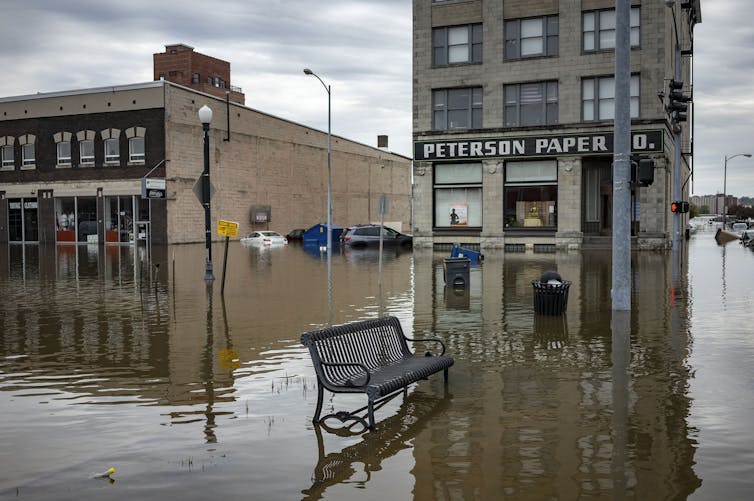
Heavy downpours and a thick snowpack in the Western mountains and Upper Midwest have put communities in several states at risk of flooding this spring – or already under water.
Flooding is the costliest type of natural disaster in the U.S., responsible for about 90% of the damage from natural disasters each year. It happens almost every day somewhere in the country.
Yet, much of the aging infrastructure meant to protect U.S. communities is in bad shape and, in some cases, failing. The American Society of Civil Engineers gave the nation’s dams, levees and stormwater infrastructure a D grade in its latest report card, in 2021.
Help is coming. Congress authorized billions of dollars for infrastructure projects under the Infrastructure Investment and Jobs Act in 2021. But there’s a problem: New infrastructure planning frequently relies on historical flood patterns for its benchmarks rather than forecasts of changing risks as the climate warms.
We study flood risks and mitigation strategies as civil and environmental engineers. As federal funding for infrastructure rolls in, communities run the risk of spending millions of dollars on systems that weren’t built to handle the flood risks ahead.
Infrastructure is failing
Much of the nation’s flood control infrastructure was designed for 20th century storms and flooding. And in many cases, stormwater systems, levees and dams are now approaching the end of their useful life, or are already well beyond it.
The nation’s river levees are 50 years old on average. Retention ponds are meant to last 20-30 years on average. Stormwater systems are also aging, and retrofits in cities like Chicago and Philadelphia are getting expensive.
Midland, Michigan, saw the risks in 2020 when heavy rainfall caused the Edenville Dam, built in 1925, to collapse. The rush of water overwhelmed a second downstream dam, creating a disaster that drained two lakes and damaged or destroyed more than 2,000 homes. The dams’ owner had lost its hydropower license for the Edenville Dam two years earlier, in part for failing to widen its spillway for safety.
Increasing damage like this has pushed federal flood insurance costs higher – more than three times higher in parts of coastal Louisiana and Florida under the Federal Emergency Management Agency’s new risk-based premiums, newly released FEMA data show. At the same time, many of the people most at risk are low-income families who can least afford the costs of recovery without help.
Old data won’t protect against future flood risk
The Infrastructure Investment and Jobs Act, the most significant U.S. infrastructure law in recent years, includes $55 billion in new spending for water infrastructure – money that is making its way to communities. But that’s barely an eighth of what the American Society of Civil Engineers estimates is needed for drinking water, wastewater and stormwater infrastructure improvements.
And another problem arises when the money arrives.
Often, new infrastructure is designed using historical data, such as past high-water marks and storm intensity, to determine future flood risk. However, climate change is moving those baselines.
Years of satellite observations have shown that, globally, both extreme wet and extreme dry conditions have increased in extent, duration and severity. A warming atmosphere can hold more moisture, leading to stronger downpours. As heavy precipitation intensifies, more frequent and severe flooding events have hit the U.S.
The Federal Emergency Management Agency currently estimates that approximately 13 million Americans – around 4% of the population – live in 100-year flood zones, meaning the area has at least a 1% chance of flooding in a given year. But FEMA’s maps often overlook smaller streams that frequently run through heavily populated areas.
Federal flood maps also take years to update. Many still rely on decades-old data and fail to consider the rising risks from climate change. That can lead to complacency for community leaders and residents – until it’s too late.
There are alternatives that communities can use to help align their planning with a more likely future.
Researchers working with the nonprofit First Street Foundation developed some of the first U.S. flood maps that account for future flood risk at the local level. They estimate that climate change alone will increase flood damage in the U.S. by 26% by 2050 and expand into areas that rarely saw severe flooding in the past. With people continuing to build in high-risk areas, the costs and number of people at risk rise even higher.
What can communities do?
Protecting communities starts with changing the status quo, including incorporating climate change into infrastructure planning and developing innovative policies for better flood management.
Stopping construction of new homes in flood-prone areas can help avoid future damage and the need for expensive infrastructure, though political pressure and housing shortages can make these measures difficult.
Buyouts of flood-prone homes to prevent rebuilding are expensive and slow, but they have been used in over 1,100 counties in almost every state to avoid repeated flooding. In some cases, moving away from coastlines and riversides is the only option. Known as managed retreat, it is gaining interest, particularly in communities at risk from sea level rise, but it’s also controversial. Success largely depends on whether the effort is community-led.
Nature-based solutions, such as bioswales, wetlands and rain gardens, can be relatively affordable methods to help capture and absorb rainwater, reducing the amount of runoff that flows into rivers and exacerbates flooding.
But for many communities to remain unchanged, building and maintaining large-scale infrastructure will be necessary. Designing structures like levees or seawalls so they can be expanded or raised in the future is one strategy that can ultimately save money.
Innovative and sustainable funding mechanisms will likely be needed to support flood resilience efforts. One option is establishing local dedicated funds to finance flood resilience initiatives, supported by government grants, private donations and small local taxes. Managed well, these funds could invest in long-term solutions and sustainable land practices that can reduce the frequency and severity of flooding.
Many communities are making an effort, often pushed by residents lobbying officials to prioritize flood initiatives and investments designed to stand up to the future. Changes won’t happen overnight, but taking proactive measures and supporting innovative solutions will benefit communities in the long run and is the fiscally responsible thing to do.
Antonio Arenas Amado, Assistant Professor of Civil, Construction and Environmental Engineering, Iowa State University and Lu Liu, Assistant Professor of Civil, Construction and Environmental Engineering, Iowa State University
This article is republished from The Conversation under a Creative Commons license. Read the original article.
LAKE COUNTY, Calif. — For decades Clear Lake has been a popular spot for “flying boats” and seaplanes, and this fall the Museums of Lake County will feature an exhibit on that slice of aviation history.
In the video above, discover the fascinating history of flying boats on Clear Lake with museum curator Clark McAbee, a former brown shoe Airedale in Naval Aviation.
McAbee also offers a sneak peek into the upcoming fall exhibit, “Wings over Water — An Aviation History of Lake County.”
For more information, visit the Museums of Lake County website.
Dogs available for adoption this week include mixes of American bulldog, Anatolian shepherd, border collie, German shepherd, husky, pit bull, plott hound and terrier.
Dogs that are adopted from Lake County Animal Care and Control are either neutered or spayed, microchipped and, if old enough, given a rabies shot and county license before being released to their new owner. License fees do not apply to residents of the cities of Lakeport or Clearlake.
The following dogs at the Lake County Animal Care and Control shelter have been cleared for adoption.
Call Lake County Animal Care and Control at 707-263-0278 or visit the shelter online for information on visiting or adopting.

‘Sparkles’
“Sparkles” is a 6-year-old female terrier with a short black and tan coat.
She is in kennel No. 2, ID No. LCAC-A-5116.

‘Max’
“Max” is a 7-month-old male terrier mix with a short black coat.
He is in kennel No. 5, ID No. LCAC-A-4248.

Male pit bull
This 1-year-old male pit bull has a short tan coat.
He is in kennel No. 8, ID No. LCAC-A-5120.

‘Tux’
“Tux” is a 2-year-old male border collie-shepherd mix has a long black coat.
He is in kennel No. 9, ID No. LCAC-A-5012.

Male Anatolian shepherd
This one and a half year old male Anatolian shepherd has a tan and black coat.
He is in kennel No. 12, ID No. LCAC-A-5036.

Female pit bull-shepherd puppy
This 5-month-old female pit bull-shepherd puppy has a short black and tan coat.
She is in kennel No. 13, ID No. LCAC-A-5071.

‘Kyle Barkson’
“Kyle Barkson” is a 5 and a half year old male pit bull with a black and white coat.
He is in kennel No. 15, ID No. LCAC-A-5039.

Male German shepherd
This 9-month-old male German shepherd has a short black and tan coat.
He is in kennel No. 17, ID No. LCAC-A-5054.

Male plott hound
This 2-year-old male plott hound has a short brown coat.
He is in kennel No. 18, ID No. LCAC-A-5143.

Male American bulldog
This 4-year-old male American bulldog has a gray and white coat.
He is in kennel No. 19, ID No. LCAC-A-5204.

‘Pluto’
“Pluto” is a 2-year-old male pit bull terrier-hound mix with a short brown coat.
He is in kennel No. 20, ID No. LCAC-A-5052.

Male pit bull terrier
This 3-year-old male pit bull terrier has a short black and white coat.
He is in kennel No. 21, ID No. LCAC-A-5076.

Male shepherd
This 2-year-old male shepherd has a tan and white coat.
He is in kennel No. 22, ID No. LCAC-A-5223.

Male terrier
This 1-year-old male terrier mix has a short brown coat.
He is in kennel No. 23, ID No. LCAC-A-5110.

Male terrier
This 1-year-old male terrier has a short tan coat.
He is in kennel No. 24, ID No. LCAC-A-5111.

Male pit bull terrier
This 1-year-old male pit bull terrier has a black coat with white markings.
He is in kennel No. 27, ID No. LCAC-A-5203.

‘Max’
“Max” is a 13-year-old male terrier with a long white coat.
He is in kennel No. 28, ID No. LCAC-A-5115.

Male husky-shepherd
This 2-year-old male husky-shepherd has a tricolor coat.
He is in kennel No. 30, ID No. LCAC-A-5210.

Female pit bull-shepherd puppy
This 5-month-old female pit bull-shepherd puppy has a short tricolor coat.
She is in kennel No. 32, ID No. LCAC-A-5072.
Email Elizabeth Larson at