 How to resolve AdBlock issue?
News
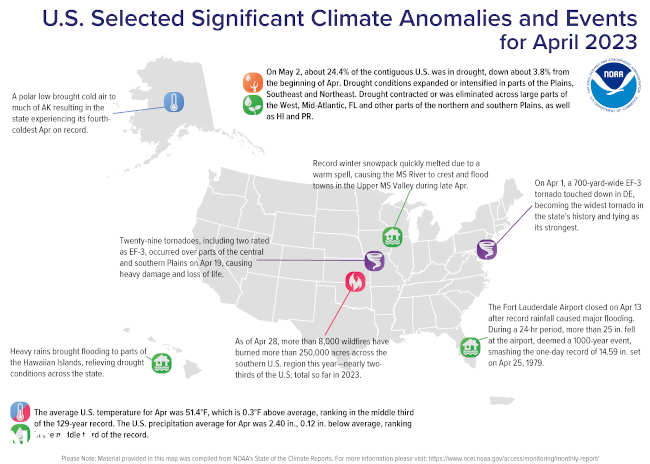
So far, 2023 stands out for the remarkable warmth that covered many parts of the U.S., with some states seeing their warmest January–April period on record.
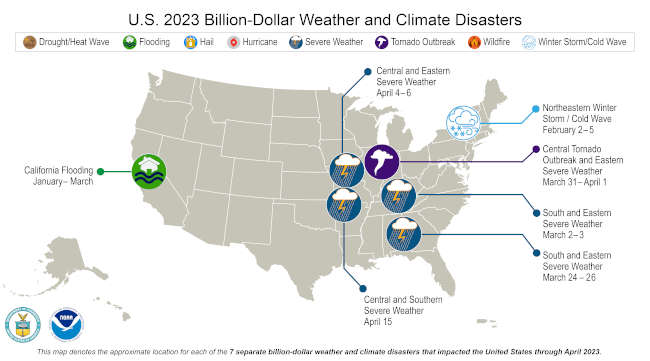
The first four months of the year have also been marked by seven separate billion-dollar disasters that have struck the nation, according to scientists from NOAA’s National Centers for Environmental Information.
Below are more takeaways from NOAA’s latest monthly U.S. climate report:
Climate by the numbers
April 2023
The average April temperature across the contiguous U.S. was 51.4 degrees F (0.3 of a degree above the 20th-century average), ranking the month in the middle third of the 129-year climate record.
Maryland and Delaware ranked second warmest on record for April while New Jersey ranked third warmest on record. Connecticut, Florida, Massachusetts, New Hampshire, New York, Pennsylvania, Rhode Island, Vermont and Virginia each saw their top-10 warmest Aprils on record.
Conversely, below-average temperatures covered the Northwest to the central Rockies and northern Plains, and parts of the southern Plains. North Dakota ranked 10th coldest on record for the month.
The average precipitation for the month was 2.40 inches — 0.12 of an inch below average, which places the month in the middle third of the historical record.
Arizona, Missouri, Nebraska and New Mexico saw their third-to-sixth driest Aprils on record, respectively. Meanwhile, Delaware ranked seventh wettest, North Carolina eighth wettest and New Jersey saw its 10th-wettest April on record.
Year to date | January through April 2023
The average U.S. temperature for the year to date (YTD) was 40.9 degrees F (1.8 degrees above average), ranking in the warmest third of the climate record.
Delaware, Florida, Maryland, New Jersey, North Carolina, Pennsylvania and Virginia each had their warmest January–April YTD on record. Connecticut, Massachusetts, New Hampshire, New York, Rhode Island, South Carolina and West Virginia each had their second-warmest such YTD, while 14 additional states ranked among their warmest 10 January-to-April periods on record.
The average precipitation for the first four months of 2023 was 10.22 inches (0.74 of an inch above normal), ranking in the wettest third of the January–April record.
Wisconsin saw its wettest such YTD on record, while Michigan ranked fourth wettest and Utah ranked seventh wettest. On the dry side, Maryland ranked 13th driest on record for this four-month period.
Other notable climate events in this report
Seven separate billion-dollar disasters struck this year: Through the end of April 2023, the U.S. was struck with seven separate weather and climate disasters, each with losses exceeding $1 billion, including:
• Five severe weather events.
• A Northeastern winter storm/cold wave.
• A California flooding event.
The total cost of these events exceeds $19 billion and resulted in 97 direct and indirect fatalities. The number of billion dollar disasters so far in 2023 is significant. Only 2017 and 2020 had more during this timeframe, with eight separate disasters recorded in the January-April period.
An active severe weather month: Several notable weather systems produced severe thunderstorms and a number of tornadoes that impacted portions of the U.S. in April 2023:
• April 1: A 700-yard-wide EF-3 tornado that touched down in Delaware was the widest tornado in the state's history. The same tornado was equal in strength to one that struck Delaware on April 28, 1961 — the strongest tornadoes recorded in the state.
• April 19: A tornado outbreak occurred across areas of the southern and central Plains. A total of 29 tornadoes, including two EF-3 tornadoes, was confirmed by the National Weather Service, causing heavy damage and loss of life.
• April 30: A state of emergency was declared after a rare EF-3 tornado touched down in Virginia Beach, destroying more than 100 structures.
Parts of Florida inundated with flooding: In less than a 24-hour period, more than 25 inches of rain fell at the Fort Lauderdale Airport on April 13. The event, deemed a 1,000-year event by the National Weather Service, smashed the previous one-day record of 14.59 inches of rain set on April 25, 1979.

The World Health Organization declared on May 5, 2023, that the COVID-19 pandemic is no longer a public health emergency. Although the virus is still causing hospitalizations and deaths, many travelers who were reluctant to go abroad because of the pandemic now feel freer to travel internationally again.
That’s going to be a whole lot easier to do this summer if you already have a valid passport. The wait times for getting one are soaring. The State Department says it can take up to 13 weeks for it to process passport applications, and up to nine weeks for expedited service that requires the payment of extra fees. It’s getting about 500,000 passport applications a week, which is at least 30% more than last year, Secretary of State Antony Blinken said in March. And delays in processing were already aggravating in 2021 and 2022.
I’m among the many Americans who have had to cancel or delay trips because of the long wait times. I was hoping to fly to London for a weeklong break between teaching economics courses. Unfortunately, renewing my passport took so long I couldn’t go.
The government says staffing issues are contributing to the delays. As an economist who researches the everyday experiences of consumers, I wondered if there was more to the story, since international travel is a big business. U.S. residents spent around US$17 billion in just the month of March 2023 going abroad.
Origin of passports
Passports have been around a long time. They became more widespread about four centuries ago during the reign of the French King Louis the XIV. The king gave people with royal connections letters asking foreign officials to let the traveler “passe port” – French for pass through – the port or border of another country safely.
You can find a similar statement in the front of every U.S. passport, which “requests all whom it may concern to permit the citizen/national of the United States named herein to pass without delay or hindrance.”
One reason for the passport bottleneck in the United States is a long-term increase in demand for those official blue booklets. Back in 1989, there were three valid passports for every 100 people in this country. Today there are more than 45 passports for every 100 Americans. More recently, many Americans who let their passports expire because they were avoiding international travel when the pandemic began are eager to travel again.
Changes after 2000
The U.S. population has increased about 1% each year over the past three decades. During that same period the number of people holding a valid passport has jumped an average of 10% each year, 10 times faster than population growth.
Part of the rising demand for passports followed a policy change in the early 2000s. Before then no passport was required for U.S. citizens to travel to Canada, Mexico or the Caribbean. A driver’s license or an official document like a birth certificate was suitable documentation to visit countries that shared a common border with the U.S. By 2009, however, a passport was needed to visit those nearby countries by air, land or sea.
But the new rules don’t fully account for the surge in passport issuance. In 2010, about 100 million people had valid U.S. passports. Today, over 150 million do.
Lost, stolen and damaged passports
Another reason for the passport boom is that the State Department is fielding more requests than before for reissued passports to replace lost or stolen documents.
One problem while traveling is keeping your passport safe. While so far no one has ever stolen my passport, I have spilled food on it while climbing mountains, gotten it soaked in a monsoon and crushed it in my luggage on the world’s longest flight.
If your passport is ever lost, destroyed or stolen, you need to file a DS-64 form with the State Department. Filing this form prevents a thief from using that passport. The data is not just kept in the U.S. but is also sent to Interpol’s Stolen/Lost Travel Document database, which prevents worldwide travel by someone posing as you when traveling with your stolen passport.
The government periodically releases the number of DS-64 forms filed. In 2005 a bit more than 100,000 were submitted. This jumped fivefold to over 500,000 people who reported losing their passports in 2021.
Who gets passports?
Where do passport applications come from?
Not surprisingly, states with more people tend to get more passports. For example, Californians got the highest number of passports, about 2.7 million, in 2022.
But some states have more wanderlust than others. After adjusting for population, over the past few years the top two sources for international travel are the high-income states of New Jersey and Massachusetts. Around 1 out every 17 residents in those places applied annually for a passport.
The states where residents are the least likely to apply for a passport are the low-income states of Mississippi and West Virginia. In those places only about 1 out every 65 residents applied on average each year.
What can be done?
One of the reasons passport processing times have gotten so long is that many people are taking trips they put off in the spring of 2020. What can be done?
I suggest two things.
First, the Caribbean is one of the most popular U.S. tourist destinations. U.S. travelers today can visit the U.S. Virgin Islands and Puerto Rico without a passport because they are U.S. territories. I believe that expanding this access to a small number of Caribbean countries, as was possible before the 2009 policy change, would boost tourism and reduce passport demand.
Second, citizens with a current passport should be able to use it while waiting for a renewal. Right now old passports must be submitted with renewal forms, which blocks international travel. The State Department doesn’t really need the old documents. It recently ran a trial allowing people to renew passports online without asking for their current passport books.
Once a new passport is issued, the old one becomes invalid. This could present a problem for people traveling abroad while their passport renews. There is a simple solution for this. At the beginning of the COVID-19 pandemic the State Department allowed U.S. citizens who were abroad when their passports expired to reenter the country.
Extending this policy would mean people could continue traveling no matter how long it takes to renew their passport.
Jay L. Zagorsky, Clinical Associate Professor of Markets, Public Policy and Law, Boston University
This article is republished from The Conversation under a Creative Commons license. Read the original article.

New images taken by NASA’s Perseverance rover may show signs of what was once a rollicking river on Mars, one that was deeper and faster-moving than scientists have ever seen evidence for in the past.
The river was part of a network of waterways that flowed into Jezero Crater, the area the rover has been exploring since landing more than two years ago.
Understanding these watery environments could help scientists in their efforts to seek out signs of ancient microbial life that may have been preserved in Martian rock.
Perseverance is exploring the top of a fan-shaped pile of sedimentary rock that stands 820 feet (250 meters) tall and features curving layers suggestive of flowing water. One question scientists want to answer is whether that water flowed in relatively shallow streams – closer to what NASA’s Curiosity rover has found evidence of in Gale Crater – or a more powerful river system.
Stitched together from hundreds of images captured by Perseverance’s Mastcam-Z instrument, two new mosaics suggest the latter, revealing important clues: coarse sediment grains and cobbles.
“Those indicate a high-energy river that’s truckin’ and carrying a lot of debris. The more powerful the flow of water, the more easily it’s able to move larger pieces of material,” said Libby Ives, a postdoctoral researcher at NASA’s Jet Propulsion Laboratory in Southern California, which operates the Perseverance rover. With a background in studying Earth-based rivers, Ives has spent the last six months analyzing images of the Red Planet’s surface. “It’s been a delight to look at rocks on another planet and see processes that are so familiar,” Ives said.
Following the curves
Years ago, scientists noticed a series of curving bands of layered rock within Jezero Crater that they dubbed “the curvilinear unit.” They could see these layers from space but are finally able to see them up close, thanks to Perseverance.
One location within the curvilinear unit, nicknamed “Skrinkle Haven,” is captured in one of the new Mastcam-Z mosaics. Scientists are sure the curved layers here were formed by powerfully flowing water, but Mastcam-Z’s detailed shots have left them debating what kind: a river such as the Mississippi, which winds snakelike across the landscape, or a braided river like Nebraska’s Platte, which forms small islands of sediment called sandbars.
When viewed from the ground, the curved layers appear arranged in rows that ripple out across the landscape. They could be the remnants of a river’s banks that shifted over time – or the remnants of sandbars that formed in the river. The layers were likely much taller in the past. Scientists suspect that after these piles of sediment turned to rock, they were sandblasted by wind over the eons and carved down to their present size.
“The wind has acted like a scalpel that has cut the tops off these deposits,” said Michael Lamb of Caltech, a river specialist and Perseverance science team collaborator. “We do see deposits like this on Earth, but they’re never as well exposed as they are here on Mars. Earth is covered in vegetation that hides these layers.”
A second mosaic captured by Perseverance shows a separate location that is part of the curvilinear unit and about a quarter mile (450 meters) from Skrinkle Haven. “Pinestand” is an isolated hill bearing sedimentary layers that curve skyward, some as high as 66 feet (20 meters). Scientists think these tall layers may also have been formed by a powerful river, although they’re exploring other explanations, as well.
“These layers are anomalously tall for rivers on Earth,” Ives said. “But at the same time, the most common way to create these kinds of landforms would be a river.”
The team is continuing to study Mastcam-Z’s images for additional clues. They’re also peering below the surface, using the ground-penetrating radar instrument on Perseverance called RIMFAX (short for Radar Imager for Mars’ Subsurface Experiment). What they learn from both instruments will contribute to an ever-expanding body of knowledge about Mars’ ancient, watery past.
“What’s exciting here is we’ve entered a new phase of Jezero’s history. And it’s the first time we’re seeing environments like this on Mars,” said Perseverance’s deputy project scientist, Katie Stack Morgan of JPL. “We’re thinking about rivers on a different scale than we have before.”
More about the mission
A key objective for Perseverance’s mission on Mars is astrobiology, including the search for signs of ancient microbial life. The rover will characterize the planet’s geology and past climate, pave the way for human exploration of the Red Planet, and be the first mission to collect and cache Martian rock and regolith (broken rock and dust).
Subsequent NASA missions, in cooperation with ESA (European Space Agency), would send spacecraft to Mars to collect these sealed samples from the surface and return them to Earth for in-depth analysis.
The Mars 2020 Perseverance mission is part of NASA’s Moon to Mars exploration approach, which includes Artemis missions to the Moon that will help prepare for human exploration of the Red Planet.
JPL, which is managed for NASA by Caltech in Pasadena, California, built and manages operations of the Perseverance rover.
For more about Perseverance, visit www.mars.nasa.gov/mars2020/.

Lake County OES is seeking to receive the comments on or before May 26 at 5 p.m.
Minor edits may be made, and some data is being finalized before incorporation of public comment and final submission to Cal OES in June.
Please submit all comments by email to
The plan update began in September 2022, when the Board of Supervisors established a Hazard Mitigation Planning Committee, chaired by Lake County OES and comprised of county and local stakeholders including one member from each supervisorial district.
Information from each meeting and session is available online at www.lakesheriff.com/about/oes/hmp.
Lake County OES facilitated the plan update and engaged county departments and stakeholders (referred to as the working group) to complete each section of the plan update.
This is the second draft release to request public comment.
Public participation is encouraged.
To view the working draft, visit www.lakesheriff.com/about/OES/HMP.
Additional opportunities for information and feedback are available several ways:
• Follow www.facebook.com/lakecountyOES for ongoing public information and education regarding hazard mitigation and all things emergency management.
• Visit any Lake County Library branch to review hard copies of all planning components during the planning process.
• Visit www.lakesheriff.com/about/OES/HMP to learn more about hazard mitigation, the planning process and progress, upcoming events and more.
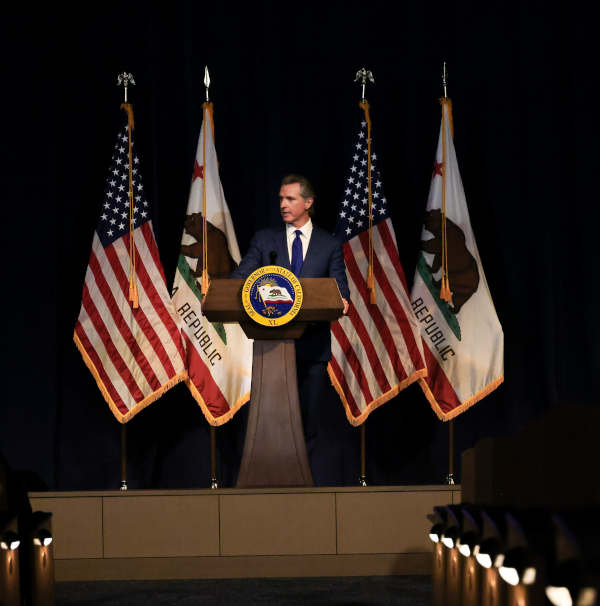
Gov. Gavin Newsom on Friday released his May Revision proposal, a balanced budget plan that his office said maintains critical investments to address California’s biggest challenges while preparing for continued economic uncertainty due to global economic issues.
The governor’s budget closes a projected $32 billion budget shortfall while protecting key investments in the issues that matter most to Californians, including education, health care, housing and homelessness, public safety and climate action.
Following two years of unprecedented growth, revenues have fallen short of monthly estimates since the 2022 Budget Act was enacted last June.
California has planned for this potential shortfall, with the governor and Legislature paying down the state’s prior debts, building unprecedented reserves and prioritizing one-time investments.
“In partnership with the Legislature, we have made deep investments in California and its future — transformative efforts that will benefit generations of Californians, and that this budget will continue to guide as we navigate near-term ups and downs in revenue,” said Gov. Newsom. “As we prepare for more risk and uncertainties ahead, it’s critical that we keep the state on a solid fiscal footing to protect Californians and our progress in remaking the future of our state.”
Senate Majority Leader Mike McGuire, who represents Lake County in the State Senate, called the revised budget “a commonsense approach” that focuses on the state’s current fiscal challenges by limiting and reducing spending, strengthening reserves and paying down pension liabilities.
“And, we can’t stop investing in the programs and priorities that will strengthen the lives of Californians in every corner of this state. This includes funding as promised to combat our homelessness crisis, build thousands of workforce affordable housing units, tackle our climate crisis and make communities more wildfire safe and record dollars for our kids and public schools,” said Sen. McGuire.
With unprecedented investments over the past two state budgets, in addition to federal funding targeting infrastructure and inflation reduction, California will invest more than $180 billion over the next several years in clean energy, roads, bridges, public transit, water storage and conveyance and expanded broadband service.
These investments will create hundreds of thousands of new jobs while building the infrastructure to make our state better connected, safer and more prepared for our future.
While the May Revision does not forecast a recession, it recognizes increased risks to the budget since January that could significantly change the state’s fiscal trajectory in the near term.
Taking this into account, the plan reflects $37.2 billion in total budgetary reserves, including $22.3 billion in the Budget Stabilization Account.
In addition to addressing the budget shortfall, the May Revision maintains investments in key priorities for Californians.
This includes:
PROTECTING HEALTH CARE ACCESS. Following Gov. Newsom’s actions to expand health care access and reduce costs, the May Revision maintains billions to continue implementing these measures — programs like CalAIM to transform Medi-Cal, extending health care to low-income Californians of all ages regardless of immigration status, making insulin more affordable through CalRx, and more.
TACKLING HOMELESSNESS. Gov. Newsom has invested $15.3 billion to address homelessness — up from $500 million when he took office and more than ever before in state history. The May Revision maintains billions of dollars for aid to local governments, encampment resolution grants, and more. With this funding will come new accountability — no more status quo.
INCREASING HOUSING SUPPLY. In the last four years, California invested more to increase housing supply than ever before in state history while holding local governments accountable. The state continues to deploy a comprehensive set of strategies — improving state financing, targeting housing investments, providing technical assistance, eliminating regulations, and leveraging land use tools. The state adopted a legally binding goal that local governments must plan to build approximately 2.5 million new units by 2030, and 1 million of these units must be affordable.
CALIFORNIA’S CLIMATE COMMITMENT. California is advancing a $48 billion multiyear commitment to implement its world-leading agenda to achieve carbon neutrality by 2045, protect communities from harmful oil drilling, deliver 90% clean electricity by 2035, and more. It also proposes the development of a Climate Resilience Bond to increase and sustain investments in our climate initiatives.
KEEPING CALIFORNIANS SAFE. The May Revision sustains over $800 million in record-level public safety investments, including supports for victims’ services, officer wellness and training, nonprofit security grants, efforts to combat fentanyl, and more.
UNIVERSAL TRANSITIONAL KINDERGARTEN. The May Revision continues to fully fund the first and second years of expanded eligibility for TK, creating a whole new grade.
FREE MEALS FOR EVERY STUDENT. California is investing $1.6 billion for all students, regardless of income, to access two free school meals per day — up to 12 million meals per day statewide.
Additional details on the May Revision can be found at www.ebudget.ca.gov.
In California, people often transfer their real properties and other assets to their living trust to avoid court administered proceedings later-on when they are unable to manage the trust assets due to incapacity or death, such as conservatorships and probates).
That is, when the settlor is no longer able to serve as trustee then a successor trustee steps-in and administers the trust without court involvement.
The death beneficiaries may at that time become anxious and ask, what, if any, rights do we future beneficiaries now have? Are we now entitled to receive a copy of the trust, accountings, and information about trust assets and liabilities?
In California, while a trust is revocable, a trustee owes the fiduciary (legal) duties to account and to provide information regarding the trust to the settlor who established the trust (Probate Code sections 15800(a) and 16069).
The settlor of a trust is treated the same as the owner of the trust assets because the settlor can revoke the trust so long as he is competent to revoke the trust.
Until the settlor dies, the future death beneficiaries named by the settlor in the trust have only a mere expectancy of a possible future inheritance. Thus, generally, the trustee owes all duties to the settlor while the settlor is alive and is competent.
Nonetheless, recent California case law recognizes that when a settlor is incompetent that the death beneficiaries have standing to receive trust accountings and information about the trust and its administration and that a beneficiary has standing to contest a revocable trust if the beneficiary proves or could have proved the settlor's incompetence (Drake v. Pinkham (Cal.App.4th 400 (2013)).
After the death of the settlor, the death beneficiaries can also hold the trustee accountable for the trust being properly administered while the settlor was incompetent, but only to the extent that an wrongdoing reduced what they inherited at the settlor’s death (Estate of Giraldin, 55 Cal.4th 1058 (2012).
In 2022, California clarified and made explicit the rights of trust death beneficiaries prior to a settlor’s death, by amending section 15800 of the Probate Code (in response to case law) to provide that the incompetency of a settlor means that the trustee owes certain trustee duties to death beneficiaries: When no person who can revoke the trust, in whole or in part, is competent then the trustee provide future beneficiaries — i.e., the persons whom the trustee would then be required, or authorized, to make distributions if the settlor were then deceased — with notice and a copy of the trust (within 60 days of receiving information as to the settlor’s incompetence), annual accounting(s), and, upon request by a future beneficiary, information about trust assets, liabilities and the administration (Probate Code section 15800 (b).
Whether a trustee owes a future beneficiary such duties under section 15800 depends on whether the beneficiary has a vested interest (due to the settlor’s capacity) or has a contingent (unvested) interest.
The trustee has discretion whether to notify beneficiaries whose interest are not yet vested, “… due to the interest being conditioned on some factor not yet in existence or not yet determinable …” (Probate Code section 15800(b)(4).
For example, alternative death beneficiaries who would inherit if an intended death beneficiary predeceased the settlor do not yet have a vested interest if the intended beneficiary is alive (e.g., the settlor’s grandchildren who would take in place of a still living child if the child later predeceased the still living settlor).
Whether a settlor is incompetent to trigger these rights under section 15800 is determined either using a method provided in the trust document or a court determination of incompetency.
A trust might, for example, say that a settlor is incompetent to revoke the trust when a licensed physician issues a written statement to the effect that the settlor does not have sufficient capacity to amend the trust. Otherwise, a court petition to determine capacity may be necessary.
The foregoing is not legal advice. For legal guidance consult a qualified attorney.
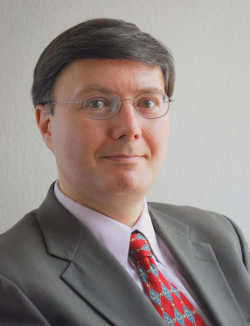
Dennis A. Fordham, attorney, is a State Bar-Certified Specialist in estate planning, probate and trust law. His office is at 870 S. Main St., Lakeport, Calif. He can be reached at