 How to resolve AdBlock issue?
News

LAKEPORT, Calif. — The city of Lakeport said thousands of pounds of garbage were cleaned up during the Spring 2023 Community Cleanup Day.
The city and its Lakeport Public Works Department expressed appreciation and thanks to all who participated in the event, which took place on Saturday, April 29.
Lakeport Disposal reported a solid turnout of City of Lakeport residents who were appreciative of the opportunity to dispose of unwanted junk and trash at no cost.
More than 10,000 pounds of unwanted materials were collected at the event last weekend.
Lakeport Disposal reported the following statistics, in pounds, for the cleanup:
• Household trash: 9,380.
• Appliances: 185.
• Electronics: 920.
• Mixed recyclables: 120.
• Diversion total: 1,225.
The city offered a special thanks to Lakeport Disposal Inc. and its staff for coordinating a safe and well-organized event and for collecting tons of trash, recyclables and other solid waste materials.
The Lakeport Community Cleanup Day began in 2017 and is a semi-annual event intended to help keep the community clean and beautiful and to promote recycling opportunities.
Participation is limited to city of Lakeport residents.
Since the event began, more than 15,000 pounds of recyclable materials have been diverted from disposal in Lake County’s landfill.
The event is sponsored by the city of Lakeport and Lakeport Disposal Inc., the city’s contracted waste hauler and service provider.
Look for the next city of Lakeport Community Cleanup Day in the fall.
Dogs available for adoption this week include mixes of Anatolian shepherd, border collie, German shepherd, pit bull, plott hound, schnauzer, standard poodle and terrier.
Dogs that are adopted from Lake County Animal Care and Control are either neutered or spayed, microchipped and, if old enough, given a rabies shot and county license before being released to their new owner. License fees do not apply to residents of the cities of Lakeport or Clearlake.
The following dogs at the Lake County Animal Care and Control shelter have been cleared for adoption.
Call Lake County Animal Care and Control at 707-263-0278 or visit the shelter online for information on visiting or adopting.

‘Sparkles’
“Sparkles” is a 6-year-old female terrier with a short black and tan coat.
She is in kennel No. 2, ID No. LCAC-A-5116.

‘Max’
“Max” is a 7-month-old male terrier mix with a short black coat.
He is in kennel No. 5, ID No. LCAC-A-4248.

Male pit bull
This 1-year-old male pit bull has a short tan coat.
He is in kennel No. 8, ID No. LCAC-A-5120.
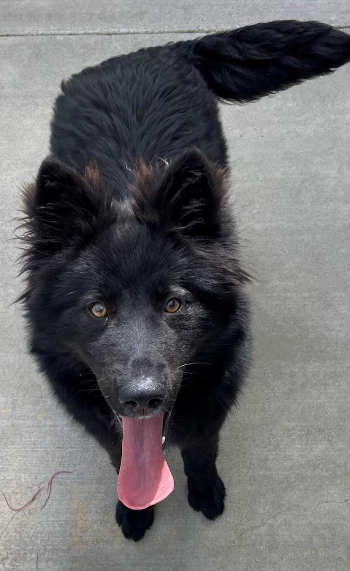
‘Tux’
“Tux” is a 2-year-old male border collie-shepherd mix has a long black coat.
He is in kennel No. 9, ID No. LCAC-A-5012.

Male Anatolian shepherd
This one and a half year old male Anatolian shepherd has a tan and black coat.
He is in kennel No. 12, ID No. LCAC-A-5036.

Female pit bull-shepherd puppy
This 5-month-old female pit bull-shepherd puppy has a short black and tan coat.
She is in kennel No. 13, ID No. LCAC-A-5071.

Female shepherd
This 1-year-old female shepherd has a short tan coat.
She is in kennel No. 14, ID No. LCAC-A-5113.

‘Kyle Barkson’
“Kyle Barkson” is a 5 and a half year old male pit bull with a black and white coat.
He is in kennel No. 15, ID No. LCAC-A-5039.

Male German shepherd
This 9-month-old male German shepherd has a short black and tan coat.
He is in kennel No. 17, ID No. LCAC-A-5054.
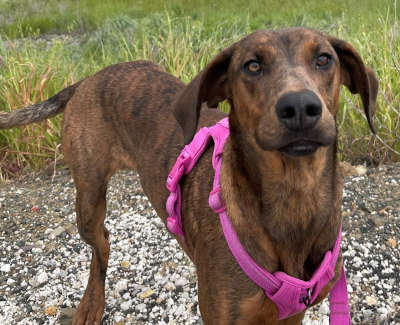
Male plott hound
This 2-year-old male plott hound has a short brown coat.
He is in kennel No. 18, ID No. LCAC-A-5143.

‘Pluto’
“Pluto” is a 2-year-old male pit bull terrier-hound mix with a short brown coat.
He is in kennel No. 20, ID No. LCAC-A-5052.

Male pit bull terrier
This 3-year-old male pit bull terrier has a short black and white coat.
He is in kennel No. 21, ID No. LCAC-A-5076.

This 1-year-old male terrier mix has a short brown coat.
He is in kennel No. 23, ID No. LCAC-A-5110.

Male terrier
This 1-year-old male terrier has a short brown coat.
He is in kennel No. 24, ID No. LCAC-A-5111.
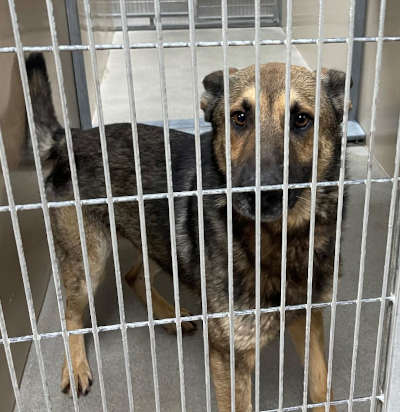
Male German shepherd
This 5 and a half year old male German shepherd has a black and tan coat.
He is in kennel No. 25, ID No. LCAC-A-4994.

‘Max’
“Max” is a 13-year-old male terrier with a long white coat.
He is in kennel No. 28, ID No. LCAC-A-5115.

Female schnauzer-standard poodle puppy
This 4-month-old female schnauzer-standard poodle puppy has a gray coat.
She is in kennel No. 31, ID No. LCAC-A-5197.

Female pit bull-shepherd puppy
This 5-month-old female pit bull-shepherd puppy has a short tricolor coat.
She is in kennel No. 32, ID No. LCAC-A-5072.

‘Slim’
“Slim” is a 1-year-old male pit bull with a short tan coat.
He is in kennel No. 33, ID No. LCAC-A-5107.
Email Elizabeth Larson at
The famous first image of a black hole just got two times sharper. A research team used artificial intelligence to dramatically improve upon its first image from 2019, which now shows the black hole at the center of the M87 galaxy as darker and bigger than the first image depicted.
I’m an astronomer who studies and has written about cosmology, black holes and exoplanets. Astronomers have been using AI for decades. In fact, in 1990, astronomers from the University of Arizona, where I am a professor, were among the first to use a type of AI called a neural network to study the shapes of galaxies.
Since then, AI has spread into every field of astronomy. As the technology has become more powerful, AI algorithms have begun helping astronomers tame massive data sets and discover new knowledge about the universe.
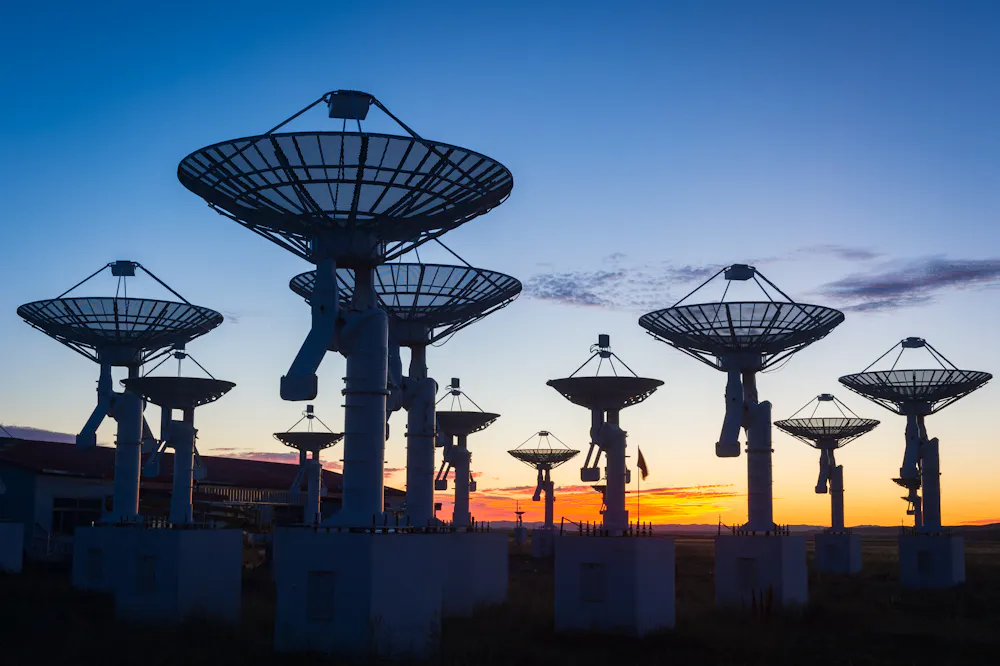
Better telescopes, more data
As long as astronomy has been a science, it has involved trying to make sense of the multitude of objects in the night sky. That was relatively simple when the only tools were the naked eye or a simple telescope, and all that could be seen were a few thousand stars and a handful of planets.
A hundred years ago, Edwin Hubble used newly built telescopes to show that the universe is filled with not just stars and clouds of gas, but countless galaxies. As telescopes have continued to improve, the sheer number of celestial objects humans can see and the amount of data astronomers need to sort through have both grown exponentially, too.
For example, the soon-to-be-completed Vera Rubin Observatory in Chile will make images so large that it would take 1,500 high-definition TV screens to view each one in its entirety. Over 10 years it is expected to generate 0.5 exabytes of data – about 50,000 times the amount of information held in all of the books contained within the Library of Congress.
There are 20 telescopes with mirrors larger than 20 feet (6 meters) in diameter. AI algorithms are the only way astronomers could ever hope to work through all of the data available to them today. There are a number of ways AI is proving useful in processing this data.

Picking out patterns
Astronomy often involves looking for needles in a haystack. About 99% of the pixels in an astronomical image contain background radiation, light from other sources or the blackness of space – only 1% have the subtle shapes of faint galaxies.
AI algorithms – in particular, neural networks that use many interconnected nodes and are able to learn to recognize patterns – are perfectly suited for picking out the patterns of galaxies. Astronomers began using neural networks to classify galaxies in the early 2010s. Now the algorithms are so effective that they can classify galaxies with an accuracy of 98%.
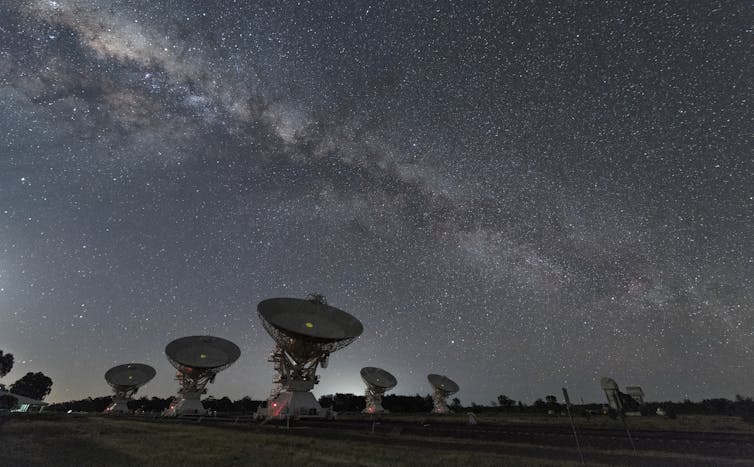
This story has been repeated in other areas of astronomy. Astronomers working on SETI, the Search for Extraterrestrial Intelligence, use radio telescopes to look for signals from distant civilizations. Early on, radio astronomers scanned charts by eye to look for anomalies that couldn’t be explained. More recently, researchers harnessed 150,000 personal computers and 1.8 million citizen scientists to look for artificial radio signals. Now, researchers are using AI to sift through reams of data much more quickly and thoroughly than people can. This has allowed SETI efforts to cover more ground while also greatly reducing the number of false positive signals.
Another example is the search for exoplanets. Astronomers discovered most of the 5,300 known exoplanets by measuring a dip in the amount of light coming from a star when a planet passes in front of it. AI tools can now pick out the signs of an exoplanet with 96% accuracy.

Making new discoveries
AI has proved itself to be excellent at identifying known objects – like galaxies or exoplanets – that astronomers tell it to look for. But it is also quite powerful at finding objects or phenomena that are theorized but have not yet been discovered in the real world.
Teams have used this approach to detect new exoplanets, learn about the ancestral stars that led to the formation and growth of the Milky Way, and predict the signatures of new types of gravitational waves.
To do this, astronomers first use AI to convert theoretical models into observational signatures – including realistic levels of noise. They then use machine learning to sharpen the ability of AI to detect the predicted phenomena.
Finally, radio astronomers have also been using AI algorithms to sift through signals that don’t correspond to known phenomena. Recently a team from South Africa found a unique object that may be a remnant of the explosive merging of two supermassive black holes. If this proves to be true, the data will allow a new test of general relativity – Albert Einstein’s description of space-time.

Making predictions and plugging holes
As in many areas of life recently, generative AI and large language models like ChatGPT are also making waves in the astronomy world.
The team that created the first image of a black hole in 2019 used a generative AI to produce its new image. To do so, it first taught an AI how to recognize black holes by feeding it simulations of many kinds of black holes. Then, the team used the AI model it had built to fill in gaps in the massive amount of data collected by the radio telescopes on the black hole M87.
Using this simulated data, the team was able to create a new image that is two times sharper than the original and is fully consistent with the predictions of general relativity.
Astronomers are also turning to AI to help tame the complexity of modern research. A team from the Harvard-Smithsonian Center for Astrophysics created a language model called astroBERT to read and organize 15 million scientific papers on astronomy. Another team, based at NASA, has even proposed using AI to prioritize astronomy projects, a process that astronomers engage in every 10 years.
As AI has progressed, it has become an essential tool for astronomers. As telescopes get better, as data sets get larger and as AIs continue to improve, it is likely that this technology will play a central role in future discoveries about the universe.
Chris Impey, University Distinguished Professor of Astronomy, University of Arizona
This article is republished from The Conversation under a Creative Commons license. Read the original article.
LAKE COUNTY, Calif. — Separate power outages were reported overnight at both ends of Clear Lake.
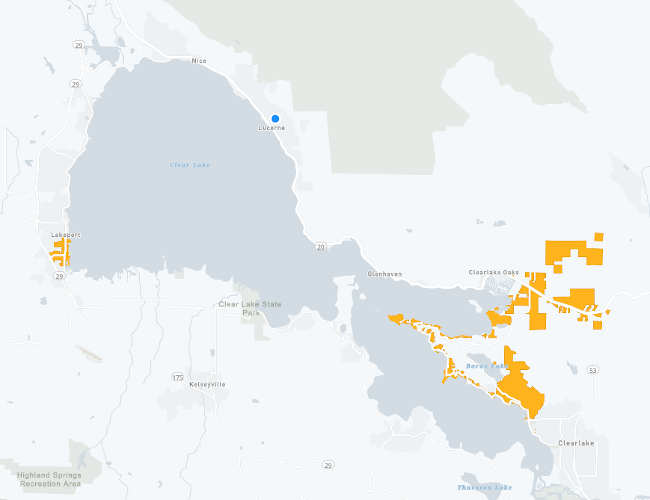
The outages, in Clearlake and Lakeport, were reported about 15 minutes apart.
At 4:16 a.m. Saturday, an outage impacting 2,833 customers in the Clearlake area was reported, according to Pacific Gas and Electric Co.
A crew was assigned to assess the outage’s cause, which wasn’t reported.
Power is expected to be restored by 8 a.m. Saturday.
Then, in Lakeport, shortly after 4:30 a.m. there were reports of multiple transformers arcing, according to radio traffic.
Fire radio traffic indicated that a large portion of the city was without power.
The problem area was narrowed down to a power pole at the corner of Armstrong and Main Streets, firefighters reported over the air.
PG&E’s outage map showed that 800 Lakeport customers were impacted.
The power in that portion of Lakeport also was originally estimated to be back on by 8 a.m. Saturday, but PG&E said it was restored by 5 a.m.
Email Elizabeth Larson at
Fish and Wildlife said Tuesday that it would not give the listing to the hitch, also known as the “chi” to Lake County’s Pomo tribes, but that a full species evaluation is underway.
That evaluation is expected to be completed in 2025. It’s possible that a listing following the regular process could follow, based upon the study’s conclusions.
“Lake County Farm Bureau believes in informed decisions made on the basis of thorough scientific research and analysis. We are confident that USFWS will continue to analyze the status of the Clear Lake hitch in order to make the most appropriate listing decision for the species by the original 2025 review period,” said Executive Director Rebecca Harper.
The Big Valley Pomo, which along with Lake County’s other tribes joined the Center for Biological Diversity and the California Fish and Game Commission in advocating for Fish and Wildlife to grant the emergency measure, voiced its disappointment in the decision.
Tribal Chair Philip Gomez said the emergency listing could have resulted in changes to water diversions that would have increased water flow in creeks during the spawning period.
Center for Biological Diversity representative Meg Townsend this week had cautioned that a listing itself doesn’t necessarily lead to saving a species.
As the species evaluation moves forward, Harper said agricultural stakeholders remain committed to voluntary actions that will improve spawning conditions for the hitch.
“Stakeholders will continue working with state and federal agencies as well as community partners to identify and implement strategies that allow us to move forward together,” Harper said.
Beginning in March, hitch began to run in large numbers in county creeks, which has appeared to be a result of this year’s high water levels.
That led to some overflow of creeks into fields in the Kelseyville area, which saw Harper and local farmers working alongside the tribes to safely move the fish to prevent them from being stranded.
“While acknowledging that one year of successful spawning will not save the species, seeing the chi in such significant numbers in our tributaries this spring has been very encouraging,” said Harper.
She added, “We hope that this successful spawning run will help to stabilize the population while ongoing in-lake and stream-based studies aim to address larger issues that may be impacting the population.”
Email Elizabeth Larson at
The group will meet from 6 to 7:30 p.m. at the Lucerne Alpine Senior Center, 3985 Country Club Drive.
The meeting can be accessed via Zoom; the meeting ID is 957 8198 0635, pass code is 491079. For one-tap mobile, dial 16699006833,,95781980635#,,,,*491079# US.
The town hall’s board members, appointed by the Board of Supervisors on May 2, are Kathy Herdman, Priest Martinez, Atlas Pearson, Austin Pratt and Becky Schwenger.
The group will have a welcoming statement in which it will announce that the Central Region Town Hall “is solely an advisory body to provide recommendations to the Board of Supervisors.”
Action items include officer selection, times and dates for meetings, and the determining of future agenda items.