 How to resolve AdBlock issue?
News
The board will meet beginning at 9 a.m. Tuesday, June 6, in the board chambers on the first floor of the Lake County Courthouse, 255 N. Forbes St., Lakeport.
The meeting can be watched live on Channel 8, online at https://countyoflake.legistar.com/Calendar.aspx and on the county’s Facebook page. Accompanying board documents, the agenda and archived board meeting videos also are available at that link.
To participate in real-time, join the Zoom meeting by clicking this link.
The meeting ID is 916 6355 7399, pass code 414368. The meeting also can be accessed via one tap mobile at +16699006833,,91663557399#,,,,*414368#.
All interested members of the public that do not have internet access or a Mediacom cable subscription are encouraged to call 669-900-6833, and enter the Zoom meeting ID and pass code information above.
At 9:10 a.m., the board will present a proclamation designating the month of June 2023 as LGBTQIA+ Pride Month in Lake County and direct staff to display the pride flag for the month of June at the Lake County Courthouse.
At 1 p.m., the board will get a presentation by the Cobb Municipal Advisory Council.
The full agenda follows.
CONSENT AGENDA
5.1: Adopt proclamation designating the month of June 2023 as LGBTQIA+ Pride Month in Lake County.
5.2: Approve Amendment No. 3 to the agreement between county of Lake and Sierra Vista Hospital for acute inpatient psychiatric hospital services and professional services associated with acute inpatient psychiatric hospitalizations for fiscal years 2020-21, 2021-22, and 2022-23 with no change to the contract maximum and authorize the board chair to sign.
5.3: Approve agreement between county of Lake and the California Mental Health Services Authority for remote clinical supervision services in the amount of $50,000.00 for FYs 2023-24 and 2024-25 and authorize the board chair to sign.
5.4: a) Adopt resolution of the Board of Supervisors of the county of Lake in support of the CSAC “At Home” Plan; and b) approve letter of support of the At Home Plan that Includes a comprehensive approach to effectively and equitability addressing homelessness in California and authorize the chair to sign.
5.5: Approve request of Child Support Services director to participate in the 9/80 alternative work schedule.
5.6: Approve request to hire welfare fraud investigator Victor Rico at advanced step five.
5.7: Approve Amendment No. 1 to the facility space license agreement with T-Mobile West LLC for continued occupancy of space on the courthouse roof, and authorize the chair to sign.
5.8: Approve to waive the 900 hour extra help limit for staff in the sheriff’s department.
5.9: Approve budget transfers from the Sheriff/Coroner budget 2201 to both the Sheriff/Dispatch budget 2202 and the Sheriff/Jail budget 2301.
5.10: Authorize the closure of all Social Services facilities for staff enrichment, appreciation and team building on Thursday, June 22, from the hours of 10 a.m. to 5 p.m.
5.11: Approve contract between county of Lake and Lake County Pumpers for septic services, in the amount of $49,000.00 per fiscal year from April 1, 2023, to June 30, 2024, and authorize the chair to sign.
5.12: a) Waive the formal bidding process pursuant to County Ordinance 3109 Section 2-38 due to 38.2(3), not in the public interest as competitive bidding would produce no economic benefit to the county; and, b) approve contract to lease agreement between county of Lake and OMarshall Inc. for the property Located at 16170 Main Street in Lower Lake, in the amount of $85,836 per fiscal year from July 1, 2023, to June 30, 2024, and authorize the chair to sign.
5.13: a) Waive the formal bidding process pursuant to County Ordinance 3109 Section 2-38 due to 38.2(3), not in the public interest as competitive bidding would produce no economic benefit to the county; and, b) approve second amendment to lease agreement between county of Lake and Charles Sawyer and Nancy Sawyer for the property located at 9055 Highway 53 in Lower Lake, in the amount of $140,377.68 per fiscal year from July 1, 2023, to June 30, 2024, and authorize the chair to sign.
5.14: Sitting as the Lake County Sanitation District, Board of Directors, adopt resolution revising the Fiscal Year 2022-2023 Adopted Budget of the County of Lake by canceling capital improvement reserves in the amount of $10,000 for Lands End/South Lakeport Sewer to make appropriations in Budget Unit 8351, Object Code 783.23-80 to pay for sewer treatment costs.
5.15: a) Waive the competitive bidding process, pursuant to Lake County Code Section 2-38.2, based on the unique nature of the goods; (b) approve agreement between the county of Lake and Megabyte Systems Inc. for FY 2023-24 MPTS property tax system maintenance, online business property filing license/support and the transient occupancy tax licensing/support in the amount of $224,965.00 and authorize the chair to sign; (c) approve addendum to provide tax sale maintenance/support in the amount of $25,000.00; (d) approve web services addendum to the agreement between the county of Lake and Megabyte Systems Inc. for FY 2023-24 online tax bills and e-payment processing services, in the amount of $6,463.00 and authorize the chair to sign.
5.16: a) Waive the competitive bidding process, pursuant to Lake County Code Section 2-38.2, based on the unique nature of the goods; (b) approve agreement for payment processing professional services between county of Lake and RT Lawrence Corp; and authorize the chair to sign.
5.17: a) Waive the Formal Bidding Process Pursuant to Lake County Code Section 2-38.2 as competitive bidding would produce no economic benefit to the county; (b) approve agreement between county of Lake and GC Services pursuant to State of California Master Agreement 2018-14, and authorize the chair to sign.
TIMED ITEMS
6.2, 9:07 a.m.: Pet of the Week.
6.3, 9:08 a.m.: New and noteworthy at the Library.
6.4, 9:10 a.m.: a) Presentation of proclamation designating the month of June 2023 as LGBTQIA+ Pride Month in Lake County; and (b) direction to staff to display the pride flag for the month of June at the Lake County Courthouse.
6.5, 9:15 a.m.: a) Consideration of proposed resolution authorizing Proposition 64 Public Health & Safety Grant Program Funding (Cohort 3); and (b) consideration of Agreement No. BSCC 937-22 by and between the Board of State and Community Corrections and the county of Lake in the amount of $2,996,546, for cannabis code enforcement and comprehensive “WRAP” program services, and authorize the chair to sign.
6.6, 9:30 a.m.: Consideration of Lakeport Fire Protection District letter of support for the USDA Community Facilities Technical Assistance and Training Grant Program.
6.7, 11 a.m.: Consideration of California Cannabis Authority membership compliance software.
6.8, 1 p.m.: Presentation by the Cobb Municipal Advisory Council.
UNTIMED ITEMS
7.2: Consideration of composition and activation of the Food Policy Council.
7.3: Consideration of ordinance Amending Section 2-3A.2, Compensation of the Board of Supervisors, and Section 2-3B, Trial and Grand Jurors, of Article 1, Chapter 2 of the Lake County Code.
7.4: Consideration of appointment to the North Coast Opportunities Governing Board.
7.5: Consideration of the following Advisory Board Appointment: Lower Lake Waterworks District.
CLOSED SESSION
8.1: Conference with legal counsel: Existing litigation pursuant to Gov. Code sec. 54956.9 (d)(1) – FERC Project No. 77, Potter Valley Hydroelectric Project.
8.2: Conference with legal counsel: Significant exposure to litigation pursuant to Gov. Code section 54956.9(d)(2), (e)(1) – Two potential cases.
Email Elizabeth Larson at
The council will meet at 6 p.m. Tuesday, June 6, in the council chambers at Lakeport City Hall, 225 Park St.
The agenda can be found here.
The council chambers will be open to the public for the meeting. Masks are highly encouraged where 6-foot distancing cannot be maintained.
If you cannot attend in person, and would like to speak on an agenda item, you can access the Zoom meeting remotely at this link or join by phone by calling toll-free 669-900-9128 or 346-248-7799.
The webinar ID is 973 6820 1787, access code is 477973; the audio pin will be shown after joining the webinar. Those phoning in without using the web link will be in “listen mode” only and will not be able to participate or comment.
Comments can be submitted by email to
The main item on the agenda is a budget workshop for the recommended fiscal year 2023-24 budget.
The council also will receive a report on the position summary included in the proposed 2023-24 budget and provide direction to staff as needed.
On the consent agenda — items considered noncontroversial and usually accepted as a slate on one vote — are warrants, ordinances; minutes of the regular council meeting on May 16; approval of application 2023-017, with staff recommendations, for the 2023 Fourth of July Craft Faire; approval of application 2023-018, with staff recommendations, for the 2023 Old Time
Machines Car Show; receipt and filing of the draft minutes of the MZAC special meeting of May 23, 2023.
Email Elizabeth Larson at
In this new phase of the pandemic, in which about 70% of Americans have had at least two shots of a COVID-19 vaccine, many may be tempted to ditch masks altogether. But is that the best option?
There’s a new, and fast-spreading omicron subvariant, popularly dubbed “Arcturus,” gaining traction in the U.S. It’s estimated to account for about 15% of all recent COVID-19 cases nationally, the CDC reported in May.
So, if to mask or not to mask is your question, we asked UC San Francisco’s Peter Chin-Hong, MD, an infectious disease expert, for the answer.
What’s the latest with COVID-19? Do people still need to wear masks?
Chin-Hong: If you want to protect yourself from COVID-19, the most important thing you can do is stay up-to-date with the vaccine. Research shows COVID-19 boosters are about 70% effective at preventing serious COVID-19 and hospitalization. Taking Paxlovid or other therapies like remdesivir early in the course of infection can also reduce the risk of hospitalization even if you are unvaccinated.
If you’re up-to-date on the vaccine but still wondering if you need to mask, then I’d say it depends on who you are, who you live with and the context.
When hospitalizations are high, everyone should wear a high-quality mask. But when we’re seeing medium numbers of hospitalizations, people at high risk for serious COVID-19 should mask in crowded indoor settings like public transportation and airports. This would include people who are older than 65, immunocompromised, unvaccinated or not up-to-date on their booster shots. At low levels of hospitalizations, people can choose to wear a mask at any time, particularly in the setting of indoor public transit. If you live with someone at high risk, you should also consider masking to help protect them – even if you are up-to-date with your vaccines.
In California, you can check the level of COVID-19 hospitalizations in your county.
Places where infections spread quickly, like hospitals, shelters and assisted living facilities may continue to mandate mask use, regardless of how many cases we see.
Of course, if you suspect you have COVID-19 or have been diagnosed, you should always wear a mask for at least five days.
How effective are face masks at preventing the spread of COVID-19?
Chin-Hong: Face masks are highly effective at reducing COVID-19 transmission, especially when a high-quality mask is used with other preventive measures like social distancing and frequent handwashing. No face mask provides 100% protection and not all masks are created equal.
How do masks prevent COVID-19?
Chin-Hong: The virus that causes COVID-19 spreads primarily through respiratory droplets – or tiny drops released into the air when an infected person talks, coughs or sneezes that can also settle on surfaces. These droplets can infect others if they come into contact with the nose, mouth or eyes through the air or if someone has touched a contaminated surface and then touched their face. A mask helps to block these droplets from spreading, which reduces the risk of transmission.
What type of mask should I use?
Chin-Hong: Medical N95, KN95 and KF94 masks all filter out lots of particles from the air and are the best at protecting against COVID-19. Avoid masks with valves, which allow a wearer’s breath to pass out unfiltered, spreading germs.
Disposable surgical masks are less effective but still reduce your COVID-19 risk especially if well fitting.
Cloth masks aren’t recommended but are better than no mask. Wearing a surgical mask beneath a cloth mask makes it more effective.
How should I wear my mask?
Chin-Hong: The mask should cover your nose and mouth and fit snugly against the sides of your face without gaps. Wash your hands before putting on your mask and avoid touching it while wearing it. Remove the mask by the ear loops or ties and avoid touching the front of the mask.
How many times can you use a mask before replacing it?
Chin-Hong: Clean and undamaged N95, KN95 and KF94 masks can be reused for a few days. Surgical masks are meant for one-time use, but a reused surgical mask is better than no mask. Cloth masks should be washed after each use with soap and water and dried. If you have access to a dryer, dry the masks on a high heat setting.
Can wearing a face mask cause skin irritation or acne?
Chin-Hong: Wearing a mask for a long time can cause skin irritation or acne, but these can be prevented by using a clean mask and properly washing and moisturizing your face.
Can wearing a face mask cause carbon dioxide (CO2) poisoning?
Chin-Hong: No, wearing a face mask does not cause carbon dioxide poisoning. The amount of carbon dioxide that accumulates inside a mask is negligible and not harmful to the body.
What if I get COVID-19?
Chin-Hong: If you are 12 years or older and at high risk of developing serious COVID-19, find out if you’re eligible for the antiviral medication Paxlovid by talking to your health care provider or pharmacist. If taken within the first five days after symptoms start, Paxlovid can stop the virus from replicating and reduce your chances of developing serious COVID-19. Remdesivir and molnupiravir are other options.
Paxlovid can prevent being hospitalized with COVID-19 by as much as 90% if you are at high-risk for the development of serious disease. It also reduces the risk of “long-COVID,” a condition with symptoms like shortness of breath, “brain fog” and even mood changes that persist for weeks after a person recovers from an initial COVID-19 infection.
COVID-19 is here to stay so wearing a mask is a cheap and easy way to avoid getting infected and having to stay home. It can also help protect you from colds and flu.
Laura Lopez Gonzalez writes for the University of California, San Francisco.

When national student test scores revealed recently that knowledge of U.S. history and civics had reached an all-time low, one Republican lawmaker described the drop as an “outright failure that should concern every parent across the country.”
The test scores showed that 86% of America’s eighth graders were not proficient in U.S. history, and 79% were not proficient in civics.
While one top U.S. education official described the scores as “alarming,” the official rightly pointed out that the decline actually began nearly a decade ago.
In my view as a historian of education reform and policy, the latest history and civics test scores were a predictable outcome. While it is difficult to establish an exact cause of the decline, here are four factors that I believe contributed to it.
1. Pandemic fears of learning loss
When students gradually began to return to their physical school buildings after they were closed when the COVID-19 pandemic began, researchers, politicians and critics of teachers unions began to worry about learning loss in math and reading.
Historically, when there are worries about test scores in core subjects like reading and math, other subjects become less of a priority. This deemphasis on subjects beyond reading and math has taken place before. Specifically, after the Bush-era policy No Child Left Behind became the law of the land in 2002, teachers reported that the emphasis on testing took away time and resources for social studies. They also say it threatened arts education, which has been shown to benefit children’s overall academic, emotional and social well-being.
2. The politicization of social studies education
At the same time that many education experts were worried about learning loss in reading and math, conservative politicians were working incessantly to limit what can be taught in social studies.
In one of his first acts as governor, Virginia’s Glenn Youngkin, for example, set up an anonymous tip line for parents to report teachers who taught “divisive concepts,” such as the notion that the U.S. is “fundamentally racist or sexist” or that a person from a particular race or sex bears responsibility for past actions committed by other members of the same race or sex. The tip line has since been quietly shut down.
Across the country, state legislatures led by conservative politicians have adopted bills banning instruction about aspects of U.S. history that could, they believe, make white children feel “discomfort” or “guilt.”
All of this has created an atmosphere of fear for the nation’s teachers, who remain largely unsure of what they can and cannot teach. For some teachers, this political context has led them to self-censor and limit what they teach about American history, potentially depriving students of a richer understanding of the nation’s politics and policy.
3. Education budget cuts
Although research has long shown that funding matters for student achievement, many school districts around the country are currently struggling for adequate resources.
The pandemic has amplified existing racial and economic disparities – and recent national test scores in history and civics are an extension of those disparities. Not only were the average scores on U.S. history tests lower for Black students than white ones, but the decline from 2018 scores to 2022 was 42% greater for Black students. Black students collectively lost 4.5 points, or 1.8% of their average scores, from 2018 to 2022, versus 3.5 points, or 1.29%, for white students.
And the situation was even more stark for low-income kids. Compared with 2018, children who are eligible for free or reduced lunch – a standard measure of poverty – saw their scores drop more than twice as much as they did for their higher-income peers who did not qualify for the program. Specifically, they lost five points – going from 250.5 in 2018 to 245.5 in 2022, versus just two points for those who do not qualify for free and reduced lunch, who saw their scores drop from 274 to 272 between 2018 and 2022.
4. Teacher shortages
Mounting job stress and the blaming of teachers have led many educators to leave schools altogether, generating widespread teacher shortages.
Among teachers who left the profession in 2022, a record high 64% quit, as opposed to being laid off or fired, leaving district and state leaders scrambling to lower requirements for substitutes in an effort to find adequate classroom support. Evidence suggests that experienced, professionally trained teachers are critical for students’ academic achievement. With that in mind, low test scores in history and civics begin to make more sense.
Keys to improvement
What American kids know – or don’t – about the nation’s history and civics is a reflection not of the kids, but of the political and economic circumstances that affect their schools.
The factors that support student learning – funding, qualified teachers and high-quality curricula – are well known. In my view, if history and civics scores are to improve, then what is needed is more funding for public schools, more support for professional teachers and the freeing up of educators from policies shaped by contentious political debates about what they can and can’t teach about U.S. history in America’s classrooms.
Diana D'Amico Pawlewicz, Associate Professor of Education Research & Director, I-REEED, University of North Dakota
This article is republished from The Conversation under a Creative Commons license. Read the original article.

Dear Lady of the Lake,
We are visiting our family that lives on Clear Lake this weekend, is it safe to swim? What about our children and pets? Thanks for your columns.
— Swimmer Sara
Dear Swimmer,
Thanks for asking this question Sara! It's a great time to talk about safe recreation on Clear Lake. In fact, this is one of the most common questions I get from the public during spring and summer seasons.
In today’s column I will touch on the three most common things I get asked about when people are looking to recreate on Clear Lake including cyanobacteria, mercury, and swimmer’s itch. The focus activity will be swimming,tubing, wake boarding /surfing, and water skiing, which is generally when humans have the most direct contact with the water. While less directly, recreational water activities that could involve some minor skin-to-water contact include wading, fishing, jet skiing, paddle boarding, sailing, boating, canoeing, kayaking, or just sitting on the beach.
Being safe while recreating in natural or manmade water bodies is very important, and it’s vital to be aware of your surroundings and any posted signage when you are swimming or recreating in any water body.
For example, if you go to an ocean beach, many of which do not have lifeguards, you will read any posted signage warning about rip tides or dangerous marine wildlife. Recreating at the inland, freshwater lake is no different. Make sure to read any posted signs and take the time to understand the information the signs are providing. Usually signs have contact information, links to websites and other resources to get more information.
If you are visiting a waterbody from a private property, take a few minutes to drive by a nearby public beach to look at any signage, or visit the local Environmental Health Lake County office website or Natural Resources or Water Resources webpages. Likewise you could call the agency that manages a local park with beach / boating access and ask them what signage they currently have posted.
A good rule of thumb, when recreating in any natural water body, you want to be aware of any weird discolorations, noxious odors, or nuisances, that might make you stop, and consider the conditions. Generally, Clear Lake is a healthy, green lake. So the presence of “green” water doesn’t necessarily mean that it’s dangerous. Green water can indicate several things - mostly the presence of algae or cyanobacteria.
Cyanobacteria, Cyanotoxins, blue-green algae
Now it’s important to recognize that algae is not cyanobacteria, and cyanobacteria is not algae. They may look similar to us standing on the beach or a boat, but they actually originate in different biological kingdoms.
Cyanobacteria are as different to green algae as a mushroom is to a horse - they are not similar at all! They just happen to inhabit the same space - water.
Green algae are microscopic plants (sometimes called phytoplankton) that are the primary fish food in the lake. Clear Lake is very green - that is from the green algae and that is why we have a world class fishery and people come from all over to catch record-sized fish living in the lake.
Cyanobacteria, which are sometimes called blue-green algae, are not really algae, but bacteria that live in the water alongside green algae. Cyanobacteria is also the culprit behind the “Harmful Algal Blooms, or HABs” colloquial. Cyanobacteria is NOT a preferred food source for fish.
Sometimes when cyanobacteria populations grow in great numbers (called blooms) they can produce toxins that can cause public health hazards (hence their reference as Harmful Algal Blooms or HABs). Not all cyanobacteria genera will produce toxins, and some that are capable of producing toxins don’t always.
For more information about cyanobacteria in Clear Lake, visit the “County of Lake Cyanobacteria” webpage.
Both algae and cyanobacteria conduct photosynthesis, meaning they turn sunlight energy and carbon in the air into both oxygen and food energy or starch to grow.
For more detailed information about Cyanobacteria in Clear Lake, refer to my first Lake of the Lake column from July 11,2021, “Concerned about Cyanobacteria in Soda Bay.”
For Clear Lake, there is a comprehensive cyanobacteria monitoring program managed by Big Valley EPA and other tribal partners. Big Valley has a website with most recent monitoring data posted. They sample about 20 sites every two weeks in the summer and every month in the winter. Results are also posted on the Facebook page called “Clear Lake Water Quality”.
The information gathered from this important monitoring program is used when the County Department of Health Services makes informational sign posting decisions.
Monitoring results identify concentration levels, or triggers, to indicate cyanotoxin levels of concern in the lake. Red pins mean DANGER levels have been found and it’s recommended to not go into the water in that area. Orange pins mean WARNING, and yellow mean CAUTION. Green pins mean no cyanobacteria toxins have been detected in the sampled water from that area. Generally, areas with green pins can indicate that risk is very low, to nonexistent, for swimming or other activities where skin can come into contact with the water.
However, the trigger thresholds are based on the toxin level needed to impact a full grown, adult male. Children and pets are smaller, and therefore can be impacted by less concentrations in the water then an adult male. If swimming or recreating with children and pets, remember to consider this information when making safe decisions.
General safety precautions for everyone, of all ages and sizes, is to limit exposure, especially during really hot days, stay hydrated, as dehydration can enhance or complicate any reactions someone might have, and its best practice to always rinse if not wash off with clean, filtered or potable water after spending any time in a natural waterbody. Most public parks have water spigots that provide clean water for this very purpose.
Dog owners always ask me if it's safe for their dogs to swim, and generally the answer is complicated because dogs don’t understand they are not supposed to drink lake water and when they exit the water they like to lick their fur - both behaviors increase the risk of ingestion water the could have some cyanotoxins present, which could have serious impacts to a smaller fur friend.
A tip I tell my doggie friends is to follow the same rules as people (limit exposure and rinse off afterwards) and some dogs that really like to swim enthusiastically will benefit from a doggie life vest. Not only does it make the dog a model water-user but it keeps the dog’s head above the water level when they “doggie paddle” so they are less likely to inadvertently ingest a bunch of lake water while they are swimming after the stick or frisbee.
Lastly, when it comes to pets and children especially, when in doubt, stay out. Find another place to recreate in the water. This could be a different area of Clear Lake, or a different water body in Lake County.
Unfortunately, cyanobacteria blooms are becoming more prevalent, in California and across the Country. Monitoring efforts are also increasing, which leads to more reporting of conditions. For example, here in California HABS data can be reported and shared on the My Water Quality HABS portal as part of the California Water Quality Monitoring Council.
On the California HABs portal is a link to a HAB Incident Reports Map, which provides data on voluntarily reported blooms in California. The data may include reports under investigation and/or confirmed incidents of HABs, but it’s a good visual to see what conditions are in water bodies in different parts of the state.
This site also provides a satellite freshwater HABmap tool developed by San Francisco Estuary Institute, or SFEI. This map displays estimated amounts of cyanobacteria in large water bodies calculated from satellite imagery. The map includes approximately 250 water bodies in California large enough to be detected by the satellite. It is designed as a screening level analysis tool to indicate past 10-day aggregate conditions.
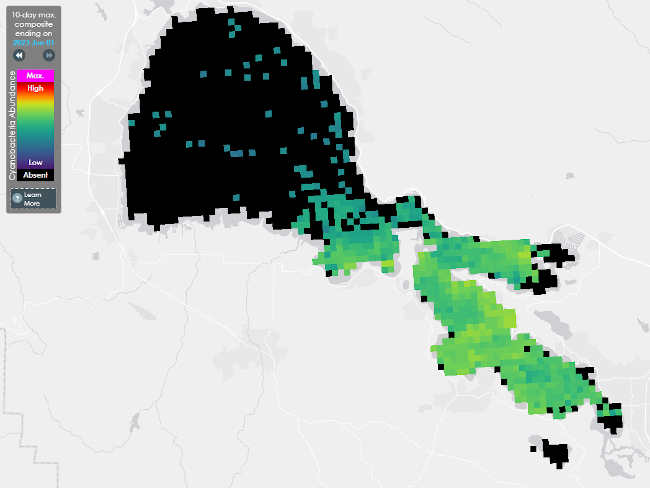
The use of these tools in making informed decisions when recreating on or in freshwater is invaluable. Before planning a water excursion, you can see what current bloom conditions are in a lake of interest, and can use that knowledge to stay safe while enjoying the lake.
The CDC is a great resource for learning more about potential health impacts of cyanobacteria, what to look for, and how to protect you, your family, and pets, when recreating in freshwaters.
Also important to know that Clear Lake is huge, and when one area of the lake may be impacted by a bloom, other areas of the lake are not. There are also other Lake County water bodies that can be recreation destinations if recreating in Clear Lake is of current concern.
Highland Springs Recreation Area has a beautiful spring and stream-fed reservoir that has historically been algae and cyanobacteria free year round. The area around the reservoir has picnic areas, kayak launches, and a small beach. No motorboats are allowed on the reservoir, which makes it a quiet water recreation paradise. The park itself has miles of trails, disc golf courses, and horsebacking riding and mountain biking access.
Blue Lakes, located north west of Clear Lake along highway 20, consists of two, deep, cold spring-fed lakes. Although no public launches are available, there is foot access along highway 20 and several private and resort access locations that have boat rentals and sandy beaches. Blue Lakes is a great swimming lake since motor boats are speed restricted and the lakes are stocked with trout by California Department of Fish and Wildlife.
Mercury
This is probably the second most common topic I get asked when people are wondering about swimming safety. The good news is that even if someone swam everyday in Clear Lake, they would not be exposed to mercury or suffer toxicity issues. Mercury is not floating around in the open water and even consumption of water (never drink lake water without proper filtration!) would never lead to mercury toxicity.
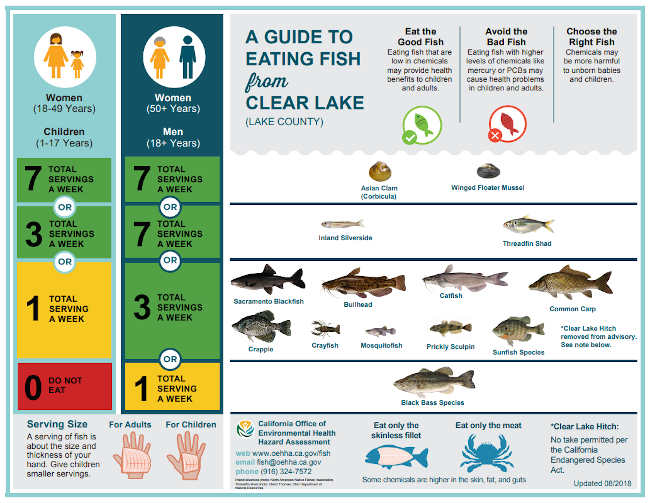
The main exposure pathway for mercury is through consuming fatty fish - not swimming, boating, or recreating in water. And one would need to eat a good amount of fish, on a regular basis, to become susceptible to mercury poisoning.
Mercury contamination in lakes and reservoirs in California is not unique to Clear Lake. Due to the heavy and widespread mining activity across the State during the 1950s - early 1900s, allowed mercury to mobilize from the sediments into runoff, surface, and some groundwaters. Today, most, if not all of the waterways, lakes, reservoirs, and streams in California are considered contaminated by mercury.
In fact, the Office of Environmental Health Hazard Assessment, or OEHHA, has a blanket fish advisory recommendation for all California lakes and reservoirs for a majority of the most commonly fished species. There is also a fish consumption advisory specific to Clear Lake, which can be seen at most of the public ramps, parks, and fishing access points, in both English and Spanish.
The most important takeaway from this section about mercury is that swimming, floating, wading, or recreating in the waters of Clear Lake does not expose you to mercury. Mercury is a heavy elemental metal that is attached to soils and sediments in some parts of the lake and can be found in fish tissues.
In Clear Lake, mercury is mostly found in the soils around the superfund site (south eastern Oaks Arm) and is a legacy left over from the mining activity when mercury (quicksilver) was mined from the Sulfur Bank Mercury Mine. The US EPA, through the Superfund program, is currently remediating the site and clean up will further reduce the movement of mercury from the site into the lake and over time, mercury-impacted fisheries will become less and less.
For more detailed information about the Sulfur Bank Mercury mine please refer to my column from November 2022 Lady of the Lake: Superfund Site.
Swimmers Itch
Anyone who loves swimming and recreating in water bodies has probably heard of or succumbed to Swimmer’s Itch. Much like allergies, some people respond to swimmer’s itch more severely than others.
For example, I went swimming with three co-workers in a reservoir in Ohio, we all swam the exact same places, for the exact same time and two of them got a really itchy, annoying case of swimmer's itch. Myself and the fourth co-worker did not get even a single itchy spot. Sometimes, it really depends on luck of the draw and genetics - similar to poison oak/ivy reactions.
Swimmer's itch, also called cercarial dermatitis, appears as a skin rash caused by an allergic reaction to certain parasites that infect some birds and mammals. These microscopic parasites are released from infected snails into fresh and even saltwater.
While the parasite's preferred host is the specific animal, the parasite can’t differentiate between a host animal skin and human swimmer skin, and it burrows into the skin, sometimes causing an allergic reaction and rash. Swimmer's itch is found in water bodies throughout the world and is more frequent during summer months.
Because swimmer's itch is caused by an allergic reaction to infection, the more often one swims or wades in infested water, the more likely they will be to develop more serious symptoms. The greater the number of exposures to infested water, the more intense and immediate symptoms of swimmer's itch will be. Luckily, water isn’t always infested, and conditions can change throughout the year and even season.
Within minutes to days after swimming in infested water, you may experience tingling, burning, or itching of the skin. Small reddish pimples appear within twelve hours. Pimples may develop into small blisters. Scratching the areas may result in secondary bacterial infection, so it’s best to prevent scratching and use remedies to lessen the need to scratch. Itching may last up to a week or more, but will gradually go away with no permanent damage or scarring. Some people are more sensitive than others to the symptoms of swimmer’s itch.
You can still go swimming! Stay in open water areas, away from heavily vegetation shallow areas where the snails are more likely to be living. The best way to prevent getting swimmer’s itch is to rinse your skin with clean water and towel dry after swimming or recreating in the water. If the skin does become itchy, usually anti-itch creams like cortisone and epsom salt baths can provide relief.
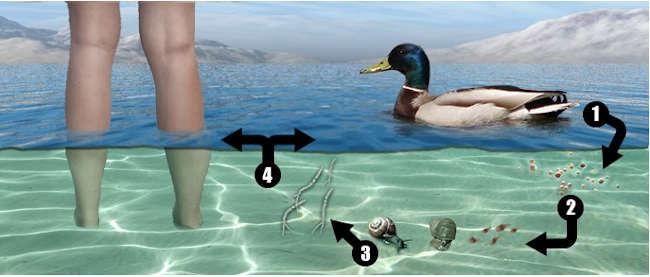
Anyone who swims or wades in infested water may be at risk. Larvae are more likely to be present in areas with high bird populations, aquatic vegetation and shallow water by the shoreline. Children are most often affected because they tend to swim, wade, and play in the shallow water more than adults. Also, they are less likely to towel dry themselves when leaving the water.
Unfortunately for pet owners, not only can dogs get swimmer's itch, but the parasite can live inside a dog’s blood and sometimes successfully reproduce. Therefore, it’s really important to rinse and towel dry a dog immediately when they exit the lake after water play.
Prevention can include keeping dogs away from weedy areas heavy with aquatic or wetland plant growth, and having dogs enter the water from a boat, dock, or ramp instead of the shoreline is another measure that can reduce risk of dogs coming into contact with the parasite.
I hope I answered all your questions Sara and while I couldn’t give you a resounding “It’s safe to swim!”, I hope I have provided you with some valuable information for you to make the best decision for your individual family when you are deciding to swim and recreate in a natural water body, like Clear Lake.
Every day the lake is different, and not every area of the lake is the same on any given day, so you really need to make the right choice for you, based on the conditions you are seeing, and the type of recreation and water-use you want to participate in on that day.
— Sincerely Lady of the Lake
Angela De Palma-Dow is a limnologist (limnology = study of fresh inland waters) who lives and works in Lake County. Born in Northern California, she has a Master of Science from Michigan State University. She is a Certified Lake Manager from the North American Lake Management Society, or NALMS, and she is the current president/chair of the California chapter of the Society for Freshwater Science. She can be reached at

People once believed the planet could always accommodate us. That the resilience of the Earth system meant nature would always provide. But we now know this is not necessarily the case. As big as the world is, our impact is bigger.
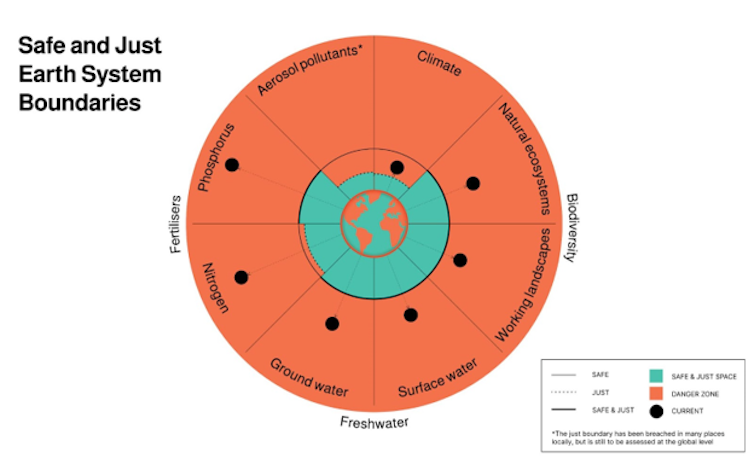
In research released May 31, an international team of scientists from the Earth Commission, of which we were part, identified eight “safe” and “just” boundaries spanning five vital planetary systems: climate change, the biosphere, freshwater, nutrient use in fertilisers and air pollution. This is the first time an assessment of boundaries has quantified the harms to people from changes to the Earth system.
“Safe” means boundaries maintaining stability and resilience of our planetary systems on which we rely. “Just”, in this work, means boundaries which minimise significant harm to people. Together, they’re a health barometer for the planet.
Assessing our planet’s health is a big task. It took the expertise of 51 world-leading researchers from natural and social sciences. Our methods included modelling, literature reviews and expert judgement. We assessed factors such as tipping point risks, declines in Earth system functions, historical variability and effects on people.
Alarmingly, we found humanity has exceeded the safe and just limits for four of five systems. Aerosol pollution is the sole exception. Urgent action, based on the best available science, is now needed.
So, what did we find?
Our work builds on the influential concepts of planetary boundaries by finding ways to quantify what just systems look like alongside safety.
Importantly, the safe and just boundaries are defined at local to global spatial scales appropriate for assessing and managing planetary systems – as small as one square kilometre in the case of biodiversity. This is crucial because many natural functions act at local scales.
Here are the boundaries:
1. Climate boundary – keep warming to 1℃
We know the Paris Agreement goal of 1.5℃ avoids a high risk of triggering dangerous climate tipping points.
But even now, with warming at 1.2℃, many people around the world are being hit hard by climate-linked disasters, such as the recent extreme heat in China, fires in Canada, severe floods in Pakistan and droughts in the United States and the Horn of Africa.
At 1.5℃, hundreds of millions of people could be exposed to average annual temperatures over 29℃, which is outside the human climate niche and can be fatal. That means a just boundary for climate is nearer to 1°C. This makes the need to halt further carbon emissions even more urgent.
2. Biosphere boundaries: Expand intact ecosystems to cover 50-60% of the earth
A healthy biosphere ensures a safe and just planet by storing carbon, maintaining global water cycles and soil quality, protecting pollinators and many other ecosystem services. To safeguard these services, we need 50 to 60% of the world’s land to have largely intact natural ecosystems.
Recent research puts the current figure at between 45% and 50%, which includes vast areas of land with relatively low populations, including parts of Australia and the Amazon rainforest. These areas are already under pressure from climate change and other human activity.
Locally, we need about 20-25% of each square kilometre of farms, towns, cities or other human-dominated landscapes to contain largely intact natural ecosystems. At present, only a third of our human-dominated landscapes meet this threshold.

3. Freshwater boundaries: Keep groundwater levels up and don’t suck rivers dry
Too much freshwater is a problem, as unprecedented floods in Australia and Pakistan show. And too little is also a problem, with unprecedented droughts taking their toll on food production.
To bring fresh water systems back into balance, a rule of thumb is to avoid taking or adding more than 20% of a river or stream’s water in any one month, in the absence of local knowledge of environmental flows.
At present, 66% of the world’s land area meets this boundary, when flows are averaged over the year. But human settlement has a major impact: less than half of the world’s population lives in these areas. Groundwater, too, is overused. At present, almost half the world’s land is subject to groundwater overextraction.
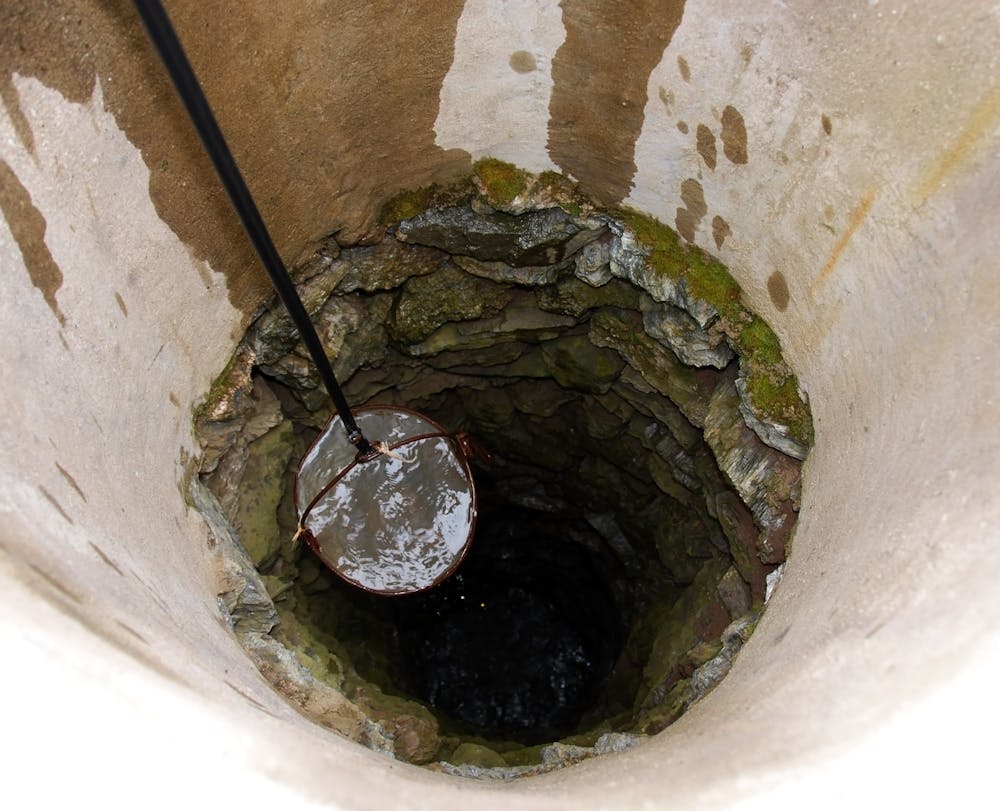
4. Fertiliser and nutrient boundaries: Halve the runoff from fertilisers
When farmers overuse fertilisers on their fields, rain washes nitrogen and phosphorus runoff into rivers and oceans. These nutrients can trigger algal blooms, damage ecosystems and worsen drinking water quality.
Yet many farming regions in poorer countries don’t have enough fertiliser, which is unjust.
Worldwide, our nitrogen and phosphorus use are up to double their safe and just boundaries. While this needs to be reduced in many countries, in other parts of the world fertiliser use can safely increase.
5. Aerosol pollution boundary: Sharply reduce dangerous air pollution and reduce regional differences
New research shows differences in concentration of aerosol pollutants between Northern and Southern hemispheres could disrupt wind patterns and monsoons if pollutant levels keep increasing. That is, air pollution could actually upend weather systems.
At present, aerosol concentrations have not yet reached weather-changing levels. But much of the world is exposed to dangerous levels of fine particle pollution (known as PM 2.5) in the air, causing an estimated 4.2 million deaths a year.
We must significantly reduce these pollutants to safer levels – under 15 micrograms per cubic metre of air.
We must act
We must urgently navigate towards a safe and just future, and strive to return our planetary systems back within safe and just boundaries through just means.
To stop human civilisation from pushing the Earths’s systems out of balance, we will have to tackle the many ways we damage the planet.
To work towards a world compatible with the Earth’s limits means setting and achieving science-based targets. To translate these boundaries to actions will require urgent support from government to create regulatory and incentive-based systems to drive the changes needed.
Setting boundaries and targets is vital. The Paris Agreement galvanised faster action on climate. But we need similar boundaries to ensure the future holds fresh water, clean air, a planet still full of life and a good life for humans.
We would like to acknowledge support from the Earth Commission, which is hosted by Future Earth, and is the science component of the Global Commons Alliance
Steven J Lade, Resilience researcher at Australian National University, Australian National University; Ben Stewart-Koster, Senior research fellow, Griffith University; Stuart Bunn, Professor, Australian Rivers Institute, Griffith University; Syezlin Hasan, Research fellow, Griffith University, and Xuemei Bai, Distinguished Professor, Australian National University
This article is republished from The Conversation under a Creative Commons license. Read the original article.