 How to resolve AdBlock issue?
News
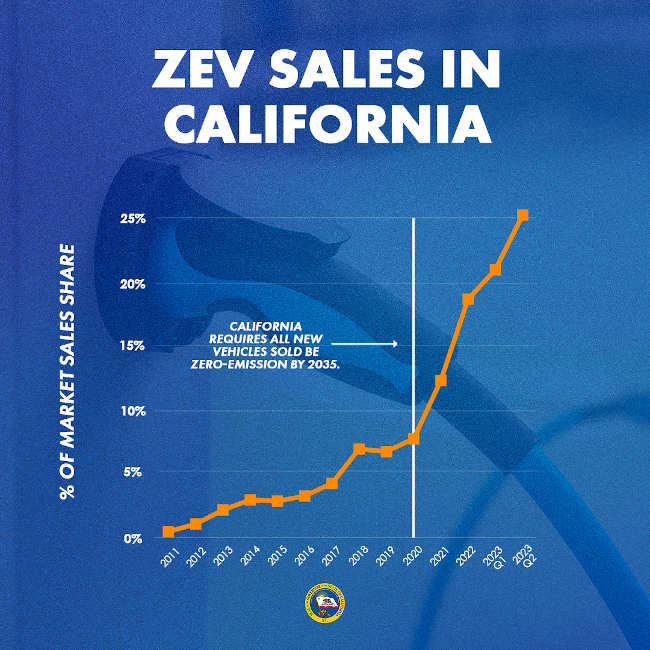
In a historic first, one in every four new cars sold last quarter in California were zero-emission vehicles, or ZEVs.
Earlier this year, the state surpassed its goal of selling 1.5 million ZEVs —a full two years ahead of schedule.
These latest sales figures come as a group of major automakers announced a partnership to build public ZEV charging networks throughout the country, showcasing where the industry has been going and California’s success in encouraging a thriving and competitive ZEV marketplace with the state’s world-leading requirement of 100% ZEV new car sales by 2035.
“California is showing the world what’s possible — fostering innovation and creating space for an industry to flourish,” said Gov. Gavin Newsom. “The proof is in the numbers: one in four new cars sold in our state are zero-emission — and thanks to our unparalleled incentives that make it cheaper than ever, we’re not leaving anyone behind.”
CALIFORNIA’S ZEV RECORD
• 25.4% of all new cars sold in California last quarter were ZEVs, according to the California Energy Commission, or CEC.
• 125,939 ZEV sales in Q2 2023.
• 1,623,211 total ZEV sales to date.
• 34% of new ZEVs sold in the U.S. are sold in California, according to the Veloz EV Market Report.
• Thousands of dollars in grants and rebates available for low-income Californians (learn more at www.ClimateAction.ca.gov).
• The historic $52 billion California Climate Commitment includes over $10 billion for zero-emission cars, trucks, buses and infrastructure.

Picture two homes on the same street: one constructed in the 1950s and the other in the 1990s. There are no trees or other shade. The air conditioning units are identical, recently replaced, and operating perfectly. Identical thermostats are set at 82 degrees Fahrenheit (27.8 Celsius).
When it’s 110 F (43.3 C) outside, the 1950s house will likely feel at least 10 F (5.6 C) warmer inside, even with the same air temperature.
Why?
The answer has to do with radiant heat. Radiant heat is what keeps you toasty warm at a campfire on a cold winter night. The fire doesn’t warm the air much; rather, like the Sun, most of the fire’s heat moves through invisible waves directly from the campfire to your body.
In the radiant heat of the Arizona sun, the surface temperature of the uninsulated post-and-beam ceilings in my house, one of 41,000 built in Tucson during the post-World War II era, can reach over 100 F (37.8 C). The single-glazed steel windows register 122 F (50 C), and the uninsulated concrete block walls aren’t much cooler.
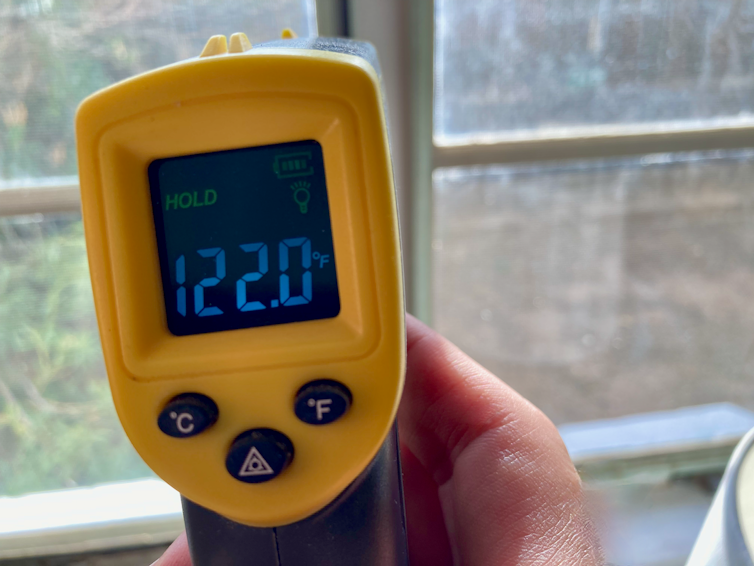
Inside my house on triple-digit days, it can feel like I’m standing near a campfire, even with the air conditioner roaring to maintain 75 F (23.9 C). And when the system breaks – as it did during the long-running 2023 heat wave, when Phoenix hit 110 F (43.3 C) every day for weeks – temperatures rise dangerously fast. Without the AC, the hot surfaces plus the swirl of air from the ceiling fan makes the house feel like an air fryer.
Air temperature: An incomplete indicator of comfort
While people are used to thinking about how clothing, air movement, temperature and humidity affect comfort, two lesser-known measures help explain how they experience comfort indoors:
-
Mean radiant temperature. This is the average temperature of all the surfaces that surround us: ceiling, windows, walls, floor. For radiant heat to move between an object and the human body, it needs an uninterrupted line of sight, so ceilings and unobstructed windows have an outsized influence on the radiant temperature experienced in a specific place in a house.
-
Operative temperature. This can be approximated by averaging the mean radiant temperature and the average air temperature in a room. Other calculations of operative temperature take into account effects of air movement, humidity and additional variables. Roughly half of how you experience comfort is determined by the radiant environment.
Unfortunately, as the building scientist Robert Bean (no relation) says, “an entire industry of manufacturers, suppliers, builders and tradespeople incorrectly equate thermal comfort with air temperatures.” The result is that most people are completely oblivious to what actually makes a space feel comfortable — or uncomfortably hot.
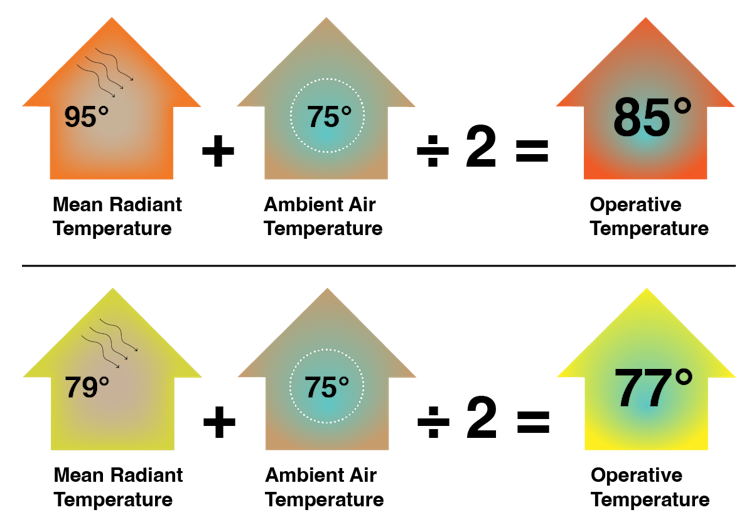
On a hot, sunny day, good insulation and double-pane windows slow heat transfer enough for air conditioning to keep the mean radiant temperature inside the building within a few degrees of the air temperature.
However, in an under-insulated building, such as my house, or in some older public housing projects in Phoenix, the high mean radiant temperature can push the operative temperature over 90 F (32.2 C) – even with the thermostat set to 75 F (23.9 C). When the surface temperature exceeds the temperature of our skin, heat will begin to radiate from the hot surface into the body, making heat stroke more likely.
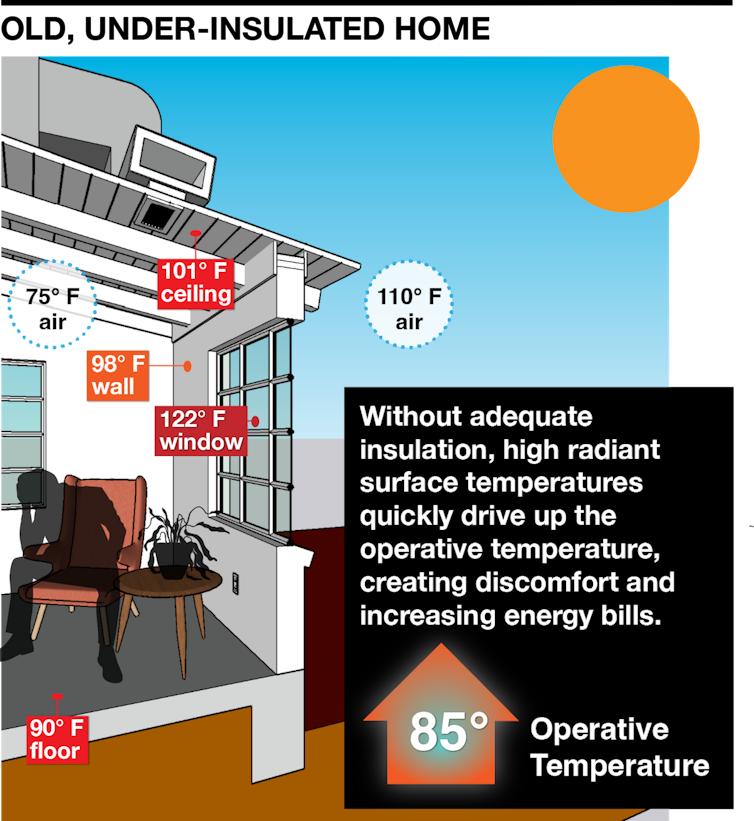
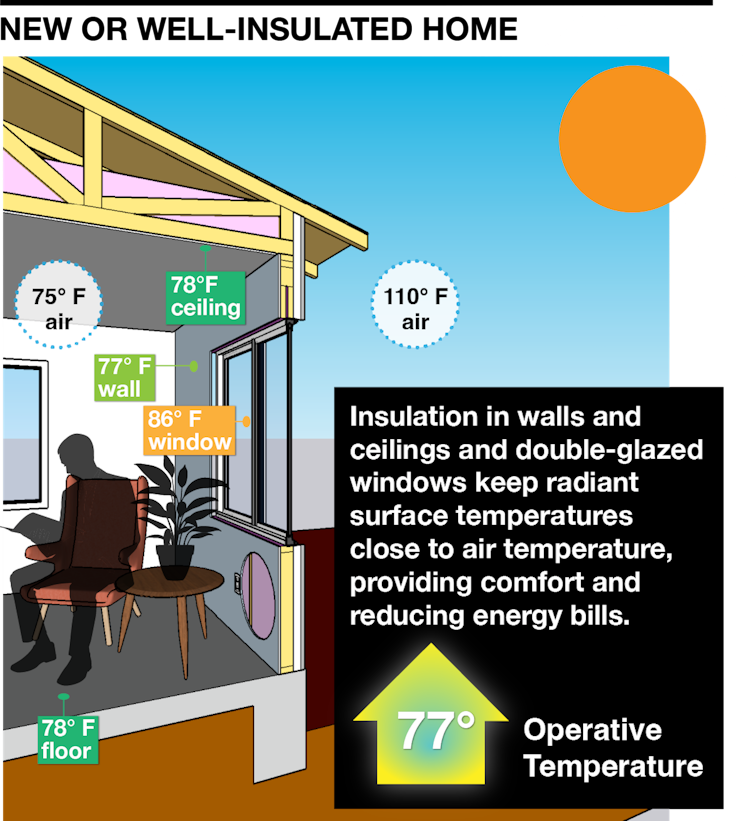
While the exact threshold where overheating becomes dangerous is debated, most people would agree that 90 F (32.2 C) is far too warm for comfort.
Hot surfaces are why smaller buildings, such as mobile homes, tiny homes, shipping containers and garages turned into apartments, often feel uncomfortable regardless of the thermostat setting. Smaller structures expose occupants to three, four or even six surfaces with the exterior exposed to the sun and hot outside air. More warm surfaces, more discomfort.
Cooler surfaces, more comfort
If you live in an under-insulated building and don’t mind using more electricity, you can set the thermostat lower. But if the mean radiant temperature is high, a 2 F (1.1 C) drop in air temperature will feel like only 1 F (0.6 C) — and those hot surfaces will still make you feel uncomfortable.
Adding insulation to your roof and replacing single-pane windows with double-pane units with low-emissivity (low-E) glass can help reduce the mean radiant temperature and your energy bills. They’re expensive improvements, but new federal tax credits and forthcoming rebates, to be administered by individual states, can help.

Trees, awnings and exterior shades can also reduce mean radiant temperatures by blocking direct sunlight. However, glass is a lousy insulator, so in very hot climates, single-pane windows completely protected from the sun can still become uncomfortably warm.
Adding a curtain inside — and keeping it closed — can help decrease mean radiant temperature because the curtain will be closer to the air temperature than the glass.
What about renters in old buildings?
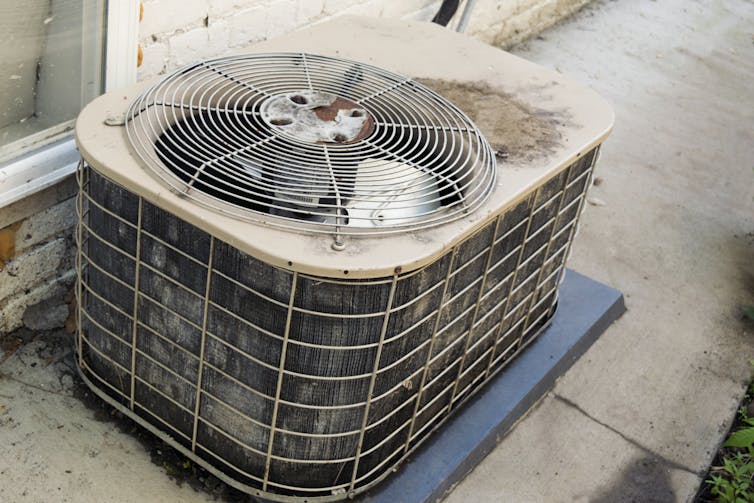
Renters in older, under-insulated buildings are often less able to afford large energy bills, and landlords may be unable or unwilling to make expensive improvements. Making matters worse, older air conditioning systems use two to three times as much energy as newer units to deliver the same amount of cooling.
Since creating a comfortable operative temperature requires setting the thermostat lower, an HVAC system in an under-insulated building must work longer and harder, using more energy and further raising the cost. And the costs of discomfort are not only financial: Hot buildings also have adverse impacts on health and productivity.
Millions of Americans now live in places where cooling is the only thing preventing a mass casualty event. In Phoenix, city code requires rental units cooled by air conditioning to maintain a temperature of no more than 82 F (27.8 C), measured 3 feet above the floor in the center of the room. Unfortunately, the code does not specify whether 82 F is the operative temperature or the air temperature.
That one word makes a world of difference.
In an older, under-insulated building similar to my house — or, in what might be the worst-case scenario, a sun-fried southwest unit of the top floor of an uninsulated concrete high-rise — a seemingly safe air temperature of 82 F could easily mask dangerous operative temperatures of 96 F (35.6 C) or higher.
The key to better design
As a professor of architecture and building science, I believe today’s byzantine building codes and rental rules could be greatly improved for comfort by regulating mean radiant temperature rather than air temperature. Vast sections of code could be jettisoned by requiring that interior surfaces, which are easy to measure with an inexpensive infrared thermometer, be kept within a comfort range above 60 F (15.6 C) and below 85 F (29.4 C).
For more comfortable buildings, architects and engineers can apply simple, established principles, such as natural ventilation, shading and the right insulation and windows for the climate. Keeping heat out in the first place means we don’t have to spend so much on energy for cooling. Research shows that these measures can also make us safer by keeping buildings cooler for longer in summer power outages.
The happy result: homes and other buildings that are not only comfortable, but also safer and more affordable to operate.
Jonathan Bean, Associate Professor of Architecture, Sustainable Built Environments and Marketing, University of Arizona
This article is republished from The Conversation under a Creative Commons license. Read the original article.
The number of reports were unprecedented, as Lake County had not seen a significant amount of EBT skimming in previous months, officials said.
District Attorney Susan Krones said her welfare fraud investigators recognized this to be part of large scale criminal activity that has affected millions of individuals and families nationwide, who depend on these benefits for food and shelter.
During the last week of June, welfare fraud Investigators began going to Lake County’s grocery and retail stores to check for skimmers on point-of-sale card readers, and to show store employees how to identify skimming devices.
One of these contacts resulted in the discovery and removal of two skimming devices; another contact resulted in the recovery of a skimming device which had been previously discovered and removed by store personnel.
EBT skimming is a type of theft that involves placing a device on a point-of-sale card reader to collect card information and pin numbers.
Once placed, the devices can be difficult to detect. The thieves then use the stolen data to clone the EBT cards and use them to purchase food or withdraw cash from ATMs.
Card skimming can also happen to people using the magnetic stripe to make purchases with their credit, debit or gift cards.
Chip readers and contactless (tap) technology is much more difficult to skim and requires more sophisticated equipment.
Since EBT cards do not currently utilize advanced security technology they are a prime target.
Although July saw fewer skimming victims, Krones said investigators believe Lake County can get back to $0 skimming loss with the help of the community.
The Lake County District Attorney’s Office along with Lake County Department of Social Services and California Department of Social Services are proactive and committed to combat skimming in Lake County.
Investigators will continue to inspect point-of-sale locations for skimmers and EBT accounts will be monitored for unusual activity so EBT cards can be replaced, and clients notified before benefits are stolen.
Listed below are things you can do to protect yourself from skimming.
Community members can help by watching for and reporting any suspicious activity or skimming devices on a retailers point of sale card reader to the store manager and to Lake County District Attorney’s Office Welfare Fraud hotline 707-995-4302.
If you believe there is a skimmer on a point of sale terminal, do not use the terminal and notify a store employee immediately.
Do not try to remove the skimmer yourself or intervene if you observe someone placing a skimmer.
CalFresh and CalWORKs program recipients or anyone with a magnetic stripe credit/debit card can protect themselves by:
• Avoid the use of simple PIN numbers, keep your PIN number secret, and change your PIN number frequently.
• Beware of phishing such as texts, emails or phone call requesting your EBT information or saying your account is frozen. Social Services will never call, text or email you with a request for your card and PIN number.
• Change your pin number often so if you card is compromised, thieves will not have your current pin number. At a minimum, change your PIN each month the day before your benefits are issued. Changing your PIN is the most effective thing you can do to protect yourself from skimming.
• Check your account regularly for charges, activity or balance inquiries you did not make.
If you believe you are the victim of skimming and your CalFresh or CalWORKs benefits were stolen, contact the Lake County Social Services office at 707-995-4200 or by going to 15975 Anderson Ranch Pkwy in Lower Lake.
Additionally, Welfare Fraud Division investigators encourage anyone who is a victim of skimming to file a police report, though this is not required.
The funds include $780,000 to the Natural Resources Agency and $1.1 million to the University of California, Davis for BRC-approved projects critical to Lake County’s economy, ecosystem, and heritage.
“I am truly grateful for the continued support by Gov. Newsom for the rehabilitation of Clear Lake,” said Aguiar-Curry. “I commend Natural Resources Secretary Wade Crowfoot and the Members of the Committee for their continued dedication toward improving the health of the Lake and the surrounding communities. The work we began with AB 707 in 2017 continues to gather momentum as we work on this critical resource for Lake County and Northern California. My heart is warmed by the local leadership of the BRC. This ongoing effort is the best example of what we can accomplish when state officials work in true collaboration with residents from the local community.”
“We are deeply grateful to Assembly Speaker pro Tempore, Cecilia Aguiar-Curry, for her constant support of Lake County’s Natural Resources-focused needs and priorities,” said Lake County Supervisor Eddie Crandell.
As the author of the legislation, 2017’s AB 707, that created the Blue Ribbon Committee for the Rehabilitation of Clear Lake and our legislative partner in securing $15 million for the land acquisition phase of the Middle Creek Flood Damage Reduction and Ecosystem Restoration Project, no one has done more to support sustainable environmental quality in Lake County than Aguiar-Curry, Crandell said.
“Thanks to Gov. Newsom and our Legislature, new investments of nearly $2 million will be made to improve the health of Clear Lake,” California Secretary for Natural Resources Wade Crowfoot said. “These funds build on $3 million of state funding already invested in lake improvements, and this new funding will help deliver more locally designed projects to improve water quality. This marks the third straight year of substantial investment to restore Clear Lake, California’s largest and oldest natural lake.”
“The investments included in the 2023 Budget Act will not only benefit the health of Clear Lake but also improve the habitat for the threatened Clear Lake hitch and the cultural and economic prosperity of the local tribes and community,” California Natural Resources Agency Deputy Secretary for Tribal Affairs Geneva E. B. Thompson said. “We are grateful to the members of the Blue Ribbon Committee for the Rehabilitation of Clear Lake for their tireless advocacy and continued collaborative efforts to protect this critical resource.”
These approved projects will bring great value to Lake County as it tries to rehabilitate Clear Lake and prepare for future droughts.
These projects are:
• Adobe Creek Hydrology and Groundwater Monitoring with the Big Valley Band of Pomo Indians: This project is to better understand discharge in Adobe Creek, which carries nutrients and sediment that decrease water quality in Clear Lake. This information is vital to understanding how nutrients that cause Harmful Algal Blooms (HABs) enter Clear Lake and how the surface water interacts with groundwater.
• Airborne Electromagnetic Survey of Lake County Groundwater Basins with the County of Lake Watershed Protection District: This project will utilize the same technology used previously by the California Department of Water Resources (CADWR) to study at-risk groundwater basins of Lake County to ensure sustainable growth and prepare for the uncertain climatic future.
• Scotts Valley Aquifer Evaluation with the Scotts Valley Band of Pomo Indians: This project will evaluate the local aquifer conditions and storage potential in Scotts Valley. Future development of groundwater supplies may be required to provide water security for the residents of Scotts Valley and maintain stream flow to benefit the environment of Clear Lake.
• Web-based Clearinghouse for Data and Reports and Expansion of the Bay Area Council Citizen Science App and Dashboard with the Big Valley Band of Pomo Indians: This project seeks to create a web-based clearing house for reports and links to data sets that span all entities collecting water quality and Chi/Hitch data on Clear Lake and tributaries. This project will also build off the existing Big Valley Band of Pomo Indians citizen science-monitoring program for fish kills to include HAB and expand outreach, manage data, and share data with other state and federal agencies.
“Lake County has, in many respects, experienced some of the leading effects of Climate Change,” said Crandell. “Repeated wildfires and profound drought have brought renewed urgency to better understanding all of Lake County’s water resources. Many will be aware that the chi/Clear Lake hitch, which is culturally significant to Lake County’s sovereign Tribal Nations, has been severely threatened, in recent years, by insufficient water to support their spawning runs. Despite the relatively wet winter of 2022-23, we must remain vigilant and take action.”
“We greatly appreciate the California Department of Water Resources’ previous investments in Airborne Electromagnetic (AEM) Surveys of medium and above priority groundwater basins, including the Big Valley basin in Lake County,” said Marina Deligiannis, deputy water resources director for the county of Lake. “This AEM project will further that vital work and promote responsible natural resource management and sustainable growth as we face an uncertain climatic future.”
In addition to the projects, UC Davis’ Tahoe Environmental Research Center, or TERC, will develop a hypolimnetic oxygenation pilot project to design, construct, and implement monitoring, water testing, and scenario testing of hypolimnetic oxygenation, or HO, in the Oaks Arm of Clear Lake.
This site is the smallest basin affected by long-term mercury issues. It is also the site for many of the largest harmful algal blooms. HO will use a device to add oxygen back into the lake to improve water quality. The research on the HO process has empirically shown to improve HABs and methyl-mercury production significantly.
“UC Davis Tahoe Environmental Research Center’s Hypolimnetic Oxygenation Pilot Project in the Oaks Arm of Clear Lake also carries the potential to be a very positive step forward for Lake County,” said Deligiannis. “Cyanobacteria has affected tourism and recreation on Clear Lake, and reducing Harmful Algal Blooms to the maximum extent possible and mitigating their effects will promote both greater economic activity and public health in our region. We appreciate the Legislature and Governor’s thoughtful investment.”
An additional $3 million from Proposition 68 funds for direct restoration projects covers nearly all of the requested funding for projects approved by BRC in 2022, further demonstrating the efficacy of this collective.
AB 707 outlines the Blue Ribbon Committee members, including significant participation from local officials, Lake County tribal nations, local experts and community members.
Aguiar-Curry represents the Fourth Assembly District, which includes all of Yolo, Napa, Colusa, Lake counties, and parts of Sonoma County.
Milder, of Oakland, is a seasoned prosecutor and antitrust expert who most recently served the U.S. Department of Justice’s Antitrust Division as counsel to the assistant attorney general.
He has successfully investigated and prosecuted companies and individuals that tried to rip off consumers by engaging in price-fixing, bid-rigging and bribery.
Milder also worked at California’s Department of Justice enforcing state antitrust laws against oil and gas companies.
The new oil watchdog office is a key part of Gov. Newsom’s gas price gouging law, which was approved during a special session of the Legislature earlier this year and took effect in June.
The division will closely monitor the industry on a daily basis to identify irregular or illegal behavior, and will refer any violation of law – including industry misconduct or market manipulation — to the attorney general for prosecution.
“California is serious about holding Big Oil accountable,” Newsom said. “Tai Milder has an impressive record of going after companies that rip off consumers, and that’s exactly what he’ll be doing — serving as a watchdog over the oil and gas industry and protecting Californians.”
“I’m looking forward to leading the nation’s first independent oil and gas watchdog,” Milder said. “Transparency and accountability are essential to protecting California consumers and those principles will guide the work of this division every day.”
Tuesday’s announcement comes as the CEC is unveiling a new interactive dashboard to increase transparency within the oil and gas industry.
The dashboard, which has data from January 1999 to present, has a detailed price breakdown of costs, taxes and fees for a gallon of gasoline. It also has estimated gross margins for refiners and distributors, which is one of many indicators that can be used to look at how the petroleum market in California is operating.
In recent months, the CEC has also hosted several public workshops to ensure that industry has no excuse for failing to comply with the law.
Milder has served as counsel to the assistant attorney general for the Antitrust Division at the U.S. Department of Justice since 2022, where he also served as a trial attorney from 2009 to 2017 and again in 2021.
Milder served as a deputy attorney general in the Antitrust Law Section at the California Department of Justice from 2019 to 2021. He was counsel at Robins Kaplan LLP from 2017 to 2019.
Milder served as a special assistant U.S. attorney at the U.S. Department of Justice from 2014 to 2015.
He earned a Juris Doctor degree from the University of California, Berkeley School of Law and a Bachelor of Arts degree in plitical science from the University of California, Berkeley.
This position requires Senate confirmation and the compensation is $199,740. Milder is a Democrat.
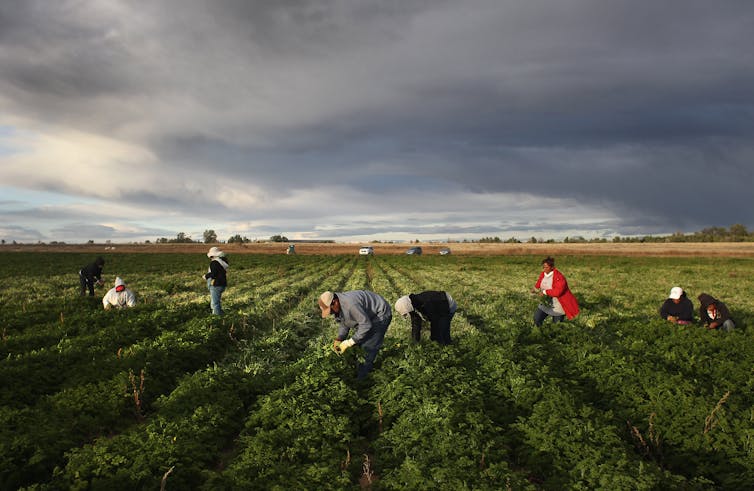
Television crime shows often are set in cities, but in its third season, ABC’s “American Crime” took a different tack. It opened on a tomato farm in North Carolina, where it showed a young woman being brutally raped in a field by her supervisor.
“People die all the time on that farm. Nobody cares. Women get raped, regular,” another character tells a police interrogator.
The show’s writers did their research. Studies show that 80% of Mexican and Mexican American women farmworkers in the U.S. have experienced some form of sexual harassment at work. Rape is common enough for some to nickname their workplace the “fields of panties.” For comparison, about 38% of women in the U.S. report experiencing some kind of workplace sexual harassment.
In a recent report, the U.N. Food and Agriculture Organization called for transformative changes to the formal and informal social systems that disempower women who work on farms and in the food sector around the world. While violence against women in agriculture may seem like an issue mainly experienced in developing countries, the truth is that it also happens all too often to women and girls on farms in the U.S.
As we see it, sexual exploitation perpetrated by men in positions of power instills fear that keeps farm laborers obedient, despite precarious working conditions – and keeps fruits and vegetables cheap.
Vulnerable workers
In our research on rural development, agriculture and rural gender inequality, we have found that gender-based violence against female workers is frighteningly common on U.S. farms.
According to the U.N., violence against women and girls includes “any gender-based act that creates sexual, psychological, or physical harm or suffering.” Men and boys can, of course, experience gender-based violence on U.S. farms, but to our knowledge no corroborating research exists.
Most often, sexual violence against women is committed by men in positions of power, such as foremen, farm labor contractors, farm owners and co-workers. Unfortunately, farm workers often buy into the myth that women bring sexual harassment on themselves. This belief makes it difficult for victims to get support.
Immigrant women farm workers are vulnerable because of power imbalances in their male-dominated workplaces. Women represent 28% of the nation’s farm workers, making them a minority on many farms. Most are immigrants from Latin America, and many are undocumented.
Female farm workers also face a gender wage gap of about 6%, partly because of parenting responsibilities that limit the number of hours they can work. Researchers have documented how men in positions of power take advantage of this vulnerability by offering hours and job perks in exchange for sexual favors and threatening to fire women if they refuse.
The role of child labor
Girls under the age of 18 are particularly vulnerable to sexual harassment and abuse on farms. While much-needed reporting has generated a public outcry against arduous work conditions for migrant child laborers, migrant children have worked in agriculture in the U.S. for decades – legally.
Agriculture holds a special status under federal labor laws, which permit farm owners to hire children as young as 12. Facing low wages and high poverty rates, farm worker families often rely on income from children’s work.
Experts say young girls may be especially vulnerable to sexual harassment and violence on farms because they are less likely to recognize and report abuse. Currently, children as young as 12 can be hired on farms without a cap on the number of hours they work, as long as they don’t miss school.
Democrats in Congress have repeatedly introduced versions of the Children’s Act for Responsible Employment and Farm Safety (CARE) Act since 2005. The bill would help address the vulnerability of young girls in farm work by aligning the legal farm working age with other industries.
Are guest worker visas the answer?
Since one major driver of the threat of violence against female farm workers is the fact that many of them are undocumented, could expanding the national H-2A agricultural guest worker visa program be a solution?
The H-2A program has exploded in popularity among farmers as a way to address agricultural labor shortages. The number of U.S. farm jobs certified for H-2A workers increased from 48,000 in 2005 to 371,000 in 2022 as farmers pressed Congress to allow more foreign nationals into the U.S. to fill temporary agricultural jobs.
This program, at least in theory, addresses several of the structural vulnerabilities of female farm workers. A visa confers a legal right to enter the country, alleviating the severe risk of sexual assault during clandestine border crossings. Legal status should also eliminate fear of deportation, which would bolster women’s courage to speak up against sexual violence in the workplace.
But the key word here is “should.”
Concerningly, migrant labor advocates have charged that the H-2A program promotes “systemic sex-based discrimination in hiring.” Only 3.3% of H-2A guest workers admitted in 2021 were women, a level that reflects historical trends. Some foreign advertisements for H-2A workers explicitly state that recruiters are looking for capable male workers.
When female farm workers are few in number, they have less collective capacity to protest or report sexually abusive conditions. Moreover, one 2020 report on labor conditions among H-2A workers found that 12% of participants – including women and men – had experienced sexual harassment. The authors believed this figure represented a gross undercount.
Guest worker visa programs can actually make workers more likely to tolerate abusive situations, because the workers’ legal status in the U.S. by definition is tied to their employment. Guest workers are often particularly fearful of employer retaliation if they complain about sexual abuse. In our view, guest worker visa programs institutionalize workers’ uncertain position instead of solving it.
A path forward
We agree with the U.N. that sweeping change is needed to empower women, raise farm productivity and promote human rights in the global food system. As U.S. lawmakers craft the next farm bill, they could do enormous good for women around the world by setting an example in American fields and farms.
As a first step, we believe lawmakers should pass the CARE Act, which would raise the legal working age on farms to 14, reducing the number of young girls who are vulnerable to abuse.
Second, legalizing the nation’s approximately 283,000 unauthorized farm workers would make those workers less vulnerable to sexual abuse by expanding employment opportunities outside of the agricultural sector.
Third, in our view, efforts to legalize farm workers – most recently through the Farm Workforce Modernization Act – should strengthen labor law enforcement and provide well-funded channels for reporting abuses and changing jobs when abuse occurs.
Bills proposing a pathway to legalization for agricultural workers have focused on providing enough labor for farm employers. For example, some proposals would expand the H-2A program and require workers already in the U.S. to continue working in agriculture for a number of years to receive a green card.
But without steps to improve labor protection systems, such changes could make workers even more vulnerable to sexual and other labor abuses, and have the counterproductive result of making them more likely to want to leave agriculture as soon as they can.
Kathleen Sexsmith, Assistant Professor of Rural Sociology, Penn State; Francisco Alfredo Reyes, Ph.D. Candidate in Rural Sociology & International Agriculture and Development, Penn State, and Megan A. M. Griffin, Student Community Engagement Specialist, Connecticut College
This article is republished from The Conversation under a Creative Commons license. Read the original article.