 How to resolve AdBlock issue?
News
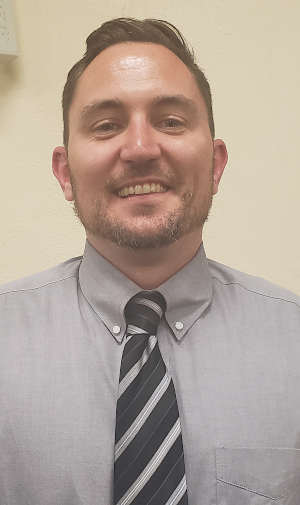
LAKEPORT, Calif. — The city of Lakeport has welcomed its new Community Development director, a Lake County native who has worked in a variety of jobs in bigger cities around the state but is returning to move up to a new step in his career.
Joey Hejnowicz was introduced to the Lakeport City Council and the community at the council’s Tuesday evening meeting.
Hejnowicz grew up in Kelseyville, and after graduating from high school at age 18, he decided to head off to San Diego because he was looking to live in a bigger city.
He received his undergraduate degree in business with an emphasis in hospitality and tourism and was a hospitality manager for 10 years.
Hejnowicz then made his way closer to home, to Santa Rosa, where he worked in wine sales and business development for a winery for about a year.
Then he landed a job with the city of Santa Rosa, working for the finance department and later in the city manager’s office for several years.
During his time at the city of Santa Rosa, Hejnowicz gained diverse experience, from working on utility billing and rent stability ordinances, to acting as the city’s zero waste coordinator.
Hejnowicz said he is excited to meet more of the community in his new role with the city of Lakeport.
He and his wife and dog are living in Kelseyville, in the home he grew up in, which has remained in his family.
Hejnowicz succeeds Jennifer Byers, who left in November to take the assistant economic development director job with the city of Bakersfield after just over two years with the city of Lakeport.
Email Elizabeth Larson at
Although gun violence is the leading cause of death for American kids, the House of Representatives has yet to vote on even one gun violence prevention bill in this Congress.
“American children should not be scared to go to school. Parents should not be scared that when they send their kids off in the morning that it may be the last time they see them alive,” said Thompson, who represents Lake County in the House of Representatives.
“Gun violence demands our attention, yet the Republican House Leadership has not brought a single gun violence prevention bill up for a vote. The Gun Violence Prevention Task Force is calling on Speaker McCarthy to help us save lives and pass legislation that would keep our kids safe,” Thompson said.
Republicans canceled the last day of scheduled votes in July over disagreements within the Republican conference about how to proceed on a government funding bill.
Should the vote schedule fall apart again, the letter calls on House Republican Leadership to use that time to vote on life-saving gun violence prevention legislation, instead of canceling votes altogether.
The full text of the letter is below.
Dear Speaker McCarthy,
We are disappointed that Republican leadership cancelled votes in July with so many pressing issues facing our country. Foremost amongst those is the gun violence crisis that is the leading cause of death for children in America.
As Members of the Gun Violence Prevention Task Force, we call on you to schedule votes on gun violence prevention legislation as soon as possible this year. We also have a new standing request that should the vote schedule fall apart again, you would fill that time to vote on life-saving gun violence prevention legislation, instead of canceling votes altogether.
Gun violence is the leading cause of death of children in America since 2020. Last year, 1,686 children were killed and another 4,485 were injured by gun violence. Despite this preventable carnage, the House has yet to vote on even one gun violence prevention bill.
To save the lives of our kids, we only need the opportunity to vote on gun violence prevention legislation and the support from a tiny minority of the Republican Conference. For example, if only 20 Republicans, 10 in the House and 10 in the Senate voted for the Bipartisan Background Checks bill, we would have the votes to help prevent felons, domestic abusers, terrorists and people with serious mental health conditions from accessing guns.
The American people strongly support action on the gun violence crisis and the gun violence prevention laws that will keep their kids alive. A recent Fox News poll shows that 87 percent support universal background checks; 80 percent support red flag laws and 61 percent support banning assault weapons.
We reiterate our insistence that the House schedule votes on gun violence prevention legislation without further delay and also offer to quickly advance gun violence prevention legislation should other planned legislation be canceled again.
Thompson represents California’s Fourth Congressional District, which includes all or part of Lake, Napa, Solano, Sonoma and Yolo counties.
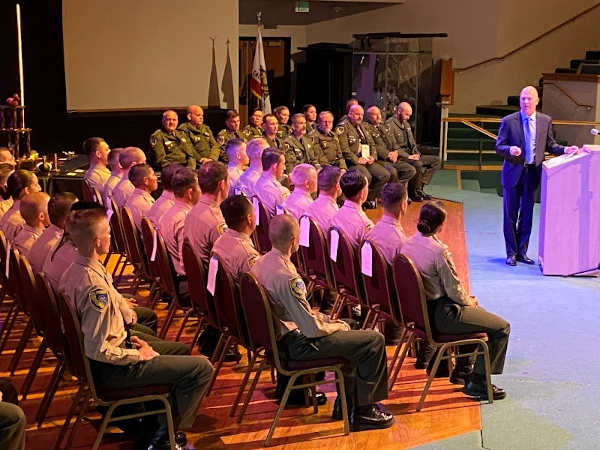
NORTHERN CALIFORNIA — The California Department of Fish and Wildlife Wildlife Officer Academy graduated 43 cadets today in Paradise, Butte County.
The academy is California Peace Officer Standards and Training, or POST, certified and offers training consistent with every law enforcement agency in California.
In 2008, CDFW partnered with Butte College to provide peace officer academy training for prospective wildlife officers. That partnership provided CDFW with a state-of-the-art POST-certified academy facility with nearly 50 years of police training history.
“One of the best days of the year for us is adding a graduating class of wildlife officers to CDFW’s Law Enforcement Division,” said David Bess, CDFW deputy director and chief of law enforcement. “It is a pleasure to see 43 eager graduates ready to support our mission to protect California’s natural resources and provide public safety through effective and responsive law enforcement.”
The newly sworn peace officers will soon begin a Field Training Program where they will apply their academy training under the immediate supervision of seasoned field training officer, or FTOs.
Field training with experienced FTOs is also mandated by POST to be sure new wildlife officers can apply the skills they learned during the academy to real life circumstances.
FTO is the final stage of formal training. Upon successful completion, these officers will begin patrolling California to protect the natural resources of this great state.
The wildlife officers will be deployed across the Law Enforcement Division’s programs: regular patrol, marine enforcement, investigation of petroleum spills and response, and cannabis enforcement, to name a few.
The Law Enforcement Division is hiring. For more information about becoming a wildlife officer, please visit www.wildlife.ca.gov/enforcement.
Deadly traffic incidents have declined in most developed countries in recent years. But in the U.S. they’re becoming more common. Deaths in motor vehicle crashes rose more than 33% from 2011 to 2021. Since 2010, pedestrian deaths nationwide have climbed a shocking 77%, compared with a 25% increase in all other types of traffic fatalities.
Light trucks injure pedestrians more severely than passenger cars in crashes, and the size of cars and trucks sold in the U.S. continues to swell. Some current models, such as the Toyota Rav4, are one-third larger than they were 15 years ago.
Based on my experience researching urban planning and street design for the past three decades, I know that U.S. cities are primarily vehicle-centered rather than human-centered. Rules established in the 1920s govern how people use vehicles in public streets, and other governmental controls tell manufacturers how big those vehicles can be.
Today, these sets of rules have created public spaces where it is safer to be inside a vehicle than outside.
The U.S. has not moved as quickly as other countries to prioritize the safety of people outside of cars, especially as cars have grown larger and heavier. As a consequence, Americans are paying the price in lives lost, skyrocketing public health costs and reduced mobility.
Larger, heavier and deadlier
Data clearly shows that since 2008, cars and trucks sold in the U.S. have been continually getting bigger. The Department of Transportation’s corporate average fuel economy standards have constrained overall gasoline consumption but have also led to an increase in vehicle size.
That’s because these standards have two sets of rules: one for cars and a looser set for light trucks. As a result, automakers have built more sport utility vehicles and light trucks, as well as cars designed to meet light truck standards, like the Subaru Outback. For almost a decade, they have increasingly moved away from producing small cars and sedans.
Modern auto showrooms are dominated by sport utility vehicles, minivans and pickup trucks. According to 2022 data from the U.S. Environmental Protection Agency, three-quarters of new vehicles produced in the U.S. are light trucks.
Those large vehicles create severe safety hazards on neighborhood city streets for children or adults who might be walking or cycling. Because these vehicles are taller, they are more likely to strike people at higher points and produce head or neck injuries rather than leg injuries. Their larger frames worsen visibility for drivers, especially when a vehicle is turning.
As a result, transport agencies, journalists and public safety advocates are increasingly identifying large vehicles as a significant impediment to creating communities with safer streets.
A slow federal response
Until now, the U.S. has not enacted regulations that require car manufacturers to consider the safety of anyone outside of cars. Now, however, the National Highway Traffic Safety Administration is proposing to add information to its crash test ratings measuring how well cars protect pedestrians in crashes. For example, bumpers and hoods could be redesigned to bend more easily and absorb more energy if a vehicle strikes a person.
But as currently proposed, pedestrian safety would not be factored into the overall five-star safety rating. A vehicle could receive a failing grade for protecting pedestrians yet still earn a five-star safety rating overall.
People deserve to safely travel on public streets and in parking lots. In my view, the quickest and most effective way to tackle car bloat is to transform social expectations for the shape and size of vehicles. Several European cities show how this kind of shift can happen.
A time for local action
Amsterdam and Copenhagen are widely viewed as models for using public space in ways that prioritize people – but they weren’t always that way. Starting in the 1970s, grassroots movements in both cities pressed officials to reduce the dominance of cars and make streets safer for the public. These movements initially were slow to catch on but gained support over time.
Today, similar initiatives are moving forward in cities across France and Germany. Even traditionally car-centric European cities, such as Brussels and Ghent, are increasingly adopting human-focused policies by designating where cars, especially large cars, can and cannot travel.
As a visiting professor in the Netherlands, a Fulbright scholar to Italy and a lecturer across Germany and Poland, I have seen the benefits of these initiatives close at hand. I’ve also learned that it will require public action to create support for such changes in the U.S.
The goal is to modify the design of neighborhood streets and parking areas in ways that prioritize pedestrians, bicycles and new forms of personal transport like microcars. Federal survey data shows that nearly half of trips that Americans drive are shorter than four miles (6.5 kilometers). Ideally, people can be discouraged from using large passenger vehicles for most of this type of travel.
What communities can do
Streets and roads are local public spaces. Therefore, local officials and citizens have important roles to play in mitigating escalating car size in their community.
Some policymakers are proposing to rein in large vehicles through tax policies, such as weight-based registration fees. But measures like this won’t avert the emerging safety crisis in the near term. Rather, I believe this kind of broad cultural shift requires collective action, starting at the local level with street design reform.
In my view, communities seeking to discourage the predominance of oversize vehicles and encourage use of smaller, lighter and slower vehicles could consider taking such steps as:
-
Creating prioritized parking spaces closer to stores for all forms of mobility that are narrow or less than 8 feet (2.5 meters) long.
-
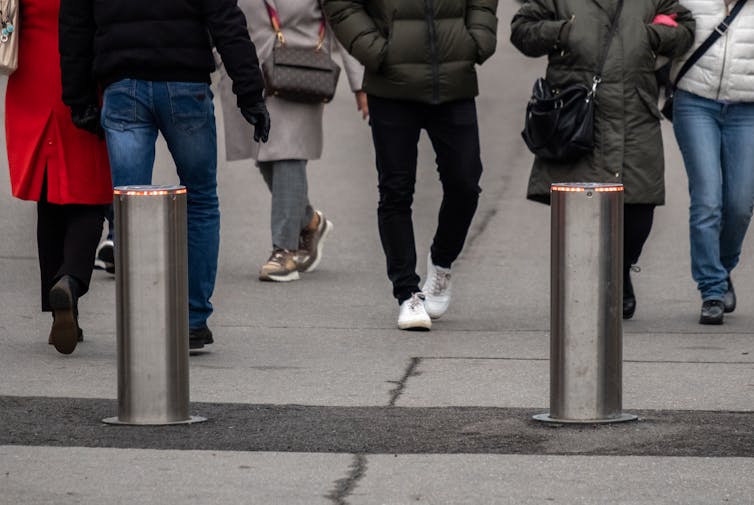
Using posts or bollards, which can be removable, to limit vehicle access to commercial areas and neighborhoods where pedestrians, bikes and smaller cars get priority.
-
Radically narrowing travel lanes on streets to force traffic to slow down and free up space for wider sidewalks and bike lanes.
-
Limiting or ending vehicle access to streets near schools and economically vibrant commercial districts, either permanently or at high-use times of day.
How would such steps make people safer? Ask communities around Boston, which have cut several accident-prone four-lane roads down to two lanes each, reducing traffic speeds and crashes and creating more green space. Or those in the Atlanta suburb of Peachtree City, which has used parking lots and street space to augment a network of more than 100 miles (160 kilometers) of paved paths for walkers, bikers and registered golf carts.
Repurposing space in streets and parking areas requires city governments and residents to emphasize the public right of way and view street space as a place to devise solutions. There is ample evidence that doing so will make U.S. communities safer.
Kevin J. Krizek, Professor of Environmental Design, University of Colorado Boulder
This article is republished from The Conversation under a Creative Commons license. Read the original article.
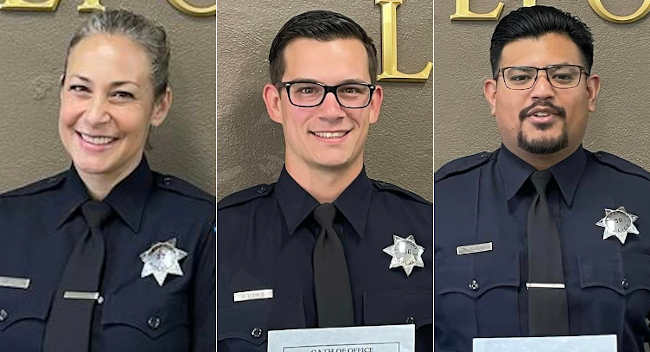
LAKEPORT, Calif. — The Lakeport Police Department has welcomed three new sworn personnel, among them the first woman to hold the rank of sergeant in the agency’s 135-year history.
The new department members are Sgt. Sarah Hardisty, and officers Jonatan Moreno and Austin Eldred, all of whom took their oaths earlier this week.
Hardisty, a 16-year veteran of local law enforcement, is the newest sergeant, joining sergeants Ryan Cooley and Andrew Welter.
She previously worked as a deputy sheriff for the Lake County Sheriff’s Office and as an officer for the Clearlake Police Department.
Lakeport Police Chief Brad Rasmussen said Hardisty is so far the highest-ranking female officer in the department, which has served the city since its founding in 1888.
Rasmussen said Eldred attended the police academy and had prior experience with the Ukiah Police Department.
Moreno also attended the police academy and had previously served as a correctional deputy in Lake County, Rasmussen said.
All three new hires are residents of Lake County. “We are proud they have chosen to work for our agency,” said Rasmussen.
Over the past few years the Lakeport Police Department has struggled to keep staff, a challenge not unique just to that agency but part of a nationwide trend.
However, with the arrival of Hardisty, Eldred and Moreno, the total sworn officers on the police force is up to full staffing with 14 officers to serve the city of about 5,000 residents.
Lakeport Police’s 14 sworn officers include two reserve officers, along with two recruits who are attending the police academy.
In addition, the department has a K-9 officer, Olin, a German shepherd who is partnered with Sgt. Welter.
While Congress routinely provides relief for farmers impacted by natural disasters, the lack of a permanent program has resulted in multiple administrative changes, which can cause unnecessary delays in implementation and confusion for farmers.
“California has been ground zero for the impacts of climate change, and farmers and growers in our state and across our country are seeing the impact of climate-related disasters on their crops,” said Thompson. “I authored legislation to create the Emergency Relief Program to provide our agriculture community with financial relief to cover disaster-related crop losses, but as climate change continues to worsen, it’s clear that this program needs to be made permanent. Proud to have introduced legislation with Senators Feinstein and Padilla and Representative LaMalfa to make the Emergency Relief Program permanent and streamline the process for all farmers and growers to receive the relief that deserve.”
“Climate change is increasing the frequency and severity of natural disasters and farmers across the country are bearing the brunt of these events,” Senator Feinstein said. “Unfortunately, there is not a permanent relief program for farmers who lose crops during a disaster, creating unnecessary delays and confusion whenever Congress approves relief. Our bill fixes that. It would create a permanent structure for the program and improve the process for all farmers, including those that grow specialty crops.”
“Our farming communities have felt the devastating impacts of climate change firsthand as drought, floods, fires, and smoke have threatened their livelihoods and the economic viability of agriculture in California and across the nation,” said Senator Padilla. “Our growers need and deserve relief quickly — there must be a long-term solution to ensure they can get back on their feet in the face of natural disasters. By permanently authorizing the Emergency Relief Program, this bill would bolster the safety net for the people that produce our food and improve farmers’ resiliency against the climate crisis.”
“American farmers and ranchers, especially those in California, must sometimes face devastation from natural disasters. When a food producer suffers crop losses, they are forced to deal with a complicated and lengthy process to get financial relief. There are farmers in California who are still waiting on aid for losses from several growing seasons ago,” said Congressman LaMalfa. “Creating a permanent disaster program — especially for specialty crop producers — is essential to ensure family farms stay in operation and our nation’s food security is preserved.”
The Agricultural Emergency Relief Act would:
• Create a permanent structure of the USDA’s Emergency Relief Program. The program was originally established through language in the fiscal year 2022 emergency supplemental appropriations bill and received additional appropriations in the fiscal year 2023 omnibus, but has not been formally authorized.
• Include as eligible disasters droughts, wildfires, floods, hurricanes, derechos, excessive heat, excessive moisture, winter storms and freeze events, including polar vortexes.
• Require farmers who apply for relief payments to purchase crop insurance for two years after receiving a payment.
• Allow payment calculations to be based on indemnities reported to USDA or on losses in revenue to better accommodate specialty crop growers.
• Allow Congress to continue to appropriate supplemental disaster funds in response to the level of damage incurred in a specific year or event.
Thompson represents California’s Fourth Congressional District, which includes all or part of Lake, Napa, Solano, Sonoma and Yolo counties.