 How to resolve AdBlock issue?
News

LAKE COUNTY, Calif. — The Clearlake Police Department is attempting to locate a missing teenager.
Alysa Ontko, 16, is described as a native female juvenile with dark brown hair, brown eyes, standing 5 feet, 4 inches tall, and weighing 125 pounds.
She was last seen on Monday in the area of Carle High School wearing a black zip up hoodie and black jeans.
If you have any information regarding her whereabouts, please contact the Clearlake Police Department at 707-994-8251, Extension 1.
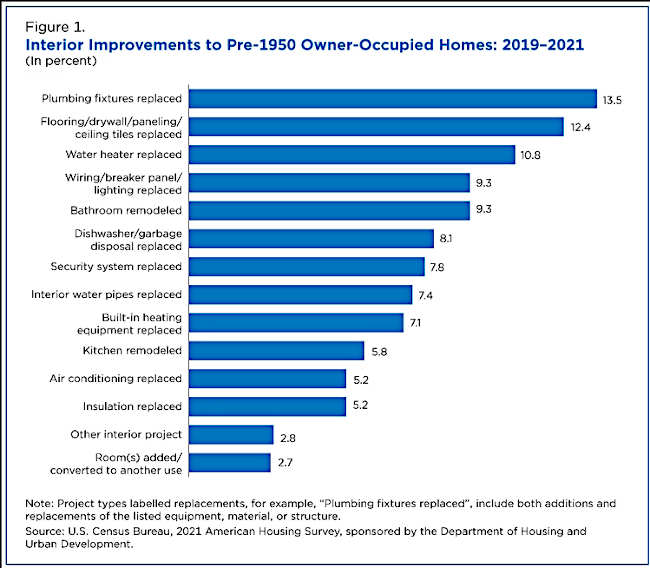
Initial costs of upkeep were higher for new owners of older homes than for those who had lived in their homes for at least 10 years, according to recently released Census Bureau data.
The 2021 American Housing Survey (AHS) shows that in 2021, the median age of all owned homes was 41 years. Older homes — those built before 1950 — made up about 17% of homes and their owners spent a median of $1,800 a year on upkeep.
Upkeep includes both home improvement projects such as remodeling a kitchen or installing a security system and routine maintenance such as painting, plumbing, roofing and other minor repairs.
The AHS asks homeowners how much they spent on home improvements over the previous two years, or since they moved in if they had lived in the home less than two years.
Owners of older homes who had moved in within the past two years tended to spend more on overall upkeep. These new owners spent a median of $3,900 per year, while longtime owners who had lived in older homes for at least 10 years spent about $1,500 annually.
To estimate annual spending, the amount reported was averaged over the time the owner lived in the home between 2019 and 2021:
About 61% of owners of older homes started a home improvement project between 2019 and 2021, spending a median of $4,100 on all their home improvement projects during that time.
Median annual spending on maintenance alone was around $540 for owners of older homes.
Types of home improvement
Regardless of the home’s age, the most common type of projects were interior improvements. Nationwide, 47% of homeowners undertook such projects. The percentage of owners of older homes with interior projects did not differ from this national percentage.
Among owners of older homes, 59% of new owners who had moved in within the last two years did interior projects, compared to 46% of longtime owners who had lived in the home at least 10 years.
The most common types of interior improvements in older homes were additions or replacements of plumbing fixtures; flooring, drywall, paneling or ceiling tiles; and water heaters.
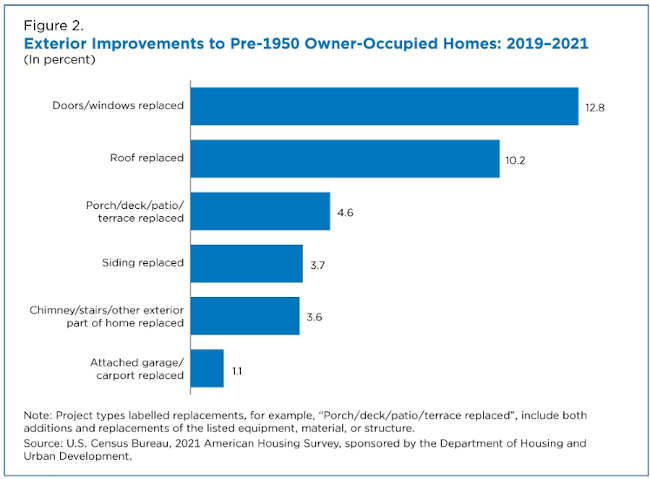
About 27% of owners of older homes made exterior improvements. The most common types of projects were window and door replacements; replacing the roof; and adding or replacing a porch, deck, patio or terrace.
About 21% of owners of older homes made land improvements, which was not statistically different from the share of all homeowners.
The top land improvement projects among owners of older homes were landscaping; adding or replacing fencing; and adding or replacing a driveway or walkway.
New owners of older homes were more likely (32%) than longtime owners (18%) to undertake land improvements.
Spending by home size
Older homes tend to be smaller, with a median of 1,290 square feet of living space compared to around 1,500 square feet for all homes.
Owners of older homes spent a median of $200 per 500 square feet of living space on routine maintenance annually.
Those who undertook at least one home improvement project spent a median of about $700 for each 500 square feet of living space on their projects.
Spending by home value
More than half of owners of older homes spent less than 1% of their home’s value annually on home improvement and maintenance.
New owners spent more than longtime owners: a median of 1.5% of the home’s value, compared to 0.6%.
Characteristics of owners of older homes in 2021
The median age of owners of older homes was 58 and 26% of their households had children.
Nationwide, 15% of homeowners lived in an older home. For householders who were Black, Hispanic, White, or Two or More Races, the percentage of homeowners in an older home was not statistically different from the national percentage.
About 10% of homes owned by Asian American and Pacific Islander (AAPI) householders and 7% of homes owned by American Indian and Alaska Native (AIAN) householders were built before 1950.
More housing data
The AHS Table Creator has further information on home improvement from the 2021 AHS and on topics such as maintenance needs, physical characteristics of homes, neighborhood features and household demographics.
The AHS is conducted by the Census Bureau and sponsored by the U.S. Department of Housing and Urban Development. It provides up-to-date information on the quality and cost of housing in the United States and major metropolitan areas. The 2021 American Housing Survey page provides related definitions and information on sampling and nonsampling error.
All comparative statements in this article have undergone statistical testing and, unless otherwise noted, are statistically significant at the 10% significance level.
Katie Gustafson is a statistician in the Census Bureau’s Social, Economic, and Housing Statistics Division.


Curious Kids is a series for children of all ages. If you have a question you’d like an expert to answer, send it to
How many hours does the average American spend on devices each year? – Maxwell P., age 10
Think about your favorite devices – your smartphone, laptop, tablet, computer or console – the things you use to play cool games, watch hilarious videos and connect and chat with friends.
Many young people spend a lot of free time looking at them. Turns out that teens spend an average of 8½ hours on screens per day, and tweens – that’s ages 8 to 12 – are not far behind, at 5½ hours daily.
Keep in mind those numbers are for only social media, gaming and texting. They do not include the time that kids used screens for schoolwork or homework.
What’s more, much of the time taken up by social media and texting is apparently not even enjoyable, much less productive. A 2017 study of teens ages 13 to 18 suggests they spend most of those hours on the phone in their bedroom, alone and distressed.
These lonely feelings correlate with the rise in the use of digital media. In 2022, 95% of teens had smartphones compared with only 23% in 2011. And 46% of today’s teens say they use the internet almost constantly, compared with 24% of teenagers who said the same in 2014 and 2015.
Our team of psychiatrists who treat young people with digital addiction have many patients who spend over 40 hours per week on screens – and some, up to 80 hours.
Think about it: If you spend “just” an average of 50 hours per week on devices from ages 13 to 18 – the total time you will spend on screens equates to more than 12 years of school!
Find the right balance
All this is not to say that everything about devices is bad. In this digital age, people embark on exciting journeys through the screens of their devices. Sometimes, screens are the windows to a magical adventure.
But too much screen time can lead to problems. As human beings, we function best when we’re in a state of balance. That happens when we eat well, exercise regularly and get enough sleep.
But spending too much time using digital devices can cause changes in the way you think and behave. Many teens and tweens developed the “fear of missing out” – known as FOMO. And one study shows some people develop nomophobia, which is the fear of being without your phone, or feeling anxious when you can’t use it.
Moreover, digital addiction in high school may predict serious depression, anxiety and sleep disruption in college.
Rates of depression and anxiety are skyrocketing among college students. The fear of missing out is pervasive, resulting in sleep disruption; too many college students sleep with smartphones turned on and near their bed – and wake up to respond to texts and notifications during the night. Sleep disruption itself is a core symptom of both depression and anxiety.
How to avoid device addiction
A 2016 poll indicated that half of teens felt they were addicted to their mobile devices.
Getting hooked on screens means missing out on healthy activities. To achieve a better balance, some experts recommend the following: Turn off all screens during family meals and outings. Don’t complain when your parents use parental controls. And turn off all the screens in your bedroom 30 to 60 minutes before bedtime – this step will improve sleep.
You may be a “screen addict” if you:
- Feel uneasy or grumpy when you can’t use your device.
- Don’t take breaks while spending hours on your device.
- Ignore other fun activities you enjoy, like going outside or reading a book.
- Have trouble sleeping, or falling asleep, because your screen time is too close to bedtime.
- Experience eye, lower back and neck strain.
- Struggle with weight gain or obesity because you’re inactive.
- Have difficulty with real-life, face-to-face social interactions.
If you notice these signs, do not dismiss them. But also realize you’re not alone and help is out there. You can find balance again.
A healthy approach
Exercise – riding a bike, playing sports, lifting weights or going for a jog or walk – keeps your brain healthy and protects it against depression and anxiety, as well as limiting your screen time.
Another way to be happier and healthier is to spend time with people – face to face, not via a screen. Seeing people live and in person is the best way to bond with others, and it may be even better for life span than exercise.
Creative hobbies are good, too. Cooking, playing an instrument, dancing, any arts and crafts, and thousands of other fun things make people happier and more creative. What’s more, hobbies make you well rounded and more attractive to others – which leads to more face-to-face interactions.
It’s also critical for parents to practice healthy screen habits. But about one-third of adults say they use screens “constantly.” This is not exactly a great example for kids; when adults take responsibility to minimize their own screen time, the whole family gets better.
Our research team used magnetic resonance imaging, also known as MRI, to scan the brains of teens who had digital addiction. We found impairment in the brain’s decision-making, processing and reward centers. But after a digital fast – meaning the addicted teens unplugged for two weeks – those brain abnormalities reversed, and the damage was undone.
Our findings also showed that kids with a desire to overcome digital addiction did better with a digital fast than those who were less willing or who denied their addiction.
A balanced lifestyle in the digital age is all about finding joy in screenless activities – being active, connecting with others and exploring your offline interests.
Hello, curious kids! Do you have a question you’d like an expert to answer? Ask an adult to send your question to
And since curiosity has no age limit – adults, let us know what you’re wondering, too. We won’t be able to answer every question, but we will do our best.
David Rosenberg, Professor of Psychiatry and Neuroscience, Wayne State University and Natalia Szura, Research Assistant in Psychiatry, Wayne State University
This article is republished from The Conversation under a Creative Commons license. Read the original article.
The agency’s forecast created it a “spinning surface low” that was centered right along the
northwest California coast for the rain that took place across the region on Sunday.
The forecast said that additional periods of cool temperatures and rain are possible in the middle and later parts of the week.
Rainfall totals in inches for the 24-hour period ending at 1 a.m. Monday are as follows:
— Cobb: 1.30;
— Indian Valley Reservoir: 0.89;
— Kelseyville: 0.75;
— Lake Pillsbury: 0.94;
— Lower Lake: 1.50;
— Lyons Valley: 1.08;
— Middletown: 1.65;
— Nice: 0.29.
The weather system that brought Sunday’s showers is expected to leave the North Coast region on Monday, the National Weather Service said.
That will be followed by more chances of rain in parts of Lake County on Wednesday, and again on Thursday and Friday, the National Weather Service reported.
Temperatures this week are expected to drop into the 50s in the day and the low 40s at night. Windy conditions are possible on Wednesday.
The forecast said the Climate Prediction Center is “showing a slight risk of heavy precipitation for northwest California for the first few days of November. This is pretty far out there but something to note.”
Email Elizabeth Larson at
The board will meet beginning at 9 a.m. Tuesday, Oct. 24, in the board chambers on the first floor of the Lake County Courthouse, 255 N. Forbes St., Lakeport.
The meeting can be watched live on Channel 8, online at https://countyoflake.legistar.com/Calendar.aspx and on the county’s Facebook page. Accompanying board documents, the agenda and archived board meeting videos also are available at that link.
To participate in real-time, join the Zoom meeting by clicking this link.
The meeting ID is 918 0684 7503, pass code 500534. The meeting also can be accessed via one tap mobile at +16694449171,,91806847503#,,,,*500534#.
In an item timed for 1:30 p.m., the supervisors — sitting as the Board of Directors of the Lake County Watershed Protection District — will consider a draft comment letter to the State Water Resources Control Board regarding draft emergency regulations proposed for the Clear Lake watershed.
Those draft regulations allow the State Water Resources Control Board’s deputy director or designee to issue an order to water right holders or users to provide information related to water diversion, extraction, or use in the Clear Lake watershed, “including but not limited to groundwater well location and depth, beneficial uses of diverted or extracted water, place of use of diverted or extracted water, volume and timing of diversions or extractions, the basis of right with supporting documents or other evidence, parcel information, or any other information relevant to the Board’s Clear Lake hitch protection efforts.”
The regulations note, “Orders may require reporting of diversions or extractions made in prior months and diversions or extractions anticipated during subsequent months. Orders may require submission of information on a repeated or ongoing basis.”
Failure to comply could lead to civil liability, the regulations state.
Supervisors Michael Green and Bruno Sabatier, in a memo to their board colleagues, note that written comments on the draft regulations are due on Oct. 31.
A draft letter to the State Water Resources Control Board from the county asks for the Upper Cache Creek watershed to be excluded from the regulations, and for there to be regulations that are “narrowly tailored and applied” for the remaining watersheds.
“We oppose regulations that would require reporting of water usage or well locations on or near ephemeral watercourses,” the draft letter states.
The full agenda follows.
CONSENT AGENDA
5.1: Approve joining Operation Green Light and lighting the county courthouse with green lights.
5.2: a) Rescind Resolution 2002-71, resolution approving Waste Reduction and Recycled Products Procurement Policy; and b) adopt resolution approving the County of Lake Environmentally Preferable Purchasing Policy.
5.3: a) Approve Budget Transfer in Budget Unit 3011 – Roads for $32,420 from account 730.53-55 to Capital Asset account 730.62-74; and, b) approve amendment to the list of capital assets of the 2023-2024 budget to include a Fecon FMX 28’ Brush Cutter and authorize the Chair to the Board of Supervisors to sign.
5.4: Approve update to the property policy, Section 8 Purchasing Real Property by the County, Item 3 Exemption.
5.5: Approve agreement between county of Lake and the California Mental Health Services Authority (CalMHSA) for the State Hospital Program in the amount of $8,412 for FYs 2023-25 and approve the memorandum of understanding (MOU) between CalMHSA and the California Department of State Hospitals for county use of state hospital beds and authorize the Department Head to Sign the Agreement and MOU.
5.6: Approve request to close Health Services office on Thursday, Nov. 9, from 8 a.m. to 5 p.m. and Thursday, Dec. 14, from 1 to 5 p.m. for all-staff training.
5.7: (a) Approve a side letter to Lake County Employee Association, October 21, 2021 – June 30, 2025; (b) approve a side letter to Lake County Safety Employees Association, Oct. 21, 2021 – June 30, 2025; (c) approve a side letter to Lake County Correctional Officer Association, Oct. 21, 2021 – June 30, 2023; (d) approve a side letter to Lake County Deputy District Attorney Association, Oct. 21, 2021 – June 30, 2025; (e) approve a side letter to Lake County Deputy Sheriff Association, Oct. 21, 2021 – June 30, 2025; (f) approve a side letter to Lake County Sheriff’s Management Association, Nov. 1, 2021 – June 30, 2025; and authorize chair to sign all letters.
5.8: a) Approve Budget Transfer in Budget Unit 1904-Information Technology for $2,000 from Salaries & Wages account 719.01-11; and b) increase the allocation for account 719.62-72 Autos & Light Trucks to $36,000; and c) approve the purchase of a Ford Bronco Sport from Folsom Lake Ford for $35,967.88 and authorize the information technology director to issue a purchase order.
5.9: Approve purchase order for the purchase of a vehicle from Matt Mazzei Chevrolet for the Probation Mobile Services Unit and authorize the chief probation officer to sign purchase order.
5.10: Approve Amendment No. 6 to the lease agreement with New Cingular Wireless relative to space allocation on the courthouse roof, and authorize the chair to sign.
5.11: Approve the Facilities Capital Improvement Plan for FY 2023-24 through FY 2027-28.
5.12: Approve Change Order No. 1 Middletown Multi-Use Path Improvement Project, State Project No. ATPL - 5914(102) Bid No. 22-05 for an increase of $158,700 and a revised contract amount of $1,276,149.60 and authorize the chair to sign.
5.13: a) Waive the formal bidding process, pursuant to Lake County Code Section 2-38.2 (2) based on the unique nature of services provided; and, b) approve contract between county of Lake and Evident Change for Safe Measure internet access, in the amount of $29,000 per year from Oct. 1, 2023 to Sept. 30, 2025, and authorize the chair to sign.
5.14: Sitting as the Board of Directors Lake County Watershed Protection District, adopt the resolution authorizing the Lake County Watershed Protection District to accept a California State Parks Division of Boating and Waterways Quagga and Zebra Mussel Infestation Prevention FY 2023/2024 Grant for $330,755 and approve Water Resources director as signature authorization to execute agreement.
TIMED ITEMS
6.2, 9:07 a.m.: Pet of the Week.
6.3, 9:08 a.m.: New and noteworthy at the Library.
6.4, 9:15 a.m.: Presentation on CalWORKs Outcome & Accountability Review (Cal-OAR) presentation by Social Services, Employment Services Program Manager Theresa Showen.
6.5, 10:30 a.m.: Consideration of a resolution amending the master fee schedule for departmental services rendered by the county.
6.6, 11:30 a.m.: Consideration of Agreement between county of Lake - Behavioral Health Services as the lead administrative entity for the Lake County Continuum of Care and Blue Horizons Foundation in the amount of $104,400 for fiscal year 2023-24.
6.7, 1 p.m.: Consideration of report to the Board of Supervisors explaining the emergency conditions that necessitated the summary abatement for the property located at 10305 Hok Has Ha Lane, Kelseyville / APN#043-343-07.
6.8, 1:30 p.m.: Sitting as the Board of Directors of the Lake County Watershed Protection District, consideration of a draft comment letter to the State Water Resources Control Board regarding draft emergency regulations proposed for the Clear Lake watershed.
CLOSED SESSION
8.1: Conference with real property negotiators pursuant to Government Code Section 54956.8 Property: APN 024-083-06; 5245 Third St, Kelseyville. Negotiating parties: (a) County Negotiators Susan Parker, Stephen Carter and (b) Karlene Ellis and Lorna Sue Sides. Under negotiation: Terms of payment.
8.2: Conference with labor negotiator: (a) County negotiators: S. Parker, P. Samac, and Rob Howe; and (b) Employee Organizations: LCDSA and LCCOA.
8.3: Conference with legal counsel: Existing litigation pursuant to Government Code section 54956.9 (d)(1): Earthways Foundation, Inc. v. County of Lake, et al.
Email Elizabeth Larson at
Burn permits are required for all outdoor burning in the Lake County Air Basin.
Burn permits can be obtained online at www.lcaqmd.net and follow the quick links to burn permits, at www.southlakecountyfire.org/home/permits/ or in person at the Lake County Air Quality Management District office. Appointments are required for all in person burn permit issuance.
A smoke management plan is required for multi-day burns, overnight burns, standing vegetation burns, whole tree or vine removal, burns over 20 acres, and any other burn where significant smoke impacts may occur or sensitive receptors may be impacted.
A smoke management plan can be obtained at the Lake County Air Quality Management District office; call 707-263-7000 to make an appointment. Bring a map showing the burn location (https://gispublic.co.lake.ca.us/portal/home/), burn site coordinates (GPS locations), parcel number or address, acres to be burned, and details of vegetation to be burned.
A fee is required for all burn permits, payable at the time the permit is issued. Smoke management plans, agricultural burn permits and residential burn permits are $33, land development/lot clearing burn permits are $99. In person payments may be made by cash, check, or money order. Online permit payment is by credit card only.
Only clean dry vegetation that was grown on the property may be burned. Residential burn permits require a one acre or larger lot of record, a burn location that is at least 100 feet from all neighbors, and at least 30 feet from any structure in order to qualify.
Land development/lot clearing burn permits may only be issued where no other feasible method of vegetation disposal is possible. Read your burn permit carefully and follow all the conditions.
Please be considerate of your neighbors. A permit does not allow you to create health problems for others. You can be liable for health care costs, fines, and other costs resulting from your burning.
Consider composting or using the vegetative waste pickup provided with your waste collection service as an alternative to burning leaves.
Lake County’s joint fire agencies and air quality management district’s open burning program has incorporated both fire safety and air quality management since 1987.
The Lake County Air Quality Management District thanked the community for its cooperation this burn season.