 How to resolve AdBlock issue?
News
With the conclusion of daylight saving time arriving this weekend, the California Highway Patrol is reminding motorists how the shift in time and insufficient sleep can affect their ability to drive safely.
Daylight saving time ends this year at 2 a.m. Sunday, Nov. 5.
The CHP joins the National Sleep Foundation in recognizing Nov. 5 to 11 as Drowsy Driving Prevention Week and encourages everyone to prioritize sleep and only drive when they are alert and refreshed.
Although we “fall back” and gain an extra hour of sleep this weekend, it does not necessarily equate to added rest, according to the American Academy of Sleep Medicine.
In the fall, people tend to wake up earlier, which results in less sleep throughout the week.
The time change can also disrupt sleep/wake patterns, which can put motorists at an increased risk of crashes.
Every year thousands of crashes occur in California involving drowsy drivers.
According to preliminary data from the CHP’s Statewide Integrated Traffic Records System, or SWITRS, there have been more than 4,000 crashes in California in 2023 involving a drowsy driver.
There were more than 5,000 crashes involving drowsy drivers in each of the two previous years.
Whenever motorists begin to feel tired or fatigued, the CHP reminds motorists to pull safely off the road and use one of the California Department of Transportation’s (Caltrans) statewide roadside rest areas for a quick mind-clearing break.
To find a rest area or to check for the latest travel information on state highways, visit the Caltrans QuickMap at http://quickmap.dot.ca.gov/.
Motorists are advised against stopping on the side of the road where they risk getting hit by another car.
Daylight saving time ends this year at 2 a.m. Sunday, Nov. 5.
The CHP joins the National Sleep Foundation in recognizing Nov. 5 to 11 as Drowsy Driving Prevention Week and encourages everyone to prioritize sleep and only drive when they are alert and refreshed.
Although we “fall back” and gain an extra hour of sleep this weekend, it does not necessarily equate to added rest, according to the American Academy of Sleep Medicine.
In the fall, people tend to wake up earlier, which results in less sleep throughout the week.
The time change can also disrupt sleep/wake patterns, which can put motorists at an increased risk of crashes.
Every year thousands of crashes occur in California involving drowsy drivers.
According to preliminary data from the CHP’s Statewide Integrated Traffic Records System, or SWITRS, there have been more than 4,000 crashes in California in 2023 involving a drowsy driver.
There were more than 5,000 crashes involving drowsy drivers in each of the two previous years.
Whenever motorists begin to feel tired or fatigued, the CHP reminds motorists to pull safely off the road and use one of the California Department of Transportation’s (Caltrans) statewide roadside rest areas for a quick mind-clearing break.
To find a rest area or to check for the latest travel information on state highways, visit the Caltrans QuickMap at http://quickmap.dot.ca.gov/.
Motorists are advised against stopping on the side of the road where they risk getting hit by another car.
Some step children and foster children may qualify as heirs to a deceased step or foster parent’s estate and so qualify to inherit when their deceased step parent or foster parent dies without a will.
Until now, it was widely accepted that a step child or foster child could only inherit if the following two conditions were both conditions of Probate Code section 6454 are satisfied: (1) the relationship began during the step child/foster child’s minority and continued throughout their joint lifetimes; and (2) it is established by clear and convincing evidence that the step parent/foster parent would have adopted the step child/foster child but for a legal barrier.
The legal barrier requirement eliminates adult step children and foster children from qualifying under section 6454 because adult adoptions do not require any consent of the biological parent; the barrier is thus removed.
Now, however, the California Court of Appeal, Fourth Appellate District, issued its opinion in Nick Zambito v. Tracy Martino (Super Ct. No. 37-2020-000002011-PR-LA-CTL) that allows step children and foster children to qualify as an heir under section 6453.
Unlike section 6454, section 6453 is not specific to step children. Section 6453 incorporates the various ways that a parent child relationship can be established under the Uniform Parentage Act (“UPA”).
As relevant, a child does not have to be a biological child, an adopted child, or even a step child, for a parent child relationship to be established under section 6453.
Section 7661 of the Family Code, a section within the UPA, defines a “natural parent” as “a nonadoptive parent established under this part, whether biologically related to the child or not.”
In Nick Zambito v. Tracy Martino, the decedent died intestate (i.e., without a will) and the decedent’s step child initially petitioned to inherit under section 6454 the pathway specifically and uniquely provided for step children and foster children to establish inheritance rights.
However, the stepchild conceded that he did not qualify because once his biological father had died the legal barrier to adoption was removed; thus, the step child no longer qualified under section 6454.
The stepchild amended his petition to assert that his deceased step father was his “natural parent,” for inheritance purposes, under section 6453 of the Probate Code.
One way that a parent-child relationship can be established under UPA for inheritance purposes under section 6453 is if a person receives a child into his home and openly holds out the child as his natural child under section 7611(d) of the Family Code.
As the court opinion in Nick Zambito says, “… a man ‘with no biological connection to the mother, and no way to satisfy the statutory presumption of paternity may nevertheless be deemed a presume father’ under Family Code section 7611, subdivision (d), if he can prove ‘an existing familial relationship with the child,’ a bond the likes of which ‘should not lightly be dissolved’. [(citing, In re D.M. (2012) 210 Cal. App. 4th 541, 554; AG v. County of Los Angeles (2018) 28 Cal. App. 5th 373, 380.] Thus, to qualify under section 7611(d) of the Family Code, the person claiming to be a child must prove that the parent both “received the child into his or her home” and “openly held out the child as his or her natural child.”
In sum, the requirements under sections 6453 and 6454 are different and it is possible, at least in California’s Fourth Appellate District at present, for a step child to establish a parent child relationship under one section but not the other.
The appellate court harmonized section 6453 and 6453 based on each statute's own terms and the fact that section 6454 did not expressly limit a step child to establishing a parent child relationship under section 6454.
The foregoing discussion is not legal advice. Consult a qualified estate planning attorney for fact specific legal guidance.
Dennis A. Fordham, Attorney, is a State Bar-Certified Specialist in estate planning, probate and trust law. His office is at 870 S. Main St., Lakeport, Calif. He can be reached at
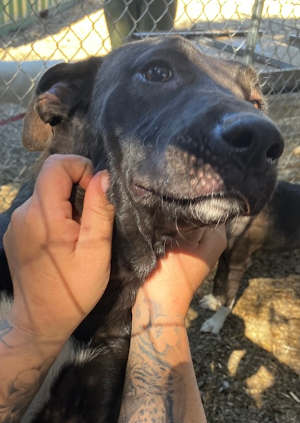
CLEARLAKE, Calif. — Clearlake Animal Control’s kennels are filled with dogs deserving a chance at new homes.
The Clearlake Animal Control website lists 48 adoptable dogs.
This week’s dogs include “Skittles,” a one and a half year old female pit bull terrier mix with a black and white coat.
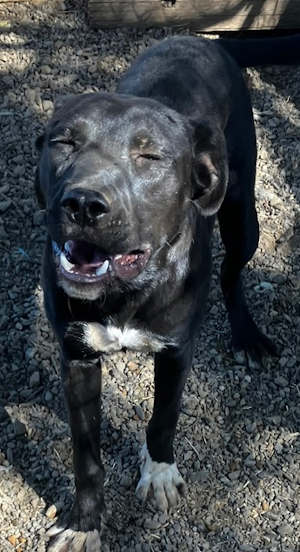
There also is “Dumbo,” a year-old male pit bull terrier with a black and white coat.
The shelter is located at 6820 Old Highway 53. It’s open from 9 a.m. to 6 p.m. Tuesday through Saturday.
For more information, call the shelter at 707-762-6227, email
This week’s adoptable dogs are featured below.
Email Elizabeth Larson at
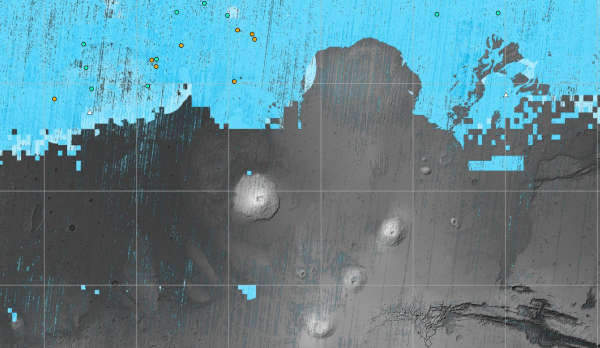
The map could help the agency decide where the first astronauts to the Red Planet should land. The more available water, the less missions will need to bring.
Buried ice will be a vital resource for the first people to set foot on Mars, serving as drinking water and a key ingredient for rocket fuel.
But it would also be a major scientific target: Astronauts or robots could one day drill ice cores much as scientists do on Earth, uncovering the climate history of Mars and exploring potential habitats (past or present) for microbial life.
The need to look for subsurface ice arises because liquid water isn’t stable on the Martian surface: The atmosphere is so thin that water immediately vaporizes.
There’s plenty of ice at the Martian poles – mostly made of water, although carbon dioxide, or dry ice, can be found as well – but those regions are too cold for astronauts (or robots) to survive for long.
That’s where the NASA-funded Subsurface Water Ice Mapping project comes in. SWIM, as it’s known, recently released its fourth set of maps – the most detailed since the project began in 2017.
Led by the Planetary Science Institute in Tucson, Arizona, and managed by NASA’s Jet Propulsion Laboratory in Southern California, SWIM pulls together data from several NASA missions, including the Mars Reconnaissance Orbiter, or MRO, 2001 Mars Odyssey, and the now-inactive Mars Global Surveyor. Using a mix of data sets, scientists have identified the likeliest places to find Martian ice that could be accessed from the surface by future missions.
Instruments on these spacecraft have detected what look like masses of subsurface frozen water along Mars’ mid-latitudes.
The northern mid-latitudes are especially attractive because they have a thicker atmosphere than most other regions on the planet, making it easier to slow a descending spacecraft.
The ideal astronaut landing sites would be a sweet spot at the southernmost edge of this region — far enough north for ice to be present but close enough to the equator to ensure the warmest possible temperatures for astronauts in an icy region.
“If you send humans to Mars, you want to get them as close to the equator as you can,” said Sydney Do, JPL’s SWIM project manager. “The less energy you have to expend on keeping astronauts and their supporting equipment warm, the more you have for other things they’ll need.”
Building a better map
Previous iterations of the map relied on lower-resolution imagers, radar, thermal mappers, and spectrometers, all of which can hint at buried ice but can’t outright confirm its presence or quantity.
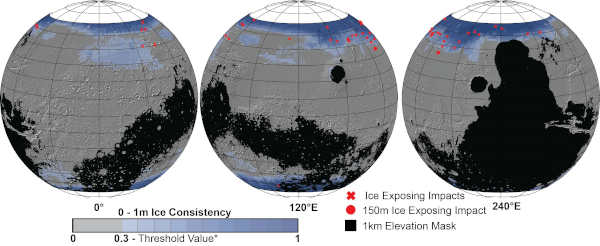
For this latest SWIM map, scientists relied on two higher-resolution cameras aboard MRO. Context Camera data was used to further refine the northern hemisphere maps and, for the first time, HiRISE (High-Resolution Imaging Science Experiment) data was incorporated to provide the most detailed perspective of the ice’s boundary line as close to the equator as possible.
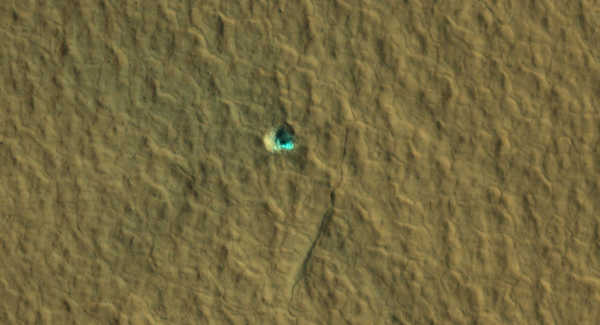
Scientists routinely use HiRISE to study fresh impact craters caused by meteoroids that may have excavated chunks of ice. Most of these craters are no more than 33 feet (10 meters) in diameter, although in 2022 HiRISE captured a 492-foot-wide (150-meter-wide) impact crater that revealed a motherlode of ice that had been hiding beneath the surface.
“These ice-revealing impacts provide a valuable form of ground truth in that they show us locations where the presence of ground ice is unequivocal,” said Gareth Morgan, SWIM’s co-lead at the Planetary Science Institute. “We can then use these locations to test that our mapping methods are sound.”
In addition to ice-exposing impacts, the new map includes sightings by HiRISE of so-called “polygon terrain,” where the seasonal expansion and contraction of subsurface ice causes the ground to form polygonal cracks. Seeing these polygons extending around fresh, ice-filled impact craters is yet another indication that there’s more ice hidden beneath the surface at these locations.
There are other mysteries that scientists can use the map to study, as well.
“The amount of water ice found in locations across the Martian mid-latitudes isn’t uniform; some regions seem to have more than others, and no one really knows why,” said Nathaniel Putzig, SWIM’s other co-lead at the Planetary Science Institute. “The newest SWIM map could lead to new hypotheses for why these variations happen.” He added that it could also help scientists tweak models of how the ancient Martian climate evolved over time, leaving larger amounts of ice deposited in some regions and lesser amounts in others.
SWIM’s scientists hope the project will serve as a foundation for a proposed Mars Ice Mapper mission — an orbiter that would be equipped with a powerful radar custom-designed to search for near-surface ice beyond where HiRISE has confirmed its presence.
On Thursday, Rep. Mike Thompson (CA-04) and Rep. Doug LaMalfa (CA-01) announced that their bipartisan bill to make settlements from the PG&E Fire Victims Trust nontaxable passed out of the Ways and Means Committee by a vote of 38-0.
“No wildfire survivors should be made to pay taxes on a settlement payment that does not even cover the full loss they experienced,” Thompson said Thursday. “Today, the Ways and Means Committee passed my bill to exempt PG&E Fire Victims Trust settlements from taxes, moving us one step closer to providing essential tax relief to fire survivors. This bill remains my top priority and I will continue to move it forward until President Biden signs it into law.”
“This legislation is critical for disaster survivors throughout the nation, from hurricane survivors in Florida to Fire Victim Trust claimants in Northern California. Wildfire survivors have waited far too long with this cloud of uncertainty over their heads, not knowing if their settlement money will be taxed. This initiative has been a top priority for my office and it has gathered broad bipartisan support. I am hopeful that Congress will quickly enact this bill into law so that wildfire survivors can have financial certainty,” said LaMalfa.
Thompson represents California’s Fourth Congressional District, which includes all or part of Lake, Napa, Solano, Sonoma and Yolo counties.
“No wildfire survivors should be made to pay taxes on a settlement payment that does not even cover the full loss they experienced,” Thompson said Thursday. “Today, the Ways and Means Committee passed my bill to exempt PG&E Fire Victims Trust settlements from taxes, moving us one step closer to providing essential tax relief to fire survivors. This bill remains my top priority and I will continue to move it forward until President Biden signs it into law.”
“This legislation is critical for disaster survivors throughout the nation, from hurricane survivors in Florida to Fire Victim Trust claimants in Northern California. Wildfire survivors have waited far too long with this cloud of uncertainty over their heads, not knowing if their settlement money will be taxed. This initiative has been a top priority for my office and it has gathered broad bipartisan support. I am hopeful that Congress will quickly enact this bill into law so that wildfire survivors can have financial certainty,” said LaMalfa.
Thompson represents California’s Fourth Congressional District, which includes all or part of Lake, Napa, Solano, Sonoma and Yolo counties.
LAKEPORT, Calif. — The Board of Supervisors is seeking applicants to fill two vacancies on the Lakeport Fire Protection District Board of Directors.
Interested applicants must reside within the Lakeport Fire Protection District’s boundary and be registered to vote in Lake County.
These appointments would be effective Jan. 2, 2024.
Applications are available at the Lake County Courthouse, Clerk of the Board Office, Room 109, 255 N. Forbes St., Lakeport, or online at www.lakecountyca.gov on the Board of Supervisors page.
The membership on the fire board is voluntary.
For additional information, please contact Assistant Clerk of the Board Johanna DeLong at 707-263-2580 orThis email address is being protected from spambots. You need JavaScript enabled to view it. .
Interested applicants must reside within the Lakeport Fire Protection District’s boundary and be registered to vote in Lake County.
These appointments would be effective Jan. 2, 2024.
Applications are available at the Lake County Courthouse, Clerk of the Board Office, Room 109, 255 N. Forbes St., Lakeport, or online at www.lakecountyca.gov on the Board of Supervisors page.
The membership on the fire board is voluntary.
For additional information, please contact Assistant Clerk of the Board Johanna DeLong at 707-263-2580 or