 How to resolve AdBlock issue?
News
Although it had been nearly 60 years since the American Revolution had ended, the compendium (now available online) listed the surviving pensioners, including widows, of that war.
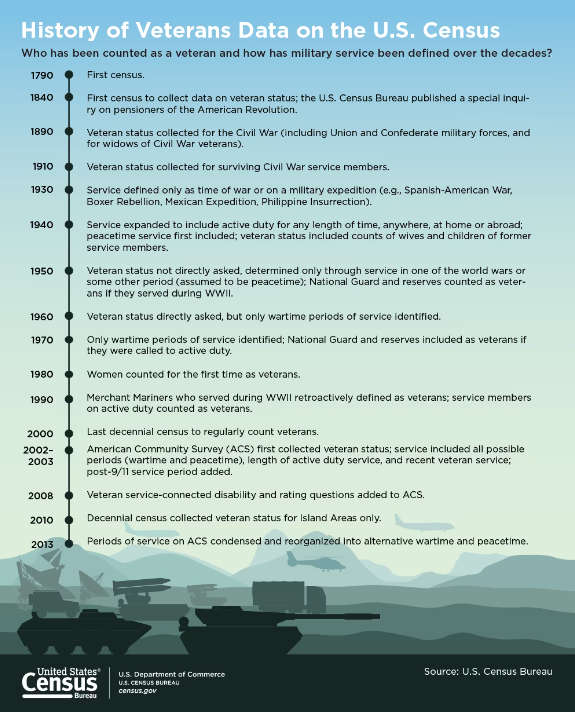
In the 18 decades that followed, the data that the Census Bureau collected about veterans continually shifted and expanded, providing a historical record of just how much the definition of military service has been redefined over centuries.
Who was counted as a veteran depended on when and where a man served in the U.S. armed forces. And, yes, for most of the nation’s history, only men were considered veterans.
It wasn’t until 50 years later, in 1890, that another census collected data on veteran status. That census identified only veterans of the Civil War and the widows of Union and Confederate ex-service members.
At that time, the main reason for classifying veterans in the United States was for determining pension eligibility. As veterans benefits expanded in the early 1900s, the importance of including veterans data in the decennial census also increased, particularly to track whether veterans were engaged in military operations or were killed in action and left surviving widows and children.
For decades, the decennial census only classified as veterans the men who served during wartime or went abroad as part of a military operation. By 1930, the definition of a veteran expanded to include men who served on military expeditions, which included the Spanish-American War (1898), Philippine Insurrection (1899–1902), Boxer Rebellion (1900–1901), and Mexican Expedition (1916–1917).
Men who served in peacetime, or who did not experience combat or service overseas, were not counted as veterans.
Major turning points in how we classified veterans
Starting in 1930, veteran questions appeared on every decennial census to varying degrees until the 2000 Census.
With the end of World War II in 1945, the nation faced a burgeoning veteran population as most of the 16.1 million men who served during the war returned to civilian life.
The influx of veterans further fueled the need for data on military service and experiences.
1940
The 1940 Census marked a significant turning point in how the Census Bureau defined and collected data on veterans.
For the first time, the census included peacetime service, specified whether a veteran had served on active duty, and in which branch, for any length of time regardless of duty location (United States or abroad).
This was the broadest definition of a veteran and military service to date. Since military pensions were still a focus, the 1940 Census included dependents of ex-service members in the count of veterans and determined the mortality status of veteran husbands and fathers.
History of veterans data on the U.S. Census
Before 1940, the decennial census had been primarily concerned with identifying how and where veterans served, and consequently counted men as veterans only if they met certain conditions (i.e., service in a specific war, branch, or military expedition).
The 1940 Census shifted the focus to who served and when they did so, including both wartime and peacetime service.
1980
The “who” of military service changed again in 1980, when the census counted women as veterans for the first time. Women had long been connected to the U.S. military, even before they could formally serve or were recognized as veterans for their service.
A report on the history of women veterans from the Department of Veterans Affairs (VA) writes that although not recognized as veterans until 1980, women served on the battlefield alongside men during the American Revolution — some even masquerading as men.
Some women served as spies during the Civil War but their main contributions were in the field of medicine.
“The nurses who served during the Spanish-American War paved the way for the creation of a permanent corps of nurses in the Army and Navy. In 1901, the Army Nurse Corps (ANC) was established,” according to the VA.
Counting women as veterans marked a major shift in the way the Census Bureau measured the veteran population. Until that point, only men were considered to be veterans regardless of the military service or experiences of women.
Today’s veterans
With the implementation of the American Community Survey (ACS) in 2005, the 2000 Census was the last decennial census to collect data on veteran status for the United States (the Census Bureau continues to collect it for the Island Areas Censuses).
The ACS further expanded the “what” and “when” of veteran status by including questions on all possible periods of service, specifying each wartime period and delineating peacetime periods. The 2022 ACS shows there are 14.5 million men and 1.7 million women veterans.
In 1950, the White population made up about 93% of veterans. Today that figure is around 74%, which reflects in part the changing racial composition of the broader U.S. population.
The ACS also collected information on:
• Length of active-duty service.
• Time of most recent service in the U.S. armed forces.
• Current active-duty service (rather than just service in the past).
• Service-connected disability status and rating of veterans who sustained an injury or became disabled because of their service.
This content, although it has changed in wording and scope, has remained the focus of veterans data at the Census Bureau since the ACS began.
In addition to the ACS, other Census Bureau surveys have expanded data collected on veterans.
The Survey of Income and Program Participation, or SIPP, is the only Census Bureau source of data on participation in VA programs and benefits.
The types of veterans data collected in SIPP include:
• Use of the GI Bill.
• Home loans secured through the VA.
• Military retirement.
• VA pension.
• Disability compensation, which are widely available to former service members, their dependents, and surviving family members of deceased veterans.
Just as earlier censuses reflect the changing definition of a veteran, today’s data on disability, pensions and other VA benefits reflect the need to better understand not just who veterans are, but their health and well-being.
As military service, roles and experiences continue to evolve, the Census Bureau will continue to adapt its data collection to better understand the changing needs of the men and women who serve in America’s armed forces.
Jonathan Vespa is a demographer in the U.S. Census Bureau’s Social, Economic, and Housing Statistics Division.
This semiannual event promotes safe and responsible off-highway vehicle, or OHV, recreation across California's dedicated OHV public lands.
This year’s theme is “Be the Off-Road Hero,” and OHV enthusiasts can be heroes by following safety protocols and protecting the state’s natural resources.
“Being a hero usually exemplifies the best qualities in all of us,” said Off-Highway Motor Vehicle Recreation Division, or OHMVR, Division Chief Callan McLaughlin. “To ‘Be the Off-Road Hero’ really means to be the example and set the standard for others to follow while recreating safely and responsibly in our beautiful off-highway vehicle areas.”
The fall OHV Safety Week provides an excellent opportunity for all riders, both experienced and newcomers, to enhance their knowledge, skills, and awareness of safe OHV practices by taking safety courses and following simple rules. Training to be an Off-Road Hero starts with:
• Be visible: Use a whip and flag, wear high-visibility clothing, and practice trail etiquette.
• Suit up: Wear a properly fitted helmet, chest protector, knee guards, and all recommended safety equipment.
• Train now for a better tomorrow: Take a free safety class, which can help you become a more experienced rider.
During this year’s OHV Safety Week, several state vehicular recreation areas, or SVRAs, will host free safety training classes for OHV riders.
Clay Pit, Carnegie, Heber Dunes, Ocotillo Wells, and Prairie City SVRAs will host several all-terrain vehicle, or ATV, classes.
Additionally, recreational OHV courses will also be available at Prairie City and Hungry Valley SVRAs. Dirt bike school classes will be available at Carnegie, Hollister Hills, Hungry Valley and Prairie City SVRAs.
For those interested in participating in these free classes, schedules and sign-up information is available on the California Outdoor Recreation Foundation website. Check with the SVRAs for updated course schedules.
The Bureau of Land Management will host several OHV safety and information booths at the:
• Indian Valley Management Area at the staging area on Saturday, Nov. 11.
• Knoxville Management Area from Nov. 16 to 17 at 2 p.m., join BLM staff to ride the trails and hear feedback on vital route assessment at the Hunting Creek Campground.
Working together with the Tread Lightly! Initiative, California Highway Patrol, California Outdoor Recreation Foundation, Specialty Vehicle Institute of America, ATV Safety Institute (ASI), Recreational Off-Highway Vehicle Association (ROHVA), Motorcycle Industry Council, Motorcycle Safety Foundation (MSF) and BLM, the OHMVR Division has been providing a mix of safety messages and activities during the OHV safety awareness weeks, using park interpretive programs, in-person events, and safety messaging via various social media platforms. Additionally, ASI, ROHVA, and MSF have teamed up with the division to provide free dirt bike, ATV, and recreational OHV training.
In October 2020, the California OHMVR Commission passed a resolution dedicating two weeks of the year to promote and focus on safe and responsible OHV practices.
California’s OHMVR Program was created in 1971 out of the critical need to better manage the growing demands for OHV recreation, while fostering respect for private property rights and protecting the state’s natural and cultural resources.
Today, there are nine SVRAs across California: Carnegie, Clay Pit, Eastern Kern County Onyx Ranch, Heber Dunes, Hollister Hills, Hungry Valley, Oceano Dunes, Ocotillo Wells, and Prairie City.
These public lands provide recreational opportunities on approximately 145,000 acres of lands with more than 600 miles of designated OHV trails and terrain.
Some SVRAs also feature camping, swimming, and other recreational opportunities. A variety of wildlife, sensitive habitats, plants, and animal species call them home.
The OHMVR program also supports safe and responsible OHV recreation beyond the State Park System. Since 1971, more than $803 million in grants, managed by the OHMVR Division, have been awarded to federal and local partners, funding acquisition and development, resource protection, safety and education, and law enforcement for OHV recreation.
For more information about the OHMVR Division, including grant opportunities, please visit https://ohv.parks.ca.gov/.
The four agencies — the U.S. Department of the Interior, the Environmental Protection Agency, the U.S. Department of Agriculture, and the Centers for Disease Control and Prevention — also released a joint plan outlining wildland fire-related priorities the agencies will focus on over the next two years.
"This year has shown the entire country and the world that wildfires don’t stop at a state or country line – they impact all of us and require a coordinated and collaborative approach,” said Secretary of the Interior Deb Haaland. “The Biden-Harris administration is committed to using every tool available to protect communities from the hazards of wildfire smoke, while also ensuring we have the tools we need to reduce the future risk of large, high severity wildfire events.”
“From coast to coast, the nation is facing a growing threat of wildfire induced by climate change, including from the smoke that can harm people hundreds of miles away,” said EPA Administrator Michael S. Regan. “We can have a bigger impact on protecting people by partnering across the Biden-Harris Administration. “With today’s interagency agreement we commit to urgent action to reduce the risk of severe wildfires and dangerous smoke.”
“Since fires and smoke don’t recognize borders or jurisdictions, neither should we, and this agreement will help agencies under the Biden-Harris Administration better protect the people and communities we serve,” said Agriculture Secretary Tom Vilsack.
“The increasing frequency and magnitude of wildfires pose an ever-growing threat to the health of the American public,” said Mandy Cohen, M.D., M.P.H, Director of the Centers for Disease Control and Prevention. “This MOU demonstrates the U.S. government’s commitment to mitigating the negative health consequences from wildfire smoke and is a pledge to protect health by reducing the risk of future, large-scale wildfires.”
The MOU outlines how the agencies are working together to advance public health preparedness, minimize smoke impacts to the public and ensure regulatory pathways under the Clean Air Act accommodate greater use of prescribed fire.
Under the MOU, the four agencies commit to coordinating the implementation of policies, communications, and programs that relate to the use of prescribed fire to benefit restoration of forests and other wildlands, and protect communities. T
he agencies will work together to reduce the negative health impacts of smoke on human health and community well-being.
The joint workplan outlines areas of focus for the agencies’ partnership for fiscal years 2024 and 2025:
• community preparedness;
• ensuring that land management and public health goals are addressed together;
• data collection and sharing; and
• interagency communication and messaging.
The MOU and workplan follow the recent Wildland Fire Mitigation and Management Commission Report to Congress, which urged an “all of the above” approach — at all levels of society — to address the impacts of wildfires on communities across the country. While many of the Commission’s recommendations focus on actions Congress must take, this MOU represents a major step forward to the report’s vision of greater coordination and collaboration among agencies working on wildfire.
This work complements the historic investments from President Biden’s Investing in America agenda to increase the resilience of lands facing the threat of wildland fires and to better support federal wildland firefighters.
The Bipartisan Infrastructure Law includes $1.5 billion for the Department of the Interior and $3 billion for the USDA to invest in preparedness, fuels management, post-fire restoration, and fire science – all of which will help strengthen long-term fire preparedness, reduce fire risk across states, and invest in our wildland firefighter workforce.
To read the MOU and the joint workplan, visit USDA’s website.
To read the Wildland Fire Mitigation and Management Commission report, visit USDA’s website.

The cars, cellphones, computers and televisions that people in the U.S. use every day require metals like copper, cobalt and platinum to build. Demand from the electronics industry for these metals is only rising, and companies are constantly searching for new places on Earth to mine them.
Scientists estimate that lots of these metals exist thousands of miles beneath Earth’s surface, in its molten core, but that’s far too deep and hot to mine. Instead, some companies hope to one day search for deposits that are literally out of this world — on asteroids.
The commercialization of asteroid mining is still a ways off, but in October 2023, NASA launched a scientific mission to explore the metal-rich asteroid Psyche. The main goal of the mission is studying the composition and structure of this asteroid, which could tell scientists more about Earth’s core since the two objects might have a similar makeup.
Both likely contain platinum, nickel, iron and possibly even gold – materials of commercial interest.
I am a planetary geologist whose work explores other planets and astronomical objects like Mars, Venus and the Moon. I will be following the Psyche mission closely, as this is the first time that scientists will be able to learn about the composition and structure of a possible piece of a planetary core similar to the Earth’s, without indirect seismic or magnetic measurements, or replicating the pressure and temperature conditions of the Earth’s core in our labs.
With the spacecraft estimated to arrive at the asteroid’s orbit in 2029, the findings from the Psyche mission will provide unique insights into the type of metals present on the asteroid’s surface, as well as their amount, and the minerals containing these metals. This data is essential both for scientists like me exploring the formation and evolution planetary bodies, as well as for companies investigating the possibility of asteroid mining.
Asteroid formation
Asteroids come in a variety of sizes. Some are the size of a town, while others are the size of a state. Most asteroids are made of rocks and represent the leftovers from the early formation of our solar system around 4.6 billion years ago.

Not every asteroid is the same – some, like Bennu, the target of NASA’s OSIRIS-REx mission, are rich in carbon. These are very old, and they will teach scientists more about how planets formed and how life may have begun on Earth.
Others, like Psyche, are made of metals and potentially result from one or more collisions between astronomical objects when the solar system was forming. These collisions left debris flying through space — including potential pieces of a planet’s metal-rich core. A NASA spacecraft will orbit and analyze the surface of Psyche.
Mining in space
Not every mineral deposit on Earth is mineable. Companies first look for deposits with a high level of metal purity. They also investigate how affordable and feasible extracting the metal would be before choosing where to mine.
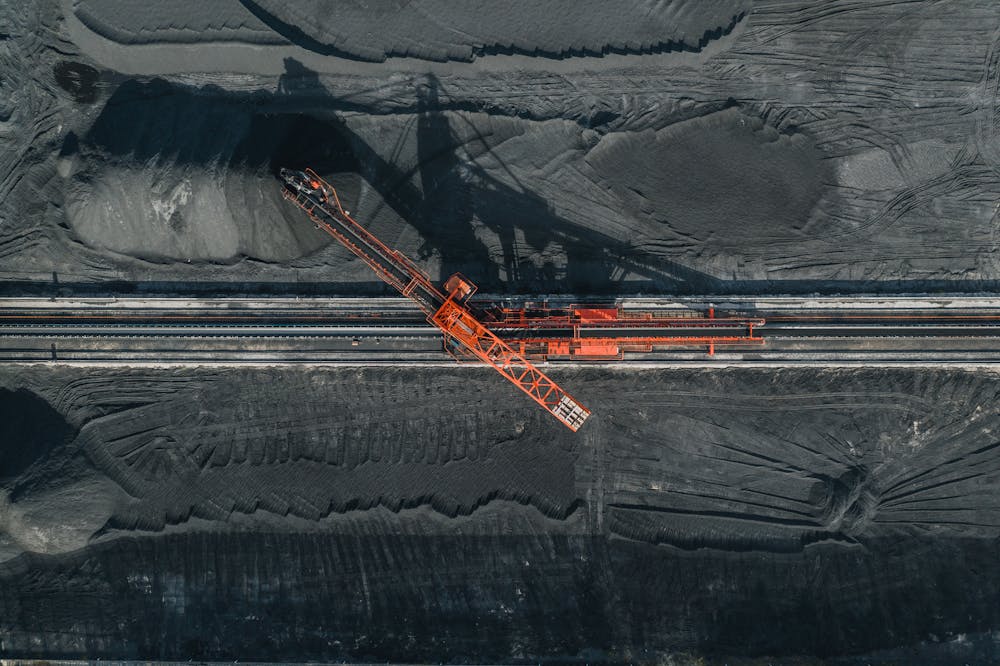
Similarly, before mining an asteroid, companies will have to think about all those factors, and they’ll have to come up with the infrastructure needed to mine at a distance and transport the metals they mine hundreds of millions of miles back to Earth. The technology to do that is still years away, and transporting metals would require major funding.
A few companies around the world have already started to think about what the best and lowest cost approach would be, drawing from processes similar to those used on Earth.
The first step would be finding a mineable metal deposit. Next, they’d drill and extract the metals on the asteroid. One of the most important differences with Earth mines is that each step would be undertaken remotely with spacecrafts orbiting around the asteroid and robots landing on its surface. Then, a spacecraft would send the resulting materials back to Earth.
Asteroid mining plans are still at their earliest stages. A few companies like Planetary Resources and Deep Space Industries, with goals to extract metals from space, were acquired by other companies.
Experts can’t quite tell yet how acquiring valuable metals from asteroids would affect the global economy, but these metals could potentially flood the market and lower their values.
The Psyche mission is a huge step in figuring out what sort of metals are out there, and it may also answer questions about the composition and properties of Earth’s core.
Valerie Payré, Assistant Professor of Earth and Environmental Sciences, University of Iowa
This article is republished from The Conversation under a Creative Commons license. Read the original article.
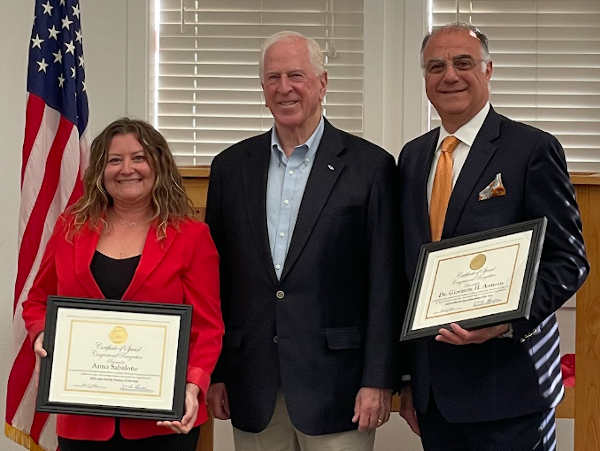
UPPER LAKE, Calif. — Two outstanding Lake County educators recently received a visit from Congressman Mike Thompson, who honored them for achievements in their field.
On Monday, Oct. 30, Congressman Mike Thompson presided over a ceremony honoring Upper Lake Unified School District’s Superintendent Dr. Giovanni Annous and Dean of Students Anna Sabalone for their extraordinary achievements in service to the district and the Northshore Community.
Both received a “Certificate of Special Congressional Recognition” presented by Thompson.
Dr. Annous was recently recognized by the Small School Districts Association as 2023 California Superintendent of the Year, and Sabalone was recognized as 2023 Lake County Teacher of the Year.
During the event, Congressman Thompson praised the efforts of Dr. Annous for implementing positive change while solidifying a strong sense of community and belonging at the district.
He noted that Dr. Annous’ dedication to excellence in educational leadership and for his going above and beyond for students every day.
Congressman Thompson also hailed his support of empowering the next generation of adults.
In addition to the accolades directed to Dr. Annous, Sabalone also was congratulated on her various achievements as a teacher in the district, having taught and shepherded students of the Northshore for nearly 20 years.
Sabalone, a very creative artist at heart, would lead her students from the linear to the abstract as applied to both thinking and artistic talent.
Well respected by her peers and the Northshore Community, Sabalone embodies education excellence.
After the presentation of the Congressional Recognition certificate, Dr. Annous thanked the Congressman for his support in the arena of education and his dedication to those in his district.
Annous continued and thanked Lake County Supervisor Eddie (EJ) Crandell for his support over the years, working on behalf of students to increase services and provide access for all students.
Dr. Annous also thanked the Habematolel-Pomo of Upper Lake and Robinson Rancheria for their partnership over the years, whether it had been in the area of facility and program improvements, as well as student engagement.
In attendance were Upper Lake Unified School District Board President Diane Plante and Vice President Joanne Breton, and Lake County Office of Education Superintendent Brock Falkenberg, who received recognition from Dr. Annous for their support and continued service to the public of Lake County.
Sabalone expressed her gratitude for her fellow staff members and the school district’s administration for supporting her over the years she had been teaching, and commented further about how she had benefited from the core friendships she had established during her tenure.
Annous thanked the school district staff and community noting that none of the achievements would have been possible without their support. Although a laborious journey, he said it was one of camaraderie with a focus on community and collective growth.
The ceremony concluded with a quick word by Plante and Breton who said that they weren’t completely surprised at the recognition as it was simply an acknowledgment of what the school board had known for years.
They closed by expressing their gratitude for the servant leadership they provide, not only to the school community, but also to the greater community of Lake County.

CLEARLAKE, Calif. — Clearlake Animal Control has new dogs ready for new homes this week.
The Clearlake Animal Control website lists 48 adoptable dogs.
This week’s dogs include “Jupiter,” a male German shepherd mix with a black and tan coat.

Another adoptable dog is “Truffles,” a German shepherd mix with a brown brindle coat.
The shelter is located at 6820 Old Highway 53. It’s open from 9 a.m. to 6 p.m. Tuesday through Saturday.
For more information, call the shelter at 707-762-6227, email
This week’s adoptable dogs are featured below.
Email Elizabeth Larson at