 How to resolve AdBlock issue?
News
The council will meet Tuesday, Nov. 21, at 5 p.m. for a special meeting, to be followed by its regular meeting at 6 p.m. in the council chambers at Lakeport City Hall, 225 Park St.
The agenda can be found here.
The council chambers will be open to the public for the meeting. Masks are highly encouraged where 6-foot distancing cannot be maintained.
If you cannot attend in person, and would like to speak on an agenda item, you can access the Zoom meeting remotely at this link or join by phone by calling toll-free 669-900-9128 or 346-248-7799.
The webinar ID is 973 6820 1787, access code is 477973; the audio pin will be shown after joining the webinar. Those phoning in without using the web link will be in “listen mode” only and will not be able to participate or comment.
Comments can be submitted by email to
During the special meeting beginning at 5 p.m., Lakeport Police Chief Brad Rasmussen will present a Citizen Commendation to Dalton Harris in recognition of exceptional efforts to enhance the quality of life in our community.
The council also will consider reappointing incumbent George Spurr to a four-year term on the Lake County Vector Control District Board effective Jan. 1, 2024, and expiring Dec. 31, 2027.
In other business, the council will interview applicants and appoint one member to the Lakeport Fire Protection District Board and three members to the Lakeport Economic Development Advisory Committee, or LEDAC.
At the regular meeting beginning at 6 p.m., City Manager Kevin Ingram will present a resolution confirming the fulfillment of all provisions outlined in the memorandum of understandings, dated Jan. 11, 2011, and July 19, 2011, between the Judicial Council of California and the city of Lakeport in connection with the development of the new Lake County Superior Courthouse to be located at 675 Lakeport Blvd.
Also on Tuesday, Utilities Director Paul Harris will give the council an update on the continuing efforts to identify and mitigate Inflow and Infiltration in the city’s wastewater collection system.
On the consent agenda — items considered noncontroversial and usually accepted as a slate on one vote — are ordinances; minutes of the Nov. 7 council meeting; approval of amendment to application 2023-020, with staff recommendations, to operate a sled hill on Second Street, between Forbes and Main, in conjunction with the Dickens’ Festival; adoption of an ordinance repealing and replacing Section 17.17.080 of Chapter 17.17 of Title 17 of the Lakeport Municipal Code regarding the time limit for Planned Development Combining Districts; and approval of the side letter agreement for the city of Lakeport Police Officers’ Association amending section 6.18 of the MOU regarding premium pay for detective trainee work.
Email Elizabeth Larson at
At its meeting on Nov. 9, the board — which oversees both Yuba and Woodland community colleges — unanimously approved the appointment of Patricia Barba as the Lake County Campus’ interim dean.
She succeeds Dean Ingrid Larson, who left in September for a job at Mendocino College.
Barba will receive an annual salary of $113, 774.
The position continues until May 10, 2024.
At the same meeting, the board also unanimously approved other appointments for Woodland Community College, including Geoffrey Hulbert as director of Department of Supportive Programs and Services and Caren Fernandez as the interim assignment for acting director of matriculation and EOPS/CARE Program.
Email Elizabeth Larson at
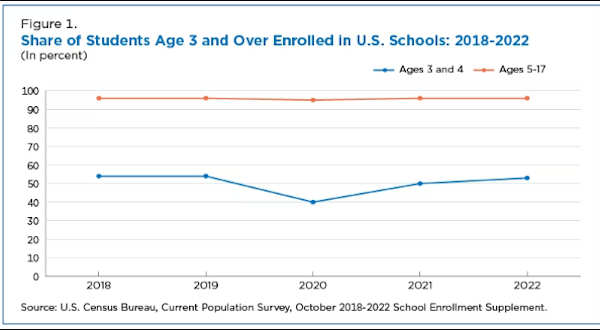
The COVID-19 pandemic transformed many parents’ home and work lives, with some changes like shuttered schools and remote learning leading to a drop in enrollment of children ages 3 and 4.
But new data show enrollment has started to bounce back to pre-pandemic levels.
Non-Hispanic Black 3- and 4-year-olds experienced higher enrollment levels (61.7%) in 2022 than in the four previous years, despite a slow enrollment recovery.
The 2022 Current Population Survey (CPS) shows that the share of 3- and 4-year-olds enrolled in all U.S. schools, both federally funded and private, increased by 13.0 percentage points from 40.3% in 2020, the first year of the pandemic, to 53.3% in 2022 when the pandemic emergency ended (Figure 1).
There was a smaller change in enrollment of students ages 5 to 17 during that period.
In this article, we focus on changes in school enrollment of children ages 3 and 4.
The share of these children enrolled in school in 2022 was up by 2.9 percentage points from 2021 and 13.0 percentage points from 2020. School enrollment for this group in 2022 was not statistically different than it was in 2018 and 2019.
Hispanic 3- and 4-year-old enrollment
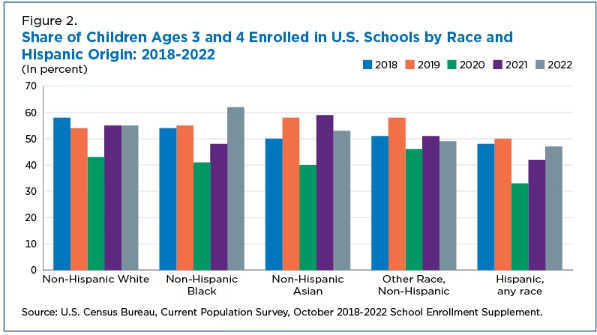
Figure 2 shows the share of 3- and 4-year-olds enrolled in school by race and Hispanic origin between 2018 and 2022.
Enrollment among Hispanic 3- and 4-year-olds of any race decreased by 16.8 percentage points between 2019 and 2020 but fully recovered from 2020 to 2022 when enrollment increased by 14.4 percentage points.
Hispanic 3- and 4-year-olds had an enrollment rate of 47.4% in 2022, which was not statistically different from 2021.
Non-Hispanic Black 3- and 4-year-olds
Another large enrollment decline during the pandemic was for non-Hispanic Black 3- and 4-year-olds.
In 2020, 40.9% were enrolled, 14.1 points lower than in 2019 and 20.8 points lower than in 2022.
Non-Hispanic Black 3- and 4-year-olds experienced higher enrollment levels (61.7%) in 2022 than in the four previous years, despite a slow enrollment recovery.
Non-Hispanic white 3- and 4-year-olds
Enrollment of non-Hispanic White 3- and 4-year-olds dropped by 11.0 percentage points between 2019 and 2020. But it rebounded and fully recovered with an 11.2 percentage point increase from 2020 to 2022.
Other race, non-Hispanic 3- and 4-year-olds
Enrollment of Other Race, non-Hispanic 3- and 4-year-olds did not make a statistically significant recovery since 2020. It was 46.4% in 2020, down from 57.9% in 2019. Enrollment inched up to 49.1% in 2022, which was not statistically different from the four years prior.
Definitions and more information on confidentiality protection and sampling and nonsampling error are available in the technical documentation. All comparative statements in this story have undergone statistical testing and, unless otherwise noted, are statistically significant at the 10% significance level.
Adrienne Griffiths is a survey statistician in the Census Bureau’s Social, Economic, and Housing Statistics Division.
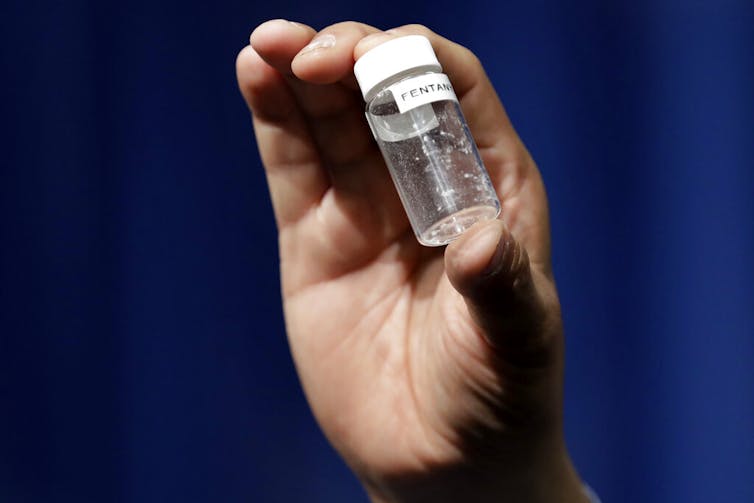
Buying drugs on the street is a game of Russian roulette. From Xanax to cocaine, drugs or counterfeit pills purchased in nonmedical settings may contain life-threatening amounts of fentanyl.
Physicians like me have seen a rise in unintentional fentanyl use from people buying prescription opioids and other drugs laced, or adulterated, with fentanyl. Heroin users in my community in Massachusetts came to realize that fentanyl had entered the drug supply when overdose numbers exploded. In 2016, my colleagues and I found that patients who came to the emergency department reporting a heroin overdose often only had fentanyl present in their drug test results.
As the Chief of Medical Toxicology at UMass Chan Medical School, I have studied fentanyl and its analogs for years. As fentanyl has become ubiquitous across the U.S., it has transformed the illicit drug market and raised the risk of overdose.
Fentanyl and its analogs
Fentanyl is a synthetic opioid that was originally developed as an analgesic – or painkiller – for surgery. It has a specific chemical structure with multiple areas that can be modified, often illicitly, to form related compounds with marked differences in potency.
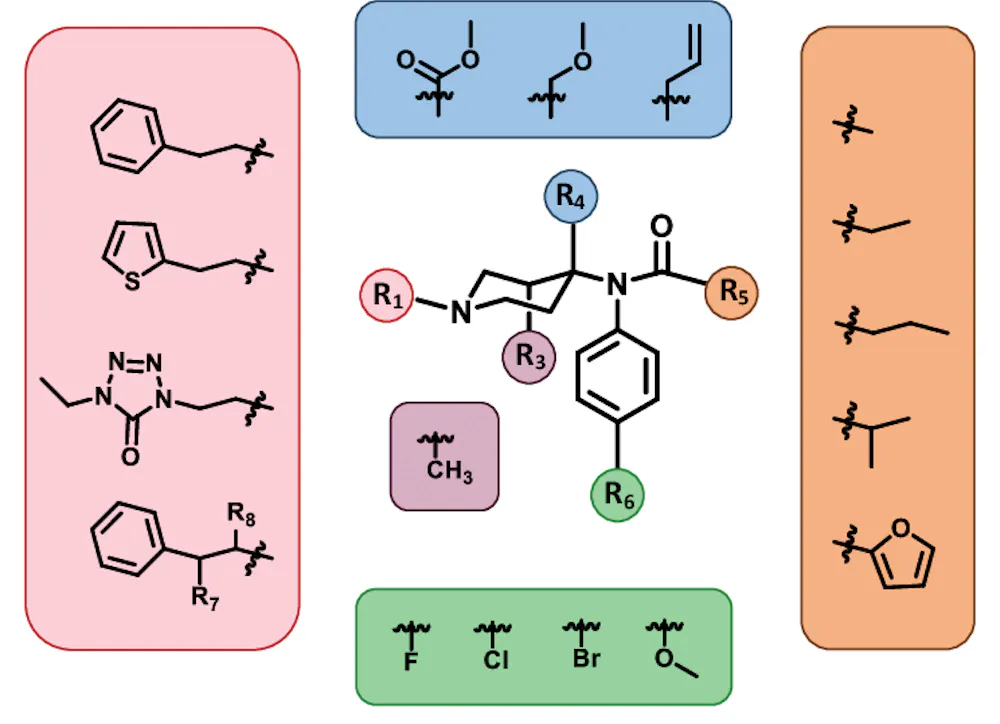
For example, carfentanil, a fentanyl analog formed by substituting one chemical group for another, is 100 times more potent than its parent structure. Another analog, acetylfentanyl, is approximately three times less potent than fentanyl, but has still led to clusters of overdoses in several states.
Despite the number and diversity of its analogs, fentanyl itself continues to dominate the illicit opioid supply. Milligram per milligram, fentanyl is roughly 50 times more potent than heroin and 100 times more potent than morphine.
Lacing or replacing drugs with fentanyl
Drug dealers have used fentanyl analogs as an adulterant in illicit drug supplies since 1979, with fentanyl-related overdoses clustered in individual cities.
The modern epidemic of fentanyl adulteration is far broader in its geographic distribution, production and number of deaths. Overdose deaths roughly quadrupled, going from 8,050 in 1999 to 33,091 in 2015. From May 2020 to April 2021, more than 100,000 Americans died from a drug overdose, with over 64% of these deaths due to synthetic opioids like fentanyl and its analogs.
Illicitly manufactured fentanyl is internationally synthesized in China, Mexico and India, then exported to the United States as powder or pressed pills. China also exports many of the precursor chemicals needed to synthesize fentanyl.
Additionally, the emergence of the dark web, an encrypted and anonymous corner of the internet that’s a haven for criminal activity, has facilitated the sale of fentanyl and other opioids shipped through traditional delivery services, including the U.S. Postal Service.
During the 2023 Asia-Pacific Economic Cooperation summit, U.S. President Joe Biden and Chinese President Xi Jinping reached an agreement to combat fentanyl trafficking.
Fentanyl is both sold alone and often used as an adulterant because its high potency allows dealers to traffic smaller quantities but maintain the drug effects buyers expect. Manufacturers may also add bulking agents, like flour or baking soda, to fentanyl to increase supply without adding costs. As a result, it is much more profitable to cut a kilogram of fentanyl compared to a kilogram of heroin.
Unfortunately, fentanyl’s high potency also means that even just a small amount can prove deadly. If the end user isn’t aware that the drug they bought has been adulterated, this could easily lead to an overdose.
Preventing fentanyl deaths
As an emergency physician, I give fentanyl as an analgesic, or painkiller, to relieve severe pain in an acute care setting. My colleagues and I choose fentanyl when patients need immediate pain relief or sedation, such as anesthesia for surgery.
But even in the controlled conditions of a hospital, there is still a risk that using fentanyl can reduce breathing rates to dangerously low levels, the main cause of opioid overdose deaths. For those taking fentanyl in nonmedical settings, there is no medical team available to monitor someone’s breathing rate in real time to ensure their safety.
One measure to prevent fentanyl overdose is distributing naloxone to bystanders. Naloxone can reverse an overdose as it occurs by blocking the effects of opioids.
Another measure is increasing the availability of opioid agonists like methadone and buprenorphine that reduce opioid withdrawal symptoms and cravings, helping people stay in treatment and decrease illicit drug use. Despite the lifesaving track records of these medications, their availability is limited by restrictions on where and how they can be used and inadequate numbers of prescribers.
Other strategies to prevent overdose deaths include lowering the entry barrier to addiction treatment, fentanyl test strips, supervised consumption sites and even prescription diamorphine (heroin).
Despite the evidence supporting these measures, however, local politics and funding priorities often limit whether communities are able to give them a try. Bold strategies are needed to interrupt the ever-increasing number of fentanyl-related deaths.
This article was updated on Nov. 16, 2023 to note developments regarding fentanyl at the Asia-Pacific Economic Cooperation summit.
Kavita Babu, Professor of Emergency Medicine, UMass Chan Medical School
This article is republished from The Conversation under a Creative Commons license. Read the original article.
At its Nov. 7 meeting, the Lakeport City Council approved a professional services agreement with Vanir for the study, which will be funded by the Permanent Local Housing Allocation program.
Assistant City Manager/Finance Director Nick Walker’s written report explained that navigation centers “are emerging as a promising approach to addressing homelessness in many communities,” offering temporary shelter, social services, and support designed to help individuals transition from homelessness to more stable and permanent housing situations.
“By providing a safe and welcoming environment, Navigation Centers aim to bridge the gap between homelessness and permanent housing, offering a path to stability and self-sufficiency,” he wrote.
Walker told the council at the meeting, “We’ve been discussing homelessness and how complicated and complex that issue is, not just in the city of Lakeport, but statewide, nationwide.”
He said the city’s plan for awhile has been to start with developing a navigation center. That process begins with a request for proposals to develop the center, Walker said.
He said they received two proposals for the work, noting it’s a relatively new industry.
The grant’s five-year plan includes a feasibility study and predevelopment costs that will be fully covered by Permanent Local Housing Allocation funding, according to Walker, who reported that the city has so far received $369,896 for the first three years of the program. He said they plan to apply for additional funds.
Key aspects of the study include assessing need, identifying potential sites, engaging stakeholders, conducting a financial analysis, developing a program plan, assessing potential impacts and providing recommendations.
“I think it’s important to discuss why we’re recommending a much higher consulting cost than the low bid or low proposal,” said Walker.
Walker said it was clear to the review committee that the level of service that was being offered by the second firm wasn’t comparable to Vanir. He added that it wasn’t easy to recommend something that’s five times the price.
However, Walker said city staff believe that in the long run they will be able to go from this study straight to implementation of a project.
City Manager Kevin Ingram said the selection committee took the matter of the higher cost very seriously, noting Vanir can get them closer to shovel ready.
Councilmember Kim Costa said the proposal makes sense.
“This is a huge project,” she said, noting the city is rolling up its sleeves and getting to work.
Mayor Pro Tem Michael Froio agreed, adding that cities up and down California are trying to find ways to address homelessness.
He said Lakeport’s leadership isn’t just trying to get a navigation center project done in the city but doing it in a way that fits the small and unique community.
District 4 Supervisor Michael Green also voiced his support for the study.
The council voted 5-0 to approve the selection of Vanir to conduct the navigation study.
During the Nov. 7 meeting, the council held a public hearing to discuss a proposed zoning ordinance amendment regarding the time limit for planned development combining district and set a second reading for Nov. 21; approved a $28,740 bid from CR Fence Co. Inc. dba Humboldt Fence Co. for the Xabatin Park fencing; and approved an agreement for a grant with the Department of Alcoholic Beverage Control.
Email Elizabeth Larson at
The text of the proclamation and a copy can be found below.
During Native American Heritage Month, California recognizes and honors the first people to call this state and nation home, while also committing to the personal, collective and institutional work we must continue to embrace as we create a California that respects, values and uplifts Native peoples.
Over the course of the last year, we celebrated the unveiling of a new monument to California Native peoples on the grounds of the State Capitol, witnessed the validation of the Indian Child Welfare Act from the nation’s highest court and felt every emotion with the conclusion of Reservation Dogs. We also saw California tribal nations leading the state in historic efforts to address climate change, launch state-of-the art cultural centers and compel institutions to once and for all return Native ancestors to their lands and communities. These milestones are all testaments to the power of shifting the narrative, making space for Native people to determine their own place in our collective culture and elevating the Native experience in the story of California.
While we celebrate these achievements with Indian Country, we remind ourselves that they are but small signs of goodwill and progress in the journey toward truth and healing. Native people in California have been advocating for greater space, voice and understanding for hundreds of years—during which time their communities and cultures have been actively erased, displaced and painted over. Peoples that long predate even the concept of “California” have fought to keep languages and families intact in the face of ongoing waves of settlement of this place. This month, it is our task to reflect on our knowledge gaps and fully educate ourselves on the histories, cultures and governments of the first peoples of this place in order to codesign a future that elevates Native voices and experiences where many of our predecessors sought their eradication.
If the only time we reflect on the Native Peoples of the United States is during the month of November, we are selling ourselves—and Native peoples—far too short. It is incumbent on all Californians to remind ourselves of the price Native peoples had to—and continue to—pay as a result of centuries of oppression and the settlement of California beaches, grasslands and mountains. We owe it to them to better understand, acknowledge and elevate their place as the first peoples of these lands.
This Native American Heritage Month, I challenge all Californians to commit to the lifelong process of learning more about the diverse Native peoples in California as we work toward truth, justice and accountability for all.
NOW THEREFORE I, GAVIN NEWSOM, Governor of the State of California, do hereby proclaim November 2023, as “Native American Heritage Month.”
IN WITNESS WHEREOF I have hereunto set my hand and caused the Great Seal of the State of California to be affixed this 18th day of November 2023.
GAVIN NEWSOM
Governor of California
ATTEST:
SHIRLEY N. WEBER, Ph.D.
Secretary of State