 How to resolve AdBlock issue?
News
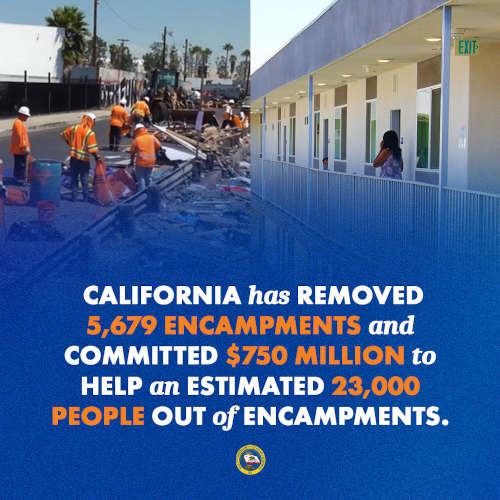
To date, California has remediated 5,679 encampments in the state right-of-way and has provided $415 million to locals to move people from encampments into housing and get those encampments cleaned up.
Now, the state is making an additional $299 million available to locals to build on the state’s progress and assist an estimated 10,000 individuals experiencing homelessness.
Half of the new grants will be prioritized for encampments on the state right-of-way, helping to make sure the state’s highways remain safe and secure for everyone.
“Since day one, combatting homelessness has been a top priority. Encampments are not safe for the people living in them, or for community members around them. The state is giving locals hundreds of millions of dollars to move people into housing and clean up these persistent and dangerous encampments. And we are doing the same on state land, having removed 5,679 encampments since 2021,” said Gov. Gavin Newsom.
The California Interagency Council on Homelessness, or Cal ICH, is now accepting applications for the $299 million in grants.
These competitive grants are available to cities, counties and continuums of care, and applications will be accepted on a rolling basis until June 30, 2024, or until funds are exhausted.
To date, 66 communities have been awarded $414 million from the fund since its inception in 2021.
“Housing is the solution to homelessness, and these grants will help our local partners assist their unhoused neighbors move from dangerous and unsightly encampments into safe and stable places they can call home,” said Cal ICH Executive Officer Meghan Marshall.
In just the past two-plus years, Caltrans has cleared nearly 5,700 encampments throughout the state while working in partnership with local communities to address the needs of individuals prior to clearing a site.
“Through the Encampment Resolution Grants, Caltrans is working to connect people experiencing homelessness on its right-of-way to more secure and stable housing situations offered by local partners,” said Alisa Becerra, Caltrans Deputy Division Chief, Office of Homelessness and Encampments, Division of Maintenance. “The strength of this effort relies on collaboration, trust, and a shared commitment to creating real solutions that help the people who need it most.”
The Encampment Resolution Fund was designed by Gov. Newsom and the Legislature to provide communities of all sizes with the funding to provide supportive services to people living in encampments and help them move into housing, reflecting California’s nation-leading commitment to find innovative solutions to addressing the tragedy of homelessness.
In total, the administration has budgeted $750 million to help an estimated 23,000 individuals living in dangerous conditions on our streets without shelter.
For more details on encampment grants and to apply for these funds, click here.
LAKE COUNTY, Calif. — The Board of Supervisors this week will return to a discussion of once again providing funds to buy the Kelseyville Senior Center building, and also will offer a proclamation to an individual who saved a teenager at Lakeport Unified.
The board will meet beginning at 9 a.m. Tuesday, Nov. 28, in the board chambers on the first floor of the Lake County Courthouse, 255 N. Forbes St., Lakeport.
The meeting can be watched live on Channel 8, online at https://countyoflake.legistar.com/Calendar.aspx and on the county’s Facebook page. Accompanying board documents, the agenda and archived board meeting videos also are available at that link.
To participate in real-time, join the Zoom meeting by clicking this link.
The meeting ID is 894 4656 8969, pass code 306404. The meeting also can be accessed via one tap mobile at +16699006833,,89446568969#,,,,*306404#.
In an item timed for 1 p.m., the board will consider Supervisor Jessica Pyska’s proposal to purchase the Kelseyville Senior Center, located at 5245 Third St., then lease it back to Kelseyville Seniors Inc.
In 2002, the county provided funds to allow the nonprofit that runs the senior center to purchase it providings $165,000 for the purchase and $35,000 for renovations, as Lake County News has reported.
County staff is recommending the board now go forward with buying the site contingent on approval of the general plan conformity report by the Planning Commission on Dec. 14, and also consider a lease agreement with Kelseyville Seniors Inc.
The proposed contract says the purchase price is $117,795, which will come from American Rescue Plan Act. In the 2022-23 budget, the county had included $700,000 for renovating the building.
“The community of Kelseyville is one of the few major communities in Lake County which does not have a full-scale senior citizens center. The current ‘center’ is a very small County-owned building which contains space for little more than an office. There are limited food services provided at this facility,” said the memo to the board from County Administrative Officer Susan Parker and Assistant County Administrative Officer Stephen Carter.
Their memo goes on to state, “Administration has been working diligently with Kelseyville Senior Center Inc. to ensure the purchase, and subsequent lease agreement, to allow for a seamless transition with no loss of services. The purchase of the Kelseyville Senior Center will allow for the development of a sustainable senior citizens center which would serve the entire Kelseyville area, including the Rivieras, Buckingham and portions of Cobb.”
In other business on Tuesday, at 9:08 a.m. the board will present a proclamation commending Billy Roberson for heroic actions in saving the life of a teenager at Lakeport Unified School District.
The full agenda follows.
CONSENT AGENDA
5.1: a) Waive the formal bidding process, subject to Lake County Code Section 38.2, as it is not in the public interest due to the unique nature of good or services; and b) approve agreement between county of Lake and AireMedCare Network for air ambulance services and authorize the chair to sign.
5.2: Approve renewal of universal designation of subrecipient’s agent resolution authorizing the county administrative officer and the auditor-controller to provide assurances and agreements required by the California Office of Emergency Services for disaster events.
5.3: Approve agreement between county of Lake and Sacramento Behavioral Healthcare Hospital for acute inpatient psychiatric hospital services and professional services associated with acute inpatient psychiatric hospitalizations in the amount of $50,000 for fiscal years 2023-24 and authorize the board chair to sign.
5.4: Ratify closure of the Lake County Behavioral Health Services Department to the public for a mandatory all staff training regarding safe deescalation on Thursday, Nov. 16, 2023.
5.5: Approve Board of Supervisors meeting minutes from Sept. 12, 2023, and Sept. 19, 2023.
5.6: Approve agreement between county of Lake and Lake County Office of Education for Family WRAP Services as Part of the Prop 64 – Health and Safety Grant (Cohort 3), through Sept. 30, 2028, in an amount not to exceed $800,000, and authorize the chair to sign.
5.7: a) Approve Budget Transfer in Budget Unit 6022 – Library for $53,342 from account 760.28-30 to Capital Asset account 760.62-72; and b) amend the list of capital assets of the 2023-2024 budget to increase the Mobile Library Vehicle (Bookmobile) to $200,000 and authorize the chair to the Board of Supervisors to sign.
5.8: Adopt proclamation commending Billy Roberson for heroic actions in saving the life of a teenager at Lakeport Unified School District.
5.9: a) Waive competitive bidding pursuant to Lake County Code Section 2-38.2(2) due to the unique nature of the goods and services provided; and b) approve the agreement between the county of Lake and Nordhammer Art Foundry for the creation and installation of a life-size bronze cast Lake Pomo family sculpture in the amount of $230,000, and authorize the chair to sign the agreement.
5.10: a) Waive the Formal Bidding Process Pursuant to County Ordinance 3109 Section 2-38 due to 38.5 purchase of proprietary articles in which contractor is the sole provider of service; and b) approve contract between county of Lake and Fiscal Experts Inc. for time study service, in the amount of $33,120 per fiscal year from Jan. 1, 2024, to June 30, 2026, and authorize the chair to sign.
5.11: Approve first amendment to contract between county of Lake and MRI Software LLC for Voucher Waitlist Module, in the amount of $500 per fiscal year from Oct. 1, 2023, to Sept. 30, 2026, and authorize the chair to sign.
5.12: Approve budget transfer allocating money from object code 18.00 to 61.60 in the amount of $87,616 for the replacement of Media AC at the Soda Bay Water Treatment Plant.
TIMED ITEMS
6.2, 9:07 a.m.: Pet of the Week.
6.3, 9:08 a.m.: Presentation of proclamation commending Billy Roberson for heroic actions in saving the life of a teenager at Lakeport Unified School District.
6.4, 9:15 a.m.: Consideration of Lake County Resource Conservation District’s annual report.
6.5, 9:30 a.m.: Presentation of Partnership Health Plan Expansion and Lake County Partnership Health ordinance update.
6.6, 9:45 a.m.: Presentation of Public Health Officer Dr. Noemi Doohan work plan for Sept. 1, 2023, to Sept. 1, 2024.
6.7, 10:30 a.m.: Public hearing, consideration of proposed negative declaration (IS 23-03), general plan amendment (GPAP 23-01), and rezone (RZ 23-01) for Reynolds System Inc., to Change the general plan designation of a portion of the parcel from rural lands to industrial, and rezone a portion of the parcel from rural lands to heavy industrial; Location: 18649 CA State Highway 175, Middletown (APN: 013-046-04).
6.8, 11 a.m.: Continued from Nov. 7, consideration of proposed findings of fact and decision in the appeal of Scotts Valley Energy Corp. (AB 23-01).
6.9, 1 p.m.: a) Consideration of Real Property Purchase and Sale Agreement of 5245 Third St. Kelseyville, CA 95451 contingent upon approval of the general plan conformity report; and b) consideration of lease agreement between the county of Lake and Kelseyville Seniors Inc., and authorize chair to sign.
6.10, 1:15 p.m.: a) Consideration of request to waive the competitive bidding process to for data management software pursuant to Lake County Code, Chapter 2, Section 38.4; (b) consideration of proposed agreement between the county of Lake and OpenGov, for electronic permitting software and services for the Community Development Department.
6.11, 1:45 p.m.: Consideration of letter of support for CalWild’s State Coastal Conservancy Grant funding request to support Upper Eel River Watershed community visioning process.
UNTIMED ITEMS
7.2: a) Consideration of a resolution authorizing application for grant funding under the Regional Climate Collaboratives Program, as Administered by the Strategic Growth Council; (b) consideration of a draft partnership agreement for the Climate Safe Lake Project, and authorization of a designee to sign.
7.3: Consideration of update on department progress on establishing administrative citation and collections processing for code enforcement violations.
7.4: Consideration of the following advisory board appointments: Emergency Medical Care Committee.
7.5: Consideration of nomination of Dr. Noemi Doohan as the second seat to the Partnership Health Plan Board.
CLOSED SESSION
8.1, 3 p.m.: Public employee appointment pursuant to Gov. Code Section 54957(b) (1): Interviews for Health Services director; appointment of Health Services director.
8.2: Conference with legal counsel: Existing litigation pursuant to Gov. Code sec. 54956.9 (d)(1) – FERC Project No. 77, Potter Valley Hydroelectric Project.
Email Elizabeth Larson atThis email address is being protected from spambots. You need JavaScript enabled to view it. . Follow her on Twitter, @ERLarson, or Lake County News, @LakeCoNews.
The board will meet beginning at 9 a.m. Tuesday, Nov. 28, in the board chambers on the first floor of the Lake County Courthouse, 255 N. Forbes St., Lakeport.
The meeting can be watched live on Channel 8, online at https://countyoflake.legistar.com/Calendar.aspx and on the county’s Facebook page. Accompanying board documents, the agenda and archived board meeting videos also are available at that link.
To participate in real-time, join the Zoom meeting by clicking this link.
The meeting ID is 894 4656 8969, pass code 306404. The meeting also can be accessed via one tap mobile at +16699006833,,89446568969#,,,,*306404#.
In an item timed for 1 p.m., the board will consider Supervisor Jessica Pyska’s proposal to purchase the Kelseyville Senior Center, located at 5245 Third St., then lease it back to Kelseyville Seniors Inc.
In 2002, the county provided funds to allow the nonprofit that runs the senior center to purchase it providings $165,000 for the purchase and $35,000 for renovations, as Lake County News has reported.
County staff is recommending the board now go forward with buying the site contingent on approval of the general plan conformity report by the Planning Commission on Dec. 14, and also consider a lease agreement with Kelseyville Seniors Inc.
The proposed contract says the purchase price is $117,795, which will come from American Rescue Plan Act. In the 2022-23 budget, the county had included $700,000 for renovating the building.
“The community of Kelseyville is one of the few major communities in Lake County which does not have a full-scale senior citizens center. The current ‘center’ is a very small County-owned building which contains space for little more than an office. There are limited food services provided at this facility,” said the memo to the board from County Administrative Officer Susan Parker and Assistant County Administrative Officer Stephen Carter.
Their memo goes on to state, “Administration has been working diligently with Kelseyville Senior Center Inc. to ensure the purchase, and subsequent lease agreement, to allow for a seamless transition with no loss of services. The purchase of the Kelseyville Senior Center will allow for the development of a sustainable senior citizens center which would serve the entire Kelseyville area, including the Rivieras, Buckingham and portions of Cobb.”
In other business on Tuesday, at 9:08 a.m. the board will present a proclamation commending Billy Roberson for heroic actions in saving the life of a teenager at Lakeport Unified School District.
The full agenda follows.
CONSENT AGENDA
5.1: a) Waive the formal bidding process, subject to Lake County Code Section 38.2, as it is not in the public interest due to the unique nature of good or services; and b) approve agreement between county of Lake and AireMedCare Network for air ambulance services and authorize the chair to sign.
5.2: Approve renewal of universal designation of subrecipient’s agent resolution authorizing the county administrative officer and the auditor-controller to provide assurances and agreements required by the California Office of Emergency Services for disaster events.
5.3: Approve agreement between county of Lake and Sacramento Behavioral Healthcare Hospital for acute inpatient psychiatric hospital services and professional services associated with acute inpatient psychiatric hospitalizations in the amount of $50,000 for fiscal years 2023-24 and authorize the board chair to sign.
5.4: Ratify closure of the Lake County Behavioral Health Services Department to the public for a mandatory all staff training regarding safe deescalation on Thursday, Nov. 16, 2023.
5.5: Approve Board of Supervisors meeting minutes from Sept. 12, 2023, and Sept. 19, 2023.
5.6: Approve agreement between county of Lake and Lake County Office of Education for Family WRAP Services as Part of the Prop 64 – Health and Safety Grant (Cohort 3), through Sept. 30, 2028, in an amount not to exceed $800,000, and authorize the chair to sign.
5.7: a) Approve Budget Transfer in Budget Unit 6022 – Library for $53,342 from account 760.28-30 to Capital Asset account 760.62-72; and b) amend the list of capital assets of the 2023-2024 budget to increase the Mobile Library Vehicle (Bookmobile) to $200,000 and authorize the chair to the Board of Supervisors to sign.
5.8: Adopt proclamation commending Billy Roberson for heroic actions in saving the life of a teenager at Lakeport Unified School District.
5.9: a) Waive competitive bidding pursuant to Lake County Code Section 2-38.2(2) due to the unique nature of the goods and services provided; and b) approve the agreement between the county of Lake and Nordhammer Art Foundry for the creation and installation of a life-size bronze cast Lake Pomo family sculpture in the amount of $230,000, and authorize the chair to sign the agreement.
5.10: a) Waive the Formal Bidding Process Pursuant to County Ordinance 3109 Section 2-38 due to 38.5 purchase of proprietary articles in which contractor is the sole provider of service; and b) approve contract between county of Lake and Fiscal Experts Inc. for time study service, in the amount of $33,120 per fiscal year from Jan. 1, 2024, to June 30, 2026, and authorize the chair to sign.
5.11: Approve first amendment to contract between county of Lake and MRI Software LLC for Voucher Waitlist Module, in the amount of $500 per fiscal year from Oct. 1, 2023, to Sept. 30, 2026, and authorize the chair to sign.
5.12: Approve budget transfer allocating money from object code 18.00 to 61.60 in the amount of $87,616 for the replacement of Media AC at the Soda Bay Water Treatment Plant.
TIMED ITEMS
6.2, 9:07 a.m.: Pet of the Week.
6.3, 9:08 a.m.: Presentation of proclamation commending Billy Roberson for heroic actions in saving the life of a teenager at Lakeport Unified School District.
6.4, 9:15 a.m.: Consideration of Lake County Resource Conservation District’s annual report.
6.5, 9:30 a.m.: Presentation of Partnership Health Plan Expansion and Lake County Partnership Health ordinance update.
6.6, 9:45 a.m.: Presentation of Public Health Officer Dr. Noemi Doohan work plan for Sept. 1, 2023, to Sept. 1, 2024.
6.7, 10:30 a.m.: Public hearing, consideration of proposed negative declaration (IS 23-03), general plan amendment (GPAP 23-01), and rezone (RZ 23-01) for Reynolds System Inc., to Change the general plan designation of a portion of the parcel from rural lands to industrial, and rezone a portion of the parcel from rural lands to heavy industrial; Location: 18649 CA State Highway 175, Middletown (APN: 013-046-04).
6.8, 11 a.m.: Continued from Nov. 7, consideration of proposed findings of fact and decision in the appeal of Scotts Valley Energy Corp. (AB 23-01).
6.9, 1 p.m.: a) Consideration of Real Property Purchase and Sale Agreement of 5245 Third St. Kelseyville, CA 95451 contingent upon approval of the general plan conformity report; and b) consideration of lease agreement between the county of Lake and Kelseyville Seniors Inc., and authorize chair to sign.
6.10, 1:15 p.m.: a) Consideration of request to waive the competitive bidding process to for data management software pursuant to Lake County Code, Chapter 2, Section 38.4; (b) consideration of proposed agreement between the county of Lake and OpenGov, for electronic permitting software and services for the Community Development Department.
6.11, 1:45 p.m.: Consideration of letter of support for CalWild’s State Coastal Conservancy Grant funding request to support Upper Eel River Watershed community visioning process.
UNTIMED ITEMS
7.2: a) Consideration of a resolution authorizing application for grant funding under the Regional Climate Collaboratives Program, as Administered by the Strategic Growth Council; (b) consideration of a draft partnership agreement for the Climate Safe Lake Project, and authorization of a designee to sign.
7.3: Consideration of update on department progress on establishing administrative citation and collections processing for code enforcement violations.
7.4: Consideration of the following advisory board appointments: Emergency Medical Care Committee.
7.5: Consideration of nomination of Dr. Noemi Doohan as the second seat to the Partnership Health Plan Board.
CLOSED SESSION
8.1, 3 p.m.: Public employee appointment pursuant to Gov. Code Section 54957(b) (1): Interviews for Health Services director; appointment of Health Services director.
8.2: Conference with legal counsel: Existing litigation pursuant to Gov. Code sec. 54956.9 (d)(1) – FERC Project No. 77, Potter Valley Hydroelectric Project.
Email Elizabeth Larson at
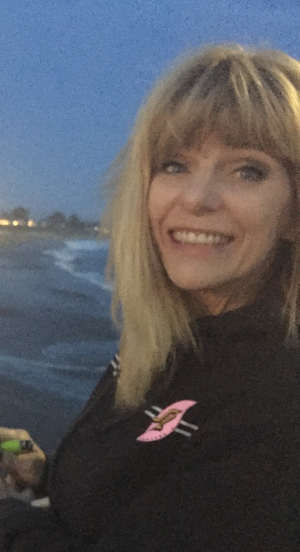
LAKE COUNTY, Calif. — The Clearlake Police Department said it is trying to locate a woman missing since the weekend.
Barbara Jean Guzzi, 58, was last seen on Saturday at 1 p.m. when she was leaving the San Jose area in a white Nissan Murano. She was enroute to the city of Clearlake.
Guzzi suffers from medical conditions and is considered at risk.
She is a white female, 5 feet 6 inches tall and 130 pounds, with shoulder length blonde hair and blue eyes.
Guzzi was last seen wearing a black jacket, blue jeans, brown boots and was wearing three silver rings on each hand.
If you have any information regarding Guzzi’s whereabouts, please contact the Clearlake Police Department at 707-994-8251, Extension 1.
The number of people who moved between states rose from nearly 7.9 million people in 2021 to approximately 8.2 million people in 2022, according to newly released U.S. Census Bureau estimates.
The American Community Survey (ACS) shows state-to-state movers also made up a larger share of all movers between 2021 and 2022, increasing from 18.8% to 19.9%.
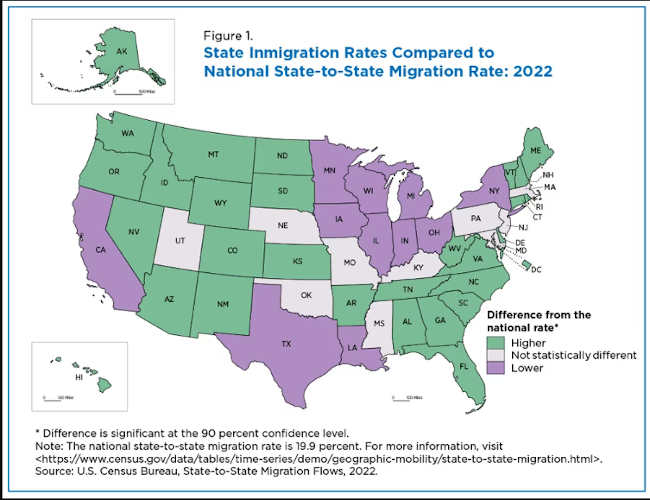
Inmigration rates — the number of people moving into a state as a share of that state’s total number of movers — were higher than the national state-to-state migration rate of 19.9% for states concentrated in the South and West.
This increase in the number and share of state-to-state movers continued a decade-long trend of rising state-to-state migration even as overall migration has declined. Between 2021 and 2022, the overall national migration rate – the number of movers in the United States relative to the population age 1 year and over – dropped from 12.8% to 12.6%.
The Census Bureau regularly publishes estimates of state-to-state migration flows. Estimates are based on 1-year data from the 2022 ACS. The ACS asks respondents who moved in the past year to report their previous place of residence, allowing us to assess migration between origin and destination geographies.
By examining state-to-state migration patterns, we can better understand resources needed in response to changes in states’ demographic, social and economic profiles.
Inmigration rates
Inmigration rates — the number of people moving into a state as a share of that state’s total number of movers — were higher than the national state-to-state migration rate of 19.9% for states concentrated in the South and West (Figure 1).
The District of Columbia had one of the highest (44.3%) inmigration rates. Most (13,093) people moving into the District of Columbia arrived from neighboring Maryland.
California had the lowest (11.1%) inmigration rate. Despite a relatively large number of in-movers, California also had a relatively large base of movers overall, helping to explain the state’s low inmigration rate. Most (44,279) people moving to California arrived from Texas.
Outmigration rates
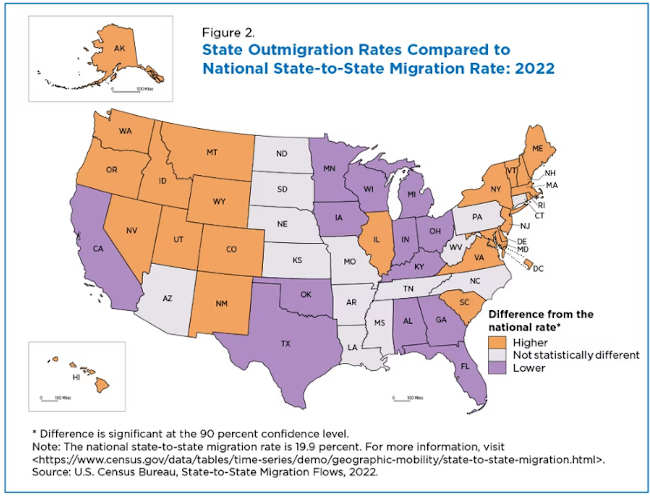
Outmigration rates — the number of people moving out of a state as a share of that state’s total number of movers — tended to be higher than the national state-to-state migration rate for states in the Northeast and West (Figure 2).
The District of Columbia had the highest (46.6%) outmigration rate, with most people moving to neighboring Maryland (17,770) or Virginia (13,582).
Texas had the country's lowest (11.7%) outmigration rate, with most of those who did move relocating to California (42,479) or Florida (38,207).
Notable state-to-state migration flows
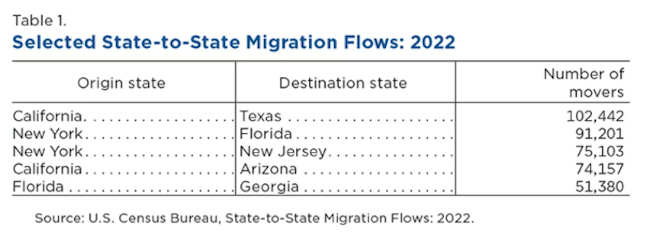
Some of the largest state-to-state migration flows in 2022 involved people moving to and from highly populated states (Table 1). The two largest flows, which were not statistically different from each other in size, came either to or from the four most populous states: large numbers of people moved from California to Texas and from New York to Florida.
Other large state-to-state migration flows involved people moving from highly populated to neighboring states. For example, many people moved from New York, the fourth most populous state, to New Jersey.
All estimates are for the population age 1 year and over. Estimates of national and state-level migration rates reflect people who moved between states and the District of Columbia relative to all movers, including people who moved from Puerto Rico and abroad. Estimates of state-to-state migration flows reflect people who moved between the states and the District of Columbia.
Mehreen Ismail is a survey statistician in the Census Bureau’s Social, Economic, and Housing Statistics Division.
The National Endowment for Financial Education, or NEFE, has released the results of its in-depth opinion polling of Indigenous community members nationwide about their experiences with the financial services sector.
One-third of respondents say they have experienced bias, discrimination or exclusion from financial services institutions and individuals, which is double that of the general U.S. adult population.
This new data continues NEFE’s research into the disparate issues marginalized communities encounter.
“Through this polling, we are gaining a better understanding of the bias and exclusion that marginalized communities experience, and these data can be the key to helping researchers, educators and policymakers focus on improvements in access to equitable and effective learning interventions,” says Billy Hensley, Ph.D., president and CEO of NEFE. “Objective attention to these data will unequivocally provide decision makers with evidence to move toward meaningful change.”
NEFE, in conjunction with SurveyUSA, polled U.S. adults who are members of a native community. The sample was a cross-section of native respondents, including American Indian (73%), Indigenous American (21%), Native Hawaiian (11%), First Nations/Inuit (6%) and Alaska Native (5%).
Key outcomes of the polling were:
• One-third of respondents say they experienced bias, discrimination or exclusion by or from institutions and individuals within the financial services sector while seeking services related to banking, saving, lending, credit, insurance, taxes, financial planning, financial counseling and/or housing. Additionally, 15% say they are unsure if they experienced bias, discrimination or exclusion.
• When asked about owning a bank account, 17% of respondents say they are “unbanked,” defined as neither they nor any members of their household own a bank account. This is more than four times higher than the FDIC’s estimate of unbanked households nationwide.
• Over the past year, 30% of respondents say they cashed a check somewhere other than a bank or a credit union.
• Ten percent say they took out a payday or payday advance loan sometime within the past year.
When asked about using online payment services (PayPal, Venmo, etc.), 68% of respondents overall say they use these services, including 62% of unbanked respondents.
A breakdown of key data from the polls include:
• Of those who say they have experienced bias, discrimination or exclusion, 30% say they believed it was due to their race/ethnicity, while 27% feel their age was the cause.
• In addition, 27% of those who experienced bias, discrimination or exclusion strongly disagree that their financial situation helps them feel optimistic about their future.
• Over half (54%) say they can succeed financially if they put their mind to it.
• A majority of respondents who identify as Black (58%) say they have experienced bias, discrimination or exclusion in seeking financial services, compared to 48% of those identifying as Hispanic/Latino. In addition, 45% of those who identify as LGBTQ+ say they experienced bias, discrimination or exclusion.
• A quarter of respondents with household incomes < $30,000 say they are unbanked as do 21% of respondents who say they are currently unemployed.
• More respondents under 50 years old say they used a non-bank service to cash a check within the past year, compared to those over 50 years old (36% vs. 21%).
• Online payment services are preferred by those under 50 years old (81% vs. 49%).
“Collectively, the field of financial education must understand and heed the systemic, technological and personal barriers that exist to people proactively addressing their financial well-being. Through continued understanding of access challenges, particularly among Native communities, we can eliminate barriers and strive for more equitable solutions,” adds Hensley.
For more on this survey, visit the Consumer Poll section of the NEFE website.
One-third of respondents say they have experienced bias, discrimination or exclusion from financial services institutions and individuals, which is double that of the general U.S. adult population.
This new data continues NEFE’s research into the disparate issues marginalized communities encounter.
“Through this polling, we are gaining a better understanding of the bias and exclusion that marginalized communities experience, and these data can be the key to helping researchers, educators and policymakers focus on improvements in access to equitable and effective learning interventions,” says Billy Hensley, Ph.D., president and CEO of NEFE. “Objective attention to these data will unequivocally provide decision makers with evidence to move toward meaningful change.”
NEFE, in conjunction with SurveyUSA, polled U.S. adults who are members of a native community. The sample was a cross-section of native respondents, including American Indian (73%), Indigenous American (21%), Native Hawaiian (11%), First Nations/Inuit (6%) and Alaska Native (5%).
Key outcomes of the polling were:
• One-third of respondents say they experienced bias, discrimination or exclusion by or from institutions and individuals within the financial services sector while seeking services related to banking, saving, lending, credit, insurance, taxes, financial planning, financial counseling and/or housing. Additionally, 15% say they are unsure if they experienced bias, discrimination or exclusion.
• When asked about owning a bank account, 17% of respondents say they are “unbanked,” defined as neither they nor any members of their household own a bank account. This is more than four times higher than the FDIC’s estimate of unbanked households nationwide.
• Over the past year, 30% of respondents say they cashed a check somewhere other than a bank or a credit union.
• Ten percent say they took out a payday or payday advance loan sometime within the past year.
When asked about using online payment services (PayPal, Venmo, etc.), 68% of respondents overall say they use these services, including 62% of unbanked respondents.
A breakdown of key data from the polls include:
• Of those who say they have experienced bias, discrimination or exclusion, 30% say they believed it was due to their race/ethnicity, while 27% feel their age was the cause.
• In addition, 27% of those who experienced bias, discrimination or exclusion strongly disagree that their financial situation helps them feel optimistic about their future.
• Over half (54%) say they can succeed financially if they put their mind to it.
• A majority of respondents who identify as Black (58%) say they have experienced bias, discrimination or exclusion in seeking financial services, compared to 48% of those identifying as Hispanic/Latino. In addition, 45% of those who identify as LGBTQ+ say they experienced bias, discrimination or exclusion.
• A quarter of respondents with household incomes < $30,000 say they are unbanked as do 21% of respondents who say they are currently unemployed.
• More respondents under 50 years old say they used a non-bank service to cash a check within the past year, compared to those over 50 years old (36% vs. 21%).
• Online payment services are preferred by those under 50 years old (81% vs. 49%).
“Collectively, the field of financial education must understand and heed the systemic, technological and personal barriers that exist to people proactively addressing their financial well-being. Through continued understanding of access challenges, particularly among Native communities, we can eliminate barriers and strive for more equitable solutions,” adds Hensley.
For more on this survey, visit the Consumer Poll section of the NEFE website.
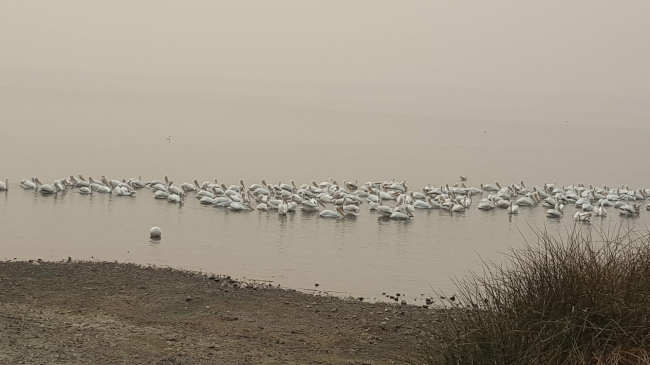
Dear Readers,
In today’s column, I won't be answering a question, but I will be describing why I am grateful for Clear Lake and why Clear Lake is so special. I am grateful for this column and the readers – you! – because without your questions, comments, inquiries, and readership I wouldn’t be able to learn about, teach, and explore this wonderful lake on digital paper every two weeks to a month.
Part of this column will contain excerpts from a speech I recently gave as the guest speaker at the Lake County Land Trust 30th Celebration Dinner on Oct. 28 at Boatique Winery in Kelseyville. I was asked to talk about why “The Lady of the Lake Loves Clear Lake” and for many of those things I love I am also grateful for, and so today's column and that speech have some overlapping content.
If you don’t know much about the Lake County Land Trust, I recommend you visit their website and learn about the many properties they have acquired that are essential to the protection of land and water in Lake County for future generations of people, plants, and animals to enjoy.
Also, if you are looking for a local, nonprofit organization to donate to this holiday season, the Lake County Land Trust will use your donation in high-impact ways such as acquisition, restoration, management, and educational stewardship of lands around Clear Lake and within Lake County.
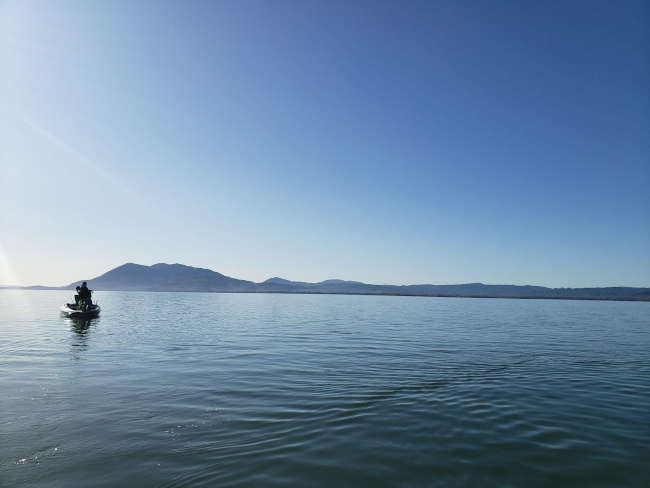
Why Clear Lake is unique and special
Clear Lake is very special, especially to a limnologist. Technically, I am a limnologist by degree and by trade, meaning I study and work with inland freshwaters, like lakes, streams, wetlands, and ponds. Between all my academic, professional, and personnel experiences, I have probably been to over 1000 lakes in my life (one summer when I worked for the University of Notre Dame Center for Aquatic Conservation, our team visited 500 lakes in Ohio, Indian, and Illinois alone!), and I can still confidently say that Clear Lake is my favorite.
Clear is firstly unique and special because of her shape, containing three individual basins that express their own wind patterns and currents. This shape means that you can be in one part of the lake and have calm, quiet waters, and once you travel into another part, you will have turbulent waves or whitecaps. She has multiple personalities, mostly driven by her shape and form.
I talked about the formation and shape of Clear Lake in a previous column “Clear Lake Creation Story.” This column also describes how the lake has shifted watersheds by changing flows from south to north back to south again.
Clear Lake is really not like any other lake in the world, and while there are many reasons why she is special, from the perspective of a limnologist, I will present a few of the things that make her very special to me.
Clear lake is old and little studied compared to younger lakes
Historically, the field of limnology has been studied on large, deep lakes, usually in higher latitudes, think European countries, Canada, Wisconsin, Great Lakes, New York areas; these lakes also ice over during the cold, winter months.
To see an example of such lakes, visit website for the Canadian Experimental Lakes Area (https://www.iisd.org/ela/about/, now managed by The International Institute for Sustainable Development) which was established as The Freshwater Institute in 1966 to study important lake issues like acid rain and agricultural impacts to lakes in North America.
The term limnology was coined in 1868 by a swiss doctor studying Lake Geneva and in 1908, limnology was born in North America is the University of Wisconsin, Madison.
These type of lakes (i.e. northern latitude, cold, and deep) are essential to whole – lake manipulation and comparison studies (like those that determined that phosphorus is the nutrient that drives algal growth, and sometimes specific ratios or combinations of nitrogen and phosphorus are needed to drive algal growth).
Throughout the 20th century, these studied lakes provided valuable information and data that would lead to the basic foundational knowledge of limnology and lake management, but these lakes represent only a subset of lakes that exist in the world.
For example these lakes are located in cool-cold remote forest, boreal regions, they stratify during winter and summer and mix in spring and fall, and they ice over during winter. These lakes are also mostly oligotrophic or mesotrophic, or classified as low or medium in productivity, with relatively low baseline concentrations of nutrients and algae growth.
Information derived from these lakes might not apply or not apply in the same way for mediterranean lakes, tropical lakes, polymictic lakes, (more than two mixing events), shallow, or naturally eutrophic lakes. Clear Lake checks all the boxes in this list except for being tropical.
Additionally,many of these lakes are remnants of the last glacial retreat, which was fairly recent, in geological terms. In fact, the great lakes are only about 20,000 years old, and were formed by retreating continental glacial ice sheets.
Lakes in the midwest are slightly older, since they were at the edge of glacial retreat, and lakes in Canada are slightly younger as they were at the end of the retreat.
To put this in perspective, the area of Clear Lake has had a presence of water, as a lake, pond, wetland, and interconnecting streams, for about 2.5 million years. The Clear Lake we see today, has been in its general shape and form for about 500,000 years.
Clear Lake is older than most other North American lakes, and is probably the oldest freshwater lake. Mono Lake is a prehistoric lake, but is a saline soda lake.
While Clear Lake is old for North America, she is a toddler compared to some of the oldest lakes in the world. For example, Lake Zaysan in Kazakhstan is about 60 million years old and Lake Baikal in Siberia is about 25 million years old.
Age is just a number, right?
When it comes to age, the amount of time a lake has been around is very important. All the in-lake processes that contribute to the form and function of the lake, can be influenced by a lake’s age. For Clear Lake, this is especially true because she has a large, shallow basin.
The upper arm of Clear Lake is probably on a slow trajectory to becoming a very large marsh, and for lakes, this process can take a long, long time. First the basin has to become shallow, a physical process over time that requires the accumulation of sediments. Then the basin has to fill in with aquatic and wetland plants.
If you think about it, the upper arm collects sediments from the Middle-Scotts Creek subwatershed through Rodman Slough. There is even an island that formed outside of Rodman slough from the collection of sediment leaving the slough and during the drought, the land bridge at the mouth of Rodman Slough was populated by wetland plants and a refuge for waterfowl, otters, and deer.
During the summer months, the amount of aquatic and shoreline vegetation is significant, and in some areas poses a nuisance to boaters and water users that the county of Lake maintains a permitted aquatic plant management program to chemically treat and control submerged aquatic plants that can clog boat motors and propellers.
Through the shoreline development process over the last 100 years, about 50 percent of Clear Lake’s original wetlands were removed. Within the upper arm, before development, the shoreline probably comprised 50-200 feet wide stretches of tule, spikerush, smartweed, water lilies, and other emergent and floating leaf aquatic plant species. This plant community would creep inward and outward to coincide with the lake’s fluctuating water levels.
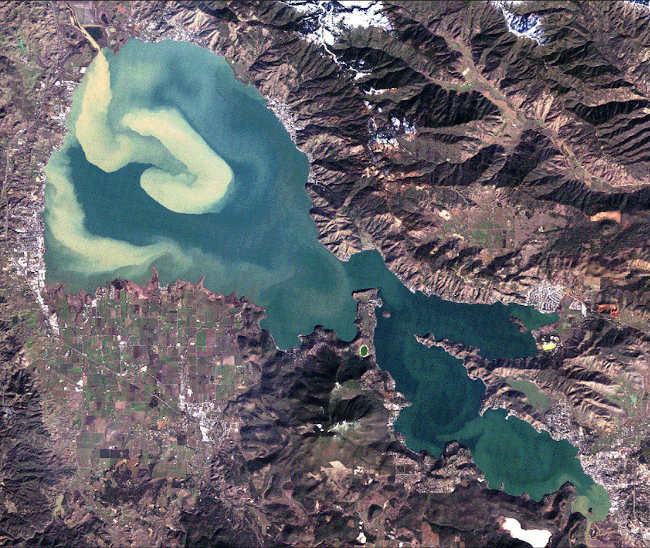
The large areas of shoreline vegetation were essential in presenting large sediment inputs from contributing large nutrient banks to the rest of the lake. The vegetation buffer would have trapped the sediment and nutrient inputs, and used them to build upon more vegetation, both as infrastructure and as a nutrient source.
Without the large vegetative shoreline around the lake, inputs are free to flow and move throughout the upper arm, getting picked up by currents and mobilizing throughout the rest of the lake. Check out this Science Friday post on the county of Lake Water Resources Department’s Facebook page describing the currents throughout Clear Lake.
Now, without the vegetative shoreline around the lake, large inputs, from storms mostly, can contribute nutrient-rich sediment into the lake, which can serve as a ready-made food source for cyanobacteria and algae.
In fact there have been so many inputs into the lake, that the lake has built up a large nutrient sediment bank at the bottom of the lake. This means that additional inputs, while important, are not a large contributor as the nutrients already stored in the sediment bank. This is also unique to Clear Lake.
Most of the lakes I mentioned earlier in the column, that formed the basis of limnological study, would respond quickly to manipulated inputs from external sources, meaning that if an external source of nutrients or sediments was completely removed, the lake would rebound and algae growth would lessen. Remember, these are experimental lakes, so researchers did manipulate lakes by adding large doses of nutrients just to see what would happen or not happen.
Clear Lake is different. Even when there are large, but sporadic, inputs of soils and sediments, like from a wildfire, they don’t have much impact on the internal lake nutrients, especially phosphorus concentrations.
Last year, working with partner limnologists from Michigan State University and Dartmouth College, we conducted a research study on the impacts of wildfire and climate change in the Clear Lake basin. We published the paper in the online, public access journal Ecosphere (Vol 13, issue 12).
We found that climate change impacts, including low winter rain, warmer winter temperatures are associated with increased phosphorus in the water column (where it can feed cyanobacteria and algae) and wildfires are not.
When we looked at the phosphorus concentrations in the water column of all three arms, three years before and three years after major wildfires in the Clear Lake basin (1982, 1996, 2018), we did not see any differences.
Meaning that phosphorus concentrations didn’t change, didn’t increase or decrease, before or after large wildfires, during the time period that we have in-lake phosphorus water quality data (1968-2020). Data used for this study can be found from the Department of Water Resources Data water library.
This is a unique finding for lakes, as most other lakes studied for wildfire impacts are highly impacted by fires occurring in their basin, but Clear Lake is not. She has probably evolved with wildfires over time, and the highly eutrophic nature of her water quality, already enriched with phosphorus, is unaffected by a wildfire here or there. And this is just one more thing that makes Clear Lake unique and special.
Clear Lake vs. Reservoirs
I receive many questions, both through my Lady of the Lake email, and my phone at my day job for County of Lake Water Resources, but the most common question I get is probably, “how and when is the lake going to be cleaned?”
This is a difficult question, in several ways. Let’s think about a useful follow up question, what does a “clean” lake look like? If you close your eyes and picture this in your mind, what does it look like to you?
If you described blue, clear, cold water, then you probably need to evaluate what your perception of a large, shallow, old, and naturally formed freshwater lake looks and acts like.
Most of the time, when people describe their ideal “cleaned up” lake, they are describing reservoirs. And, of course we can’t compare Clear Lake to reservoirs, which are at most 90 years old. In fact, according to the FEMA National Inventory of Dams, the average age of reservoirs (that are dammed) is only 61 years.
When you think about it, a 61 year old lake is a baby, infant lake. Clear Lake is surrounded by these baby, reservoir lakes, such as Barryessa, Folsom, Shasta, Mendocino and Sonoma, just to name a few.
These baby lakes are flowing systems really, that are almost completely drained each year and refilled with fresh and clean rain water. Reservoirs are drained from the bottom, which allow any built up sediments and nutrients in the water column to also flow out the dam intake and down river, sometimes powering hydroelectric facilities.
Clear Lake, has a natural outflow, over the Grigsby Riffle at a narrow point in Cache Creek. This outflow point is at the top of the water column actually. Any water that flows down Cache Creek, leaving Clear Lake, is from the surface, like a pitcher of water filled to the top – the top will leave the pitcher through the spout if overfilled. The bottom water will remain in the pitcher unless enough water is added to overflow at the spout.
This means that, generally, any materials that flow into the lake from the rivers, creeks, or urban areas, can basically remain in the lake forever because they sink and settle to the bottom and the only point of water that is leaving the lake is from the surface of the lake to about 7 feet, or when the lake stops flowing down through Cache Creek and over the Grigsby Riffle.
This concept is really important when comparing Clear Lake to reservoirs and understanding why Clear Lake will never, ever look or act like a reservoir.
To make the analogy clear, reservoirs are brand new, shiny, right out of the box, like a slip n’ slide, with clean hose water moving over the plastic. Clear Lake is an above ground pool that has been left outside for 500,000 years. Clear Lake actually looks pretty good, considering this analogy. But no wonder she is green and full of life!
No other lake in the world is like Clear Lake. She is fascinating and complicated. Restoring her to her prior glory, whatever that might be, it’s still being determined, will take a long time, and a highly collaborative effort.
This complicated uniqueness of Clear Lake is what makes her so special, and why I love being able to work on this fascinating system. There will always be a need for further research on Clear Lake, because she is so unique and not like any other lakes out there. This is why I am grateful for Clear Lake, and thankful that I get to write about her in the Lake County News.
Sincerely,
Lady of the Lake
Angela De Palma-Dow is a limnologist (limnology = study of fresh inland waters) who lives and works in Lake County. Born in Northern California, she has a Master of Science from Michigan State University. She is a Certified Lake Manager from the North American Lake Management Society, or NALMS, and she is the current president/chair of the California chapter of the Society for Freshwater Science. She can be reached at