 How to resolve AdBlock issue?
News
LAKE COUNTY, Calif. — Members of the public will be aware that multiple incidents of youth opioid overdose have recently occurred in Lake County communities.
Each is a tragic and stark reminder consumption of drugs, even once, can prove fatal.
With the rise of fentanyl, xylazine and similar chemical compounds, events such as these have become far too common.
Families, school cohorts and communities are rocked to the core, and we grieve with those most affected.
Opioid misuse and overdose is a national public health crisis.
In 2022, more than 100,000 people died due to overdose in the United States. Of those, 79 were Lake County residents. Fentanyl contributed to most of these incidents.
People of all ages are at risk, including our communities’ youth.
Despite evidence that even one-time use can be deadly, young people may misuse prescription opioids due to curiosity or peer pressure.
Unintentional ingestion of opioids, including fentanyl, has likewise brought devastating results. In some of these cases, prescription drugs were not securely stored in households.
Among youth and young adults aged 15 to 24, the average annual overdose death rate is 12.6 out of every 100,000.
Counterfeit (fake) pills were to blame for nearly a quarter of poisoning and overdose deaths among adolescents aged 10 to 19.
Fake pills are widely available for purchase in the illicit drug market. Teens acquire them through social media platforms, such as TikTok and Snapchat. Pills are made to look like real prescription drugs such as Oxycodone or Xanax. However, they commonly include a deadly amount of illicit fentanyl.
“It is critically important we educate our youth on the dangers of drug use,” states Elise Jones, Lake County’s Behavioral Health Services director. “Nearly all youth who use drugs do not expect to die. Experimenting with drugs is dangerous and common. Discussing Naloxone with your child is an essential complement to encouraging them not to misuse drugs.”
Naloxone is safe and saves lives
“Naloxone (Narcan nasal spray) is a remarkably safe medicine, designed to be given by bystanders witnessing a possible overdose in a person who has collapsed whose breathing is stopping,” said Lake County’s Public Health Officer Noemi Doohan, MD, PhD, MPH. “Like CPR, Naloxone is a tool to help a good Samaritan save a life. The Centers for Disease Control and Prevention and the Food and Drug Administration do not have age limits on who may receive naloxone.”
The American Academy of Pediatrics’ parent information website HealthyChildren.org states, “There is virtually no downside to giving naloxone to a child or teen, even if you are not sure if they overdosed on opioids.”
“The Lake County Office of Education works closely with the county of Lake’s Health Services Department to ensure Narcan is available on all school campuses in Lake County,” said Lake County Superintendent of Schools Brock Falkenberg.
Fentanyl and other potentially life-threatening opioids are present in Lake County, and that clear and present threat demands a response.
“If your child had a life-threatening allergy, you would have an EpiPen on hand,” said Jones. “If your child had diabetes, you would always have insulin or glucagon at the ready. Similarly, if your child is exposed to fentanyl or other opioids, it’s important to have naloxone available.”
Jones added, “Naloxone is not a comprehensive solution to the opioid addiction epidemic. It does not treat opioid addiction. However, the availability of naloxone at our schools, and in our homes, can prove lifesaving.”
“One pill can end a life,” said Falkenberg. “Please talk to your children today about the dangers of substance abuse.”
Myths and facts about naloxone
Myth: Naloxone prevents people from seeking treatment.
Fact: Studies have shown Naloxone does not keep people in active addiction from seeking treatment. For many people, surviving an overdose motivates them to seek treatment.
Myth: Having Naloxone on hand means you are more likely to try or use opiates.
Fact: To date, no studies have demonstrated increased opioid use due to Naloxone availability.
If you are concerned your child (or someone you know) may be experimenting with opioids, seek help. Lake County Health Services (707-263-1090), Behavioral Health Services (707-274-9101 or 707-994-7090) and school staff can connect you to appropriate resources.
For more information on Naloxone, visit, https://www.cdc.gov/drugoverdose/featured-topics/naloxone.html. The short CDC video shown above can increase your comfort level in preparing yourself to respond to an overdose.
The following seats are available. All vacancies are countywide unless stated and all are voluntary.
Big Valley Groundwater Sustainability Plan Advisory Committee: Six vacancies — two environmental / ecosystem users, two underrepresented user(s), one private user – domestic well owner, and one private user.
Central Region Town Hall (CeRTH): Two vacancies – two general membership.
Child Care Planning and Development Council: Four vacancies – two consumer, one public agency and one discretionary appointee.
East Region 3 Town Hall: One vacancy – one member from Clearlake Oaks Keys Property Owner's Association.
Emergency Medical Care Committee: Seven vacancies – one community college district, four consumer interest group, one ER-affiliated medical care coordinator, and one fire department.
Fish and Wildlife Advisory Committee: Seven vacancies – two tribal government, one agriculture, and four general public, districts 1, 2, 3 and 5.
Glenbrook Cemetery District: Three vacancies — general membership (must live within the district boundaries and be registered to vote in Lake County).
Heritage Commission: Four vacancies – one representative from each supervisorial district 1, 4, and 5, and one member-at-large.
In Home Support Services Public Authority Advisory Committee: Six vacancies – four senior consumers and two disabled consumers.
Kelseyville Cemetery District: One vacancy — general membership (must live within the district boundaries and be registered to vote in Lake County).
Lake County Ag Advisory Committee: Seven vacancies – four Crop Growers, one organic farmer and two ag processors.
Library Advisory Board: Four vacancies — one representative from each supervisorial districts 1, 2, 3 and 5.
Lower Lake Cemetery District: Four general membership (must live within the district boundaries and be registered to vote in Lake County).
Lower Lake Waterworks District One Board of Directors: Three vacancies – public member (must live within the district boundaries and be registered to vote in Lake County).
Maternal, Child and Adolescent Health (MCAH) Advisory Board: Five vacancies – general membership.
Mental Health Board: One vacancy — one member-at-large.
Middletown Cemetery District: Three vacancies — general membership (must live within the district boundaries and be registered to vote in Lake County).
Resource Conservation District: One vacancy — one member-at-large.
Scott’s Valley Community Advisory Board: Two vacancies — public members-at-large.
Spring Valley CSA No. 2 Advisory Board: Two vacancies — general membership (must live within the district boundaries and be registered to vote in Lake County).
Upper Lake Cemetery District: One vacancy — general membership (must live within the district boundaries and be registered to vote in Lake County).
Western Region Town Hall (WRTH): Four vacancies — one public member-at-large, one public member — Blue Lakes, one public member — Nice and one public member — Upper Lake.
If you have questions regarding a vacancy on one of these advisory boards, please contact the Clerk of the Board at 263-2580 or email
Applications are available online at http://lakecountyca.gov or at the Lake County Courthouse, Clerk of the Board Office, Room 109, 255 N. Forbes St., Lakeport.
Space News: Massive planet too big for its own sun pushes astronomers to rethink exoplanet formation

Imagine you’re a farmer searching for eggs in the chicken coop – but instead of a chicken egg, you find an ostrich egg, much larger than anything a chicken could lay.
That’s a little how our team of astronomers felt when we discovered a massive planet, more than 13 times heavier than Earth, around a cool, dim red star, nine times less massive than Earth’s Sun, earlier this year.
The smaller star, called an M star, is not only smaller than the Sun in Earth’s solar system, but it’s 100 times less luminous. Such a star should not have the necessary amount of material in its planet-forming disk to birth such a massive planet.
The Habitable Zone Planet Finder
Over the past decade, our team designed and built a new instrument at Penn State capable of detecting the light from these dim, cool stars at wavelengths beyond the sensitivity of the human eye – in the near-infrared – where such cool stars emit most of their light.
Attached to the 10-meter Hobby-Eberly Telescope in West Texas, our instrument, dubbed the Habitable Zone Planet Finder, can measure the subtle change in a star’s velocity as a planet gravitationally tugs on it. This technique, called the Doppler radial velocity technique, is great for detecting exoplanets.
“Exoplanet” is a combination of the words extrasolar and planet, so the term applies to any planet-sized body in orbit around a star that isn’t Earth’s Sun.
Thirty years ago, Doppler radial velocity observations enabled the discovery of 51 Pegasi b, the first known exoplanet orbiting a Sunlike star. In the ensuing decades, astronomers like us have improved this technique. These increasingly more precise measurements have an important goal: to enable the discovery of rocky planets in habitable zones, the regions around stars where liquid water can be sustained on the planetary surface.
The Doppler technique doesn’t yet have the capabilities to discover habitable zone planets the mass of the Earth around stars the size of the Sun. But the cool and dim M stars show a larger Doppler signature for the same Earth-size planet. The lower mass of the star leads to it getting tugged more by the orbiting planet. And the lower luminosity leads to a closer-in habitable zone and a shorter orbit, which also makes the planet easier to detect.
Planets around these smaller stars were the planets our team designed the Habitable Zone Planet Finder to discover. Our new discovery, published in the journal Science, of a massive planet orbiting closely around the cool dim M star LHS 3154 – the ostrich egg in the chicken coop – came as a real surprise.
LHS 3154b: The planet that should not exist
Planets form in disks composed of gas and dust. These disks pull together dust grains that grow into pebbles and eventually combine to form a solid planetary core. Once the core is formed, the planet can gravitationally pull in the solid dust, as well as surrounding gas such as hydrogen and helium. But it needs a lot of mass and materials to do this successfully. This way to form planets is called core accretion.
A star as low mass as LHS 3154, nine times less massive than the Sun, should have a correspondingly low-mass planet forming disk.
A typical disk around such a low-mass star should simply not have enough solid materials or mass to be able to make a core heavy enough to create such a planet. From computer simulations our team conducted, we concluded that such a planet needs a disk at least 10 times more massive than typically assumed from direct observations of planet-forming disks.
A different planet formation theory, gravitational instability – where gas and dust in the disk undergo a direct collapse to form a planet – also struggles to explain the formation of such a planet without a very massive disk.

Planets around the most common stars
Cool, dim M stars are the most common stars in our galaxy. In DC comics lore, Superman’s home world, planet Krypton, orbited an M dwarf star.
Astronomers know, from discoveries made with Habitable Zone Planet Finder and other instruments, that giant planets in close-in orbits around the most massive M stars are at least 10 times rarer than those around Sunlike stars. And we know of no such massive planets in close orbits around the least massive M stars – until the discovery of LHS 3154b.
Understanding how planets form around our coolest neighbors will help us understand both how planets form in general and how rocky worlds around the most numerous types of stars form and evolve. This line of research could also help astronomers understand whether M stars are capable of supporting life.
Suvrath Mahadevan, Verne M. Willaman Professor of Astronomy & Astrophysics, Penn State; Guðmundur Kári Stefánsson, NASA Hubble Fellow, Department of Astrophysical Sciences, Princeton University, and Megan Delamer, Graduate Student, Department of Astronomy, Penn State
This article is republished from The Conversation under a Creative Commons license. Read the original article.
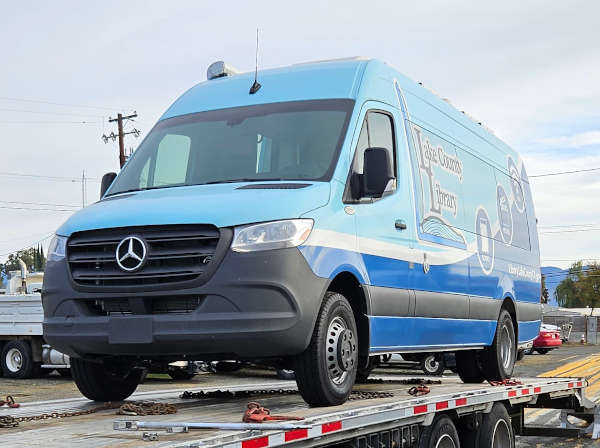
LAKE COUNTY, Calif. — A new bookmobile will soon be rolling along Lake County’s roads.
The Lake County Library reported that the vehicle arrived on Nov. 21 in Lakeport.
Then, on Tuesday, as part of its consent agenda, the Board of Supervisors approved a budget transfer of $53,342 from the capital asset account to the library account, which County Librarian Christopher Veach told Lake County News allowed the library to make the final payment to the bookmobile vendor.
In April of 2022, Lake County was among 15 libraries across to receive grants from the California State Library to acquire or upgrade their bookmobiles or community outreach vehicles, as Lake County News has reported.
That $199,865 grant aimed to provide mobile library services for Lake County residents more than 20 miles from an established branch, along with enhancing library outreach efforts with the presence of the mobile library vehicle at events.
In addition to the state grant, the Lake County Library reported that an American Rescue Plan Act allocation from the Board of Supervisors covered the remaining funds needed.
Purchased from Ohio-based Farber Specialty Vehicle, the bookmobile made its cross-country journey to California on a flatbed truck.
Farber won the project in a competitive county consultant selection process. The company has been crafting custom health, dental, STEM labs and bookmobiles for three decades, producing 150 to 180 custom specialty vehicles each year, the county reported.
“The library’s valuable offerings go well beyond books,” said Brandon Mach, library assistant and bookmobile driver. “I'm thrilled that we can now extend resources and services to even more Lake County residents.”
Veach said they don’t yet have a definite date for the bookmobile’s roll out.
County staff will first receive comprehensive training on its features, including the solar system, onboard wheelchair lift and media capabilities.
Later this month or in January, the bookmobile will embark on its welcome tour.
In anticipation of the bookmobile's arrival, Mach has been actively surveying Lake County’s communities to understand needs and preferences for bookmobile services.
Beginning in early 2024, the bookmobile is expected to maintain a regular route — three days each week — reaching residents currently underserved by existing county library branches in Clearlake, Lakeport, Middletown and Upper Lake.
Bookmobile services will also be available at special events, the county reported.
Veach is looking forward to expanding the library's reach.
“Libraries are for everyone. Knowing our bookmobile will soon reach every corner of Lake County is truly exciting,” Veach said.
Learn more about the Lake County Library system at https://library.lakecountyca.gov.
Email Elizabeth Larson at
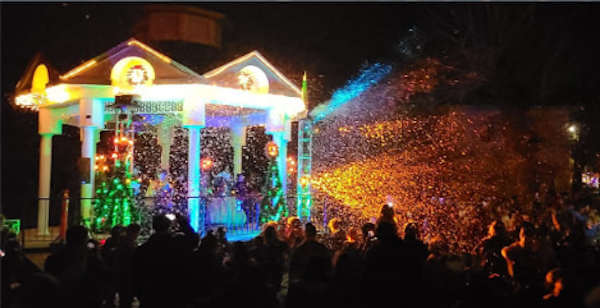
LAKEPORT, Calif. — Get ready for a magical winter experience as the Rotary Club of Lakeport proudly presents the Lakeport Blizzard, a festive event set to transform Library Park's Gazebo into a winter wonderland on Thursday, Dec. 14, and Thursday, Dec. 21, at 6 p.m., weather permitting.
While Lakeport may not be known for its snowy landscapes, the Rotary Club is set to defy expectations and create a winter spectacle that will delight attendees of all ages.
The Lakeport Blizzard promises a joyful and enchanting atmosphere, offering residents and visitors a unique opportunity to experience the magic of the season.
"We're thrilled to bring the Lakeport Blizzard to our community," said Rotary President Mark Lipps. "This event is our way of spreading holiday cheer and creating a festive environment for families to come together and celebrate. It's a free event, open to everyone, and we encourage the community to join us for this special experience."
Attendees can expect the chance to witness the Gazebo transformed into a snowy spectacle, complete with lights and music. The event will feature holiday music, hot cocoa (provided by the Lakeport Fire Department), and of course, falling “snow.”
The Rotary Club of Lakeport is dedicated to serving the community, and the Lakeport Blizzard is just one example of their commitment to spreading joy and building connections among residents.
The event is made possible through the generous support of local sponsors and volunteers who share in the spirit of community and holiday celebrations.
As the sun sets over Library Park, organizers said the Lakeport Blizzard will bring a touch of winter magic to Lakeport, proving that even in a place where snow is a rare sight, the community can come together to create a Blizzard of holiday joy.
For more information about the Lakeport Blizzard and other Rotary Club of Lakeport events, please go to their website.

CLEARLAKE, Calif. — Clearlake Animal Control has more than three dozen dogs awaiting their new families as the holidays approach.
The Clearlake Animal Control website lists 41 adoptable dogs.
Available to a new home is “Ophelia,” a female pit bull terrier with a brown and tan coat.
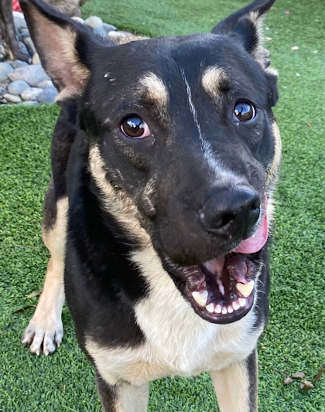
This week’s adoptable dogs also include “Jupiter,” a male German shepherd mix with a tricolor coat.
The shelter is located at 6820 Old Highway 53. It’s open from 9 a.m. to 6 p.m. Tuesday through Saturday.
For more information, call the shelter at 707-762-6227, email
This week’s adoptable dogs are featured below.
Email Elizabeth Larson at