 How to resolve AdBlock issue?
News
Under present California trust law, trustees are the only fiduciaries (i.e., legally appointed representatives) with the duty, authority and power to administer a trust’s assets, liabilities and financial and legal affairs.
The trustee’s primary duty is to carry out the terms of the trust for the benefit of the beneficiaries.
Effective Jan. 1, 2024, however, the Uniform Directed Trust Act (“UDTA”) becomes law. The UDTA adds new sections 16600 to 16632 to the Probate Code to allow Directed Trusts to exist in California.
The UDTA allows for an additional type of fiduciary, called a Trust Director, to participate in trust administration.
The directed trust was created in the early 1900’s because wealthy families wanted to make trust investment decisions, instead of the trustee, that the trustee would perform. Under the UDTA, a trustee becomes a directed trustee.
A directed trustee must carry-out the trust director’s decisions within the scope of the trust director’s authority. That is, “[i]n a directed trust, the terms of the trust grant a person other than a trustee a power over some aspect of the trust’s administration.”
The trust director is essentially a trustee in all but name: “A trust director has the same fiduciary duty and liability in the exercise or nonexercised of the power, if the power is held individually, as a sole trustee in a like position and under similar circumstances … .”
The one difference is that the trust director is authorized to direct a trustee to take certain actions.
In fact, the UDTA allows a trust director to have a, ” [p]ower of direction [that] includes a power over the investment, management, or distribution of trust property or other matters of trust administration.”
Thus nothing in the UDTA prevents a trust director from controlling all of the trust administration and making the directed trustee a mere agent of the trust director.
The essence of the UDTA is that it allows for trust directors and directed trustees to have compartmentalized duties, for them not to become liable for what the other is doing, and for the trust director to direct the directed trustee.
Under the UDTA, the directed trustee and the trust director do not have to monitor each other’s performance of their duties, do not have to advise each other and do not have to warn the trust beneficiaries or the settlor who established the trust (if still alive) as to any concerns each may have regarding the decisions that the other is making.
A possible use of UDTA in California might be to appoint a trust director in a special needs trust with authority over all discretionary distributions for the special needs beneficiary.
The directed trustee’s risk of being held liable for complying with an instruction from a trust director is greatly reduced: “A directed trustee shall not comply with a trust director’s exercise or non-exercise of a power of direction … to the extent that, by complying, the trustee would engage in willful misconduct.”
The “willful misconduct threshold is a high standard to meet.
Interestingly, the UDTA allows the directed trust rules to apply to the duties and relationships between co-trustees. That is, co-trustees may be responsible for different areas of the trust administration, the same way as trust directors and directed trustees, and not have to monitor each other.
Again, a trust director is essentially the same as a trustee, so why not allow co-trustees a very similar relationship.
For example, one co-trustee could be responsible for investments and the other co-trustee be responsible for discretionary distributions to beneficiaries.
We do not know all the possible applications of the Directed Trust Act in California. We do know from the use of directed trusts in other states that the trust director’s role usually involves investment decisions, discretionary distribution decisions, and control over special assets that like investments require some special expertise (e.g., managing businesses, artwork, intellectual property, etc.).
The foregoing discussion is not legal advice. Consult a qualified estate planning attorney for guidance.
Dennis A. Fordham, Attorney, is a State Bar-Certified Specialist in estate planning, probate and trust law. His office is at 870 S. Main St., Lakeport, Calif. He can be reached at

The NASA/ESA Hubble Space Telescope has measured the size of the nearest Earth-sized exoplanet that passes across the face of a neighboring star.
This alignment, called a transit, opens the door to follow-on studies to see what kind of atmosphere, if any, the rocky world might have.
The diminutive planet, LTT 1445Ac, was first discovered by NASA’s Transiting Exoplanet Survey Satellite in 2022.
But the geometry of the planet’s orbital plane relative to its star as seen from Earth was uncertain because TESS does not have the required optical resolution.
This means the detection could have been a so-called grazing transit, where a planet only skims across a small portion of the parent star’s disk. This would yield an inaccurate lower limit of the planet’s diameter.
“There was a chance that this system has an unlucky geometry and if that’s the case, we wouldn’t measure the right size. But with Hubble’s capabilities we nailed its diameter,” said Emily Pass of the Harvard-Smithsonian Center for Astrophysics in Cambridge, Massachusetts.
Hubble observations show that the planet makes a normal transit fully across the star’s disk, yielding a true size of only 1.07 times Earth’s diameter. This means the planet is a rocky world, like Earth, with approximately the same surface gravity. But at a surface temperature of roughly 260 degrees Celsius, it is too hot for life as we know it.
The planet orbits the star LTT 1445A, which is part of a triple system of three red dwarf stars that is 22 light-years away in the constellation Eridanus.
The star has two other reported planets that are larger than LTT 1445Ac. A tight pair of two other dwarf stars, LTT 1445B and C, lies about 4.7 billion kilometers away from LTT 1445A, also resolved by Hubble.
The alignment of the three stars and the edge-on orbit of the BC pair suggests that everything in the system is coplanar, including the known planets.
“Transiting planets are exciting since we can characterize their atmospheres with spectroscopy, not only with Hubble but also with the James Webb Space Telescope. Our measurement is important because it tells us that this is likely a very nearby terrestrial planet. We are looking forward to follow-on observations that will allow us to better understand the diversity of planets around other stars,” said Pass.
"Hubble remains a key player in our characterisation of exoplanets", added Professor Laura Kreidberg of the Max Planck Institute for Astronomy in Heidelberg (who was not part of this study). "There are precious few terrestrial planets that are close enough for us to learn about their atmospheres — at just 22 light years away, LTT 1445Ac is right next door in galactic terms, so it’s one of the best planets in the sky to follow up and learn about its atmospheric properties."
The Hubble Space Telescope is a project of international cooperation between ESA and NASA.
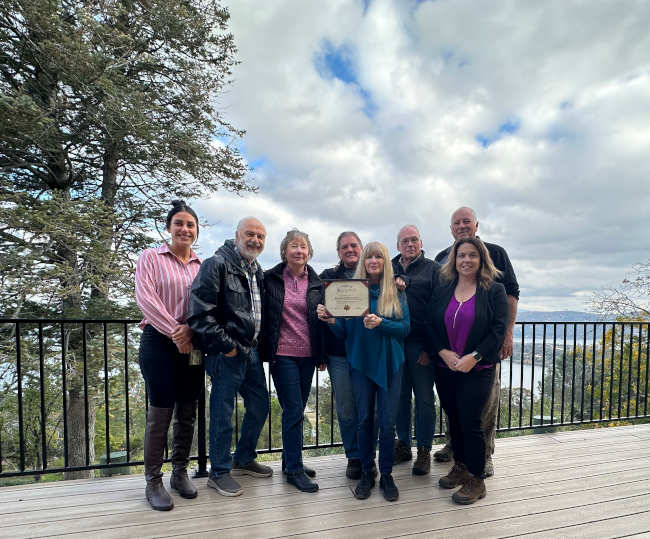
LAKE COUNTY, Calif. — The Lake County Sheriff's Office of Emergency Services, or OES, extends its gratitude to partners who embody our mission, which is dedicated to strengthening Lake County's ability to withstand disasters.
While OES serves as the lead emergency management agency for the county, achieving our mission would be unattainable without the proactive collaboration of both the public and private sectors, as well as the collective efforts of individuals and county employees.
Resilience is a core aspect of the OES mission, encompassing a comprehensive approach to emergency management, or EM.
This approach covers all types of hazards and emphasizes the crucial phases of mitigation, preparation/planning, response, and recovery.
Throughout the county, numerous agencies and individuals are unwavering in their commitment to one or more of these EM phases.
“As we reflect on the past year, we would like to highlight the exceptional partners who have exhibited qualities that are not only commendable but also serve as replicable examples to enhance Lake County's resilience,” said Emergency Services Manager Leah Sautelet.
By category, the honorees for 2023 are:
PRIVATE SECTOR | KONOCTI FIRE SAFE COUNCIL
The Konocti Fire Safe Council, a 501c(3) nonprofit corporation established with the aim of enhancing wildfire resilience in Lake County's Soda Bay Road corridor, which is home to approximately 7,800 residents. The council's dedicated efforts are concentrated on preparedness, mitigation, education and evacuation across the eight evacuation zones within their service area. These objectives are achieved through collaborative efforts with the resources provided by four homeowners associations and the Firewise communities in the region.
The Lake County Office of Emergency Services recognizes the importance of their vision, effective coordination, and substantial contributions in the pursuit of creating a more resilient community.
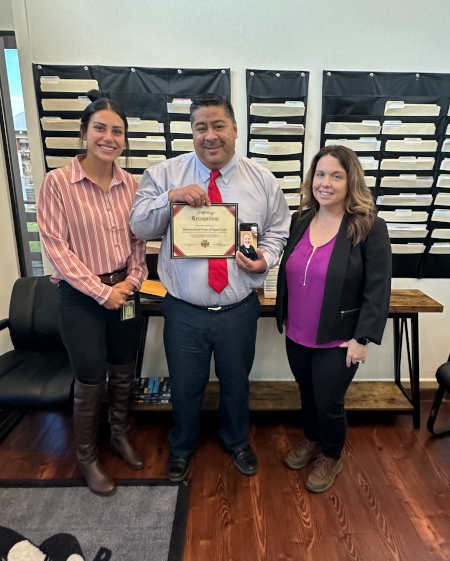
PUBLIC SECTOR | HABEMATOLEL POMO OF UPPER LAKE
The Habematolel Pomo of Upper Lake’s primary objective is to serve its tribal members, yet it consistently seizes opportunities to assist the broader community. When necessary, the tribe graciously opens its community center to the public to provide support during events such as warming centers and PSPS relief efforts.
Furthermore, the Habematolel Pomo has generously offered its facilities to Lake County Office of Emergency Services for hosting vital public information sessions and emergency management training sessions.
INDIVIDUAL | BETSY CAWN
Cawn is a highly engaged and dedicated citizen who exemplifies an unwavering commitment to Lake County and its emergency management efforts. She actively participates in various public forums, including Disaster Council meetings and public information sessions, where she contributes her invaluable historical knowledge and insights.
Cawn's contributions are particularly noteworthy in areas that address the unique needs of the aging and access or functional needs populations, showcasing her profound dedication to the betterment of our community.
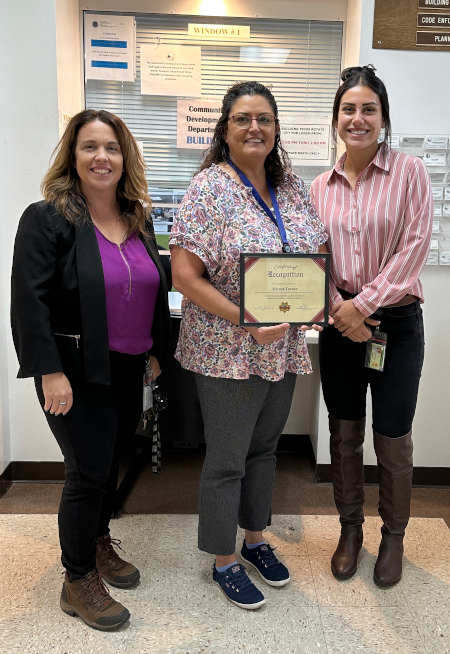
COUNTY EMPLOYEE / DSW | MIREYA TURNER
Turner rejoined the County as the Community Development Director in fall 2022. Shortly thereafter, she reached out to OES to initiate a discussion regarding staffing requirements for the Emergency Operations Center, or EOC, and extended her department's assistance to bolster emergency management endeavors.
She also played an active role in supporting the Hazard Mitigation Plan Update process.
Though additional hours and responsibilities might not be everyone's aspiration, Turner embraced her duty as a disaster service worker and proactively immersed herself in the process, all in the pursuit of enhancing Lake County's well-being.
Lake County OES appreciates the dedication of all Lake County residents, visitors, service providers and government entities.
To learn more about what you can do to build Lake County’s resilience to disaster, visit www.lakesheriff.com/about/oes.
Bring the kids for a day of family fun to the Lower Lake Hometown HoliDaze Street Fair, Main Street of Lower Lake will be transformed to a holiday landscape.
This festive event is loaded with holiday cheer. Come enjoy the many food and craft vendors, get your holiday shopping done early. Merchants will be open.
Children can visit Santa in the community center and share their heart’s desires.
The Brick Hall will be set up for children with a bounce house, face painting, art projects, games and more.
For added fun, there will be a Children’s Holiday Hunt with prizes for all participants, (while supplies last).
“This small-town USA experience will bring you joy,” said the Lower Lake Community Action Group, which is presenting the event.
Join them in Lower Lake, on Sunday, Dec. 3, where you can revel in holiday magic while shopping locally.
The CHP has partnered with the California Office of Traffic Safety, or OTS, to implement the “California Restraint Safety Education and Training” — CARSEAT for short — campaign, boosted by a $850,000 federal grant.
The yearlong CARSEAT campaign focuses on reducing the number of children injured or killed in traffic crashes throughout California.
To help accomplish this goal, the CHP will host educational seminars, classes, and child safety seat inspections.
These efforts will highlight the importance of child passenger restraint by providing education on the proper installation of child passenger safety seats.
“Ensuring the safety of our youngest passengers begins with a simple but critical act — securing them in properly installed child safety seats,” said CHP Commissioner Sean Duryee. “It is the single most effective way to protect a child in a vehicle crash.”
California law requires a child to be properly restrained in an appropriate child safety seat in the rear seat of a vehicle until they are at least 8 years of age.
Children under 2 years of age should ride in a rear-facing car seat unless the child weighs 40 or more pounds or is 40 or more inches tall.
For more information regarding child passenger safety, child safety seats, and seat belt regulations, please contact your local CHP Area office.
The Clear Lake Area Office can be reached at 707-279-0103.
Funding for this program was provided by a grant from the California Office of Traffic Safety through the National Highway Traffic Safety Administration.
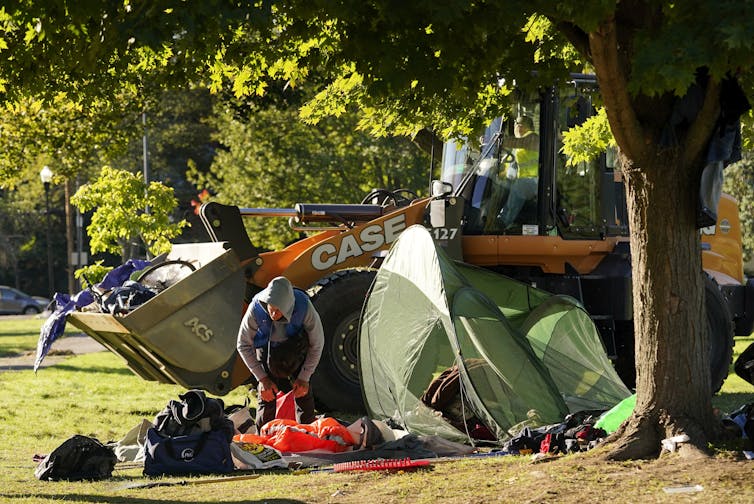
Homelessness is a state of deprivation. Those who are homeless need shelter to be safe; they don’t have it. They need a toilet for basic bodily functions; they don’t have one. They need a shower to keep clean; they don’t have that, either.
Because such deprivation dramatically affects the well-being of people who are homeless, public discussion of homelessness tends to focus on whether and to what extent the government should carry out anti-homelessness policy as a way of improving people’s overall quality of life.
Some philosophers have argued that while homelessness is clearly a state of deprivation, it is also a condition in which a person’s freedom is profoundly compromised.
These theorists insist a society that cherishes freedom – such as the U.S. – must implement anti-homelessness policy as a way of liberating people who lack housing.
Because the number of people experiencing homelessness continues to rise at a record rate, these academic ideas have become increasingly relevant to the real world. I am a philosopher interested in exploring the moral dimensions of homelessness, as well as shining a light on underdiscussed aspects of it. I believe that public debate would benefit greatly from increased attention to the ways homelessness limits Americans’ freedom.
Freedom to be somewhere
Since homelessness is usually discussed in terms of deprivation, the claim that homelessness has much to do with freedom can seem surprising.
Freedom is commonly understood as the ability to do what one chooses without being interfered with. My freedom is limited if you lock me in a cell or place a boulder on the street I want to drive down.
Homelessness, on the other hand, seems at first glance like a condition in which a person is mostly able to do as they choose, albeit without important resources that would make their life better.
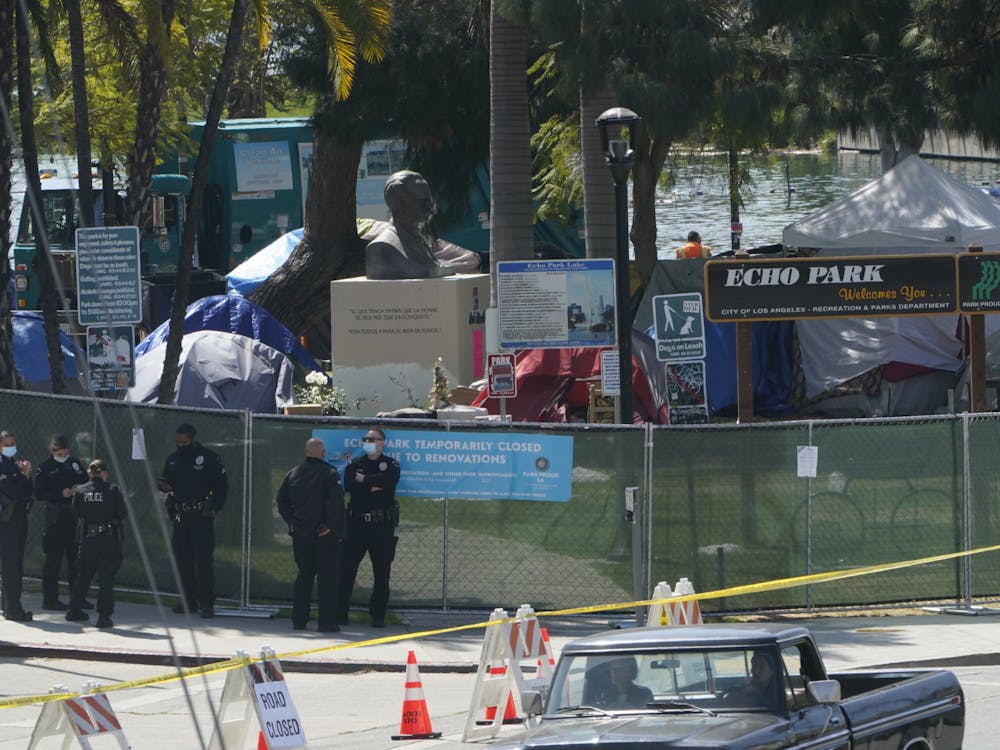
The philosopher and legal theorist Jeremy Waldron sees things differently. Waldron says that private property often serves to interfere with people’s choices. If a person wants to walk in New York City from midtown Manhattan to Harlem, others’ property interferes with their ability to choose the most direct route. If a person wants to see a particular Andy Warhol painting, the fact that it is kept at a private residence interferes with their ability to choose to view it.
In itself, this isn’t a problem, as no one should be free to go anywhere and do anything they want. The trouble, says Waldron, comes when a person who is homeless does not have private property that they are able to occupy, free from interference. In such instances, the person will be confined to public spaces, such as sidewalks and parks.
But public spaces themselves are highly regulated through local ordinances, limiting who may use them and for what purposes.
A person who is homeless and sleeps on a public bench will often be told by the police to move. Someone who sets up a tent on a sidewalk will usually have it confiscated. Someone who urinates or defecates in a park can be arrested.
Now you can see why some think that homelessness compromises a person’s freedom. Sleeping and relieving oneself are necessary, life-sustaining tasks.
But as Waldron points out, “Everything that is done has to be done somewhere. No one is free to perform an action unless there is somewhere he is free to perform it.”
Given the way society protects private property and regulates public spaces, it seems that people who are homeless are left with no space at all in which they are free to do the things they need to do in order to live. This is about as severe an infringement on freedom as you can imagine, and Waldron’s point is that a society that loves freedom simply cannot tolerate it.
Anti-homelessness is not just about benevolence and generosity, then. It is about protecting liberty.
Freedom from others
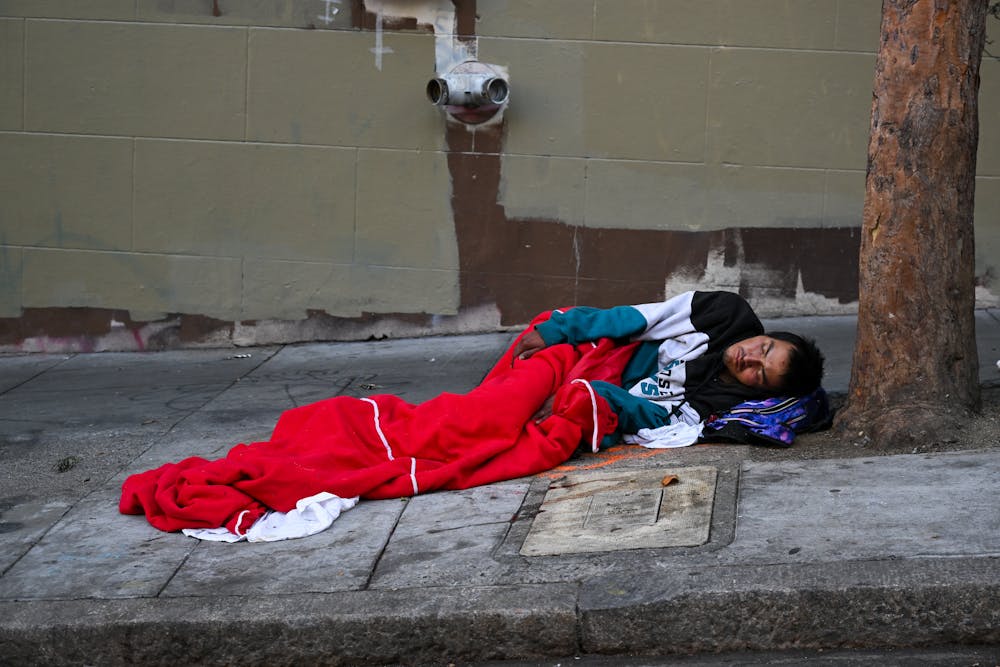
Of course, people who are homeless do sleep and relieve themselves. So, in what sense do they actually lack the freedom to do so?
The political philosopher Christopher Essert argues that Waldron’s analysis should be taken one step further by considering its implications for interpersonal relations.
Since a person who is homeless has nowhere to freely perform life-sustaining tasks, typically they will either seek permission from someone to use their property, use the property and hope to not be noticed or, at worst, seek forgiveness. Either way, they depend upon the grace of another in order to do the things they need to do.
This puts people who are homeless at the mercy of those who have property.
Whether a homeless person has a place to sleep or whether they are arrested for sleeping somewhere without permission is completely determined by the wishes of others. Keesha might sleep on Felix’s couch for a few nights. But as soon as Felix is in a bad mood, he can throw her out. Or Felix might make access to his couch conditional upon her attending church services, supporting his preferred political candidate or performing sexual acts. What she does and does not do is now up to Felix.
Essert connects this set of observations to what is called a “republican” conception of freedom. This way of understanding freedom is less about whether a person is actually interfered with and more about the way they are placed under the arbitrary power of another.
The intuitive idea is that if someone else always has the power to determine your choices, then you aren’t free. Since a homeless person is always on property over which someone else has authority, they are always, writes Essert, “under the power of others, dependent on them, dominated by them, unfree.”
In the U.S. especially, arguments that appeal to freedom are taken very seriously. Even those who insist that it is not the government’s job to ensure everyone a good quality of life believe that it must ensure freedom. Even those whose ears close when they hear calls for charity and beneficence seem to pay attention when freedom is at stake.
By proposing this way of seeing the life of someone who is homeless, then, philosophers have raised the possibility that allowing homelessness to persist contradicts values that are, at heart, fundamentally American.
Paul Schofield, Associate Professor of Philosophy, Bates College
This article is republished from The Conversation under a Creative Commons license. Read the original article.