How to resolve AdBlock issue?
News

Dear Readers,
The year of 2023 is almost over and that means that the Lady of the Lake photo contest is almost over. This is your last call to send in your water or wildlife photos to the 2023 Lady of the Lake Photo Contest!
The annual contest was opened in spring, with submission closing December 31, 2023.
The purpose of the photo contest is to get the readership to think about and appreciate lakes, rivers, creeks, and anything water in Lake County. Water holds a special beauty, especially paired with the beautiful contrast colors of fall. Now is the time to capture that beauty on camera, maybe with some fall or winter colors and hues.
Winners from each category will win a free breakfast or lunch (or Brunch!) with Lady of the Lake sponsored by Angelina’s Bakery on Main Street in Lakeport, CA. Photo winners will also be highlighted in the Lady of the Lake Column in the Lake County News. Every photo submitted to the contest will be eligible to be used in the Lake of the Lake Column alongside relevant column topics, with proper credit reference.
The rules are simple:
There are two submission groups; Novice and expert / professional.
There are two types of photo categories: Water and Wildlife.
Because this is the Lady of the Lake photos contest, all photos submitted have to include a lake, creek, stream, wetland, marsh, or pond. For those who have asked, temporary water bodies do count and would include aquatic resources such as vernal pools and intermittent streams. Landscapes and scenery will be included into the “water” category, and anything with an animal focus will be grouped into the “wildlife” category.
For example, a landscape shot of Clear Lake with birds flying in the sky will still be considered in the “water” category, but a close up of a grebe mating dance on Clear Lake, will be considered in the “wildlife” category.
This is a nature-centric photo contest. Humans, from a distance, can be included in photos, but their faces can not be close enough to be recognizable. For privacy, any photos that contain recognizable faces will be disqualified.
All photos must be sent as digital JPG / TIFF / PNG attachments or google drive links to the
When submitting photos, in the email subject line include: “Photo Contest _ group type_category” For example, if you are a novice submitting a photo of a river otter sunbathing on a rock, the subject of your photo would be “Photo Contest_novice_wildlife”. Save your photos files using your last name.
There is a limit to 3 photos submitted in each category by a single photographer, so a single photographer can submit a maximum of 6 photos, 3 in each category of water and wildlife.
Photos must not be more than 5 years old and of course, taken within Lake County boundaries.
There are no restrictions on the type of camera used to take the photos, so feel free to use those camera phones as well as point and shoots and DSLRs.
Photos will be judged and ranked by a panel of three members of the professional photographic and business Lake County community. Judges will not be participants in the contest.
Good luck!
Sincerely,
Lady of the Lake
Angela De Palma-Dow is a limnologist (limnology = study of fresh inland waters) who lives and works in Lake County. Born in Northern California, she has a Master of Science from Michigan State University. She is a Certified Lake Manager from the North American Lake Management Society, or NALMS, and she is the current president/chair of the California chapter of the Society for Freshwater Science. She can be reached at

The hikes are part of America's State Parks First Day Hikes program.
The nationwide First Day Hikes program offers individuals and families an opportunity to begin the New Year by taking a healthy hike on Jan. 1 at a state park close to home.
Participants can choose between two routes this year. The first hike will be a leisurely trip to the end of the former McVicar trail.
In order to honor the heritage of the indigenous peoples who have inhabited the land now known as Anderson Marsh State Historic Park, the McVicar Trail was recently renamed the Dawa Qanoq’ana trail, which in the Pomo language means “south way in front of me.”
This hike will go from the parking lot to the shores of Clear Lake across from Indian Island, a round-trip distance of about 7½ miles of mainly flat terrain, with the first about .3 miles being accessible.
This hike should take between three and four hours, depending on how many times we stop to admire what we see along the way.
The second shorter hike covers a 3½-mile loop over the Cache Creek, Marsh and Ridge trails, with the first roughly half mile being accessible. This hike should take between two and two and a half hours.
The New Year’s Day hikes will be led by State Parks volunteers associated with the Anderson Marsh Interpretive Association, or AMIA.
“The event offers a wonderful opportunity to begin the New Year right by getting outside, enjoying nature and welcoming the New Year with friends and family on Jan. 1,” said Henry Bornstein, an AMIA Board Member who is one of this year’s hike leaders.
Hikers will experience grasslands, oak woodlands, willow and cottonwood riparian habitats, and the tule marsh habitat of the Anderson Marsh Natural Preserve, and may encounter a variety of migrating and resident birds and other wildlife.
Both hikes begin at noon at the park off Highway 53, between Lower Lake and Clearlake.
Children of all ages are welcome. Hikers should bring water and snacks, binoculars if they have them, and a hat for protection against the weather.
Sturdy shoes that can handle a little mud are recommended.
Participants on both hikes are welcome to walk part way and make an early return at their own pace.
No dogs are allowed on these trails, which pass through the Anderson Marsh Natural Preserve.
Heavy rain will cancel the walks.
For further information, the public is asked to contact AMIA at (707) 995-2658 or
Dogs available for adoption this week include mixes of Australian shepherd, Chihuahua, Doberman pinscher, German shepherd, Great Pyrenees, hound, Labrador retriever, pit bull, shepherd, terrier, Welsh corgi and West Highland terrier.
Dogs that are adopted from Lake County Animal Care and Control are either neutered or spayed, microchipped and, if old enough, given a rabies shot and county license before being released to their new owner. License fees do not apply to residents of the cities of Lakeport or Clearlake.
Those dogs and the others shown on this page at the Lake County Animal Care and Control shelter have been cleared for adoption.
Call Lake County Animal Care and Control at 707-263-0278 or visit the shelter online for information on visiting or adopting.
The shelter is located at 4949 Helbush in Lakeport.
Email Elizabeth Larson at




















At the beginning of A Charlie Brown Christmas, the 1965 Peanuts Christmas movie, the story’s anti-hero, Charlie Brown, expresses sentiments with which many of us can identify at this time of year: “Christmas is coming, but I’m not happy. I don’t feel the way I’m supposed to feel … I always end up feeling depressed.”
Charles Schulz understood the uncomfortable truths of human nature like few other cartoonists. This is part of why A Charlie Brown Christmas so effectively conveys the double-sidedness of the holiday season.
New Yorker writer Adam Gopnik recognized this in his 2011 CBC Massey Lecture in Edmonton, “Recuperative Winter,” noting that we experience “the happiest time of year as a time of maximum stress, with feelings of sadness, disappointment, confusion, depression …” more often “than elation.”
And yet we cannot and would not want to envision a winter without holidays. At least if we look to broadcaster choices for this time of year, many of us keep returning to holiday screen narratives from childhood, whether those of Charlie Brown, Rudolph the Red-Nosed Reindeer (1964) or Frosty the Snowman (1969).
Key to the formation of this Christmas nostalgia is the music.
Flawed heroes
Why do we continue to find such pleasure in these tales? After all, these title characters not only experience challenges to their identities but are somehow impaired in and of themselves. Charlie Brown remains a blockhead, Rudolph’s unique bright nose, for which he is ostracized by other reindeer, keeps glowing brightly and Frosty ultimately melts.
Even George Bailey, the ostensible “hero” of It’s a Wonderful Life, (1946) responds less than admirably to the various hardships that beset him.
The Christmas classic film sees an angel intervene in the life of a suffering and frustrated businessman. But after the holidays, Bailey will still have to deal with banker Potter in the “crummy little town” of Bedford Falls.
That viewers identify with these flawed characters helps explain the attraction their holiday specials have, and for some families, annual rituals of watching them in a family circle.
Indeed, it may well be such collective engagement with these musical narratives of broken individuals and compromised conclusions that makes it possible for some of us to feel a sense of familial togetherness and belonging often associated with the holidays.
Though the outcomes of the stories are known, admirers revisit them for the recuperative memories of past experiences with family, or at least for the catharsis that nostalgia can evoke. This is the case even though these idealized and romanticized pasts may never have existed for viewers.
Music and emotions
Music serves as the foundation for the emotional economy of holiday-themed specials.
The traditional carols and newer songs typically communicate messages of religious fulfilment (“God Rest Ye Merry Gentlemen”), family pleasure (“Jingle Bells”) and overcoming personal struggles (“Rudolph the Red-Nosed Reindeer”). Yet they do not ignore the darker emotional worlds of the holidays.
Gopnik singles out “In the Bleak Midwinter” as his “favourite carol.” The carol’s lyrics are a poem written by Christina Rossetti in the 19th century, and the song is best known in the musical arrangement by composer Gustav Holst. As Gopnik writes, “It is a song about the remaking of the world, and it also is a song about, well, the bleak mid-winter.”
The Economist published an essay in 2016 under the title, “The Curious Comforts of ‘In the Bleak Midwinter’,” with the subhead: “Though sombre in tone, the carol is a perennial festive favourite.” A 2008 BBC poll also named it “Best Christmas Carol.”
Beloved jazz piano Christmas
But the most celebrated musical representation of ambivalent emotions toward the holiday remains A Charlie Brown Christmas from almost 60 years ago.
Curiously, the show almost did not see the light of day due to various complications in production, including pushback from CBS executives, who felt it lacked action, the children’s voices needed more polish, and the jazz was inappropriate for a kids’ program.
And yet that music by jazz pianist Vince Guaraldi — a self-described “reformed boogie-woogie piano player” — is a big part of what has endeared A Charlie Brown Christmas to generations of viewers.
Pulitzer-winning novelist Michael Chabon sums up its impact: “That show, in its plot, characters and perhaps above all in its music, captures an authentic bittersweetness, the melancholy of this time of year, like no other work of art I know.”
Bittersweet vibes
Guaraldi’s chart-topping creation “Cast Your Fate to the Wind” (1963) has the same bittersweet vibe as his tracks for the television special, and in fact serves as the source for the iconic Charlie Brown Christmas dance number “Linus and Lucy.”
Beyond Charlie Brown, Frosty and Rudolph, other holiday musical TV specials from the 1960s are also based on eponymous pre-existing songs that invoke loss or impairment. In The Little Drummer Boy (1968), Baba the sheep is seriously injured, while Santa Claus is Comin’ to Town (1970) presents loss through the the banning of toys.
Of course these popular audiovisual narratives exploit core threats depicted in their plots to make the outcomes seem all the more miraculous, yet a residue of loss remains, even in the most optimistic of them.
At the end of Santa Claus is Comin’ to Town, for example, Santa is compelled to limit himself to spreading his largesse on only one night of the year.
Joy, stress and melancholy
Charlie Brown does not undergo a Scrooge-like conversion or social redemption in the closing moments of his Christmas special either.

After he claims to have ruined the tree and then suggests it needs “a little love,” one of his friends re-affirms his “loser” identity with the sarcastically insinuating phrase, “Charlie Brown is a blockhead …”
Nevertheless, the beloved Christmas music — simple, tuneful and memorable — possesses the power to mediate the characteristic holiday mix of joy and stress and melancholy. Its power? Helping us ever again return to the time of year with hope for more of the one and less of the others.
James Deaville, Professor of Music, Carleton University
This article is republished from The Conversation under a Creative Commons license. Read the original article.
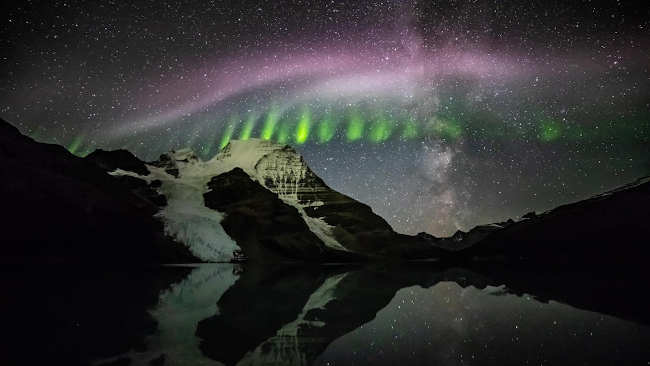
Phenomena called “Steve” and “picket fence” are masquerading as auroras, graduate student argues
BERKELEY, Calif. — The shimmering green, red and purple curtains of the northern and southern lights — the auroras — may be the best-known phenomena lighting up the nighttime sky, but the most mysterious are the mauve and white streaks called Steve and their frequent companion, a glowing green "picket fence."
First recognized in 2018 as distinct from the common auroras, Steve — a tongue-in-cheek reference to the benign name given a scary hedge in a 2006 children's movie — and its associated picket fence were nevertheless thought to be caused by the same physical processes. But scientists were left scratching their heads about how these glowing emissions were produced.
Claire Gasque, a University of California, Berkeley, graduate student in physics, has now proposed a physical explanation for these phenomena that is totally different from the processes responsible for the well-known auroras. She has teamed up with researchers at the campus's Space Sciences Laboratory, or SSL, to propose that NASA launch a rocket into the heart of the aurora to find out if she's correct.
Vibrant auroras and glowing phenomena such as Steve and the picket fence are becoming more common as the sun enters the active period of its 11-year cycle, and November was a good month for Steve observations in the northern latitudes.
Because all these transient luminous phenomena are triggered by solar storms and coronal mass ejections from the sun, the approaching solar maximum is an ideal time to study rare events like Steve and the picket fence.
Gasque described the physics behind the picket fence in a paper published last month in the journal Geophysical Research Letters and will discuss the results on Dec. 14 in an invited talk at the American Geophysical Union meeting in San Francisco.
She calculated that in a region of the upper atmosphere farther south than that in which auroras form, electric fields parallel to Earth's magnetic field could produce the color spectrum of the picket fence. If correct, this unusual process has implications for how physicists understand energy flow between Earth's magnetosphere, which surrounds and protects Earth from the solar wind, and the ionosphere at the edge of space.
"This would upend our modeling of what creates light and the energy in the aurora in some cases," Gasque said.
"The really interesting thing about Claire's paper is that we've known for a couple of years now that the Steve spectrum is telling us there's some very exotic physics going on. We just didn't know what it was," said Brian Harding, a co-author of the paper and an SSL assistant research physicist. "Claire's paper showed that parallel electric fields are capable of explaining this exotic spectrum."
The paper was a side project from Gasque's Ph.D. thesis, which is focused on the connection between events like volcanoes on Earth's surface and phenomena in the ionosphere 100 kilometers or more above our heads.
But after hearing about Steve — which has now become an acronym for Strong Thermal Emission Velocity Enhancement — at a conference in 2022, she couldn't resist looking into the physics behind Steve and the picket fence.
"It's really cool," she said. "It's one of the biggest mysteries in space physics right now."
The physics of Steve and picket fence
The common auroras are produced when the solar wind energizes particles in Earth's magnetosphere, often at altitudes higher than 1,000 kilometers above the surface. These energized particles spiral around Earth's magnetic field lines toward the poles, where they crash into and excite oxygen and nitrogen molecules in the upper atmosphere. When those molecules relax, oxygen emits specific frequencies of green and red light, while nitrogen generates a bit of red, but primarily a blue, emission line.
The colorful, shimmering curtains that result can extend for thousands of kilometers across the northern or southern latitudes.
Steve, however, displays not individual emission lines, but a broad range of frequencies centered around purple or mauve. And unlike auroras, neither Steve nor the picket fence emit blue light, which is generated when the most energetic particles hit and ionize nitrogen. Steve and the picket fence also occur at lower latitudes than the aurora, potentially even as far south as the equator.
Some researchers proposed that Steve is caused by ion flows in the upper atmosphere, referred to as subauroral ion drift, or SAID, though there's no well accepted physical explanation for how SAID could generate the colorful emissions.
Gasque's interest was sparked by suggestions that the picket fence's emissions could be generated by low-altitude electric fields parallel to Earth's magnetic field, a situation thought to be impossible because any electric field aligned with the magnetic field should quickly short out and disappear.
Using a common physical model of the ionosphere, Gasque subsequently showed that a moderate parallel electric field — around 100 millivolts per meter — at a height of about 110 km could accelerate electrons to an energy that would excite oxygen and nitrogen and generate the spectrum of light observed from the picket fence. Unusual conditions in that area, such as a lower density of charged plasma and more neutral atoms of oxygen and nitrogen, could potentially act as insulation to keep the electric field from shorting out.
"If you look at the spectrum of the picket fence, it's much more green than you would expect. And there's none of the blue that's coming from the ionization of nitrogen," Gasque said. "What that's telling us is that there's only a specific energy range of electrons that can create those colors, and they can't be coming from way out in space down into the atmosphere, because those particles have too much energy."
Instead, she said, "the light from the picket fence is being created by particles that have to be energized right there in space by a parallel electric field, which is a completely different mechanism than any of the aurora that we've studied or known before."
She and Harding suspect that Steve itself may be produced by related processes. Their calculations also predict the type of ultraviolet emissions that this process would produce, which can be checked to verify the new hypothesis about the picket fence.
Though Gasque's calculations don't directly address the on-off glow that makes the phenomenon look like a picket fence, it's likely due to wavelike variations in the electric field, she said. And while the particles that are accelerated by the electric field are probably not from the sun, the scrambling of the atmosphere by solar storms probably triggers Steve and the picket fence, as it does the common aurora.
Enhanced auroras exhibit a picket fence-like glow
The next step, Harding said, is to launch a rocket from Alaska through these phenomena and measure the strength and direction of the electric and magnetic fields. SSL scientists specialize in designing and building instruments that do just that. Many of these instruments are on spacecraft now orbiting Earth and the sun.
Initially, the target would be what's known as an enhanced aurora, which is a normal aurora with picket fence-like emissions embedded in it.
"The enhanced aurora is basically this bright layer that's embedded in the normal aurora. The colors are similar to the picket fence in that there's not as much blue in them, and there's more green from oxygen and red from nitrogen. The hypothesis is that these are also created by parallel electric fields, but they are a lot more common than the picket fence," Gasque said.
The plan is not only "to fly a rocket through that enhanced layer to actually measure those parallel electric fields for the first time," she said, but also send a second rocket up to measure the particles at higher altitudes, "to distinguish the conditions from those that cause the auroras." Eventually, she hopes for a rocket that will fly directly through Steve and the picket fence.
Harding, Gasque and colleagues proposed just such a sounding rocket campaign to NASA this fall and expect to hear back regarding its selection in the first half of 2024. Gasque and Harding consider the experiment an important step in understanding the chemistry and physics of the upper atmosphere, the ionosphere and Earth’s magnetosphere, and a proposal in line with the Low Cost Access to Space (LCAS) program sponsored by NASA for projects like this.
"It's fair to say that there's going to be a lot of study in the future about how those electric fields got there, what waves they are or aren't associated with, and what that means for the larger energy transfer between Earth's atmosphere and space," Harding said. "We really don't know. Claire's paper is the first step in the chain of that understanding."
Gasque expressed appreciation for the input from people who study the middle ionosphere, or mesosphere, and the stratosphere, whose ideas helped her puzzle out the solution.
"With this collaboration, we were able to make some really cool progress in this field," she said. "Honestly, it was just following our nose and being excited about it."
In addition to Harding, her other co-authors are Reza Janalizadeh of Pennsylvania State University in University Park, Justin Yonker of the Applied Physics Laboratory at Johns Hopkins University in Laurel, Maryland, and D. Megan Gillies of the University of Calgary in Alberta, Canada.
Partial support for this work was provided by the National Science Foundation (AGS-2010088), National Aeronautics and Space Administration (80NSSC21K1386) and Robert P. Lin Fellowship at UC Berkeley.
Robert Sanders writes for the UC Berkeley News Center.
City of Clearlake, Elem Indian Colony form collaborative agreement for new travel center development

CLEARLAKE, Calif. — The Clearlake City Council last week unanimously approved a new agreement with the Elem Indian Colony in support of the tribe’s new travel center development in the city.
The project will be built on a 1.1-acre property consisting of two parcels at 14825 and 14855 Lakeshore Drive, near Redbud Park and formerly the site of Mario’s Restaurant and Silk’s Bar and Grill.
City officials and the tribe were complimentary of each other and their efforts to work together, and both said the project will be economically beneficial for the community.
The tribe’s leadership said at the Dec. 7 council meeting that they worked hard to understand the city’s concerns and to be consistent with the city’s vision.
Blue Stone Consulting Group, working on behalf of the tribe, reported that the building style is “modern mountain design,” with high ceilings and natural light.
It will feature a 4,650-square-foot building with a convenience store, an in-house food facility with offerings including sandwiches and salads plus fresh coffee, office space and an all-access drive through, along with both indoor and outdoor eating areas.
While there will be a tobacco stand, the tribe has agreed to follow California regulations for tobacco sales, which it is not required to do.
There also will be a total of 20 gas pumps — of which four will be for diesel fuel — and 10 dispensing stations, plus four to six electric vehicle charging stations.
In an effort to make the project as green as possible, the design includes solar panels on the top of the gas station.
The tribe is ready to break ground as soon as possible. Construction is expected to be completed in January or February of 2025.
Elem purchased the property in 2019 from receivership. In February, the Bureau of Indian Affairs approved Elem’s request to place the land in trust, which means the tribe does not have to pay taxes on operations or seek city approval on the project.
City Manager Alan Flora said the city had concerns about the project, especially with it being in trust. “The city has essentially no jurisdiction over that sovereign land.”
However, in spite of those concerns, he said the city and the tribe have developed what he called “a very strong relationship.”
Flora said the tribe came to the city and wanted to address its concerns, including how it might impact city operations. That “positive and collaborative way” of responding to the city’s concerns resulted in the memorandum of agreement before the council that night.
The agreement covers several key areas, among them, tax revenue, which the tribe is not required to pay because transactions on tribal lands are not subject to federal, state or local taxes.
Despite that, Flora said Elem has agreed to pay the city an equal amount of tax receipts that would be generated by the city’s two tax measures, Measure P, which supports the police department, and Measure V, the road sales tax. The tribe will contribute 60% of the city’s sales tax rate, increasing it by 10% annually until it reaches 100%.
Flora said the tribe is doing everything it can to make the travel center consistent with city ordinances and plans, despite no obligation to do so. The city’s engineers, which are working on a project on Lakeshore Drive, are sharing their information with the tribe and their team.
Although the city does not have permitting jurisdiction over the project — projects on tribal lands are not subject to review and approval for building, grading and other types of permits — Elem has agreed to submit the plans to the city for review, comment and recommendation.

Flora said the Clearlake Police Department will provide law enforcement services for the property until such time as the tribe decides to develop a tribal police force.
In response to concerns about tobacco use, the tribe agreed to adopt the state ban on flavored tobacco sales.
Other key aspects of the agreement include Elem’s pledge to establish a public benefit fund with an initial grant of $100,000 to assist with projects benefiting the community at large. Two city and two tribal representatives will jointly determine the projects to support.
The agreement also includes a tribal/city advisory committee. Flora said the tribe asked the city to participate in that committee, which also will include two representatives each from the city and tribe in order to have regular discussions and work through any issues that might arise.
“It’s been a very positive working relationship,” said Flora, adding he was proud of how they came together.
Elem Chairman Agustin Garcia said Elem is a historic tribe both in Clearlake Oaks and in Clearlake.
The other land the tribe has in trust is in Clearlake Oaks, next to the Sulphur Bank mercury mine, which is a federal Superfund site that is about to undergo a major cleanup.
Garcia said being next to that mine has devastated the tribe, adding it’s hard to build on contaminated land.
“We sought out other lands. We made a choice to purchase this property here in the city of Clearlake,” Garcia said.
He said the tribe has had a great experience working with Flora, with everything falling into place.
“We want to settle whatever notion that you have that we're just going to be one of these tribes that’s going to come in, develop this site and not work with you guys. That's not going to happen,” Garcia said, noting the agreement nails down everything the tribe was there to pledge they would do.
He added, “It’s a great steppingstone because we plan to invest in the city.”
His mother, Sarah Garcia, has been Elem’s secretary/treasurer since she was 21 years old. She recounted traveling with her father since she was a teenager, and how that the tribe didn’t get electricity at its Clearlake Oaks rancheria until 1965, and waited until 1973 to get running water.
She said she’s thrilled with the new clinic — an apparent reference to Lake County Tribal Health’s new facility that opened in Clearlake earlier this year — and now the travel center.
“Now I can begin to think about retiring and let the younger generation move forward,” she said.
Council members lauded the tribe for their effort to work with the city and for investing in the community.
“We really appreciate the collaborative effort to get this project off the ground. It’s a good thing for both. We really appreciate that,” said Councilman Dirk Slooten.
“Thank you. Thank you for investing in our shared community. Even if we didn't have an agreement, that investment alone means so much to the people here,” said Councilman David Claffey.
“The visuals are stunning,” Claffey added, noting he’s going to try to get Flora to include modern mountain design for the City Hall upgrades.
Councilman Russell Cremer moved to approve the agreement, with Councilwoman Joyce Overton seconding and the council approving it 5-0.
Following the vote there was a round of applause from the chambers.
In a following statement issued jointly by the tribe and the city, Elem Chair Agustin Garcia said “this agreement is the culmination of the tribe's desire for economic development in the city the tribe calls home. We appreciate the city’s commitment to work collaboratively with us to create a project that reflects both the tribe’s and city’s vision for Clearlake and Lake County that will stand for generations. The agreement also reflects what can happen when all issues are placed on the table and both parties work toward common goals. The Elem Indian Colony thanks city leaders for their support and trust in approving the agreement.”
Flora said that the city “can’t express enough how much we appreciate the interest in benefiting the community by Elem tribal leadership throughout this process.”
He added, “In many cases, negotiations like this are combative and end up in court. But Elem considered our needs and concerns and addressed them in a meaningful way. We see this as a long and cooperative relationship with Elem that will benefit the Clearlake community and support tribal sovereignty.”
The situation with Elem stands in contrast to the city’s legal challenges with the Koi Nation, a Lower Lake tribe that has sued over the city’s 18th Avenue improvement project and the Burns Valley sports complex. Last month a judge ruled against the Koi’s 18th Avenue suit and earlier this week denied the Koi a continued stay on that project.
Email Elizabeth Larson at