 How to resolve AdBlock issue?
News
On the Grindstone District, the trail closure is in effect as of 2 p.m. on Dec. 18, per Forest Order 08-23-09.
On the Upper Lake Ranger District, the trail closure will be in effect beginning at midnight on Dec. 19, per Forest Order 08-23-10.
Temporary wet weather trail closures go into effect when two inches of rainfall occur within a 24-hour period or when the soils are saturated. The weather forecast is also showing 90-100% chance for showers through Wednesday this week.
Wet weather trail closures restrict the use of motor vehicles on National Forest System trails when conditions are too wet to sustain use without causing soil loss, impacting water quality, damaging trail tread and putting public safety at risk.
These limited duration closures will remain in place until no measurable precipitation is recorded within 48 consecutive hours.
By issuing these closures as precipitation events occur, forest managers said they provide for public safety, protect natural resources during and after storms and allow time for trails to dry out prior to resuming use.
The restrictions may be implemented anytime during fall and winter seasons through June 2024.
The following persons are exempt from this order:
1. Any federal, state, or local officer, or member of an organized rescue or fire-fighting force in the performance of an official duty.
2. Persons with Forest Service Permit No. FS-7700-48 (Permit for Use of Roads, Trails, or Areas Restricted by Regulation or Order), specifically exempting them from this Order.
Trail users can check the precipitation data online before traveling to the forest.
When closures occur, information will be posted on the forest website and social media.
Forest orders and updates can be found at https://www.fs.usda.gov/alerts/mendocino/alertsnotices.

A lot can go wrong in a large urban water system. Pumps malfunction. Valves break. Pipes leak. Even when the system is functioning properly, water can sit in pipes for long periods of time. Water shortages are also a growing problem in a warming world, as communities across the Southwestern U.S. and in many developing nations are discovering.
That’s why cities have started experimenting with small-scale alternatives – including wastewater recycling and localized water treatment strategies known as decentralized or distributed systems.
I study large- and small-scale water systems, focusing on innovative system designs that allow local use of water sources that might otherwise go to waste. As technology improves, cities are discovering something that rural communities have long known: Small-scale water treatment, properly engineered, can be cheaper and easier to maintain than a centralized system, and it can improve water security and even the environment.
Cleaning water – nature’s lessons
Almost all water has value and can be cleaned and put to use.
Nature does a great job of cleaning water naturally as it flows through the ground. The soil physically filters water, and chemical and biological processes help strip away contaminants over time.
Those processes can be mimicked by water treatment plants and filters that are becoming increasingly effective.
Traditionally, cities have relied on centralized water systems that treat freshwater from a river or aquifer at a central facility, then distribute it through a large network of pipes. But that infrastructure becomes increasingly vulnerable to disruptions as it ages. And climate change, water scarcity and population growth increase stress on the system.
So, some cities are experimenting with what are known as distributed systems. These are small-scale water treatment, reclamation and recycling plants that are designed to collect, treat and reuse water in close proximity to both the source and the user. Some are separate operations. Others are connected to the larger system in a hybrid model.
For example, a decentralized system might treat wastewater in an urban area and recycle it for reuse within that area by the same users, as El Paso, Texas, is doing. Or it could collect storm runoff and wastewater from homes and redirect it specifically for irrigation or to recharge groundwater, as Austin, Texas, and San Francisco do.
Windhoek, Namibia, a city of about 430,000 people surrounded by an arid landscape, has been treating wastewater to achieve a drinking standard and returning it to homes since 1968 for all kinds of uses, including cooking and drinking. Storm water runoff, industrial water, wastewater and even agricultural runoff can be treated and recycled with modern technology to become drinkable.
All of these approaches, whether connected to the main system or as separate closed systems, can reduce the community’s overall demand for freshwater from rivers or aquifers.
Technology is making more water more reusable
Small-scale treatment can range from advanced filters inside individual homes to treatment at tanks serving clusters of homes or commercial, industrial and agricultural facilities.
Often, the treated water goes to non-potable uses like toilet flushing or to replenish groundwater. But advances in technology are making these decentralized water systems more feasible and expanding their uses.
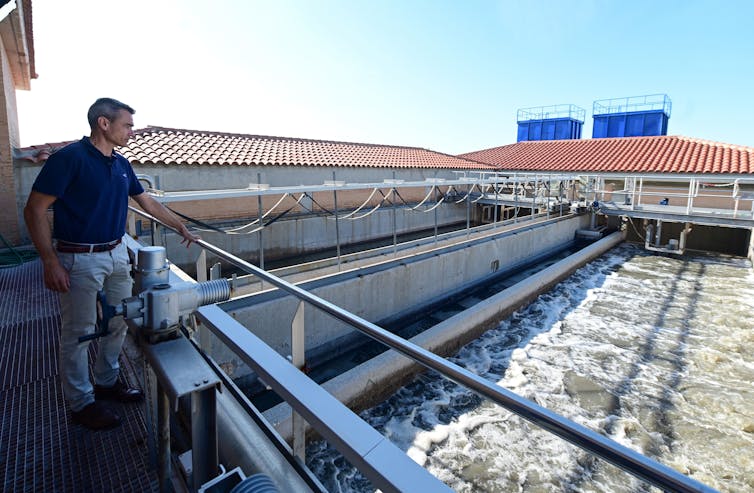
Membrane-based and electrochemical processes have shown great potential for recovering fresh water, nutrients – which can be used for fertilizer – and energy from wastewater. These processes include reverse osmosis, which pushes water through a semipermeable membrane to remove impurities, and electrodialysis, which uses an electric field.
Microbial fuel cells go a step further and use the microbes present in wastewater to both produce electricity and facilitate the treatment of wastewater simultaneously. Another energy recovery method involves capturing biogas, primarily methane, from decomposing organic matter in wastewater in the absence of oxygen.
Unlike conventional treatment technologies, which work on a large scale, these emerging treatment processes use modular designs that can be easily scaled up or down.
They can also be used to create hybrid systems by supplementing large centralized systems with treated water, particularly in arid regions where water supplies are scarce.
How a hybrid system might help Houston
To test how a hybrid system might help avoid water shortages due to disruptions to the system, my colleagues and I created a model of Houston, a city with 7,000 miles of pipelines and 2.2 million residents. We simulated the impact that different types of water outages can have on that large centralized water supply and how distributed sources could help reduce the impact.
Overall, we found that installing hybrid systems did a better job supplying water and avoiding low flows across the city than the centralized system alone, particularly in areas where low water pressure is common.

The pressurized flow from reclaimed water could also limit the spread of contamination from sources such as a terrorist attack in the vicinity of the reclaimed water source.
That doesn’t mean new water sources are risk-free, of course. Additional sources connecting to a large water system can also introduce new potential sources of contamination, so the design of the system is important.
Several factors determine how effective distributed water can be. Population and building density, local water demand, soil characteristics, climate conditions, infrastructure and the state of existing water infrastructure all play a role. Research indicates that regions with high energy demands for water distribution, significant local water requirements and the capacity to reuse wastewater stand to gain the most.
Notably, San Francisco has emerged as a pioneer in extreme decentralization, with initiatives extending down to the individual building level. In some buildings, water tanks, filters and treatment in the basement make water reusable for activities such as flushing toilets.

What’s standing in the way?
Despite the benefits, water reuse accounts for less than 1% of total water use in the U.S. today.
Public perceptions concerning recycled water are one challenge, including enduring skepticism regarding the safety, reliability and appropriate use of reclaimed water.
Wastewater recycled properly is considered safe to drink and may even contain less toxic risk than the sources of water we already drink. However, water that is not treated to the appropriate level can pose significant human health risks. A robust business model is also needed to make decentralized systems cost-effective, coupled with a supportive governance structure.
As federal funds pour in to revitalize America’s water infrastructure, U.S. communities have a golden opportunity to bolster their large water systems with a decentralized approach. Globally, with climate change fueling extreme storms and making water supplies less reliable in many areas, small-scale decentralized systems could provide water security and increase water access in areas that are underserved today.
Lu Liu, Assistant Professor of Civil, Construction and Environmental Engineering, Iowa State University
This article is republished from The Conversation under a Creative Commons license. Read the original article.
The board will meet beginning at 9 a.m. Tuesday, Dec. 19, in the board chambers on the first floor of the Lake County Courthouse, 255 N. Forbes St., Lakeport.
The meeting can be watched live on Channel 8, online at https://countyoflake.legistar.com/Calendar.aspx and on the county’s Facebook page.
Accompanying board documents, the agenda and archived board meeting videos also are available at that link.
To participate in real-time, join the Zoom meeting by clicking this link.
The meeting ID is 883 9520 6748, pass code 377409. The meeting also can be accessed via one tap mobile at +16694449171,,88395206748#,,,,*377409#.
In an item timed for 11 a.m., the board will consider a resolution to approve the purchase of the Kelseyville Senior Center, located at 5245 Third St., then lease it back to Kelseyville Seniors Inc. for continued use as a senior center.
The board had planned to discuss the purchase at its Nov. 28 meeting but held it over. On Dec. 14, the Lake County Planning Commission approved a general plan conformity report, upon which the purchase is contingent.
The proposed purchase price is $117,795, which will come from American Rescue Plan Act.
This is the second time the county has been involved with a purchase of the building. The county provided funds to allow the nonprofit that runs the senior center to purchase it providings $165,000 for the purchase and $35,000 for renovations in 2002.
In other business, in an untimed item, the board will hear the result of an audit of the operations of Elijah House, which ran the county’s emergency homeless shelter for two years, beginning in July 2020.
The Oroville-based nonprofit was out of compliance with state reporting rules for nonprofits throughout the time it was in contract with the county of Lake, and in February, the California Attorney General’s Office suspended Elijah House’s nonprofit registration for failure to bring its reporting current.
At 10:30 a.m., the board will consider a three-year, $1.5 million contract for LG Sonic technology to abate toxic algae blooms in the Clearlake and Clearlake Oaks arms of Clear Lake.
The proposal will include 28 LG Sonic buoys to treat the lake for algae, with eight of those buoys collecting data to help Water Resources and other agencies with early cyanobacteria level detection.
The full agenda follows.
CONSENT AGENDA
5.1: Approve letter of support for the Konocti Fire Safe Council’s “Wildfire Prevention Education and Safety in the Soda Bay Corridor Communities” and authorize the chair to sign.
5.2: Ratify letter of support for CSA-2 Spring Valley application for BRIC funding for the Spring Valley Drought Resiliency Project.
5.3: Ratify the following advisory board appointments for District 3 from the Jan. 10, 2023, Board of Supervisors meeting: East Region Town Hall, Pamela Kicenski; Upper Lake Cemetery District, Lynne Kary-Rana.
5.4: Approve letter regarding termination of Blue Shield contract with Adventist Health and authorize the chair to sign.
5.5: a) Approve Budget Transfer in Budget Unit 1781 – for $10,432 from account 717.23-80 to Capital Asset account 717.62-74; and b) amend the list of capital assets of Budget Unit 1781 for the 2023-2024 budget to include two washer/dryer combo units and c) create a capital asset in Budget Unit 4014 – Behavioral Health, account 740.62-72, for a Wolf Stove in the amount of $17,644.50 and authorize the chair to the Board of Supervisors to sign.
5.6: Approve long distance travel to Washington DC for Katherine VanDerWall to attend the California Agricultural Commissioner and Sealers Association’s DC delegation trip serving as the North Group Representative from March 16 to 22, 2024, for an amount not to exceed $4,600.
5.7: Approve Board of Supervisors meeting minutes from Nov. 14, 2023, and Nov. 28, 2023.
5.8: Approve addendum to agreement between the county of Lake and Tyler Technologies to add additional services for an amount of $15,000; and authorize the chair to sign.
5.9: Approve a letter of opposition to AB 702, which proposes changes to the Juvenile Justice Crime Prevention Act and local juvenile justice coordinating councils and authorize the chair to sign.
5.10: Approve the 2023-2024 Juvenile Justice Realignment Block Grant Plan.
5.11: Adopt resolution authorizing the Public Services director to sign the notice of completion for work performed under the agreement for the Courthouse Roof Replacement Project.
5.12: (a) Approve Lake County Sheriff’s Office application for the Cal Fire Wildfire Prevention Grant (Education) in the amount of $100,000 for “Operation Lake Co Ready,” a joint partnership between Lake County Sheriff’s Department Office of Emergency Services and the Lake County Fire Chief’s Association to fund prevention and preparedness outreach materials and community education events at local fire districts; (b) authorize County Administrative Officer Parker to sign forms: STD19, STD21 and STD204.
5.13: Approve first amendment to contract between county of Lake and Lake County Office of Education for differential response services in the amount of $107,000 from July 1, 2023 to June 30, 2024, and $129,200 per fiscal year from July 1, 2024, to June 30, 2026, and authorize the chair to sign.
5.14: Adopt resolution authorizing the department head and/or deputy director of LCDSS to apply for and accept the county allocation award under Round 5 of the Transitional Housing Program and Round 2 of the Housing Navigation and Maintenance Program.
TIMED ITEMS
6.2, 9:07 a.m.: Pet of the Week.
6.3, 9:10 a.m.: Consideration of report to the Board of Supervisors explaining the emergency conditions that necessitated the summary abatement for the property located at 3025 Spring Valley Road / APN# 062-331-04.
6.4, 9:20 a.m.: Consideration of presentation on the multi-county agency full functional evacuation shelter exercise.
6.5, 10 a.m.: Consideration of presentation for overview of grant award from the Governor’s Office of Planning and Research under the Adaptation Planning Grant Program.
6.6, 10:30 a.m.: Consideration of LG Sonic proposal.
6.7, 11 a.m.: a) Consideration of resolution authorizing purchase of real property located at 5245 Third St., Kelseyville, CA 95451 for the continued purpose of a Kelseyville Senior and Event Center; and b) consideration of real property purchase and sale agreement contingent upon approval of the general plan conformity report; and c) consideration of lease agreement between the county of Lake and Kelseyville Seniors Inc. and authorize chair to sign.
6.8, 11:30 a.m.: Public hearing, consideration of proposed negative declaration (IS 23-03), general plan amendment (GPAP 23-01) and rezone (RZ 23-01) for Reynolds System Inc., to change the general plan designation of a portion of the parcel from rural lands to industrial, and rezone a portion of the parcel from rural lands to heavy industrial; location: 18649 CA State Highway 175, Middletown (APN: 013-046-04).
UNTIMED ITEMS
7.2: Consideration of presentation of the compliance and fiscal audit of the Elijah House Foundation.
Email Elizabeth Larson at
The council will meet Tuesday, Dec. 19, at 6 p.m. in the council chambers at Lakeport City Hall, 225 Park St.
The agenda can be found here.
The council chambers will be open to the public for the meeting. Masks are highly encouraged where 6-foot distancing cannot be maintained.
If you cannot attend in person, and would like to speak on an agenda item, you can access the Zoom meeting remotely at this link or join by phone by calling toll-free 669-900-9128 or 346-248-7799.
The webinar ID is 973 6820 1787, access code is 477973; the audio pin will be shown after joining the webinar. Those phoning in without using the web link will be in “listen mode” only and will not be able to participate or comment.
Comments can be submitted by email to
On Tuesday, the council will hold its annual reorganization, and elect the 2024 mayor and mayor pro tem.
The council also will consider adopting the cellphone policy for management and City Council members.
In other business, City Manager Kevin Ingram will present a proposed amendment to the Westside Community Park, Phase II Master Plan to include a designated area for the future development of pickleball courts.
Police Chief Brad Rasmussen will ask the council to approve the license agreement between the city of Lakeport and Lake County Behavioral Health staff to work out of the Lakeport Police Department station.
On the consent agenda — items considered noncontroversial and usually accepted as a slate on one vote — are ordinances; minutes of the City Council’s regular meeting on Dec. 5; and the Nov. 30 warrant register.
Email Elizabeth Larson at
The National Weather Service is forecasting several days of rain this week leading up to the Christmas holiday.
The storm system moving over the region started to drop heavy rain on Lake County throughout the day Sunday and into the night.
Rainfall totals in inches for the 24-hour period ending at 2 a.m. Monday are as follows:
• Cobb: 0.32;
• Hidden Valley Lake: 0.35.
• Indian Valley Reservoir: 0.18;
• Kelseyville: 0.42.
• Lake Pillsbury: 0.37.
• Lower Lake: 0.33.
• Lyons Valley: 0.27.
• Middletown: 0.28.
The forecast is calling for rain and possible thunderstorms on Monday and Tuesday, as well as more rain on Wednesday.
Conditions are forecast to clear on Thursday, with chances of rain on Friday, followed by another day of clear weather on Saturday.
Chances or rain are again in the forecast for Sunday, Christmas Eve.
Nighttime temperatures this week will dip into the high 30s, with daytime conditions in the mid to high 50s.
Wind, with gusts of close to 30 miles per hour, are forecast for Monday, with lighter winds of around 10 miles per hour expected on Tuesday.
Email Elizabeth Larson at
They offer a special thanks to the Clear Lake Gleaners for the generous donation of turkey and other items.
Turkey, ham, potatoes, vegetables, rolls and dessert will be served at the Presbyterian Church at 5340 Third St. in Kelseyville from 3 to 5 p.m. on Christmas Day.
All seniors in the Kelseyville area, as well as anyone who finds themselves without a meal on Christmas Day, are welcome to drop by to enjoy a meal and good company at the Friendship Hall.
Piano music will be provided by Julianne Carter.
They can also bring the meal to your vehicle to take home and enjoy.
Contact them by phone at 707-349-2628 or by email at