 How to resolve AdBlock issue?
News
Georgina Marie Guardado, the current poet laureate, officially announced the search.
“It has been my honor to serve two consecutive terms in this role during a period of history that was undoubtedly challenging for all of us. And yet, the power of words did not yield. Our county undoubtedly has a rich literary community and I look forward to the search for the next Poet Laureate!” Guardado said in a Facebook post.
The poet laureate, which is a volunteer post, represents and promotes poetry and literacy in the community.
The person filling the role also will help “facilitate collaborations between local creatives, cultural organizations, local businesses, and community institutions,” according to the online application.
The Board of Supervisors established the poet laureate post in 1998.
Guardado has held the post for two terms since 2020.
She is the youngest Lake County poet laureate, as well as its first Hispanic American female.
Guardado also is the first person to be appointed to the office for more than one term, and the 11th individual to hold it.
The next term will be for 2024 to 2026.
She reported that applications — which opened on Dec. 15 — will be accepted through Feb. 1, 2024.
Visit this website to see application guidelines and to apply online.
For questions or assistance with the application, email Guardado at
Dogs available for adoption this week include mixes of Australian shepherd, border collie, Chihuahua, Doberman pinscher, German shepherd, Great Pyrenees, hound, Labrador retriever, pit bull, Queensland heeler, shepherd and terrier.
Dogs that are adopted from Lake County Animal Care and Control are either neutered or spayed, microchipped and, if old enough, given a rabies shot and county license before being released to their new owner. License fees do not apply to residents of the cities of Lakeport or Clearlake.
Those dogs and the others shown on this page at the Lake County Animal Care and Control shelter have been cleared for adoption.
Call Lake County Animal Care and Control at 707-263-0278 or visit the shelter online for information on visiting or adopting.
The shelter is located at 4949 Helbush in Lakeport.
Email Elizabeth Larson at


























More than 115.2 million people are expected to travel during the holiday between Dec. 23 and Jan. 1. That number is 2.2% higher than last year and marks the second-highest number since 2000.
More than 15.4 million Calfornians will be among those packing their bags, beating the previous record set in 2019 by 2.6%.
“The travel outline for the year-end holidays echoes what we’ve been seeing in travel throughout 2023,” said Brian Ng, senior vice president of membership and travel marketing for AAA Northern California. “Despite high costs, more Americans are prioritizing creating memories with loved ones and exploring new destinations.”
The organization said drivers should anticipate up to 20% longer travel times nationwide.
The heaviest congestion is expected Saturday, Dec. 23, and Thursday, Dec. 28.
AAA Northern California urges people to check the forecast, consider reservations for airport parking spots and avoid checking luggage if possible, make sure your vehicle is ready and to travel during off-peak periods.
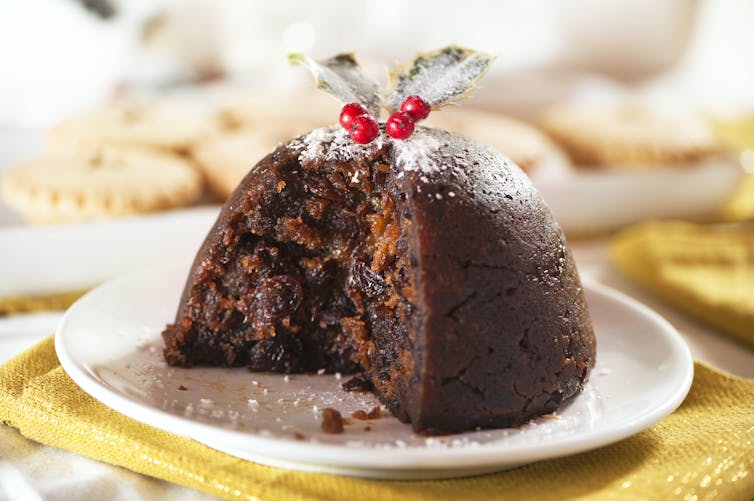
As an American living in Britain in the 1990s, my first exposure to Christmas pudding was something of a shock. I had expected figs or plums, as in the “We Wish You a Merry Christmas” carol, but there were none. Neither did it resemble the cold custard-style dessert that Americans typically call pudding.
Instead, I was greeted with a boiled mass of suet – a raw, hard animal fat this is often replaced with a vegetarian alternative – as well as flour and dried fruits that is often soaked in alcohol and set alight.
It’s in no danger of breaking into my top ten favorite Christmas foods. But as a historian of Great Britain and its empire, I can appreciate the Christmas pudding for its rich global history. After all, it is a legacy of the British Empire with ingredients from around the globe it once dominated and continues to be enjoyed in places it once ruled.
Christmas pudding takes its shape
Christmas pudding is a relatively recent concoction of two older, at least medieval, dishes. The first was a runny porridge known as “plum pottage” in which any mixture of meats, dried fruits and spices might appear – edibles that could be preserved until the winter celebration.
Until the 18th century, “plum” was synonymous with raisins, currants and other dried fruits. “Figgy pudding,” immortalized in the “We Wish You a Merry Christmas” carol, appeared in the written record by the 14th century. A mixture of sweet and savory ingredients, and not necessarily containing figs, it was bagged with flour and suet and cooked by steaming. The result was a firmer, rounded hot mass.
During the 18th century, the two crossed to become the more familiar plum pudding – a steamed pudding packed with the ingredients of the rapidly growing British Empire of rule and trade. The key was less a new form of cookery than the availability of once-luxury ingredients, including French brandy, raisins from the Mediterranean, and citrus from the Caribbean.
Few things had become more affordable than cane sugar which, owing to the labors of millions of enslaved Africans, could be found in the poorest and remotest of British households by mid-century. Cheap sugar, combined with wider availability of other sweet ingredients like citrus and dried fruits, made plum pudding an iconically British celebratory treat, albeit not yet exclusively associated with Christmas.
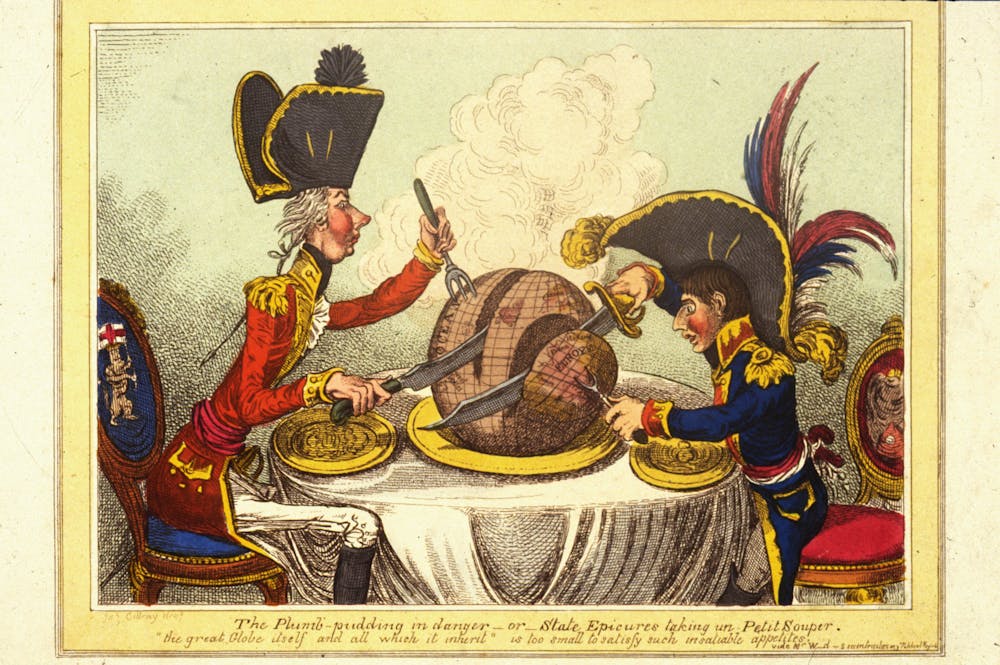
Such was its popularity that English satirist James Gillray made it the centerpiece of one of his famous cartoons, depicting Napoleon Bonaparte and the British prime minister carving the world in pudding form.
Linked with Christmas
In line with other modern Christmas celebrations, the Victorians took the plum pudding and redefined it for the holiday season, making it the “Christmas pudding.”
In his 1843 internationally celebrated “A Christmas Carol,” Charles Dickens venerated the dish as the idealized center of any family’s Christmas feast: “Mrs Cratchit entered – flushed, but smiling proudly – with the pudding, like a speckled cannon-ball, so hard and firm, blazing in half of half-a-quarter of ignited brandy, and bedight with Christmas holly stuck into the top.”
Three years later, Queen Victoria’s chef published her favored recipe, making Christmas pudding, like the Christmas tree, the aspiration of families across Britain.
Christmas pudding owed much of its lasting appeal to its socioeconomic accessibility. Victoria’s recipe, which became a classic, included candied citrus peel, nutmeg, cinnamon, lemons, cloves, brandy and a small mountain of raisins and currants – all affordable treats for the middle class. Those with less means could either opt for lesser amounts or substitutions, such as brandy for ale.
Eliza Acton, a leading cookbook author of the day who helped to rebrand plum pudding as Christmas pudding, offered a particularly frugal recipe that relied on potatoes and carrots.
White colonists’ desires to replicate British culture meant that versions of Christmas pudding soon appeared across the empire. Even European diggers in Austrialia’s goldfields included it in their celebrations by mid-century.
The high alcohol content gave the puddings a shelf life of a year or more, allowing them to be sent even to the empire’s frontiers during Victoria’s reign, including to British soldiers serving in Afghanistan. Christmas celebrations for British soldiers fighting in the Crimea in 1855 included the Christmas pudding – a welcome respite from the cold winter.
Empire pudding

In the 1920s, the British Women’s Patriotic League heavily promoted it – calling it “Empire Pudding” in a global marketing campaign. They praised it as emblem of the empire that should be made from the ingredients of Britain’s colonies and possessions: dried fruits from Australia and South Africa, cinnamon from Ceylon, spices from India and Jamaican rum in place of French brandy.
Press coverage of London’s 1926 Empire Day celebrations featured the empire’s representatives pouring the ingredients into a ceremonial mixing bowl and collectively stirring it.
The following year, the Empire Marketing Board received King George V’s permission to promote the royal recipe, which had all the appropriate empire-sourced ingredients.
Such promotional recipes and the mass production of puddings from iconic grocery stores like Sainsbury’s in the 1920s combined to place Christmas puddings on the tables of a myriad of peoples who resided across an empire on which the sun never set.
After the empire
Decolonization did not diminish the appeal of the Christmas pudding. Passengers transiting through London’s airports can find them in abundance this time of year. Their shape and density have baffled airport security scanners for some time, leading to requests to carry them as hand luggage.
In former white settler colonies, like Canada, the tradition endured, although in Australia, where Christmas falls in summer, trifle and pavlova are at least equally common. In parts of India, where it is sometimes known as “pudim,” it remains a traditional favorite, “steeped in tradition,” according to the leading English national daily newspaper, the “Hindustan Times.”
Reflecting modern palates and trends, Jamie Oliver, the celebrated British chef and author, has gluten-free and more modern options this year. His “classic” recipe, however, would not have been out of place on Queen Victoria’s table.
Like so many adaptations around the former empire, it includes some American ingredients: pecans and cranberries as well as bourbon substituted for brandy – an Anglo-American concoction – much like my own family. And I will embrace this one.
Troy Bickham, Professor of History, Texas A&M University
This article is republished from The Conversation under a Creative Commons license. Read the original article.

Curious Kids is a series for children of all ages. If you have a question you’d like an expert to answer, send it to
Why are there small and big black holes? Also, why are some black holes invisible and others have white outlines? – Sedra and Humaid, Abu Dhabi, United Arab Emirates
Black holes are dense astronomical objects with gravity so strong that nothing, not even light, can escape. Anything that crosses the boundary of a black hole’s gravitational influence, called the event horizon, will fall into the black hole. Inside this deep, dense pit, it is never to be seen again.
Black holes litter the universe. Some smaller black holes are sprinkled randomly throughout galaxies like our Milky Way. Other gigantic ones, called “supermassive” black holes, lie at the centers of galaxies. Those can weigh anywhere between a million to a billion times the mass of our Sun. So you might be wondering: How can astronomers possibly see something so dark and so big?
I am an astronomer who studies the very first supermassive black holes that formed in our universe. I want to understand how black holes form and what kinds of astrophysical neighborhoods they grow up in.
Types of black holes
Let’s talk about how black holes begin their lives. Two famous scientists, Albert Einstein and Karl Schwarzchild, first pitched the idea of a black hole. They thought that when a large star dies, its core might shrink and shrink until it collapses under its own weight. This is what we astronomers call a “stellar mass black hole,” which is just another way of saying it’s comparatively very small.
Stellar mass black holes are only a few times bigger than our Sun. Supermassive black holes are more of a mystery, though. They are many millions of times heavier than our Sun, and they are packed into a small area that’s about the size of our solar system. Some scientists think supermassive black holes might form by many stars colliding and collapsing at once, while others think they might have already started growing several billion years ago.
Growing black holes
What do black holes look like? Most of the time, they are not actively growing, so they are invisible. But we can tell they’re there because stars can still orbit around them, just like Earth around the Sun.
When something is orbiting an invisible object at high speeds, scientists know there must be a massive black hole in the middle. This is the case for the closest supermassive black hole to us, which lies at the center of the Milky Way – safely millions of miles away from you.
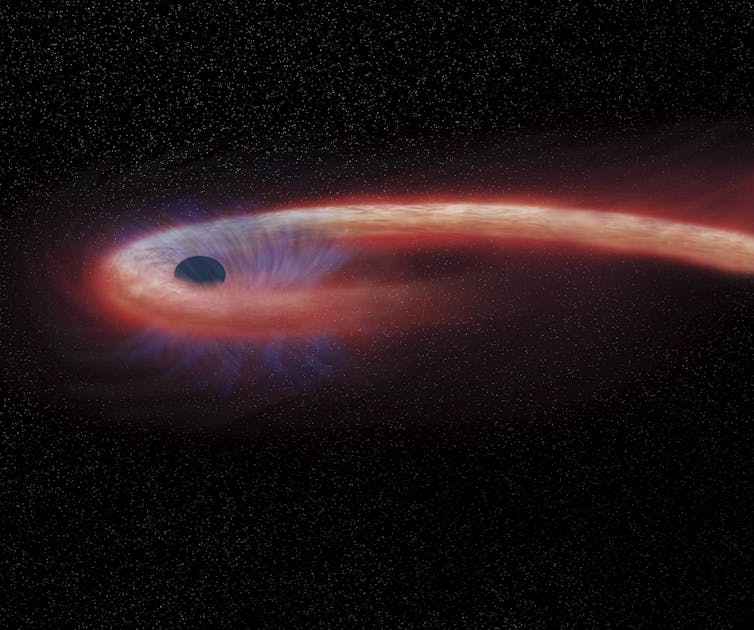
Meanwhile, when a hungry black hole is eating up gas in a galaxy, it heats that gas up until you can see a glowing ring of X-rays, optical light and infrared light around the black hole. Once it exhausts all of the fuel near the event horizon, the light dies down once again and it becomes invisible.
Outlines around black holes
One of the most famous “white outlines” is the image of a black hole from the movie “Interstellar.” In that movie, they were trying to show the white-hot, glowing ring of gases that are falling into the actively growing black hole.
In real life, we don’t get such a close-up view. The best image of the ring around a real black hole comes from the Event Horizon Telescope, showing scientists the supermassive black hole at the center of a galaxy called M87. It might look blurry to you, but this doughnut is actually the sharpest image ever taken of something so far away.

There are lots of types of black holes out there in the universe. Some are small and invisible, and some grow to gigantic proportions by eating up stuff inside a galaxy and shining bright. But don’t worry, black holes can’t just keep sucking in everything in the universe – eventually there is nothing close enough to the black hole to fall in, and it will become invisible again. So you are safe to keep asking questions about black holes.
Hello, curious kids! Do you have a question you’d like an expert to answer? Ask an adult to send your question to
And since curiosity has no age limit – adults, let us know what you’re wondering, too. We won’t be able to answer every question, but we will do our best.
Jaclyn Champagne, JASPER Postdoctoral Researcher, University of Arizona
This article is republished from The Conversation under a Creative Commons license. Read the original article.
The contract between Blue Shield of California and Adventist Health Keep Care Local | Adventist Health provides Blue Shield members in-network access to all 18 Adventist hospitals across California.
In a joint statement, the two organizations reported that the new arrangement’s effective date is retroactive three weeks, to Dec. 1 — the date when the contract dispute resulted in Adventist Health hospital facilities no longer being part of Blue Shield’s network.
“As a mission-driven health plan, our goal is for our members to have access to quality care that’s sustainably affordable,” said Aliza Arjoyan, Blue Shield’s senior vice president of provider partnerships and network management. “Adventist Health has been a part of Blue Shield’s network of providers for a long time, and I look forward to continued collaboration with the hospital system.”
“We are pleased to continue our long-working relationship with Blue Shield of California,” says Kerry L. Heinrich, president and CEO. “Our mission calls us to provide access to high-quality care close to home in the communities we serve, and we are excited to continue caring for Blue Shield members.”
Adventist and Blue Shield have been in negotiations for nearly a year, and the attempts to come to a new contract broke down by the end of November.
On Monday, Kim Lewis, spokesperson for Adventist Health Clear Lake, told Lake County News that Adventist Health remained open to discussions.
Lewis said she couldn’t say how many Lake County residents were affected by the contract issues. “Blue Shield will not currently share the number of members with Adventist Health who are impacted. They are the only ones who have this information as the health insurance provider.”
Statewide, Blue Shield reported that it serves more than 4.8 million members through network relationships with about 350 hospitals and more than 122,000 providers across the state.
Then, on Tuesday, the Board of Supervisors approved a letter urging both sides to come to an agreement and pointing to Lake County’s low health rankings.
The letter recognized that transportation can be difficult for many in Lake County. Blue Shield had suggested by that point that its Lake County members travel to Enloe Medical Center or Oroville Hospital in Butte County, Queen of the Valley Medical Center in Napa County or Santa Rosa Memorial Hospital for Blue Shield facilities that can provide the care they need.
During that Tuesday discussion, Supervisor Bruno Sabatier pointed out that 51% of Lake County’s population is covered by Medi-Cal.
The letter was approved unanimously.
It explained, “While Blue Shield does not represent a large portion of the health coverage in Lake County it still represents a significant portion of our community members being impacted by this terminated contract. Lake County is 56th out of 58 counties when reviewing our health rankings in the State of California. Any action that breaks the continuity of care that our community members require exacerbates the health issues that we are already encountering across our county.”
Editor’s note: The article previously stated incorrectly that 51% of Lake County’s population is covered by Medicare, when in fact it is Medi-Cal.
Email Elizabeth Larson at