 How to resolve AdBlock issue?
News

Californians can ring in 2024 by redeeming their empty wine and liquor containers for cash.
Starting Jan. 1, California adds wine and liquor sold in bottles, cans, boxes, and pouches to the state’s Beverage Container Recycling Program to cut waste and pollution by turning more recycled materials into new products.
What’s new for consumers?
Californians pay a 5-, 10- or 25-cent California Redemption Value, or CRV, deposit on newly added wine and liquor containers and redeem deposits at recyclers or obligated retailers.
• Newly added containers are not required to have CRV labeling until July 1, 2025.
• Bag-in-box containers must be intact to be eligible for redemption.
What’s new for businesses?
• Stores update shelf labels and systems to reflect new CRV container additions.
• Recycling centers and obligated retailers redeem newly added beverages and container types (with or without a CRV label).
• Beverage manufacturers and distributors register and submit CRV payments.
California is implementing several historic Bottle Bill reforms to recycle more beverage containers and make redemption easier for consumers.
In addition to wine and liquor, large juice containers are redeemable starting Jan. 1.
Retailers in areas without recycling centers must redeem in-store or join new dealer cooperative systems starting Jan 1, 2025.
Over $285 million to increase material reuse and recycling sites with funding for:
• Hassle-free redemption options like reverse vending machines, mobile recycling, and bag-drop recycling.
• Beverage container recycling business start-up costs.
• Reuse/refill system innovations for beverage containers.
• Collection, transportation, and remanufacturing of materials.
https://calrecycle.ca.gov/bevcontainer/basics/
Visit RecycleCRV.com.
Beverage container recycling program fast facts
California passed its Bottle Bill in 1986 to reduce litter and increase recycling.
California collected 491 billion beverage containers for recycling since 1988, including a record 19.5 billion beverage containers in 2022.
California’s current beverage container recycling rate is 70%.
With the addition of wine and spirits, CalRecycle estimates about 1.1 billion additional wine and spirits containers could enter the program each year.
Beginning at 6:01 p.m. on Friday, Dec. 29, the CHP will implement a statewide Maximum Enforcement Period, or MEP, which will continue through 11:59 p.m. on Monday, Jan. 1, 2024.
The CHP conducted a similar enforcement effort during the recent Christmas holiday.
Tragically, 20 people were killed in crashes within CHP jurisdiction between 6:01 p.m. on Friday, Dec. 22, through 11:59 p.m. on Monday, Dec. 25.
Additionally, CHP officers made more than 900 arrests for driving under the influence, or DUI – an average of one every five minutes.
“Our personnel work through the holidays to help ensure people arrive safely at their destinations,” said CHP Commissioner Sean Duryee. “The goal is to maintain a safe environment on California’s roads, which is achievable when all motorists make responsible decisions behind the wheel.”
In addition to assisting drivers and looking for traffic violations, such as failure to wear a seat belt, speeding, and distracted driving, CHP officers will be paying close attention to people suspected of driving under the influence of drugs and/or alcohol.
During the last New Year’s Day MEP, CHP officers made 570 DUI arrests statewide.
As we close out 2023, avoid becoming a statistic. Have a plan and designate a sober driver or use ride-share services, avoid distractions while driving, and always wear your seat belt.
If you see or suspect an impaired driver, call 9-1-1 immediately. Be prepared to provide the dispatcher a description of the vehicle, the license plate number, location, and direction of travel. Your phone call may save someone’s life.

With economic forecasters rewriting their 2024 outlooks following recent moves from the Federal Reserve, The Conversation turned to two financial economists to share their thoughts on the upcoming year.
D. Brian Blank and Brandy Hadley are professors who study finance, firm financial decisions and the economy. They explain what they’re watching in 2024.
1. At this time last year, many experts saw a downturn on the horizon. Will that long-predicted recession finally come to pass in 2024?
The good news is, probably not.
The U.S. economy is not in a recession and will likely continue growing. Over the past year, gross domestic product has outpaced expectations, inflation is trending downward and employment remains robust. Real wages have increased, as has consumer spending. Additionally, housing demand is strong and financial markets are at all-time highs. While no one should argue that there will never be another recession, 2024 seems to be an unlikely time for one – unless there’s some unexpected spark like, for example, a new global pandemic.
To be fair, optimism leads to risk-taking, which can always contribute to the next downturn. And the U.S. economy faces plenty of challenges, including already elevated debt costs, a possible government shutdown, rising consumer debt and continued distress in commercial real estate, which could result in rolling industry downturns. Other headwinds include the national debt, other nations’ weaker economies and ongoing global conflict and trade tensions.
While 2023 has seemed to many people like a “soft landing” – that elusive achievement in which policymakers reduce inflation without sparking a downturn – prior recessions have followed periods where people thought they had been avoided. That may be why bankers, finance leaders and economists are still noting the risks of interest rates remaining high.
Still, the fundamentals are strong and may be on the rise, if you believe chief financial officers. Plus, despite dysfunction in Washington, recent laws and policies like the CHIPS and Science Act, the bipartisan infrastructure deal, the AI Bill of Rights and the Executive Order on Safe, Secure, and Trustworthy Use of Artificial Intelligence could further boost economic growth by stimulating job creation and enhancing competitiveness. Notably, public and private manufacturing and industrial investment are at unprecedented levels, and technology is quickly advancing, further contributing to the positive economic outlook, not to mention strong consumer balance sheets.
2. Then what about a ‘vibecession’? Are we in one now, and why does it matter for 2024?
When you look at the economic pessimism revealed in polls and on social media, a fascinating paradox emerges – despite the collective bad vibes, the majority of Americans say their personal economic situations are basically fine.
The writer Kyla Scanlon has called this state of affairs a “vibecession”: While the economy continues to grow, the vibes are just off. The fact that consumer spending continues to see sustained growth, despite the gloomy economic outlook, underscores a curious split between sentiment and economic activity.

3. What if individual income and spending keep rising? Wouldn’t that be enough to end the vibecession?
In short: Not necessarily.
While inflation has been high over the past couple of years – reaching a peak of 9.1% in June 2022 before falling to 3.1% recently – most Americans have not seen their income rise as fast as inflation since 2021. As a result, many are frustrated that they can’t afford what they could in 2020. Is reminiscing like prior generations about how Coca-Cola used to cost a nickel killing the vibes? If inflation rises faster than wages in 2024, the vibes may suffer.
What’s more, other positive economic developments have seemed to barely affect the vibes. Just about everyone who wants a job has one, which is a crucial factor in maintaining consumer confidence and spending habits.
To be sure, gas prices also play an outsized role in shaping sentiment, and as they unexpectedly fell in December, sentiment improved. This highlights the impact of energy costs on the public’s mood and suggests that fluctuations in gas prices can quickly influence overall economic sentiment.
However, we suspect that consumers will keep doing what they’re doing – spending money and feeling bad about the economy – until some shock forces them out of it. This weird contradiction between perceived gloom and personal financial well-being highlights the complex interplay of psychological factors and material realities that shapes the overall economic narrative.
4. Could the vibecession become a self-fulfilling prophecy?
Consumers say they feel bad, but they’re continuing to spend more than expected, which has been the case for more than a year now. These facts seem at odds with each other, and some experts worry the pessimism itself could hurt the economy. This is because people spend less when they’re concerned about the future.
However, this has been the case for months – so it’s unclear why it should change now.
While understanding that consumer sentiment is complex, we think it makes more sense to focus on what people do, not what they say. And people are behaving in a way that’s consistent with a strong economy due to rising real income, not to mention a robust labor market.
And overall, if you tell people for the better part of two years that a recession is imminent, you shouldn’t be shocked that they’re gloomy. If the consensus is wrong, it should surprise no one when sentiment diverges from economic data – especially with politicians blaming each other for a weaker economy.
5. What else are you watching for in 2024?
Coming off the December Federal Reserve meeting, many forecasters have rewritten their 2024 outlooks with the expectation that the Fed will lower rates more than they anticipated before Chair Jerome Powell gave an optimistic press conference. Though many expected Powell to minimize discussions about lowering rates, meeting responses were strong, deeming inflation defeated and consensus expectations forecasting a benchmark federal funds rate below 4% by year end to relax financial conditions.
While investors appear to have overreacted – again – additional slowing in inflation and economic growth is likely as the economy continues to normalize post-pandemic. The most likely outcome for 2024 is that the Federal Open Market Committee lowers rates following more downward revisions to inflation data beginning as early as March until rates end the year just below the Fed’s 4.5% federal funds rate projection. However, the Fed isn’t waiting for inflation to reach its 2% target before lowering rates, which means that rapidly falling inflation could make more rate cuts possible.
Economic growth is likely to remain strong in 2024, and inflation will likely slow, albeit at a more muted rate. And with mortgage rates falling below 7% now, housing starts and mortgage originations are rising. Now, housing affordability may improve in the coming year, albeit from the worst level in decades.
While 2024 is likely to involve debates in other areas, hopefully fewer of these economic conversations will happen in 2024 than in 2023. And if we are lucky, markets will rise at least as quickly, though we should remember that almost everyone was wrong last year – and if there’s one prediction we can make with confidence, it’s that at least some of today’s forecasts will look pretty silly in retrospect.
D. Brian Blank, Associate Professor of Finance, Mississippi State University and Brandy Hadley, Associate Professor of Finance and the David A. Thompson Distinguished Scholar of Applied Investments, Appalachian State University
This article is republished from The Conversation under a Creative Commons license. Read the original article.
The brief, filed in the U.S. Supreme Court, supports the federal government petitioners in seeking reversal of the Fifth Circuit’s decision in Missouri v. Biden, which affirmed a sweeping injunction that prohibits petitioners from communicating with social media platforms about content moderation.
If upheld, the decision could chill the ability of government agencies to engage productively with the private sector to protect the public online.
“Social media is a daily source for news and information across the country,” said Bonta. “The Fifth Circuit’s decision which blocks virtually any outreach to social media platforms about content moderation by numerous federal government agencies and officials is extraordinarily sweeping and threatens efforts to address threats to public health and safety."
For decades, states and social-media companies have engaged in important dialogues about safeguarding the well-being of the public from online dangers and threats.
The coalition’s experience confirms that maintaining open lines of communication between the government and social-media companies on topics such as extremist violence, child safety and consumer protection is mutually beneficial, furthers the public interest, and fully comports with the First Amendment.
In the brief, the attorneys general argue that the Fifth Circuit’s decision wrongfully treats the exchange of information about harms and best practices as inherently coercive, and dangerously restricts the government from addressing threats to public safety.
In their amicus brief, the attorneys general argue that the Fifth Circuit’s decision:
• Fails to properly distinguish between impermissible efforts to coerce and permissible efforts to persuade when evaluating the federal government’s interactions with social media companies.
• Is inconsistent with states’ experience engaging collaboratively with social-media companies to address potentially harmful content on their platforms.
In filing the amicus brief, Attorney General Bonta joins the attorneys general of New York, Arizona, Colorado, Connecticut, Delaware, Hawaii, Illinois, Maine, Maryland, Massachusetts, Michigan, Minnesota, Nevada, New Jersey, New Mexico, Oregon, Pennsylvania, Rhode Island, Vermont, Washington, And Wisconsin, and the District of Columbia.
A copy of the amicus brief is available here.
The report said California’s unemployment rate rose by 0.1 percentage point to 4.9% in November despite the state’s employers adding 9,300 nonfarm payroll jobs to the economy, according to data released today by the Employment Development Department, or EDD.
That’s compared to 4.1% a year ago, the EDD said.
In Lake County, the jobless rate rose to 6.1% in November, up from 5.7% in October. The November rate is the highest Lake County has had since March, when it hit 6.4%.
The November 2022 unemployment rate in Lake County was 5.3%.
Lake County’s rate ranked it No. 43 out of California’s 58 counties.
The EDD reported that, since the current economic expansion began in April 2020, California has gained 3,240,500 jobs, which averages out to a gain of 75,360 jobs per month, and now sits at 485,900 jobs (or 2.7%) above the state’s pre-pandemic total.
California’s 9,300 November nonfarm job gain contributes to 11 consecutive months of job gains in 2023 to date after last December’s losses.
In related data that figures into the state’s unemployment rate, the EDD said there were 323,975 people certifying for Unemployment Insurance benefits during the November 2023 sample week.
That compares to 356,668 people in October and 306,550 people in November 2022. Concurrently, 37,594 initial claims were processed in the November 2023 sample week, which was a month-over decrease of 3,115 claims from October, and also a year-over decrease of 10,227 claims from November 2022, the EDD reported.
Email Elizabeth Larson at
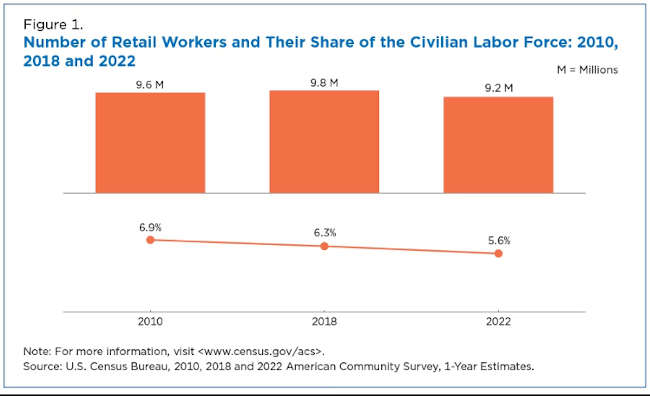
From assisting customers to ringing up sales, retail workers are the economic backbone of the nation’s retail industry, especially during the busy holiday shopping season.
In 2022, 9.2 million workers were employed as retail salespersons, cashiers or first-line supervisors of retail sales workers — collectively referred to as retail workers, according to the Census Bureau’s American Community Survey (ACS).
Since 2010, the relative number of U.S. retail workers remained over 9 million, but their share of the total workforce fell from 6.9% in 2010 to 5.6% in 2022.
The decline is expected to continue. The Bureau of Labor Statistics projects employment in retail sales occupations will decrease by 2% between 2022 and 2032.
Retail work is common
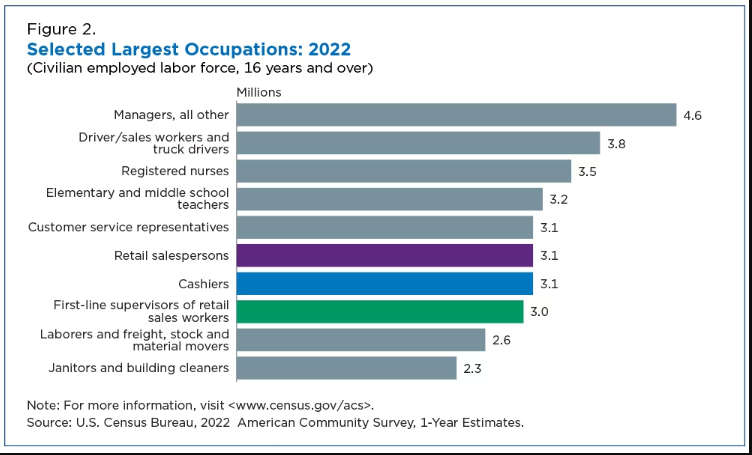
Despite the decreases in the number and share of retail workers, retail remains a common occupation. In 2022, 3.1 million workers were retail salespersons and cashiers and around 3 million were first-line supervisors of retail sales workers.
Retail jobs ranked just below other large occupations such as miscellaneous managers, driver/sales workers and truck drivers and registered nurses.
Earnings
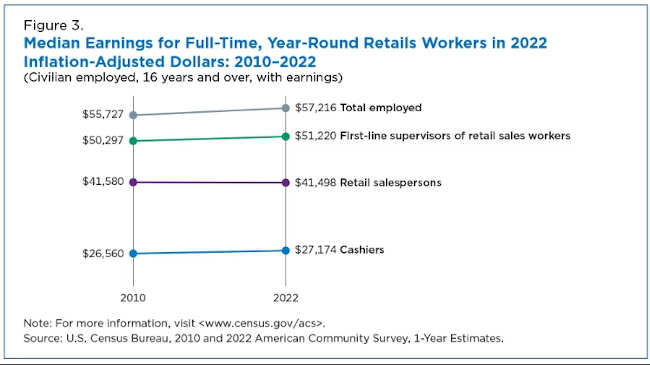
Between 2010 and 2022, the real median earnings of full-time, year-round workers increased by around $1,490 from $55,727 to $57,216. During the same period, median earnings of first-line supervisors of retail workers and cashiers increased by less than $1,000 each. The real median earnings of retail salespersons in 2022 was not statistically different from 2010.
Cashiers were among the lowest-paid members of the retail workforce. In 2022, their median earnings ($27,174) were around 47% less than those of all full-time, year-round workers ($57,216).
Brick-and-mortar stores to internet shopping
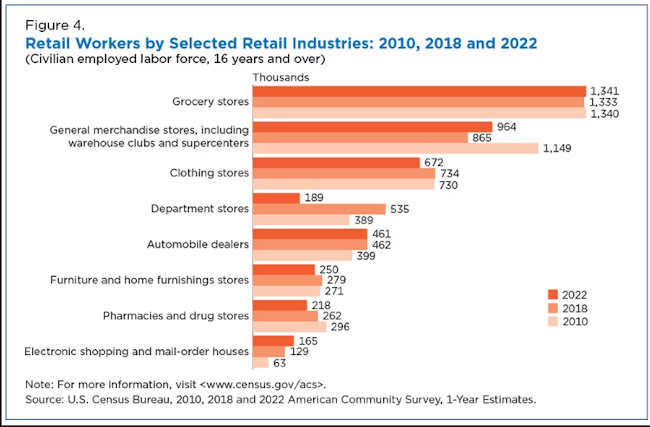
The number of retail workers in department stores fluctuated from around 389,000 in 2010 to about 535,000 workers in 2018 and dipping to about 189,000 workers in 2022. The decline in the number of workers could be related to recent closures of large retailers in the wake of the COVID-19 pandemic.
Research suggests that e-commerce will assume a larger role in the retail sector. The ACS shows that the number of retail workers in electronic shopping continually climbed between 2010 and 2022, from around 63,000 to around 165,000.
Challenges ahead
Despite ongoing technological changes in the way customers interact with retail businesses and general consolidation of retail stores, the retail workforce remains a substantial part of the American labor market.
Yet, retail occupations remain among the lowest-paying jobs and retail workers often face not only limited opportunities for advancement but nonstandard and unpredictable work schedules.
Lynda Laughlin is a senior advisor in the Census Bureau’s Social, Economic, and Housing Statistics Division, or SEHSD. Julia Beckhusen is chief of SEHSD.