How to resolve AdBlock issue?
Refresh this page
How to resolve AdBlock issue?
Refresh this page
Lake County News,California
  • Home
    • Registration Form
  • News
    • Education
    • Veterans
    • Community
      • Obituaries
      • Letters
      • Commentary
    • Police Logs
    • Business
    • Recreation
    • Health
    • Religion
    • Legals
    • Arts & Life
    • Regional
  • Calendar
  • Contact us
    • FAQs
    • Phones, E-Mail
    • Subscribe
  • Advertise Here
  • Login

News

Data centers need electricity fast, but utilities need years to build power plants – who should pay?

Data centers need lots of power – but how much, exactly? alacatr/iStock/Getty Images Plus

The amount of electricity data centers use in the U.S. in the coming years is expected to be significant. But regular reports of proposals for new ones and cancellations of planned ones mean that it’s difficult to know exactly how many data centers will actually be built and how much electricity might be required to run them.

As a researcher of energy policy who has studied the cost challenges associated with new utility infrastructure, I know that uncertainty comes with a cost. In the electricity sector, it is the challenge of state utility regulators to decide who pays what shares of the costs associated with generating and serving these types of operations, sometimes broadly called “large load centers.”

States are exploring different approaches, each with strengths, weaknesses and potential drawbacks.

A new type of customer?

For years, large electricity customers such as textile mills and refineries have used enough electricity to power a small city.

Moreover, their construction timelines were more aligned with the development time of new electricity infrastructure. If a company wanted to build a new textile mill and the utility needed to build a new gas-fired power plant to serve it, the construction on both could start around the same time. Both could be ready in two and a half to three years, and the textile mill could start paying for the costs necessary to serve it.

Modern data centers use a similar amount of electricity but can be built in nine to 12 months. To meet that projected demand, construction of a new gas-fired power plant, or a solar farm with battery storage, must begin a year – maybe two – before the data center breaks ground.

During the time spent building the electrical supply, computing technology advances, including both the capabilities and the efficiency of the kinds of calculations artificial intelligence systems require. Both factors affect how much electricity a data center will use once it is built.

Technological, logistical and planning changes mean there is a lot of uncertainty about how much electricity a data center will ultimately use. So it’s very hard for a utility company to know how much generating capacity to start building.

A large industrial site with two tall smokestacks.
Keeping older coal plants running may be an expensive way to generate power. Ulysse Bellier/AFP via Getty Images

Handling the risks of development

This uncertainty costs money: A power plant could be built in advance, only to find out that some or all of its capacity isn’t needed. Or no power plant is built, and a data center pops up, competing for a limited supply of electricity.

Either way, someone needs to pay – for the excess capacity or for the increased price of what power is available. There are three possible groups that might pay: the utilities that provide electricity, the data center customers, and the rest of the customers on the system.

However, utility companies have largely ensured their risk is minimal. Under most state utility-regulation processes, state officials review spending proposals from utility companies to determine what expenses can be passed on to customers. That includes operating expenses such as salaries and fuel costs, as well as capital investments, such as new power plants and other equipment.

Regulators typically examine whether proposed expenses are useful for providing service to customers and reasonable for the utility to expect to incur. Utilities have been very careful to provide their regulators with evidence about the costs and effects of proposed data centers to justify passing the costs of proposed investments in new power plants along to whomever the customers happen to be.

Regulators, then, are left to equitably allocate the costs to the prospective data center customers and the rest of the ratepayers, including homes and businesses. In different states, this is playing out differently.

Kentucky’s approach to usefulness

Kentucky is attempting to address the demand uncertainty by conditionally approving two new natural gas-fired generators in the state. However, the utility companies – Louisville Gas & Electric and Kentucky Utilities – must demonstrate that those plants will actually be needed and used. But it’s not clear how they could do that, especially considering the time frames involved.

For instance, suppose the utility has a letter of agreement or even a contract with a new data center or other large customer. That might be sufficient proof for the regulator to approve charging customers for the costs of building a new power plant.

But it’s not clear what would happen if the data center ends up not being built, or needing much less power than expected. If the utility can’t get the money from the data center company – because they bill customers based on actual usage – that leaves regular consumers on the hook.

A large rectangular building.
A data center in Columbus, Ohio, is just one of many being built or proposed around the country. Eli Hiller/For The Washington Post via Getty Images

Ohio’s ‘demand ratchet’ and credit guarantee

In Ohio, the major power company AEP has a specific rate plan for data centers and other large electricity customers. One element, called a “demand ratchet,” is designed to mitigate month-to-month uncertainty in electricity consumption by data centers. The data center’s monthly bill is based on the current month’s demand or 85% of the highest monthly demand from the previous 11 months – whichever is higher.

The benefit is that it protects against a data center using huge amounts of electricity one month and very little the next, which would otherwise yield a much lower bill. The ratchet helps ensure that the data center is paying a significant share of the cost of providing enough electricity, even if it doesn’t use as much as was expected.

This ratchet effectively locks in the data center’s payments for 12 months, but regulators might expect a longer commitment from the center. For instance, Florida’s utilities regulator has approved an agreement that would require a data center company to pay for 70% of the agreed-upon demand in their entire electricity contract, even if the company didn’t use the power.

Another aspect of Ohio’s approach addresses the risk of changing business plans or technology. AEP requires a credit guarantee, like a deposit, letter of credit or parent company guarantee of payment, equal to 50% of the customer’s expected minimum bill under the contract. While this theoretically reduces the risk borne by other customers, it also raises concerns.

For example, a utility may not end up signing contracts directly with a large, well-known, wealthy technology company but with a subsidiary corporation with a more generic name – imagine something like “Westside Data Center LLC” – created solely to build and operate one data center. If the data center’s plans or technology changes, that subsidiary could declare bankruptcy, leaving the other customers with the remaining costs.

Harnessing strength in flexibility

A key advantage to these new types of customers is that they are extremely nimble in the way they use electricity.

If data centers can make money based on their flexibility, as they have in Texas, then a portion of those profits can be returned to the other customers that shared the investment risk. A similar mechanism is being implemented in Missouri: If the utility makes extra money from large customers, then 65% of that revenue increase is returned to the other customers.

Change is coming to the U.S. electricity system, but nobody is sure how much. The methods by which states are trying to allocate the cost of that uncertainty vary, but the critical element is understanding their respective strengths and weaknesses to craft a system that is fair for everyone.The Conversation

Theodore J. Kury, Director of Energy Studies, University of Florida

This article is republished from The Conversation under a Creative Commons license. Read the original article.


Tuleyome Tales: Too many spiders? Forget pest control, call on mud daubers

Mud dauber nest showing materials used. Photo by Tuleyome.

Of the over 4,000 known species of wasps in California, two are known as mud daubers: Sceliphron caementarium (black and yellow mud dauber) and Chalybion californicum (blue mud dauber).

Mud daubers get their name from their habit of using mud to build their nests, while most wasp species use wood pulp for nest construction. If you ever get a chance to see the nest making process, it is a sight that inspires awe and appreciation for these hardworking builders. 

Blue mud daubers look intimidating, but if you set the fear aside, they are exquisite, with metallic blue-black bodies and iridescent wings that shimmer in the sunlight. Their threadlike waists are part of what makes them look menacing, but also add to their elegance. 

Black and yellow mud daubers don’t have the iridescent flair of the blue, but are beautiful in their own right. They are mostly black with small yellow markings on their thorax and abdomen, the yellow being more pronounced on their legs. Their long threadlike waists give them an overall slender appearance, and they have beautiful tawny-colored wings. 

Despite their intimidating appearance mud daubers are very docile, and extremely unlikely to sting a human unless provoked or accidentally smooshed. 

Mud daubers are solitary wasps, and unlike social wasp species, do not tend to be as protective of their nests. This is likely because without strength in numbers they are better off fleeing rather than fighting a threat. When a nest is disturbed, they will often abandon the nest and rebuild elsewhere. So, unless you are a spider, be not afraid. 

Both species can be found in a variety of habitats and build their nests in sheltered locations. Their nests are commonly found under eaves of buildings, under bridges and even in sheds. In natural settings they nest under rock overhangs or in hollow trees. 

In both species, it is the females who are the builders. They seek out nesting sites with access to mud and ample spiders and begin construction by gathering mud from nearby creek beds or puddles. She uses her mandibles and front legs to form a compact ball of mud and saliva which she carries back to the nest in her mouth. 

At the nesting site, she makes a high-pitched sound by activating her flight muscles, causing her head and mandibles to vibrate rapidly, which helps her to shape and spread the mud evenly into a tubelike chamber. 

She will add mud until the chamber is large enough to contain an adult wasp, usually 30 to 40 mud foraging trips. A finished nest is made up of 6 to 25 of these individual chambers, painstakingly built over the course of several days with hundreds of trips to gather mud. 

Once an individual cell is complete, she will begin to provision it with food for her egg. While adult mud daubers feed primarily on nectar from flowers (their threadlike waist or petiole is too small to process solid foods), their larvae exclusively eat spiders.

Because the larvae require fresh food, dead spiders won’t do. Instead, she will hunt and sting a spider, using venom to paralyze it, and bring the immobile but very much alive spider back to the nest, where she will stuff it into the chamber. 

This continues until the chamber is full of spiders, sometimes up to two dozen. Once filled, she will lay a single egg on the spiders, and seal the chamber with more mud before moving on to the next cell. 

The egg hatches about three days later, and the larva will begin eating the spiders over the next two weeks, until the larva spins a cocoon, where it will undergo metamorphosis before emerging as an adult the following spring or summer. 

Blue mud daubers, in addition to building their own nests, seek out abandoned nests from other species to conserve energy. Sometimes blue mud daubers will even take over an active nest of another species, especially the nests of black and yellow mud daubers. They will use water to moisten and break into the nesting chambers, remove materials, add new spiders and lay their own egg inside.

Black and yellow mud daubers seek out smaller spiders such as orb weavers, crab spiders, and jumping spiders whereas blue mud daubers are known to hunt larger and venomous spiders, their preferred prey being black widow spiders. Blue mud daubers are the primary predator of black widows and help keep their numbers in balance.
 
Adult mud daubers only live between three to six weeks, but during that time they are amazingly productive, providing ecosystem services such as pollination, and spider population management and interesting bug watching for those so inclined. They also manage to make amazing architectural structures. They are good neighbors to us. 

Alarmingly, insect populations worldwide are significantly on the decline due to habitat loss, pesticide use and climate change. One way that we can help our insect neighbors (and the species that depend on them such as birds) is by finding ways to coexist. 

You can be a good neighbor to mud daubers by leaving nests over the winter, and allowing them to complete their life cycle. Removing spent nests in spring causes no harm, and is generally considered safe. If you are so inclined, you could even leave the spent nests and save them a bit of work next year. 

More importantly, think twice before calling a pest control company or spraying pesticides as they cause harm all along the food chain and negatively impact our shared environment. Plus, those spiders might seem pesky, but they are a needed meal for a future pollinator. 

Diana Drips is a Certified California Naturalist. Tuleyome is a 501 (c)(3) nonprofit conservation organization based in Woodland, California. For more information go to www.tuleyome.org. 

Mud dauber nests. Photo by Tuleyome.

Helping Paws: More new dogs for the holidays

LAKE COUNTY, Calif. — There are many new dogs waiting for homes at Lake County Animal Care and Control’s shelter this week. 

The dogs available for adoption this week include mixes of border collie, bulldog, cattle dog, Doberman Pinscher, German shepherd, Great Pyrenees, husky, Labrador Retriever, pit bull terrier, terrier and shepherd.

Dogs that are adopted from Lake County Animal Care and Control are either neutered or spayed, microchipped and, if old enough, given a rabies shot and county license before being released to their new owner. License fees do not apply to residents of the cities of Lakeport or Clearlake.

Those animals shown on this page at the Lake County Animal Care and Control shelter have been cleared for adoption.

Call Lake County Animal Care and Control at 707-263-0278 or visit the shelter online for information on visiting or adopting.

The shelter is located at 4949 Helbush in Lakeport.

Email Elizabeth Larson at This email address is being protected from spambots. You need JavaScript enabled to view it.. Follow her on Twitter, @ERLarson, and on Bluesky, @erlarson.bsky.social. Find Lake County News on the following platforms: Facebook, @LakeCoNews; X, @LakeCoNews; Threads, @lakeconews, and on Bluesky, @lakeconews.bsky.social. 


Kennel#11 Little Momma's preview photo

Kennel#11 Little Momma

Kennel#17 Sugar's preview photo
Kennel#17 Sugar

Kennel#16 Bernard's preview photo
Kennel#16 Bernard

Kennel#14 Chief's preview photo
Kennel#14 Chief

Kennel#28 Freya's preview photo
Kennel#28 Freya

Kennel#21 Brother's preview photo
Kennel#21 Brother

Kennel#21 Sista's preview photo
Kennel#21 Sista

Kennel#6 Tallow's preview photo
Kennel#6 Tallow

Kennel#32 Feather's preview photo
Kennel#32 Feather

Kennel#18 Rex's preview photo
Kennel#18 Rex

Kennel#12 Shylah's preview photo
Kennel#12 Shylah

Kennel#7 Koda's preview photo
Kennel#7 Koda

Kennel#33 Mitzy's preview photo
Kennel#33 Mitzy

 Kennel#20 Gracie's preview photo
Kennel#20 Gracie

Kennel#22 Mochi's preview photo
Kennel#22 Mochi

Kennel#5 Coco's preview photo
Kennel#5 Coco

 
Kennel#34 Nova's preview photo
Kennel#34 Nova

Kennel #29 Star's preview photo
Kennel #29 Star

Kennel#27 Lola's preview photo
Kennel#27 Lola

Kennel#9 Amore's preview photo
Kennel#9 Amore

Kennel#2 Timmy's preview photo
Kennel#2 Timmy

 
Kennel#25a Charlie's preview photo
Kennel#25a Charlie

Kennel#25b Bear's preview photo
Kennel#25b Bear

Kennel#31a's preview photo
Kennel#31a

Kennel#31b Baxter's preview photo
Kennel#31b Baxter

Kennel#13 Lucy's preview photo
Kennel#13 Lucy

Kennel#24 Nelly's preview photo
Kennel#24 Nelly

Kennel#30 Rosa's preview photo
Kennel#30 Rosa

Kennel#10 Roland's preview photo
Kennel#10 Roland

Kennel#8(Brut)'s preview photo
Kennel#8(Brut)
Kennel#15a's preview photo
Kennel#15a

Kennel#15b's preview photo
Kennel#15b


New industry standards and tech advances make pre-owned electronics a viable holiday gift option

It’s easier than ever to repair or recycle electronic devices. Elisa Schu/picture alliance via Getty Images
Electronic gifts are very popular, and in recent years, retailers have been offering significant discounts on smartphones, e-readers and other electronics labeled as “pre-owned.” Research I have co-led finds that these pre-owned options are becoming increasingly viable, thanks in part to laws and policies that encourage recycling and reuse of devices that might previously have been thrown away.

Amazon, Walmart and Best Buy have dedicated pages on their websites for pre-owned devices. Manufacturers like Apple and Dell, as well as mobile service providers like AT&T and Verizon, offer their own options for customers to buy used items. Their sales rely on the availability of a large volume of used products, which are supplied by the emergence of an entire line of businesses that process used, discarded or returned electronics.

Those developments are some of the results of widespread innovations across the electronics industry that supply chain researcher Suresh Muthulingam and I have linked to California’s Electronic Waste Recycling Act, passed in 2003.

Recycling innovation

Originally intended to reduce the amount of electronic waste flowing into the state’s landfills, California’s law did far more, unleashing a wave of innovation, our analysis found.

We analyzed the patent-filing activity of hundreds of electronics firms over a 17-year time span from 1996 to 2012. We found that the passage of California’s law not only prompted electronics manufacturers to engage in sustainability-focused innovation, but it also sparked a surge in general innovation around products, processes and techniques.

Faced with new regulations, electronics manufacturers and suppliers didn’t just make small adjustments, such as tweaking their packaging to ensure compliance. They fundamentally rethought their design and manufacturing processes, to create products that use recycled materials and that are easily recyclable themselves.

For example, Samsung’s Galaxy S25 smartphone is a new product that, when released in May 2025, was made of eight different recycled materials, including aluminum, neodymium, steel, plastics and fiber.

Combined with advanced recycling technologies and processes, these materials can be recovered and reused several times in new devices and products. For example, Apple invented the Daisy Robot, which disassembles old iPhones in a matter of seconds and recovers a variety of precious metals, including copper and gold. These materials, which would otherwise have to be mined from rock, are reused in Apple’s manufacturing process for new iPhones and iPads.

How do consumers benefit?

In the past two decades, 25 U.S. states and Washington D.C. have passed laws requiring electronics recycling and refurbishing, the process of restoring a pre-owned electronic device so that it can function like new.

The establishment of industry guidelines and standards also means that all pre-owned devices are thoroughly tested for functionality and cosmetic appearance before resale.

Companies’ deeper engagement with innovation appears to have created organizational momentum that carried over into other areas of product development. For example, in our study, we found that the passage of California’s law directly resulted in a flurry of patents related to semiconductor materials, data storage and battery technology, among others. These scientific advances have made devices more durable, repairable and recyclable.

For the average consumer, the recycling laws and the resulting industry responses mean used electronics are available with similar reliability, warranties and return policies as new devices – and at prices as much as 50% lower.The Conversation

Suvrat Dhanorkar, Associate Professor of Operations Management, Georgia Institute of Technology

This article is republished from The Conversation under a Creative Commons license. Read the original article.

Space News: Lower-cost space missions like NASA’s ESCAPADE are starting to deliver exciting science – but at a price in risk and trade‑offs

This artist’s rendering shows the ESCAPADE probes near Mars. NASA

After a yearslong series of setbacks, NASA’s Escape and Plasma Acceleration and Dynamics Explorers, or ESCAPADE, mission has finally begun its roundabout journey to Mars.

Launched on Nov. 13, 2025, aboard Blue Origin’s New Glenn rocket, ESCAPADE’s twin probes will map the planet’s magnetic field and study how the solar wind – the stream of charged particles released from the Sun – has stripped away the Martian atmosphere over billions of years.

When I was a doctoral student, I helped develop the VISIONS camera systems onboard each of ESCAPADE’s spacecraft, so I was especially excited to see the successful launch.

But this low-cost mission is still only getting started, and it’s taking bigger risks than typical big-ticket NASA missions.

ESCAPADE is part of NASA’s Small Innovative Missions for Planetary Exploration, or SIMPLEx, program that funds low‑cost, higher‑risk projects. Of the five SIMPLEx missions selected so far, three have failed after launch due to equipment problems that might have been caught in more traditional, tightly managed programs. A fourth sits in indefinite storage.

ESCAPADE will not begin returning science data for about 30 months, and the program’s history suggests the odds are not entirely in its favor. Nonetheless, the calculus goes that if enough of these missions are successful, NASA can achieve valuable science at a reduced cost – even with some losses along the way.

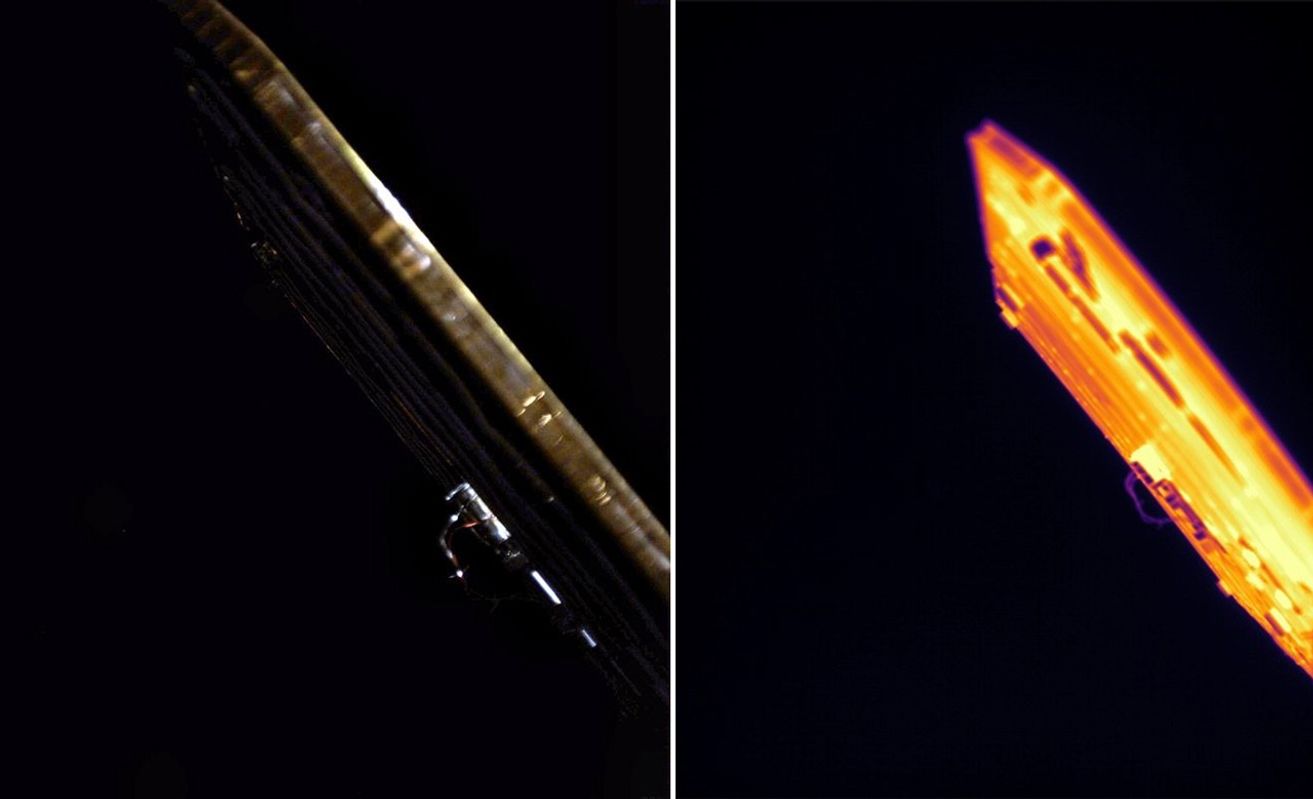
Two images showing the side of a solar panel. The left shows the image in visible light – it looks dark brown in color. The right shows the image lit up in bright yellow and orange light, in the infrared.
First light taken Nov. 21, 2025, from the VISIONS camera aboard Gold, one of NASA’s ESCAPADE spacecraft, showing the side of a solar panel. The left image is the visible-light camera, sensitive enough to image Mars’ green aurora. The right image is from an infrared camera and shows temperature differences, from warmer (yellow and orange) to cooler (purple and black), that can distinguish geologic features on Mars. NASA/UCB-SSL/RL/NAU-Radiant/Lucint

Lower cost, higher risk

NASA classifies payloads on a four‑tier risk scale, from A to D.

Class A missions are the most expensive and highest priority, like the James Webb Space Telescope, Europa Clipper and the Nancy Grace Roman Space Telescope. They use thoroughly proven hardware and undergo exhaustive testing.

ESCAPADE is at the other end. It’s a class D mission, defined as having “high risk tolerance” and “medium to low complexity.”

Of the 21 class D missions that have launched since the designation was first applied in 2009, NASA has not had a single class D mission launch on schedule. Only four remained under budget. Four were canceled outright prior to launch.

ESCAPADE, which will have cost an estimated US$94.2 million by the end of its science operations in 2029, has stayed under the $100 million mark through a series of cost‑saving choices. It has a small set of key instruments, a low spacecraft mass to reduce launch costs, and extensively uses generic commercial components instead of custom hardware.

NASA also outsourced to private companies: Much of the spacecraft development went to Rocket Lab and the trajectory design to Advanced Space LLC, with tight contract limits to make sure the contractors didn’t go over budget.

Additional savings came from creative arrangements, including the university‑funded VISIONS camera package and a discounted ride on New Glenn, which Blue Origin wanted to fly anyway for its own testing objectives.

Commercial space

ESCAPADE launched at a moment of transition in space science.

NASA and other science agencies are facing the steepest budget pressures in more than 60 years, with political winds shifting funding toward human spaceflight. At the same time, the commercial space sector is booming, with long-imagined technologies that enable cheap space travel finally entering service.

That boom has, in part, led to a resurgence in NASA’s “faster, better, cheaper” push that originated in the 1980s and ‘90s – and which largely faded after the 2003 Columbia disaster.

In theory, leaner NASA oversight, greater use of off‑the‑shelf hardware and narrower science goals can cut costs while launching more missions and increasing the total science return. If ESCAPADE succeeds in delivering important science, it will be held up as evidence that this more commercial, risk-tolerant template can deliver.

The trade-offs

A concept put forward by Jared Isaacman, the Trump administration’s nominee to lead NASA, is that 10 $100 million missions would be better than one $1 billion flagship – or top-tier – mission. This approach could encourage faster mission development and would diversify the types of missions heading out into the solar system.

But that reorganization comes with trade-offs. For example, low‑cost missions rarely match flagship missions in scope, and they typically do less to advance the technology necessary for doing innovative science.

With a narrow scope, missions like ESCAPADE are unlikely to produce the most transformative discoveries about, for instance, the origins of life or the nature of dark matter, or the first chemical analyses of oceans on a new world. Instead, they focus on more specific questions.

Early in ESCAPADE’s development, my role was to help create a planning document for the VISIONS cameras called the Science Traceability Matrix, which defines an instrument’s scientific goals and translates them into concrete measurement requirements.

My colleagues and I systematically asked: What do we want to learn? What observations prove it? And, critically, how precisely does the instrument need to work to be “good enough,” given the budget? Loftier goals usually demand more complex instruments and operations, which drive up costs.

ESCAPADE’s broader goals are to create a clearer picture of Mars’ magnetic field, how the solar wind interacts with it, and figure out what that process does to Mars’ atmosphere. That is valuable science. But it is more modest than the $583 million predecessor mission MAVEN’s more extensive scope and richer suite of instruments. It was MAVEN that determined how and when Mars lost its once-dense atmosphere in the first place.

Both ESCAPADE and MAVEN are dwarfed again by the open‑ended potential of an operation like the James Webb Space Telescope, which observes a limitless slate of astronomical objects in the infrared light spectrum with a higher resolution than any combination of prior smaller telescopes.

Flagship missions like the James Webb Space Telescope push the state of the art in new technologies and materials. These innovations then filter into both future missions and everyday life. For example, the Webb telescope advanced the medical tools used in eye exams. Smaller missions rely more heavily on existing, mature technologies.

And when systems are built by private companies rather than NASA, those companies keep tight control over the patents rather than openly spreading the technology across the scientific community.

A tense road to launch

ESCAPADE’s principal investigator, Rob Lillis, has joked that it is the mission with 11 lives, having survived 11 near‑cancellations. Problems ranged from being late in reaching the technology readiness levels that helped ensure the probes wouldn’t malfunction after launch, to the loss of its original free ride, with NASA’s Psyche mission.

In 2024, ESCAPADE received support from NASA to ride on New Glenn’s maiden flight, only to face delays as Blue Origin worked through technical hurdles. At last, in October 2025, ESCAPADE reached the launchpad.

I traveled to Cape Canaveral for the launch and felt the tension firsthand. The first window was scrubbed by bad weather and issues with ground equipment. Then a strong solar storm — ironically, a key driver of the very processes ESCAPADE will study — shut down the second window.

Concurrently, the Federal Aviation Administration imposed new launch restrictions due to the government shutdown that would have postponed the launch further if not for a last-minute exemption.

Finally, on Nov. 13, after repeated setbacks, New Glenn lifted off to cheers around the country. ESCAPADE reached orbit, and after a nervous few hours of receiver misalignment, mission controllers established communication with the spacecraft.

What’s next

While in Florida, I also watched another milestone in commercial spaceflight: the record-breaking 94th launch from Cape Canaveral in 2025, marking the most launches from Florida in a single year. It was a SpaceX Falcon 9 carrying Starlink satellites.

Like New Glenn, SpaceX’s Falcon 9 saves money by landing and reusing rockets. If multiple providers like SpaceX and Blue Origin compete to keep launch prices low, the economics of small science missions will only improve.

A bright light arching through a dark sky.
On Nov. 10, SpaceX launched a Falcon 9 rocket from Cape Canaveral, the record-breaking 94th launch of 2025. SpaceX

If ESCAPADE’s twin spacecraft reach Mars and deliver new insights as planned, they will demonstrate how minimalist, commercial-forward approaches can expand the planetary knowledge base.

But even then, a string of future SIMPLEx successes would likely not be a substitute for the uniquely capable, technology‑advancing flagship missions that answer the most far‑reaching questions. ESCAPADE can instead help test whether a broader mix of small missions – leaning on commercial partners and a few big, ambitious flagships – can together sustain planetary science in an era of tight budgets.

For now, that balance remains an open experiment, and only time will tell whether ESCAPADE is a lone bright spot or the start of a real shift.The Conversation

Ari Koeppel, Earth Sciences Postdoctoral Scientist and Adjunct Associate, Dartmouth College

This article is republished from The Conversation under a Creative Commons license. Read the original article.

Rain forecast for next week; forecasters say November rainfall well above average

LAKE COUNTY, Calif. — The early December dry spell is expected to end next week, when a series of weather systems move over the region.

The National Weather Service’s Eureka office said wetter weather will finally return starting on Monday.

The forecast calls for light to moderate rain and wind along the North Coast early next week.

Forecasters said they expect weather systems that will bring rain will pass through the region on Monday and Tuesday, with a break on Wednesday, followed by another incoming weather system on either Thursday or Friday.

The specific Lake County forecast calls for rain beginning on Monday night and continuing throughout the week. 

Daytime temperatures next week will range into the low 60s, with nighttime temperatures in the low 40s.

While December has so far been dry in Lake County, the National Weather Service’s Eureka office said overall temperatures and rainfall for November were above normal.

It offered the following November rainfall numbers for Lake County:

• Clearlake, 4.9 inches, 170% of normal.
• Clearlake Oaks, 3.29 inches, 125% of normal. 
• Lakeport, 3.78 inches, 144% of normal.
• Upper Lake, 6.25 inches, 147% of normal.

Email Elizabeth Larson at This email address is being protected from spambots. You need JavaScript enabled to view it.. Follow her on Twitter, @ERLarson, and on Bluesky, @erlarson.bsky.social. Find Lake County News on the following platforms: Facebook, @LakeCoNews; X, @LakeCoNews; Threads, @lakeconews, and on Bluesky, @lakeconews.bsky.social. 

  • 42
  • 43
  • 44
  • 45
  • 46
  • 47
  • 48
  • 49
  • 50
  • 51

Community

  • Lake County Wine Alliance offers sponsor update; beneficiary applications open 

  • Mendocino National Forest announces seasonal hiring for upcoming field season

Public Safety

  • Lakeport Police logs: Thursday, Jan. 15

  • Lakeport Police logs: Wednesday, Jan. 14

Education

  • Woodland Community College receives maximum eight-year reaffirmation of accreditation from ACCJC

  • SNHU announces Fall 2025 President's List

Health

  • California ranks 24th in America’s Health Rankings Annual Report from United Health Foundation

  • Healthy blood donors especially vital during active flu season

Business

  • Two Lake County Mediacom employees earn company’s top service awards

  • Redwood Credit Union launches holiday gift and porch-to-pantry food drives

Obituaries

  • Rufino ‘Ray’ Pato

  • Patty Lee Smith

Opinion & Letters

  • The benefits of music for students

  • How to ease the burden of high electric bills

Veterans

  • CalVet and CSU Long Beach team up to improve data collection related to veteran suicides

  • A ‘Big Step Forward’ for Gulf War Veterans

Recreation

  • Wet weather trail closure in effect on Upper Lake Ranger District

  • Mendocino National Forest seeking public input on OHV grant applications

  • State Parks announces 2026 Anderson Marsh nature walk schedule 

  • BLM lifts seasonal fire restrictions in central California

Religion

  • Kelseyville Presbyterian to host Ash Wednesday service and Lenten dinner Feb. 18

  • Kelseyville Presbyterian Church to hold ‘Longest Night’ service Dec. 21

Arts & Life

  • Auditions announced for original musical ‘Even In Shadow’ set for March 21 and 28

  • ‘The Rip’ action heist; ‘Steal’ grounded in a crime thriller

Government & Politics

  • Lake County Democrats issue endorsements in local races for the June California Primary

  • County negotiates money-saving power purchase agreement

Legals

  • March 3 hearing on ordinance amending code for commercial cannabis uses

  • Feb. 12 public hearing on resolution to establish standards for agricultural roads

How to resolve AdBlock issue?
Refresh this page