How to resolve AdBlock issue?
Refresh this page
How to resolve AdBlock issue?
Refresh this page
Lake County News,California
  • Home
    • Registration Form
  • News
    • Education
    • Veterans
    • Community
      • Obituaries
      • Letters
      • Commentary
    • Police Logs
    • Business
    • Recreation
    • Health
    • Religion
    • Legals
    • Arts & Life
    • Regional
  • Calendar
  • Contact us
    • FAQs
    • Phones, E-Mail
    • Subscribe
  • Advertise Here
  • Login

News

Tariffs 101: What they are, who pays them, and why they matter now

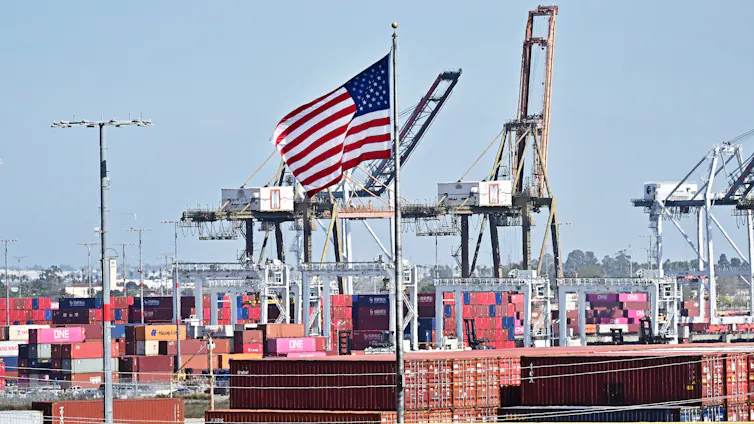
The Port of Long Beach is a key entry point for tariffed goods. Frederick J. Brown/AFP/Getty Images
The U.S. Supreme Court is currently reviewing a case to determine whether President Donald Trump’s global tariffs are legal.

Until recently, tariffs rarely made headlines. Yet today, they play a major role in U.S. economic policy, affecting the prices of everything from groceries to autos to holiday gifts, as well as the outlook for unemployment, inflation and even recession.

I’m an economist who studies trade policy, and I’ve found that many people have questions about tariffs. This primer explains what they are, what effects they have, and why governments impose them.

What are tariffs, and who pays them?

Tariffs are taxes on imports of goods, usually for purposes of protecting particular domestic industries from import competition. When an American business imports goods, U.S. Customs and Border Protection sends it a tariff bill that the company must pay before the merchandise can enter the country.

Because tariffs raise costs for U.S. importers, those companies usually pass the expense on to their customers by raising prices. Sometimes, importers choose to absorb part of the tariff’s cost so consumers don’t switch to more affordable competing products. However, firms with low profit margins may risk going out of business if they do that for very long. In general, the longer tariffs are in place, the more likely companies are to pass the costs on to customers.

Importers can also ask foreign suppliers to absorb some of the tariff cost by lowering their export price. But exporters don’t have an incentive to do that if they can sell to other countries at a higher price.

Studies of Trump’s 2025 tariffs suggest that U.S. consumers and importers are already paying the price, with little evidence that foreign suppliers have borne any of the burden. After six months of the tariffs, importers are absorbing as much as 80% of the cost, which suggests that they believe the tariffs will be temporary. If the Supreme Court allows the Trump tariffs to continue, the burden on consumers will likely increase.

While tariffs apply only to imports, they tend to indirectly boost the prices of domestically produced goods, too. That’s because tariffs reduce demand for imports, which in turn increases the demand for substitutes. This allows domestic producers to raise their prices as well.

A brief history of tariffs

The U.S. Constitution assigns all tariff- and tax-making power to Congress. Early in U.S. history, tariffs were used to finance the federal government. Especially after the Civil War, when U.S. manufacturing was growing rapidly, tariffs were used to shield U.S. industries from foreign competition.

The introduction of the individual income tax in 1913 displaced tariffs as the main source of U.S. tax revenue. The last major U.S. tariff law was the Smoot-Hawley Tariff Act of 1930, which established an average tariff rate of 20% on all imports by 1933.

Those tariffs sparked foreign retaliation and a global trade war during the Great Depression. After World War II, the U.S. led the formation of the General Agreement on Tariffs and Trade, or GATT, which promoted tariff reduction policies as the key to economic stability and growth. As a result, global average tariff rates dropped from around 40% in 1947 to 3.5% in 2024. The U.S. average tariff rate fell to 2.5% that year, while about 60% of all U.S. imports entered duty-free.

While Congress is officially responsible for tariffs, it can delegate emergency tariff power to the president for quick action as long as constitutional boundaries are followed. The current Supreme Court case involves Trump’s use of the International Emergency Economic Powers Act, or IEEPA, to unilaterally change all U.S. general tariff rates and duration, country by country, by executive order. The controversy stems from the claim that Trump has overstepped his constitutional authority granted by that act, which does not mention tariffs or specifically authorize the president to impose them.

The pros and cons of tariffs

In my view, though, the bigger question is whether tariffs are good or bad policy. The disastrous experience of the tariff war during the Great Depression led to a broad global consensus favoring freer trade and lower tariffs. Research in economics and political science tends to back up this view, although tariffs have never disappeared as a policy tool, particularly for developing countries with limited sources of tax revenue and the desire to protect their fledgling industries from imports.

Yet Trump has resurrected tariffs not only as a protectionist device, but also as a source of government revenue for the world’s largest economy. In fact, Trump insists that tariffs can replace individual income taxes, a view contested by most economists.

Most of Trump’s tariffs have a protectionist purpose: to favor domestic industries by raising import prices and shifting demand to domestically produced goods. The aim is to increase domestic output and employment in tariff-protected industries, whose success is presumably more valuable to the economy than the open market allows. The success of this approach depends on labor, capital and long-term investment flowing into protected sectors in ways that improve their efficiency, growth and employment.

Critics argue that tariffs come with trade-offs: Favoring one set of industries necessarily disfavors others, and it raises prices for consumers. Manipulating prices and demand results in market inefficiency, as the U.S. economy produces more goods that are less efficiently made and fewer that are more efficiently made. In addition, U.S. tariffs have already resulted in foreign retaliatory trade actions, damaging U.S. exporters.

Trump’s tariffs also carry an uncertainty cost because he is constantly threatening, changing, canceling and reinstating them. Companies and financiers tend to invest in protected industries only if tariff levels are predictable. But Trump’s negotiating strategy has involved numerous reversals and new threats, making it difficult for investors to calculate the value of those commitments. One study estimates that such uncertainty has actually reduced U.S. investment by 4.4% in 2025.

A major, if underappreciated, cost of Trump’s tariffs is that they have violated U.S. global trade agreements and GATT rules on nondiscrimination and tariff-binding. This has made the U.S. a less reliable trading partner. The U.S. had previously championed this system, which brought stability and cooperation to global trade relations. Now that the U.S. is conducting trade policy through unilateral tariff hikes and antagonistic rhetoric, its trading partners are already beginning to look for new, more stable and growing trade relationships.

So what’s next? Trump has vowed to use other emergency tariff measures if the Supreme Court strikes down his IEEPA tariffs. So as long as Congress is unwilling to step in, it’s likely that an aggressive U.S. tariff regime will continue, regardless of the court’s judgment. That means public awareness of tariffs ⁠– and of who pays them and what they change ⁠– will remain crucial for understanding the direction of the U.S. economy.The Conversation

Kent Jones, Professor Emeritus, Economics, Babson College

This article is republished from The Conversation under a Creative Commons license. Read the original article.

State attorney general sues over Trump Administration’s new $100,000 H-1B Visa fee

California Attorney General Rob Bonta on Friday led a coalition of 19 attorneys general in announcing a lawsuit challenging the Trump Administration over its unlawful policy imposing a $100,000 fee on new H-1B visa petitions.

H-1B visas allow U.S. employers to hire highly skilled foreign national workers in roles that require specialized skills, including as physicians, researchers, nurses and other vital workers, to alleviate nationwide labor shortages. 

The new fee would create a costly barrier for employers, especially public sector and government employers, trying to fill these positions.

In the lawsuit, Attorney General Bonta and the coalition allege that the policy, which has been implemented by the Department of Homeland Security, or DHS, is a clear violation of the law because it imposes a massive fee outside of the bounds of what is authorized by Congress and contrary to Congress’s intent in establishing the H-1B program, bypasses required rulemaking procedures, and exceeds the authority granted to the executive branch under the Administrative Procedure Act, or APA. 

“As the world’s fourth largest economy, California knows that when skilled talent from around the world joins our workforce, it drives our state forward. President Trump’s illegal $100,000 H-1B visa fee creates unnecessary — and illegal — financial burdens on California public employers and other providers of vital services, exacerbating labor shortages in key sectors,” said Bonta. “The Trump Administration thinks it can raise costs on a whim, but the law says otherwise. We are going to court to defend California’s residents and their access to the world-class universities, schools and hospitals that make Californians proud to call this state home.” 

The H-1B visa program allows employers to petition for high-skilled foreign workers to temporarily fill positions in specialty occupations that require at least a bachelor’s degree. 

In petitioning for an H-1B worker, the employer must submit an application, certified by the U.S. Department of Labor, that employment of the H-1B worker will not negatively affect the wages and working conditions of similarly employed U.S. workers. 

Congress limits the number of H-1B visas available each year for most private employers, with the current cap set at 65,000, with an exemption of 20,000 for individuals with a master’s degree or higher.

Since its inception, the H-1B visa program has been continually tailored by Congress to carry out its purpose of meeting employers’ labor needs, while protecting the interests of American workers to ensure that they are not wrongfully displaced. 

Congress has repeatedly enhanced enforcement, increased penalties and legislated on fees for H-1B petitions to prevent misuse of the program. 

Congress has also adapted the program to ensure that it is especially beneficial to many government and non-profit organizations in fulfilling their public service missions, exempting them from the 65,000-person cap.

On Sept. 19, President Trump issued a proclamation ordering an unprecedented $100,000 fee for new H-1B visa petitions, undermining the very purpose of the H-1B visa by making it harder to address severe labor shortages in critical fields such as education and healthcare and ultimately worsening the staffing crisis. 

As implemented by DHS through a series of written documents, the policy affects any application filed after Sept. 21, and grants the Secretary of Homeland Security broad discretion to determine which petitions are subject to the fee or for an exemption, raising concerns that the enforcement could be applied selectively against employers disfavored by the Trump Administration.  

The $100,000 visa fee is devastating for all states, including California, and threatens the quality of education, health care , and other core services available to residents, Bonta’s office said.

For example, the United States faces a nationwide teacher shortage and in the 2024-2025 school year, 74% of school districts in the U.S. reported having trouble filling open positions, particularly in special education, physical sciences, ESL or bilingual education, and foreign languages. 

Educators are the third-largest occupation for H-1B visa holders, with nearly 30,000 educators on the visas, and nearly a thousand colleges and universities employ hundreds of H-1B personnel to support their research and education missions. 

Because K-12 schools, colleges and universities are generally government or non-profit entities, they are incapable of absorbing an additional $100,000 for each H-1B hire. 

Hospitals and other healthcare centers also rely on the H-1B visa program to hire physicians, surgeons and nurses, oftentimes in low-income and working-class neighborhoods. Nearly 17,000 H-1B visas went to workers in medicine and health occupations in the 2024 fiscal year, and half of those were physicians and surgeons. 

Without foreign-trained physicians, the United States is projecting a shortfall of 86,000 physicians by 2036. There will not be enough doctors to care for older adults, many of whom suffer increased rates of chronic disease and have other complex medical needs. 

In California, access to specialists and primary care providers in rural areas is already extremely limited and is projected to worsen as physicians retire and these communities struggle to attract new doctors. As a result of the fee, these institutions will be forced to operate with inadequate staffing or divert funding away from other important programs to cover expenses. 

In Friday’s lawsuit, Bonta and the coalition allege that the Trump Administration’s H-1B visa fee violates the APA and the U.S. Constitution. Fees associated with H-1B visas have long been established by DHS following the APA’s notice-and-comment process pursuant to congressional authority, which limits fees to the amount necessary to sustain the agency’s work. 

Typically, an employer filing an initial H-1B petition would expect to pay between $960 to $7,595 in regulatory and statutory fees. The Trump Administration’s $100,000 fee far exceeds the actual cost of processing H-1B petitions. 

By imposing this fee, the administration is exceeding the fee-setting authority granted by Congress, which requires that fees be set based on the agency’s costs, rather than arbitrarily. 

Additionally, the Trump Administration issued the fee without going through the notice-and-comment process required by the APA and without considering the full range of impacts — especially on the provision of the critical services by government and nonprofit entities.

Attorney General Bonta and Massachusetts Attorney General Andrea Joy Campbell are leading the attorneys general of Arizona, Colorado, Connecticut, Delaware, Hawaii, Illinois, Maryland, Michigan, Minnesota, North Carolina, New Jersey, New York, Oregon, Rhode Island, Vermont, Washington, and Wisconsin in filing the lawsuit. 

Space News: What’s up for December 2025 

The 3I/ATLAS comet makes its closest approach to Earth.

The Geminid Meteor Shower sparkles across the sky.

And we spot a conjunction between the Moon and Jupiter.

That's what's up, for December. 

Comet 3I/ATLAS is making its closest approach to Earth on December 19! This could be your best bet to see this interstellar interloper.

Comet 3I/ATLAS is the third object in history from outside of our solar system to be discovered within our solar system. 

NASA continues to observe and study the object using a variety of spacecraft and telescopes so we can learn as much as we can about it while it's in our solar neighborhood. 

Comet 3I/ATLAS poses no threat to Earth and will remain far away. On its closest approach to our planet on December 19, it will still be about 170 million miles away, or more than 700 times the distance between the Earth and the Moon. 

Still, at this distance, skywatchers looking east to northeast in the early pre-dawn morning could catch the comet right under Regulus, a star at the heart of the constellation Leo, the lion. 

To see the comet before it leaves our vicinity, you'll need to be looking through a telescope with an aperture of at least 30 centimeters. Look for observatories and skywatching events in your local area!

The Geminid meteor shower will sparkle across the skies this December, peaking on the evenings of December 13 and 14. 

This meteor shower is known for being bright and colorful, made up of debris trailing the asteroid 3200 Phaethon. 

To catch the Geminids peak, look to the eastern sky all evening on Dec. 13 and Dec. 14. The meteors will appear near the bright planet Jupiter. 

With the darkest possible skies, you could see up to 120 Geminid meteors per hour!

Chelsea Gohd works for the Jet Propulsion Laboratory in Pasadena.

Impasse declared in negotiations between Upper Lake school district, teachers union

UPPER LAKE, Calif. — An impasse has been declared in the negotiations between the Upper Lake Unified School District and its teachers union, with the union’s president saying that members are ready to pursue a strike if necessary.

Both the district and the Upper Lake Employees Association, or ULEA, confirmed that a mediator is expected to join the negotiations soon.

Key issues in the negotiations breakdown revolve around teachers' pay, according to statements made by the district and the union.

On Thursday, the California Teachers Association, or CTA, issued a statement on behalf of ULEA in which it explained that a supermajority — or 88% — of ULEA’s members voted to support a potential strike.

“The Upper Lake Educators Association is prepared to strike,” Alex Stabiner, ULEA’s president, told Lake County News in a separate Thursday email. 

Stabiner said this year the union’s negotiations with the district led to the union declaring impasse. “This was not from a lack of effort. After the third round of negotiations we were still pretty far apart on the critical issues of teacher safety, special education class sizes, and salaries.”

The district said ULEA declared impasse after only four meetings and then took a strike vote. 

Noting that in the small Upper Lake district “our negotiations team and association leadership put their own time into this work,” Stabiner said ULEA conferred with CTA on how to proceed after the third round of negotiations. “CTA had recommended that we declare impasse.”

The CTA’s report said, “The issues at stake are fair working conditions, such as school site safety and ensuring teachers are part of the conversations for safer classrooms, as well as urgent, long-neglected needs within the district’s special education program. Educators in these classrooms face extraordinary demands and deserve meaningful support to ensure their students receive the services and stability they need.”

Stabiner said that, before ULEA declared impasse, it agreed to the district’s request for a fourth round of negotiations.

“In good faith, our negotiations team met with the district for a 4th round against the advisement of CTA,” Stabiner said. “Although we were able to resolve many items by the end of the fourth meeting, our core issues remained unresolved: teacher safety, special education class sizes, and salaries.”

In response, the district issued a written statement to Lake County News in which it explained that, “In just four meetings, the District and ULEA have already made strong progress, reaching agreement on 28 of the 34 items discussed.”

Stabiner said ULEA filed for impasse with the California Public Employee Relations Board, or PERB.

A search of documents in the PERB online file portal showed that ULEA filed for impasse on Nov. 14, with PERB issuing an approval for impasse and mediation on Nov. 18.

Shortly after that PERB filing, Stabiner said ULEA organized a strike authorization vote. 

“This vote was not taken lightly,” Stabiner said in the Thursday email. “This was new territory for ULEA as none of our membership had ever needed to explore a strike before. There was much discussion over what exactly is a strike and what the implications would be. Every member voted. With an overwhelming majority, ULEA voted to authorize a strike.”

Noting that the impasse and strike vote took place after only four meetings, the district said in its statement, “While the district is disappointed by these pressure tactics, we are hopeful that, through open communication and teamwork, we can reach a fair agreement without disrupting students’ learning. The District remains optimistic that the few remaining topics can be resolved through continued good-faith discussions.”

Meantime, Stabiner said the union packed the district board meeting on Tuesday. “This was a demonstration to show the district that our teachers are united, organized, and ready to stand up for our profession, our schools, and our students.”

District responds to union statements about pay for teachers

The CTA statement said key concerns cited by ULEA are the increase in time needed to meet their students' needs and teachers’ pay not keeping up with the cost of living or the increase in work. 

In response, the district said that, since the 2018-19 school year, it has increased ULEA salaries by a total of 43% across all educator pay levels.

Over that same time, the district said its funding rose only 27.81%, meaning salaries grew about 15% faster than the cost-of-living increase. 

For the top educator pay levels — those with the most experience and credentials — salaries went from $77,252 to $114,383, a 66% increase, the district reported.
In the current school year, the district said it has offered a 2% raise, an increase in the health benefits cap from $16,000 to $17,000, updated contract dates, and small clean-up changes to the extra duty list. 

ULEA has submitted additional proposals, including a request for an additional 1%, the district said.

Stabiner, quoted in the CTA statement, said ULEA hopes the district “will take immediate steps to avoid further escalation,” and that the strike vote “sends a clear and unmistakable message: educators are united, organized and ready to stand up for our students, profession and schools.”

Stabiner told Lake County News on Thursday, “We remain hopeful about the next step in the process. We expect to meet soon with the District and a PERB appointed mediator to continue bargaining with the goal of reaching a fair tentative agreement. A strike is not our goal. However, we are prepared to take lawful action in support of pay that keeps up with the cost of living and working conditions that ensure safety for educators and students.”

In its statement, the district said it is looking forward to working with a neutral mediator to work through remaining issues with ULEA.

“The District is proud of the partnership built with ULEA and values the shared dedication to students,” the district said in its statement. “We remain confident that, by continuing to work together, we can settle the last few issues and return our focus to educating the students of Upper Lake.”

Email Elizabeth Larson at This email address is being protected from spambots. You need JavaScript enabled to view it.. Follow her on Twitter, @ERLarson, and on Bluesky, @erlarson.bsky.social. Find Lake County News on the following platforms: Facebook, @LakeCoNews; X, @LakeCoNews; Threads, @lakeconews, and on Bluesky, @lakeconews.bsky.social. 

State controller publishes 2024 salary and benefits data for public school districts, charter schools, county offices of education

State Controller Malia M. Cohen has updated the Government Compensation in California website to include 2024 salary voluntarily submitted by K-12 education employers in the state. 

The data covers 345,184 positions and nearly $18.2 billion in wages of employers from public school districts, charter schools, and county offices of education.

Each year, the State Controller’s Office invites eight categories of non-mandated employers — including 1,883 K–12 education employers statewide — to voluntarily submit salary and compensation data consistent with the reports required from mandated employers. 

This year, 360 education providers submitted fully compliant reports, Cohen’s office said.

In Lake County, Konocti Unified School District and the Lake County Office of Education filed reports.

Konocti Unified reported having 766 employees, with total wages of $37,308,060 and retirement and health contributions of $15,777,376.

The Lake County Office of Education     reported that it has 200 employees, with payroll totaling $9,540,229 and retirement and health contributions of $4,224,916.

“Transparency in government is one of the strongest tools we have to build trust with the public,” said Cohen. “By publishing the 2024 salary and benefits data for California’s K–12 education employers, we are offering families, educators, researchers, and policymakers a clearer understanding of how public dollars support our schools. I want to thank the many districts and education partners who voluntarily submitted their information accurately and on time.”

The State Controller’s Office solicits compensation data voluntarily from superior courts, the University of California, community college districts, K–12 education, First 5 Commissions, and fairs and expositions. 

The agency also maintains and publishes payroll data for state departments and California State Universities, and California law requires cities, counties, and special districts to annually report compensation data to the State Controller’s Office.

The Government Compensation in California website contains pay and benefit information for more than two million government jobs in California, as reported annually by each entity. 

Users of the site can view compensation levels on maps and search by region, narrow results by district name or job title, and export raw data or custom reports.

Clearlake Animal Control: ‘Frankie’ and the dogs

“Frankie.” Photo courtesy of Clearlake Animal Control.


CLEARLAKE, Calif. — Clearlake Animal Control has many dogs and puppies that need to find new homes of their own.

The shelter has 61 adoptable dogs listed on its website.

This week’s dogs include “Frankie,” a 1-year-old male Doberman Pinscher mix with a short black and brown coat.

Shelter staff said he loves dogs and may enjoy a dog sibling, but would do best in a home without small animals. He also needs a home with older children or teens and adults.

The shelter is located at 6820 Old Highway 53. It’s open from 9 a.m. to 6 p.m. Tuesday through Saturday. 

For more information, call the shelter at 707-762-6227, email This email address is being protected from spambots. You need JavaScript enabled to view it. or visit Clearlake’s adoptable dogs here.

This week’s adoptable dogs are featured below.

Email Elizabeth Larson at This email address is being protected from spambots. You need JavaScript enabled to view it.. Follow her on Twitter, @ERLarson, and on Bluesky, @erlarson.bsky.social. Find Lake County News on the following platforms: Facebook, @LakeCoNews; X, @LakeCoNews; Threads, @lakeconews, and on Bluesky, @lakeconews.bsky.social. 

  • 43
  • 44
  • 45
  • 46
  • 47
  • 48
  • 49
  • 50
  • 51
  • 52

Community

  • Lake County Wine Alliance offers sponsor update; beneficiary applications open 

  • Mendocino National Forest announces seasonal hiring for upcoming field season

Public Safety

  • Lakeport Police logs: Thursday, Jan. 15

  • Lakeport Police logs: Wednesday, Jan. 14

Education

  • Woodland Community College receives maximum eight-year reaffirmation of accreditation from ACCJC

  • SNHU announces Fall 2025 President's List

Health

  • California ranks 24th in America’s Health Rankings Annual Report from United Health Foundation

  • Healthy blood donors especially vital during active flu season

Business

  • Two Lake County Mediacom employees earn company’s top service awards

  • Redwood Credit Union launches holiday gift and porch-to-pantry food drives

Obituaries

  • Rufino ‘Ray’ Pato

  • Patty Lee Smith

Opinion & Letters

  • The benefits of music for students

  • How to ease the burden of high electric bills

Veterans

  • CalVet and CSU Long Beach team up to improve data collection related to veteran suicides

  • A ‘Big Step Forward’ for Gulf War Veterans

Recreation

  • Wet weather trail closure in effect on Upper Lake Ranger District

  • Mendocino National Forest seeking public input on OHV grant applications

  • State Parks announces 2026 Anderson Marsh nature walk schedule 

  • BLM lifts seasonal fire restrictions in central California

Religion

  • Kelseyville Presbyterian to host Ash Wednesday service and Lenten dinner Feb. 18

  • Kelseyville Presbyterian Church to hold ‘Longest Night’ service Dec. 21

Arts & Life

  • Auditions announced for original musical ‘Even In Shadow’ set for March 21 and 28

  • ‘The Rip’ action heist; ‘Steal’ grounded in a crime thriller

Government & Politics

  • Lake County Democrats issue endorsements in local races for the June California Primary

  • County negotiates money-saving power purchase agreement

Legals

  • March 3 hearing on ordinance amending code for commercial cannabis uses

  • Feb. 12 public hearing on resolution to establish standards for agricultural roads

How to resolve AdBlock issue?
Refresh this page