 How to resolve AdBlock issue?
News
LAKE COUNTY, Calif. – Lake County Animal Care and Control has a shelter filled with mostly large dogs – and a few little dogs, too – needing new homes.
This week's adoptable dogs are mixes of Alaskan Malamute, Belgian Malinois, boxer, Labrador Retriever, mastiff, pug, rat terrier, shepherd, terrier and pit bull.
Dogs that are adopted from Lake County Animal Care and Control are either neutered or spayed, microchipped and, if old enough, given a rabies shot and county license before being released to their new owner. License fees do not apply to residents of the cities of Lakeport or Clearlake.
If you're looking for a new companion, visit the shelter. There are many great pets hoping you'll choose them.
In addition to the animals featured here, all adoptable animals in Lake County can be seen here: http://bit.ly/Z6xHMb .
The following dogs at the Lake County Animal Care and Control shelter have been cleared for adoption (additional dogs on the animal control Web site not listed are still “on hold”).
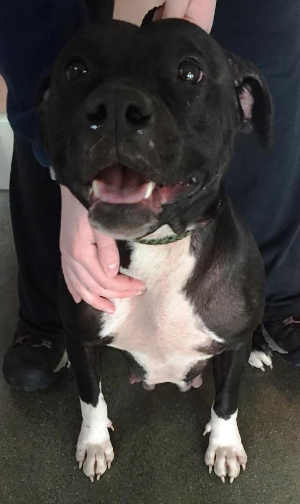
Pit bull terrier
This female pit bull terrier mix has a short black coat with white markings.
Shelter staff said she was brought in as a stray and is waiting for her forever family.
She is bouncy and sits on command, has no food aggression and was pretty calm in the cat room, showing no aggression towards them. She does great with both male and female dogs, and just wants to play.
“She should and could definitely be an ambassador for the breed,” according to shelter staff.
She is in foster, ID No. 4213.
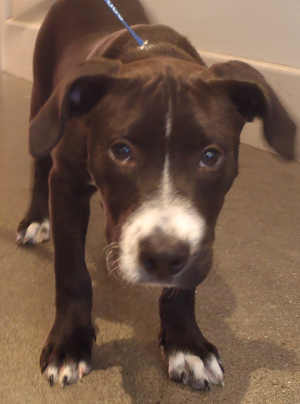
'Spencer'
“Spencer” is a Labrador Retriever-pit bull retriever mix.
Shelter staff said said he has a lot of love to give and can't contain himself.
He's in kennel No. 2, ID No. 2382.
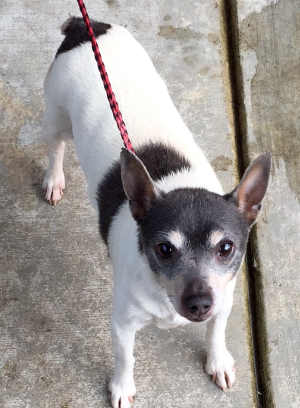
Rat terrier mix
This older gentleman is a rat terrier mix with a tricolor coat.
He get along with cats, is good with both male and female dogs, and has no food aggression, according to shelter staff. He's very reserved but appropriate.
He's in kennel No. 3, ID No. 4320.
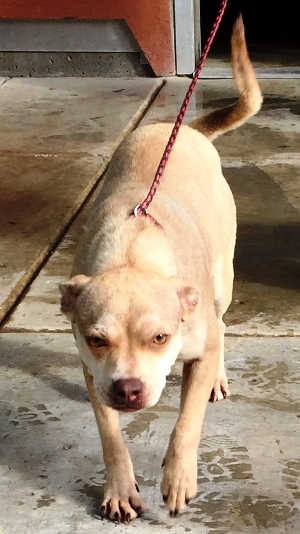
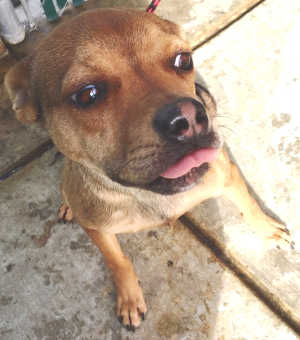
Pug-terrier mix
This female pug-terrier mix has a short tan coat.
She's in kennel No. 6a, ID No. 4341.
Pug-terrier mix
This female pug-terrier mix has a short brown coat.
She's in kennel No. 6b, ID No. 4342.
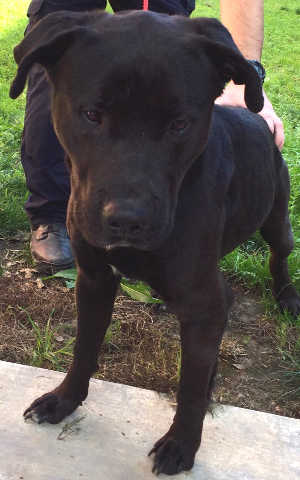
Mastiff-Labrador Retriever mix
This male mastiff-Labrador Retriever mix has a short all-black coat.
Shelter staff describes him as “a big lover.”
He's in kennel No. 10, ID 4370.
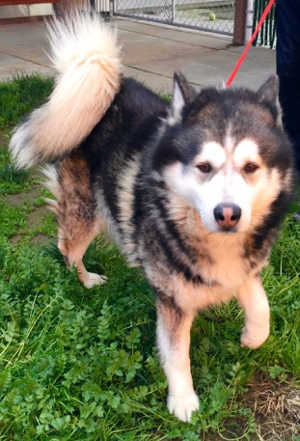
'Balto'
“Balto” is a male Alaskan Malamute with a medium-length multicolor coat.
Shelter staff said he has no issues with food guarding and does well with both male and female dogs. However, he is a dominant male who needs an owner that is knowledgeable around this breed of dog. Containment and fences at least 6 feet tall are necessary for this breed.
He would most likely do well with kids 10 and above, shelter staff said.
Balto is in kennel No. 13, ID No. 4310.
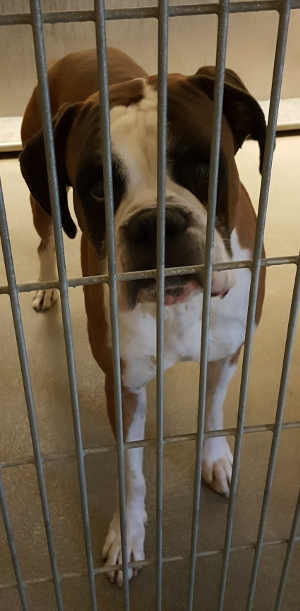
Boxer mix
This male boxer mix has a short tan coat with white markings.
He's in kennel No. 16, ID No. 4274.
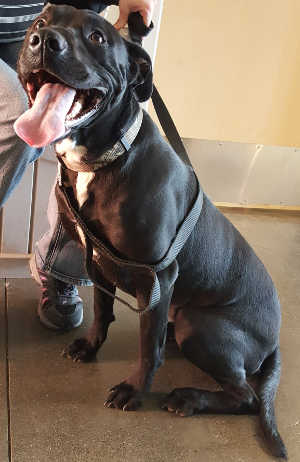
'Babs'
“Babs” is a black shepherd mix with white markings.
Shelter staff said she has no issues with food guarding and is a very sweet girl who is scared in the animal control environment.
She's in kennel No. 19, ID No. 4397.
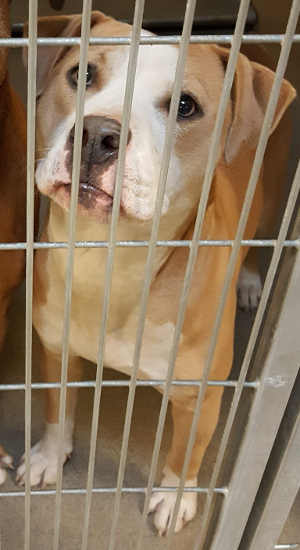
Pit bull terrier mix
This female pit bull terrier mix has a short tan coat with white markings.
She's in kennel No. 23, ID No. 4305.
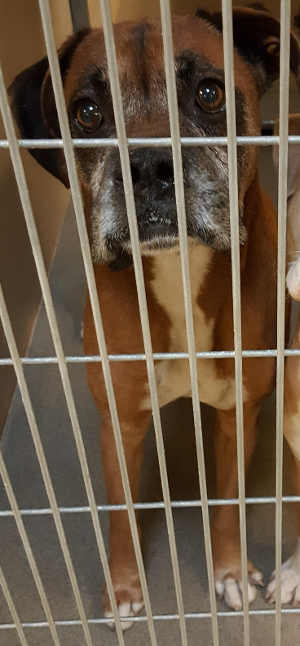
Boxer mix
This male boxer mix has a short tan coat with white markings.
He's in kennel No. 24, ID No. 4304.
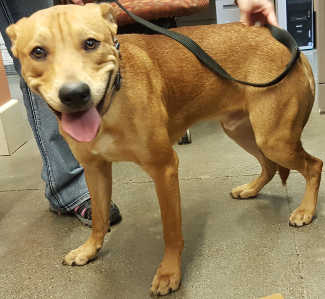
'Brownie'
“Brownie” is a young male shepherd mix with a short brown coat.
Shelter staff said he's very scared in the animal control environment and wants to go home with his new family.
He's in kennel No. 25, ID No. 4396.
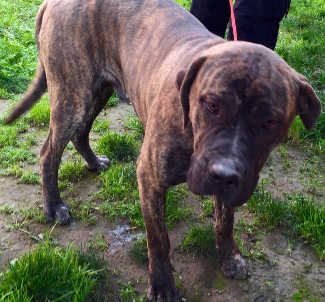
'O'Dell'
“O'Dell” is a male mastiff mix with a short brindle coat.
He's in kennel No. 27, ID No. 4354.
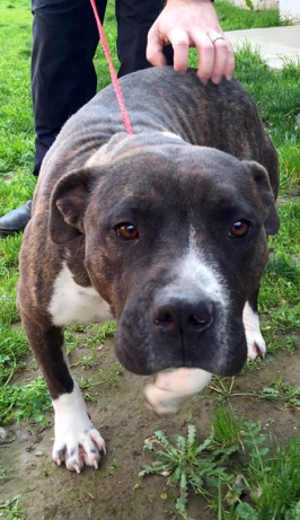
Female pit bull mix
This female pit bull mix has a short brown brindle coat with white markings.
Shelter staff said she loves cuddles and attention, and does very cute play bows.
She's in kennel No. 29, ID No. 4337.
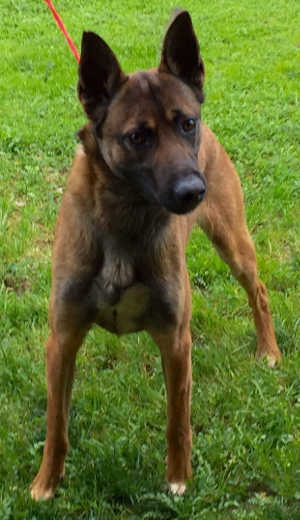
'Cassius'
“Cassius” is a male Belgian Malinois with a short brown coat.
Shelter staff said he's good with other dogs, knows basic commands, and is very smart and friendly.
He's in kennel No. 30, ID 4375.
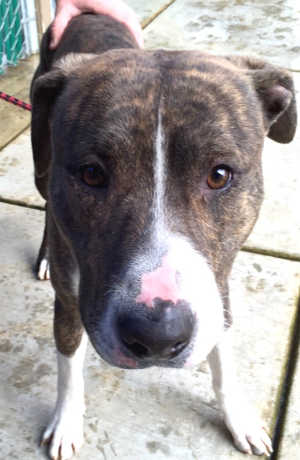
Male pit bull terrier mix
This male pit bull terrier has a short brown brindle coat with white markings.
Shelter staff describes him as being a “sweet boy.”
He's in kennel No. 32, ID No. 4373.
To fill out an adoption application online visit http://www.co.lake.ca.us/Government/Directory/Animal_Care_And_Control/Adopt/Dog___Cat_Adoption_Application.htm .
Lake County Animal Care and Control is located at 4949 Helbush in Lakeport, next to the Hill Road Correctional Facility.
Office hours are Monday through Friday, 11 a.m. to 5 p.m., and 11 a.m. to 3 p.m., Saturday. The shelter is open from 11 a.m. to 4 p.m. Monday through Friday and on Saturday from 11 a.m. to 3 p.m.
Visit the shelter online at http://www.co.lake.ca.us/Government/Directory/Animal_Care_And_Control.htm .
For more information call Lake County Animal Care and Control at 707-263-0278.
Email Elizabeth Larson at
NORTHERN CALIFORNIA – A man found growing marijuana in the Mendocino National Forest has been sentenced to federal prison.
Pablo Barreto-Cruz, 39, of Mexico, was sentenced on Tuesday by United States District Judge John A. Mendez to five years and three months in prison and ordered to pay $22,800 in restitution for cultivating marijuana on public land and depredation of public lands and resources, United States Attorney Benjamin B. Wagner announced.
According to court documents, between March 2015 and May 2015, Barreto-Cruz grew 2,998 marijuana plants in the Mendocino National Forest.
The marijuana cultivation operation caused significant harm to the habitat and water quality of the national forest, officials said.
Following Barreto-Cruz’s arrest on May 12, 2015, authorities searched the marijuana cultivation site and discovered approximately 1,000 pounds of irrigation pipe, approximately 1,000 pounds of camp debris, and several fertilizers and pesticides, including the highly toxic pesticide Carbofuran, which is dangerous to both humans and animals.
The U.S. Forest Service estimated that the marijuana cultivation site diverted approximately 18,000 gallons of water per day.
This case was the product of an investigation by the United States Forest Service, the Glenn County Sheriff’s Office and the California Department of Fish and Wildlife. Assistant United States Attorney Christiaan Highsmith prosecuted the case.
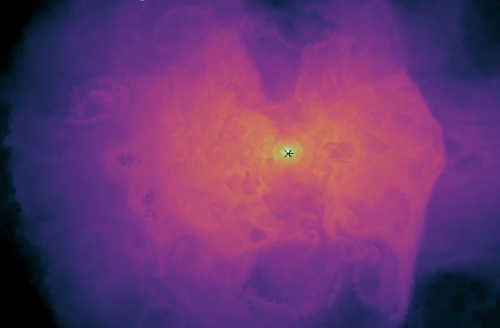
When we look at the night sky, we see stars as tiny points of light eking out a solitary existence at immense distances from Earth.
But appearances are deceptive. More than half the stars we know of have a companion, a second nearby star that can have a major impact on their primary companions.
The interplay within these so-called binary star systems is particularly intensive when the two stars involved are going through a phase in which they are surrounded by a common envelope consisting of hydrogen and helium.
Compared to the overall time taken by stars to evolve, this phase is extremely short, so astronomers have great difficulty observing and hence understanding it.
This is where theoretical models with highly compute-intensive simulations come in. Research into this phenomenon is relevant understanding a number of stellar events such as supernovae.
Using new methods, astrophysicists Sebastian Ohlmann, Friedrich Roepke, Ruediger Pakmor, and Volker Springel of the Heidelberg Institute for Theoretical Studies, or HITS, have now made a step forward in modeling this phenomenon.
As they report in The Astrophysical Journal Letters, the scientists have successfully used simulations to discover dynamic irregularities that occur during the common-envelope phase and are crucial for the subsequent existence of binary star systems.
These so-called instabilities change the flow of matter inside the envelope, thus influencing the stars' distance from one another and determining, for example, whether a supernova will ensue and, if so, what kind it will be.
The article is the fruit of collaboration between two HITS research groups, the Physics of Stellar Objects, or PSO, group and the Theoretical Astrophysics group, also known as TAP.
Prof. Volker Springel's Arepo code for hydrodynamic simulations was used and adapted for the modeling. It solves the equations on a moving mesh that follows the mass flow, and thus enhances the accuracy of the model.
Two stars, one envelope
More than half the stars we know of have evolved in binary star systems. The energy for their luminosity comes from the nuclear fusion of hydrogen at the core of the stars.
As soon as the hydrogen fueling the nuclear fusion is exhausted in the heavier of the two stars, the star core shrinks. At the same time, a highly extended stellar envelope evolves, consisting of hydrogen and helium. The star becomes a red giant.
As the envelope of the red giant goes on expanding, the companion star draws the envelope to itself via gravity, and part of the envelope flows towards it. In the course of this process the two stars come closer to one another.
Finally, the companion star may fall into the envelope of the red giant and both stars are then surrounded by a common envelope.
As the core of the red giant and the companion draw closer together, the gravity between them releases energy that passes into the common envelope.
As a result, the envelope is ejected and mixes with interstellar matter in the galaxy, leaving behind it a close binary star system consisting of the core of the giant and the companion star.
The path to stellar explosion
Sebastian Ohlmann of the PSO group explained why this common-envelope phase is important for our understanding of the way various star systems evolve: “Depending on what the system of the common envelope looks like initially, very different phenomena may ensue in the aftermath, such as thermonuclear supernovae.”
Ohlmann and colleagues are investigating the run-up to these stellar explosions, which are among the most luminous events in the universe and can light up a whole galaxy.
But modeling the systems that can lead to such explosions is bedeviled by major uncertainty in the description of the common-envelope phase.
One of the reasons for this is that the core of the giant is anything between a thousand and ten thousand times smaller than the envelope, so that spatial and temporal scale differences complicate the modeling process and make approximations necessary.
The methodically innovative simulations performed by the Heidelberg scientists are a first step towards a better understanding of this phase.
LAKE COUNTY, Calif. – Lake County residents are invited to make their voice heard by taking a few moments to complete a Community Health Survey.
Community service agencies throughout Lake County have partnered to create the survey and are requesting public feedback about how to build a healthier county.
The Community Health Survey is available now through March 20.
All residents are encouraged to complete the short, 16-question survey.
Paper surveys in English and Spanish are available in locations around the county. An online version is available at http://svy.mk/1SrquIa .
“The Community Health Survey is an important way for us to learn what residents feel are the urgent health needs of our county,” said Karen Tait, MD, county public health officer. “It’s also a way for us to get their perspective about solutions. We use this input in developing plans and applying for funding.”
Lake County is currently completing its 2016 Community Health Needs Assessment, which identifies community health needs and proposes strategies to address them effectively.
The Community Health Survey results, as well as additional feedback from focus groups and individual interviews, will be included in the assessment.
The resulting report will provide the foundation for policymakers, community organizations and advocates to strategically plan services and improvements in Lake County.
The last Community Health Needs Assessment was completed in September 2013.
“This survey is a great way to let your voice be heard about your experience with health care in our county,” explains Shelly Mascari, director of Community Wellness at St. Helena Hospital Clear Lake. “Our goal is to dramatically improve the health outcomes for our community, and we’ll be successful when we listen and take action together.”
Collaboration is central to the Community Health Needs Assessment. Partnered agencies that commissioned the report include St. Helena Hospital Clear Lake, Sutter Lakeside Hospital, Lake County Health Services, Lake Family Resource Center, First 5 of Lake County, Lake County Tribal Health Consortium, Health Leadership Network, Lake County Behavioral Health, Veteran's Affairs, Mendocino Community Health Clinic Inc., and Area Agency on Aging, Lake and Mendocino Counties. These agencies use the report to plan for the next three years.
“We develop programs and services to address the needs identified in the Community Health Needs Assessment,” said Tiffany Ortega, assistant administrator, Sutter Lakeside Hospital. “When the community makes its collective voice heard, it gives us a foundation upon which we can build a healthier future.”
If you have any questions about the Community Health Survey, contact Rachel Walsh at Sutter Lakeside Hospital at 707-262-5046 or
LAKE COUNTY, Calif. – The new year is starting off with a slightly improving employment picture, according to a Friday report.
The US Bureau of Labor Statistics reported Friday that nationwide unemployment for January was 4.9 percent, down from the 5 percent reported in December. The January 2015 nationwide unemployment rate was 5.7 percent.
It's the lowest national unemployment rate since the 4.9 percent rate reported in February 2008. This also is the lowest January unemployment rate since 2008, according to US Bureau of Labor Statistics data.
The report showed that job gains occurred in several industries, led by retail trade, food services and drinking places, health care and manufacturing.
At the same time, employment declined in private educational services, transportation and warehousing, and mining.
On the local and statewide levels, the California Employment Development Department is not scheduled to release January unemployment data until March 4.
However, the unemployment rate in Lake County in December was 7.3 percent, up from 7.2 percent in November and below the December 2014 estimate of 8.6 percent, the Employment Development Department said.
California's unadjusted unemployment rate for December was 5.8, down slightly from November's 5.7 percent and much improved over the 7.1 percent California recorded in December 2014, according to state records.
Email Elizabeth Larson at
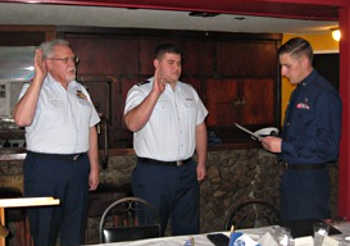
FINLEY, Calif. – On Jan. 16, the members of the United States Coast Guard Auxiliary, Flotilla 88 of Lake County met for their annual change of watch ceremony.
The ceremony, held this year at Angel’s Rock House Mexican restaurant in Finley, commemorates the changing of the flotilla commanders and its officers for the new year of 2016.
Traveling from the United States Coast Guard Motor Lifeboat Station at Noyo River in Ft. Bragg were BM2 Petty Officer 2nd Class Ross Wiley and SK2 Petty Officer 2nd Class Henry Robles.
Performing the ceremony, BM2 Wiley installed Dane Hayward as Flotilla 88 commander, Roberto Morfin as vice commander and seven of the staff officers.
The United States Coast Guard Auxiliary consists of more than 30,000 volunteer members throughout the country who provide operational support to the Coast Guard and are dedicated to promoting recreational boating safety.
Dorothy De Lope is a member of the Flotilla 88 of Lake County.