 How to resolve AdBlock issue?
News
LAKE COUNTY, Calif. – A wide variety of big and little dogs are waiting for new homes at Lake County Animal Care and Control this week.
Adoptable dogs available are mixes of Alaskan Malamute, boxer, Labrador Retriever, mastiff, pug, rat terrier, shepherd, terrier and pit bull.
Dogs that are adopted from Lake County Animal Care and Control are either neutered or spayed, microchipped and, if old enough, given a rabies shot and county license before being released to their new owner. License fees do not apply to residents of the cities of Lakeport or Clearlake.
If you're looking for a new companion, visit the shelter. There are many great pets hoping you'll choose them.
In addition to the animals featured here, all adoptable animals in Lake County can be seen here: http://bit.ly/Z6xHMb .
The following dogs at the Lake County Animal Care and Control shelter have been cleared for adoption (additional dogs on the animal control Web site not listed are still “on hold”).

'Spencer'
“Spencer” is a Labrador Retriever-pit bull retriever mix.
Shelter staff said said he has a lot of love to give and can't contain himself.
He's in kennel No. 2, ID No. 2382.
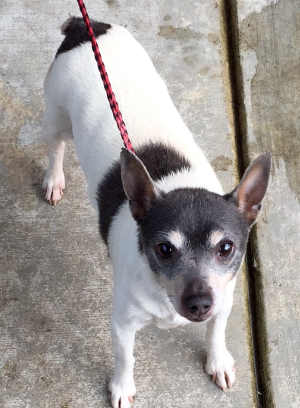
Rat terrier mix
This older gentleman is a rat terrier mix with a tricolor coat.
He get along with cats, is good with both male and female dogs, and has no food aggression, according to shelter staff. He's very reserved but appropriate.
He's in kennel No. 3, ID No. 4320.
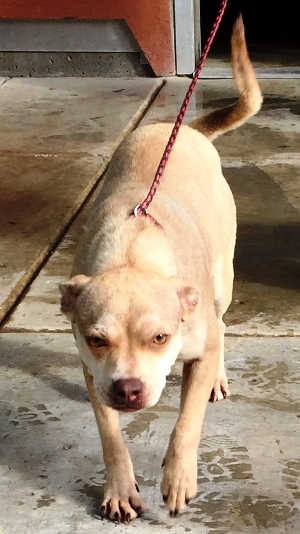
Pug-terrier mix
This female pug-terrier mix has a short tan coat.
She's in kennel No. 6a, ID No. 4341.
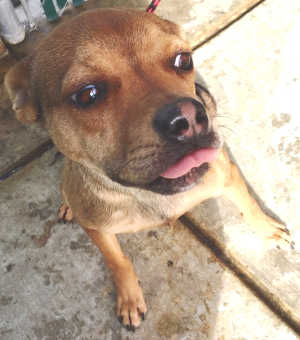
Pug-terrier mix
This female pug-terrier mix has a short brown coat.
She's in kennel No. 6b, ID No. 4342.

Mastiff-Labrador Retriever mix
This male mastiff-Labrador Retriever mix has a short all-black coat.
Shelter staff describes him as “a big lover.”
He's in kennel No. 10, ID 4370.
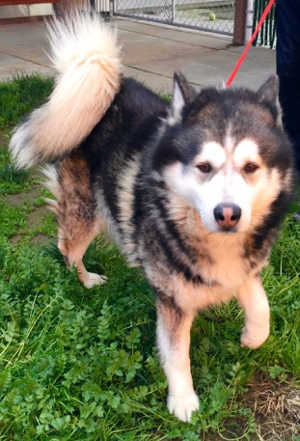
'Balto'
“Balto” is a male Alaskan Malamute with a medium-length multicolor coat.
Shelter staff said he has no issues with food guarding and does well with both male and female dogs. However, he is a dominant male who needs an owner that is knowledgeable around this breed of dog. Containment and fences at least 6 feet tall are necessary for this breed.
He would most likely do well with kids 10 and above, shelter staff said.
Balto is in kennel No. 13, ID No. 4310.
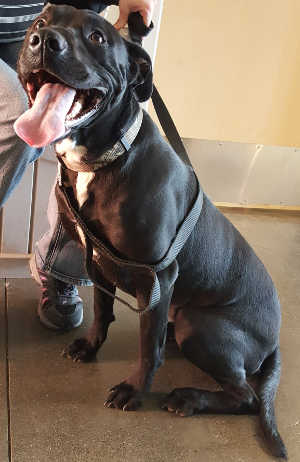
'Babs'
“Babs” is a black shepherd mix with white markings.
Shelter staff said she has no issues with food guarding and is a very sweet girl who is scared in the animal control environment.
She's in kennel No. 19, ID No. 4397.

Boxer mix
This male boxer mix has a short tan coat with white markings.
He's in kennel No. 24, ID No. 4304.

'Brownie'
“Brownie” is a young male shepherd mix with a short brown coat.
Shelter staff said he's very scared in the animal control environment and wants to go home with his new family.
He's in kennel No. 25, ID No. 4396.
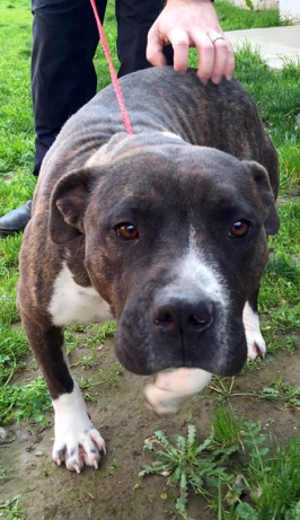
Female pit bull mix
This female pit bull mix has a short brown brindle coat with white markings.
Shelter staff said she loves cuddles and attention, and does very cute play bows.
She's in kennel No. 29, ID No. 4337.
To fill out an adoption application online visit http://www.co.lake.ca.us/Government/Directory/Animal_Care_And_Control/Adopt/Dog___Cat_Adoption_Application.htm .
Lake County Animal Care and Control is located at 4949 Helbush in Lakeport, next to the Hill Road Correctional Facility.
Office hours are Monday through Friday, 11 a.m. to 5 p.m., and 11 a.m. to 3 p.m., Saturday. The shelter is open from 11 a.m. to 4 p.m. Monday through Friday and on Saturday from 11 a.m. to 3 p.m.
Visit the shelter online at http://www.co.lake.ca.us/Government/Directory/Animal_Care_And_Control.htm .
For more information call Lake County Animal Care and Control at 707-263-0278.
Email Elizabeth Larson at

Messages from around the world are to be beamed into space at the speed of light as part of a cultural project to create a celestial time capsule.
In autumn 2016, dispatches from the public will be converted into radio waves and broadcasted towards the North Star, Polaris, this autumn, reaching their destination in 434 years.
The interstellar message in a bottle will comprise of people's responses to a single question: how will our present environmental interactions shape the future?
A Simple Response to an Elemental Message is a collaboration between the University of Edinburgh, the Royal Observatory of Edinburgh, and the UK Astronomical Technology Centre (UKATC) along with other partners.
Within 21 hours of transmission, the signal will have traveled deeper into space than mankind's first message to the stars, Voyager 1, which was launched in 1977.
Project Coordinator Paul Quast said Polaris was chosen as the destination because of its cultural significance as a reference point for navigators and star gazers.
Researchers will be able to use the responses to gauge if there are significant geographical differences in how people think about the environment and the future of the planet.
Edinburgh College of Art postgraduate student Mr Quast said: “We are at a pivotal point in this planet's history. Our present ecological decisions will have a massive impact on the future for all Earth's inhabitants. This project will create a culturally-inspired message in a bottle capturing global perspectives that will travel into space for eons.”
The public are invited to visit the official Web site, http://www.asimpleresponse.org , and leave their contributions to be broadcast into the cosmos.
The Web site is available in English, French, Spanish and Portuguese. German, Arabic, Russian and Mandarin will be available soon.
LAKE COUNTY, Calif. – February is Teen Dating Violence Awareness Month, a national effort to raise awareness and protect young people.
This year’s theme for Teen Dating Violence Awareness Month is “Love is Setting Boundaries.”
All teenagers need to know how to answer two questions: What is love? What is a healthy relationship?
More than one out of every 10 teens who have been on a date in the past year have been physically abused.
Nearly 1.5 million high school students nationwide experience physical abuse from a dating partner each year; one in three adolescents in the United States is a victim of physical, sexual, verbal or emotional abuse from a dating situation.
Girls and young women between the ages of 16 to 24 experience the highest rate of intimate partner violence – almost triple the national average – and 81 percent of parents surveyed either believe teen dating violence is not an issue or admit they don’t know if it’s an issue.
Violent relationships in teens can have serious ramifications. Victims are put at higher risk for substance abuse, eating disorders, risky sexual behavior and further domestic violence.
Teen dating violence runs across race, gender and socioeconomic lines. Both males and females can be victims, and both males and females can be abusers.
Family advocates at Lake Family Resource Center believe there is a need to build communities with commitment to safe, stable, nurturing relationships and environments, and to raise understanding and awareness about teen dating violence, with the ultimate goal being to stop it before it begins.
Lake Family Resource Center encourages teens and parents to speak out, become educated, be heard and be a part of making Teen Dating Violence Awareness Month's message effective.
If you are or someone you know is in an abusive dating relationship, free and confidential help is available 24 hours a day, seven days a week, through the Community Crisis Hotline, at 888-485-7733.
Lake Family Resource Center works to raise awareness of the devastation that results from domestic violence.
The agency provides a multitude of services to build family stability and strength, and supports Lake County residents in achieving stable, self-sufficient and healthy families and communities.
For more information call 707-279-0563.
LAKEPORT, Calif. – For the fourth straight year, Middletown High School emerged as the champion of the Lake County Mock Trial competition.
Middletown competed with Upper Lake High School in the fourth annual event, held Friday at the Lake County Courthouse in Lakeport.
Judges Michael Lunas and Stephen Hedstrom presided over the morning and afternoon sessions, respectively.
The teams took turns presenting both the prosecution and the defense in the fictional case of “People v. Hayes,” about a college student accused of killing a campus security guard.
In addition to their coaches, teams were assisted in preparing by volunteers, including local attorneys.
Judge Hedstrom noted that the case documents were well-written, realistic and difficult.
“This is really the fun part,” he told the students at the start of the afternoon arguments, noting that the hard work was behind them.
Middletown High's team included Abigail Elder, Asia Firebaugh, Connor Gill, Christian Hicks, Aiden Isaia, Jonathan Nance, Kiana Newsom, Gracie Pachie, Gary Pickrell IV, Noah Schenck, Audrey Showen, Trevor Smith, Parker Spadero, Megan Talbert, Jon Thomas III and Jessica Zell.
Upper Lake's team consisted of Dante Bassignani, David Becerra-Lopez, Darlene Duncan, Emily Dunn, Christopher Fecht, Austin Hill, Cheyanne Obedoza, Adrianna Saldana, Mercedes De Los Santos, Armando Santos, Crystal Smith, Zachary Sneathen, Rosemary Su, Darren Swaney, Macy Tomila and Lyndsay Wade.
Middletown will now move on to the state competition in Sacramento March 18 to 20.
Videos of the morning and afternoon arguments, and the awards ceremony, can be seen above and below.
Email Elizabeth Larson at
Much to my dismay, I have learned that my article, “Upheaval In the World of First Party Special Needs Trust,” published in December 2015, contained several items of misinformation.
This article makes necessary corrections concerning SSI and estate recovery and regarding certain payments that indeed can be made by first party special needs trusts.
It also expands the prior discussion regarding the general rule that special needs trusts do not replace needs based government benefits such as SSI.
No SSI reimbursement. The previous article incorrectly stated, “… when the trust terminates … the remaining assets [must] first be used to reimburse SSA and DHCS for … what the beneficiary received in SSI and Medi-Cal (underlining added).”
The foregoing is incorrect as far as SSI is concerned. Unlike with Medi-Cal benefits, SSI benefits legitimately received are not subject to estate recovery after the beneficiary’s death.
It is correct, however, that the special needs trust must direct repayment to any state where Medicaid benefits were received, even if the beneficiary never leaves California and so never receives Medicaid outside California.
The latter point is important because the Social Security Administration is taking issue with first party special needs trusts that do not provide for repayment of any state where Medicaid was received, regardless of whether the recipient only received Medi-Cal in California.
Travel expenses allowed. The previous article incorrectly stated, “[t]he Trustee may no longer pay travel expenses of family and friends to visit the beneficiary.”
Although there was a temporary proposed policy guideline to this effect, this policy was never adopted and so certain travel expenses to visit the beneficiary are permitted. Specifically, the following travel expenses are presently allowed:
(1) Payment of third party travel expenses which are necessary in order for the trust beneficiary to obtain medical treatment; and
(2) Payment of third party travel expenses to visit a trust beneficiary who resides in an institution, nursing home, or other long-term care facility (e.g., group homes and assisted living facilities) or other supported living arrangement in which a non-family member or entity is being paid to provide or oversee the individual’s living arrangement. The travel must be for the purpose of ensuring the safety and/or medical well-being of the individual ( https://secure.ssa.gov/poms.nsf/lnx/0501120201#f ).
Family members do not need to be medically trained/certified as caregivers. The previous article incorrectly states, “[n]or may the trustee pay the beneficiary’s family members to serve as the beneficiary’s care providers if they are not medically certified, medically trained or approved to provide such care. Any trust that provides to the contrary is automatically disqualified.” As of 2015, the SSA revoked that requirement.
Replacing needs based government benefits. Now let us reexamine the following statement, “The trustee [of a first party special needs trust] may use the assets for the sole benefit of the beneficiary to supplement, but not to replace, any needs based government benefits, including SSI and Medi-Cal, being received by the beneficiary.” While this is a correct statement of the general rule it would benefit from discussion of an exception.
All special needs trusts are created to preserve the beneficiary's eligibility for needs based government benefits.
Nonetheless, special needs trusts may allow trust assets to be used to replace needs based government benefits, such as SSI, if the trustee decides that doing so is in the best interests of the beneficiary.
For example, a special needs trust may authorize the trustee to purchase food and shelter, known as "In Kind Support and Maintenance" ("ISM"). Thus a trustee may provide ISM if the beneficiary's very limited SSI benefits alone are insufficient. Doing so, however, means reducing SSI benefits.
Fortunately, any reduction in ISM is capped using either one of two possible approaches as appropriate. Under the Presumed Maximum Value (“PMV”) approach any reduction in SSI is the lesser of either the value of the ISM or one-third (1/3rd) of the $733 PMV (the value in 2015) plus an extra $20, which comes to $264.33.
I offer my sincere apologies to my readers for publishing misinformation.
Dennis A. Fordham, Attorney, is a State Bar-Certified Specialist in estate planning, probate and trust law. His office is at 870 S. Main St., Lakeport, Calif. He can be reached at
NORTHERN CALIFORNIA – The California Department of Fish and Wildlife (CDFW) has confirmed the presence of New Zealand mudsnails in the low-flow section of the Feather River in Butte County, and is asking recreational users of the river to "clean, drain and dry" fishing and recreational gear and watercraft in order to help prevent the spread of these invasive snails.
New Zealand mudsnails are tiny, aquatic snails that reach, on average, up to 4-6 millimeters long.
Dense populations of New Zealand mudsnails can displace and outcompete native species, sometimes by consuming up to half the food resources in the waterway.
The snails have been linked to reduced populations of aquatic insects, including mayflies, caddisflies, chironomids and other insects upon which trout and salmon populations depend.
Boaters, anglers and others who may visit the Feather River are asked to decontaminate equipment and follow the "clean, drain and dry" directive with all equipment used in the river:
– If you wade, freeze waders and other gear overnight (at least six hours).
– After leaving the water, inspect waders, boots, float tubes, boats and trailers or any gear used in the water. Remove any visible snails with a stiff brush and follow with rinsing. If possible, freeze or completely dry out any wet gear.
– Never transport live fish or other aquatic plants or animals from one water to another.
CDFW biologists are in the process of conducting additional sampling in adjacent waterbodies around and connected to the Feather River including Lake Oroville, its Forebay and Afterbay, and the Yuba River in order to better define the geographic range of this new population.
Target sampling areas will include high traffic areas, boat launches, access points and side channels.
To date, the snails have not been identified at the Feather River Hatchery, but CDFW is setting up decontamination procedures for the hatchery as a precaution.
Decontamination procedures are currently being implemented by field crews working on the Feather River and surrounding waterbodies.
In the coming weeks, CDFW will implement public outreach and education efforts, including information cards, brochures and signage posted within and outside of the hatchery facility, bait shops and boat launches along the Feather River and at various access points and wildlife areas.