 How to resolve AdBlock issue?
News

LAKE COUNTY, Calif. – The Lake County Hero Project is challenging all families to have some “Fearless Family Fun.”
Play with your children for 30 minutes a day, three times a week throughout February and win a Hero Project Official Build a T.W.I.S.T.A. (Terrific Winter Indoor Superhero Twisting Activity) game.
Parents of children ages birth to 8 may register for the free program, participate in the bimonthly challenges and win free prizes.
The Fearless Family Fun Challenge ends on Feb. 29. Register and accept the challenge at www.lakecountyheroproject.com .
Play matters because it’s a natural outlet for children to learn – and it's fun.
Play is a tool children use to learn about themselves and those around them. Play is a tool parents use to better understand their child's individual needs.
Regular playtime creates lifelong memories and helps develop great learners who succeed in school.
Through play your child will learn about the world around them, about their body and surroundings, and about their five senses.
The Hero Project is on a mission to ensure that every child under age 8 in Lake County has an adult hero in their life.
Launched in 2014, the Hero Project continues to build excitement and energy as it spreads the message of hope and possibility.
The program showcases real-life Lake County families that are making a difference in their children’s lives.
To date, more than 1,600 grandparents, parents, aunts and uncles have joined the free program.
Accept the Fearless Family Fun Challenge today. Join the program and accept the challenge at www.lakecountyheroproject.com .
For more information contact Annie Mills at
MENDOCINO NATIONAL FOREST, Calif. – Mendocino National Forest officials are conducting public outreach to fill committee member seats and accept project proposals for several Resource Advisory Committee boards within Glenn, Colusa, Tehama, Mendocino and Lake counties.
Resource Advisory Committees, or RACs, were established as a provision of the Secure Rural Schools and Community Self-Determination Act of 2000.
By law the four-year term, 15-member committee is composed of a wide representation of national forest interests organized into three categories.
An additional member is also appointed as a replacement should a committee member leave for any reason.
“RACs are extremely beneficial to both the Forest and local communities. They allow for public engagement and approval on resource projects that benefit public lands,” said Forest Supervisor Ann Carlson.
Applicants must complete a cover letter, interest form and an FBI background check form prior to being considered for the committee.
An interest form is available on the Mendocino National Forest Web site at www.fs.usda.gov/mendocino . From the main page, click “Working Together” on the left side bar, then Advisory Committees.
To apply for Glenn, Colusa or Tehama County RACs, please address your correspondence to Zach Rich or Randy Jero, 825 North Humboldt Ave., Willows, CA 95988 or call 530-934-3316 for more information. Applications must be received on or before March 7.
To apply for Mendocino or Lake County RACs, please address your correspondence to Debbie McIntosh, RAC coordinator, 10025 Elk Mountain Road, Upper Lake, CA 95485, or call 707-275-1407 for more information. Applications must be received on or before March 15.
RAC projects must have broad community-based support with objectives that may include, but are not limited to, road, trail and infrastructure maintenance or obliteration; soil productivity improvements; improvements in forest ecosystem health; watershed restoration and maintenance; restoration, maintenance and improvement of wildlife and fish habitat; control of noxious and exotic weeds; hazardous fuels reduction; and reintroduction of native species.
Projects must be on public land but can occur on private land if it can be demonstrated that there is a benefit to public land resources.
Proposals currently being accepted for:
– Glenn County RAC: $79,998 available. Submit project proposals to Zach Rich no later than March 7.
– Colusa County RAC: $32,418 available. Submit project proposals to Zach Rich no later than March 7.
– Tehama County RAC: $200,046 available. Submit project proposals to Randy Jero no later than March 7.
– Mendocino and Lake County RAC (available amount not given). Submit project proposals to Debbie McIntosh; call 707-275-1407 for more information
Project proponents are encouraged to present their proposals at upcoming RAC meetings.
The first Tehama County RAC meeting is tentatively scheduled for March 17 from 9 a.m. to noon at the Tehama County Farm Bureau Office, 275 Sale Lane, Red Bluff.
The first Glenn and Colusa County RAC meeting is tentatively scheduled for March 21 from 1 to 4 p.m. at the Mendocino National Forest Supervisor’s Office, 825 North Humboldt Ave., Willows.
For additional information about the Secure Rural Schools legislation, including Titles I, II and III, please visit the SRS Web site at www.fs.fed.us/srs .
For further information or questions please contact each RAC coordinator directly.
California Attorney General Kamala Harris on Tuesday addressed the Stanford Cyber Initiative to release a comprehensive report detailing the nature of data breaches reported to her office over the past four years.
The report found that between 2012 and 2015, there were 657 data breaches, which compromised more than 49 million records of Californians’ personal information.
The report is accompanied by recommendations from the attorney general for organizations, businesses and lawmakers on how to protect against data breaches, and points to a specific set of actions that companies and organizations should start with to meet the state and federal mandates of reasonable security.
Last year, 178 breaches placed 24 million records of Californians at risk. This means that as many as three in five Californians may have been victims of a data breach in 2015 alone.
“Government and the private sector have a shared responsibility to safeguard consumers from threats to their privacy, finances, and personal security,” said Attorney General Harris. “California is leading the nation with measures to prevent data breaches, but we can do better. This report clearly articulates basic steps that businesses and organizations must take to comply with the law, reduce data breaches, and better protect the public and our national security.”
The report includes information on the most common types of data breached, explains what types of breaches different industry sectors were most susceptible to, and provides recommendations to reduce the frequency and impact of future breaches.
Types of data breached
– Social Security numbers, payment card data, and medical information were the top three types of data breached over the past four years.
Industry sectors
– The retail sector has been the most vulnerable industry, accounting for 24 percent of breaches and 42 percent of records breached in the past four years.
– The financial sector accounts for the second largest share of breaches at 18 percent and 26 percent of records breached. Social Security numbers are the most common data breached in this sector.
– The health care industry accounts for 16 percent of breaches, and continues to be particularly vulnerable to physical breaches.
– Small businesses represent 15 percent of all reported breaches.
Recommendations for organizations
– Adopt the Center for Internet Security’s Critical Security Controls as the start of a comprehensive information security program, since not doing so would be indicative of a failure to provide reasonable security.
– Make multi-factor authentication available on consumer-facing online accounts that contain sensitive personal information. This procedure provides greater protection than the username-and-password combination typically used for online shopping accounts, health care websites and patient portals, and Web-based email accounts.
– Consistently use strong encryption to protect personal information on laptops and other portable devices, and consider using it for desktop computers. This is particularly important for health care, which appears to be lagging behind other sectors in this area.
– Encourage individuals affected by a breach of Social Security numbers or driver’s license numbers to place a fraud alert on their credit files. This measure is free, fast, and effective in preventing identity thieves from opening new credit accounts.
Recommendations for state policy makers
– Collaborate to harmonize state breach laws on key dimensions. Such an effort could reduce the compliance burden for companies, while preserving innovation, maintaining consumer protections, and retaining jurisdictional expertise.
As data threats evolve, California must remain at the forefront of identifying and implementing creative and effective ways to fend off attackers, according to the Attorney General's Office.
In 2004, California passed its information security statute (AB 1950, Wiggins), which requires businesses that collect personal information to use “reasonable security practices and procedures.”
In 2003, California became the first state to mandate data breach notification, requiring businesses and state agencies to inform consumers when a security breach compromises their personal information (AB 700, Simitian).
As of 2012, any breach involving more than 500 Californians must be reported to the Attorney General’s Office (SB 24, Simitian).
Attorney General Harris has invested the best talent and resources of the California Department of Justice into the fight for cyber security.
In 2011, she created the eCrime Unit, which is tasked with investigating and prosecuting large-scale identity theft, technology crimes, and crimes that target electronic devices, networks, or intellectual property.
In 2012, Attorney General Harris established the Privacy Enforcement and Protection Unit to enforce and regulate state and federal laws regulating the collection, retention, disclosure, and destruction of personal information, as well as to educate organizations and consumers on privacy responsibilities and rights.
Furthermore, a number of recommendations from Attorney General Harris' previous data breach reports have been enacted into law.
SB 46 (Corbett), which took effect in January 2014, added online account credentials to the list of personal data covered under SB 24 (Simitian).
In 2014, AB 1710 (Dickinson) was enacted, requiring the source of a breach of such data to offer identity theft prevention or mitigation services at no cost to the affected person and for no less than 12 months. The law took effect in January 2015.
In 2015, SB 570 (Jackson) amended the breach law to require the use of a format for breach notices that makes them easier to understand. It took effect in January 2016.
View the full California Data Breach Report February 2016 at https://oag.ca.gov/breachreport2016 .
NICE, Calif. – The California Highway Patrol has identified the Northshore man who was struck by a vehicle and mortally injured while crossing Highway 20 Monday evening.
Timothy Hartnett, 68, of Nice died of his injuries after being transported out-of-county for medical care, according to the CHP.
At about 6:20 p.m. Aaron Simpson, 42, of Redwood City was driving his 2000 Jeep Cherokee westbound on Highway 20 at a stated speed of 40 miles per hour approaching the Tower Mart in Nice, the CHP said.
For reasons yet to be determined, the CHP said Simpson's vehicle struck Hartnett, who was crossing the street while dressed in dark clothing.
The CHP said Hartnett came to rest within the westbound lane prior to being moved onto the right shoulder. When Simpson's vehicle stopped, it was facing west in the westbound lane prior to him moving it off the road.
Simpson was determined to not be under the influence of any substance at the time of the collision, the CHP said.
Firefighters transported Hartnett to a landing zone at Sentry Market, where a REACH air ambulance responded to pick him up, based on reports from the scene.
The CHP said Hartnett was flown to Santa Rosa Memorial Hospital, where he died of his injuries.
The cause of the crash remains under investigation, the CHP said.
Email Elizabeth Larson at
The Federal Emergency Management Agency (FEMA) on Tuesday released new data on National Flood Insurance Program (NFIP) policies, showing an increase of more than 27,000 new NFIP policies written in California during the month of December 2015.
There is a 30- to 90-day waiting period for new policies to be reported to FEMA and the latest available data, released Tuesday, shows an increase of more than 55,500 new flood insurance policies purchased in California from Aug. 31 to Dec. 31, 2015.
The nearly 25-percent increase for the state is the first of its kind, in any state, in the history of the National Flood Insurance Program, created in 1968.
“FEMA recognizes that a government-centric approach to emergency management is not adequate to meet the challenges posed by a catastrophic incident,” said FEMA Region 9 Administrator Robert Fenton. “Utilizing a whole community approach to emergency management reinforces that FEMA is only one part of our nation’s emergency management team and individuals are arguably the most important part of that team.”
Although the agency does not directly correlate all NFIP claims this year to El Niño, FEMA has already seen 127 National Flood Insurance Program policyholders submit claims in California during January 2016 compared to only 1 claim submitted in California for the same period during the previous year.
Although parts of FEMA Region 9 have recently been in a relative dry period, according to the National Weather Service, the impact of El Niño is not over.
“It has not been uncommon during past strong El Niño events to go through drier periods, even during the winter months,” said National Oceanic and Atmospheric Administration/National Weather Service meteorologist Scott Carpenter. “A change in the weather pattern around the last week of February may start bringing the storm track farther south and across more of California into March.”
NOAA's Climate Prediction Center forecasts climate anomalies associated with the ongoing El Niño episode are expected to result in at least minimal improvements to the drought conditions across much of California and western Nevada through the end of April.
NOAA's mission is to understand and predict changes in the Earth's environment, from the depths of the ocean to the surface of the sun, and to conserve and manage our coastal and marine resources.
Flooding can happen anywhere, but certain areas are especially prone to serious flooding. Many areas in California are at increased flood risk from El Niño, as a direct result of wildfires and drought.
Residents should be aware of a couple things:
– You can’t get flood insurance at the last minute. In most cases, it takes 30 days for a new flood insurance policy to go into effect. So get your policy now.
– Only Flood Insurance Covers Flood Damage. Most standard homeowner’s policies do not cover flood damage.
– Get all the coverage you need. An agent can walk you through coverage options.
– Know your flood risk. Visit www.FloodSmart.gov (or call 1-800-427-2419) to learn more about individual flood risk, explore coverage options and to find an agent in your area.
In September, FEMA’s Region 9 office in Oakland, Calif., established an El Niño Task Force with the mission of preparing for the impact of El Niño.
The task force is evaluating the core capabilities needed to protect against, mitigate, respond to, and recover from any flooding that occurs across the Region this winter and spring.
In December, FEMA Region 9 released its draft El Niño severe weather response plan and convened a Regional interagency steering committee meeting in Northern California to exercise the plan. The plan is a living document and is continuously updated as new information on the El Niño threat emerges.
FEMA administers the National Flood Insurance Program and works closely with more than 80 private insurance companies to offer flood insurance to homeowners, renters, and business owners.
In order to qualify for flood insurance, the home or business must be in a community that has joined the NFIP and agreed to enforce sound floodplain management standards.
NFIP is a federal program and offers flood insurance which can be purchased through private property and casualty insurance agents.
Rates are set nationally and do not differ from company to company or agent to agent. These rates depend on many factors, which include the date and type of construction of your home, along with your building's level of risk.
Visit www.ready.gov for more preparedness tips and information and follow @FEMARegion9 on Twitter.
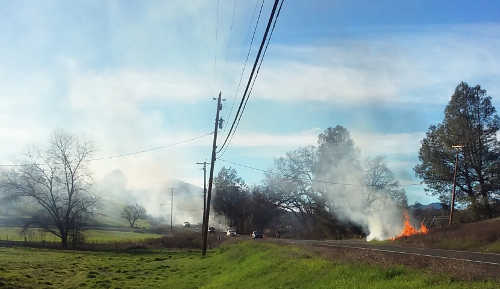
LOWER LAKE, Calif. – Firefighters put out several small spot fires that broke out along Highway 29 on Monday afternoon.
The fires were first reported at around 3:45 p.m., according to radio reports.
Lake County Fire Chief Willie Sapeta said a total of six small fires burned along the roadside in the area between Seigler Canyon Road and Lee Barr Drive.
Sapeta said Lake County Fire, Cal Fire, Kelseyville Fire and Northshore Fire responded with a total of six engines plus firefighters, two commanding officers and two medic units.
The California Highway Patrol and Lake County Sheriff's Office closed the road as Sapeta explained that the small, smoky fires were creating a dangerous situation for firefighters along the busy highway.
The highway was reported to be closed for less than an hour, with one-way traffic opened up shortly before it was fully reopened at around 5 p.m., according to radio reports.
Sapeta said the largest of the fires was about 20 feet by 40 feet along the northbound lane.
Acreage estimates from Sapeta and Cal Fire firefighters on scene ranged between an eighth of an acre and half an acre.
“We're not sure of the cause yet,” Sapeta said early Monday evening, adding that Cal Fire is conducting the investigation.
Charles Lamp – who lives in the Bay Area and has a place in the Clear Lake Riviera – was traveling through the area with his family on the way to Lower Lake and reported the fires.
He said the first one, which they saw just before 3:45 p.m., was about 3 feet wide. Fifty feet down the highway there was another fire that he estimated was 6 feet in diameter, and a still-larger fire was another 200 feet away from that second one. All were round in shape.
“The fire grew fast,” he said, adding, “Within 10 minutes it stopped traffic going westbound.”
Lamp said it was hard to believe that, with all of the recent rain, the green grass would burn.
“It was almost like it was fueled by something other than green grass,” he said.
Lamp added, “We lost our cabin up in Cobb this fall, so we are really vigilant when we see a fire.”
Email Elizabeth Larson at