 How to resolve AdBlock issue?
News
 CLEARLAKE, Calif. – The Clear Lake Associated Students of the Lake County Campus of Woodland Community College will present this year’s Black History Month event on Wednesday, Feb. 24.
The celebration will take place starting at noon in room 209 on the campus, located at 15880 Dam Road Extension in Clearlake.
This year’s event – which is free and open to the entire community – will feature two uplifting guest speakers, authentic Southern-style food and beautiful music from the Harlem Renaissance era.
The first guest speaker will be Randall Cole, who earned a Drug and Alcohol Counseling Certificate at the Lake County Campus.
He is the author of “Felonies Before Birth.” His speeches are passionate, personal and inspirational.
The second guest speaker will be Voris Brumfield.
Brumfield is an experienced and distinguished speaker on the subject of Black History Month and in the past has even dressed as Martin Luther King’s mother while giving speeches. She is passionate about the subject matter and will inspire those who attend the event.
If you bring an appetite, you’ll have the chance to purchase Aromas Café’s Southern soul food meal for $10 between 11:30 a.m. and 1 p.m. This is their favorite event to cater and they are excited to be a part of it once again.
For more information, call 707-995-7900.
After years of preparatory studies, NASA is formally starting an astrophysics mission designed to help unlock the secrets of the universe – the Wide Field Infrared Survey Telescope (WFIRST).
With a view 100 times bigger than that of NASA’s Hubble Space Telescope, WFIRST will aid researchers in their efforts to unravel the secrets of dark energy and dark matter, and explore the evolution of the cosmos.
It also will discover new worlds outside our solar system and advance the search for worlds that could be suitable for life.
NASA's Agency Program Management Council, which evaluates the agency's programs and projects on content, risk management, and performance, made the decision to move forward with the mission on Wednesday.
“WFIRST has the potential to open our eyes to the wonders of the universe, much the same way Hubble has,” said John Grunsfeld, astronaut and associate administrator of NASA’s Science Mission Directorate at Headquarters in Washington. “This mission uniquely combines the ability to discover and characterize planets beyond our own solar system with the sensitivity and optics to look wide and deep into the universe in a quest to unravel the mysteries of dark energy and dark matter.”
WFIRST is the agency's next major astrophysics observatory, following the launch of the James Webb Space Telescope in 2018.
The observatory will survey large regions of the sky in near-infrared light to answer fundamental questions about the structure and evolution of the universe, and expand our knowledge of planets beyond our solar system – known as exoplanets.
It will carry a Wide Field Instrument for surveys, and a Coronagraph Instrument designed to block the glare of individual stars and reveal the faint light of planets orbiting around them.
By blocking the light of the host star, the Coronagraph Instrument will enable detailed measurements of the chemical makeup of planetary atmospheres.
Comparing these data across many worlds will allow scientists to better understand the origin and physics of these atmospheres, and search for chemical signs of environments suitable for life.
“WFIRST is designed to address science areas identified as top priorities by the astronomical community,” said Paul Hertz, director of NASA's Astrophysics Division in Washington. “The Wide-Field Instrument will give the telescope the ability to capture a single image with the depth and quality of Hubble, but covering 100 times the area. The coronagraph will provide revolutionary science, capturing the faint, but direct images of distant gaseous worlds and super-Earths.”
The telescope’s sensitivity and wide view will enable a large-scale search for exoplanets by monitoring the brightness of millions of stars in the crowded central region of our galaxy.
The survey will net thousands of new exoplanets similar in size and distance from their star as those in our own solar system, complementing the work started by NASA's Kepler mission and the upcoming work of the Transiting Exoplanet Survey Satellite.
Employing multiple techniques, astronomers also will use WFIRST to track how dark energy and dark matter have affected the evolution of our universe.
Dark energy is a mysterious, negative pressure that has been speeding up the expansion of the universe. Dark matter is invisible material that makes up most of the matter in our universe.
By measuring the distances of thousands of supernovae, astronomers can map in detail how cosmic expansion has increased with time. WFIRST also can precisely measure the shapes, positions and distances of millions of galaxies to track the distribution and growth of cosmic structures, including galaxy clusters and the dark matter accompanying them.
“In addition to its exciting capabilities for dark energy and exoplanets, WFIRST will provide a treasure trove of exquisite data for all astronomers,” said Neil Gehrels, WFIRST project scientist at NASA's Goddard Space Flight Center in Greenbelt, Maryland. “This mission will survey the universe to find the most interesting objects out there.”
WFIRST is slated to launch in the mid-2020s. The observatory will begin operations after traveling to a gravitational balance point known as Earth-Sun L2, which is located about one million miles from Earth in a direction directly opposite the Sun.
WFIRST is managed at Goddard, with participation by the Jet Propulsion Laboratory (JPL) in Pasadena, California, the Space Telescope Science Institute in Baltimore, the Infrared Processing and Analysis Center, also in Pasadena, and a science team comprised of members from U.S. research institutions across the country.
For more information about NASA's WFIRST mission, visit http://www.nasa.gov/wfirst .
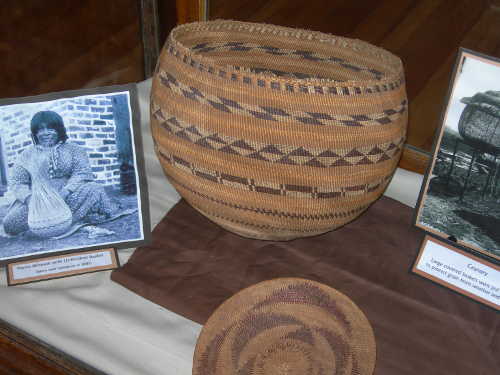
LAKE COUNTY, Calif. – American Indians of Lake County and what is now the United States created many varieties of baskets, but the supreme basket makers were the Pomo Indians of Lake and Sonoma counties.
The ancient art of basket making was elevated to a new level by the skilled Pomo Indian basket weavers.
Dr. Greg Sarris, tribal chairman of the Federated Indians of Graton Rancheria, wrote about the world-renowned basket weaver Mabel McKay in his book, “Mabel McKay: Weaving the Dream,” part of his “Portraits of American Genius” series.
In his book he painstakingly extracts profound truths from McKay, the famed elder basket weaver. He drew out her genius with ongoing conversations and through close contact over time.
McKay was a basket weaver who helped keep the dying tradition alive within her Pomo culture. She gave a lifetime of lessons in showing others the way the spirit heals and speaks through what is called “The Dream.”
Her humble life working in a cannery belies the art that came out in her basketry – baskets so rich and beautiful that they are now found in the Smithsonian Museum.
Sarris – who wrote a blurb on the back of my book, “Anderson Marsh State Historic Park – A Walking History, Prehistory, Flora and Fauna Tour of a California State Park” – found that the story of her life was not a “first this, then that” sort of chronology to be told.
Instead, in order to gain understanding of her dual arts of healing and artistry, he needed to suspend the natural inclinations of a writer to document a chronology, and to enter what was natural for McKay's life in dwelling in the supernatural and spiritual worlds.
In his book, “Weaving the Dream,” he quotes McKay as follows: “I was born in Nice, Lake County, California, 1907, January 12. My mother, Daisy Hansen. My father, Yanta Boone. Grandma raised me. Her name, Sarah Taylor. I followed everywhere with her. I marry once in Sulphur Bank. Second time I marry Charlie McKay. We live in Lake County, then Ukiah, then Santa Rosa. I weave baskets, and show them different places. Have son, Marshall. Now grandkids, too. My tribe, Pomo. There, how's that? That's how I can tell my life for the white people's way. Is that what you want? It's more, my life. It's not only the one thing. It's many. You have to listen. You have to know me to know what I'm talking about.”
The Pomo Indians who once lived at what is now Anderson Marsh were hunter-gatherers. This lifestyle required an array of basketry containers and implements.
There were woven tools for beating the grasses so that they would release their seeds, baskets in which to collect the seeds, special burden baskets for carrying a multitude of items.
Fish traps were constructed of woven materials, along with other woven hunting traps for quail and woodpeckers.
The basket hopper was a funnel in shape, without a bottom in its form, and was set over a mortar to collect acorn meal as it was being prepared. It was often constructed of twined redbud, using a geometric pattern.
A myriad of other baskets were in use in times past, for storing, sifting and even for cooking. Babies were placed in woven cradles, and there were unique and beautiful ceremonial baskets in use then, too.
The materials used for weaving varied from dogwood, white willow, sedge, bulrush and redbud. Tule and grapevine were employed as well.
Certain baskets had feathers woven into them, such as feathers from duck, quail, red-headed woodpecker, Bullock's Oriole and meadowlark.
For more information, and to view beautiful basket specimens, visit our local museums.
Kathleen Scavone, M.A., is an educator, potter, writer and author of “Anderson Marsh State Historic Park: A Walking History, Prehistory, Flora, and Fauna Tour of a California State Park” and “Native Americans of Lake County.” She also writes for NASA and JPL as one of their “Solar System Ambassadors.” She was selected “Lake County Teacher of the Year, 1998-99” by the Lake County Office of Education, and chosen as one of 10 state finalists the same year by the California Department of Education.
LAKE COUNTY, Calif. – For decades, the high school sport of wrestling was not widely open to middle and high school girls.
However, as girls have been increasingly allowed to enter the ranks of competitive wrestlers over the last several years in Lake County, they have quickly made up for lost time.
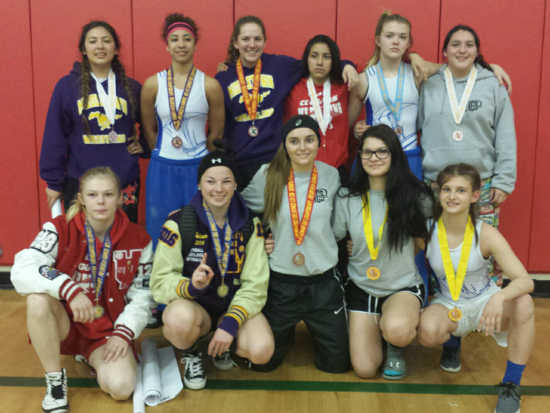
This year, a record number of young women in local high schools are headed to the 2016 CIF State Girls Wrestling Championships, which takes place Feb. 26 and 27 in Visalia.
At the Girls North Coast Section Tournament held last weekend at Albany High School, Lake County had seven state qualifiers and 11 total medalists, according to Clear Lake High School Assistant Coach Rick Pyorre.
The top three finishers in each weight class advance to the state finals.
The California Interscholastic Federation began offering regional wrestling finals – for Northern and Southern California – for girls in 2006. A combined state championship began in 2011, according to the organization's Web site.
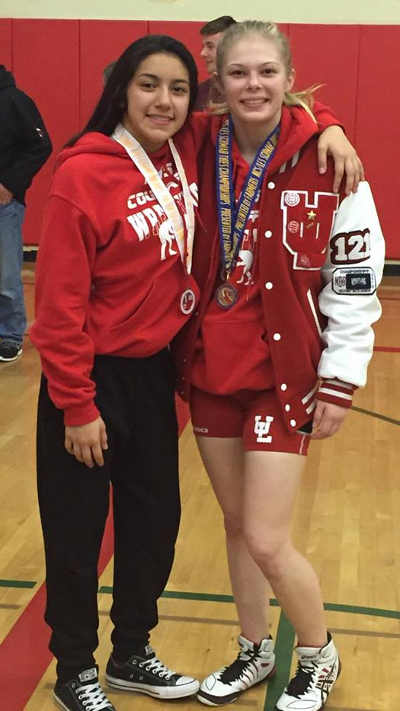
The seven who now advance to state include Emily Psalmonds of Clear Lake High and Adriana Lopez of Upper Lake High, who finished second and third, respectively, in the 106-pound weight class; Christina Wilson of Upper Lake, first in the 121-pound class; Kailei Foltmer, Middletown, who was first in the 131-pound class; Alixe Olson of Middletown, second in the 143-pound class; Isabella Quintana-Ocken of Middletown, third in the 150-pound class; and Jasmin Clarke of Kelseyville, who placed third in the 189-pound class.
Psalmonds, seeded third in the tournament, battled through with two decision and one major decision matches to finish 3-1 and take second place in the 106-pound division.
Her performance makes her the first Clear Lake High School girl wrestler to advance to state, her coaches reported.
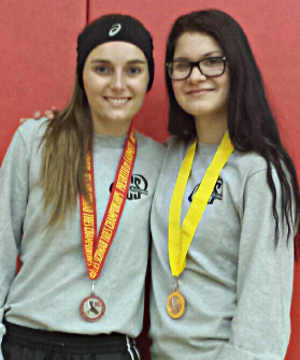
“She wrestled excellent! We are extremely proud of her,” said Head Coach Aden Pierson.
Medaling but not qualifying for state were Krystal Lockwood of Lower Lake, fourth place, 101 pounds; Alicia Ledesma, fourth place, 111 pounds; Abebreanna Gonzalez, Lower Lake, sixth place, 116 pounds; Mikelynn Rowe, Lower Lake, seventh place, 131 pounds.
Alicia Ledesma is a first-year wrestler who came out to wrestle as her senior project, Pyorre said. She went 3-2 to take fourth place in the 111-pound division, with three pins, just missing advancing to the state championships in a close battle with the second seed, losing 2-0. Her only other loss was to the first seeded wrestler.
Pyorre said all of her coaches believe she deserves an A+ on her senior project.
Pyorre said there also were three additional state qualifiers and one more medalist from the local League Coastal Mountain Conference, bringing the total to 10 state qualifiers and 15 medalists. He said those wrestlers included Dillynn Perry, Fort Bragg, third place, 126 pounds; Nicole Karkar, Willits, third place, 131 pounds; Gabby Agenbroad, Willits, first place, 189 pounds; and Selena Verbera, Saint Helena, fifth place, 189 pounds.
Pyorre and Kelseyville High wrestling coach Rob Brown had high praise for all seven of Lake County's state-bound wrestlers.
“They're so athletic and they fight so hard, people are amazed at the drive the have and the desire,” Brown said.
Brown singled out Upper Lake's Christina Wilson, a sophomore who also went to state last year, for special praise.
He called Wilson “extraordinary.”
She has mostly wrestled boys and hasn't participated in a lot of girls' tournaments. But when she does, “she dominates,” he said.
“I don't think I've had a boy ever beat her. They fear her,” Brown said.
Advancing girls wrestling opportunities
“We've always had girls wrestling,” said Brown.
The difference, however, is that up until several years ago, the girls had to wrestle boys, and had no specific competition structure just for them.
While wrestling may still be thought of by many as a male sport, it was added to the Olympic roster in 2004 and offers the opportunity for female athletes to receive scholarships at the college level.
It's also a fast-growing sport for girls in high schools, although it continues to be dominated by male competitors, and isn't yet amongst the top 10 sports for girls ranked by participation level, according to data from the National Federation of State High School Associations.
The association tracks annual participation by students in dozens of different sports.
Small numbers of female wrestlers – sometimes only a handful a year, and usually participating as part of an established male team – began showing up in the statistics in the early 1980s, and over the last 10 years have started to show steady growth.
In the 2014-15 school year – the latest year for which numbers were available – the association reported that 1,806 schools nationwide had programs for girls wrestlers, who numbered 11,496. That's compared to the 10,597 school programs for 258,208 male wrestlers across the country.
Several years ago, Brown and other coaches around Lake County began to build their girls' teams, but up until last year girls couldn't wrestle in middle school, an important time for building skills before entering high school competition.
Brown went to local schools and asked for support to let the middle school girls wrestle, suggesting, “I think we should do it until someone complains.”
He added, “I just wouldn't give up on it.”
Pyorre credits Brown for stepping up to settle the matter about letting middle school girls wrestle, a decision that's benefiting programs countywide.
In 2015, the girls middle school wrestling began, and Brown said it has resulted in stronger girls high school wrestlers.
“To me, it's so important for the entire sport,” he said.

Added Pyorre – who was himself a high school wrestler and has coached since 1987 when he was still a high school student – “It's come a long way.”
He said that Terrace Middle School recently had more girl wrestlers come out than boys.
Pyorre's own daughter, Mavis, is an eighth grader wrestler. He said the middle school experience gives both girls and boys the benefit of more exposure to the sport, and a chance to get the basics down before arriving at high school.
Asked what makes a good wrestler, Pyorre said heart, dedication, balance, pressure and speed, and perseverance and determination are all key characteristics.
He said the sport, in turn, helps build young athletes' self-esteem, teaching them great life lessons about overcoming difficulties and the challenges set before them.
Pyorre said there still remain key differences in the boys' and girls' wrestling competition structures.
This coming weekend, boys are going to league finals in order to qualify for sections, a step not needed for female wrestlers due to their fewer numbers, he said. As the numbers grow, he said the pools will need to be narrowed for championships.
When the girls are at the state competition in Visalia, the boys will go to their sections finals. For a comparison of participation numbers, he said that there are at least eight mats running at the boys' sections, and three at the girls' sections.
The boys' state competition will take place in Bakersfield March 4 and 5 in Bakersfield.
In the days ahead, the wrestlers will be doing more practice and conditioning to get ready for the state finals, Pyorre said.
He said it's key to be in good shape, as they will need to be in the best shape possible for those three, two-minute rounds on the mat.
Email Elizabeth Larson at
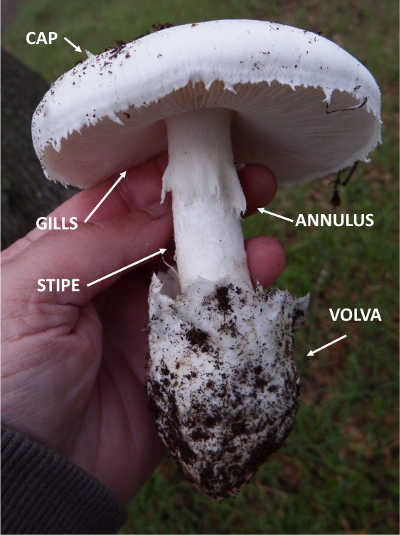
NORTHERN CALIFORNIA – There are loads of mushrooms popping up all over the Berryessa Snow Mountain National Monument region right now, and learning how to properly identify them can be somewhat tricky.
There’s an old joke that goes something like: trying to identify a mushroom by its cap alone is like trying to identify a bald man by just looking at the top of his head. You need a lot more information to make a correct ID.
The color, size and shape of the cap are fair indicators of what kind of mushroom you’ve found. The cap of a common big laughing gymn (smooth and about the size of a dinner plate) is very different from that of a morel (ridged and pitted).
But because a lot of mushrooms mimic one another – and many of them are toxic – “fair indicators” aren’t really enough. You also need to look at the stipe (the stem of the mushroom), the gills (if it has them), and at its spore print.
The construction, length and color of the stipe of a mushroom will all help you get closer to a proper identification. Is the stipe long or short?
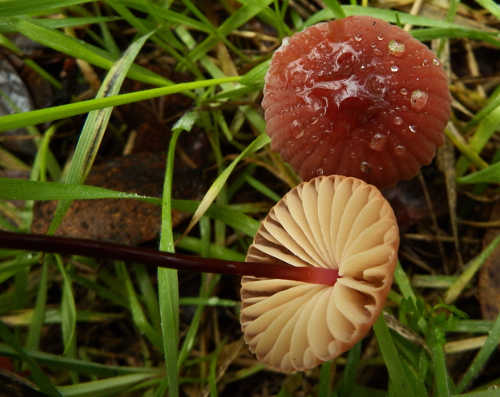
Some mushrooms like the common red threads (Marasmius plicatulus) have a very long stipe compared to the size of the cap.
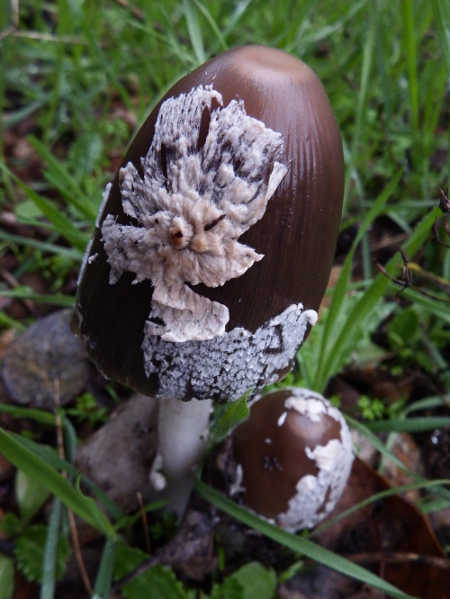
What does the stipe feel like? That of the inky cap mushroom (Coprinopsis atramentaria), is fragile and may fall apart between your fingers, while that of the big laughing gymn (Gymnopilus junonius) feels almost woody.
Whether or not there’s an annulus attached to the stipe below the cap will also give you more information. The annulus is that ring or collar you’ll find on the stipe of some mushrooms. It’s actually the remnant of a veil that covered the gills when the mushroom was younger.
You’ll also find that some mushrooms actually have two veils: one that covers the gills and one that covers the whole mushroom while it’s in the ground, also called a volva or universal veil.
On mushrooms like the Inky Cap, remnants of the universal veil can be seen as soft white flecks on the cap; whereas in specimens like the highly toxic Destroying Angel (Amanita ocreata) remnants can be found on the cap and the stipe.
Now, look under the cap. Does the mushroom have gills or does it have pores?
The gills (lamella) are those thin ridges radiating out from the center of the like the spokes on a bicycle wheel. This is where spore production takes place.
The color of the gills and how they are arranged will tell you more about the kind of mushroom you have. The gills of the inky cap, for example, are black and rather “crowded,” whereas the gills of the red thread are cream colored and look “distant” from one another.
If you’re holding something that looks like a gilled mushroom but doesn’t actually have gills under the cap, you’ve probably got a bolete of some kind.
Bolete mushrooms have what look like open pores on the underside of the cap. Each of those pore-looking things is actually the open end of a tubule, and it’s inside these tubes that these mushrooms generate their spores.
Along with the information you’ve gathered about the cap, stipe and gills of the mushroom, checking for the color of its spores will also help identify it. The spores of the big laughing gymns are rust-orange, those of the inky cap are black and those of the red threads are white.
To collect a spore print, remove the stipe from the cap and place the cap gills-down on a piece of newspaper in a warm dry place and leave it overnight. The next morning, you’ll be able to see the spores on the paper.
So you see, there’s a lot more to properly identifying mushrooms than simply looking at the cap. For safety’s sake, gather as much information as you can before adding those lovely wild mushrooms you found to your entrée at dinner.
Tuleyome is a501(c)(3) nonprofit conservation organization based in Woodland, Calif. For more information, visit www.tuleyome.org . Mary K . Hanson is a Certified California Naturalist and author of the blog, The Chubby Woman’s Walkabout. For more information on fungi in the Berryessa Snow Mountain Region see “A Species Guide to the Berryessa Snow Mountain Region” available online at www.Lulu.com .
LAKE COUNTY, Calif. – Travelers to Latin America and other parts of the world need to be aware of health risks posed by the Zika virus – an infection transmitted through mosquito bites that has recently enlarged its territory to Latin American countries, including Mexico.
The infection was previously associated with travel to other countries with outbreaks, such as areas of Africa, Southeast Asia and the Pacific Islands. Its appearance in Latin American countries brings the disease potential closer to home.
The illness is usually mild and symptoms of Zika virus infection typically begin three to seven days after a person is bitten by an infected mosquito.
Lasting several days to a week, symptoms include fever, rash, joint pain and redness of the eyes. There is no specific treatment for the infection.
Of greatest concern is the association of a serious birth defect known as microcephaly (abnormally small head and brain) in newborns born to women infected with Zika virus while pregnant.
Zika virus is primarily transmitted through the bite of Aedes aegypti and Aedes albopictus mosquitoes.
While these species of mosquito are not yet found in Lake County, they have been detected in 12 California counties.
“We all can take simple steps to reduce the spread of mosquitoes and prevent Zika virus and similar mosquito-borne diseases from finding their way to Lake County,” said Lake County Vector Control District Manager and Research Director Dr. Jamesina Scott. “The most important thing you can do is get rid of standing water in your yard because this is where those mosquitoes develop.”
Transmission of the infection can also take place via blood transfusion, sexual contact, and from mother to child around the time of delivery and possibly earlier during pregnancy.
There is no vaccine to prevent Zika virus infection, so it is important to avoid becoming infected. If you are traveling to a region affected by Zika, chikungunya or dengue, you should avoid mosquito bites during the day and at night.
Recommended precautions include:
– Use an insect repellent containing DEET, picaridin, IR3535, oil of lemon eucalyptus, or para-menthane-diol (PMD). If you use both sunscreen and insect repellent, apply the sunscreen first and then the repellent.
– Pregnant women and women who are breastfeeding can and should choose an EPA-registered insect repellent (such as DEET, picaridin, or IR3535) and use it according to the product label.
– When weather permits, wear long-sleeved shirts and long pants.
– Use air conditioning or window/door screens to keep mosquitoes outside. If you are not able to protect yourself from mosquitoes inside your home or hotel, sleep under a mosquito bed net.
– Reduce the number of mosquitoes outside your home or hotel room by emptying standing water from containers such as flowerpots or buckets.
Lake County Health Officer Dr. Karen Tait said that Lake County residents often travel to Mexico and urges pregnant women and women who may become pregnant to consider postponing travel to areas where Zika virus transmission is ongoing.
Tait cautioned, “If travel to a location with active Zika virus transmission cannot be avoided, strict precautions to avoid mosquito bites at all hours of the day and night should be followed.”
More detailed information about locations with active Zika virus transmission can be found at http://www.cdc.gov/zika/geo/index.html .
Travelers returning from areas with Zika virus outbreaks should see their doctor if they have fevers or other symptoms of Zika virus, which can resemble infections from several other related viruses.
Doctors should report possible cases to the local public health department, which can assist them with accessing public health laboratory tests for the virus.
Residents can reduce mosquitoes near their homes with these steps:
– Remove or drill holes in the bottom of all plant pots, saucers, barrels, bins, and old tires so that they no longer hold water.
– Do not keep water in buckets; cover trashcans, toys, and recycle bins; and keep unneeded items out of the rain.
– Store canoes and other small watercraft indoors or upside-down so they do not collect rainwater.
– Regularly inspect tarps and dump out the water that collects in low spots.
– Properly seal rain barrels to keep mosquitoes out of the water. Thousands of mosquito eggs can be laid inside rain barrels.
– Contact the Lake County Vector Control District at 707-263-4770 or www.LCVCD.org for help with preventing mosquitoes in unmaintained swimming pools and spas, stock tanks, ornamental ponds, and other water features that cannot be drained.
A strong program of mosquito control, both community-wide as well as what individuals can do to protect themselves, is the most effective means of avoiding Zika virus and other mosquito-borne diseases.
More information is available at http://www.cdc.gov/zika/ .