 How to resolve AdBlock issue?
News
LAKE COUNTY, Calif. – The Redbud Audubon Society is encouraging Lake County residents to participate in the Great Backyard Bird Count.
The 19th annual count will be held Friday, Feb. 12, through Monday, Feb. 15.
The Great Backyard Bird Count is a free, fun, and easy event that engages bird watchers of all ages in counting birds to create a real-time snapshot of bird populations.
Participants are asked to count birds for as little as 15 minutes (or as long as they wish) on one or more days of the four-day event and report their sightings online at www.birdcount.org .
Anyone can take part in the Great Backyard Bird Count, from beginning bird watchers to expert, and you can participate from your backyard, or anywhere in the world.
Launched in 1998 by the Cornell Lab of Ornithology and National Audubon society, the Great Backyard bird Count was the first online citizen-science project to collect data on wild birds and to display results in near real-time.
Since then, more than 100,000 people of all ages and walks of life have joined the four-day count each February to create an annual snapshot of the distribution and abundance of birds.
Redbud Audubon invites you to participate. Simply tally the numbers and kinds of birds you see for at least 15 minutes on one or more days of the count, Feb. 12 to 15.
If you are new to the count, first register online then enter your checklist. If you have already participated in another Cornell Lab citizen-science project, you can use your existing login.
During the count, you can explore what others are seeing in your area or around the world. Share your bird photos by entering the photo contest, or enjoy images pouring in from across the globe.
Then keep counting throughout the year with eBird, which uses the same system as the Great Backyard Bird Count to collect, store and display data any time, all the time.
Each checklist submitted during the Great Backyard Bird Count helps researchers at the Cornell Lab of Ornithology and the National Audubon Society learn more about how birds are doing and how to protect them and the environment we share.
Please visit the official Web site at www.birdcount.org for more information and be sure to check out their latest educational and promotional resources.
LAKE COUNTY, Calif. – Lake County Vet Connect is entering 2016 with plans to restructure to allow for a new meeting schedule as it seeks to serve local veterans.
The organization that has been operating since 2011 and has developed a wide ranged network of providers all wanting to help local veterans connect with the services they have earned.
Previously meeting the second and third Wednesday of each month in Clearlake and Lakeport, respectively, Vet Connect is restructuring to meet quarterly in these cities.
It is currently organizing the first of the new Lake County Vet Connect “Hook Up Hub” events on Wednesday, March 16, at Umpqua Bank in Lakeport from 10 a.m. to 2 p.m.
Lunch will be provided. Numerous service providers in the Vet Connect network will be represented.
Veterans and their families are encouraged to attend to take advantage of these resources in one location.
Lake County Vet Connect is still available to veterans who require services urgently. Chairman Frank Parker can be reached at 707-274-9512 for referrals to these resources.
To stay up-to-date regarding these events, to request information or if you interested in being a provider at these events, join the Lake County Vet Connect Hook Up Hub Facebook group.
Donations can be made to Lake County Vet Connect at Umpqua Bank in Lakeport.
Donations will be used for food and refreshments at these events as well as goods and services provided to veterans at the Stand Down event in September.
In a letter to U.S. Secretary of Commerce Penny Pritzker, Gov. Edmund G. Brown Jr. on Tuesday requested federal declarations of a fishery disaster and a commercial fishery failure in response to the continued presence of unsafe levels of domoic acid, a potent neurotoxin, in Dungeness and rock crab fisheries across California and the corresponding closures of those fisheries.
“Crabs are a vital component of California’s natural resources and provide significant aesthetic, recreational, commercial, cultural and economic benefits to our state,” Gov. Brown said in the letter to Secretary Pritzker. “Economic assistance will be critical for the well-being of our fishing industry and our state.”
North Coast state Sen. Mike McGuire, chair of the Joint Committee on Fisheries and Aquaculture, has been focused on the unprecedented delay of the crab season for months.
Leading a bipartisan delegation of state legislators, on Jan. 25 McGuire requested Gov. Brown advance a disaster declaration due to the devastating closure of the multimillion dollar crab harvest.
“We are grateful to the governor, as well as the director of Fish and Wildlife, for making the official request for a disaster declaration today to assist our crab fishermen, their families and crews,” McGuire said. “This will provide desperately needed assistance to the crab industry and local businesses who are struggling. Fishermen are losing homes, racking up debt they can’t afford, and selling off assets, and the impacts are even greater in coastal towns that depend on a healthy crab harvest for their livelihood.”
In early November 2015, the Office of Environmental Health Hazard Assessment (OEHHA), in consultation with the California Department of Public Health (CDPH), recommended a closure based on unsafe levels of domoic acid found in crab tissue that was likely to pose a human health risk.
Domoic acid is a potent neurotoxin that can accumulate in shellfish and other invertebrates. At high levels, it can cause persistent short-term memory loss, seizures and death. At low levels, domoic acid can cause nausea, diarrhea and dizziness.
In response to the health and safety risk, the California Department of Fish and Wildlife (CDFW) and the California Fish and Game Commission took emergency regulatory action to delay the commercial and recreational fisheries for Dungeness crab and close the commercial and recreational fisheries for rock crab north of the Santa Barbara/Ventura County line.
CDFW and the Ocean Protection Council, within the California Natural Resources Agency, have continued to work closely with the Dungeness Crab Task Force in seeking advice from fishing representatives.
CDFW has continued to vigilantly monitor the health risks in coordination with OEHHA, CDPH and the Governor’s Office of Emergency Services.
Domoic acid levels have remained at unsafe levels in California fisheries and it remains unclear when it will be safe to reopen these fisheries.
The Dungeness crab industry alone is one of the highest valued commercial fisheries in California with a value of up to $90 million a year.
“The federal declaration of a commercial fishery failure will help hardworking Californians who have lost their livelihood to this natural disaster to receive vital economic assistance,” said Charlton H. Bonham, director of CDFW. “We remain committed to doing everything we can for the affected fishing families and businesses – and communities that depend upon them – across every sector of the crab industry.”
In December 2015, Director Bonham told a Joint Committee on Fisheries and Aquaculture that the department was building a case for federal assistance.
In January 2016, Governor’s Office of Emergency Services Director Mark Ghilarducci wrote Tanya Garfield, the U.S. Small Business Administration’s director of Disaster Field Operations Center requesting that 15 California counties affected by the crab closure be declared a disaster area to provide Economic Injury Disaster Loan Program assistance to impacted businesses.
The governor’s request to the secretary of commerce initiates the evaluation of a federal fishery resource disaster under the Interjurisdictional Fisheries Act of 1986 and a commercial fishery failure under the Magnuson-Stevens Fishery Conservation and Management Act of 1976.
Should a determination be made to declare a disaster and failure, this enables state and federal agencies to work together to determine the full economic impact of the disaster and to provide economic relief to affected crabbers and related businesses.
“CDFW remains committed to working with federal officials to complete the required review for a fishery resource disaster declaration and a commercial fishery failure declaration,” Bonham said.
More details of the crab disaster declaration will be discussed at this Thursday’s annual Fisheries Forum, convened by Sen. McGuire.
The 43rd annual Zeke Grader Fisheries Forum, set to take place at the State Capitol, will include presentations from Bonham and California’s Natural Resources Secretary John Laird, as well as commercial and recreational fishing representatives, river advocates, aquaculture producers and fish processors.
The hearing begins at 10 a.m. in Room 112 of the Capitol. The public is welcome to attend. The hearing will also be livestreamed on the State Senate’s Web site at www.senate.ca.gov .
For more information about the Fisheries Forum visit the committee Web site at http://fisheries.legislature.ca.gov/ .
For more information on the state’s ongoing responses to the health and safety issues posed by high domoic acid levels in California crab fisheries please visit www.cdph.ca.gov/healthinfo/pages/fdbdomoicacidinfo.aspx .
LAKEPORT, Calif. – Two local high school teams are preparing to go head-to-head in court this week as part of the annual Mock Trial competition.
The competition, now in its fourth year, will take place Friday, Feb. 12, in Lake County Superior Court, located on the fourth floor of the Lake County Courthouse, 255 N. Forbes St. in Lakeport.
Competing once again this year will be Middletown and Upper Lake high schools.
The first trial will begin at 9 a.m. in Department 1, with Judge Michael Lunas presiding.
Judge Stephen Hedstrom will preside over the second trial, which will begin at 1 p.m. in Department 4.
The public is invited to attend.
The competition involves the teams taking turns presenting the prosecution and defense in a fictional criminal case.
The Constitutional Rights Foundation, the California Mock Trial's founding organization, reported that this year's case is “People v. Hayes.”
The case brief explains that the fictional Hayes – a student at Central Coast University on a track and field scholarship – faces a felony charge of murder for the homicide on May 15, 2014, of Lee Valdez, a campus security guard, who was attempting to restrain another track team member who also was a suspect in theft cases.
Key matters for the students to explore in the case are the defense claim of justifiable homicide, allegations that Hayes had sent a threatening message against Valdez to campus security as well as pretrial issues involving the Fifth Amendment protection against self-incrimination.
The winning team will advance to the state competition in Sacramento March 18 to 20, according to the Constitutional Rights Foundation.
Email Elizabeth Larson at
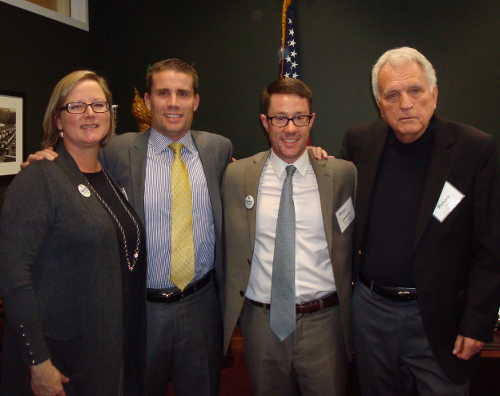
LAKE COUNTY, Calif. – Habitat for Humanity Lake County President Richard Birk and representatives of other Northern California Habitat affiliate offices met recently with state Sen. Mike McGuire in Sacramento to discuss matters pertinent to low-income housing and housing issues relating to the Lake County fires of 2015.
Habitat for Humanity Lake County is seeking additional sources to provide rebuild funding for those uninsured, low-income families who lost their homes in the fires, or those low-income renters who have been displaced by the fires.
Restoring residences within Lake County is beneficial not only for the County but for the state as well, and assistance from the state is crucial to the rebuilding efforts, the organization reported.
Rebuild efforts are slated to begin soon and funds to support the work are urgently needed.
For more information about how you can contribute to Habitat for Humanity Lake County’s rebuild efforts, or to donate to the Fire Rebuild Fund, visit www.lakehabitat.org ; mail donations to P.O. Box 1830, Lower Lake, CA 95457; or contact the office at 707-994-1100.
LAKEPORT, Calif. – The Lakeport Planning Commission this week will discuss amending the environmental document for the Downtown Improvement Project, honor a retiring commissioner and discuss planning department activity.
The commission will meet beginning at 5 p.m. Wednesday, Feb. 10, in the council chambers at Lakeport City Hall, 225 Park St.
On the meeting's agenda is an award presentation to retiring Commissioner Ross Kauper, who has served on the commission since October 2002.
In other business, planning staff will take to the commission the amended negative declaration for the Downtown Improvement Project's phase two, set to run from this spring until the fall on South Main Street between First and Fourth streets.
A report to the commission from city Associate Planner Daniel Chance said the original mitigated declaration for the plan was accepted in 2006, covering both the first and second phases.
However, Chance said the commission needs to consider the amendment because the original document did not analyze the potential impacts related to nighttime construction, which is how the work on the second phase is proposed to take place.
“The purpose of the construction taking place at night is to limit the impacts on the downtown businesses, reduce traffic impacts, and faster completion of the improvements,” Chance wrote.
Also on Wednesday, the commission will get the planning department's 2015 year-end report – including a summary of various land use applications, code enforcement activities and nuisance abatement activities for the 2015 calendar year – as well as an update on projects pending approval as of Feb. 4.
Email Elizabeth Larson at