How to resolve AdBlock issue?
News
LAKE COUNTY, Calif. – There are eight dogs ready and waiting for new homes at Animal Care and Control this week.
This week's adoptable dogs are mixes of border collie, boxer, hound, husky, Labrador Retriever and pit bull.
Dogs that are adopted from Lake County Animal Care and Control are either neutered or spayed, microchipped and, if old enough, given a rabies shot and county license before being released to their new owner. License fees do not apply to residents of the cities of Lakeport or Clearlake.
If you're looking for a new companion, visit the shelter. There are many great pets hoping you'll choose them.
In addition to the animals featured here, all adoptable animals in Lake County can be seen here: http://bit.ly/Z6xHMb .
The following dogs at the Lake County Animal Care and Control shelter have been cleared for adoption (additional dogs on the animal control Web site not listed are still “on hold”).

Pit bull terrier
This female pit bull terrier mix has a short black coat with white markings.
Shelter staff said she was brought in as a stray and is waiting for her forever family.
She is bouncy and sits on command, has no food aggression and was pretty calm in the cat room, showing no aggression towards them. She does great with both male and female dogs, and just wants to play.
“She should and could definitely be an ambassador for the breed,” according to shelter staff.
She is in foster, ID No. 4213.

'Spencer'
“Spencer” is a Labrador Retriever-pit bull retriever mix.
Shelter staff said said he has a lot of love to give and can't contain himself.
He's in kennel No. 2, ID No. 2382.
Border collie-husky mix
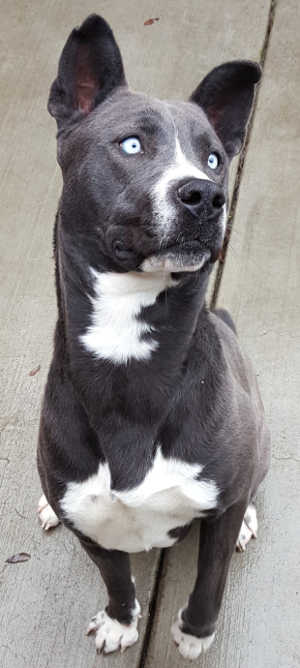
This female border collie-husky mix has a short gray and white coat.
Shelter staff said she has no issues with food aggression, and would be good with children ages 7 and above.
She's in kennel No. 9, ID No. 4217.
Hound mix
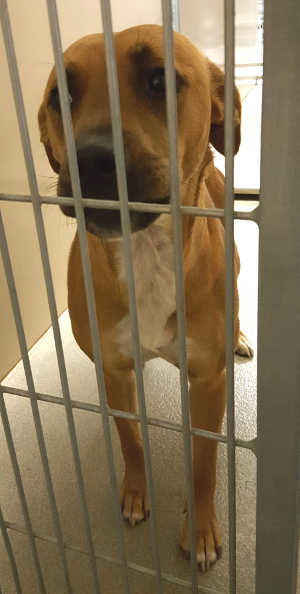
This female hound mix has a short tan coat with white markings.
She is in kennel No. 12, ID No. 4298.
'Mom'
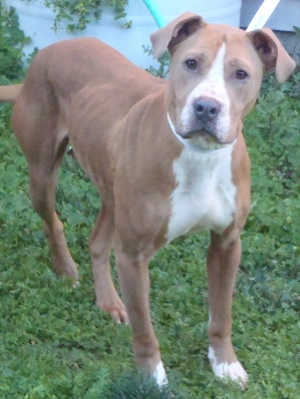
“Mom” is a pit bull terrier mix with a short brown and white coat.
She's in kennel No. 15, ID No. 4242.
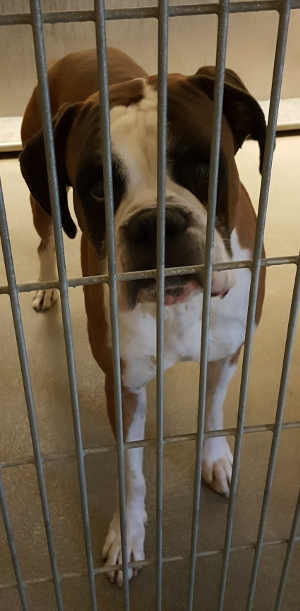
Boxer mix
This male boxer mix has a short tan coat with white markings.
He's in kennel No. 16, ID No. 4274.

Pit bull terrier mix
This female pit bull terrier mix has a short tan coat with white markings.
She's in kennel No. 23, ID No. 4305.

Boxer mix
This male boxer mix has a short tan coat with white markings.
He's in kennel No. 24, ID No. 4304.
To fill out an adoption application online visit http://www.co.lake.ca.us/Government/Directory/Animal_Care_And_Control/Adopt/Dog___Cat_Adoption_Application.htm .
Lake County Animal Care and Control is located at 4949 Helbush in Lakeport, next to the Hill Road Correctional Facility.
Office hours are Monday through Friday, 11 a.m. to 5 p.m., and 11 a.m. to 3 p.m., Saturday. The shelter is open from 11 a.m. to 4 p.m. Monday through Friday and on Saturday from 11 a.m. to 3 p.m.
Visit the shelter online at http://www.co.lake.ca.us/Government/Directory/Animal_Care_And_Control.htm .
For more information call Lake County Animal Care and Control at 707-263-0278.
Email Elizabeth Larson at
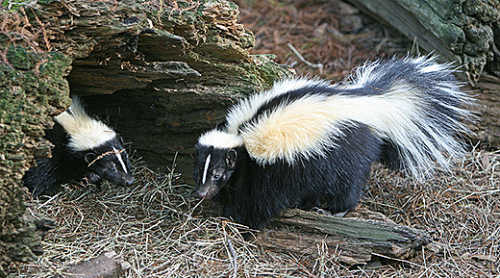
LAKE COUNTY, Calif. – Classified as mammals, striped skunks may look cuddly, but looks, as they say, may be deceiving.
These furry fellows are reportedly simple to domesticate and have been turned into pets by some. In the United States one would need to obtain a permit to do so.
There are skunks of many descriptions with varying fur colors and patterns, such as spotted, hooded, beige, black and white.
Here in Lake County we find striped skunks. Their distinctive color patterns are considered as warning colors.
The skunk's ubiquitous stripes are in place at birth, and some kits even sport stripes on their legs.
Here's a fancy word for you: crepuscular. Skunks are crepuscular creatures, meaning that they are most active just prior to dawn, and after dusk.
The skunk's usual preference is as a solitary creature, with the exception of those living in the colder regions. Then, they prefer to den together.
Their lengthy claws come in “handy” for digging up insect larvae, salamanders, snakes and lizards. They also dine on honey bees, teaching their young the nuances of hunting the winged insects.
Omnivores, skunks subsist on fungi, nuts, grasses and berries as well. The size of a striped skunk ranges in size from 15 to 37 inches and weighs in at 6 to 10 pounds. Their Arizona relatives, the hog-nosed skunk can weigh up 18 pounds.
The stinky portion of the skunk is located in its two anal scent glands which hold noxious-smelling chemicals comprised of sulphurs strong enough to keep bears at bay.
They have accurate “sites” on their “weapons” and spray targets accurately up to 10 feet, never squandering it, as their “magazine” holds only five or six doses before the requisite 10-day recoup time.
Contrary to popular belief, tomato juice is not the best way to neutralize odors if pets have been unlucky enough to be blasted with the skunk's weapon.
According to the Humane Society, use a concoction consisting of baking soda, liquid dishwashing soap and hydrogen peroxide instead.
Kathleen Scavone, M.A., is an educator, potter, writer and author of “Anderson Marsh State Historic Park: A Walking History, Prehistory, Flora, and Fauna Tour of a California State Park” and “Native Americans of Lake County.” She also writes for NASA and JPL as one of their “Solar System Ambassadors.” She was selected “Lake County Teacher of the Year, 1998-99” by the Lake County Office of Education, and chosen as one of 10 state finalists the same year by the California Department of Education.
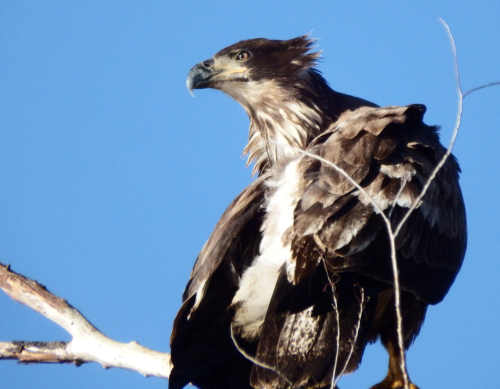
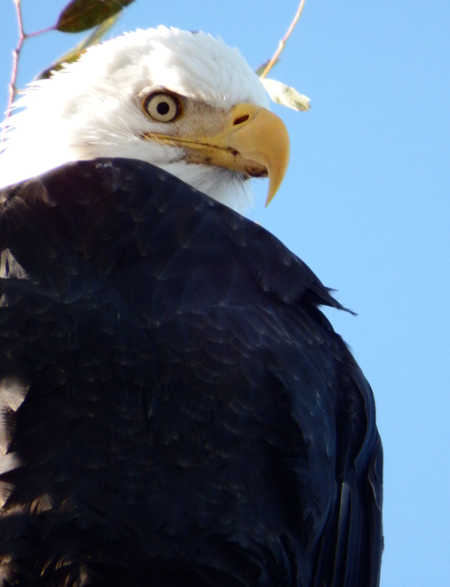
NORTHERN CALIFORNIA – A lot of people seem surprised when I tell them I’ve spotted and photographed Bald Eagles in the Berryessa Snow Mountain National Monument region, but then I remind them that the region boasts the second largest population of wintering bald eagles in the state of California.
Yes. The bald eagles are here, and right now is one of the best times of the year to see them in our area.
The only eagles unique to North America, the bald eagles’ mating season starts in September and can go through to April – depending on where they live.
During this time, you may often see males and females doing their courtship dance in the air high over your head.
While flying, the partners lock their talons together and then tumble in a spiral down to the earth, separating above the ground and flying off again just before they crash.
The adult eagles – which mate for life – can weigh around 14 pounds and live for up to 30 years in the wild, but they don’t get their distinctive white head and yellow beak until they’re a little over 4 years old.
Younger bald eagles are mottled brown and white with a black beak, and are sometimes confused with juvenile golden eagles, which look very similar.
The easiest way to tell juvenile baldies from juvenile goldens is to look at the legs. If there is feathering down the leg to the toes, it’s a golden eagle. Juvenile bald eagles' feet and “ankles” are bare.
Female bald eagles have the same coloring as males, but can be distinguished from the males by their larger in size.
Here are a few other fun facts about our national bird:
• Bald Eagles like to play. They’ve been observed tossing around plastic bottles and other light objects on the ground, and even passing sticks back and forth between them when in flight.
• For optimum saturation of oxygen, when the eagle takes a breath, the air passes through the lungs twice before it’s exhaled.
• The eagles’ eyes are almost as large as those of a human, but their eyesight is four times keener than ours.
• Their nests can be up to 8 feet wide and weigh over a ton. Males and females work together to build their nests and the construction can take up to 3 months. Bald Eagles will often use the same nest site year after year.
• They can fly at speeds up to 35 miles per hour, and can “swim” by using their wings like oars to move them across the top of the water.
• Bald eagles are “diurnal” which means they’re most active during the day – which in turn makes it easier for us to see them!
• The large birds prefer a diet of fish, but will eat just about anything they can find; and they’re not above literally stealing meals out of the mouths of other animals like otters and Osprey. Baldies have also been known to gorge themselves when food is plentiful, then sit quietly for several days while their gigantic meal is digested.
The fact that we’re still able to see bald eagles in our region at all is due to some great conservation efforts.
In 1978, as their populations were plummeting due to DDT poisoning, shooting, trapping and other factors, bald eagles were placed on the endangered species list.
It took almost 30 years to restore their numbers, but by 2007 populations were healthy enough so that the bird could be delisted.
Eagles are still protected under the Bald and Golden Eagle Act, however, and it is against the law to trap, purchase or sell the eagles, their nests, eggs or body parts.
In fact Federation Regulation 50472, Section 22.12 clearly states twice that not only are these acts illegal, the federal government “will not issue a permit to authorize these acts.”
For the chance to see some bald eagles yourself, check out the Cache Creek area in Yolo County, around Clear Lake in Lake County, along the shores of Lake Berryessa in Napa County and at the Sacramento National Wildlife Refuge in Glenn County.
Also check periodically on the Bureau of Land Management’s Web site for the bald eagle hikes they do in January and February each year, or call their Ukiah field office at 707-468-4000.
Tuleyome Tales is a monthly publication of Tuleyome, a 501(c)(3) nonprofit conservation organization based in Woodland, Calif. Mary K. Hanson is a Certified California Naturalist and author of “The Chubby Woman’s Walkabout” blog. For more information about Tuleyome, see their Web site at www.tuleyome.org .
A colorful animation shows a simulated flight over the surface of dwarf planet Ceres, based on images from NASA’s Dawn spacecraft.
A colorful new animation shows a simulated flight over the surface of dwarf planet Ceres, based on images from NASA's Dawn spacecraft.
The movie shows Ceres in enhanced color, which helps to highlight subtle differences in the appearance of surface materials.
Scientists believe areas with shades of blue contain younger, fresher material, including flows, pits and cracks.
The animated flight over Ceres emphasizes the most prominent craters, such as Occator, and the tall, conical mountain Ahuna Mons.
Features on Ceres are named for earthly agricultural spirits, deities and festivals.
The movie was produced by members of Dawn's framing camera team at the German Aerospace Center, DLR, using images from Dawn's high-altitude mapping orbit.
During that phase of the mission, which lasted from August to October 2015, the spacecraft circled Ceres at an altitude of about 900 miles.
“The simulated overflight shows the wide range of crater shapes that we have encountered on Ceres. The viewer can observe the sheer walls of the crater Occator, and also Dantu and Yalode, where the craters are a lot flatter,” said Ralf Jaumann, a Dawn mission scientist at DLR.
Dawn is the first mission to visit Ceres, the largest object in the main asteroid belt between Mars and Jupiter.
After orbiting asteroid Vesta for 14 months in 2011 and 2012, Dawn arrived at Ceres in March 2015.
The spacecraft is currently in its final and lowest mapping orbit, at about 240 miles from the surface.
LAKE COUNTY, Calif. – Inaccuracies were discovered in the recently corrected tax bills that were sent by the county of Lake on Jan. 20 to property owners who lost structures on their land during the Rocky, Jerusalem and Valley fires.
“Revised corrected” bills are scheduled to be mailed on Feb. 3 to approximately 450 property owners, the county reported. Each bill will contain a letter with an explanation of the error that occurred.
“An incorrect data set was used to generate the recent bill,” said Assessor-Recorder Richard Ford. “The 'revised corrected' property tax bills will be higher than the 'corrected' property tax bill that was recently sent, but lower than the original property tax bill received in October.”
Ford said that there are also some fire-damaged properties that are still being analyzed for the proper tax corrections and those bills have not yet been sent.
Any property owner whose structure was damaged or destroyed by the fires, and has not received an adjusted property tax bill by Feb. 19, or anyone having any other questions about post-fire valuation on property should call the Lake County Assessor’s Office at 707-263-2302.
If you have questions regarding payment of your property tax bill, please call the Lake County Treasurer-Tax Collector's Office at 707-263-2234.
NORTHERN CALIFORNIA – Lake County's state senator is the leader of a successful effort to provide more than 300,000 of California’s neediest children access to school meals.
One out of every four California children go to bed hungry each night and, tragically, California has the highest rate of children in poverty in America.
But thanks to the efforts of a coalition led by state Sen. Mike McGuire and Sen. Holly Mitchell, that is now starting to change.
In 2015, as chair of the Senate Human Services Committee, Sen. McGuire joined with Sen. Mitchell, chair of the Senate Budget Committee on Health and Human Services, to convene a working group of leaders from the California Department of Education, Department of Social Services and Department of Health Care Services.
McGuire, Mitchell and the committee worked for the greater part of the year to cut through red tape that was blocking California’s neediest kids access to free school lunches.
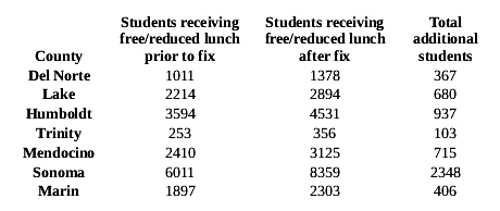
It was announced late Thursday by the California Department of Education that, because of these efforts, 326,029 additional kids are now receiving free and reduced lunch at school.
This is a 32-percent increase in the number of students automatically approved to receive free meals in California schools as a result of these collaborative efforts.
“We worked as a team to cut through bureaucratic red tape and this action ensures hundreds of thousands of kids will now have access to healthy food,” Sen. McGuire (D-Healdsburg) said. “It’s hard to be successful in school when you’re hungry, we know this move will improve kids health and help them succeed in the classroom.”
In December 2015, the last month complete data is available, the 32-percent increase meant that 326,029 additional students were automatically approved for free school meals in California’s school nutrition programs. That brings the total number of automatically eligible students in the state to 1.3 million.
Students are enrolled in the free meals program through a “direct certification” process that grants automatic eligibility to students from families already participating in CalFresh without the families having to complete any additional meal applications.
This relieves needy families and school districts from another administrative burden and helps ensure the most vulnerable kids have access to nutritious meals during the school day.
“When we work together, California is stronger,” said McGuire. “I can’t thank Sen. Mitchell, Superintendent Torlakson and the entire Department of Education team – along with the Department of Social Services and Department of Health Care Services – enough for all of their efforts over the past many months.”
While this represents one of the most significant steps forward in years, Sen. McGuire knows there is a lot more work to be done to make sure students have access to nutritious breakfast and lunch at our local schools and is committed to continuing that effort.
Below is a chart listing the North Bay/North Coast increases in students receiving free and reduced lunches with the new changes.