 How to resolve AdBlock issue?
News

The California Senior Legislature hosted its annual meet and greet for its members and members of the California State Legislature.
Leaders from across California showed strong support for California’s strongest voice advocating for senior citizens.
“We in the Legislature recognize the California Senior Legislature is a valuable voice for seniors,” said Assemblyman Donald Wagner (R-Irvine). “They provide to us the information and direct connection to seniors and some ideas that help us make the lives of seniors up and down the state that much better.”
In California, the senior population will grow at twice the rate of the state overall population, officials reported. Over half the counties in California will see a 100-percent increase in the elderly population by 2020.
With the help of the California Senior Legislature, or CSL, the growing needs of seniors has not gone unnoticed by state leaders.
“Seniors have so many needs and so many concerns. We have to continue to make sure we look out for our seniors. Seniors need transportation, they need housing, and they need to pay for their medicine. The SSI and SSP that many seniors have does not stretch far enough. So we have to work with the legislature to make sure their needs are taken care of,” said Assemblywoman Cheryl Brown (D-San Bernardino), chair Assembly Aging and Long Term Care Committee.
CSL has a 35-year distinguished history of advocating for senior’s rights.
Its track record includes the Silver Alert program and work that led to the updating of the state emergency plan for evacuating senior citizens during a declared disaster.
CSL continues to advocate for the rights of elders throughout California and the nation.
As CSL continues its growth and advocacy in the elder community, its goal is to make certain that its efforts are in line with the needs of its diverse and growing community.
“CSL has become the voice for the voiceless in California. California Senior Legislature is necessary for helping seniors have a safe and secure future,” said senior Sen. Mickey Peabody (Oakdale).
CSL is an entirely volunteer organization and does not receive any state funding. Contributions that fund CSL can be made by California taxpayers checking Box 427, The California Senior Legislature Fund, on their annual state income tax form.
Without these contributions, the state’s vulnerable elderly population could lose their strongest advocate.
“If people don’t check Box 427 on their tax forms this year, we’re in real danger of losing the single biggest champion for our elders in the state. Your contributions provide vital funds needed to continue our work to protect our seniors,” said senior Assemblyman John Pointer (Laguna Niguel).
MIDDLETOWN, Calif. – Volunteers, including residents who lost their homes in the Valley Fire and active community members, are organizing an exposition to inspire and invigorate residents of south Lake County to rebuild their neighborhoods.
The “Valley Fire Rebuild Expo” will be held on Saturday, Feb. 20, and Sunday, Feb. 21, at Twin Pine Casino Event Center, 22223 Highway 29 in Middletown.
The event's goal is to create excitement about the rebuilding process by bringing a range of resources, products and services under one roof.
According to the expo's Web site, “Building a house can feel like an overwhelming task under normal circumstances, add the stress of a major catastrophe, and it is down-right daunting. We need our people to come back and rebuild for a resilient future.”
This event is presented by the Cobb Resiliency Action Group – or “CRAG” – and the nonprofit group Friends of Cobb Mountain.
Preregistration is encouraged and there is no charge for attending. The vendor charge is $100.
For more information about attending or becoming a vendor, visit www.valleyfirerebuildexpo.com .
LAKEPORT, Calif. – Mendocino College Lake Center students, staff and faculty will be welcomed with an open house and free barbecue on Thursday, Feb. 4, at the Lakeport campus.
Serving of the hot dog barbecue will begin at noon and continue to 1:30 p.m.
Other activities will include games to win Mendocino College tote bags, sweatshirts and vouchers for the bookstore.
The open house is sponsored each spring and fall semester by the Lake County Friends of Mendocino College, an affiliate of the Mendocino College Foundation, in partnership with members of the Lakeport Kiwanis Club.
The public is invited to attend, meet students and college officials, and learn about the programs and classes offered at the Lake Center.
A full variety of classes is available on campus and online at http://www.mendocino.edu/ .
The Lake Center is located at 2565 Parallel Drive in Lakeport. Call the center for more information at 707-263-4944.
LAKE COUNTY, Calif. – Four cats are waiting for new homes at Lake County Animal Care and Control this week.
The adult cats this week include three males and one female.
In addition to spaying or neutering, cats that are adopted from Lake County Animal Care and Control are microchipped before being released to their new owner. License fees do not apply to residents of the cities of Lakeport or Clearlake.
If you're looking for a new companion, visit the shelter. There are many great pets there, hoping you'll choose them.
In addition to the animals featured here, all adoptable animals in Lake County can be seen here: http://bit.ly/Z6xHMb .
The following cats at the Lake County Animal Care and Control shelter have been cleared for adoption (other cats pictured on the animal control Web site that are not listed here are still “on hold”).

Domestic medium hair mix
This domestic medium hair cat has a calico coat with white markings.
She's in cat room kennel No. 14, ID No. 4280.

'Sweetie Pie'
“Sweetie Pie” is a domestic long hair mix with an orange tabby coat.
He's in cat room kennel No. 10c, ID No. 4292.

'Little'
“Little” is domestic long hair cat with a black coat.
Shelter staff said he is a sweet boy who was surrendered by his previous owner who was moving.
He's in cat room kennel No. 10b, ID No. 4294.

'Big'
“Big” is a domestic long hair mix with a black coat.
He's in cat room kennel No. 10a, ID No. 4293.
Adoptable cats also can be seen at http://www.co.lake.ca.us/Government/Directory/Animal_Care_And_Control/Adopt/Cats_and_Kittens.htm or at www.petfinder.com .
To fill out an adoption application online visit http://www.co.lake.ca.us/Government/Directory/Animal_Care_And_Control/Adopt/Dog___Cat_Adoption_Application.htm .
Lake County Animal Care and Control is located at 4949 Helbush in Lakeport, next to the Hill Road Correctional Facility.
Office hours are Monday through Friday, 11 a.m. to 5 p.m., and 11 a.m. to 3 p.m., Saturday. The shelter is open from 11 a.m. to 4 p.m. Monday through Friday and on Saturday from 11 a.m. to 3 p.m.
Visit the shelter online at http://www.co.lake.ca.us/Government/Directory/Animal_Care_And_Control.htm .
For more information call Lake County Animal Care and Control at 707-263-0278.
Email Elizabeth Larson at

MIDDLETOWN, Calif. – Middletown Christian School on Thursday celebrated an outpouring of compassion from Christian schools across the state that is helping students and staff impacted by the Valley fire get back up on their feet.
Just as it has for the larger community, the fire has been an extreme test of faith and resilience for the children and adults who form the school's family.
However, Principal Anna Mayfield would point out that the fire has led to an amazing exhibition of love, support and prayers from people far and wide.
The school, located on the grounds of Middletown Bible Church, held a Thursday morning assembly to welcome representatives from the Association of Christian Schools International, or ACSI, who brought a gift of more than $26,000 to help the school's impacted members.
The Thursday gathering was a celebration of hope as attention now focuses on rebuilding lives and communities. It also was about making new friends, offering gratitude for surviving trials and recognizing answered prayers, she said.
Mayfield said the school has 10 more students now than before the fire, has received help and hope, and has experienced generosity and compassion from strangers.
Dr. Cecil Swetland, ACSI's director for the California-Hawaii region, and Bruce Johnson, superintendent of Redwood Christian Schools in Castro Valley, made the trip to Middletown to visit with the staff and children and deliver the check. Johnson also regaled the children with his yo-yo skills and even called a class up to help him with some tricks.
Middletown Christian School has 45 students from kindergarten through 12th grade, with six teachers and one administrator, Mayfield.
When the Valley fire broke out on Sept. 12, thousands of south county residents were forced to evacuate, with the school's students and staff among them.
For many, the waiting to find out if homes and properties had been destroyed or survived was a tense and immensely painful time.
The school's students and teachers suffered a particular heartache when a Bay Area television station specifically reported that the school had burned down. However, as it turned out, the school – located in one of the areas of Middletown that suffered less damage – came out all right.
School officials reported that the school's doors were closed for two weeks because Pacific Gas and Electric emergency response teams were using the campus for the base of its operations.
The fire destroyed more than 1,300 homes total, according to officials.
Altogether, of the 31 families whose children attend the school, six lost their homes. Of the six teachers, one, Patti Buck of Anderson Springs, lost her residence, as did a board member, the school reported.
But miracles – big and small – have continued to emerge out of the devastation the fire left behind.
Buck said she thought she had lost in the fire a leather-bound copy of Laura Ingalls Wilder's “Little House on the Prairie” stories. Yet one day she found it on a shelf in her classroom. “I cried and the kids cried.”
On the day she found out her home had been destroyed, within about a half hour she received an outpouring of offers of places to stay after the fire.
Middletown Christian School alumni also have participated in helping community members sift through the wreckage on their properties in hopes of finding belongings.
When school reopened in the fall, students and teachers found themselves on the receiving end of donations of everything from educational supplies to toys from dozens of churches, schools and individuals.
Upon hearing of the fire, Johnson reached out to Mayfield on behalf of ACSI to see how they could help.
“It was hard news to hear,” Swetland said of the fire.

While it's natural for Christians to ask other believers for prayers of support, Swetland said the next step was to raise funds.
To that end, ACSI set up a specific fund to help the school, with donations coming in from more than 25 schools all over California.
Like Middletown Christian, the schools that donated are small, but together they accomplished a mighty task.
Konocti Christian Academy in Lakeport donated backpacks and school supplies.
Children at the sister schools also held fundraisers. Highland Christian School in San Bruno sponsored a “denim day” event. The idea was that the school's students – who are required to wear uniforms – were able to pay $5 per day to wear jeans. They raised $1,400, and the administration pitched in another $1,000.
St. Raymond School in Dublin sent truckloads of school supplies, clothing, toys and other items.
Along with the gifts of funds, the donor schools also sent along letters of greeting and encouragement.
Swetland said he hopes the school's children will, in turn, help others in need who they encounter in life.
Johnson told the school's children and adults that they had shown others courage.
He also reminded them the importance of one's outlook, despite the tragedy and loss in the world. “My faith and my joy, I'm keeping.”
He added, “I just admire all of you so much.”
His wife, Linda, a well-known Christian lyricist, sent along autographed copies of one of her best known songs, “Be Strong in the Lord,” both for Mayfield and the school.
While ACSI had been aiming to raise $20,000 to help the school, it surpassed that mark. Mayfield had expected a $23,000 check, but the one she got Thursday was even larger.
“They kept giving. Money kept coming in,” said Swetland, giving her a large ceremonial check for approximately $26,874.95.
Mayfield said the funds will be used to help the families impacted by the fire as well as Buck. She said some of the money will go toward next year's tuition – about $3,500 per child – for the fire victims.
“God is good,” said Mayfield as Swetland and Johnson handed her the check.
To which Johnson responded, “All of the time.”
Email Elizabeth Larson at

Weather forecasts have become increasingly more reliable thanks to improvements over the past several decades in computer modeling and observational equipment.
However, when it comes to severe weather, that reliability typically begins to deteriorate beyond a two-day forecast.
To provide an accurate severe weather outlook three or more days in advance, forecasters need to capture the fine-scale behavior of clouds, vertical wind shear and other local processes, as well as the global atmospheric conditions surrounding the local region of interest.
Regional models examine fine-scale conditions at high resolution, but they have a difficult time with accuracy between the area of interest and the surrounding region.
Errors in these so-called boundary regions can distort the results for the target area. Simulating the entire globe in high resolution would help, but that takes an exorbitant amount of computing time.
A global software platform called Model for Prediction Across Scales, or MPAS, aims at resolving those issues. It offers a new way of simulating the atmosphere while providing scientists with more flexibility when focusing on regional conditions.
Its development comes at a time when the U.S. National Weather Service wants to increase the lead time and accuracy of forecasts of severe storms, including hurricanes, tornadoes and flash floods, so communities can be better prepared.
Unlike traditional three-dimensional models that calculate atmospheric conditions at multiple points within a block-shaped grid, MPAS uses a hexagonal mesh resembling a soccer ball or honeycomb that can be stretched wide or compressed for higher resolution as needed.
“The mesh allows for a smooth transition between areas of coarse and fine resolution, with the goal of eliminating boundary distortions,” said University Corporation for Atmospheric Research Senior Scientist William Skamarock, one of the developers of MPAS.
Vertical wind shear, or the change of winds at height, is a critical factor in determining thunderstorm severity. MPAS is able to simulate vertical wind shear at higher resolutions over local areas of interest, as well as cloud behavior and other processes vital to severe weather prediction.
Ocean currents and many other global factors also can alter weather quickly. Global forecasts produced by the National Oceanic and Atmospheric Administration (NOAA) go out to 16 days; for tropical cyclones and hurricanes it's five days, but accuracy declines for the extended forecasts.
“For some weather events, such as tropical cyclones, what's going on at the other side of the globe can influence the forecast for your region,” Skamarock said. So forecasters need to portray the global environment surrounding a region that's under threat.
Jointly developed at NCAR and the Los Alamos National Laboratory in New Mexico, MPAS is being groomed especially to improve regional and global weather forecasts, climate modeling, and atmospheric chemistry research, such as regional air-quality forecasts.
Last July, MPAS was selected by NOAA as one of the finalists to become the National Weather Service’s next-generation global weather model. The decision is expected later this year.
“The fact that MPAS is a finalist is an expression of confidence in the model’s capabilities,” Skamarock said.
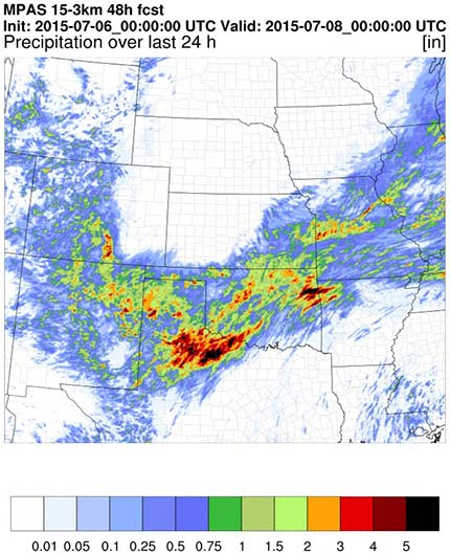
In tests, MPAS has performed well in predicting springtime thunderstorms and other severe weather over the Great Plains. It also has produced realistic simulations of certain tropical cyclones, including Hurricane Sandy of 2012.
However, along with other U.S. models, it missed on 2015's Hurricane Joaquin.
Longer lead times ahead
NOAA has reported that MPAS provided realistic, fine-scale detail for Hurricane Sandy in 2012 and for 2013 springtime weather over the continental U.S., including the tornado that struck Moore, Okla.
“MPAS also did reasonably well in providing five-day forecasts during a NOAA hazardous weather experiment last May,” Skamarock said.
In spring 2015, MPAS also won high marks for the accuracy of its three-day forecasts that helped guide research aircraft missions during a major field campaign to study nighttime thunderstorms on the Great Plains, called PECAN (Plains Elevated Convection at Night).
NCAR Project Scientist Stan Trier, who worked as a forecaster on the PECAN campaign, said the MPAS forecasts were usually the first he would look at for planning purposes because MPAS was the only model that had the resolution to indicate possible storm structures beyond 48 hours.
Then, as the time to make decisions on overnight field operations approached, he would update these earlier forecasts with new information produced by shorter-range, high-resolution models.
“There were multiple situations where MPAS did quite well at these longer time ranges,” Trier said. “Forecasts with two to three days of lead time are less accurate than one-day forecasts. This is expected. But overall, I would definitely say that MPAS was a useful part of the PECAN forecasting process.”
Most recently, MPAS has been tested in Antarctica and during the 2015 tropical cyclone season in the Atlantic and Pacific oceans. It also is being used as a component within the NCAR-based Community Earth System Model for long-term climate prediction, and has been tested at the Taiwan Typhoon and Flood Research Institute to predict severe weather events in that country.
Even if MPAS emerges as the National Weather Service’s next-generation weather model, there will still be a role for the Weather Research and Forecasting platform hosted by NCAR.
WRF, an open source model used widely worldwide, is especially adept for local and regional weather predictions in the mid-latitudes.
And, while MPAS's variable-mesh design conserves computing requirements, as a global model, it still uses more computing resources than WRF.
“With MPAS, we want to predict severe thunderstorms with a mesh spacing of a few kilometers,” Skamarock said. “That takes a lot of computer power.”
Jeff Smith is science writer and public information officer for the University Corporation for Atmospheric Research.